




Abstract
Resistance to housing and welfare reforms on economic, ‘practical’ grounds was shattered by the covid-19 pandemic, which demonstrated that where there is a will there is a way when it comes to providing housing. Despite a purported ‘right’ to adequate housing, many people in the UK face profound challenges accessing stable accommodation. Drawing from a biographical-narrative study, this article details experiences of men who have the right to adequate housing denied and thus experience housing insecurity. Subsequently, it explores how such insecurity exacerbates pre-existing mental health problems. The core argument of the article is that welfare reforms produced the sense of a constant threat of homelessness and destitution for the 17 male participants in the study who claimed sickness benefits. This sense of constant threat manifested itself through (a) the production of present homelessness at the time of the research and (b) and underlying anxiety, fear and threat of homelessness. The article contends that the UK social security system perpetuates the structural and emotional drivers of mental distress, creating a deleterious cycle of poverty, insecurity and ill-health, concluding that the provision of stable housing is an upstream intervention to improve mental health and reduce social exclusion.
Introduction
Homelessness has recently moved up the political agenda in England, both in terms of policy and capturing public conscience (Bevan, 2022). This is in part due to the increased public awareness of homelessness during the early stages of the covid-19 pandemic. In principle, UK citizens have a right to adequate housing provided by the Universal Declaration of Human Rights (UN, 1948) and the International Covenant on Economic, Social and Cultural Rights (UN, 1966). In the Marshallian concept of citizenship this represents social rights to economic welfare and security, protected by a welfare state (Marshall, 1950). This is not however reflected in current UK policy provision for marginalised people and, particularly, the challenges many face in housing access. Homelessness has increased each year since 2010 and in 2019 over 150,000 people were homeless in the UK (Fitzpatrick et al., 2019). Whilst definitions of homelessness are diverse, adding complexity to quantifying homelessness rates, the authors understand homelessness as including both ‘rough sleeping’ and the so-called ‘hidden homeless’: those staying in hostels, refuges, shelters, and other unsuitable accommodation.
This article reports on findings from a wider study (Jordan, 2021) based on 33 psycho-social interviews held in Liverpool between 2018–2019 with 17 men. All participants were entitled to and in receipt of long-term sickness benefits because of needs arising from mental health-related issues. During the research it emerged that 12 of the men had previously or were currently experiencing homelessness. This manufactured a profound sense of homelessness as a ‘constant threat’ and this article explores relationships between welfare reform, housing and insecurity. The article begins by outlining the policy context and then detailing the study and psycho-social method used. It then explores this sense of constant threat through the participants’ experiences of homelessness – both past, present and in a perceived future – and considers the impact of an absence of shelter on mental health. The core contention of the article is that welfare reforms beginning in the 2010s have arguably created conditions that can and do exacerbate pre-existing mental distress or illness, and were integral to the creation of the perceived constant threat of homelessness and destitution.
Policy context
The UK's homelessness policies vary significantly. This article focuses on England, where the research was conducted. The Homelessness Reduction Act (2017) legislated that English local authorities (LA) must offer material assistance to all eligible homeless households and those threatened with homelessness within 56 days, regardless of whether they are in a ‘priority need’ category. Nevertheless, England's record on homelessness prevention is poor (Fitzpatrick et al., 2019). The most detailed report of the 2017 Act (Local Government and Social Care Ombudsman, 2020) exposed serious flaws in LAs’ adherence to the Act and highlighted significant shortcomings in how LAs were fulfilling their responsibilities. The most severe and visible form of homelessness – ‘rough sleeping’ – more than doubled in England over the last decade. A single night in 2010 saw an estimated 1770 individuals ‘rough sleeping’ on the streets; the corresponding figure for 2017 was 4750 people (Wilson and Barton, 2022). Simultaneously, around 20 per cent of bed spaces for single homeless people were lost (Aldridge, 2020). Common explanations of homelessness in the UK are frequently individualistic and focus on the behaviour of homeless people, particularly in relation to addiction and mental illness (Bramley and Fitzpatrick, 2018). However, alternative structural explanations connect homelessness with poverty, attributing one of the main drivers to the insufficient protection to low-income households via the social security system: much diminished since 2010.
Underpinning this complex relationship between homelessness/housing insecurity, poverty and benefit receipt is the prevalence of shame and stigma, argued to be characteristic of neoliberal societies (Peacock et al., 2014). Recently there has been a shift away from an individualised focus on stigma (Link and Phelan, 2001), with a resurgence of critically unpacking ‘welfare stigma’: or the 'negative socio-physiological consequences of ‘psychic costs’ of being on welfare' (Besley and Coate, 1992: 167). Bolton et al. (2022: 645) describe the ‘costs’ of welfare stigma as being part of a cultural and political crafting in the service of power and austerity capitalism, which '(re)produce norms of power and erode actual or potential solidarities and critical consciousness'. Pinker (1970: 17) argued that stigma is a unique, ‘slow’ and ‘highly sophisticated’ form of violence 'which can best be compared to those forms of psychological torture in which the victim is broken psychically and physically but left to all outward appearances unmarked'. Tyler (2020: 18) observes 'people who are stigmatised are cognisant of the ways in which the ‘stigma machines’ in which they are entangled have been engineered'.
Benefit claimants in the UK have been further ‘entangled’ in such stigma machines through the intensification of welfare conditionality, which has become a defining feature – or organising principle – of the contemporary welfare state (Dwyer, 2019; Watts and Fitzpatrick, 2018). Conditionality refers to the conditions attached to receiving a social security payment; with the introduction of a harsher regime of conditionality since 2010 (Reeve, 2017), the risk of both homelessness and substance misuse has increased (Barr et al., 2016; Duncan and Corner, 2012). Conditionality has also been extended to groups beyond unemployed people, for example lone parents and disabled people. For the latter, the Work Capability Assessment (WCA) – an assessment tool for eligibility – has become notorious in gauging whether people are ‘fit for work’. Such notoriety stems from the harm the WCA has inflicted on sick and disabled people (Barr et al., 2016; Baumberg et al., 2015; Mills, 2018), for inaccurate assessments of work capability (Stewart, 2015), and for its exorbitance (Grover, 2017).
The WCA process has been found to induce feelings of hopelessness, shame and has led some people to avoid support services; this risks disrupting help with addiction and may lead to homelessness (Hansford et al., 2019). In research with social security claimants, many narratives reveal a 'shared typical' (McIntosh and Wright, 2018: 449) where people illustrate how the stress of job searches, persistent poverty, and the worry of losing access to benefits (Wright and Patrick, 2019) can result in homelessness. Tyler (2013) describes the sanctioning regime, a punitive form of conditionality, as an example of the neoliberal adjustment of society; sanctions are used to motivate individual actions and change behaviour through the imposition of insecurity and anxiety (Reeves and Loopstra, 2017). The effects of sanctions are now well documented and include the risk of exacerbated financial hardship, as reported in several separate, official UK Government reviews (Williams, 2019).
The intensification of sanctioning has also been associated with an increase in psychological distress amongst benefit claimants (Wickham et al., 2020). This is true whether or not claimants have pre-existing mental health needs (Jamieson, 2020); if they do, sanctions can worsen acute physical and mental health problems (Wright et al., 2018). Cheetham et al. (2019) also found that Universal Credit increased not just the risk of poverty but also suicidality (inter alia Cain, 2015; Hansford et al., 2019). Other studies show how homeless, unemployed people are more likely to be sanctioned (Batty et al., 2015; Reeves and Loopstra, 2017) and that sanctions raised the likelihood of a range of harmful outcomes: from mental health problems to 'begging, borrowing and stealing' (Dwyer, 2018: 150). This context of inadequate housing, austerity, and conditionality results in a vicious cycle, combining benefit insecurity, mental distress, poverty and homelessness (Barr et al., 2016; Lima et al., 2020). Simultaneously, homelessness itself is 'associated with feelings of demoralisation, depression, loss of self-esteem, self-neglect and feelings of helplessness and hopelessness' (Holt et al., 2012: 491) and can be both a cause and consequence of mental illness (Perry and Craig, 2015).
This article explores a population of men experiencing mental illness, in receipt of disability benefits and focuses on their experiences of housing insecurity. The findings presented are drawn from a wider doctoral project exploring how men who claim benefits due to mental illness negotiate the changing social security system. The highest risks of destitution are faced by single men aged under 35 (Bramley et al., 2018) and the majority of homeless people are men, who comprise around 80 per cent of service users in day centres and hostels (Perry and Craig, 2015). Homelessness is associated with a wide range of health problems and life expectancy for homeless people is around 30 years younger than the general population (Webb et al., 2020). Despite a clear housing crisis, there is no legal obligation to provide emergency accommodation to single people in England, leaving them in a legally weaker position compared to other European countries (Fitzpatrick et al., 2019). Good health thus becomes hard to maintain when homeless people cannot afford the essentials of food, warmth, and personal hygiene.
Methodology
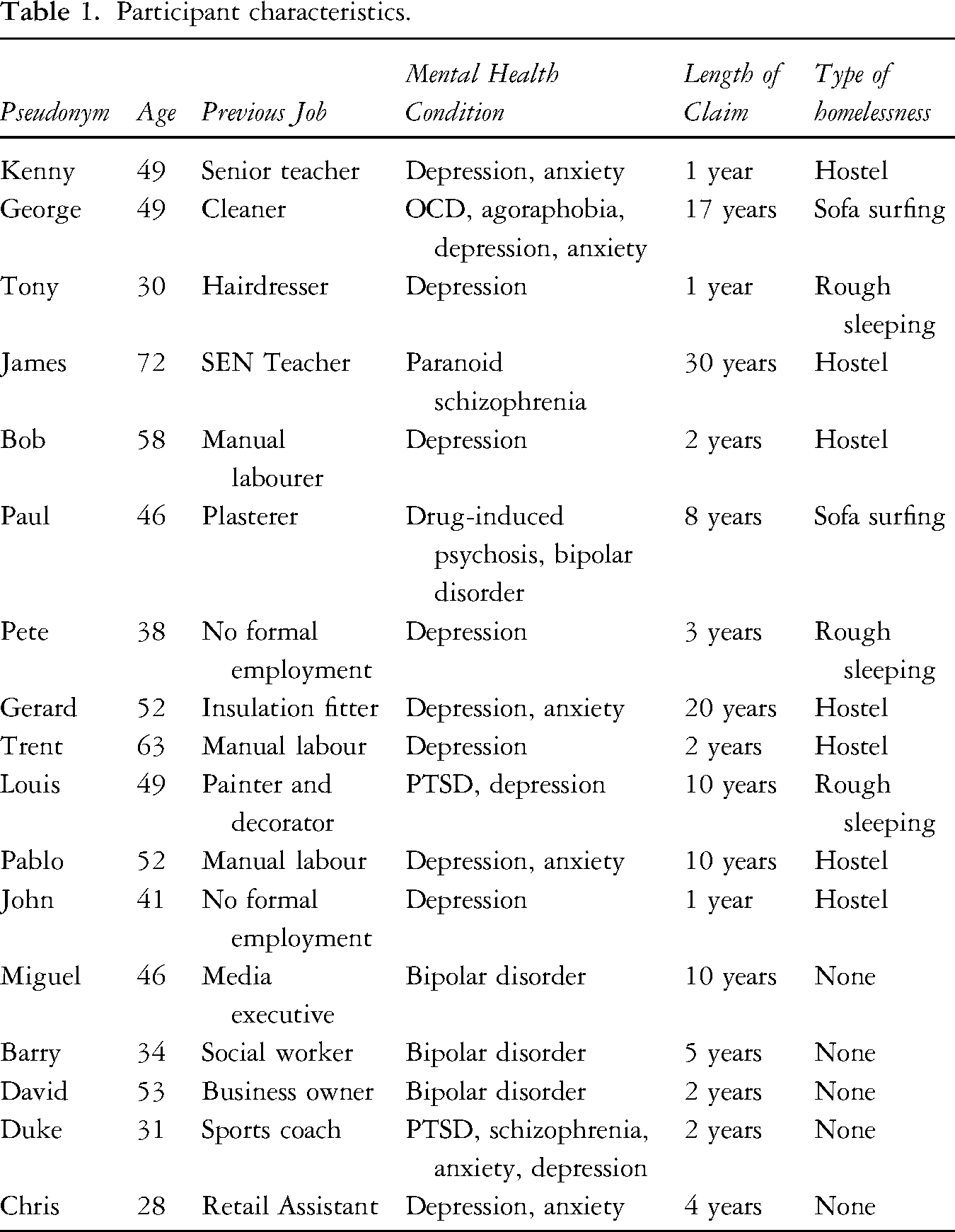
Ethical approval for the study was obtained from Edge Hill University and biographical-narrative interviews were conducted. Sixteen men were interviewed twice and one man was interviewed once, totalling 33 interviews. Interviews were transcribed in full and fully anonymised. The participant group was consciously targeted to address a gap in research. All the men were in receipt of ‘incapacity benefits’: an umbrella term used to capture a range of benefits for those unable to work due to illness or disability. At the time of interview, 13 men were claiming Employment Support Allowance (ESA), two were claiming Universal Credit (with ‘Limited Capability to Work’) and two were claiming Personal Independence Payment (PIP). Further characteristics of the participants are provided in Table 1. Names have been replaced with pseudonyms to protect participants’ identities.
Participant characteristics.
Recruitment occurred at four sites. These included two adult day centres that provide often marginalised people with the opportunity to meet others, engage in activities and access food. The other services were a sports-based charity supporting physical activity and supported accommodation: a type of housing that provides high-level care and support for people with complex needs. Participants were given options of three interview locations: the support organisation, a university setting, or their home. The needs of participants were central throughout the research and several safeguarding protocols were in place, which were agreed with gatekeepers at each organisation who ensured participants had access to support. Issues of capacity and consent were routinely considered by the researchers and so they were able to identify any concerns about impaired mental capacity. Informed consent was sought at the beginning of each interview by the lead researcher and each participant was asked to provide written consent. This occurred after the Participant Information Sheet was read aloud and all questions related to the study were answered by the researcher.
Method
Biographical-narrative interviews were conducted using the Free Association Narrative Interview (FANI) method (Hollway and Jefferson, 2013). First interviews were primarily biographical; the content was participant-led to minimise researcher presumptions about the stories the men produced of their lives. There was a broad topic guide supporting both interviews that indicated items to be discussed. The idea that there is a Gestalt – a whole that is more than the sum of its parts – informing each person's life, which the researcher can elicit, influences the FANI method and is drawn from the principles of biographical interpretative methods (Hollway and Jefferson, 2013). Through preservation of the Gestalt, the data allow stories to relate to personal identities, unconscious meanings, and social and cultural representations (Squire, 2013). Homelessness and/or housing insecurity were not an explicit focus of the research; the aim was to use an interview frame that produced respondents’ narratives rather than straightforward responses to questions.
The FANI method of respondent-driven data elicitation is intended to reduce the hierarchical relationship of the research context, to place the voices and experiences of participants at the core of the research and recognise their place in knowledge production (Archard, 2020). Instead of the researcher imposing themes or subjects through specific questions (Garfield et al., 2010; Peacock et al., 2014), the idea of housing insecurity evolved through an open-ended conversational style that allowed participants to talk freely (Boydell, 2009). The depth of analysis required by the FANI method necessitated a small sample and did not aim to be representative of the entire population. Claimants were recruited through four services via gatekeepers. The inclusion criteria were that they were male, in current receipt of social security benefits and unable to work due to their mental health, therefore some incapacity benefit claimant groups, such as those who have physical disabilities, were underrepresented. Additionally, out of 17 participants 16 identified as white British and one identified as Black Caribbean and white British; this is not representative of the population of Liverpool or of social security claimants. The lack of voice from people of other ethnic groups is a limitation to this study and could be indicative of a structural access barrier to the services recruitment took place at. This is an important avenue for future research as studies such as de Vries et al. (2017) found Black and Mixed ethnicity are the most likely to be referred for sanction (see also Scullion, 2018).
The analysis proceeded iteratively as the interviews progressed within a data analysis group consisting of four researchers from different research backgrounds, using the interpretation group method in the Dubrovnik tradition (see Hollway and Volmerg, 2010). Space does not permit a detailed exploration of the process of analysis and sense making, but the method of analysis was modelled upon the approach employed by Hollway and Volmerg (2010). The themes were generated organically from the data, alongside the research team's allegiances and situated knowledge. The lead researcher's background is in social work, which influenced their decision to conduct research with men experiencing mental distress and claiming long term sickness benefits. At the time of writing this article the lead researcher was working in hostel accommodation for homeless men.
Findings
The core finding from this part of the study was how social security changes produced a perceived sense of ‘constant threat’ around housing security. Constant threat thus functioned as a barrier to any sense at all of feeling ‘secure’. First, this article considers the impact of homelessness on four participants who experienced it at the time of interview. Two of the participants were in emergency accommodation and two were in hostel accommodation. Second, it outlines how even for those who had homes, the shadow and threat of homelessness loomed large. This was unsurprising; 12 out of the 17 men had experienced homelessness, with six having slept ‘rough’, one sofa surfed and five lived in temporary accommodation. Finally, the discussion explores how all the men had an absence of guaranteed shelter and the insidious impacts this constant threat had.
Present experience of homelessness
For the participants that were homeless at the time of interview, none felt they received anything resembling adequate support. Louis, who had previously been ‘rough sleeping’, was living in emergency accommodation at the time of interview: …it feels like I’ve got nothing important in my life. The only important thing is when I get a flat, so I can start rebuilding me life up again. Start again… Yeah, I can’t wait because it’ll make me feel better, it's mine then and I can build me life up. (Louis, 49).
Louis captured the difficulty of having any sense of security, stability, or direction when the most basic need of shelter is absent. Without a home, it became hard to access other support services: especially mental health provisions. Louis was unable to work because he experienced depression, anxiety and heroin dependency; he believed that the ‘safety net’ of a home was essential before he could start to seek and use services to support his complex needs. This approach is shared by the homelessness policy solution ‘Housing First’ (National Housing Federation, 2022).
A disconnect in services that failed to recognise the inter-related complexities of insecure housing and unemployment was evidenced for all homeless participants. Tony, a survivor of domestic abuse, sustained injuries that prevented him from working after his partner attempted to murder him. After testifying in court, Tony attempted suicide and was detained involuntarily in a mental health unit; he was then discharged to live with his grandparent but after their death he began ‘rough sleeping’: It just got worse and worse and I started begging in town, because, em, the thought of going to the Jobcentre and signing on and doing job searches and all of that… eh, you’re homeless, no one's going to give you a fucking job, what's the point? You’re on the street. (Tony, 34).
For Tony, homelessness and unemployment were causally entwined: he had no housing options because he was unemployed and he was unemployable because he was homeless. Whilst ‘rough sleeping’, Tony relied on charitable food provision and supported his drug and alcohol use through begging and shoplifting. After a year of ‘rough sleeping’, he had a severe seizure due to alcohol withdrawal, was hospitalised and supported into a rehabilitation facility. At the time of interview, Tony had been sober for six months and was living in temporary accommodation.
At interview, Pete had been in receipt of ESA due to depression for three years. Six months prior to our initial contact, Pete received a letter from the Department for Work and Pensions (DWP). Pete, who is illiterate, could not read the full document but recognised an appointment in bold text. He explained: 'if I get a benefit letter that I can’t read, I don’t trust people to get them to read it for me.' Pete attended the Jobcentre on the stated date but did not bring a form of identification requested in small print. Despite explaining to the work coach, and his illiteracy stated in DWP documentation, Pete was sanctioned. This meant he was unable to pay his rent and his private landlord evicted him. Pete explained: It's not like you can sue the Jobcentre because they’ve made me lose that two-bedroom house, and because they’ve sanctioned my money. I’ve got kicked out. I can’t get, I can’t get reimbursed on the stress that it's caused me. (Pete, 38).
Crucially for Pete, it was not just the financial but the emotional stress that he experienced after losing his home. He began ‘rough sleeping’ and at the time of interview was living in a homeless shelter. He experienced particularly profound distress as he had been separated from his dog as a requirement of the shelter. Losing his home and his dog dramatically affected his mental health and Pete attributed this decline, including suicidal thoughts, to being sanctioned and made homeless. Pete's example illustrates the punitive nature of intensified conditionality, as well as the justified sense of constant threat felt by the other participants.
Anxiety, fear and the threat of homelessness
Even for those men who were securely housed, the constant threat of housing insecurity was ever-present and explicit. The fear of homelessness was heightened by the introduction of Universal Credit (UC) as it replaced most existing means-tested benefits. UC represented further welfare transitions and upheaval that provoked fear in participants: I do worry about me with Universal Credit, what's going to happen…you’ve got to worry about the future. Know what I mean? If you don’t, you’re going to end up in a trap and on the streets. That scares me, walking along (the street), where you see all them people begging. (Pablo, 52).
See I’m worried now, and I’ve already started making meself ill about…Uh, what is it called, the new benefit coming in? …’Cause if I fall behind with me rent or something, I could lose the flat that means I’ve lost everything and end up on the streets or something…I can’t not worry. Me sleeping, that's terrible. I’m up all night. (George, 49).
Pablo and George's accounts suggest a system built on insecurity, threat and fragility. They connected the transition to UC with homelessness and this was heightened by their previous experiences. Pablo, who experienced depression, anxiety and substance dependency, was homeless 12 years prior to the interview after being released from prison. George, who was diagnosed with OCD and agoraphobia, had a fear of homelessness that stemmed from being evicted due to the Spare Room Subsidy (‘Bedroom Tax’) after the death of his mother. Their concerns of homelessness were realistic and persuasive, rooted not just in their lived experience but because welfare reforms, especially sanctions, have been connected to the present homeless crisis (Daly, 2018; Reeve, 2017; Stuckler and Basu, 2013). Further, the increasing visibility of homelessness and ‘rough sleeping’ served as a trigger for anxiety to those with prior experience and who felt insecure in their receipt of social security.
Gerard had been in receipt of ESA and its predecessor Incapacity Benefit for 20 years and had been living in his home for a decade at the time of interview. Gerard was unable to work due to both his mental health (anxiety and depression) and his physical health (deep vein thrombosis and chronic obstructive pulmonary disease). He had received support from third sector organisations for two decades due to a combination of mental health problems, opioid dependency and homelessness. Gerard explicitly cited welfare reform and housing benefit as causing him anxiety: This new system of paying your money monthly. Paying all your benefits, including your rent, your water, straight into one bank account. That worries me, if it goes a week before Christmas, and my grandchildren still have no new shoes, then unfortunately you’re going to break into that rent money to put on the kid's feet, which in turn is a bad idea because in the long run you’re going to lose your place which you’re living in. (Housing Benefit) keeps the roof over, over your head. Keeps your home. It's a home I love. So, I’d say that that's my main worry is getting paid my benefits once a month and then just falling behind with the rent, that is the most frightening thing. Losing my home, and my sanity, fully. (Gerard, 52).
Gerard's situation highlights the financial tightrope erected and tightened because of welfare reform. He was living in a housing executive property at the time of interview but had previous experience of ‘rough sleeping’ and living in hostels. As a claimant of incapacity benefits, Gerard was also concerned that if he was judged as ‘fit for work’ and required to appeal, he would then lose his home, '(w)hile you’re appealing, you don’t get no benefits at all [sic]. Which means your housing benefits not getting paid which means you’re going to lose your home, ‘cause they’re not gonna wait 18 months for the money.'
Indeed, many participants shared Gerard's view that the social security system was causing homelessness: I think it puts people back on the street…it's this new system of being sanctioned for not turning up to appointments, or not doing what they say…is scary. You can tell them that you’re waiting for an appeal, and you might get a housing association that might say 'okay we’ll wait and see', but there's no guarantee that you’ll win your appeal, so not many housing associations will take that chance. (Trent, 63).
These concerns illustrate how welfare reforms affected vulnerable groups in a variegated, complex way, incorporating the exacerbation of mental illness, fear of poverty, and anxiety around housing insecurity. The enhanced complexity of DWP paperwork further instilled a sense of the presumed fraudulence of claimants, as well as the view that those completing the forms are undeserving until they can navigate these barriers. None of the participants felt capable of completing the forms independently and all required some support, which became increasingly difficult in the context of austerity: If people weren’t there to help me fill the forms in, I wouldn’t have a clue. Good job I got the right help off the right people. Because I realise I could’ve ended up on the streets. [Laughs]. Which I don’t want to ever do that again that was horrific. (Bob, 58).
Ending his sentence on 'horrific', Bob was unable to dwell further on the repercussions if he did not have support to fill in forms to receive social security payments. His experiences reflected the underlying fear of destitution that was present in participants’ narratives. These findings demonstrate how an increasingly punitive, neoliberal benefit system enforced the toughest standards of demonstrating ‘sickness;’ this ranged from completing a Byzantine series of forms to how one appeared and ‘performed’ at an assessment. This has simultaneously led to an industry of people in place to support marginalised people to navigate the system and negotiate its barriers. For many participants, the sense of constant threat produced the risk of ‘re-traumatising’: the revival of past suffering by a disciplinary, bureaucratic and surveillant welfare state.
Discussion
This article was derived from a study that explored the lived experiences of sickness benefit claimants and, although participants were in receipt of social ‘security’, they felt anything but secure. Underpinning this insecurity was a profound and total sense of constant threat. This manifested itself in a range of ways, including fear of destitution, worsening health or, as is the focus of this article, homelessness. Regardless, something dark always loomed in the men's narrative and their defences were constantly active.
This cycle of insecurity with the right to benefits under constant threat was arguably the most insidious aspect of conditionality. Within a climate of heightened conditionality and the rolling-out of Universal Credit, anxieties were heightened, health impacted, and a system purported to support those with mental health needs compromised people's wellbeing. With the constant threat of destitution and homelessness, participants’ rightly felt that the rug could be pulled beneath them at any time. Thus the welfare system achieved the opposite of what policymakers stated it aspired to: supporting those with mental health problems into the labour market (Adler, 2018; Dwyer et al., 2020).
The findings demonstrate how welfare processes are experienced as inaccessible to the people they should serve. Consequently, many remain in difficult circumstances, (re-)experience trauma and risk destitution. This supports previous research that overwhelmingly finds the benefits system fails to support those who need it most (Redman, 2021) and is – counter-productively for many – causing further distress to ill people (Allen et al., 2016; Moffatt and Noble, 2015; Saffer et al., 2018). Whilst the study focused on men who experience mental illness and did not seek out those with experience of homelessness, the results demonstrate how these issues commonly entwine. Listening to participants’ stories it became clear that the provision of stable housing is an upstream intervention to improve wellbeing and reduce social exclusion. The issue of homelessness was interweaved throughout the research findings.
The findings showed how a system purportedly designed to help vulnerable people results in perpetuating the structural and emotional drivers of distress: creating a deleterious cycle of mental ill health and poverty. For some, engaging in welfare processes such as re-assessments risked causing further harm, including the traumatising and re-traumatising of people who are ill (Jordan, 2022). Re-traumatisation is the reliving of the initial trauma event because of a conscious or unconscious recall of past trauma (James et al., 2022). A circumstance, an attitude or expression, or specific environments that mimic the dynamics of the initial trauma can all serve as triggers. This insecure social security system alienated claimants; it incorporated a battle to evidence one's ‘deservingness’ of state subsistence, the reliving of trauma, excessive bureaucracy and surveillance, and the experience of persistent reform. The result was the pushing of claimants into a position where they did not want to deal with the system, beyond the basic engagement required for claiming and receiving benefits (Redman and Fletcher, 2022). This culminated in the grim irony of a system supposed to engage with claimants and to support them back into the labour market having the opposite effect; this however could also be argued as intentional (Stewart, 2019). The narratives collected strongly suggest the need to question the fundamental foundations of the social security system on practical, economic, and humanitarian grounds.
The backdrop of significant public spending cuts during the period of research provides further context to the much-diminished services described by participants. Whilst the power of the State has increased, the power of individuals has been seriously limited as the rights of citizenship, relating to social rights and welfare, have been eroded. If we are to reclaim these rights we should seek to adopt a positive form of active citizenship, reaffirming Marshallian rights but also seeking to affirm new rights (Bell, 2016). Those in poverty and in receipt of benefits – as well as those with mental health problems – have been hardest hit by austerity policies and the combination of benefit reductions and cuts to social services (Cantillon, 2017; Cummins, 2018; Garthwaite, 2014; Levitas, 2012). The increased difficulties experienced by participants were attributed to a material reduction in their resources as well as the emotional fear of homelessness caused by a system of ‘social insecurity’. Participants expressed that they always felt the threat of destitution; it is hard to exaggerate the noxious effects that living in fear of homelessness had for the participants. People with mental illness are disproportionately represented within the homeless population (Fazel et al., 2014).
Aggravating the constant threat of housing insecurity was the difficulty many had in comprehending and navigating the social security system (Marmot, 2020). The system is designed in an overly bureaucratic way: a form of what Redman and Fletcher (2022) describe as ‘bureaucratic violence’ (see also Kiely and Warnock, 2022). During the fieldwork for this research, many claimants were unaware which benefit they were claiming and the complex rules around the requirements of claiming (see also Saffer et al., 2018). Across the country, this experience affects both the numbers of people claiming and those who feel it is not ‘legitimate’ for them to claim. Due to the complexity and stress associated with benefit claims, some ultimately halt their entitlement (Garthwaite, 2014; O’Hara, 2015), accept destitution, and rely on voluntary services or familial and charitable networks. Conducting in-depth qualitative interviews with people who had been sanctioned and were homeless, Reeve (2017) found that the conditions of welfare receipt exceeded the capabilities of many claimants and ignored the practical and systemic barriers that made compliance difficult. Thus, rather than refusing to engage, claimants were actively harmed by a system that overlooked vulnerabilities and circumstances (Stewart, 2019).
The constant threat of housing insecurity found in this article demonstrates how welfare reforms can exacerbate pre-existing mental health conditions and cause new traumas, making it highly dubious to consider how many claimants can seek, or even consider, employment in such an environment where ‘rough sleeping’ and precarious housing are a constant threat. This can be understood to be a form of violence perpetuated by welfare stigma (Bolton et al., 2022). Cooper and Whyte (2017: 24) describe how society has become so ‘accustomed to the ease with which people are evicted and made homeless that we do not make the most obvious of observations; that the age that we live in is one in which the political violence of the state is becoming normalised’. Moreover, the approach towards homelessness by many local authorities appears to be one which criminalises homeless people through forced movement, punitive bylaws, fines and sanctions. However, ‘the scale of the homelessness crisis is impossible to hide’ (Tyler, 2020).
Homelessness and ‘rough sleeping’ have become highly visible in many countries across the developed world. In England for example, the number of homeless people has risen dramatically since 2010 (Aldridge, 2020); this is thought to be a result of the economic climate, cuts to benefits and the housing shortage (Perry and Craig, 2015). What is often overlooked, however, is the importance of bearing witness to this phenomenon with those with direct experience. The focus of the original study was not homelessness. The participants had shared characteristics of being male, living in north-west England and receiving social security benefits due to mental illness. Yet despite no specific focus on homelessness, 71 per cent (12/17) of participants had been homeless or currently were homeless: supporting other findings that homelessness is not evenly distributed across the population but significantly more likely to affect certain groups (Bramley and Fitzpatrick, 2018). This unequal distribution of housing risk was already compounded by the backdrop of a decade of welfare reform and austerity even before the covid-19 pandemic. Yet, one consequence of the pandemic was the demonstration that there is the capacity to provide housing for all citizens given the presence of the political will to do so. As the nation went into lockdown in the spring of 2020, local authorities were mandated by the Government to provide ‘self-contained’ accommodation to all those homeless and ‘rough sleeping’. Whist the pandemic was an extraordinary event, what it ultimately demonstrated was that extraordinary – and commonly perceived as ‘utopian’ – social policies can indeed be realistic propositions.
Conclusion
This article demonstrates findings from a small-scale study into men claiming incapacity-related benefits for mental health problems. It argues that a side effect of welfare reforms – in particular, the expansion of conditionality and the introduction of Universal Credit – have had consequences for the housing security of claimants. The primary manifestation of this insecurity was the perceived sense of constant threat that pervaded the participants’ housing experiences. This was clear in two main ways. First, there was a direct, material impact of welfare reform on housing insecurity. Some participants for example had, because of welfare changes, fallen into destitution and homelessness. This supports earlier evidence demonstrating a link between social security changes and increased risk of homelessness. Second, there was a more emotional, insidious impact of an underlying fear of housing insecurity. Even if participants remained in secure housing, the cumulative impact of welfare reforms meant that they lived in a state of fear for the future vis-à-vis housing. There was a consensus amongst participants that the stability they had with their homes could dissolve at any time. This was a direct consequence of changes to the welfare state, in particular the increased bureaucracy, surveillance, and conditionality of benefit claims. This fear was also linked to past experiences of homelessness. The effect here was to resurrect old memories and fears: a process of ‘re-traumatisation’ that risked derailing the progress many of the men had made.
Collectively, the evidence presented in this article demonstrates a public health emergency and preventable harm (Stewart, 2019) created by the social security system as part of an active demolition of the welfare state as we know it. Poor mental health, insecure housing, low investment in health services, and a meagre, authoritarian social security system are inter-linked social problems. We do know, however, how to tackle these crises; what the covid-19 pandemic demonstrated was that given the political will, social policies can be implemented that provide people with social security, housing and rapid healthcare interventions. Yet with the apparent end of the pandemic, the UK Government has seemingly reverted to a more familiar status quo. The long-term consequences of the pandemic on social investment and access to health and social services however will only intensify the vulnerability and exclusion experienced by many like the men in this study. The All Parliamentary Party Group for Ending Homelessness launched an inquiry into the Westminster Government's progress towards its manifesto commitment to ‘end the blight of rough sleeping by the end of the next Parliament’ in England by 2024 (Wilson and Barton, 2022). The success of ‘Housing First’ (Breatherton and Pleace, 2015; National Housing Federation, 2022) was outlined as a policy solution for people with multiple, entrenched needs along with urgent call for the government to strengthen preventative welfare policies (Crisis, 2020). The ongoing cost-of-living crisis, with inflation at a decades-long high and energy bills more than doubling between the winters of 2021 and 2022, has been added to this fragile milieu. Within these complex crises there is however one startlingly clear truth: never has there been a more crucial time to address them.
Footnotes
Acknowledgements
A huge thanks to the seventeen men who participated in the interviews and shared their stories for this study. Thanks also to Dr Marian Peacock and Dr Stephen Clayton for their invaluable guidance during the doctoral project.
Compliance with ethical standards
Approval was obtained from the ethics committee of Edge Hill University.
Declaration of Conflict of interst
The authors declare no conflict of interest.
Funding
The authors received no financial support for the research, authorship, and/or publication of this article