




Abstract
As cash transfers have become key tenets of social protection systems in the global South, much effort has gone into evaluating their outcomes. Less attention has been paid, however, to young beneficiaries’ experiences of cash transfers and the contextualised and differentiated impacts on their lives at the micro-level. Based on a qualitative study of young recipients of Brazil's Bolsa Família programme, this article explores the factors that shape young people's schooling trajectories. The article demonstrates the complexity of young people's lives vis-à-vis the CCT policy model; particularly, how their trajectories do not conform to its linear logic, but rather reflect a more complex interaction of gender norms and social and economic inequalities. The tension between the linearity of the policy model and these differentiated and gendered trajectories in turn complicates how young people navigate the transition to social adulthood, by marking out ‘problematic’ vs ‘successful’ transitions and trajectories.
Introduction
Cash transfers, and particularly conditional cash transfers (CCTs), have been widely adopted across the Global South. Much attention has been paid to evaluating cash transfers’ shorter-term impacts, focused on measures of consumption and school enrolment and attendance, but little attention has been paid to the longer term (Sandberg, 2016), especially to understanding how young people's longer-term life trajectories unfold and why. At the same time, much of the current evidence base, generated primarily from quantitative and macro-level analyses of CCTs, has tended to ignore the micro-level experiences of young recipients, understanding them simply as sites for development interventions, as mechanisms for reducing poverty. Though there is a growing body of qualitative research that engages directly with recipients seeking to understand their experiences of cash transfers (e.g., Reininger and Castro-Serrano, 2021), the focus has remained on adult rather than young recipients. Yet, the logic of long-term poverty reduction in the CCT policy model implicitly establishes young people as the key policy beneficiaries, through the changed schooling and life trajectories the programmes are meant to ensure for them. With a few notable exceptions (e.g., Streuli, 2010; Pires, 2014), very little attempt has been made to engage directly with young recipients to understand their experiences of cash transfers or the differentiated and contextualised impacts of such programmes at the micro-level. We thus know very little about how CCTs are experienced by young recipients, nor their longer-term trajectories through school and beyond.
This article seeks to address some of these gaps in the literature by engaging directly with young people in one of the first and largest CCT programmes, Brazil's Bolsa Família programme (BFP). It asks what young people's schooling trajectories are in the context of the BFP, and what these might suggest about the CCT policy model? The article demonstrates the complexity of young people's lives vis-à-vis the CCT policy model: young people's trajectories often do not conform to the linear logic of the policy model, but rather reflect a more complex interaction of gender norms and social and economic inequalities. In turn, the tension between the linearity of the policy model and these differentiated and gendered trajectories produces tensions in how young people navigate the transition to social adulthood, marking their transitions and trajectories out as ‘problematic’ vs ‘successful’. This process of social ordering of ‘successful’ and ‘problematic’ transitions and trajectories in turn influences young people's understandings of themselves and their lives.
The next section examines the existing literature on CCTs and on young people's life trajectories. The methods are then briefly described, followed by a discussion of the empirical findings, showing the complexity of young people's trajectories vis-à-vis the CCT policy model and the implications of this for how they navigate the transition to ‘social adulthood’. The final section reflects on the implications of the findings for young people and for policy.
CCTs, human capital and young people's trajectories
CCTs have had rapid uptake and expansion over the past several decades beginning in Latin America from the late 1990s. In many countries, cash transfers now reach large and expanding portions of the population. As one of the world's first and now largest CCT programme, Brazil's Bolsa Família (BFP) reaches approximately one-quarter of the population and has been the model for many similar programmes in other countries. The BFP emerged through policy innovation at the municipal level but was scaled up to the national level in 2001 as the Bolsa Escola, and then expanded and renamed in 2003 as the Bolsa Família (BFP).1 Though CCTs including the BFP have seen support across the political spectrum, the leftist turn from the early 2000s in Latin American and Brazilian politics under the so-called Pink Tide, marked a significant shift in efforts to establish new state-society relations and imagine new forms of democratic belonging through social policies (Grugel and Riggirozzi, 2012).
The BFP includes both fixed and variable, as well as conditional and unconditional benefits, the latter for those in extreme poverty and for pregnant women and infants. However, the best-known part of the programme and the focus of this article is the conditional benefit for families with school-age children and adolescents with conditions attached to school enrolment and attendance. While caregivers (often mothers, but sometimes grandmothers) receive the cash benefit, it is tied to the young person's presence in the household and conditional on their attendance at school. The benefit structure of the BFP at the time of research is illustrated in Table 1.
Bolsa Família benefit structure (2016)a
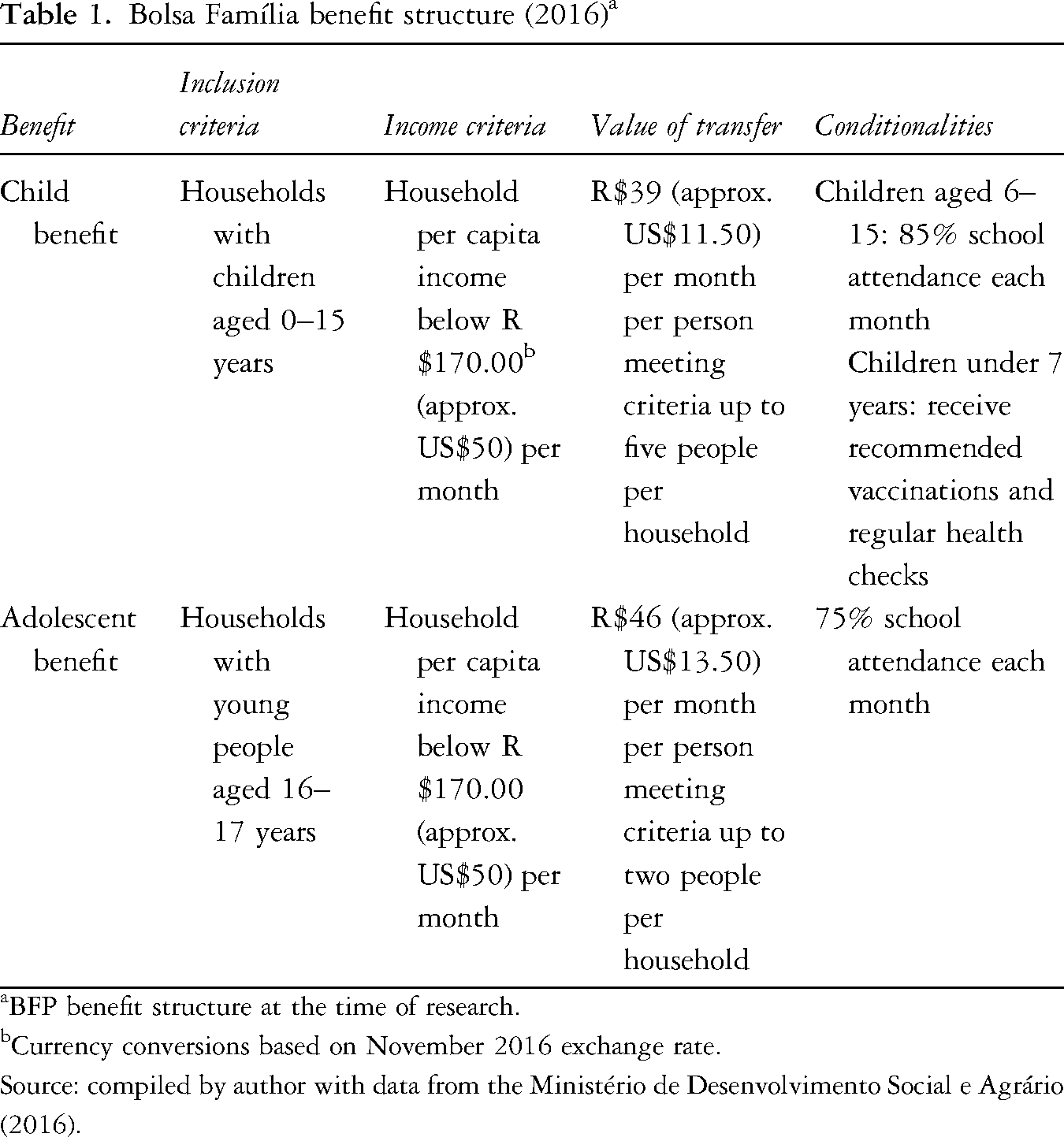
aBFP benefit structure at the time of research. bCurrency conversions based on November 2016 exchange rate. Source: compiled by author with data from the Ministério de Desenvolvimento Social e Agrário (2016).
The BFP, and CCTs more generally, understand the reproduction of poverty across generations as stemming from a lack of human capital, particularly education. They seek to address poverty over the long-term by providing the resources (cash) to address the opportunity cost of and the incentives (educational conditionalities) to take up schooling, thus ensuring investments in young people's education. These programmes are predicated on the assumption that increased access to formal schooling will improve employment outcomes for young recipients upon completion of compulsory schooling. Enhanced earnings for young people as they move into adulthood should in turn allow them to move out of poverty (Valencia Lomelí, 2008). Hence the logic of poverty reduction in CCTs is premised on a direct and linear link between young people's schooling, human capital and the labour market. Yet, as Morrow (2013) notes, this can easily overlook key factors, such as class, gender, and socioeconomic status, that lie at the heart of unequal political, economic and social structures that shape young people's lives, their opportunities and trajectories.
The CCT policy model understands young people's lives in terms of progression over the life-course through sequential stages based on age and social life – from childhood to youth, to adulthood and from school to work. Schooling and work are viewed as the 'main means of transitioning to a materially successful adulthood' (Camfield, 2011: 670). Hence CCTs anticipate that young beneficiaries will move in a linear direction through schooling, after which they will enter the labour market with greater skills and capacity to secure better livelihoods. This linear progression is reinforced by the age requirements to receive the CCT benefit, which are generally capped at the age for completion of the basic education cycle. CCTs not only assume that young people's engagement with schooling and the labour market occur sequentially, but also, by implication, conceptualise their social lives and trajectories as linear.
There is a growing body of research, however, that contests the notion of young people's lives as linear, particularly in the context of poverty (Morrow, 2013). This literature highlights the contradictions this model generates for poor young people, the ambiguity of the role of education and employment in the transition to social adulthood, and the tensions this produces for young people in navigating the transition (Thompson, 2002; Jeffrey and McDowell, 2004; Jeffrey, 2010). As Jeffrey and McDowell (2004) argue, as Western ideals of youth transitions linked to education, and the importance of educated identities, have become increasingly important in processes of identity formation and social differentiation, it has concomitantly become increasingly difficult for many young people in the global South to emulate these ideals and to grasp new social and economic opportunities. While ‘being educated’ and having a ‘good job’ have become key markers of the transition to social adulthood, entrenched structural inequalities mean access to these aspirational ‘good jobs’ and opportunities for social mobility are often beyond reach, leaving many young people ‘waiting’ (Jeffrey, 2010) for social adulthood.
Some authors have questioned the value of the concept of ‘transitions’ itself in that it suggests false binaries – between child and adult, school and work – and assumes a sequential progression from one life stage to the next (Morrow, 2013). Others have suggested that concepts such as ‘critical moments’ (Thompson, 2002) and ‘vital conjunctures’ (Johnson-Hanks, 2002) may be more useful in accounting for the uneven and sometimes contradictory notions of transition as well as the multiple places and spaces in which social identities are created and sustained. These authors demonstrate that young people's schooling, labour market and life trajectories, particularly in situations of poverty, rarely reflect a linear path. So, the notion of linearity fails to account for the diversity of young people's experiences in schooling, the labour market, and other settings, which are often 'not sequenced in any predictable manner or in the way in which classic western models of growing up might lead us to expect' (Jeffrey, 2011: 793). Young people's schooling and employment trajectories and transitions to social adulthood are rarely linear; rather, they are embedded in and shaped by social relations and context.
While the complexity of young people's trajectories, particularly in the global South and in the context of poverty, has been explored in a variety of contexts, this has not been integrated into policy thinking or design in the context of cash transfers. Indeed, the CCT policy model assumes not only that young people move in a linear fashion from school to the labour market, but also that the choices they make about school are primarily a result of either (mis)information about the value of education and/or the opportunity cost of schooling, disconnected from their social and economic context and relationships. As the discussion that follows shows, this fundamentally misunderstands young people's lives, which are deeply shaped by gender norms, and social and economic inequalities. The rigidity of the policy model, then, serves to implicitly mark out ‘successful’ versus ‘problematic’ trajectories for young recipients and in turn defines ‘successful’ versus ‘failed’ transitions to social adulthood. The result is a process of social ordering that reifies particular trajectories over others and attributes these to individual ‘success’ and ‘failure’ in conforming to the CCT policy model.
Methods
This article presents findings from a larger multi-year study focusing on young people in Brazil's BFP, in the metropolitan area of Recife, in the northeast of Brazil. The primary research participants were 24 current and former BFP beneficiary young people, aged 16 to 22 years old, along with the named caregiver for the BFP benefit. Fieldwork was conducted between March 2014 and January 2016. The sample was drawn from a 2008 questionnaire conducted for a separate municipal-level impact evaluation of the BFP.2 The sample for the present study includes families from the 2008 impact evaluation with young people in the relevant age range (16–22 years old in 2014–16). This sampling strategy offered the opportunity to explore the longer run trajectories of young people receiving the BFP, not captured in existing datasets. Nonetheless, it also brought some limitations, particularly in finding families six or seven years on from the original impact, which limited the sample for this study to those who were not geographically (and possibly socially) mobile. It is possible that this paints a more negative picture of young people's lives by excluding those who might have moved to more affluent areas. Equally, however, geographic mobility could have been prompted by a deterioration in living standards. The timing of the data collection coincided with recession years in Brazil (2015–2016), which could also contribute to a more negative picture of young people's trajectories. Nevertheless, none of our interviewees cited recent economic pressures or a sudden deterioration of household financial situations that would suggest a key role of the recession. Moreover, the current context of the Covid-19 pandemic is widely understood to have disproportionately impacted young people's schooling and employment opportunities and trajectories, and so the timing of the data collection during the 2014 recession may now represent a much less negative view of young people's trajectories in relative terms. It is important to note, however, that the findings here cannot be taken as representative of the BFP or CCTs as a whole. The small sample size was necessary given the in-depth nature of the methods, and reflects a concern with rich data, saturation, and analytical rather than statistical generalisability.
The participant households spanned 16 different communities (favelas) in the municipalities of Recife and Jaboatão dos Guararapes. The average age of young participants was 18, with a higher number of females (15) interviewed than males (9). Most young participants self-identified as ‘brown’ or ‘mixed’ race (15), while a smaller number self-identified as ‘black’ (5) or ‘white’ (4).3 Consistent data on the ethnic make-up of BFP recipients is not available, but De Micheli (2018) estimates that roughly three-quarters of recipients in 2016 were Afro-Brazilian. A higher number of young participants were former (14) rather than current (9) BFP recipients. Participants lived across informal settlements spread amongst wealthier areas of the city. Public service provision was generally limited, although access to health care and schools was notably quite good. While participants described precarious living situations, these were generally improving over time. Even so, they remained marginalised in many ways from everyday life in the city, with life revolving much more around their communities than the wider city.
Our participants all received the conditional child and/or adolescent benefit detailed in Table 1. Participants consistently explained the benefit as being conditional on school attendance. The link between education and the benefit was thus clear in the minds of our participants, as was the implication that followed for their lives: that schooling was a prerequisite for social mobility and a better life. Despite the ‘softer’ approach to the enforcement of conditionalities often noted in the BFP in comparison to other CCTs, most participants described monitoring and enforcement of education-related conditionalities, and some had lost the benefit due to non-compliance (almost always linked to pregnancy or work). Participants also clearly articulated the importance of the cash benefit for their daily lives, particularly in helping them meet basic needs, with the cash being spent primarily on a greater diversity of food, clothing, medicines and school supplies. While these material changes to daily lives cannot be underestimated, the cash benefit was far from transformative. It did not, for instance, allow them to make investments in education, businesses, or improvements to their homes.4
Data were collected primarily through semi-structured interviews conducted with young current and former recipients of the BFP, supplemented by questionnaires with female heads of households, and field diaries. The interviews were based on an interview guide structured around the themes of the BFP, experiences of schooling and the labour market, aspirations for the future, and intergenerational change. The purpose and ethics of the study were explained both over the phone and again in person, and written consent was obtained from all participants. While the ethics considerations were diverse, particular attention was paid to ensuring participants understood that the researchers had no links to or ability to influence their access to the BFP benefit.
The interview data were transcribed, translated, and coded thematically in NVivo. A theoretically informed coding frame was developed but evolved iteratively to incorporate themes emerging from the data. The analysis of the data combined both thematic and narrative approaches in considering the themes and explanations that cut across the experiences and trajectories of young beneficiaries as well as their familial, local, historical and social contexts.
While the accounts from our participants that follow are not meant to be representative of all BFP recipients’ experiences, they do capture broader patterns in the lives of our participants. The in-depth focus on two individual participants allows for a holistic perspective on young people's lives and the interaction between the range of factors that shape their trajectories. This is crucial to moving beyond a decontextualised and technocratic understanding of young people prevalent in research and policymaking around CCTs.
Young people's schooling and life trajectories
Much of the literature on CCTs focuses on quantitative measures of the uptake of schooling. Improvements to enrolment and attendance rates (e.g., Glewwe and Kassouf, 2012) are often assumed to reflect positive impacts on young people's schooling and human capital development (and in turn their employment outcomes and life trajectories). The experiences of our young participants suggest however that such indicators should not be taken to necessarily imply linear (and timely) completion of the basic education cycle. Rather, early trajectories out of school are common and reflect a more complex set of factors that shape young people's everyday lives than conditionalities imply.
Both the young people and their families reported that young people's enrolment and attendance patterns did not change upon receiving the BFP, and that they placed a high value on education, particularly in terms of defining individuals’ self-worth and in shaping future opportunities and trajectories. The bottleneck in education appears to be less one of access, and more one of progression and completion. Many of the young people interviewed were no longer enrolled in school and many reported a substantial age-grade gap, with only a few completing the basic education cycle in a linear fashion. Only 7 of 24 young participants had completed or were on track to complete the basic education cycle without any delays.
Our young participants’ schooling trajectories were marked by movements in and out of school and the labour market, resulting in significant age-grade distortions, and many leaving school prior to completion of the basic education cycle. While the CCT policy model would explain this in terms of preferences and opportunity costs, these early trajectories out of school instead seem to be a result of a more complex set of factors; in particular, the intersection of gendered social norms and social and economic inequalities, which shape the choices young people make about their schooling.
Young women's trajectories and transitions
For young women, gendered roles and responsibilities at home, and social norms around women's sexuality, embedded in wider patriarchal relations governing women's (unpaid care) labour, their sexuality, and their relation to the state (Walby, 1989), were key to understanding their schooling trajectories. These combined with social and economic inequalities in the form of household financial hardship and access to poor quality education. While not the only motivation for early school leaving, pregnancy figured prominently in young women's accounts of their schooling trajectories. The physical strain of balancing paid work, household responsibilities, and school during pregnancy proved too difficult for many young women, and families’ precarious financial situations often meant that schooling was the obvious compromise, illustrated in the experience of one of our female participants. Mayara (age 20) lives with her older sister who raised her after their parents’ deaths, along with her sister's husband, and their two children. When Mayara became pregnant in the first year of secondary school, she found the combination of attending school, working at a restaurant most days of the week, and attending to household work to be too much. Given the household's economic circumstances, Mayara was unable to cut back on her other responsibilities and instead chose to leave school:
Students must have time for everything, but we students are also made to study. Because if we get home and right away, us, women, have to do everything around the house. We get to school and we have to study. Because when I arrived at school, it was ‘arrive, sit down, do work until the end of class.’ It didn't end, there was no break.
At the same time, however, strong gendered social norms around women's sexuality, bodies, and the spaces they occupy also structured young women's trajectories. As Heilborn et al. (2007) explain, while there is 'a certain tolerance towards teenagers’ sexuality' (2007: 412), evidence of this sexuality in the form of early pregnancy is problematic, and 'young women who experience early pregnancy are not infrequently targeted by attempts to control and to label their conduct as undesirable and injurious to both their proper development and to the collective wellbeing' (2007: 405). This, the authors highlight, underlines contrasting social norms around women's sexuality vs. men's, whereby women must restrain it, while men are expected to exercise it (Heilborn et al., 2007). These gendered social norms around women's sexuality were reinforced and perpetuated by implicit and explicit stigmatisation not only in the community, but importantly, at school. Implicitly, such stigmatisation occurred through a lack of accommodation for pregnancy and childcare in schools, and explicitly through overt shaming of young women by both peers and teachers. Access to poor quality social services, in the form of stigmatising and unsupportive experiences at school, as well as a lack of access to reproductive health care and education, underpinned by a patriarchal state that prohibits abortion, coalesced with broader gender inequalities to shape young women's early trajectories out of school. Once young women had left school, they invariably remained out of school to care for their children, despite aspirations to return to complete their schooling.
One young participant, Gisele's (age 19) story illustrates particularly clearly how such gender, social, and economic inequalities intersected in shaping her early trajectory out of school. Gisele lives with her parents, younger sister and newborn son. Her father is the sole income earner in the household. The family was receiving the BFP benefit until March 2014, but the benefit had been cut off by the time of the interview because Gisele missed school on occasion due to her pregnancy. Gisele was a good student; she enjoyed school and was very active in school life, organising the annual ‘knowledge fair’ at which she presented an exhibit on early pregnancy, the only reproductive health education provided at her school. Though Gisele taught others about reproductive and sexual health, she became pregnant in the second year of secondary school. Her experience of being pregnant at school was marked by stigma and shame. She explained that she felt ridiculed and bullied by both teachers and peers.
She [the Chemistry teacher] always treated me like I was stupid. When I got pregnant, she started telling jokes… so I stopped caring. I’m not going to discuss that with my teacher, right? But that's how it was…
She would jokingly say 'Ah dear, you got pregnant so young, you haven't even finished your studies… Will you really be able to have this baby, to raise it? Will you be able to return to your studies?' And I would say, 'I will. Why not? My son won't prevent me from doing anything.'
It was a provocation. And I’d sit there in silence. As a student, I must listen to those who are older than me, so I would sit quietly, I would listen graciously. The only one who supported me was the Sociology teacher. He was the only one, the rest all criticised [me], even the students.
And then, my friend called from class saying 'they’re making fun of you here.' – It was because I had done the work on early pregnancy and I ended up getting pregnant as a teenager myself.
The unsupportive and stigmatising nature of the school environment led Gisele to feel increasingly isolated. Ultimately, the combination of social isolation and feeling physically unwell took a toll on her ability to cope. When a teacher told her she should stop attending school, she decided to leave.
Gisele's pain at the judgment she felt by many people at school as well as within her family and community was palpable throughout her interview. She cried as she described feeling alone in her life and sad in her experience of being a single mother. The rapid transition to motherhood and adulthood have been difficult and isolating, and yet conflicting and incomplete. Gisele insisted she would return to complete her schooling and missed school a lot. At the same time, she had no plans as to how or when she might be able to return to school.
I won't abandon [my studies] because I have a son now. People [say] 'Ah, I’ve had a child, so I won't be able to work, to study, to go to university.' No. If I were like that, it would be over.
While she expressed a determination to pursue her education, her expectations for the future seemed uncertain and vague, steeped in anxiety about her new responsibilities as a mother. It's difficult being a single mother. You suffer a lot of judgment… I’m still the same Gisele. I will raise my son, finish my studies. I will be someone in life.
It's not easy. … I’m a single mother. When you get pregnant as a teenager, it's not the same in your mum and dad's house. Everything changes. … I suffer in a way, for being a single mother… It hasn't all worked out.
This quote alludes to Gisele's sense of incompleteness around the transition to social adulthood in the context of motherhood and early school leaving. Her comment that 'when you get pregnant as a teenager, it's not the same in your mum and dad's house' suggests both her internalisation of a socially accepted linear ‘life stages’ model of growth and transition towards adulthood – specifically of the circumstances under which motherhood should occur – and the shame she feels for having contravened this model.
Gisele's story also illuminates the social stigma attached to ‘early’ pregnancy, despite this being a relatively common occurrence – approximately one-third of our young participants had a child. This stigma, however, operates along highly unequal gendered lines, illustrated in this quote from one of our young male participants, Alessandro (age 16), who implicitly frames ‘early’ pregnancy around young women‘s ignorance and poor choices. The complexity it implies for transitions to social adulthood is evident in his comment about his young classmate ‘losing her adolescence’, but also implicitly suggesting that she is not yet an adult, not having any goals or maturity, and crucially, not having finished school:
They go off, they get pregnant, they hurt themselves [and their futures]. Just in my class last year, there was a girl who missed the whole year because at the beginning of the year she got pregnant and had a child. 13 years old and a mother… She lost her adolescence. To become a mother at 13 years old, without any goals at all, without any maturity… Not having finished school hurts you… It's not very good. It's quite complicated.
Such understandings of adolescent pregnancy are similarly reflected in national policies. With early pregnancy seen as a key mechanism for the intergenerational transmission of poverty, public policy has historically been informed by a risk-based understanding of early pregnancy. National policies have tended to ignore the more complex setting in which adolescent pregnancy occurs, involving considerations of social status, class, gender, socioeconomic situations, instead understanding adolescent pregnancy as the key problem rather than a symptom of broader structural inequalities (Burratini, 2021). Though not a new phenomenon, as social expectations for young people have shifted particularly around educational attainment (Heilborn et al., 2007), public policy has juxtaposed adolescent pregnancy with the completion of education, reinforcing the choice and incompatibility between the ‘desirable’ trajectory of schooling and the ‘undesirable’ trajectory of early pregnancy. At the same time, policy and data collection have reinforced gendered norms that have sanctioned adolescent pregnancy and responsibilised young women for pregnancy and parenthood by failing to acknowledge the role of (young) men (Burratini, 2021). Despite the existence of national policies on adolescent pregnancy dating back to at least the late 1980s, these have oscillated between more risk and abstinence-based approaches and more progressive and empowerment-focused approaches (Burratini, 2021). It remains unclear, however, the extent to which such national level policies have been reflected in micro-level experiences of young people, particularly highly marginalised groups. The experiences of the young people interviewed here suggest that reproductive health education remains patchy at best The insufficiency of reproductive health education is, of course, compounded by legal limits on access to reproductive health services, such as abortion.
Some research in Brazil links ‘early’ pregnancy to women's strategies for managing and acquiring social status through the cultural meanings attached to motherhood, linking it clearly to social adulthood (Pantoja, 2003). Yet, this does not seem to hold true for the young women here. Their experiences of stigmatisation and early school leaving, the sense of incomplete and unclear transition to social adulthood, and the perceptions of the constraints and obstacles to their future trajectories suggest that the social interpretation of pregnancy and motherhood in this context do not offer social value to these young women. As social expectations for young people have shifted around increased educational attainment and the associated promise of better jobs and lives, not least perpetuated by the assumptions in the CCT policy model, the transition to social adulthood appears to be increasingly linked to the completion of schooling (Heilborn et al., 2007). Failing to live up to this model seems to produce tensions in young women's understandings of their trajectories and the transition to social adulthood.5
Young men's trajectories and transitions
Similarly, gender norms and structures, intertwined with social and economic inequalities shaped young men's schooling trajectories. Social norms around masculinities, both at home and at school, shaped young men's understandings of academic ability and success and who is ‘good at school’ and who should ‘provide’ in the home. At the same time, social and economic factors in the form of poverty, along with access to poor quality schooling collided with such gender norms in structuring young men's schooling choices and trajectories.
Gendered identities and roles at school shaped young men's understandings of who is ‘good at school’, who is smart, what roles boys and girls should play at school, as well as expectations of achievement and learning. Our young male participants, with only one exception, viewed school as girls’ domain and explained that they did not actively participate or engage with activities in the classroom because that was ‘for the girls’. Young men's notions of masculinity at school appear to be rooted in gendered ideas about education and work, as well as patriarchal norms around who should financially support their families. Research in Brazil (Teixeira et al., 2008) and beyond has argued that ‘hegemonic masculinity’, embedded in broader processes of socialisation, lead boys to associate academic success with femininity and in turn contributes to them doing less well in school and valuing school less relative to girls, often leading to early school leaving in favour of labour market entry (Carvalho, 2015). Alongside this, patriarchal norms around work – both in the more expansive job options available to young men without having completed school (particularly, manual labour) and feelings of responsibility to provide financially for their families (often in the context of an absent male head of household) – are likely to reinforce such gendered ideas about school. The quote from José Antonio (age 20), below, shows how these various factors may coincide. He frames his decision to pursue work and to leave school in terms of his sense of gendered familial responsibilities to ‘provide,’ his family's economic situation, and his need to explore the ‘transition to adulthood’:
Because my family was poor, I had to help with the monthly income, and look for my own personal independence a bit. I gave up a few things – of doing full time secondary school, of studying full time, to go work. And I gave up my leisure time because of work. So it was difficult. And this was one of the reasons that I ended up leaving school.
Frustrations with the quality of schooling also impacted young men's engagement with school. While the BFP may have ensured greater access to schooling, young people's experiences highlighted the often poor-quality of this education, including short school days in the context of a multi-shift system, poor infrastructure, content of (at least perceived) limited relevance to everyday life, and at times, poor quality teaching. In turn, experiences of poor-quality schooling featured prominently in how young men explained their schooling choices and trajectories.
In parallel to this, notions of masculinity in terms of responsibilities in the home, and the (at least, perceived) need to take on the role of economic ‘provider’ within the household in the context of poverty, often led young men to leave school prior to completion because of the need or choice to seek employment. From an early age, young men faced pressures to provide economically, whether because of parental expectations or their own sense of gendered familial responsibility, as we see in José Antonio's comments above. Young men described feeling a need to be self-sufficient, to be responsible, both because of a desire to take part of the financial burden off the family and to accelerate transitions to social adulthood, to ‘become an adult’.
Drawing on the story of one of our young male participants, Gabriel, we can see clearly how economic deprivation and access to poor quality education, combined with particular notions of masculinity, coalesce to shape trajectories out of school. Gabriel, a 17-year-old former BFP recipient, living with his mother and younger brother, left school in the seventh grade of elementary school. His family continued receiving the BFP benefit for a time linked to his severely disabled younger brother, but this had been cut off by the time of the interview because the school was no longer able to accommodate for his disabilities. At first, he explained his decision to leave school to work as an itinerant vendor as rooted in a desire to financially support himself and contribute to his family's income:
It was me who decided to leave school. My mother tried to discourage me, but I did it and left in order to work. I wanted to provide an income for myself. I didn't want to depend on her.
His comments evoke a sense of responsibility to work, to provide for himself and therefore not burden his mother, as well as the desire for independence, for transitioning towards adulthood.
At first, his decision to leave school seemed to reflect a set of gendered norms around who should financially sustain the household and when and how the transition to social adulthood should occur. As our conversation delved into Gabriel's experiences at school, however, it became clear that these were at least as important in shaping his decision. He maintained that he worked hard at school and attended regularly, both before and while receiving the BFP. Yet, he also revealed that he never considered finishing school, nor post-secondary education. He explained that his teachers never talked about university and lamented the lack of encouragement to pursue any further education: ‘[t]he teachers didn't encourage us’. Though he described myriad issues of poor infrastructure, a lack of teachers and cancelled classes, the poor quality of teaching seemed particularly influential in his experience:
In the school where I was, there was a real lack of teachers, more than anything else… There would be two classes and then we would come home… The teachers weren't interested, really… They didn't take attendance or give homework. They just put the work on the board and that's it. If we finished the assignment, we could go home.
He concluded by noting that ‘the teachers didn't even want to go to school…’ and suggesting that if they did not want to go to school, why would he have wanted to? When asked what he would have changed about his experience at school, he responded simply: ‘Everything.’ Discussing how important school had been for his life today and will be for his future, he explained that it was not important at all because he did not finish school, but he also made a point to note that school had not helped him in life because ‘the teachers didn't give enough,’ they did not teach well enough for him to be ‘well educated’ today. He insisted that he would have liked to finish school and felt ashamed that he had not.
For young men, early school leaving and entry into the labour market were seen as key markers of the transition to social adulthood. Yet, having left school early, many expressed a conflicted view of the relationship between their schooling trajectories and transitions to social adulthood, evident in Gabriel's expression of shame at not having completed school. Having contravened the CCT model, with the expectation of a linear movement from school to work, young men expressed a sense of shame and regret, and alluded to a perceived incomplete transition to social adulthood. Many insisted on wanting to return to complete secondary school at some point for the promise of better job opportunities but also for the social significance of ‘being educated’.
The social ordering of trajectories and transitions
Our young participants’ accounts highlight that the BFP may not be impacting decisions about schooling in anticipated ways; rather, how young people navigate their schooling trajectories and transition to social adulthood reflects a more complex interaction of gender, social, and economic structures than the CCT policy model accounts for. Gisele's story shows how early school leaving in the context of motherhood produced a conflicted and incomplete sense of transition to social adulthood, deeply marked by patriarchal structures. Young women expressed regret for having ‘failed’ to complete the basic education cycle – and implicitly, for contravening the linear model of moving from schooling to work, from youth to adulthood, reified by the CCT model. The notion of transition to social adulthood felt forced upon them by the social sanctioning of ‘early’ pregnancy and the social understanding of parenthood as an indisputable marker of adulthood. But in leaving school, they perceived that they had ‘failed’ at the ‘acceptable’ way of transitioning to social adulthood – that is, via education and employment. Young men also experienced a clear tension in navigating the transition to social adulthood. Gendered roles at school and at home, intertwined with poverty, propelled them to speed up the transition to social adulthood through early trajectories out of school in favour of the labour market. Yet, contravening the notion of a ‘successful’ transition to social adulthood in the CCT policy model, premised around completing school then entering the labour market, produced feelings of shame and regret.
Young people's schooling and life trajectories are thus more complicated than the CCT policy model conceptualises, in terms of both the non-linearity of their trajectories as well as the deeply embedded social and economic factors that influence their trajectories. Young people's trajectories are about much more than incentives and conditionalities; rather, contextualised and structural inequalities are key to understanding young recipients’ schooling trajectories and lives. Yet, there is a clear tension between the rigidity of the policy model in how it understands young people's trajectories and their lived realities. The policy model implicitly defines ‘successful’ schooling trajectories and transitions to social adulthood, framed around the (linear) completion of the basic education cycle and subsequent entry to the labour market. This serves to conversely define ‘problematic’ trajectories – such as ‘early’ motherhood and early school leaving – marked out by the benefit being cut off where young people do not conform to the expected trajectory. This is internalised in how young people understand and navigate the transition to social adulthood, in the shame and regret that they note in relation to their early trajectories out of school. 'Educated identities' have become central to young people's understandings of themselves and their lives, seemingly reified by policy narratives that cement the linkage between schooling and subsequent entry to the labour market and transitions to adulthood. This process of social ordering, then, serves to delineate ‘success’ and ‘failure’ in young people's lives, while failing to account for the structural gender, social, and economic inequalities that shape the choices and pathways available to them.
Conclusion
This article has shown that young BFP recipients’ schooling choices and trajectories contest and complicate the linearity of how the CCT policy model conceptualises their lives and how they might move out of poverty. In contrast to the dominant understanding of young people's choices and trajectories, framed around incentives, opportunity costs, and conditionalities, the decisions they make about schooling are shaped by deeply embedded gender, social, and economic structures. CCTs have ascribed to, if not reproduced and reinforced, particular ideas about the life-course, education and employment, and their role in the transition to social adulthood, rooted in a decontextualised, linear understanding of young people's lives. But these ideas exist in conflict with young people's lived realities. The CCT policy model, then, not only misunderstands some crucial factors shaping young people's trajectories, but also complicates how they navigate the transition to social adulthood. As educational attainment is increasingly linked with the transition to social adulthood, a process of social ordering follows, whereby young people's trajectories are implicitly marked out as ‘successful’ or ‘problematic’ and when and how the transition to social adulthood happens is defined. Conforming to such expectations comes to delineate personal success and failure in navigating the transition to social adulthood. Where young people are unable to live up to notions of ‘successful’ trajectories and transitions, a sense of shame and regret may follow.
While much research has focused on the ways in which CCTs have perpetuated patriarchal norms around motherhood and maternal responsibilities (Molyneux, 2006; Cookson, 2018), the findings here suggest that the importance of patriarchal structures goes well beyond this. There is a clear need to pay careful attention to the gendered impacts of CCTs on young recipients, not just mothers. Our young participants’ experiences illustrate how several patriarchal structures coalesce in shaping young women's (but also young men's) trajectories, including a patriarchal mode of production that exploits and ignores women's unpaid care work; a patriarchal state that restricts access to reproductive health education resources, including abortions; patriarchal relations that govern (and sanction female) sexualities, and a patriarchal culture that establishes gendered norms around, for instance, who is good at school, who should provide for the family, who is responsible for domestic and care work (Walby, 1989). Further exploration is thus needed of the differentiated gendered impacts of CCTs, and the mechanisms for these impacts – not least the importance of patriarchal structures and constructions of femininities and masculinities –, on young women and men.
The experiences of our young BFP recipients here show clearly that a decontextualised model that aims to tweak the ‘input’ of education with the assumption that it will necessarily or automatically improve the ‘output’ of improved labour market and life trajectories is overly simplistic. Rather, we need to account better for the ways in which the intersection of contextual and structural factors shape young recipients’ lives, if CCTs are likely to achieve the aim of improving their life trajectories and wellbeing.
Several implications for CCT/BFP policy follow. Greater attention is needed to (a) the ways in which patriarchal relations and constructions of gender shape young people's trajectories, and how policy might contribute to shifting ideas about the roles of young women and men in school and the household/family; (b) the quality of schooling received by BFP recipients and how their experiences of school matter. Avenues for complementary policies to address these issues include: (a) comprehensive sexual and reproductive health education in schools, and (b) finding ways of supporting young women to remain in school, such as through the provision of childcare or flexible or reduced school schedules. For CCT policies and the BFP itself, the findings suggest that the rationale for conditionalities may be weaker than typically argued, given the range of factors shown here to shape young people's trajectories through schooling, which have very little to do with conditions. On the one hand, the administrative costs of conditionalities may not be warranted given their seemingly marginal role in shaping young people's schooling trajectories. On the other hand, conditionalities may help to reify the linearity of the life stages model in CCTs and in turn the social ordering that follows around ‘successful’ vs. ‘problematic’ trajectories.
Footnotes
Acknowledgements
This research was conducted in part with funding from the Social Sciences and Humanities Research Council of Canada [752-2013-0687]; Queen Elizabeth House, University of Oxford; and the Canadian Centennial Scholarship Fund. I wish to thank Diego Sánchez-Ancochea and Virginia Morrow for their invaluable guidance throughout the research process, and Lena Lavinas for her generosity in sharing her data and her assistance during my fieldwork in Brazil. Most importantly, I am deeply grateful to the young people and families who opened their homes and shared their stories with me, without whom this research would not have been possible. Finally, I would like to thank several anonymous reviewers who provided valuable feedback and suggestions that helped strengthen this article.
Funding
The author disclosed receipt of the following financial support for the research, authorship, and/or publication of this article: This work was supported by the Queen Elizabeth House, University of Oxford, Canadian Centennial Scholarship Fund, Social Sciences and Humanities Research Council of Canada, (grant number 752-2013-0687)
