




Abstract
Governments are rapidly digitalising public services to increase cost-effectiveness of the public sector. This study examines older migrants’ use of digital public health and social welfare services from the perspective of social exclusion. The study uses a mixed methods approach, drawing on representative survey data of Russian-speaking migrants in Finland and qualitative interviews with third-sector representatives who assist Russian-speaking migrants with digital service use.
Our quantitative results show that a sizeable proportion of Russian-speaking older adults are excluded from digital services. In particular, those with lower socio-economic status, poor local language skills and without Finnish education are at higher risk of exclusion. Our qualitative results describe the multiple ways the exclusion from digital services intersects with other disadvantages in the everyday lives of Russian-speaking older adults. We argue that digitalisation of these services may foster social exclusion and endanger the realisation of these people's social rights.
Introduction
Contemporary western societies see digitalisation of public service delivery as an answer to reducing the size of the public sector and increasing its cost-effectiveness (e.g. Schou and Hjelholt, 2018, 2019; Tangi et al., 2021). Reformers also advocate digitalisation as a way of providing new avenues for inclusion, helping to put the citizens in centre of the previously government-centred services (Frach et al., 2017; Ministry of Finance, 2020; Pissin, 2020).
As a part of this wider transformation, governments are rapidly digitalising public health and social welfare services by increasing the use of information systems, information and communication technology, and digital data management (Hyppönen et al., 2018). While research on digitalisation of public health and social welfare services is burgeoning, empirical research examining the effects that digitalisation may have on public service delivery from the point of view of socially disadvantaged people remains scarce. At the same time, the research tradition focusing on digital inequalities demonstrates widespread differential access to digital services and suggests that there are important interconnections between social and digital exclusion (See Helsper, 2021; Olsson et al., 2017; Pissin, 2020; Schou and Pors, 2019).
Digitalisation of the public sector is a complex process that relates to the country's wider welfare state approach and citizens social rights (James and Whelan 2021). In addition to defining social rights, the welfare state legislation and policies define the means through which public service organisations implement certain tasks, for instance service delivery (Lipsky, 1980). The ways in which services are organised and resourced define the scope within which the legislation-mandated social rights of citizens are fulfilled (Bertilsson, 1990).
This study contributes to the current research regarding digitalisation of public health and social welfare services by focusing on digital service use and social exclusion of older Russian-speaking migrants in Finland. As a Nordic welfare state, Finland has wide legislation based social rights and an extensive tax-financed public health and social welfare service sector (Christiansen and Markkola, 2006). Since the 2010s, the Finnish governments have emphasised digitalisation as an overarching goal in all policy sectors (Ministry of Finance, 2020) and implemented vast digitalisation projects in the public sector, including public health and social welfare services. Drawing from conceptualisations of multidimensional and intersectional forms of social exclusion, this study examines whether digitalisation of the Finnish public health and social welfare services threatens to further reinforce social exclusion of people in vulnerable situations.
In the following, we first discuss the earlier research regarding digitalisation of public health and social welfare services and multiple forms of social exclusion. We then describe the Finnish developments in the digitalisation of public services and introduce the present study and its methods. In the empirical part of the study, we will first use a population-based survey data to examine the determinants of non-use of the internet and the digital health and social welfare services among Russian-speaking migrants aged 50 or older in Finland. Second, we will discuss our qualitative analysis that draws from thematic interviews with personnel working for third-sector organisations assisting older Russian-speaking migrants in navigating the health and social welfare service system and in applying for benefits. In the final section, we discuss the digital public service use and the ways it intersects with social exclusion.
Digitalised welfare and multiple forms of exclusion
The burgeoning field of studies focusing on the digitalisation of the public health and social welfare services mainly examines administrative questions and emphasises employee perspectives (e.g. Buffat, 2015; Busch and Henriksen, 2018; Jansson and Erlingsson, 2014). Few studies have focused on the experiences of the service users. The digital services are seen to impose new demands on citizens, such as developing new skills and competences, which may be difficult for people already in a disadvantaged position (e.g. Hansen et al., 2018; Breit and Salomon, 2015; Steyaert and Gould, 2009). The scarce empirical research taking the viewpoint of social exclusion implies that this may sustain or even exacerbate existing social inequalities (e.g. Schou and Pors 2019; Madsen et al., 2022).
Current research on social exclusion increasingly pays attention to the dynamic and multidimensional character of the phenomenon (Cheng 2021). Scharf and Keating (2012) argue that low socio-economic status, health conditions, having a disability, being a woman, poor living conditions, living in a deprived neighbourhood, and belonging to particular minority ethnic group are associated with a higher risk of exclusion. The intersecting domains of exclusion in turn entail a lack of social connections, persistent poverty, inability to participate in civic activities and a limited access to public services (Scharf and Keating, 2012). Furthermore, migrant status itself is often associated with a higher risk of social exclusion (Sainsbury, 2012) and the intersection of a migration background and older age create specific conditions and risks for exclusion (Torres, 2019). Migration may disrupt family ties and links to other social networks and institutions, and, if migration happens later in life, there is only a limited time to reconfigure these ties and build new ties in the context of the destination society (Torres, 2019).
Digital exclusion adds a new structural dimension to vulnerabilities linked to migration and ageing. The term ‘vicious cycle’ has been used to describe a process within which social exclusion predicts digital exclusion, which in turn perpetuates and exacerbates social exclusion (Helsper, 2012; Warren, 2007). Socio-economic status is associated not only with access to digital information technologies (DIT) and digital skills, but also with ways of using DIT and benefits of use (Macevičiūtė and Wilson, 2018). Moreover, decreasing economic, social and cultural resources and declining cognitive skills may put older migrants in a disadvantaged position in regards to using and adopting new digital technologies (Baldassar and Wilding, 2020; Olsson et al., 2017).
Finally, recent studies have shown that the ‘digital divide’ is prominent between ethnic minorities and the majority populations and that language skills, educational level and socio-economic status predict this divide (e.g. Alam and Imran, 2015; Lloyd et al., 2013; Yoon et al., 2017). However, most studies on ethnic/racial inequalities in DIT use come from the US and do not explore the issue of transnational migration. Studies of the associations and interlinkages of DIT inequalities in the context of migration and ageing in Europe are few (however, see Safarov 2021; on Australia, see Millard et al., 2018). Our study contributes to closing this gap by examining the non-use of the internet and digital health and social welfare services of the Russian-speaking older adults in the Finnish welfare state.
Digitalisation of the welfare state and digital public services in Finland
Similar to other Northern European countries such as Denmark, Norway and Estonia (Schou and Pors, 2019; Hansen et al., 2018; Björklund, 2016), Finland aims to be one of the forerunners of digitalisation (Ministry of Finance, 2020). Finland has implemented vast digitalisation projects, two of which have transformed particularly the public health and social welfare services. First, applying for basic social benefits offered through the Social Insurance Institution of Finland (Kela) has been digitalised. These include basic social protection in the form of child benefit, income support, basic pension, basic unemployment security, housing benefit, disability benefit, and rehabilitation support. The second project, the My Kanta portal, constitutes an all-inclusive digitalisation of personal health records and prescriptions. In addition, different municipalities have introduced for example digital appointment booking systems, service chats and remote consultations.
The implementation of this digitalisation seems to progress as a primarily technological project without much consideration of the specific context of an extensive welfare state, even though the Finnish legislation concerning health and social welfare services largely builds on the ideal of equal access of citizens and permanent residents to state-mandated services and benefits. In this particular context, it is striking how little attention policymakers, administrators and researchers have paid to the barriers that digitalisation of health and social welfare services may create to the fulfilment of social rights in general and for people at risk of social exclusion in particular.
There are signs of rising governmental awareness of the problems of digital access and use, however. A new public office called the Finnish Digital and Population Data Service Agency (DPDA) was established in 2020. It was authorised to coordinate digital support and guidance that various public, private and third-sector organisations, projects and actors offer to Finnish residents. Moreover, research on the on-going decentralisation and privatisation of the Finnish welfare state has observed that the responsibilities of the third sector organisations have increased in the health and social care fields (Saukkonen, 2013). Besides being increasingly involved in service provision, these organisations provide people with ‘navigational assistance’ (Green et al., 2014) with the use of services. Moreover, they seem to have a new unmandated role as representatives of the governmental welfare system for the disadvantaged people struggling with the use of digital public services (Buchert and Wrede 2021; Safarov 2021).
Finland is also one of the leading EU countries in the proportion of the population with internet access: around 90% of residents use the internet daily (Hyppönen et al., 2018; Statistics Finland, 2019; Vainio et al., 2017). However, statistics show a significant variation in the use of internet by different age groups. Nearly all those younger than 45 years use the internet several times a day. In contrast, 20% of 65–74-year-olds and 59% of over 74-year-olds had not used the internet at all during the last three months (Statistics Finland, 2019).
Moreover, in the nationally representative Finsote survey, approximately 14% of the participants did not or could not use digital health and social welfare services at all, and over half of the participants reported some barriers to the use of digital services (Hyppönen et al., 2018). Non-use of digital public services was associated with older age, poorer self-rated health, lower quality of life and chronic illness. The report did not examine the migrant population in detail, but mentions Russian-speakers as less likely to use digital services compared to Finnish-speakers (Hyppönen et al., 2018: 33).
In the general population, the typical barriers for the use of the internet and digital public health and welfare services are citizens’ lack of skills in using and adopting new digital services and software, fear of misunderstanding and making mistakes, lack of juridical skills, lack and deficiencies in service guidance, and the lack of e-identification possibilities (Vainio et al., 2017). Many people prefer interactive contact with officials as that allows for requesting advice and posing questions (Vainio et al., 2017). Moreover, in Finland, many public services can be accessed only in Finnish and Swedish, and in some geographical areas, in Sami and English, despite the growing proportion of residents with other native languages (nearly 8%). In the capital area, the proportion of this population is much higher at nearly 15% (Statistics Finland, 2021). Consequently, a recent interview study shows that poor language skills and knowledge of the welfare system created barriers for digital public services access and use among older migrants in Finland (Safarov 2021).
The present study
This study contributes to these discussions by examining how digitalisation of universal public health and welfare services affects the realisation of the older foreign-born population's rights to equal access to services. Our focus is on Russian-speaking migrants, which is the biggest foreign-born language group in Finland, comprising of over 84,000 speakers and almost 21% of all foreign language speakers (Statistics Finland, 2021).
Data and methods
Our study draws on mixed methods approach. While the quantitative approach provides us with statistical representation of the phenomenon, the qualitative approach is able to elicit rich detailed accounts of people's service use problems, which the survey data cannot fully capture. This method is especially useful in addressing sensitive and complex issues, such as multidimensional inequalities (Plano Clark and Ivankova, 2016).
Our mixed-method approach builds first on investigating the determinants of access to digital services using a nationally representative survey of older Russian-speaking migrants. We explore two different paths of exclusion from digital services: the non-use of the internet and the non-use of digital public services among the internet users. Second, we examine the third-sector organisation advisers’ understanding of the digital service exclusion of Russian-speaking older adults through qualitative interviews, scrutinising the ways the digital service exclusion intersects with other disadvantages.
As the authors are not native Russian-speakers, we paid careful attention to the linguistic and cultural appropriateness of the study throughout the research process. The survey questionnaire was designed in Finnish and translated to Russian by a professional translator. The translation was reviewed and modified by a bilingual (Russian-Finnish) professor in Social Sciences and commented by several other Russian native speaking researchers. The questionnaire was piloted in Russian language focus groups and some questions were clarified as a response to the focus group participants’ concerns. Regarding the qualitative part of the study, five out of seven interviewed third sector representatives had migrated from the Former Soviet Union countries themselves. They are bilingual and use both languages in their work to mediate between the Russian-speaking migrants and the Finnish public services. The remaining two interviewees were Finnish-speaking, but worked closely with Russian-speaking colleagues. All qualitative interviews were conducted in Finnish, but mutual understanding was assured throughout the interviews and the interviewees were encouraged to express their personal views and introduce also additional topics, which they considered important.
Quantitative data
The Care, Health and Ageing of the Russian-Speaking Minority in Finland (CHARM) study focuses on Russian-speakers aged 50 or older who reside permanently in Finland. The study examines issues related to health and well-being, public service experiences, access to different types of care, and digital technology use. Data were collected in 2019 as a postal survey with an option to respond online. A random gender-stratified sample of 3000 people was drawn from the Population Registry, which covers all persons registered as living in Finland. The response rate was 36%. The responses were weighted to adjust for non-response bias. A total of 1082 people (57% men and 43% of women; mean age 63.2 years, standard deviation 8.4 years) participated in the study.
The data were analysed with multinomial regression analysis, which allows for more than two categories of the outcome variable. The outcome was a categorical variable consisting of 1) internet users who use digital health and social welfare services (reference category), 2) internet non-users and 3) internet users who do not use digital health and social welfare services. The method enabled us to examine two different paths to digital service exclusion and to compare both outcome groups to our reference category. Since category 2 had a rather low number of cases, sensitivity tests were conducted with Firth's logistic regression analysis (Firth, 1993), which gave robust results (available by request). Analyses were conducted with Stata 16.
The dependent variables were as follows: age in three age groups (50–59 / 60–69 / 70 years and older), gender (male / female), marital status (married or cohabiting / divorced or separated / widowed or not married), main activity (employed / unemployed / retired / other (i.e. stay-at-home parent or taking care of a relative)), receipt of income support during the last 12 months (yes / no), having obtained Finnish education higher than high school (yes / no), education obtained in country of origin (basic, vocational or higher), region (Southern Finland / Helsinki-Uusimaa region / Western Finland / or Northern and Eastern Finland), having Finnish citizenship (yes / no), speaking no local languages (yes / no) and the mode of response (postal / online).
Qualitative data
The qualitative data consist of seven interviews with representatives of six small third-sector organisations located mainly in the capital city area. It forms a subset of a wider set of interviews that includes 15 interviews with representatives of 13 different third-sector organisations. The organisations were selected based on their websites describing that they arrange activities and provide support for non-digital and digital service use for ‘older immigrants’, ‘older people with migrant backgrounds’ or related to ‘multiculturalism’, ‘cultural pluralism’, ‘cultural equality’ etc. The inclusion criteria for the seven interviews used in this study was that the organisations work with Russian-speaking people, solely or as one of several language groups.
All interviews were carried out by one author (UB). The interviewees were approached as representatives of their organisations and as experts in the activities and service use support provided by their organisations and the situation of their clientele. All interviewees were women, since there are very few men working in this sector. The thematic interviews included questions about background and the present situation of the interviewee, basic information about the organisation in question (its objective, activities and employees), people participating in the organisation's activities, received feedback, evaluations, plans for the future and co-operation with public health and social welfare services. The interviews lasted on average 1.5 h.
The preliminary analysis of the data revealed that the personnel employed by the third sector as advisers to older Russian-speaking migrant adults provide extensive support for their clients both with the use of public services in general and digital public services in particular. The advisers’ accumulated knowledge about difficulties that older Russian-speakers face in digital service use was assessed worth studying more closely. A two-stage qualitative analysis was conducted in order to examine the ways digital service exclusion may intersect with other disadvantages in the everyday lives of Russian-speaking older adults that seek assistance for service use from the third-sector organisations. The first stage identified all the interview excerpts containing talk about the service needs of the Russian-speaking older adults, the reasons they are unable to use the non-digital and digital services independently, and the service use support offered by the third-sector advisers. At the second stage, the content of the interview excerpts was classified inductively on the basis of themes that emerged: weak digital skills, limited Finnish language skills, unfamiliarity with the welfare service system, cognitive decline, and the fear of making mistakes.
Research ethics
The research conforms to the principles embodied in the Declaration of Helsinki. Regarding the CHARM survey, the University of Helsinki Ethical Review Board in the Humanities and Social and Behavioural Sciences approved the study protocol (#6/2019). Participation in the survey was voluntary. Informed consent for participation in the qualitative interview study was sought from each respondent. No personal data were collected, and the respondents were interviewed as representatives of their organisations. Participating organisations were anonymised.
Survey results
Descriptive results
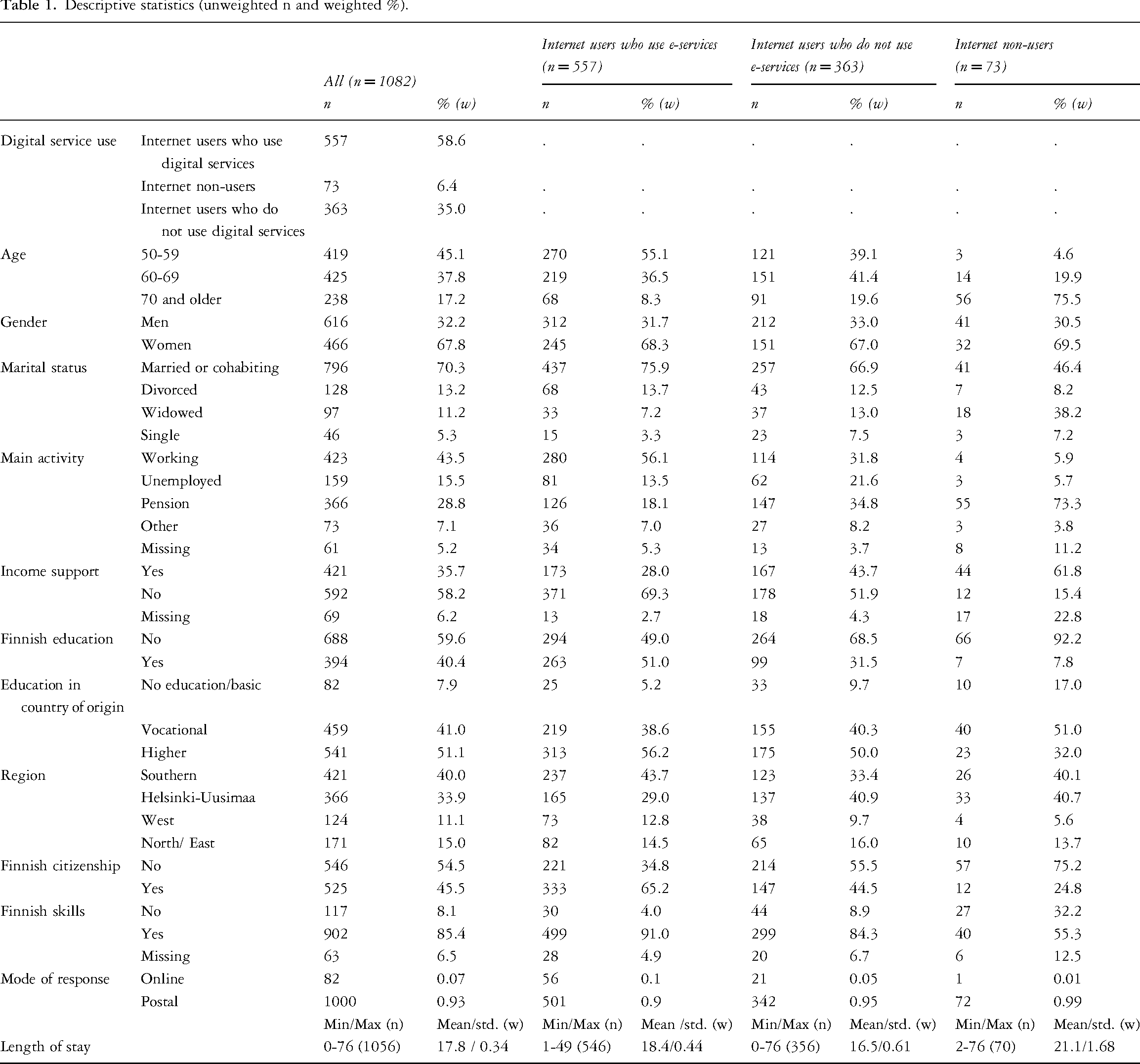
Descriptive results are displayed in Table 1. Women comprised over 67% of the study population; 45% were less than 60 years old, 38% 60–69 years old and 17% 70 years or older. About 35% had received income support during the previous 12 months. Over half the population had a higher education degree from their country of origin, but 58% had not obtained education in Finland. About 54% did not have a Finnish citizenship. Only 8% did not have any Finnish or Swedish language skills.
Descriptive statistics (unweighted n and weighted %).
Multinomial regression
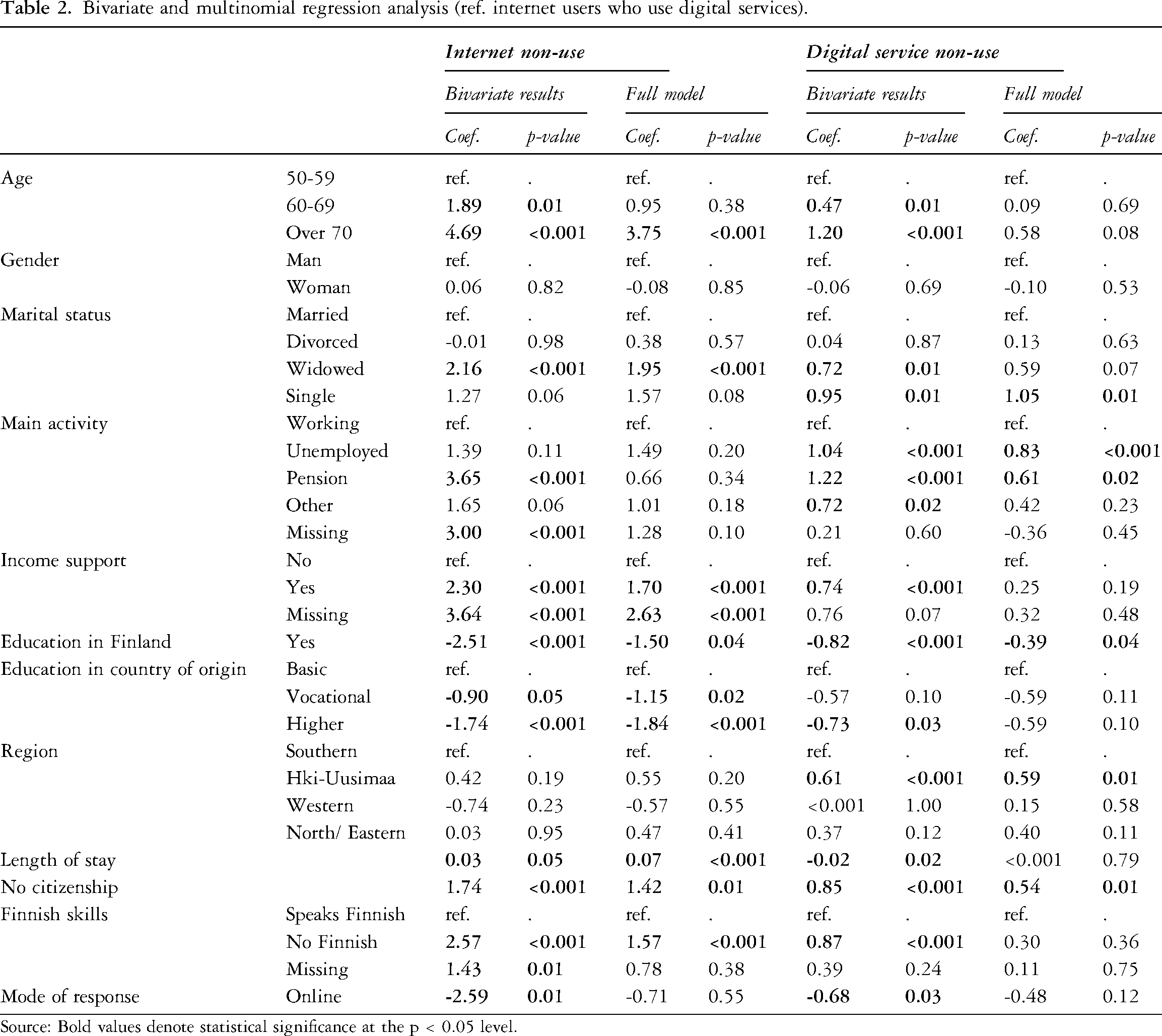
We conducted multinomial regression analysis comparing those who used both the internet and digital health and social welfare services to those who never used the internet and to those who used the internet but did not use digital services (Table 2).
Bivariate and multinomial regression analysis (ref. internet users who use digital services).
Source: Bold values denote statistical significance at the p < 0.05 level.
The bivariate results showed that those who never used the internet were older. Furthermore, being widowed, a pensioner, receiving income support, not speaking local languages and not having Finnish citizenship were associated with not using the internet. Those who had obtained some education (vocational or higher) in Finland and vocational or higher education in their country of origin had a lower likelihood of belonging to the group that never uses the internet. Interestingly, a longer stay in Finland had a positive association with the non-use of the internet. Gender did not show a significant effect on the non-use of the internet.
In the adjusted model, being 70 years or older, widowed, receiving income support, not having Finnish citizenship and not speaking Finnish/Swedish remained positively associated with never using the internet. Education in Finland and in the country of origin as well as the length of stay retained their associations.
When analysing the results in regard to those who used the internet but did not use digital health and social welfare services, the associations were broadly similar to the non-use of the internet with some variations. The bivariate associations showed a positive relationship with being older, widowed or single, receiving income support, having no local language skills and no Finnish citizenship. Having received education in Finland and higher education in the country of origin were negatively associated with the outcome, i.e. those with more education were more likely to use digital services. In this analysis, the length of stay showed a negative association with the non-use of digital services, i.e. those who had stayed longer in the country were more active users of digital services. Being unemployed, a pensioner and in the ‘other’ category of main activity were positively associated with the non-use of digital services. Living in the Helsinki-Uusimaa region (the Metropolitan area) increased the likelihood of non-use.
In the adjusted model, age, gender and length of stay were not associated with the non-use of digital services. Not being married/cohabiting, being unemployed or a pensioner showed a positive association with the non-use of digital services. Education in Finland remained negatively associated with the outcome and not having Finnish citizenship and living in the Helsinki-Uusimaa region remained positively associated with the non-use of digital services.
To sum up, our quantitative results showed that among older Russian-speaking migrants, a notable proportion of those aged 50 or older are excluded from the internet and digital health and social welfare services. Over 6% of Russian-speakers aged 50 or older never used the internet, and 35% did not use digital health and social welfare services. Our results further showed that digital exclusion is strongly linked with higher age and lower socio-economic position. In addition, less integration, in the form of lack of local language skills and citizenship pose a higher risk for digital exclusion.
Looking at older migrants who use the internet but do not use digital health and social welfare services, our results showed that similar to never using the internet, not having Finnish education and not having a Finnish citizenship predicts non-use. Moreover, being outside the labour market is associated with not using digital services. However, among those who used the internet, age, income support, and poor local language skills did not predict the non-use of digital services. These results point towards the interlinkage of lower structural integration into society and exclusion from digital services. However, in this case, the lack of local language skills was not an independent risk factor for not using digital services. Interestingly, compared to those living in other parts of the country, people living in the Metropolitan region more often did not use the services. This might indicate regional inequalities; while in the Metropolitan area, there are still possibilities for face-to-face contact in services, in other less populated parts of Finland face-to-face services have been reduced and people are forced to rely on digital services. Similarly, different non-governmental organisations provide their services mainly in the Metropolitan area and in other large cities.
Interview results
The interviewed third-sector personnel maintained that the Russian-speaking older adults asked from their organisations information, advice and support regarding both digital and non-digital service use. Even though the organisations serve both women and men, more women than men turn to them. However, according to the interviews, the need for assistance did not seem to vary between women and men, but encompassed various aspects of daily lives according to individual needs, such as translating official documents, making doctor's appointments, taking care of banking, taxation, employment and housing-related matters, but also filling in residence permit or citizenship applications. Some sought assistance occasionally and only with matters that were new, atypical or for some other reason unusually demanding for them. Others sought support more often and in many areas of life. Those that had the most demanding life situations often required constant assistance with the use of public services.
The interviewees commonly noted that their clients were often in need of social welfare benefits but were unable to independently use the e-services of the Kela, the Social Insurance Institution of Finland. That the assistance focuses on the last resort social protection, such as income support, basic pension, basic unemployment security and housing benefit suggests that the older adults relying on the organisations typically have insufficient income.
In line with previous research (Safarov 2021), the interviewees identified weak digital skills, limited local language skills and unfamiliarity with the social welfare system as important barriers in accessing digital services. Additionally, they discussed the importance of cognitive decline and fear of making mistakes contributing to the non-use of digital services. A closer analysis of the difficulties that the advisers discussed suggests that digital exclusion results from various intersecting disadvantages. The older migrants may lack both the needed digital skills and knowledge about the services, and have difficulties understanding the Finnish instructions, comprehending the service procedures and cognitively managing the required tasks.
In the context of accelerating digitalisation of services combined with rapid closing of face-to-face services, access barriers are heightened, as digitalised services are typically designed for independent use. The rationing of access to non-digital, personalised pathways to information is achieved by limiting both face-to-face and telephone-based services. Avoiding digital services tends to involve extensive queuing, which when done by phone may involve high costs.
Weak digital skills
Limited digital skills form the most obvious barrier to digital services. The interviewees told about their clients needing assistance with simple operations using mobile devices. Compared to simple uses of DIT, applying for social welfare benefits and reporting changes in one's circumstances digitally demand more advanced skills. Some Russian-speaking older adults lacked the banking ID required for digital identification for public digital services in Finland or were not able to independently use it. Locating and opening various user interfaces of digital systems and moving between different directories, programmes and pages pose difficulties, as does subscribing, saving and attaching documents. Indeed, digital service systems are rigid to the point of being merciless, because even when the user masters most of the required skills, s/he may still be unable to complete needed procedures due to a lack of one certain skill. One of the interviewees described their clients’ situation in the following way: It is hard to live digitally nowadays, when all activities are changed to be digital. They are afraid, they come here to cry, that what now, I am not able to do this. (I3)
Limited Finnish language skills
The interviewees observed that despite living in Finland already for decades, most of their clientele lacked adequate Finnish language skills needed for independent service use. Some mastered ordinary daily communication without problems, while others required the use of easy language, and still others only knew a few words. However, even clients’ excellent Finnish skills may be insufficient for handling social welfare benefit matters in digital service systems, particularly when specific vocabularies and expert language are used. Therefore, even people whose skills in Finnish may be enough in most other situations can find the language used in digital services too demanding when it comes to both understanding the information that service providers deliver and responding with the requested information.
Let's say so, honestly, because they can communicate, they may participate in social clubs and talk there in Finnish, but they cannot use the services independently. Their [Finnish] language skills are not good enough. (I15)
Unfamiliarity with the social welfare benefit system
Russian-speaking older migrants also had difficulties in applying for social welfare benefits digitally if they were not familiar with the Finnish social insurance system and eligibility criteria. The advisers described how their clients found searching for and locating adequate information from the internet demanding, in addition to which the information and the way it is offered were constantly changing. Somewhat paradoxically, as several of the advisers noted, the more people have social welfare needs that deteriorate their abilities to cope independently with their everyday lives, the more they would need to understand the complicated system and apply for different benefits using the digital service system. Meeting complex and varied service needs also requires acquiring familiarity with the ways that different aspect of social protection and the digital systems created for them are related to and affect each other. For many Russian-speaking older adults with weak digital skills, non-native Finnish language skills and unfamiliarity with the service system, managing independently is downright impossible. According to the interviewees, these difficulties were not alleviated by the information that officials currently make available online, as it does not account for people that are unfamiliar with the system and do not even know what kind of information they could look for and from where: People are rather lost and do not know what different organisations are responsible for. (I6)
Cognitive decline
The interviewed third-sector advisers noted that some Russian-speaking older adults seeking their help have memory problems and deteriorating cognitive skills, making independent use of digital services impossible in practice. Others have difficulties in learning new skills, forget things quickly or learn new matters slowly. Thus, the interviewees felt that their clients cannot be expected to improve their Finnish language skills, understanding of the welfare benefit system or digital skills. Instead, people's dependency on them as well as the number of dependent people are both likely to escalate.
For example, one lady said, ‘I learn two words, and tomorrow I remember only one of them’. And next year she won't remember … It is kind of slow learning. One should rehearse things a lot, because they are easily forgotten. (I10)
Fear of making mistakes
Any of the above discussed four barriers – weak digital skills, limited Finnish language skills, unfamiliarity with the social welfare benefit system and cognitive decline – may individually or in combination prevent digital service use. In addition, even if they do not prevent digital service use as such, they can cause a fear of making mistakes. The interviewees said that their clients’ fear of problems and the potentially serious consequences for their social protection stopped some Russian-speaking older adults altogether from using digital services independently. Many of them were afraid of misunderstandings when dealing with the complicated and bureaucratic language used in the public services. As the services concern their essential needs, many clients fear that were they to use the services without assistance, they might fail to provide all the information required, select the wrong option or attach the wrong documents.
Fear of mistakes is understandable when a single mistake may, for instance, considerably delay their benefit payments or lead to a rejection of their claim. Therefore, any level of uncertainty makes people seek assistance rather than risk making mistakes with potentially far-reaching implications. Thus, for these people, digitalised services have disabling, even disempowering, consequences.
If you leave one box unticked, you hit a waiting period. It is somehow extremely demanding even for us, who have [Finnish] language skills and somehow understand the big picture. But for people who do not understand this system and have weak [Finnish] language skills, it is frightening and difficult. [...] And yet the consequences are just quite big. (I14)
Discussion
The aim of our study was to investigate the interlinkages of digital and social exclusion from the point of view of older migrants as public service users. We examined quantitatively both the internet use in general as well as the use of digital health and social welfare services. Our results showed that a notable proportion (over 40%) of Russian-speaking older adults aged 50 or older were excluded from digital health and social welfare services. We showed that people who were older, of lower socio-economic position and with lower structural integration were at the highest risk of being excluded from the internet and digital service use.
Compared to many earlier studies on migrants’ internet use, our survey participants are not among the most marginalised groups in general, but they are rather active internet and service users. For example, earlier studies show that, compared to other groups of working-age adults, such as those of Somali and Kurdish origin, Russian-speakers report fewer internet use problems (Castaneda et al., 2012). Moreover, compared to the general Finnish population, Russian-speaking adults in Finland use the internet quite actively. In our data, only 6% of the respondents, aged 50 or older Russian-speakers, reported that they ‘never’ use the internet. Thus, our research participants’ problems in accessing digital services might be lesser compared to older migrants from other backgrounds. For example, older migrants from Somalia have been reported to have high levels of illiteracy (Mölsä et al., 2019), which is a severe problem for digital service use and should be further studied.
The results from our qualitative research helped us to untangle the ways digital service exclusion intersects with other disadvantages in the everyday lives of Russian-speaking older adults who seek third-sector assistance for accessing public services. The inability to independently use the digital public services does not merely result from weak digital skills but links in complex ways with limited Finnish language skills, unfamiliarity with the social welfare system and cognitive decline. The entanglements of these barriers vary individually, as do the consequences that the different barriers have for digital service use. Some barriers may block digital service use as such, and others indirectly by fuelling a fear of making mistakes. People already in vulnerable economic and social positions simply cannot afford exclusion from services. Accordingly, for people who, due to their various disadvantages, are entitled to social welfare benefits but who face these barriers, digital services have disabling, even disempowering, consequences. The service system pushes them to seek help from third-sector organisations rather than accepting the challenge of adapting the services to a multi-ethnic population in which the proportion of older migrants is rapidly growing. Indeed, people with limited skills in the Finnish language, a poor understanding of the service system or fragile cognitive health – let alone several of those characteristics – are likely to remain excluded from the services if the service design presupposes independent service use from all adults.
Even though our quantitative analysis shows no significant difference in the non-use of digital public services by gender, our qualitative findings suggest that women are more active in looking for help in digital technology use. Thus, future research should investigate gendered dimensions of digital exclusion in more detail.
We argue that the forms and dimensions of social and digital exclusion are multiple and complex. The strengths of our study lie in our high-quality population based survey data combined with in-depth interview data. The mixed methods approach helped us to bring forth the intersecting vulnerabilities, which shape social and digital exclusion and provided a more comprehensive understanding of the issue. However, the limitations of this research are also connected to the mixed methods approach; the article format does not leave enough space for deeper triangulation of the results.
Conclusion
Contemporary western governments perceive digitalisation as an efficient way to reduce state expenditure, increase inclusion and enhance citizen-centredness (Frach et al., 2017). However, the governments seem to have failed to consider the ways the specific responsibilities of the public sector, especially in the case of Northern European welfare states, become realised in the digitalised welfare service delivery (see also James and Whelan 2021). Little attention has been paid to the recent research showing that digitalisation does not benefit all groups equally (e.g. Alam and Imran, 2015; Olsson et al., 2017). Digital exclusion is becoming one dimension in the ‘vicious cycle’ of multidimensional social exclusion, intensifying this dynamic in ways that are particularly salient amongst older adults. Long-term implications of this exclusion from digital public services in the combination with increasing international migration and extensive welfare state remain to be seen.
The results of this study show that political goals of digitalisation may fall short when it comes to older adult migrants. Rather than removing barriers, digitalisation can create more barriers of access to services, and increase people's dependency on others. To alleviate these problems, older migrants’ service use and needs should be examined in more detail in the context of digital public welfare services and by considering the multidimensional character of social exclusion. Future research should pay attention to gender, migration histories, reasons for migration, and age at migration, which are likely to contribute to determining one's social position, social ties and, thus, exclusion risks (see Torres, 2019).
This study discussed the advisory services that the state has delegated to third-sector organisations. This arrangement raises several concerns: these organisations typically have scarce resources and they rely on short-term funding and often on volunteers. Thus, their activities lack a legislative basis and do not follow professional criteria. The new Finnish state agency DPDA aims to coordinate the ‘digital support’ that various organisations and actors offer. However, its charter replicates the narrow focus on digital skills, which, as our study shows, is far from adequate approach for tackling the complexly interlinked dimensions of digital exclusion. Relying on external digital support and advisory services in matters that concern people's basic social protection and health care may endanger personal privacy, force people to rely on potentially incompetent advisors, even exposing them to abuse. The same applies for digital support provided by family members or friends. Considering the vital role this kind of digital assistance plays, the public policies should emphasise that the public service organisations need to provide the support themselves, taking equity and equal access into consideration.
Our results are particularly significant in the context of the recent COVID-19 pandemic, in which the capacity to be digitally connected has become critical for overcoming social isolation and limited access to health services. Overall, our results emphasise the need for securing the possibility to access public services in person to guarantee equity. Efforts to guarantee support for digital service use should concentrate not only on digital and technological skills but also on support in understanding the services’ content and variation in people's life situations. Both service providers and technology companies have been urged to pay careful attention to the information security and accessibility of services so that digital services do not increase inequality (Hyppönen et al., 2018: 42–44). We argue that in order to prevent digitalisation of public services from producing and reinforcing social exclusion, health and social welfare policies need to absorb digitalisation to work for its goals, i.e. social inclusion and equity. Otherwise, digitalisation seems to work to the exact opposite direction.
Footnotes
Declaration of conflicting interests
The authors declared no potential conflicts of interest with respect to the research, authorship, and/or publication of this article.
Funding
This study was funded by the Academy of Finland (grants 312310 and 336669 for the Migration, Care and Ageing Research Group of the Centre of Excellence in Research on Ageing and Care), the Strategic Research Council at the Academy of Finland (grants 327145 and 327148 for the DigiIN Project), Faculty of Social Sciences at the University of Helsinki (contribution to the Centre of Excellence in Research on Ageing and Care funding), and the University of Helsinki 3-year research grants. The sponsors did not have any involvement in the review or approval of the manuscript for publication.
Author biographies
Her recent publications are : Buchert, U. & Wrede, S. (2021) ‘Bridging’ and ‘fixing’ endangered social rights in the digitizing welfare state. The ambiguous role of the third-sector advising service for marginalized older migrants in Finland. In: Hirvonen H., Tammelin, M. Hänninen, R, & Wouters E. (eds.) Digital Transformations in Care for Older People: Critical Perspectives. Routledge, 54-71 and Kaihlanen, A., Virtanen, L., Buchert, U., Safarov, N., Valkonen, P., Hietapakka, L., Horhammer, I., Kujala, S., Kouvonen, A. & Heponiemi, T. (2022) Towards digital health equity - a qualitative study of the challenges experienced by vulnerable groups in using digital health services in the COVID-19 era. BMC Health Services Research (22), 188.
Her most recent publications are: Shin, Y. K., Koskinen, V., Kouvonen, A., Kemppainen, T., Olakivi, A., Wrede, S., & Kemppainen, L. (2022). Digital Information Technology Use and Transnational Healthcare: A Population-Based Study on Older Russian-Speaking Migrants in Finland. Journal of immigrant and minority health, 24(1), 125-135 and Kemppainen, T., Kemppainen, L., Kuusio, H., Rask, S. & Saukkonen, P. (2020). Multifocal Integration and Marginalisation: A Theoretical Model and an Empirical Study on Three Immigrant Groups, Sociology 54(4), 782-805
His recent publications include: Olakivi, A. & Wrede, S. (2021). Pragmatic inattention and win-win narratives: How Finnish eldercare managers make sense of foreign-born care workers’ structural disadvantage? In Vincent Horn, Cornelia Schweppe, Anita Böcker & María Bruquetas-Callejo (Eds.), The global old age care industry: Tapping into care labour across borders. Singapore: Palgrave Macmillan, 169-191 and Zechner, M., Näre, L., Karsio, O., Olakivi, A., Sointu, L., Hoppania, H-K. & Vaittinen, T. (2022). The politics of ailment: a new approach to care. Bristol: Bristol University Press.
Recent publications include: Wrede, S., Näre, L., Olakivi, A. & Nordberg, C., 2021. Neoliberal ‘flexibility’ and the discursive incorporation of migrant labour in public eldercare in Finland. In Mora, C. & Piper, N. (eds.) The Palgrave Handbook of Gender and Migration. Palgrave Macmillan, 253-268 and Kara, H. & Wrede, S. Love's Labour's Lost? Separation as a Constraint on Displays of Transnational Daughterhood. Sociology (e-pub ahead of print) 
Recent publications include: Kouvonen A, Kemppainen T, Taipale S, Olakivi A, Wrede S, Kemppainen L. Health and self-perceived barriers to internet use among older migrants: a population-based study. BMC Public Health 2022(22), 574 and Heponiemi T, Kaihlanen A, Kouvonen A, Leemann L, Taipale S, Gluschkoff K. The role of age and digital competence on the use of online health and social care services: A cross-sectional population-based survey study. Digital Health 2022. 28(8):20552076221074485