




Abstract
The article explores the experiences of people displaced from work by the introduction of labour-saving technology in Finland. Interviews with 13 unemployed individuals are used as data. The study is underpinned by a Marxist interpretation of potentially emancipatory technology under capitalism reduced to an instrument for reorganizing skilled workers into an exploitable, precarious cadre of surplus and abstract labour. Loïc Wacquant’s thesis on advanced marginality is used as a theoretical framework to unpack and understand the little-studied experience of being displaced from work by technology. The interviewees share a sense of growing alienation and social exclusion. Feeding these experiences are capricious changes in skill-demands and deskilling under automation and robotisation of work. The experiences are exacerbated by digitalised, vertiginous and isolating job-seeking and employment services that cast responsibility on the unemployed individual. While the participants of this study were not on the brink of acute or extreme socio-economic marginalisation, their experiences are rooted in the very same social, economic and political dynamics as advanced marginality. The findings of the study help anticipate the risk of advancing marginality faced by displaced workers, if social policy reforms are not carried out in the short term. In the long term, the findings support the argument that studies on labour-saving technologies and unemployment pay closer attention to the particular role of technology under capitalism.
Keywords
Introduction
The story of Finnish companies’ significant advances in information and communication technologies (ICT) during the 1990s has been told countless times. How these companies (mostly Nokia) boosted Finland’s national economy, lifted the country from a severe economic depression and made it an internationally recognised leader in the ICT field, is a chapter seldom missed by those writing the nation’s contemporary history. The regurgitation of this narrative has also been important in the political project of building an entrepreneurial ethos in Finland. One important voice in this project is Sitra (the Finnish Innovation Fund). Sitra is a think tank and investment company promoting economic growth and national competitiveness under the supervision of the Finnish Parliament. An influential book that tells the ICT success story of Finland is The Finnish Model of the Information Society, published in 2002 by Sitra.
In the book the authors Manuel Castells and the Finnish philosopher Pekka Himanen introduced a concept related to Castells’ (1996) earlier concept of ‘network society’ and suggested calling Finland an ‘information society’. They defined information society as one characterised by an ICT-economy, extensive use of digital networks in the public sector, and access to personal computers. They compared Finland to with other developed information societies, namely Silicon Valley and Singapore. Thanks to its welfare state, Finland showed higher degrees of social inclusion and equality than the other two information societies.
Castells and Himanen (2002) advised Finnish decision makers to embrace the combination of ICT-economy, digitalisation of public welfare services and free universal higher education. In other sectors they recommended economic deregulation and privatisation in order to encourage an innovative and entrepreneurial business environment, which they saw as key to the country’s continued success. The promise of a world-leading information society was not lost on Finnish decision makers, and the publications of Sitra, including the work of Castells and Himanen, inspired economic, education and employment and innovation policies (Knight and Routti, 2012). Similar reforms were made across Europe, motivated not least for the generous ICT subsidies made available by the EU for member states.
Today, few speak of the information society as ICT has permeated our daily lives. It has become an integral part of our homes and workplaces, but also made homes into places of work – other than domestic and household work. But technological advances have also seen to the increasing use of labour-saving technologies (LST) both to assist people at work and to replace human employees. Although Castells (1996) explored digitalisation, automation and robotisation of labour already in his work on the network society, the topic was neglected in his analysis with Himanen. Now, LST has replaced the information society as a topic of international debates regarding work and technology. It is also garnering growing interest of scholars in Finland, where LST is estimated to do away with a third of the jobs in the country in the near future (Pajarinen and Rouvinen, 2014).
LST has both its devotees and critics. Some Finnish and international authors predict that humanity is heading towards an emancipated future where human potential becomes fulfilled as menial tasks are outsourced to robots (Autor, 2014; Arntz et al., 2016; Bastani, 2019; Brynjolfsson and McAfee, 2014; Purokuru, 2018). Others fear that the transformation risks displacing people from wage labour, leading to growth of precariousness, unemployment and inequality (Böckerman and Vainiomäki, 2014; Collins, 2014; Ford, 2015; Frey and Osborne, 2017; Pulkka, 2017). One question largely omitted from analyses is how contemporary workers, displaced and unemployed because of LST, experience the transformation.
Experiences of unemployment have been widely studied as they relate to, for example, health, well-being and family life (Ahn et al., 2004; Björklund et al., 2015; Ervasti, 2004; Hiswåls et al., 2017; Hult et al., 2016; Sage, 2019; Weckström, 2012), but also how unemployed people navigate stigmatised identities (Pemberton et al., 2016), how unemployment is experienced by immigrants and non-immigrants (Stören, 2004), the particularities of women’s experiences of disconnection from the labour market (Grant, 2009) and how different age groups experience unemployment (Brandt and Hank, 2011). This article studies the experience of being displaced from work by LST. Interviews with unemployed individuals are used as data to explore what their experiences teach us about so-called ‘technological unemployment’ (Keynes, 2010), what specific problems and needs individuals are facing, and how to develop corresponding employment and social policies.
As Anaf et al. (2012) point out, job loss is both a structural and a personal story. To better understand the personal experiences of unemployment, the article begins in the next section with the structural story of the Marxist interpretation of the particular purpose of LST under capitalism, drawing especially on the work of Harvey (2006). The story continues in the third section by introducing a theoretical apparatus that is both sensitive to the automation and digitalisation of work and public services, and their role in the displacement of workers – Wacquant’s (2008) theory of advanced marginality. The research methods and data are introduced in the fourth section. The fifth section then moves to analysing the personal stories of technological unemployment. Three issues of particular relevance are distinguished and discussed in their respective sub-sections. First, the experiences reflect increasing labour insecurity due to ostensibly contradictory forces of deskilling and growing skill demand. Second, the unemployed are being thrown into an isolating and vertiginous digitalised world of job seeking and employment services. And third, the above phenomena combined are deepening the precariousness and alienation of labour, exacerbating the risk of an insidiously advancing marginality. Finally, the concluding section draws together and discusses findings and makes suggestions for policy and future research. The experiences of interviewees shed light on new demands for education, use and access to employment services and job seeking, and the need to develop social policies. They also illuminate the urgent need for critical discussion and analyses regarding the role of technology in the capitalist economy.
Labour-saving technology and unemployment
Concerns are growing regarding the outcomes of extensive implementation of LST for employment. Frey and Osborne (2013) calculate that over half of American jobs are soon to disappear. Collins (2014) anticipates that while traditional working-class jobs in production have been automated to a large degree, it is the middle-class, white-collar work that is about to disappear next. And Ford (2015) predicts that technological disruption of work could feed into other vast crises of our time, envisioning a future where growing global inequality, unemployment and the climate crisis all become mutually reinforcing. In Finland, Pajarinen and Rouvinen (2014: 1) find a third of Finnish jobs ‘highly susceptible to computerization in the next decade or two’ and suggest that ‘there is no guarantee that the relative balance between job creation and destruction would remain favourable. And even if it would, possibly increasing labour market churning may lead to a higher natural rate of unemployment’. Böckerman and Vainiomäki (2014) show how technological disruption has been closely linked to employment polarisation in Finland. Pulkka (2017; 2019) and Pulkka and Kangas (2017) predict growth in both unemployment and precariousness of the labour force due to LST.
Insightful predictions aside, how to explain the relationship of LST and unemployment in contemporary economy? Fitzpatrick (2003: 133) emphasizes that ‘[n]ew technologies do not emerge ex nihilo but are always embedded within social contexts whose contours shape the ways in which technologies are constructed and utilized.’ The context which I am concerned with is that of advanced capitalism and my approach to its study is underpinned by Marxist political economy. This approach begins by acknowledging both the historical project of the ruling capitalist class – accumulation for the sake of accumulation – and unemployment as a central dynamic in this project. As capitalists seek for greater profits by replacing workers with machines, Marx argued, a growing reserve army of surplus labour is created to keep wages down and provide checks on the power of organised workers. Importantly, with the introduction of new machinery, workers also undergo a process of deskilling or a change from skilled to abstract labour.
Marx (1993: 104–105) explains abstract labour in Grundrisse, as ‘[i]ndifference towards specific labours correspond[ing] to a form of society in which individuals can with ease transfer from one labour to another, and where the specific kind is a matter of chance for them, hence of indifference. [. . .] labour in reality has here become the means of generating wealth in general, and has ceased to be organically linked with particular individuals in any specific form.’ Deskilling then comes about ‘through the technical division of labour, mechanization, automation and scientific management’ (Harvey, 2006: 118). It is in the interest of capital that an organized and skilled labour transforms into a disorganized, flexible and substitutable precariat of surplus and abstract labour with homogeneous machine tending abilities. Introducing LST under capitalism is one more step in enforcing and ensuring the ‘perpetual reorganizations of the labour process in the search for relative surplus value’ (Harvey, 2006: 133). From the perspective of capital, new technology promises ever increasing and effective production. This promise has resulted in a situation where LST has even become its own field of business and fetish of capitalist aspirations (Harvey, 2014).
It is not only in the private sector that labour is made abstract. Technological approaches of the business world were introduced in public administration and social service delivery in Europe during the 1990s. As there is an inherently quantifying characteristic to technology its use easily overruled qualitative approaches to service provision with quantifiable ones like performance indicators for social service workers (Gillingham and Graham, 2016). These ‘performance indicators are based on measurements of service inputs, outputs and throughputs, such as the numbers of referrals, service users seen, cases closed and so on. The problem is that such measures, in focussing on the quantitative aspects of service delivery, do not capture more qualitatively expressed measures of outcomes for individual service users’ (Gillingham and Graham, 2016: 193). Social service technologies are also ‘more likely to be used to control rather than to empower staff and claimants’ (Henman and Adler, 2003: 159). LST in social service provision means that practitioners are also deskilled and rendered substitutable.
Building on the Marxist interpretation of the role of technology under capitalism, and acknowledging the risks involved in adopting technology in public service provision, this article studies LST and unemployment from the perspective of displaced labour. Sensitive to this perspective is Wacquant’s (2008) thesis on advanced marginality, which is introduced in the next section before applying it to analyse the data on experiences of displacement.
The structural dynamics of advanced marginality
Advanced capitalism, including its technological innovations, bring great social and material comforts to some. But as capitalism organises society into a class hierarchy, it also excludes great many others from those comforts. Because of a number of structural dynamics of advanced capitalist societies, this exclusion is reflected as a risk of what Wacquant calls ‘advanced marginality’. Advanced, because we can see those dynamics at work today and distinguish their outcome as growing future socio-economic marginality. Wacquant presents four structural dynamics: a macrosocial dynamic, an economic dynamic, a political dynamic and a spatial dynamic. I have explored the spatial dynamics of marginality in Finland elsewhere (Hyötyläinen, 2019). This article is concerned with the first three dynamics, which are particularly helpful in interpreting worker displacement and are now discussed as they pertain to Finland.
The macrosocial dynamic refers to occupational polarisation and inequality in access to rewards from durable employment in the context of economic advancement and prosperity. Today an increase in highly skilled and highly paid professional positions can be seen, meanwhile jobs in traditional labour-intensive production, managerial and administrative tasks are eliminated. Many middle-income workers’ training is no longer desired in the labour market, and they fall back on precarious, low-income service work and into unemployment (Wacquant, 2008). As to this macrosocial dynamic in Finland, during the 1980s Finland had the lowest income inequality in the OECD countries (Atkinson et al., 1995). The country underwent financial deregulation and suddenly available credit led to a boom in consumption and investment. In 1990 the boom turned to a bust, resulting in a serious depression. As noted earlier, the success of the Finnish ICT-sector helped the country out of the depression. The information society was forged during the 90s, creating occupational opportunities for highly educated professionals (Castells and Himanen, 2002). An increase was also seen in low-income work as demand for services grew. Adding to this trajectory the introduction of LST, today middle-income industrial, administrative and skilled routine workers face a difficult time in the occupationally polarised economy as the jobs meeting their educational attainment diminish (Böckerman and Vainiomäki, 2014).
The second, political, dynamic behind advanced marginality is the withdrawing of welfare measures and social protection (Wacquant, 2008). During the past 20 years access to social support has been reduced, growth of social budgets minimised, and welfare-to-workfare practices implemented in Finland. In 2013 Finnish Prime Minister Katainen of the National Coalition Party (liberal-conservative, centre-right) – who today is the president of Sitra – commissioned a report on sustainable growth and the future of the ICT-economy from Castells and Himanen (2013). The expensive yet ambiguous report was a cause of public outcry and criticism at a time when public spending was seeing proposed heavy cutbacks. Soon after, however, a state-led digitalisation programme called ICT 2015 saw great public investment. Investment in the digitalisation of welfare services was calculated to save on public spending in the long term. Meanwhile, from 2014 to 2019 the state budget saw reductions in spending on health care and education. In 2018 income support for the unemployed was reduced up to 40 per cent. Prime Minister Katainen and his successors, it seems, learned from Castells and Himanen (2002; 2013) an appreciation for the ICT-economy, deregulation, and digitalisation of welfare services, but disregarded the scholars’ strong emphasis on the importance of education and welfare spending.
Wacquant’s (2008) third, economic, dynamic of advanced marginality is defined as wage labour and social protection no longer having the unifying influence of yesteryear over the working class. Stressing not to romanticize life under industrial capitalism, Wacquant discusses how during Fordism-Keynesianism work created shared experiences of daily life, predictability and a sense of community for the working class. During the period of industrialisation, universal social welfare was also forged in Finland. Traditionally in the Nordic societies, participation in work has been seen as a goal in itself, and lack of work is ‘conceived as a problem for both the jobless person and society at large’ (Kvist and Fritzell, 2012: 6). In the Finnish information society, however, work as duty was being swapped for an entrepreneurial ethos based on a narrative of creativity and individual passions. ‘Pleasures are replacing Puritanism’, wrote Haila (2002: 432). Coupled with the creative, entrepreneurial and highly individualistic approach to work were the deterioration of the basic conditions of employment, remuneration and social insurance for wage-earners. For contemporary ‘deproletarianized’ populations the wage-labour relation itself has become ‘a source of fragmentation and precariousness’ (Wacquant, 2008: 265–267). Instead of a community of people with shared experiences, the working-class in advanced capitalist countries is made up of an atomised precariat of abstract labour navigating part-time contracts, temporary and short time work, erosion of union protection and growing privatisation of social goods and digitalisation of social services (see also Standing, 2016). Futhermore, neoliberal discourse then depicts coping with unemployment as both an individual responsibility and a cause of social dependence (Pemberton et al., 2016).
The three above-described structural dynamics risk casting unemployed people into an advancing marginality. This article investigates a specific aspect intricately linked to all three dynamics – the introduction of LST and worker displacement. Finnish authors (Pajarinen and Rouvinen, 2014; Pulkka, 2019) have projected a quantitative shift towards growing displacement due to the introduction of LST. This qualitative study explores what individual experiences reveal of this shift.
Data and methods
Thirteen interviews were conducted with individuals (see Appendix 1), born between the years 1959 and 1993, who were or had at some point been unemployed because of LST. Unemployment had lasted from two months to two years and six months. Ten participants had been dismissed as their tasks were automated or digitalised. The remaining three were unemployed for other reasons and now unable to find work as the tasks they were trained for had disappeared due to LST. Interviewees had been employed in both the private and public sectors, in large international companies and small local firms. One interviewee had higher education, three were currently in higher education and nine had vocational education.
Ten interviews were conducted in person in locations chosen by the participants in southern Finland. Three interviews were done on the phone. All interviewees have been assigned pseudonyms in this article. The interviews were designed and recorded by the author while a professional transcriber was used. Interview outtakes were translated from Finnish to English by the author. The interviewees were reached through newsletters and the social media of labour unions and local unemployment offices and a respectable, public Facebook group discussing social and economic inequalities and public policy in Finland. 1 The call for interviews was sent out through these outlets in the summer and fall of 2018. A grocery store gift card was given for participants as compensation for their time. The obvious ethical question to consider was whether vouchers incentivise people to take part in the study, replicating a workfare approach. However, after weighing whether to offer a token of appreciation for the small number of participants, it was decided in favour of. The data consists of volunteered information and the participants were genuinely interested in talking about their experiences of displacement and unemployment at length.
The participants are ten women and three men, a distribution that would point to a need to explore the gender dimension of LST and unemployment. Does LST displacement affect women more than men? There is little data on this. What we do know is that in Finland the unemployment rates between men and women are similar. In 2017 – the year prior to the interviews of this study – they were 8.5 percent for women and 9 percent for men, lasting on average 9 months and 12 months respectively (Statistics Finland, 2018–2020). We also know from The Statistics Finland Labour Force Survey data that in recent years about 20% of employed Finnish women are on part-time contracts, whereas for men the number is 10%. Then again, Finnish men are reported to experience more uncertainty over their work than women. Work that has been predominantly done by men in industry, construction and transport is volatile to economic fluctuation, whereas the jobs in services and the public sector where more women are employed, are less so (Statistics Finland, 2018–2020). In short, we first need better quantitative data on the nexus of unemployment rates and LST to extend this discussion regarding its important, gender aspect.
Eleven interviewees were native Finns and two were immigrants belonging to an ethnic minority. In the thesis on advanced marginality race and ethnicity play a central role. Systemic racism is reflected heavily in employment practices also in Finland and discrimination affects multiply marginalised populations such as the Finnish Roma (Anttonen, 2009). Immigrants, especially ethnic and language minorities struggle disproportionately in the Finnish labour markets where their position is weaker compared to the Finnish speaking ethnic majority (Heikkilä, 2005). Unfortunately, this study cannot provide an extensive investigation of the connection of race, ethnicity, LST and unemployment. As with gender, we need first data on the vulnerability of different groups to LST induced unemployment in particular, before studying their qualitative features. This important work must be left for future studies.
The interviews consisted of 50 questions, which were mainly used as an interview guide to assist the participants in telling their own stories, their experiences, and opinions. An open-ended interview approach was chosen to help analyse the individual experiences of the following predetermined themes: opinions of LST, experiences of displacement from work and unemployment, coping strategies, personal well-being, social and family life, and thoughts on employment services and job seeking. In the preliminary coding of the data interview outtakes were categorised according to these themes. This revealed three issues that featured consistently in participants’ accounts. These issues were given a tripartite categorisation. The categories are 1) growing skill demand and deskilling, 2) digitalisation of job seeking and employment services, 3) precariousness and alienation. The rest of the article is devoted to the analysis of these three categories by using Wacquant’s theory of advanced marginality. Finally, while the data of this study does not lend to generalisations, its purpose is rather to highlight individual participants’ experiences and thoughts on unemployment resulting from LST. Whatever generalisations are made in this article can merely be supported by, not based on, the data and arguments are mostly preliminary. However, despite the admittedly small sample, the results of the analysis give good insight to and help understand personal experiences of unemployment, social services and job seeking in the face of LST.
The making of abstract labour: Growing skill demand and deskilling
LST is often portrayed as an exogenous force, eating up jobs with little human involvement. The participants, however, saw their predicament as the outcome of very deliberate actions of former employers who had cut labour costs and left employees without vital training. Three participants were former bank clerks who were let go as banking services moved online. Clerks with decades-long careers saw their work terminated overnight with no chances to learn the skills needed for new, advanced tasks at their place of work. Bank clerk Tuovi was fired from her job in her hometown branch. She found an open position and was hired by the bank in the next town. However, she received no training to use the branch’s new computers. With trouble getting on with the work, she was soon offered a severance package. She explained: ‘Nobody had time to teach me anything. They had a new, unfamiliar register system and I was given no instructions on how to use it. There were tens of people queueing up, unsatisfied customers, and I had no idea how to use the new system. There I was, after 34 years, saying to myself that enough is enough. The emphasis on technology meant that respect towards the employees and the customers disappeared.’ Occupational skill demand grows in advanced capitalist countries (Spitz-Oener, 2006). The participants had experienced this change in skill demand but also employers’ reluctance to offer training and lack of opportunities for acquiring new skills or adapt to new technologies. The former bank clerks all felt that new technology was not introduced to make their work easier or more efficient, nor to simplify customer services. It was about cutting costs and hiring new and fewer staff who had the required, advanced skills.
52-year-old Sami had worked in the administration at a large ICT-company. Holding invaluable skills regarding administrative work, he felt confident in his job. The introduction of a project management programme, however, displaced Sami as the company digitalised its administration. Sami was shocked and blamed himself for not predicting the effects of digitalisation. He struggled to find work meeting his skill-level and had recently accepted a part-time position with lower educational requirements and salary. Sami talked about how the layoff took him by surprise. With his job had gone his optimism towards future employment: ‘I think about what kind of a jobseeker I was 20 years ago. I had drive and motivation and I always thought that things will be sorted out in the end. Now I don’t really have that drive. I should have anticipated the transformation sooner. When I was fired, I thought ‘ok, this is just a temporary thing, I’ll get through this’. I don’t think like that anymore. My family has adapted to a much humbler life.’ Neoliberal discourse tends to reconceptualize unemployment as the outcome of personal failings and inadequacies which replace the blame of macrosocial and economic realities (Henman and Adler, 2003). Unemployed individuals will often see their predicament as caused by some personal shortcoming, such as failure to anticipate changes in the workplace or lack of motivation.
But the experiences of unemployed clerks and administrators reflect the macrosocial dynamics of occupational polarisation and disappearance of middle-class jobs in the churn of the digital disruption of work (Wacquant, 2008; Collins, 2014). Sami’s experience appears contradictory to the rise in skill demand experienced by the bank clerks but is part and parcel of the very same process. Traditionally, skills bestow power upon their holder because those skills are to an extent, monopolizable. Sami felt secure in his job thanks to his skills regarding administration at the company. But capital seeks to promote the development of skills that allow for adaptability, flexibility and substitutability. Monopolizable skills are ‘anathema to capital’ writes Harvey (2006: 109), and they ‘can act as a barrier to the accumulation of capital and prevent the penetration of capitalist social relations of domination and subordination’. So, an online tool was created to displaced Sami and his skill monopoly. Similarly, as banks introduced LST, clerks were replaced by fewer workers with advanced, but non-monopolizable skills.
Policymakers and scholars tend to see the answer to skills-related predicaments in education. Pulkka and Kangas (2017) argue that as LST is introduced, a flexible transition to new occupations and tasks is essential and view education imperative in this transition. Some authors now advocate a model of life-long learning and training. Stevens and Marchant (2017: 5) argue for a ‘shift to a life-long training paradigm in which workers are continuously being trained and updated to match new employment opportunities and technologies.’ Often workers themselves have the best grasp of their own educational needs and the use of unemployment benefits for independent and self-assigned studying has been shown in Finnish research to have positive outcomes for employment prospects (Permanto, 2016; Holm, 2017).
Participants felt that in practice it is still up to the employment officers to decide what type of education best contributes to an individual’s employability. Photographer Maria had found it difficult to update her skills while unemployed. Instead, she explained, officials urged her to learn a new trade: ‘Getting education while unemployed is tricky, because the officials won’t give a permission for anything. And you have to ask for a permit in advance. So, you have enthusiastic people like me, who would still like to maintain their skills and expertise and maybe even one day be employed in their own field again. I don’t want to learn a thousand new jobs.’ While interviewees called for more freedom to use unemployment benefits for studying, they hoped to become better at the work they were already doing, not to be updated to match opportunities and technologies. The use of unemployment benefits for education may also risk casting more responsibility on the worker. Peters (2020: 486) accurately observes ‘[e]ducation is seen as a social sponge and lifelong learning is seen as a ‘solution’ to the need for perpetual retaining in new skills. The emphasis seems to fall on mopping up the unemployed [. . .] rather than focusing on a sustainable future society that can protect its citizens.’ The making of abstract labour under the macrosocial dynamic of occupational polarisation means the disappearance of skilled work and its replacement with LST. Displaced workers are then encouraged to acquire advanced, but non-monopolizable machine-tending skills.
The experience of unemployment also reflected the increasing digitalisation of employment services and job seeking, which play a part in the process that Wacquant (2008) calls the political dynamic of advanced marginality or retrenchment of the welfare state, which I turn to next.
Lost in a maze: The digitalisation of employment services and job seeking
LST has introduced changes in the process of applying for work. Home videos have replaced job applications, and applicants are interviewed via online tests. Such processes are often anonymous on part of the employer. The participants shared similar experiences of digital job seeking. Employers’ reluctance to face the candidates was found puzzling and online interviews thought of as unreliable. Participants felt that home videos did not provide an accurate representation of workers. Roosa had been a supervisor in a logistics company for many years but was now unemployed and looking for work. She felt that without personal contact the employers had no way of getting an accurate picture of her as an applicant: ‘I don’t get it. How can you just outsource the hiring of new workers to some online test? Like that test could then tell what kind of person the applicant is. It is unbelievable that someone might think that a machine has better understanding of people than people do, and they let a machine decide who is hired.’ Participants who had applied for work shared the experience of anonymity, which had amplified their sense personal powerlessness and weakened their confidence in their skills.
LST also affects unemployment services and the influence of the work of Castells and Himanen (2002; 2013) on the push to digitalise public services in Finland was discussed above. Public service digitalisation goes hand in glove with Wacquant’s (2008) political dynamic – the piecemeal retrenching of social services and qualitative transformation of social policy. For example, the Public Employment and Business Services – the Finnish state department for employment services – now prioritise online transactions over in-person services. Unemployed graphic designer Tiina who had experienced the digitalisation of the print industry, talked about the strenuousness of using online services: ‘I’m irritated by this type of facelessness, because I like to deal with people when it comes to these matters. The employment office is just some place on the internet, I never actually met an officer so far.’ Tiina was upset because corporeal unemployment services were replaced by online services.
The findings of this study amplify the argument that digitalised public services are part of the retrenchment of the welfare state. They are austerity camouflaged as efficiency, feeding into the political dynamic of advanced marginality (Wacquant, 2008). The unemployed now face a disorienting process that attempts to get people displaced by technologies back to work with the help of technologies, which displace those people from work whose job it is to help people back to work (for a similar analysis see Saurama, 2018). Sami described his experience of being thrown in this vertiginous cycle: ‘When you are left unemployed, you go on the webpage of the national pensions institute and the webpage of the employment offices and then you read up and perhaps after three days you have understood what they require from you so you can apply for benefits. Those three days you really should have been looking for and applying for jobs. There should be a model in place where they do not throw you into the unemployment-benefits-maze first, but your primary task should be to find your way in the job-seeking-maze. So that you don’t spend your time finding out if you’re entitled to benefits and what type of benefits.’
Just as digitalisation had adverse outcomes for the users of public services, studies have also discussed how it undermines the work of frontline practitioners (Gillingham and Graham, 2016). The digitalisation of unemployment services means spending on officers’ salaries is reduced. Pulkka and Kangas (2017) urge towards a renewal of the Finnish social security model and the reallocation of resources for employment officers. They point out how currently employment offices are underfunded, and officers time is spent figuring out who is entitled to what kind of remuneration, instead to actually supporting the unemployed in finding work. Increasingly computers are being used to make decisions automatically, such as when to review a claimant’s circumstances and when to cut eligibility. The qualitative, monopolizable skills of practitioners to personally address claimants are hindered (Henman and Adler, 2003: 147).
Meanwhile, individuals are left on their own to deal with virtual services. The retrenchment of the welfare state is reflected in personal stories of isolation, and risks marginalising those cast out from work life by LST. The trend is universal in countries of advanced capitalism. Fletcher and Flint (2018) have studied the experiences of welfare claimants with an offending background in England and Scotland. They found that the encounters with the welfare system were marked by alienation, rather than engagement or support. When one no longer has a job that offers a sense of community and identity and the setting for daily social life, an employment officer or even the interviewer for a job may have an essential role in providing the unemployed or job-applicant a sense of agency over their own prospects and the social process of re-employment. Social contact, discussion and consulting, feedback and guidance are important aspects of an unemployed individual’s management and adaptation strategies. Digitalisation has made job seeking and unemployment services anonymous and alienating, experienced more as a punishment for personal failure than social assistance at a time of hardship.
Community undone: Worker displacement, precariousness and alienation
Unemployment research has shown that among the most difficult obstacles reported by the unemployed are the disappearance of social networks and the alienation from social life (e.g. Ensminger and Celentano, 1988; Brand, 2015). The participants of this study felt they had been left outside their communities at work and their social lives had suffered. Their experiences paint a picture of a lack of important social bonds. These experiences reflect one of the key features of advanced marginality under its economic dynamic – the deproletarianisation of the labour force (Wacquant, 2008). In the Marxist analysis, this very social impoverishment of labour is in the interest of capital as the working class becomes atomised into a precariat of easily exploitable abstract labour.
Kaisa had worked as a cashier and manager at a local grocery store. She was fired as the owner automated the store. Kaisa felt improving customer service was not the goal of automation – cutbacks in salaries were. The outcome was layoffs, the complication of customer experience and the doing away with both the community of workers and the social moment of service. Kaisa explained: ‘We were a local shop catering for predominantly elderly people. It was where the old folk got their milk and bread. But now they have that robot shop, the one moment of socialisation during the day for many of those people, of chatting with us, it’s now gone. The robot doesn’t chat with you at the checkout.’ Wacquant (2008) writes how the risk of marginalisation is accentuated as traditional forms of social life eradicate. Uncertainty about the future of social life in an automated society was a recurring topic of concern and interviewees were eager to discuss their worries over changes in social life under increasing robotization and digitalisation.
Former bank clerks explained that the closing of branches was not done in favour of their customers, although that was the selling point of introducing digital services. Raija declared: ‘They [banks] advertise that people no longer have to go the bank. Well, damn sure they don’t, there’s no bank to go to!’ Regarding the experiences of welfare claimants in the UK, Fletcher and Flint (2018: 773) note how ‘precarious and threatening social and economic conditions can generate specific forms of alienation in individuals, what Merton (1938) famously termed ‘anomie’ [. . .] Alienation may be experienced as a form of societal isolation and personal dislocation resulting from powerlessness.’ For the displaced worker, both deskilling and changes in skill demand, and the digitalisation of employment services and job seeking may add up as such threatening conditions.
Marx predicted that new technology under capitalism becomes fetishized as ‘a thing in itself’ as the ‘presumption of the necessity and inevitability of technological change becomes so strong that the striving for it – embodied in a prevailing ideology of technological progress – becomes an end in itself’ (Harvey, 2006: 122). The introduction of LST disintegrates scenes of social life and at a time, when most have the access to personal computers and online services, many are left alone. Roosa described her experience: ‘I just wish I had a place to work. The worst thing about unemployment is that I no longer have social contacts. I’m just sat at home on the computer. Everything is online.’ Labour solidarity is effectively disintegrated by atomizing the working class into a divided, individualized (Castells, 1996) and deproletarianized (Wacquant, 2008) alienated precariat, left to navigate an exclusive and disorienting online world with painful experiences of displacement. Wacquant’s prediction about work as an increasing source of insecurity is reflected in the experiences of those interviewed here. For many, a reliable career development trajectory was something they might have anticipated in the past, but no longer held much hope for. The attitude to one’s prospects becomes ever more pessimistic, the trust in one’s capabilities weakens and the overall sense of dislocation from the social setting of work enforced. The findings of this study amplify the argument, that the shareholder-value-driven technological disruption of work under advanced capitalism pushes some into the ranks of the unemployed reserve army of surplus labour, while others are forced to grapple for any, unsuitable and precarious work offered for abstract labour.
Conclusion
This article explored the experiences of people displaced from work by labour-saving technology. The analysis was rooted in a Marxist understanding of the relation between technology and unemployment, while Wacquant’s (2008) thesis of advanced marginality was used to unpack the experiences. The participants of this study had experienced the simultaneous increase in skill demand in the labour market and deskilling of the workforce. Their experiences reflect what Wacquant (2008) calls the macrosocial dynamic of advanced marginality; a polarisation of the workforce into a prosperous professional class, and increasingly de-skilled, working and middle classes falling back on precarious, abstract labour and into unemployment. Second, the introduction of LST is also experienced in the digitalisation of unemployment services and job-seeking. These transformations can best be understood as part and parcel of what Wacquant (2008) calls the political dynamic of advanced marginality, or the retrenchment of the welfare state. The risk of marginalisation intensifies as traditional, corporeal practices of social services and protection are withdrawn and individuals are left to face a dizzying array of digital services. And third, the macrosocial and political dynamics are feeding the alienation of unemployed people or the deproletarianization of labour under the economic dynamic of advanced marginality. The findings of this study suggest, that for workers the introduction of LST is not an emancipatory project, but a disruption that increases their precarity.
The findings support developing the discussion concerning the introduction of LST and unemployment on at least two particular fronts. These share the relationship between Keynesian and Marxian thinking, where ‘Keynes was concerned with short-run phenomena and the stabilization policies governments could pursue, whereas Marx was far more concerned with long-run dynamics and the inner logic of capitalism as the motors of historical change’ (Harvey, 2006: 78). To meet the ongoing transformation in the short term, employment and social policies are in need of reform in Finland and elsewhere. The risks caused to labour by the introduction of LST are now often only accentuated by the ongoing responsibilisation of the unemployed via isolating digital social services. Instead of workfare that ‘reconceptualizes welfare in terms of responsibilities and obligations’ (Henman and Adler, 2003: 145), policy reform should aim at solutions that truly ease the lives of those suffering from precariousness in the labour market. In Finland social security and unemployment services are under reform. In making these reforms, technological disruption and the new needs for social security should be considered closely. Social security and unemployment benefits should be developed so their use enforce a sense of individual purpose. Instead of being dependent on participation under harsh workfare policies, benefits should cater to individual needs, ensuring that a person’s sense of a life trajectory, sense of community and meaningful social life are disturbed as little as possible due to unemployment. The more free combining of training, employment and the use of benefits in personalised ways and the coordination of social security with services are steps in this direction. Universal basic income trials in Finland – although in many ways left wanting – give some evidence to suggest that the approach could be explored further in the future (Pulkka, 2017). And instead of the retrenchment of welfare services into an austere, digital realm, more resources should be directed at personalised and face-to-face, corporeal services.
These policy reforms aim at ensuring welfare measures are better equipped to address the needs of the unemployed and those who risk facing marginalisation. Yet, they are are ultimately directed at the displaced worker to either help them cope with their predicament or update them to better match new technologies. Such policies do little to address the long term dynamics of why capitalism relegates people into serving capitalist technologies instead of developing technologies that serve all. Neither do they address unemployment as an outcome of the continued creation of an exploitable pool of surplus and abstract labour. Unemployment due to LST is an expression of this creation under the pretext of technological development. The emancipatory potential of technology will be unfulfilled for many under capitalist class relations, as technology is merely used to place workers in an ever-poorer position to negotiate. The experiences of displaced labour studied here reflect the wider social and economic predicament of our time, a time when for so many ‘the prosperity of ‘the new economy’ has yet to come and the rosy promise of ‘the information age’ remains a bitter fairy tale’ (Wacquant, 2008: 260). In the long term, a radical alternative must be planned by close scrutiny of the inner logic of capitalism, condemning accumulation, articulating how working-class power is wrestled back and envisioning how to harness the emancipatory potential of technology for the common good.
Footnotes
Appendix
Interviewees (names are pseudonyms), birth year, education, job before unemployment, length of unemployment, what they were doing at time of interviews.
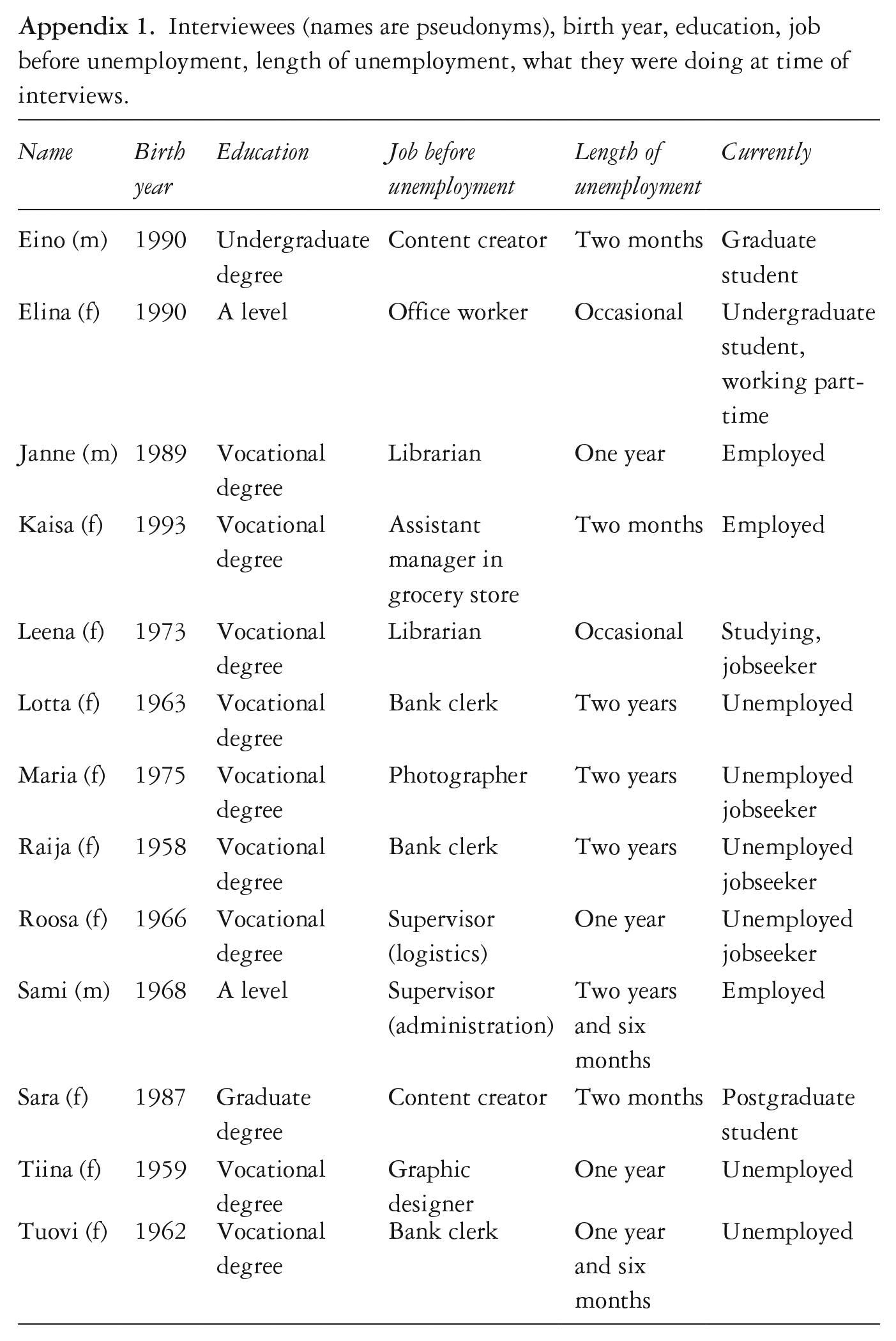
| Name | Birth year | Education | Job before unemployment | Length of unemployment | Currently |
|---|---|---|---|---|---|
| Eino (m) | 1990 | Undergraduate degree | Content creator | Two months | Graduate student |
| Elina (f) | 1990 | A level | Office worker | Occasional | Undergraduate student, working part-time |
| Janne (m) | 1989 | Vocational degree | Librarian | One year | Employed |
| Kaisa (f) | 1993 | Vocational degree | Assistant manager in grocery store | Two months | Employed |
| Leena (f) | 1973 | Vocational degree | Librarian | Occasional | Studying, jobseeker |
| Lotta (f) | 1963 | Vocational degree | Bank clerk | Two years | Unemployed |
| Maria (f) | 1975 | Vocational degree | Photographer | Two years | Unemployed jobseeker |
| Raija (f) | 1958 | Vocational degree | Bank clerk | Two years | Unemployed jobseeker |
| Roosa (f) | 1966 | Vocational degree | Supervisor (logistics) | One year | Unemployed jobseeker |
| Sami (m) | 1968 | A level | Supervisor (administration) | Two years and six months | Employed |
| Sara (f) | 1987 | Graduate degree | Content creator | Two months | Postgraduate student |
| Tiina (f) | 1959 | Vocational degree | Graphic designer | One year | Unemployed |
| Tuovi (f) | 1962 | Vocational degree | Bank clerk | One year and six months | Unemployed |
Acknowledgements
Many thanks to Heikki Hiilamo, Franklin Obeng-Odoom and the three anonymous referees who all read some version of this article and provided their comments and suggestions for improvement. Any errors in the work are solely the responsibility of the author.
Funding
The author disclosed receipt of the following financial support for the research, authorship, and/or publication of this article: The research for this article was funded by the Academy of Finland Strategic Research Council Project ‘Manufacturing 4.0 – Reshaping social policies’ (WP5).