




Abstract
This article provides a corrective to the dominant celebratory narrative about the conditional cash transfer programme in the Philippines, the Pantawid, and its associated social registry, the Listahanan. Based on extensive documentary analysis and fieldwork in the Philippines in 2017 and 2018, we argue that the targeting system has in fact been unable to function according to its primary purpose of identifying the poor and providing them social protection, despite being celebrated precisely for this purpose. This has been partly – but not only – due to the increasingly obsolescent data of the registry, which the political system has been incapable of correcting, leading to stasis at a fairly low level of coverage, at a peak of about 19 percent of national households in 2014 and since subsiding to about 17 percent by 2020, with transfer amounts at a fraction of the food poverty line. This dysfunction has resulted in a quasi-permanent group of cash payment recipients, with little or no reflection of evolving poverty profiles. This revised reading of the Pantawid and Listahanan, in what might be considered as a strong case to examine social protection performance, brings us back to the perennial problems associated with poverty targeting in even best-case social protection programmes promoted by international donors and organisations.
Introduction
The conditional cash transfer (CCT) programme in the Philippines – the Pantawid Pamilyang Pilipino Program (tr. Bridging Programme for the Filipino Family), hereafter Pantawid – has been celebrated as a model of best practice by international organisations such as the World Bank (WB) and the Asian Development Bank (ADB), both of whom have been key stakeholders in the development of the programme. The WB and associated authors have claimed that the Pantawid is one of the best targeted CCTs of its size in the world (e.g. WB, 2015a, 2015b; Acosta and Velarde, 2015). What started as an ad hoc poverty alleviation measure in 2007 evolved into a large-scale social protection programme with around four million household-beneficiaries in 2019. In that year, it had an annual budget reaching 89.7 billion Philippine Pesos (PhP), equivalent to 1.79 billion US dollars, accounting for 65 percent of the budget of the Department of Social Welfare and Development (DSWD) and 2.4 percent of the national government’s total budget (GoP, 2019). Pantawid also automatically entitles its beneficiaries to a host of assistance programmes from the government, as part of an effort of what the WB and the government refer to as ‘convergence’, or the cross-sectoral integration of programmes. Such convergence as well as the purported success in poverty targeting have occurred through a national social registry known as the Listahanan, a portmanteau combining Filipino words for list (lista) and home (tahanan).
The studies that posit the programme’s purported success have focused on expected programme outcomes – in particular behavioural changes that lead to greater uptake of specific public health and education services – as well as depoliticization and administrative streamlining through the implementation of the Listahanan. Scratching the veneer of these assessments, however, reveals considerable dissonance, particularly around the accuracy of poverty identification. Notably, the identification of beneficiaries up to at least 2014, the last year of significant expansion, was still based on the first round of household assessments undertaken in 2009 (Listahanan 1). Moreover, even if the Listahanan 2 was conducted in 2015 and has been used by other programmes since it was launched in 2016 (see Acosta et al., 2019; WB, 2019b), ongoing identification of Pantawid beneficiaries continued to be based on Listahanan 1 until at least 2019, by which time even the Listahanan 2 was already four years out of date. Hence, even if we accept the initial studies on targeting performance in the early years of the Pantawid, such performance would have been increasingly difficult to maintain or even ascertain over time in the absence of any credible updates to the household assessments, especially with the extent of social churning in and out of poverty in the Philippines. 1 Given the practical impossibility of accurate targeting as time elapsed since the inception of the programme, the celebration of the programme appears unwarranted, at least in terms of being a model of poverty targeting.
This article provides a corrective to this dominant narrative about the Pantawid and the Listahanan through a process tracing of the politicised institutional evolution of these two programmes, also taking into consideration the roles of key actors in the process. The analysis covers the period from 2007 to 2019, during the administration of three successive presidents: Gloria Macapagal-Arroyo (2001–2010); Benigno Aquino III (2010–2016); and Rodrigo Duterte (2016–2022). We argue that the targeting system – to a large extent influenced by external institutional pressures – has in fact been unable to function according to its primary purpose of identifying the poor and providing them social protection, despite being celebrated precisely for this purpose. This has been partly, but not only, due to the increasingly obsolescent data of the registry, which the political system has been incapable of remedying. The dysfunction has led to what we refer to as stasis, meaning a state that does not change or that stagnates without any further evolution. It refers to a quasi-permanent group of cash payment recipients, with little or no reflection of the movements into and out of poverty among the targeted population, defined by the programme as the poorest 20 percent of the population as measured by income proxies. The beneficiary group did reach almost 4.5 million households in 2014 – or about 19 percent of total households in the country – although less than half of these were estimated to be within the poorest 20 percent (as discussed further below). Since then, the beneficiary group remained largely unchanged besides some marginal attrition and replacement, with coverage falling to about 17 percent of households by 2020. 2 The limited value of the transfer should also be noted, reaching at most only about one third of the bare subsistence food poverty line. 3
This revised reading of the Pantawid and Listahanan brings us back to the perennial problems associated with poverty targeting – both technical and political economic – in even best-case CCT programmes. Indeed, the Philippines might be considered as a strong case to examine targeted cash transfer performance given stronger state capacity and resources compared to many other developing countries, and supportive politics at least at the level of the central government. The urgency of making this critical assessment is underscored by the increasing promotion and use of poverty-targeting systems across the broader social policy systems of the Philippines and many other developing countries, in line with donor and government efforts to streamline the coordination of administratively fragmented social assistance programmes.
Our corrective assessment is presented in five sections. In the first, we review the literature that asserts the narrative of success and locate this within broader debates about social protection in the Global South. The second outlines our research methodology. The third discusses the processes of adopting, implementing and expanding both the Pantawid and the Listahanan, highlighting the institutional dynamics and the role played by external actors therein. The fourth analyses the politicised problems of updating the Listahanan, which contributed to its obsolescence and to stasis in the Pantawid. In the conclusion, we reflect on how these policy and political dynamics foreclose the possibilities for more egalitarian and transformative social policy trajectories.
Interrogating narratives of success
Most of the initial studies in the early years of the Pantawid that showed strong targeting performance were impact evaluations focused on the delivery of expected outputs, such as the promotion of desired behavioural changes at the individual level that in turn bring about positive impact at the household-level. Behavioural changes are associated with the programme conditions, which include: immunisation and growth monitoring for children aged 0-5 years in the recipient household; 85 percent school attendance for school-age children; prenatal care and professionally attended childbirth for pregnant members; as well as regular participation in family development sessions (DSWD, n.d.: 1–2). These studies purported to show how the programme kept children in school, addressed child labour by decreasing the number of days that children work, and improved the utilisation of important healthcare services such as pre- and antenatal care for women, as well as immunisation and growth monitoring for children (Chaudhury and Okamura, 2012; Onishi et al., 2014; Orbeta et al., 2014). They also argued that, contrary to critiques from the right, the programme did not promote ‘bad behaviours’ such as indolence and unwillingness to work, or spending on gambling, cigarettes, and alcohol. The WB (2018a: 84–93) also commended the Pantawid for its ‘adaptive’ quality, that is, the ability to build resilience among poor households through human capital development and to adapt its programming when necessary. These positive changes have been used to justify the huge programme budget and to deem it as ‘money well spent’ (Schelzig, 2015).
Another dimension of these positive evaluations pertains to how the programme, through the Listahanan, has ostensibly reached the truly poor and vulnerable with hardly any political discretion in allocating social assistance. By using supposedly objective criteria and an information technology (IT)-based identification method within a highly centralised targeting system, the claim is that the Listahanan has helped minimise intervention by local ‘politicos’ in identifying beneficiaries for Pantawid (Kim and Yoo, 2015; Hayakawa et al., 2015; Mendoza and Olfindo, 2016; Swamy, 2016). A number of reports revealed that most Pantawid beneficiaries were found to be in the two poorest income quintiles as measured by the Family Income and Expenditure surveys and the Annual Poverty and Indicator Survey 4 – about 92 percent of total beneficiaries in 2009 and 82 percent in 2013 (Fernandez and Olfindo, 2011; Acosta and Velarde, 2015). It is also said to have a high benefit incidence – the percentage of total transfers that are received by the poorest quintile – which at 45.2 percent in 2013, was deemed by the WB as well above the threshold of 20 percent by which it judges a programme to be pro-poor or progressive (WB, 2015a: 47). It is also on this basis that it was deemed one of the best targeted social safety net programmes in the world (WB, 2015a; WB, 2015b). Of course, this latter measure is somewhat misleading insofar that we would expect a programme targeted at only the bottom quintile to have a high benefit incidence – 100 percent if perfectly targeted – although this point speaks to the high degree of inaccuracy of targeting systems elsewhere in developing countries and also to the interpretation of ‘pro-poor’ in WB discourse.
Aside from the problematic metrics used to judge targeting performance, there are also concerns regarding the partiality of many of these studies and reports, as most of them were produced either by staff of and/or consultants commissioned by the WB, ADB, and/or DSWD (e.g., Velarde and Fernandez, 2011; Chaudhury and Okamura, 2012; Reyes et al., 2013; Paqueo et al., 2013; Onishi et al., 2014; Orbeta et al., 2014; Acosta and Velarde, 2015; Orbeta and Paqueo, 2016). These studies and reports focus on building evidence on the merits of CCTs and on improving programme implementation, such as further refining the targeting mechanism to reduce errors, instead of asking whether poverty targeting actually works.
The asserted success of the programme, particularly in terms of poverty-targeting, has in turn been used to justify the deployment of the Listahanan to select beneficiaries for an increasing range of social protection programmes beyond the Pantawid. For example, ADB (2016) reported that the social registry had been used to identify beneficiaries for 25 national programmes by the end of Aquino’s term in 2016. Duterte continued with this practice and ADB (2020) notes that as of 2020, five government bodies were using the registry to identify social assistance beneficiaries for major programmes, including: national health insurance (PhilHealth); cash transfers to alleviate the effects of tax reforms; financial assistance for tertiary education; milk supplementation to address child malnutrition; and rice subsidies.
This broadening implementation of the Listahanan is presented as a programme achievement in these ADB reports. The logic follows from evaluations of social protection in the Philippines that have repeatedly highlighted the problem of fragmentation (ILO, 2007: 26; WB, 2018b: 10). Fragmentation is understood as the existence of multiple, commonly small-scale programmes that are unconnected and uncoordinated (WB, 2012: 15). Accordingly, the Listahanan has been cast as instrumental in addressing fragmentation by allowing different programmes to complement each other through the use of a unified social registry, albeit still within a poverty targeting modality. In this way, it has become a cornerstone of WB and ADB-supported convergence efforts – again, ‘convergence’ here referring to efforts to streamline the coordination of administratively fragmented social assistance programmes.
These evaluations notably frame fragmentation and convergence as technical administrative rather than social problems, to be remedied through improved poverty targeting. This is in contrast to the fragmentation of provisioning across social groups or classes that is often exacerbated by targeting, or convergence as the greater integration of social assistance with social security systems, or as unification in the quality of social provisioning provided across groups. The latter conceptions are emphasised in the more critical social policy scholarship as crucial for supporting social inclusiveness and the political sustainability of social protection, such as with respect to discussions around universal versus targeted modes of provisioning. In particular, various scholars (Fischer, 2010, 2020; Franzoni and Sánchez-Ancochea, 2016; Lavinas, 2013; Mkandawire, 2005; UNRISD, 2010) have discussed how poverty targeting tends to limit and even foreclose the potential for cross-class integration, alliances and solidarities by reinforcing stratified systems of social provisioning, and thereby even exacerbates fragmentation and divergence. However, the evaluations of social protection in the Philippines ignore such scholarship and instead follow the cues of the WB and other international donors in terms of how these terms have come to be used (also see Aldaba and Ang, 2012; DAP, 2009).
Accordingly, the Listahahan has been associated with the widening scope of poverty-targeting within highly stratified social provisioning in the Philippines. This has also been in line with the shift in the meaning ascribed to ‘universal’ provisioning that has been cultivated by the WB, which as noted by Fischer (2018), amounts to a claim that universalism is achieved as long as everyone has access to something, regardless of how it is provided. Indeed, this precise claim was made to us by a senior WB staff person who we interviewed in the Philippine office in 2018.
That these narratives of success of the Pantawid and Listahanan have been mostly produced or commissioned by international donors that simultaneously support the widening scope of poverty-targeting in social provisioning sheds light on broader processes of external influence in the evolution of social policy systems in the Global South. In this respect, much of the literature on external influence in social protection focuses on the politics of dissemination (e.g. Foli, 2016; Lavers and Hickey, 2016; Franzoni and Voorend, 2011; Sugiyama, 2011) without necessarily questioning the nature of the model being disseminated (with some exceptions, such as Ouma and Adésínà, 2019 or Adésínà, 2020). Our analysis here provides a corrective to this tendency.
Methodology
The research is based on extensive documentary analysis together with fieldwork in the Philippines in 2017 and 2018, the latter involving 44 interviews with key informants from government (n=27) and relevant donor agencies (n=7), as well as with DSWD field workers (n=6), beneficiaries and officers of the national alliance of Pantawid families (n=3), and academics (n=2). The informants were identified through purposive and snowball sampling, which was deemed appropriate given that the interviews mostly involved policy elites. Most of the interviews were conducted by the first author, a Filipino PhD researcher, although she was accompanied by the co-authors (her PhD supervisors, one Canadian and one Filipino) on two separate occasions during her fieldwork. Most of the interviews were recorded with consent from participants. For those who did not want to be recorded, notes of the interviews were taken instead. Interview guides were prepared based on sub-themes of the research (e.g., adoption and expansion of CCTs, adoption and institutionalisation of the social registry, external donor involvement, and political tensions), which in turn facilitated a thematic analysis of interview data. Ethical research protocols concerning informed consent and confidentiality were strictly observed during the field research, especially given the tensions surrounding the Duterte administration at the time of our research regarding how critical comments about the government were being dealt with. As one consideration of these protocols, we maintain strict anonymity in the reporting of these research results, unless informants indicated that they wished to be identified.
Meanwhile, the documentary analysis included: the Philippine Social Protection Notes produced by the WB; periodic and impact assessment reports by the DSWD, WB and ADB as well as external experts; the operations manuals of Pantawid and Listahanan; 47 loan-related documents from 2009 to 2020; and various news media coverage related to the programme. These documents provided relevant information such as the design and implementation arrangements of the Pantawid and Listahanan, changes made in these initiatives over the years, the findings of impact evaluations, and the expansion of the number of Pantawid household-beneficiaries until it stalled in 2015. These documents were also used to prepare for the interviews and to triangulate the subsequent analysis.
The Pantawid and Listahanan from inception to stasis
The Pantawid was adopted against the backdrop of a reform process in the DSWD, which was intended to consolidate the department’s national ‘steering’ role in social assistance and social protection (DSWD, 2010: 1). Although there is not enough space here to elaborate on the politics surrounding this process, it suffices to note that there was a consensus among the donor and DSWD key informants that the WB and the ADB played major roles, in particular around the adoption of CCTs in the Philippines. This view is also confirmed in the documents we examined and in some of the secondary literature, and is instantiated by the fact that the policy process was strongly supported by two sets of loans from the WB and the ADB, the first during Aquino’s term and the second at the start of Duterte’s administration in 2016, with additional WB funding approved in 2019 (ADB, 2016; WB, 2016, 2019c). Donors were also heavily involved in the processes of setting-up and consolidating the poverty targeting system used to identify the Pantawid beneficiaries. Consultants for capacity-building and institutional development were hired through technical assistance from the WB, ADB, Japan International Cooperation Agency (JICA), and Australia’s Department of Foreign Affairs and Trade (DFAT), among others (WB, 2009, 2016; ADB, 2010b, 2013). According to a former Listahanan official we interviewed, the WB also funded study trips abroad, such as to Colombia and Mexico in 2010, the latter involving mostly IT staff. Some of our informants were nonetheless uncomfortable with this evident role of external influence in the policy process, which was in dissonance with their tendency to portray the process as a nationally ‘owned’ and driven.
Following several years of WB-mediated promotion, the DSWD proposed a CCT pilot to the cabinet of Macapagal-Arroyo in 2007. The proposed pilot was approved in March 2007 and officially launched as Ahon Pamilyang Pilipino (tr. Filipino Family Ascend) in September 2007, with a target of 6,000 household-beneficiaries across four rural municipalities and two cities in Metro Manila (Howlett et al., 2018; Fernandez and Olfindo, 2011). It was originally planned to run for a year, from September 2007 to September 2008. However, barely three months from inception, Arroyo decided to ramp up the programme in 2008, re-naming it as the Pantawid, expanding target household beneficiaries to about 320,000, and allocating five billion PhP from the windfall of expanded value-added tax (Dadap, 2011). Further expansions in its beneficiary base were undertaken later in light of another executive decision to reach one million household-beneficiaries by the end of 2009, during Arroyo’s last year in office (Fernandez and Olfindo, 2011).
According to the WB (2009:1) and ADB (2010a: 1), Arroyo’s decision to rapidly expand the Pantawid was prompted by the food and fuel crisis in 2008, as well as the country’s dismal performance in meeting the poverty targets of the Millennium Development Goals. Scholars like Reid (2016), however, alluded to the political pressures emerging from accusations of electoral fraud, corruption, and violence that the President was facing at that time. Irrespective of these dissenting narratives, the DSWD was not prepared for the rapid expansion. A former Pantawid staff member described the situation as ‘chaotic’ in that full-scale implementation preceded the setting-up of necessary systems, such as the IT system on which registration of beneficiaries, monitoring of compliance to conditionalities, and payment of cash grants depended. As explained by a former national manager of the Pantawid, the programme deals with large datasets, hence, its effective implementation depends on a reliable targeting and IT system. However, the targeting system was still to be developed when the programme was first substantially expanded. The said official added that the targeting system should have been established before the roll-out of the CCT programme, but the two initiatives were developed parallel to each other. In the meantime, the DSWD had to deploy its own targeting tool to identify beneficiaries in 2008 and 2009 – a one-page questionnaire on basic household information and income – and the full-scale CCT programme was already running for more than two years when the poverty targeting system, then called the National Household Targeting System for Poverty Reduction (NHTS-PR), was undertaken. The official further revealed that there were many technical issues when the DSWD tried to integrate the existing and the ‘new’ datasets.
When Aquino assumed office in 2010, he decided to continue Pantawid and substantially expand its beneficiary base by more than one million households from 2010 to 2011 (ADB, 2015: 3; Velarde and Fernandez, 2011; see Figure 1). In our interview with the former social welfare secretary under Aquino, Dinky Soliman, she said that the expansion was pursued despite initial reservations expressed by the WB and ADB, at least with regard to the rapidity of expansion. Later in Aquino’s term, the DSWD effected some adjustments in the programme. First, beginning in 2012, it implemented the Modified Conditional Cash Transfer (MCCT), an additional feature of Pantawid, designed to reach poor families who could not be covered by the regular CCT programme, such as homeless families and indigenous communities in remote areas. Second, in that same year and with the approval of the cabinet, it expanded Pantawid benefits to include the automatic membership of CCT beneficiaries to the national health insurance programme (PhilHealth). Third, starting in 2013, it extended the age cohort of children-beneficiaries from 0-to-14 to 0-to-18 years old, effectively extending the five-year limit in programme participation (more on this below). Pantawid benefits were further expanded in 2017 by the administration of Duterte, who, in a bid to fulfil a campaign promise, decided to provide monthly rice subsidies to CCT beneficiaries (Macas, 2016; Reyes, 2017).
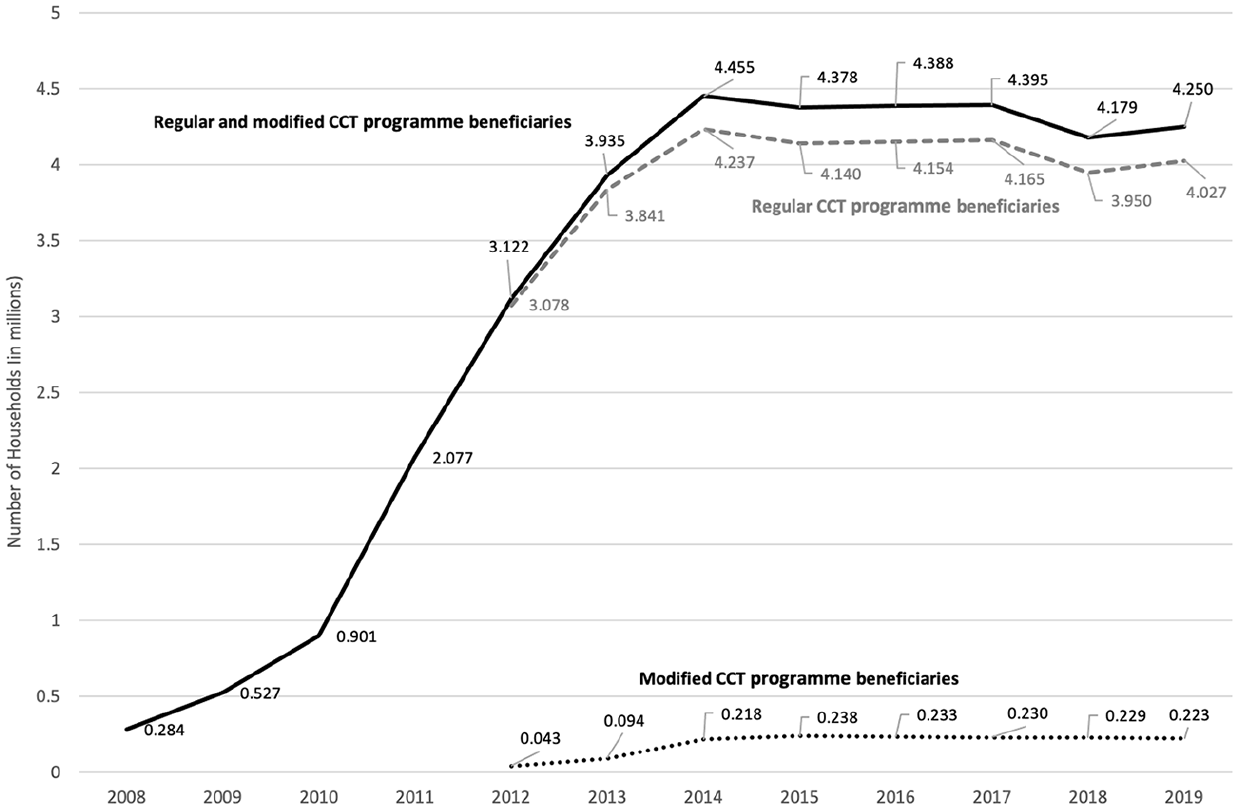
Number of Pantawid household-beneficiaries, 2008-2019.
The expansion of enrolment stalled after 2015 towards the end of Aquino’s and during Duterte’s terms. This is shown in Figure 1 above, which is based on the end-of-year Pantawid Implementation and Status Reports from 2012 to 2019. Data from these reports show beneficiaries peaking at 4.455 million in 2014 and subsequently declining to 4.25 million in 2019. Various sources from the WB also indicate that no new households had been enrolled in the programme from 2016 until 2018, with the result that the total number of regular CCT beneficiaries declined due to attrition (see Acosta et al., 2019; WB, 2019b). This was also confirmed to us during our fieldwork in 2018 by a report given to us by the national manager of Pantawid (see DSWD, 2017), in which reporting on additions by annual sets of enrolment also stopped in 2015.
With the stalled expansion during the term of Duterte, exit from the programme was mostly limited to so-called ‘natural attrition’ (Acosta et al., 2019), referring to when a household no longer has children aged 0 to 18 years old, or else removals due to inclusion errors, fraud and other reasons. In total, about 525,000 households were reported to have been removed from 2008 to June 2020 (DSWD, 2020: 7). 5 Not all of these would have necessarily ‘graduated’, in terms of an improvement in socio-economic conditions above a designated poverty threshold, 6 although the static and lagged nature of the Listahanan (as discussed below) makes this difficult to evaluate. However, despite the decline in the total number of households enrolled after 2014, the slight increases in 2016–2017 and 2019 (as shown in Figure 1) indicate that there was some marginal replacement of those removed during those years. Moreover, 4.396 million household beneficiaries were reported as of June 2020 (DWSD, 2020), reflecting at least 150 thousand new enrolments since 2019, although this was possibly due to the social protection response related to the Covid-19 pandemic (e.g. see Dadap-Cantal et al., 2020).
Moreover, as explained further below, all of the enrolment into the programme from 2009 until at least 2019 – whether as expansion or replacement – was based on Listahanan 1. This implies that the programme has been targeting beneficiaries using an increasingly obsolete social registry. The government’s own auditing agency, the Commission on Audit (COA), noted in its assessment of the programme in 2017 that this increased the possibility of including households no longer classified as poor (COA, 2017: 23). The COA audit also alluded to attrition in Pantawid as happening for reasons other than changing conditions of poverty, and to the failure of the programme to add ‘new’ poor in its beneficiary base. Meanwhile, a more recent report by the WB (2020: 7) indicated that ‘current beneficiaries’are still based on the said version of the registry, underscoring the persistence of this practice.
The stalled expansion, marginal attrition and presumed replacement, together with the use of a dated social registry in all these processes, has resulted in stasis in the beneficiary base. The consequence of stasis is that the programme has become largely unresponsive to changing conditions of poverty among both its beneficiaries and its target population not covered by the programme. While the implications for inequality are difficult to assess precisely because of the lack of any appropriate data, both exclusion and inclusion errors in the programme would have definitely worsened given the increasing lag with updated census data, with deleterious impacts on perceptions of fairness at the very least. In the following section, we explore further the struggles specifically related to the Listahanan and how these contributed to stasis in the programme.
Targeting in the Pantawid: Explaining stasis
A confluence of political and administrative factors led to stasis in the Pantawid. We do not have space to discuss the ideological positions towards social policy underpinning these (see Ramos, 2020 for some discussion). Suffice to say that while political resistance within the Duterte administration directly contributed to stasis, this was facilitated by the challenges already facing the Listahanan and Pantawid, which provided for convenient rationale for resistance.
Resistance to the expansion of the Pantawid during Duterte’s term was most notably articulated by his former DSWD Secretary Judy Taguiwalo, who imposed a moratorium on the use of Listahanan 2 and additional enrolments to the programme in 2016. Taguiwalo was not as supportive of the Pantawid as Duterte, who as mentioned earlier, expanded the programme benefits to include monthly rice subsidies in line with a campaign promise. Taguiwalo on the other hand was one of the prominent Leftist personalities appointed soon after Duterte took office in 2016, in a bid to incorporate a faction of the Left into his governing coalition. 7 A social worker and university professor, she was associated with a faction of the left that initially opposed the adoption of CCTs in the country (Dadap, 2011). From her first day in office, she expressed her opposition to the institutionalisation of the Pantawid through a national law, which was still being campaigned for at that time, describing the programme as merely a stop-gap measure that allegedly had been used for patronage and anti-insurgency, rather than an anti-poverty measure. She has also publicly declared her preference for universal over targeted social services, and for job creation and asset reform programmes (Gonzales, 2016; Tupaz, 2016). She reiterated this position when we interviewed her in March 2018, saying that if the said initiatives were pursued, then there would be no need for targeted programmes like CCTs. However, she said that the Pantawid could not be suspended, as the Philippine government was tied by the WB and ADB loans supporting it. Meanwhile, she clarified that her moratorium was part of a review process aimed at improving programme implementation and finding alternatives that address poverty in both the short and long terms. Nevertheless, the moratorium effectively stalled both expansion as well as ‘graduation’ based on newer poverty data while maintaining the existing household-beneficiaries, as could be deduced from Figure 1.
In our interview with Taguiwalo, she explained that before Duterte took office, his predecessor Aquino reported that some 1.3 million Pantawid household-beneficiaries had been lifted out of poverty. 8 Then, as soon as she started her term as Secretary in 2016, she asked for the whereabouts of those households and found out that they still remained in the programme and that there had been no clear plan for helping them exit the programme. She also questioned the comparability of the results of Listahanan 1 and 2, in view of the changes to the PMT models used in the latter (see Mapa and Albis, 2013), implying that such changes compromised the comparability of the two datasets. 9 Issues with the updated social registry were echoed by a Listahanan official we interviewed, who said that their IT division did a ‘cross-matching’ to determine how many of the 5.1 million identified as poor in Listahanan 2 were existing Pantawid households, that is, part of the 4.2 million identified as eligible from Listahanan 1. Of the 4.2 million, he said that around 780,000 households or 18.6 percent ‘could not be located’ in Listahanan 2, because either these households had escaped poverty, or else they had changed the names of the household heads or representatives. On the basis of all these types of concern, Taguiwalo issued the moratorium pending the results of community validations, called Kamustahan, where social welfare officials and staff would visit poor communities to profile and account for Pantawid household-beneficiaries and assess the programme implementation on the ground. 10
However, even before Taguiwalo’s moratorium, political and administrative conditions had already been creating the preconditions for stasis. Foremost of these was the delay of the Listahanan 2. Based on its Operations Manual, Listahanan is to be updated every four years. Hence, following the creation and implementation of Listahanan 1 in 2009, Listahanan 2 should have been undertaken in 2013 (DSWD, 2015a: 16). However, the DSWD had difficulty securing the budget. According to Listahanan officials we interviewed, there were members in the cabinet of then-President Aquino who were critical of the social registry due to reports of significant inclusion and exclusion errors. This resulted in a long drawn out discussion between the leadership of the DSWD and that of relevant departments on the imperative of having new datasets for poverty-targeted programmes. Listahanan 2 was finally undertaken in 2015 and by the time it was launched in 2016, seven years had already passed since Listahanan 1. As a result of this delay, DSWD continued to use Listahanan 1 to identify beneficiaries for the expansion of about 1.5 million households in 2014, with data that was at that point five years out of date. Subsequent replacements up until at least 2019 and possibly up to 2020 were apparently also based on the continued use of Listahanan 1, as noted above.
Another factor that contributed to the stasis in the beneficiary base was the decision in 2013 to extend the age limit for children of Pantawid households from 14 to 18 years old in order to support them through high school. This effectively extended the time limit for programme participation. As we noted earlier, the Pantawid was initially conceived as a short-term poverty measure with a five-year participation limit, meaning that household-beneficiaries enrolled in 2008 would have ‘graduated’ from the programme by 2013. However, two studies in 2013 argued for an extension of the age limit for children-beneficiaries to 18 years old, arguing that there was no point in only focusing on primary-school children when enrolment at their level was almost 100 percent (Paqueo et al., 2013; Reyes et al., 2013). Further, they emphasised that if the intent was to improve the income of future workers, children should be given the chance to finish or at least reach high school, as studies showed that those with high school education had better income prospects than those with only primary education. The suggestion to ‘deepen the assistance rather than expand the coverage’ (Reyes et al., 2013: 37) also contributed to this idea. The government heeded the recommendation and, by 2014, the social welfare department started adopting the new age requirement (as noted in ADB, 2015: 4; Acosta and Velarde, 2015; COA, 2017: 14). Household-beneficiaries who were delisted from the programme for the reason that their children already passed the initial 14-year-old limit were re-evaluated for possible reinstatement (DSWD, n.d.: 3). This change in age limit thereby effectively extended the participation of households past the critical years during which Listahanan 2 was being conducted and launched.
These issues, particularly the outdated social registry, have been acknowledged in WB reports (WB, 2020; WB, 2019a: 22, 23, 25; Acosta et al., 2019). Yet while these reports have pointed out the declining coverage and targeting efficiency of Pantawid, they have nonetheless maintained the narrative that the programme ‘remains progressive, with the greatest share of benefits going to the poorest households’, and that it ‘continues to make an important contribution to reducing poverty’, based on their own calculations using DSWD data and the Annual Poverty and Indicator Survey (APIS) of the Philippine Statistics Authority (Acosta et al., 2019: 8, 10). This was despite the fact that at this point, the programme was still based on Listahanan 1, with beneficiary targeting based on data that was ten years old and the bulk of beneficiaries having effectively become quasi-permanent.
Moreover, these dynamics were reinforced by the eventual enactment in April 2019 of a law that Taguiwalo resisted: the Republic Act 11310, which institutionalised the Pantawid by making it a regular programme of the national government. While this ensured its continuity and annual budget, the Act also reaffirmed the programme design, such as the use of the Listahanan as basis for identifying beneficiaries, the use of programme conditionalities, and the close monitoring of beneficiaries’ compliance with these conditionalities. Likewise, it promotes ‘convergence’ by mandating inter-agency partnerships for more coordinated and harmonised programmes, thereby deepening the ethos of poverty targeting even while stasis in the beneficiary base has continued.
Conclusion
Ultimately, over the decade when the Listahanan was created and deployed within the rapid expansion and then stagnation of the Pantawid, the combination of the two yielded an increasingly outdated picture of who needs social protection in the Philippines. They have in fact been unable to function according to their primary purpose of identifying the poor and providing them social protection, despite being celebrated precisely for this purpose. This has been partly – but not only – due to the increasingly obsolescent data of the registry, in the face of administrative bottlenecks that delayed possibilities for updating it, changes in rules that delayed graduation from the programme, and then initial political resistance when Duterte first came to power, which compounded these extant problems. The systemic dysfunction has led to the establishment of a quasi-permanent group of beneficiaries from 2015 onwards, which has since remained largely unchanged besides some marginal attrition.
While the creation of such a group could theoretically form the basis for a gradual universalisation of the social protection system, political and institutional dynamics arguably truncated and foreclosed such possibilities, at least in the current context. Instead, the programme has exhibited a tendency towards stasis at a fairly low level of coverage and has encouraged stratified segregation in the broader social policy system, as demonstrated by the deployment of the Listahanan in the health care and non-contributory pension programmes (not analysed here due to lack of space, but see Ramos 2020). These tendencies have been reinforced by donor-promoted ‘convergence’ efforts, referring to the coordination of different poverty-targeted programmes through the Listahanan, whilst not addressing the ways these reinforce social stratification.
This revised reading of the Pantawid and Listahanan, in what might be considered as a strong case for examining targeted social protection performance, brings us back to the perennial problems associated with poverty targeting – both technical and political economic. These ironically render social protection systems ineffective in addressing the changing conditions of poverty of their target populations, and ultimately encourage tendencies towards stratified segregation in the broader social policy system. As such, the case offers a corrective assessment of the potential limitations of even best-case CCT programmes in fostering integrated and equitable systems of social protection, and instead points towards their limited (if not counterproductive), transformative potential.
Footnotes
Funding
The author(s) disclosed receipt of the following financial support for the research, authorship, and/or publication of this article: This research was funded by the European Research Council under the European Union’s Horizon 2020 research and innovation programme, for the AIDSOCPRO research project (Aiding Social Protection: the Political Economy of Externally Financing Social Policy in Developing Countries; grant agreement No 638647).