




Abstract
The purpose of this article is to expand the economic discourse beyond single interest as the dominant analytical foundation of microeconomics towards dual interest and metaeconomics. Metaeconomics is based on the reality of joint and non-separable self and other-interest arising because of non-allocable goods and non-allocable inputs. Non-allocable goods are explained by the internal tendencies in the mind to a more primal ego-based self-interest tempered by an empathy-based other (shared with the other, while internalised within the own-self-interest). Non-allocable inputs giving joint products and dual interest in the outcomes are explained by thermodynamics: production is internal to and non-separable from the natural system on the Spaceship Earth. Dual Interest Theory (DIT) assumes that self-interest is accompanied by empathy-based other-interest and that individuals tend to balance both interests in their decisions and behaviour. Several empirical tests of DIT demonstrated its advantages in explaining the observed behavioural outcomes as compared to the consideration of self-interest alone. DIT is also more powerful in explaining many other social phenomena than if one relies on the single/self-interest assumption of microeconomics alone.
Introduction
Traditional microeconomics generally presumes fully allocable goods and allocable inputs, and thus both consumption and production, demand and supply, are separable and independent. Microeconomics assumes that individuals behave in pursuit of self-interest. Microeconomics (except for game theory allowing for strategic interdependency) also presumes that each person is generally independent of other persons and of natural systems on Spaceship Earth—we refer to this as Single Interest Theory (SIT).
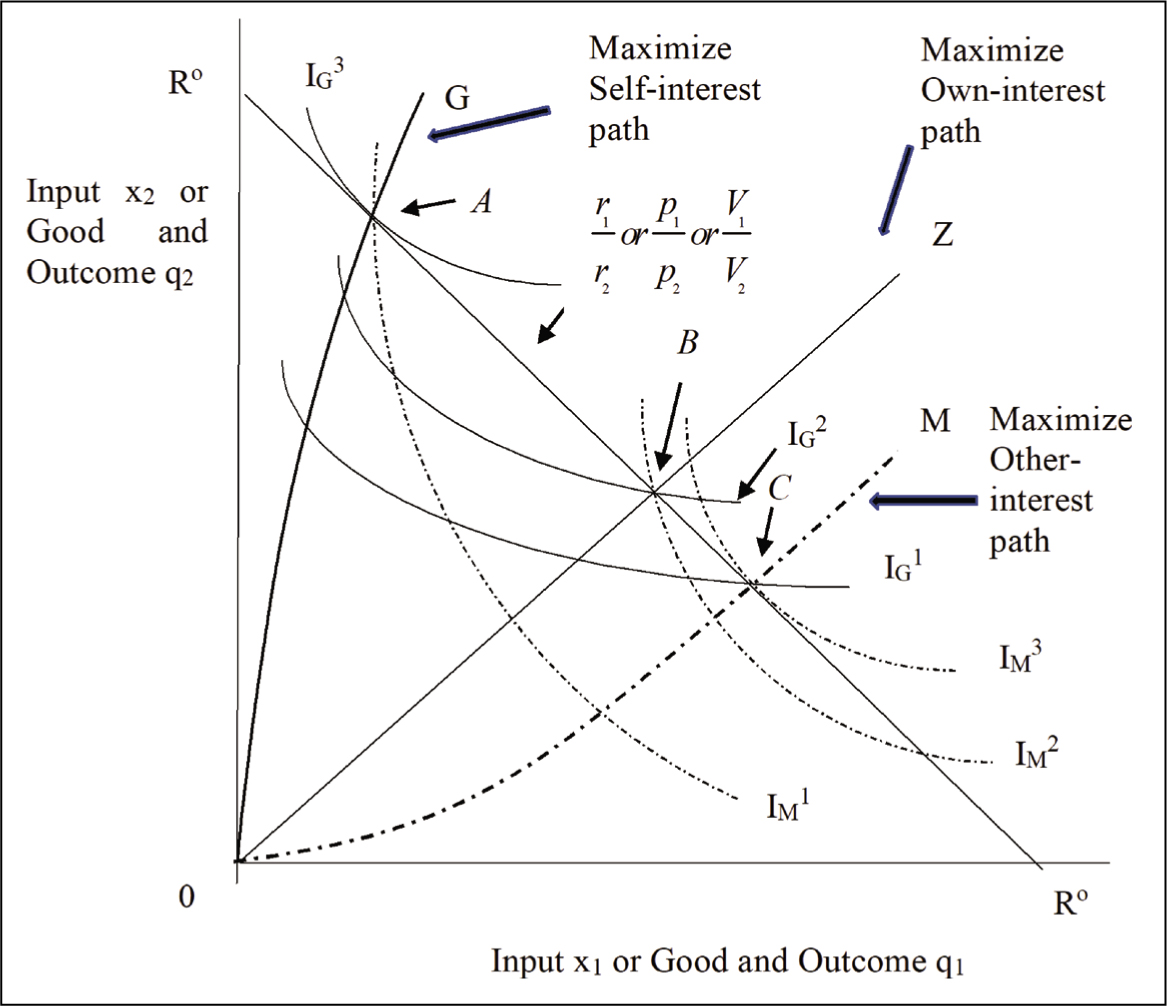
The main problem with SIT is that it assumes no walking-in-the-shoes-of-others, no empathising. SIT sees only the self-interest set of indifference curves IG (Figure 1) for bundles of the socially beneficial good 1 (quantity q1) and the selfish good 2 (q2), for example, recycled versus regular paper; plane tickets with a carbon offset fee versus plane tickets without; green versus conventional electricity. Given the budget constraint R0R0, self-interest is maximised at point A. As the budget changes, ceteris paribus these optimal points produce an expansion path 0G.
Dual Interest Theory (DIT) assumes that an individual is motivated by two interests: ego-based self-interest IG and other-interest (IM). Other-interest is empathy-based; it is a shared interest which is internalised within the own-self. Given the budget constraint R0R0, other-interest is maximised at point C (Figure 1). Expansion path 0M represents optimal other-interest if the budget changes. An individual can choose to maximise self-interest following path 0G or shared other-interest on path 0M. Thus, by optimising one interest, the person sacrifices the other. DIT postulates that one will be balancing both interests by choosing 0Z, called the own-interest path.
Isoquants for Non-allocable Inputs (ϰ1ϰ2) or Indifference Curves for Non-allocable Goods/Outcomes (q1 q2).
DIT should be differentiated from DMT, Dual Motive Theory (Cory, 2006a, 2006b), with which it has some common ground. DIT expanded the role of empathy by focusing on empathy-based ethics forming the core of the shared other-interest (Sheeder & Lynne, 2011). This understanding of ethics echoes in the argument by Dietrich and Rowen (2005) that individuals behave ethically both because they value ethics in itself and because it is in their own-interest to do so. As will be discussed later, DIT should also be differentiated from other frameworks focusing on interdependent utility such as social preferences and social value orientation (SVO) (Murphy and Ackermann, 2011; Murphy et al., 2011) as DIT acknowledges the impossibility of knowing the utility of another person.
Another important feature of DIT is the role of self-control. DIT recognises that people are inherently challenged in finding the best balance in the self- and other-interest, that is, the location of the path 0Z (Adam Smith referred to this as the problem of self-command). People tend to slip back to the more hedonistic, primal self-interest-only path. However, being mindful of the other-interest (the moral dimension and community, the ethics, the conscience and the Spaceship system) is essential to maximising the own-interest. For instance, donors making charitable contributions have been shown to give special importance to their relationship with others and community (Gandullia et al., 2021).
The concept of own-interest requires an open mindset and may feel uncomfortable for some who have been taught and are used to operating only in the SIT domain; in that, DIT focuses on the more nuanced notion of own-interest rather than on self-interest. In the following sections, we will present DIT in more detail and provide its applications to a variety of social phenomena. For the mathematical metaeconomics, see Lynne (2006 a, b) and Appendix in Lynne (2020).
Metaeconomics of a Consumer Problem
Edgeworth was the first to propose the indifference curve (Lenfant, 2012, p. 117), which became a core construct in SIT used to explain the origin of demand. According to Sen (1977, p. 318), Edgeworth considered a person an impure egoist and that ‘…between the claims of oneself and the claims of all lie the claims of a variety of groups - for example, families, friends, local communities, peer groups, and economic and social classes’. Lynne (1995, 1999) was apparently the first to represent such claims as the empathy-based other-interest, which led to the graphical representation of the DIT using two overlapping sets of indifference curves (Figure 1). Initially, the notion of non-allocable goods was framed as a dual-utility theory following Etzioni (1986, 1988). Over time, influenced by empirical testing, it was changed to focus on dual interest (Lynne et al., 2016) rather than dual utility (i.e., separable pleasure and moral utility).
DIT is more accurate than a dual utility model because it recognises jointness. It is also more flexible because the payoff can be framed in other terms such as happiness and peace of mind. DIT also accommodates such frames as the Kantian imperative (White, 2006), focused on the tension between a joint and non-separable inclination (0G) and duty (0M): sufficient self-control ensures finding and staying on the balanced (Kantian) path 0Z. The set of indifference curves IG represents the virtue of prudence; the set IM is based on empathy and represents the virtue of temperance as well as other virtues such as courage, justice, faith, hope and love. Furthermore, DIT aligns well with the neuroeconomics findings, pointing at two tendencies (selfish and empathetic), which are joint and non-separable, within different brain segments (Singer, 2009).
Marglin (2008) argued that using SIT Undermines Community. DIT, on the other hand, brings community back, allowing for various constituencies (immediate family, extended family, colleagues, clubs, sport teams, labour unions, religious affiliations, political parties, state and nation) to be incorporated in the other-interest considerations. However, when considering the influence of community in DIT, it is important to keep in mind that the other-interest reflected in community is not the same as other-regarding preferences and the other-interest does not imply interdependent utility. First, other-regarding in DIT only goes to the level of mindfulness: a person must become mindful of the other, as the starting point for empathy/walking-in-the-shoes-of-others. This regard is not other-directed, but it rather represents what one shares with the other. It is not an other-regarding preference: it is an own-preference in the domain of shared other (internalised)-interest. DIT preserves the individualism of SIT. Second, other-interest in DIT does not mean interdependent utility/interest as DIT recognises the empirical evidence that knowing the exact utility derived by another person is patently impossible. This differentiates DIT from other frameworks examining interdependent decision behaviour such as social preferences, other-regarding preferences and SVO. While SVO (Murphy and Ackermann, 2011; Murphy et al., 2011) provides a way to classify the individual motivations regarding resource allocation as fundamental (such as individualistic, prosocial, competitive and altruistic) and secondary (such as sadistic, masochistic, sadomasochistic and martyrdom), DIT postulates that regardless of how the payoffs are allocated, we cannot know whether they are truly advancing the interest of another person and the best one can do is empathise, and join in sentiment with, through projection of own-self into the situation of the other. ‘We sympathize even with the dead’ (Smith, 1759/1790, loc 407)’. So, we may well empathise with someone killed in a robbery, resulting in tempering our self-interest. Because of empathy with the person killed, a person supports a larger police budget through higher taxes and sacrifices a bit of self-interest, even though the likelihood of being killed in a robbery is extremely small, that is, the cost is greater than the expected benefit in the domain of self-interest. The gain is in shared other-interest within the own-self, with an overall gain in own-interest.
To illustrate the consumer problem with non-allocable goods, let’s use recycling. Good 1 has recycled content, while good 2 is produced only from new resources. The consumer buys a bundle q1 and q2 of these goods. Each good gives a simultaneous payoff in both the domain of self-interest IG and other-interest IM. Under the SIT solution, given budget constraint R0R0, the consumer maximises self-interest only at point A (Figure 1) with a high payoff in self-interest on the indifference curve IG3 and a small payoff in the other-interest on the indifference curve IM1. The consumer can also maximise other-interest at point C where other-interest on the indifference curve IM3 is very high, while the payoff in self-interest on the curve IG1 is very low. DIT argues that many, if not most, consumers would not be happy at point A as it mostly ignores the conscience or ‘the impartial spectator’ as Adam Smith described it. Similarly, most consumers would not be happy at point C where self-interest is mostly ignored.
DIT posits that consumers tend to balance both interests by choosing point B with moderate levels of satisfying self- and other-interest on IG2 and IM2. In effect, DIT points to maximising the broadened own-interest, made possible only by sacrificing a bit of each interest (a new meaning of altruism, which is now more than just sacrifice in self-interest; see Lynne, 2020, p. 221). As Kalinowski et al. (2006) empirically demonstrated, people sacrifice self-interest payoff to recycle and/or buy recycled content goods, and these behaviours increase as consumers identify more fully with the shared interest in recycling. Ultimately, this is about finding balance in the joint consumption of selfish and socially beneficial goods.
Metaeconomics of a Producer Problem
Ragnar Frisch was one of the first to use an isoquant (Lloyd, 2012). Frisch (1965) was the first to insert overlapping isoquants into the same space to represent non-allocable inputs, as in the wool and mutton problem. A producer/rancher has very limited control over how the grain and hay inputs are allocated between wool and mutton, internally, by the sheep. As a result, wool and mutton are inextricably intertwined—joint and non-separable. Intriguingly, the Frisch framing of jointness did not make way into mainstream microeconomics. However, this idea of jointness was developed into a foundational principle in DIT. On a larger scale, non-allocable inputs reflect the thermodynamic reality: everything is internal in a non-allocable input system (Lynne, 2020, Ch. 12). The economy is internal to the Spaceship, with limited control over it, and nothing is external except energy from the Sun, a fusion reactor on the way to maximum entropy, which also ensures nonallocability. Initially, DIT was developed for a producer-farmer who is facing a conservation choice and uses two types of inputs: industrial inputs (e.g., seed, fuel, fertiliser and land) and conservation technology (conservation tillage, cover crops and nutrient management, etc.). These inputs are non-allocable in producing food (private) and natural resource (public) products. The question is what motivates farmers to choose a higher or lower conservation level.
The research question originated in the US soil conservation effort started in the 1930s, with more concerted effort of data collection and empirical testing since the late-1980s (Lynne, 2020, Ch. 8; Lynne et al., 2016). The initial findings showed that SIT framing was explaining <20% of the variation in farmer conservation choices (Lynne et al., 1988). This led to the development of DIT raising the explanatory power to >60% of the variation (Lynne et al., 2016), confirming that conservation is driven not only by self-interest but also by empathy-based (shared) other-interest, working to temper the more primal ego-based self-interest of conservation farmers.
Under DIT, non-allocable inputs 1 and 2 (in quantities ϰ1 and ϰ2) are used to produce private good—corn for the Market on path 0G. These inputs simultaneously produce wildlife (and other public goods) for use by everyone, including deer hunters and bird watchers. Said public goods also serve the other-interest of the farmers on path 0M (Figure 1). By choosing to pursue self-interest only (isoquant IG3) and facing the capital constraint R0R0, the farmers maximise profit at point A resulting in a large quantity of corn produced for the Market and a very small amount of wildlife (small payoff in other-interest).
In contrast, if the farmers pursue other-interest (isoquant IM3 given the capital constraint R0R0), they will end up at point C with plentiful wildlife in the surrounding area (e.g., deer, birds, bees) for the Other (non-market) Forums and a small amount of corn for the Market Forum. There would be little to no monetary payoff for the farmers at point C, as deer hunting and bird watching in the region do not generate income for farmers. So, what will farmers do? It depends upon the extent to which the farmers join in empathy with others and becomes mindful of the wildlife. It depends whether they start seeing corn and wildlife as being internal to the same process.
Farmers’ choice is influenced by the larger context provided by the Community (including the farmers) and the Government charged with representing the value V of wildlife, as demonstrated in Figure 2. Meta-preferences for the private (corn) and public (wildlife) products are represented in the value V isocurves, on a higher plane of interest, generally evolving in an Other Forum beyond the Market Forum. The possibilities frontier R0R0 in Figure 2 is derived from moving along the capital constraint R0R0 in Figure 1. Areas outside of paths 0G and 0M (Figure 1) are irrational, as depicted by the positive slopes on the R0R0 possibilities frontier (Figure 2). It is irrational to not produce at least some of both the private and public products, such as at points A and C.
If the value V of wildlife is viewed as zero, then the V0 of IM = 0 horizontal line is the driving force in the balance of interests on the higher plane, pointing to point A in both Figures 1 and 2 with lots of corn and little wildlife. If corn is not highly valued relative to wildlife, as in a wildlife preservation frame, then the favoured V0 of IG = 0 curve is the driving force at point C: lots of wildlife and little corn.
Possibility RR and Value V Curves for Products, Goods and/or Outcomes q1 q2 Reflecting Balance in Self- and Other-interest.
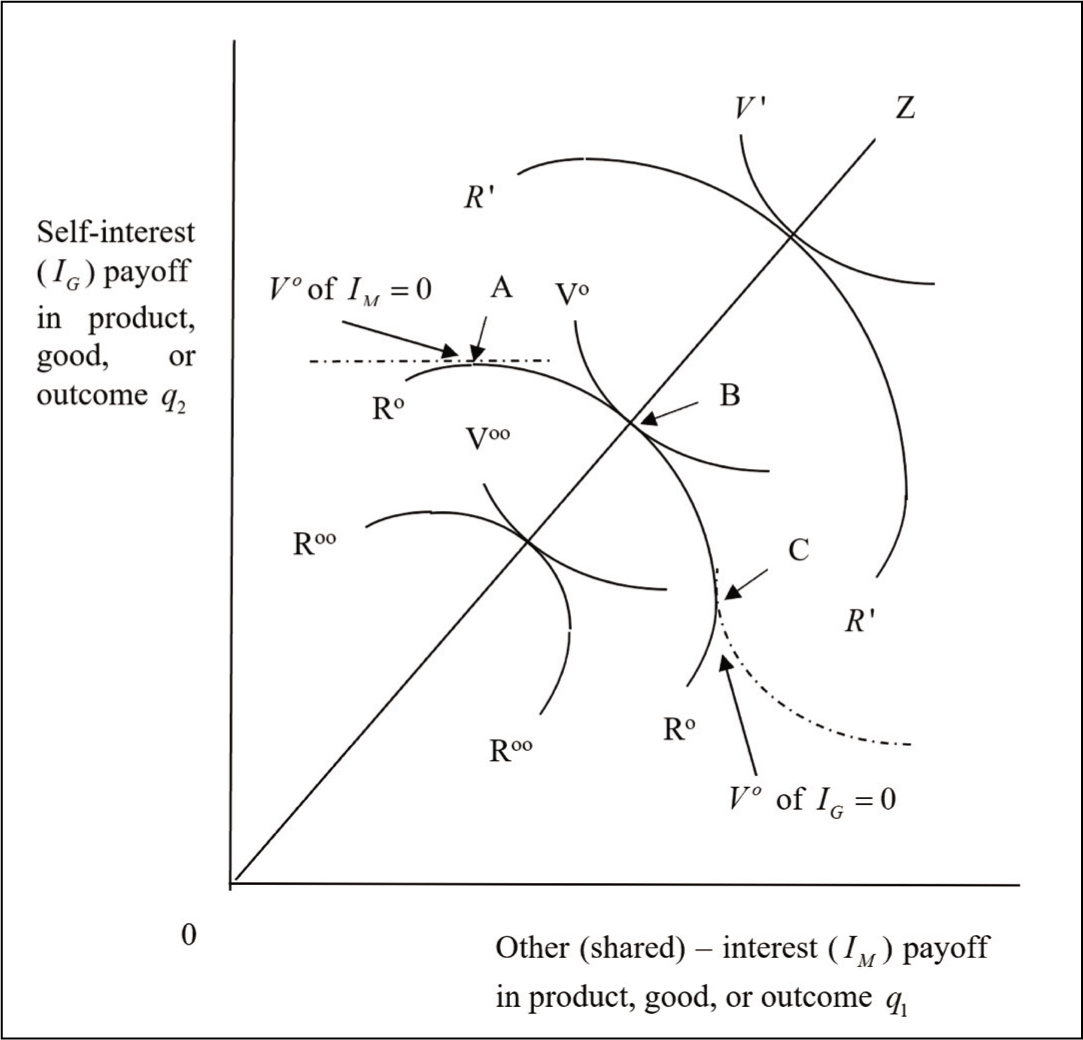
DIT allows for incommensurability: the value is not necessarily fully represented in price as not everything can or should be commodified and traded. As such, DIT handles mixed cases. For example, privately owned farmland is used to produce corn, with the price of corn evolving in the corn Market. The private property right is attenuated with the public property right in wildlife, with wildlife having value. In this situation, economic efficiency implies that everyone’s needs and wants are met in balance (i.e., farmers and consumers who want more corn are in unison with people who want more wildlife) on some path 0Z, which is determined by the interplay of Market and Government, reflecting the price P and value V. Metaeconomics indicates a legitimate and essential role for Government which is broadly and inclusively representing the entire Community.
DIT argues that it is economically irrational to not consider both interests in the zone between the two paths 0G and 0M. Maximising self-interest on path 0G, as SIT suggests, is not rational nor is it efficient unless the value of wildlife is zero for the person. Moreover, as ‘mainstream neoclassical economics does not go well with the challenge of sustainability’ Söderbaum (2008, p. 149), SIT’s choice of point A is not sustainable in the long run. DIT’s choice of point B and balancing self- and other-interest on path 0Z is more environmentally sustainable and, as such, more economically rational. However, even though most people express a shared other-interest in having some wildlife travelling (and addressing other sustainability issues) with the farmers and food consumers on the Spaceship Earth, there can be obstacles for that due to the outsized influence of the Market drowning the Other Forum’s influence. This necessitates a more prominent role for the Community and the Government representing it. Metaeconomics frames Government programmes, for example, payments to farmers using tax dollars, as essential to ensuring both food and wildlife are produced at the efficient and socially optimal level.
Through payments/cost-sharing (in the US provided by the Farm Service Agency) and technical support for conservation plans (by the US Natural Resource Conservation Service), community can signal to the farmers the value of public goods and shift their production away from 0G. If the payment for wildlife habitat/production is high enough, overall profits coming from the Market Price and Government Payments could be identical to those on path 0Z. While Government can potentially make the farmer’s profit at point B as high as at point A, it will not be needed as at point B the farmer will be receiving some payoff from the other (shared with the other)-interest which will be compensating for some of the loss in self-interest.
An alternative to the payments/cost-sharing is having the Government in direct control, requiring wildlife production without any financial compensation. In that case, farming profit would be considerably less, with hunters and bird watchers having a free ride while the farmers pay all the cost. It is also possible for the Government to nudge farmers to become mindful of the value shared with others. If nudging is done following the principles of libertarian paternalism (Thaler & Sunstein, 2021), the shared other-interest will be represented in the paternalism with influence on the libertarian self-interest.
Finally, the farmers could see wildlife as part of the aesthetics, as do passersby, the environment living on the farm. Acting on shared gains with the passersby, in the other-interest, the farmers might voluntarily move over from path 0G to path 0Z sacrificing a bit of corn production, while increasing wildlife production. The farmers may find a more fulfilling and balanced life at point B rather than point A. In our research on conservation practices, we often found farmers being disappointed because ‘the Market made me do it’, that is, the Market sends only price signals for corn and sends no value signals about wildlife.
In defending SIT, some economists would argue that Markets are inherently moral, inherently always doing the right thing (Whyte, 2019). For instance, consider a moral and ethical producer ‘swallowing’ path 0M as part of their self-interest, now forming a quasi-path 0Z. This quasi-0Z appears to be a self-interest path, albeit now a virtuous one. Frisch (1965, p. 273) refers to it as a ‘complete coupling’. DIT rejects this idea as it is misleading to hide the moral dimension in production decisions, pretending that this is the result of the invisible hand of the Market as in reality this is almost never the case, and following the Market signals leads to the destruction of wildlife and the unsustainability of the Spaceship. Metaeconomics suggests using the visible hand and keeping path 0M considerations visible in Other Forums which work to temper the Market Forum. 1
Adam Smith and Dual Interest Theory
DIT is a formal way of representing the long-understood reality of internal tension in people. The tension has been recognised going at least back to Plato (Hayes & Lynne, 2004): the stallion (ego) tempered by the mare (empathy) with the driver needing to take self-control over the team, keeping the chariot on the best path of balance in ego and empathy. The need to temper the ego-sourced, arrogant self-love of the stallion is prominent in the writing of moral philosophers, for economists like Adam Smith (Smith, 1759/1790, 1776/1789). The frame of dual interest, and the need to take self-control and find balance, is prominent in Smith’ two books considered jointly.
Some scholars of Smith, however, seemed to interpret it differently: the German Historical School is concerned with ‘das Adam Smith problem’ and, more recently, the ‘two faces of Adam Smith’ problem (Smith, 1998; Smith & Wilson, 2019). In the Wealth of Nations book, Adam Smith made clear how making wealth is driven by self-interest (i.e., self-love):
…man has almost constant occasion for the help of his brethren, and it is in vain for him to expect it from their benevolence only. He will be more likely to prevail if he can interest their self-love in his favour, and show them that it is for their own advantage to do for him what he requires of them.…Give me that which I want, and you shall have this which you want, is the meaning of every such offer; and it is in this manner that we obtain from one another the far greater part of those good offices which we stand in need of. It is not from the benevolence of the butcher, the brewer, or the baker that we expect our dinner, but from their regard to their own interest. (Smith, 1776/1789, loc 239–251)
This quote has formed the basis for SIT, suggesting that Smith is focused exclusively on making wealth in a kind of free to choose to do whatever the ego-based self-interest wants, ignoring the admonitions of the Theory of Moral Sentiments where he clarified what is meant by own-interest:
Though it may be true, therefore, that every individual, in his own breast, naturally prefers himself to all mankind, yet he dares not look mankind in the face, and avow that he acts according to this principle. He feels that in this preference they can never go along with him, … If he would act so as that the impartial spectator may enter into the principles of his conduct, which is what of all things he has the greatest desire to do, he must, upon this, as upon all other occasions, humble the arrogance of his self-love, and bring it down to something which other men can go along with. (Smith, 1759/1790, loc 1714–1727)
So, it is clear that while the creation of wealth was driven by the arrogance of self-love/self-interest, it had to be tempered to pursue a good—moral and ethical, and efficient—own-interest. And, it was not about benevolence, but it was about the sentiments—empathy-based ethics had to bring the self-interest down to ‘something which (the other) can go along with’ which is the own-interest. The production and consumption of meat, beer, and bread were not just about self-interest: it was to be tempered by ethical reflection leading to the shared other-interest, which was then to be applied with self-control/command to temper the self-interest onto the path 0Z to maximise the own-interest. So, Adam Smith had only one face (Smith & Wilson, 2019), a joint face with self- and other-interest in that one face (Lynne, 2020). This interpretation is also in line with Etzioni (1988) and Roberts (2014) that Smith not only understood what drove the making of wealth but the need to temper it and ‘in short, Adam Smith’s world is not inhabited by dispassionate rational purely self-interested agents, but rather by multidimensional and realistic human beings’ (Ashraf et al., 2005, p. 142).
It is not the Market per se that is moral (Whyte, 2019); rather, the Market must be tempered by something outside, in particular, everyone reflecting on what is shared while at the station of the impartial spectator. Often, it is a representative—the Government, trusted and operating on principles of Democracy for all, is charged with representing the shared-with-the-other-interest.
DIT proposes to revive original ideas in Adam Smith, building on recent findings in thermodynamics and behavioural science. And, while economists removed explicit consideration of ethics to build a mathematical economics (see Becchio, 2009), DIT demonstrates that ethics can be brought back into the formal model as it was argued by Dietrich and Rowen (2005).
Applying DIT to Explain Social Phenomena
DIT was refined through empirical testing using data from both surveys (including focus groups) and laboratory experiments. DIT’s null hypothesis was that shared other-interest is not a force in economic choice (i.e., SIT is the only force). Every empirical test of DIT to date has resulted in rejecting the null. In addition, a substantive amount of empirical work has been done in a wide array of areas which implicitly supported DIT: duty, commitment, cooperation, loyalty, identity with norms and traditions, religion and political ideology shared in community—all represented in empathy (ethics) based other-interest—have been shown to be determinants of individual behaviour (Altman, 2012; Etzioni, 1988; Lynne, 2020; Tomer, 2017). The applications of DIT to various social phenomena 2 considered here suggest arenas for further testing of DIT.
On Farmers’ Soil and Water Conservation
The review of the farmer conservation literature from the 1930s through the late-1980s by Lockeretz (1990) concluded that the answer to the question in the title ‘What Have We Learned About Who Conserves Soil?’ was simply ‘Not much’. Lynne et al. (1988) found the same with, as noted earlier, SIT explaining <20% of variation in conservation behaviour. Three decades of empirical research demonstrated that more than the ego was at play and led to coining the phrase ‘empathy conservation’ (Czap et al., 2015, 2018). DIT does better in explaining what motivates conservation choice (Czap et al., 2016) and showing that both financial incentives and nudging empathy are essential in encouraging conservation. Research about who conserves soil and water and why (e.g., Brown et al., 2019; Floress et al., 2017; Reimer et al., 2014) confirms that empathy is a key variable in addressing sustainability of the Spaceship Earth (Lynne, 2020, Ch. 8).
Consumer Recycling and Purchase of Recycled Content Goods
As alluded to earlier, Kalinowski et al. (2006) found that people, who identified with the shared community cause in sustaining Spaceship capabilities to hold and process waste, tempered their self-interest in simply throwing away goods. The more people identified with the community, the more they were recycling and willing-to-pay more for goods with recycled content.
The Voting Paradox and Political Ideology
SIT does not expect people to vote, as the payoff in the self-interest is usually (if not always) negative: individual benefit is lower than the individual cost of casting a vote and being an informed voter. In contrast, DIT suggests that the benefit is greater than the cost because of the larger overall payoff in the own-interest. In DIT framing, voting likely (empirical question here) entails sacrifice in the self-interest. DIT suggests efficient voting (without political chaos) through a sacrifice in both domains of interest on path 0Z.
DIT also suggests that a political interest is a shared other-(with like-politically-minded) interest (Lynne, 2020, Ch. 6). With only two parties, society’s ego-based self-interest eventually dominates without adequate regard for the needs and wants of the people from the opponent’s party. Following Drutman (2020), who argues in favour of four to six political parties (i.e., sets of shared interest), DIT posits that empathy-based other-interest will be leading to coalitions across all party lines. It is the only way to get anything done. Empathy-based shared interest would work to temper the extreme self-interest endemic to a two-party system, ultimately leading to better political outcomes. An empathy politics is needed.
Organ and Charitable Donations (and Tipping)
DIT suggests the donation of human organs arises mainly on path 0M with substantive sacrifice in path 0G. Empathy/sympathy/compassion drives charitable donations with sacrifices in self-interest. Donations operate on path 0Z (Lynne, 2020) as empathy donations. DIT also hypothesises a person must sacrifice a bit of other-interest (being too selfless can have quite negative consequences for the self) to achieve a reasonable level in self-interest. Tipping, too, is about the shared interest—sacrificing a bit of self-interest in the tip—as in empathy tipping.
Dying While Helping Another Person
DIT hypothesises that any kind of a more selfless response—a prime example is the selfless nurses, doctors, and first responders dealing with the COVID-19 pandemic—virtually always brings a lot of sacrifice in the self-interest. DIT suggests a hero’s funeral with military honours (or community support of a person who gave-all to save a stranger) is the main driver for such economic choice. DIT argues that the payoff is in the shared other-interest, including the victim and the larger community. In fact, it seems the soldier throwing their own body on top of a grenade to save their platoon may indeed maximise shared other-interest at the moment of death, sacrificing all of the self-interest, landing on the horizontal axis (Lynne, 2020). For more on the matter of selfish and selfless and the historic role of empathy in economics, pointing to a troubled past driven by trying to stay only with SIT; see Kirman and Teschl (2010). It is about the empathy self.
Great Recession 2007–2009
DIT would argue that the financial crash happened mainly because of a shared assumption of a few people in the financial industry that extreme greed is good. These agents were maximising ego-based self-interest without regard for the shared other-interest with small investors, including retirees. Excess was likely fed by the arrogance of self-love, by extreme self-interest, as financial executives claimed to be deserving their compensation and bonuses even with bail-out money, despite them bankrupting many organisations and wiping out retirement funds of millions of people (Lynne, 2020, Ch. 7). Empathy finance is needed.
Health Care
DIT suggests that efficient health care requires compassion. Compassion arises on path 0M, and it must be brought into health care to achieve happiness, more peace and calm for both patients and providers, and will result in higher efficiency on path 0Z (Lynne, 2020, Ch. 9). Costs can be cut significantly if the care and treatments provided are accompanied by empathy and compassion. Potentially both patients and health care providers can achieve higher levels of happiness and fewer deaths (as the suicide rates of health care providers are substantively higher than those of the general population). The study making the case for compassion in the health care industry by Trzeciak and Mazzarelli (2019) suggests strong empirical support for DIT. Empathy is the starting point to compassion. Empathy health care leads to better health and economic efficiency.
Public Health
DIT would hypothesise that more empathy during the COVID-19 pandemic would have led to more attention to the shared other-interest in public health (including more masking and vaccination). This would have not only saved thousands of lives but greatly reduced both the personal losses and the cost of the pandemic to society. DIT hypothesises the excesses reflected in the refusals to be part of the solution, to be part of the shared other-interest, were fed by a less-than-ethical notion of having the freedom and liberty to give the other death (Lynne, 2020, Ch. 9). Empathy public health would balance freedom with being part of the solution.
Happy Families
DIT posits the dysfunction leading to unhappiness in a family arises when even just one member is driven only by self-interest, especially in the case of hedonistic or addictive behaviours. DIT suggests the very idea of a functional family rests in the notion of a shared other-interest within the family, including an extended one. DIT suggests spouses must temper the egoistic drives—especially hedonistic sexual urges—by walking-in-the-shoes of the other spouse and asking how-would-I-wish-to-be-treated. Yet, DIT posits that self-interest is still important: we need a Me/I to Be, but without a Me, there is no We. It is about balance in a joint I and We. Also, DIT suggests families of every kind—including every variation within the LGBTQ range—need to be approached with empathy (Lynne, 2020, Ch. 10). An empathy family is a functional, happy family.
Education
DIT posits the essential need for balance in private and public schools for efficient production of education. DIT suggests private-only schooling focused on educating consumers as inherently inefficient, because it does not adequately serve the shared public interest in an educated citizen. DIT posits the need to not only produce the private good, driven by self-interest, but also to produce the public good, the shared other-interest, especially in teaching civics, and in providing liberal arts and humanities education which relies on empathy (Lynne, 2020, Ch. 11). Empathy education is essential.
Natural Resource Ownership
DIT posits the classic Tragedy of the Commons is best solved with a good balance in private and public property rather than by relying only on private property and SIT. And the empirical evidence supports it, as shown by the work of Nobel Prize winner Eleanor Ostrom (Lynne, 2020, Ch. 12; Lynne et al., 2016). DIT also posits that natural resources and environmental regulations are essential to achieving economic efficiency as they temper self-interest. Moreover, DIT suggests being anti-regulation is to be anti-economic efficiency, as reliance on self-interest alone leads to the destruction of the natural system.
Another example is represented in the existential threat of climate change (Norgaard, 2021) threatening humanity, leading to various inefficiencies, and extreme weather events. DIT-based analysis suggests putting a Government-set cap on greenhouse gas emissions and facilitating Market trade in the emission allowances. DIT recognises a universal, public property for the atmosphere, and the tax on emissions should reflect the value to society of sustaining public property. Plentiful empirical evidence exists (trade-and-cap system in sulphur to address acid rain problem in the Northeastern US, quota-and-cap systems for the ocean fishery, and trading of water use rights) providing support for DIT (see Lynne, 2020, Ch. 12). Empathy property suggests balance.
Public Goods
DIT posits that a tax for the public good is an essential aspect of attaining economic efficiency. Path 0Z and higher happiness of individuals can only be achieved with adequate provision of public goods like health care, roads, education, sustainable environment, and safety nets. Such a tax is essential to achieve balance in automobiles and public-roads, fishing-gear and public-lakes, corn and wildlife etc. and should be driven mainly by value, not just price considerations as many, if not all, of the public goods are priceless (Lynne, 2020, Ch. 13). Contributing to public goods (and paying taxes) is about civic duty and thus it should not be framed as just another price one has to pay to consume a certain good. Civic duty is driven mainly by empathy, as in empathy taxes.
Income and Wealth Inequality
Lucas (2004), who was the president of the American Economic Association, said ‘Of the tendencies that are harmful to sound economics, the most seductive, and in my opinion the most poisonous, is to focus on questions of distribution’ (Stiglitz, 2019, p. 33). So, is considering distribution questions harmful and poisonous to economics? It is harmful to SIT renditions. DIT suggests that (re)distribution—more directly, inequality—questions are, instead, essential to good economics (Lynne, 2020 Ch. 14). DIT points to optimal inequality, which reflects the shared other-interest in adequate compensation for value contributions (e.g., school teachers).
When it comes to income inequality, DIT posits the (arguably absurd) level of US CEO compensation relative to the pay for the employees is causing inefficiency. It goes far beyond providing adequate incentives. Extreme differences between the top management and workers’ compensation cause resentment, which in turn leads to company dysfunction, for example, sabotaging, absenteeism and low employee loyalty. Raising the workers’ wages helps if it is paid for by reducing the compensation at the top. Such change, motivated by empathy, should also make the top happier: more peaceful co-existence with less political chaos.
Similarly, DIT posits that reducing wealth inequality requires some sacrifices from wealthy investors who prioritise the dividends and growth of stock prices over salary growth and optimal pay for workers. Allowing for higher workers’ compensation and requiring more investment into corporate social responsibility will decrease the return for the top investors while it will allow those at the bottom to have more opportunities for vertical social mobility as well as save more for retirement, education and other needs.
DIT also posits the reason trickle down (among other ‘Zombie’ ideas in mainstream Microeconomics, after Krugman, 2020) does not work: it is not in the self-interest of the people at the top to move money down the income and wealth ladder. Empathy must be a force leading to optimal inequality.
Labour Unions and Cooperatives
DIT posits the need for a good mix of labour-empowered business organisations, like business cooperatives owned by the workers, and other ways of giving a stake in the business to the workers (e.g., paying workers partly in stocks like CEOs). DIT posits that labour unions are one of the most effective ways to offset the tendency to excess by the capital owners (and managers). Giving labour a claim to capital ensures wide-spread benefits from a capitalism-based economy (e.g., Scandinavian economies, Lakey, 2016), looking for good balance in capital and labour. It is about empathy wages and empathy power.
Crisis of Capitalism
DIT gives analytical power to the revival of contemporary political science (Hansen, 2015), as well as in institutional economics (Bromley, 2019; Lynne, 2021). Both point to the need to reconsider the SIT focus, in both mainstream political science and economics, on self-interest only. The political scientist Deneen (2018) is pointing to the same problem: too much focus on self-interest/freedom of choice without enough responsibility to the larger community of shared (other) interest has caused the failure of liberalism and the crisis of capitalism with the ‘give me liberty to give you death’ extreme frame (Lynne, 2022).
In DIT terms, the concern of Deneen (2018), part of the broader post-liberal frame, is with the failure to temper self-interest with the other (shared in community)-interest, which is the reason for Why (Classical, as well as both Cultural and Market/Neo) Liberalism Failed. The ‘ism’ represented in the excesses of possessive individualism has led to the crisis of capitalism, with the result being the current political–economic chaos unprecedented in the history of capitalism. Has the excess of the ‘I’ caused it? DIT points at how to save capitalism, by making it good, building a humane capitalism like Adam Smith had in mind. Putnam and Garrett (2020) claim a better ‘ism’ requires the ‘We’ be brought back into better balance with the ‘I’ with I and We at the top of the Upswing curve as in the mid-1950s. The best balance and better ‘ism’ can be framed with DIT (Lynne, 2020, Ch. 15). It is about empathy (humane) capitalism.
Conclusion
Leijonhufvud (2004) suggested, regarding mainstream SIT ‘Instead of looking for an alternative to replace it, we should try to imagine an economic theory to transcend its limitations…’. In this article, we proposed to refine economics by expanding single-interest analysis towards the dual-interest foundation. Such expansion will allow economic theory not only to better describe and explain a variety of social phenomena but will also provide a more adaptable analytical apparatus for designing public policies to better address the challenges humanity faces.
Footnotes
Declaration of Conflicting Interests
The authors declared no potential conflicts of interest with respect to the research, authorship and/or publication of this article.
Funding
The authors received no financial support for the research, authorship and/or publication of this article.