




Abstract
This article analyses the effects of myopic and present-biased preferences on the welfare of a naive agent when he/she is engaged in an intertemporal harvesting activity from a stock of renewable resources. The analysis is conducted by also taking into account the nature of present-biased behaviours as phenomena that is derived from a dual system of discounting and of response to short and long-term stimuli.
In the task of harvesting from a stock of renewable resources, the present biased preferences of a naive agent create a conflict between the long-run benefit of the agent and the short-run desire.
Thus, this article demonstrates and argues that in the decision-making, which involves intertemporal choices in renewable resources management, the prevalence of naive behaviour, strongly influenced by the emotional-affective system, can lead to a reduction in the overall utility enjoyed by the individual due to the present bias.
Introduction
Intertemporal resources management is frequently subjected to risks of inefficiency and mistakes. Often, people encounter difficulties in defining intertemporal choices and consistently allocating consumption over time. Economic theory generally assumes conventional exponential discounting, where future benefits are discounted at a constant rate. A discount rate that differs from the exponential one generates time-inconsistent plans and myopic behaviours (Strotz, 1956). Unfortunately, people often behave contradictory to the time-consistency assumption. Several studies underline the existence of non-compliant behaviours to the precepts of time consistency—for a review see Loewenstein and Pralec (1992) and Frederick et al. (2002). Controlled experiments in the laboratory have shown that people exhibit a systematic tendency to discount the near future more than the distant one (Loewenstein & Pralec, 1992). This depends on the impulsive behaviours of people in following the short-run benefit despite its effects in the long run. Furthermore, intertemporal choices seem to be better represented by hyperbolic discounting rather than by the exponential one (Laibson, 1997), implying that people make short-sighted decisions where costs and benefits are involved. These kinds of behaviours are interpreted as a lack of self-control or present-biased preferences (Laibson, 1997; O’Donoghue & Rabin, 1999).
In the last years, some studies have started to explore the application of non-constant discount rate in resource management (Settle & Shogren, 2004) and the environment (Brekke & Jhoansson-Stenman, 2008; Karp, 2005), discussing issues related to the present-biased preferences in these contexts—in particular, the dichotomy between biased agents and rational ones (Hepburn et al., 2010). However, the effect of the present bias on agent welfare in the field of resources management has not yet been investigated. For these reasons, this article conducts an analysis of the effect of present-biased preferences in the welfare of the agent, when he/she is involved in renewable resources harvesting. The analysis is conducted also taking into account the nature of present-biased behaviours as phenomena that are derived by a dual system of discounting with the agent’s cognitive foundations.
The investigation proceeds as follows: First, a retrospective in the relation between time inconsistency and present biased preferences is presented. In the third section, the origin of present-biased behaviours are described, taking care to expound the complexity of this phenomena in an interdisciplinary dimension. In the fourth section, the harvesting model that concerns the exploitation of a stock of renewable resources is presented and the analysis on the effect of the adoption of a non-constant discount rate in this framework is conducted. Finally, the results are obtained, showing that the present-biased preference of a naive agent in the harvesting activity generates a lower welfare level for the agent.
A Retrospective on Time Inconsistency and Present Bias
Standard economic models usually assume the exponential discounting such that the agent discounts the future with a constant discount rate. This assumption implies time consistency, which means that the future choices defined in the present, by the maximisation of the present value, will still be optimal choices in the future. Time consistency is guaranteed when the discount rate is independent from the time. However, theoretical and experimental studies have widely shown a higher discount rate over the short time and a lower discount rate in the distant one (Frederick et al. 2002; Laibson, 1997). In presence of time dependence, a violation of the stationary postulate of Koopmans (1960) occurs. This violation generates time inconsistency because an optimal choice at time t may no longer be so when the task is verified at a time that follows t (Strotz, 1956). This condition could generate preference reversal, which implies that the preference ordering defined at a given time can be reversed in the future.
The preference reversal is coherent with the observed behaviour of agents that show diminishing impatience such that the future is discounted with a declining discount rate (Hepburn et al., 2010). Evidence of this kind of behaviour is widely reported, and several observations clarify that time affects choices (Della Vigna, 2009; Frederick et al., 2002; Thaler, 1981).
Impulsivity and misevaluations of immediate rewards are included between the behavioural and cognitive origins of the preference reversal (Ainslie, 1992; Benabou & Pycia, 2002; Shefrin & Thaler, 1988). Therefore, preference reversal and time inconsistency generate a conflict between long run preferences and immediate choices, which consequently creates a conflict between the initial intentions of the agent and the realised choices.
Preference reversal, impulsive choices, and the impatience to obtain immediate rewards can be explicated by the presence of a hyperbolic discount (Ainslie, 2005). 1 It is also usual to define as ‘present bias’ the baseline behaviour that is derived from hyperbolic or quasi-hyperbolic discounting: greater impatience in the short run with a declining discount rate for a more distant future.
Present-biased preferences imply that immediate benefits drive the choices despite the long-run interest, and thus, they can induce the agent to myopic decisions. Present-biased preferences are widely observed in several frameworks: low saving rate (Ashraf et al., 2006; Harris & Laibon, 2001; Laibson, 1997; Laibson et al., 1998); health contexts (Pol & Cairns, 2002); drug, smoking or buying addictions (Frederick et al., 2002; Gruber & Koszegi, 2001; Thaler & Shefrin, 1981; Wertenbroch, 1998); and procrastinating behaviours (Bernabou & Tirole, 2003; O’Donoghue & Rabin, 1999;). Furthermore, Cropper and Laibson (1998) have analysed the non-Pareto efficiency in the context of project evaluation when agents have time inconsistent plans.
There are some contributions to the literature that show how the non-constant discount interacts with resource management and climate change policy. Settle and Shogren (2004) explored the application of the hyperbolic discount rather than the usual constant one, in the context of natural resource management. Karp (2005) analysed the role of the hyperbolic discount in a model of global warming, and Brekke and Johansson-Stenman (2008) analysed the contribution of behavioural economics in the field of climate change. The present bias has consequences in the intergenerational framework. In fact, Winkler (2006) showed that in the presence of hyperbolic discounting, there is a potential conflict between economic efficiency and intergenerational equity in public good investments. Furthermore, in the framework of intergenerational renewable resource harvesting, the present bias generates negative externalities on the welfare of future generations, reducing the resource stock even if the current generation has other-regarding preferences. This happens when the naive agent’s behaviour has no commitment (Persichina, 2021b). Moreover, the present bias also affects the agent’s decisions in the exploitation of resources in terms of disruption of cooperative behaviours. Indeed, the present-biased preferences can trigger a strategy that directs the community to excessively increase the harvesting level even in the presence of cooperative intentions because the behaviour of naive agents can activate a dynamic of cascading defections from the cooperative strategy (Persichina, 2021a). Besides, under the hyperbolic discount, the undesired collapse of the natural resources can occur when the agent is naive (Hepburn et al., 2010).
Roots of Present Bias and the Dual System of Discounting
The assumption of rationality requires that people’s choices weigh current costs and benefits against the future. In this framework, the standard intertemporal models assume a constant discount factor (Camerer, 1998). As frequently remarked by several studies, individuals face substantial limitations to apply this assumption of rationality in the time discounting (for a review, see Loewenstein & Pralec, 1992). Models that consider this peculiarity of the human behaviour include in their analysis the cases of bounded rationality. Indeed, in economics, the concept of bounded rationality is adopted to design the agent’s choices taking into account the cognitive limitations of the decision-maker (Simon, 1990). This kind of behaviour is deeply rooted in humans. An evolutionary origin seems involved in the existence of the present bias. Some authors assign the existence of myopic behaviours and present-biased preferences to evolutionary pressures (Godwy et al., 2013); for example, Dasgupta and Maskin (2005) argue that uncertainty and waiting costs have contributed to the emerging of present-biased behaviours. Furthermore, there are evidences that the evolutionary components of these behaviours are widely rooted in humans and non-humans/animals (Ainslie, 1974; Green & Myerson, 1996). 2
For example, the ability to ordinate the numbers in a correct cardinal order is not an innate ability of humans; this fact confirms the ancestral roots of present bias (Godwy et al., 2013). In fact, studies conducted on indigenous populations of Amazonia show that these populations do not have an exact numeric ordering, although they have a non-verbal numerical sense. Therefore, when they have to define a spatial ordering for increasing quantities, the space interval between the numbers becomes smaller and smaller (Pica et al., 2004). Conversely, American adults define a spatial ordering that shows an equidistant space between the numbers; the logarithmic spatial ordering of the Amazonian populations is similar to the ordering of kindergarten pupils who only in the second year of school arrive at spacing the numbers equidistantly (Stiegler & Booth, 2004).
Hence, as underlined by Godwy et al. (2013), these results effectively suggest that the non-constant discount has deep origins in human behaviour. Furthermore, some researches in the field of cognitive neuroscience support a non-constant discount rate and find two different systems designed to process discounting: one for the immediate rewards and another for the delayed ones. In particular, two distinct brain areas related to the definition of intertemporal choices are identified (McClure et al., 2004). The first area, namely, the limbic and paralimbic, is an area of the brain that is heavily innervated by the dopaminergic system and is connected to short-term rewards (Breiter & Rosen, 1999; Knutson et al., 2001; McClure et al., 2003), while the second area belongs to the frontoparietal region that supports higher cognitive functions (Loewenstein et al., 2008). Moreover, in the field of cognitive neuroscience, some experiments show the activation of the limbic circuit just before choices that provide an immediate reward (McClure et al., 2004); similar conclusions have been reached by Hariri et al. (2006) and McClure et al. (2007).
In this discussion, it is worth mentioning that the limbic system is the seat of reaction processes that are impulsive and emotional (Hariri et al., 2000; Pattij & Vanderschuren, 2008). The limbic system—which is the most ancient part of the human brain—also includes the amygdala (Isaacson, 1974) whose functions are significantly correlated with emotional activities (Cardinala et al., 2002; Hariri et al., 2002). Conversely, in the presence of choices that reflect deeper consideration for future gains, areas afferent to the neocortex are relevantly activated, whereas there is no prevalent activation of the limbic system (McClure et al., 2004). The neocortex, exclusive to mammals, is the most recently formed brain area from an evolutionary perspective. The neocortex’s areas are markedly developed in humans (Rachlin, 1989) and play a role in appropriate, deliberative cognitive activities (Miller & Cohen, 2001; Smith & Jonides, 1999). It is, therefore, possible to assume that consumer choices in an intertemporal context define a dualism between the limbic system—whose responses are characterised by rapid impulsivity and emotion—with a prevalent activation of this system in response to short-term choices, and the deliberative–cognitive system, afferent to areas of the neocortex, which is slower and more balanced.
The joint involvement of the two systems in the decision-making process is further supported by Bechara (2005), Bechara et al. (1999), Damasio (1994) and LeDoux (1996). A distinction, between the two systems of response to short- and long-term stimuli, can be defined: the information about immediate rewards is subject to the substantial involvement of the impulsive system, while a more appropriate reflective system refers to decisions about long-run rewards. Therefore, it is congruous to assert that the intertemporal decision-making process and the time inconsistency that arises out of this process is driven by the interaction of these two coexistent systems, coherently with the complexity of human nature (Loewenstein, 1996; Metcalfe & Mischel, 1999; Shefrin & Thaler, 1988).
The wide variety of fields and contexts in which the present bias emerges, the evolutionary hypothesis, the psychological foundations, the systematic manifestations of the phenomena of procrastination and the over-consumption, as well as the presence of impatience, temptation and lack of self-control, clearly outline a profile of an economic behaviour that resides outside the barriers of the pure rational behaviour that assumes time consistency. Hence, the present bias is a specific peculiarity of decisional heuristics about intertemporal choices, in particular in contexts where the long-run plans can be object of revision over the short run and where the long-run outcomes depend on a continuum of instantaneous or short-run choices. Frequently, resource dilemmas have the characteristics of the context just described. In fact, resource dilemmas describe a situation in which long-run and short-run choices can come into conflict, exposing the agent to the risks related to the present bias; particularly, in the context of the exploitation of renewable resources.
Decrease in Agent’s Welfare Due to the Present Bias
In this section, the analysis of the effect of the present bias on the welfare on a naive agent is conducted. The harvesting model adopted in the analysis concerns the exploitation of a stock of renewable resources, R(t). The dynamic of the growth of resources is given by the following equation:

where f(g,R(t))≥ 0, the constant g > 0,
3
is the growth rate, and h(t) is the harvested amount at time t such that the stock of resources is reduced over time, dR/dt < 0, when the exploitation rate exceeds the natural growth rate, h(t)/R(t) > f(g,R(t)).
4
The interval from 0 to T is the lifetime of the agent. In this model, the resources are materials; consequently, a negative stock of resources is impossible:

where R0 is the initial stock at time 0. The strictly positive initial stock and the growth rate are known by the agent, the amount harvested is not restorable in the stock of resources, such that:

Moreover, the agent is subjected to a capacity constraint and a resources constraint.
The capacity constraint implies that in each period, the agent cannot harvest an amount of resources greater than hmax, a value that is strictly positive and finite, such that, considering the non-restorable condition:

The resource constraint implies that the agent cannot harvest at time t more than the amount of resources available:

There are no exchange markets in the model, so the agent’s welfare depends only on the amount harvested and enjoyed in each time. The utility function of the agent is defined in the usual manner:
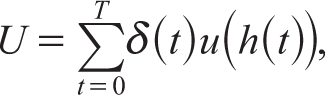
where u(h(t)) is monotonic and strictly concave on h(t) in the interval [0, hmax]:

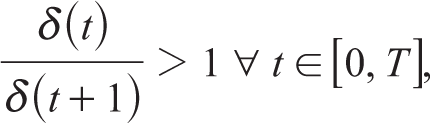
The discount factor δ(t) represents the degree of impatience of the agent,
5
such that:
Continuity for the harvesting amount on the interval [0, hmax] is assumed. Finally, the system defined assumes that it is impossible for the agent to avoid the total exploitation of the resources before the end of his/her lifetime, if he/she continuously harvests the amount hmax in all the periods. So, defining with Hi ={hi(0), …, hi(t), …, hi(T)}, a generic harvesting profile inside the set of all the feasible harvesting plans, Hi ϵ {H}, given R0,g, f(g,R(t)), this last assumption can be expressed as follows:

and

Equations (9) and (10) imply that in at least one period, h(t) < hmax Considering that the agent tends to distribute his/her consumption over time, avoiding finishing the resources before time T, it is assumed that the agent’s intertemporal preferences are given such that:

with tb < s ≤ T and tb > 0.
This means that at time 0, the agent formulates the harvesting plan, avoiding harvesting amounts equal to hmax in all the periods until time tb if this implies the depletion of the resources before the time T. This is consistent with the dependency of welfare on the harvested amount at each time, generating utility only in the period in which the amount is harvested.
Therefore, at time 0, the agent formulates his/her optimal harvesting plan:

The optimal harvesting plan evaluated in absence of present bias guarantees the time consistency of the future decisions and corresponds to the long-run harvesting plan evaluated at time 0. In fact, in the standard rational model, the agent can accurately define his/her exact optimal path of harvesting, keeping his/her bond with the initial optimal plan formulated at the beginning, and he/she will do this throughout his/her life. As discussed in the previous sections, this implies that the discount factor must be expressed in an exponential manner that guarantees time consistency; but the present bias makes an exponential discount factor impossible.
In the model adopted here, the agent shows present-biased preferences at time t when the following holds:
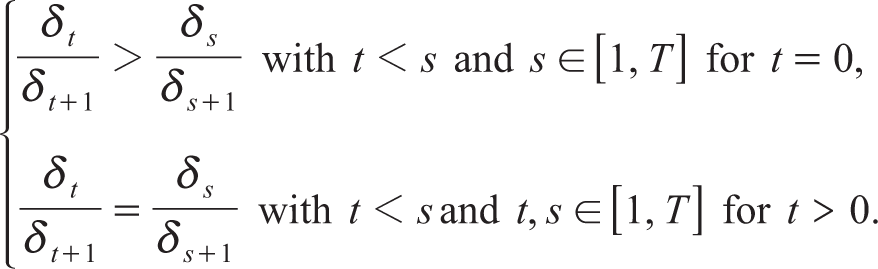
When the agent’s preferences incorporate the properties of the non-constant discount factor just enounced, the process of maximisation can lead the agent to a harvesting plan that differs from the Hopt plan defined at time zero. In this case, the harvesting plan of the agent is defined with the amounts that derive time after time by the instantaneous maximisation of the utility function under the same condition of Hopt but with a non-constant discount rate. The resulting plan is labelled as a biased harvesting plan, Hbias’ and defined as follows:

A discount factor like that one expressed in equation (13) determines the typical situation of time inconsistency. 6 The consequences are expressed in the following postulate:
If at time tb, the same optimisation problem is solved in the interval [tb,T] with the optimal solution Htb= {h(tb), …, E[h(tb+1)]
tb
, …, E[h(T)]
tb
}; and at time tb,
then,
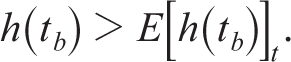
So, the amount effectively harvested at time tb,h(tb), is greater than the amount predicted for the same period when the optimal harvesting plan was evaluated at time t, t < tb.
The implications for the harvesting plan in this model can be expressed in the following proposition: 7

Thus, the present bias induces the agent to harvest an amount greater than the optimal one evaluated without the bias, leading the agent outside of the optimal harvesting path. So, by inducing the re-evaluation of the amount harvested at time tb, the present bias generates a differentiation between the two possible harvesting plans of the agent. Now, the question is, does a different harvesting profile determined by the present bias imply a reduction of the agent’s welfare, and if so, does it happen because of the present bias?
The agent faces two different harvesting plans that respond to two different systems of discounting: (a) the plan that responds to the short run, expressed by Hbias, where the amount harvested at each period is affected by the present bias, re-evaluating the harvesting plan time after time; and (b) the long run plan, Hopt, where the plan of harvesting formulated at time zero excludes the effect of the present bias and is confirmed each time.
To compare the two plans in terms of the agent’s welfare, referring to the concept of total utility of the agent is necessary. In particular, it is useful to separate the concept of decision utility from hedonistic pleasure derived by the instant utility enjoyed by the agent (Kahneman & Sugden, 2005). In this sense, the concept of utility is defined following utilitarian philosophers such as Bentham, where utility is logically separated from what choices are made (Read, 2007). The instant utility is the hedonic value of a moment of experience utility (Kahneman & Thaler, 2006), such that the total utility is derived by a temporal profile of instant utilities. Because the model of this article is focused on a global evaluation of a profile of instant utilities, which is evaluated as experienced utilities, the total experienced utility is not evaluated at a single point in time, but it is evaluated as the sum of instant utilities. Following this approach, a time-neutral weighting of the outcomes is considered. In cases in which the total experienced utility is relevant, time neutrality appears most appropriate to evaluate experienced utility (Kahneman et al., 1997). This is the case of the model of this article that compares the outcomes of two different harvesting profiles: the outcomes are evaluated as a global experienced utility that does not depend by a single moment on the time, and hence the values of the single instant utilities are equally evaluated with a time-neutral weight.
Hence, the total utility of the periods from zero to T given by the sum of the instant utilities of all periods is expressed as π and given by: the following
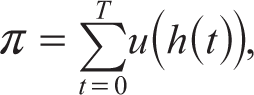
such that the agent’s welfare is evaluated by the comparison of the different profiles of the total instant utilities.
As said earlier, this article aims to understand if the overharvesting generated by the present bias (as shown in Preposition 1) can generate a reduction in the total enjoyed instant utility of the agent and if the discounting peculiarity of the present bias can determine this welfare’s reduction. In accord with these aims, this preliminary investigation studies the possibility that the adoption of the biased harvesting plan can imply a lower total enjoyed utility, than the optimal harvesting plan. To compare the two intertemporal harvesting profiles, a three-period model is adopted: present, near future and distant future (proofs are presented in the Appendix). This comparison between the levels of total utility in the optimal long-run plan and the biased short-run plan shows that the agent’s utility is greater in the optimal harvesting plan. In fact, the utility derived by the increase in harvesting at time tb (increase that is determined by the present bias) is smaller than the decreased utility given by the difference between the total amount that will be harvested following the optimal harvesting plan and the amount that will be effectively harvested under the present-bias hypothesis.
We can so assume that in front of the two alternative harvesting plans, the increased utility derived by a higher amount in the present is less than the decreased utility derived from the amount enjoyed in the future:

At this point, understanding if the present bias is the element that generates the reduction of the agent’s welfare is the main question. As it will be shown soon, the peculiarity of the present-biased time discounting generates the reduction of the agent’s welfare in the presence of a lower total enjoyed utility determined by a biased harvesting profile. To show this assertion, the adoption of the utility function with present-bias preferences that offers the essential peculiarity of the no constant discounting is helpful. The following intertemporal utility function expresses the present biased preferences:

where β, not greater than 1, represents the present bias. 8 When β = 1 the discounting guarantees time consistency (absence of present bias) with an exponential discount factor, consequently, the optimal harvesting plan is followed. When β is smaller than 1, equation (13) holds.
Proceeding to show the involvement of present bias in the welfare reduction: with {H} is defined the set of all possible harvesting profiles, and a generic profile is defined as Hi={hi(0), …, hi(t), …, hi(T)}. Because the harvesting profile derived from the biased harvesting plan, Hbias, is a profile inside {H} and it is alternative to Hopt, at time 0, it will be Hopt > Hbias such that,
9

Because u(hbias(0))=u(hopt(0)), and because the first proposition asserts that at least one time tb exists such that hbias(tb) > hopt(tb),then u(hbias(tb)) > u(hopt(tb)),
10
and so assuming that tb is the first period in which equation (16) holds, then,

Consequently, at time 0:

and this implies:

Because the agent faces an intertemporal decision-making process in which at each time he/she defines his/her harvesting amount, at time tb, he/she will re-evaluate his/her harvesting profile, choosing an amount hbias(tb) > hopt(tb) because at this time Hbias > Hopt This implies that at time tb,
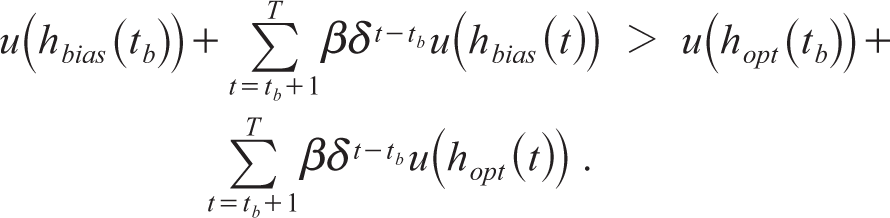
Consequently,

Because equation (22) implies the following:

Then equation (24) can be true only if β < 1.This shows that the strategy Hbias, which leads to a total utility enjoyed that is lower than Hopt, can be implemented only if a non-exponential time discount is adopted.
Hence, in conclusion, the consequence of the present bias on the agent’s welfare when he/she faces the task of intertemporal harvesting of renewable resources can then be summarised in the following proposition.

Hence, between the short-run biased harvesting plan and the long-run optimal one, it is the second that can ensure the generation of higher welfare for the agent. The short-run biased harvesting plan, Hbias, can be implemented if and only if the discount factor applied by the agent incorporates the peculiarities of the present bias.
Conclusion and Final Remarks
This article has defined a discount system that is expressed by the coexistence of two discount forms: an emotional, rapid and impulsive system for responding to short-term stimuli and a reflective system suitable for the long term. This system of intertemporal discounting is consistent with—and is a part of—the complexity of the decision-making process that characterises human beings. This complex process is based on the existence of a highly integrated decision-making system composed of two simultaneous main circuits: the affective-emotional, where the emotional component is predominant in the dynamics of decision-making; and the cognitive–deliberative, which is delegated to greater mediation in defining what actions to take given the input received. In this system, a conflict between the long run and the short run in the decision output can occur. The reason of the involvement of the present bias in this conflict has been presented and discussed. The discount system in which two potential discount patterns coexist—the long run with the constant discount rate and the short run with the non-constant discount—generates two different harvesting plans that both arise from the intertemporal preferences of the agent: two mutually excludable harvesting plans—the optimal harvesting path and the biased plan. The article has shown that the first plan can guarantee greater welfare for the agent.
Before this investigation, to the best of the knowledge of who writes, the relationship between the present bias and the agent’s welfare has not been adequately explored in the literature. Studies on specific applications involving the management of renewable resource stocks, when addressing the basic question of behaviour and decisions related to harvesting by naive agents, have focused on the effects in terms of resource management efficiency and resource conservation or depletion, implicitly assuming that the agent’s choices will always maximise his/her utility. This implicit assumption, which ignores the impact of the present bias on welfare, arises from not considering the naive biased/not-biased agent dichotomy as an element of an individual agent’s system of preferences. In fact, addressing issues on the lifetime welfare of individuals involved in managing renewable resources inevitably involves a contraposition that can be defined as a conflict of choices between those that are biased by current emotions and the rational unbiased. The second kind of choice is defined in the absence of present bias, that it is when the system of intertemporal discounting is oriented toward overall well-being. Conversely, present-biased choices lead individuals to a calculation that is predominantly oriented toward the short term and disregards their long-run preferences. This conflict is part of the decision process of the agent with the dichotomy biased/not-biased choices in the process of the realisation of the agent’s preferences.
This article shows that in the decision-making that involves intertemporal choices in renewable resources management, the prevalence of naive behaviour, strongly influenced by the emotional-affective system, can lead to a reduction on the overall welfare of the agent due to the present bias. The comparison of the two harvesting plans has shown that the utility derived by the increase in the instantaneous utility determined in the present by the present bias, could not compensate the future decrease in utility determined by the adoption of the biased harvesting plan instead of the optimal one. These conclusions pose a question about the effective intertemporal maximisation of the well-being of the naive agent when he/she adopts a present biased harvesting behaviour. It should be noted that a harvesting plan derived from present bias could be not sufficient to allow a definition of effective maximisation of the individual’s overall well-being when he/she is in a condition in which he/she cannot cope with the excessive impulsive component in the immediate present.
These results underline that a naive individual involved in the intertemporal management of renewable resources could not adopt a harvesting plan that properly maximises his/her overall well-being according to his/her long-run preferences independently from his/her ability or possibility to commit his/her behaviours or to balance the immediate impulsivity with the long-run welfare. Hence, the reduced welfare derived from the implementation of a strategy dominated by the impulsivity inherent in present bias highlights problems that are relevant to maintaining a given level of resources but also shows the need to identify tools that can ensure effective implementation of strategies that are not so strongly dominated by the present bias during the management of renewable resources. In the context in which the agent faces the risk of making decisions on the spur of the present bias, suitable nudges or instruments could be required to offer to the agent the possibility to commit his/her harvesting plan to his/her long run preferences.
Footnotes
Declaration of Conflicting Interests
The author declared no potential conflicts of interest with respect to the research, authorship and/or publication of this article.
Funding
The author received no financial support for the research, authorship and/or publication of this article.
Appendix
Proof of (16)
At time 0, the agent formulates his/her harvesting plan:
For the interval [1,T], the amount defined in Hopt at time 0 is an expected amount, so hopt(tb) can be recalled as E[h(tb)]0 Where the subscript indicated that it is the expectation evaluated at time 0 about the amount that will be harvested at time tb.
We know from (9) and (10) that at least one period, tb, in which 0 < E[h(tb)]0 < hmax exists, and because (10), if tb isn’t the last period in which it is expected a positive harvesting amount:
It is assumed that tb is the first period in which,
0 < E[h(tb)]
t
< h
max
[Condition 2]. – and because (11), this guarantees also that the condition 1 holds – such that:
From (12), we know that at time t:
Condition 2 and 3 jointly imply the following:
Still, from (12), we know that at time tb:
The conditions 1, 2, 3 and 4 make that the postulate 1 holds, and consequently, the amount effectively harvested at time tb will be higher than the expected amount, such that,
Where Hbias is composed from the amounts harvested time after time by a naive agent when (12) holds.
Proof of (18)
To show this result, a lifetime of three periods is considered (T = 3), that represents the present, the near future and the distant one, such that the total utility is given by the following:
The discount is given such that:
At time 0, the harvesting plan is defined by the following:
where Hopt > Hi,
At time 1, the agent reformulates his/her harvesting plan for the present and future periods, implementing a different strategy in these periods:
But, Hbias is one of all other feasible harvesting plans different from Hopt, meaning that at time 0, Hopt > Hbias, where Hbias={hopt(0)}U H1
bias
, which implies:
thus:
Because
where