




Abstract
Economics and engineering have much in common since both are concerned with making decisions to act, based on evidence from many sources including science. An analysis of financial trading from an engineering-systems perspective leads to a theory of obligations as a means of capturing natural, social and human capital. The treatment is based on an analogy between gravitational and electromagnetic fields of forces and fields of human interactions. An ‘obligation’ is defined as an underived unit of ‘stuff’ analogous to gravitational ‘mass’ or electromagnetic ‘charge’ in a field of interacting processes. Identifying the forces generated in the field of human obligations will help create new policy and practical interventions. These should be designed (as engineers’ design) systems to maximise net worth that includes a wide set of natural and social assets, such as biodiversity, air quality and reduced inequality.
Introduction
Economics and engineering have much in common since both are concerned, at least in part, with making decisions to act, based on evidence from many sources including science. Both have their own specialised sciences—‘engineering science’ built on the physical sciences and economics as a form of ‘social science’. But whereas the central purpose of science is to understand, the overall purpose of economics and engineering is to understand and hence make decisions to act in a world that is increasingly uncertain. The emphasis in both economics and engineering is on doing rather than knowing (Duarte & Giraud, 2020), although the editors of that volume emphasise that ‘the contributors examine the interactions between economists and engineers as they collaborate or compete to solve complex socio-technical problems’.
Mariotti (2021) sees three interpretations of this relationship—economics for engineering, economics and engineering and economics as engineering. The first is pragmatic engineering management to aid decision-making. The second recognises peer disciplines with cross fertilisation. The third adopts engineering epistemology, with systems boundaries wide enough to include policy and social consequences, to solve practical problems.
Engineering is often interpreted as a ‘hard’ science (exact and technological) in contrast to a ‘soft’ science (social and historical)—the world of the ‘technocrat’. Mariotti (2021) proposes a ‘transdisciplinary approach’ with a new mutually beneficial alliance between economics and engineering. He wants a unitary and coherent vision of reality, which results from the integration of complementary economic and engineering constructs. He argues that ‘engineering benefits from a genuine and non-instrumental economic theory, thus being vaccinated with respect to the ideology of a technocratic management of the economy, or the proposition of technology-focused solutions without due attention to social, institutional and historical factors. Economics benefits from an intellectual and scientific environment that requires addressing the complex challenges posed by technology and innovation’. A transdisciplinary approach necessarily requires a careful consideration of systems boundaries to include human and organisational factors and consequences.
As King (2017) remarks, ‘economic predictions are inherently less reliable because they depend on human behaviour’. Economic analysis is often based on analogies (Gilboa et al., 2014) and so those between economics and engineering may well be fruitful. Tustin (1953) attempted to model economic systems using control theory. His suggestions were too mechanistic for general acceptance, although Allen (1955) wrote an appreciation but pointed to the serious limitations of assuming closed-loop linear systems. The approach in this article follows Mariotti in taking a wide ‘systems thinking’ overview. It is based on a system engineering methodology developed at the University of Bristol that sets the ‘hard’ engineering of physical systems within ‘softer’ human and social systems (Blockley 2020; Blockley & Godfrey, 2017). I use the natural gravitational and electromagnetic force fields at the heart of ‘hard’ engineering systems theory to examine the fields of human interactions, first suggested by Lewin (Burnes & Cooke, 2013) to analyse economic trading. I use that analogy to extend the approach to ‘softer’ systems and use it to examine the need to expand traditional trading to include natural, human and social capital in a non-financial form based on a theory of obligations in a force field of human interactions.
Theory: Preliminaries
Engineering Systems
A field is a region of space that is under the influence (i.e., experiences a force) of some physical agency such as gravity or electromagnetism. The work, or energy transferred per unit mass (m), to move an object in a gravitational field or an electric charge in an electromagnetic field is called a potential. A mass in motion has momentum—a vector that captures how much ‘stuff’ is moving (m) and how quickly (velocity v) and in what direction. Work (W) is done when a force (F) moves an object a distance (s) in the same direction. Energy (E) is the capacity to do work and has two forms, potential and kinetic manifested in various ways, such as chemical, nuclear and thermal. Potential energy is energy stored, for example, in a spring. Kinetic energy is due to movement. Power (P) is the rate of change of energy in time (t), so P = dE/dt.
Notice the important distinction between power and potential. Potential is state of the possibility of becoming (change)—it is an available energy to do work. Power is a capability of doing or acting—a capacity to influence and make changes by the exchange of energy. In other words, potential drives the flow of change—but that flow is inhibited or impeded in three ways—both potential and flow may be stored and energy may be dissipated.
A body or system of bodies is in a state of equilibrium when the forces on it balance—but that state has the potential for change through perturbations. Stable equilibrium occurs when perturbations result in a return to the same state—unstable equilibrium occurs when they do not.
The state of an engineering system is a dynamic process. Engineers design arrangements of natural assets to control the process and do something useful. Every process is driven by a potential that creates a flow against an inhibitor. In a gravitational field, the potential is the velocity of a mass and the flow is force. The inhibitors are storage of potential to release flow (as in spring or an electrical inductor), storage of flow to create potential (as in a flywheel or a battery) and dissipation of energy (resistance).
The engineering task, which will be at the root of our analogies, is the design and development of a system of interacting parts to maintain and control the internal flows so as to deliver some useful purpose. Note that scientific knowledge is necessary but not sufficient to fulfil this task. Note also the often unacknowledged role of social science in engineering highlighted by Blockley (1980) and addressed through systems thinking (Blockley, 2020).
Of course, the evolution of the natural sciences does not, by itself, change the natural world. It changes our understanding of what we can do in the natural world and that has strongly influenced the development of engineering (Blockley, 2010). Likewise, the evolution of the social sciences changes our understanding of what we can do in the social world. However, applications to engineering have been patchy, so there is little evidence of a social science of engineering. This lack has revealed itself in many engineering failures and disasters due to human and organisational factors (Blockley, 1980). It is a common error to under appreciate the difficulty that however much we can predict, there is a drastic limit to what we can decide. (Stanford Encyclopedia of Philosophy, 2015). A long study of why engineering projects fail (Blockley, 2021) shows that people can respond in unpredictable ways unintentionally created by a central plan. We cannot command progress, but rather we encourage its evolution within a working whole while recognising that the role of design is limited.
Hayek (Hayek, 1967; ISI Archive, 2014; Schmidtz & Boettke, 2021) quite rightly sees order emerging from the interaction of individuals without central control. His ideas seem critical to every form of interventionism, but he defends the need to improve a liberal order. This tension between evolution and designing appears in all human activity. For engineering examples (e.g., the evolving design of the bicycle and of the engine, see Blockley [2010]).
As engineers and economists, human beings are rule-governed as well as purposive agents. Systematised, explicit, articulated knowledge is the crowning part of human knowledge. Hayek argues that the mind itself should be recognised as an evolved and evolving phenomenon, a structure as adapted to the circumstances of human existence as the physical body. Such a mind could (and can) evolve only because there were preexisting traditions to absorb—habitual behaviours, customs and practices. The ability to reason is a product of social experience—reason evolved with civilisation. Therefore, Hayek does not denigrate the importance of rational reflection or reason properly conceived. His aim, he says, is to make reason as effective as possible and this requires us to recognise the ‘proper sphere of authority’.
For Hayek, knowledge is pre-eminently practical, embodied in concrete tools, customs and habits, as well as in abstract rules, symbols and inarticulate techniques of thought. His views on the growth of rationality are close to Karl Popper’s views on the growth of scientific knowledge (Popper, 1976) and its relationship with the growth of engineering knowledge (Blockley & Henderson, 1980). However, equating Hayek’s ‘rationalist constructivism’ with ‘an engineering mentality’ is seriously misleading. The former is characterised by (a) a belief in a socially autonomous human reason capable of designing civilisation and culture; (b) a radical rejection of tradition and conventional behaviour; (c) a tendency towards animistic or anthropomorphic thinking; and (d) the demand for rational justification of values. An engineering mindset is quite different. It is that of a practical problem solver. The word engineer derives from the Latin ingenium, meaning one who skilfully originates or contrives something. Engineers do not believe they have the tools to design everything—especially civilisation and culture. They neither reject tradition nor think anthropomorphically (Blockley, 2010). They understand the importance of values and see their work as contributing to the flourishing of the human race. Above all, they recognise the incompleteness of knowledge (including science) and treat all theory as models of the real world, which help them make better decisions. They see science as a contingent truth that crucially depends on context.
Social Science
In the mid-twentieth century, Lewin (Burnes & Cooke, 2013) postulated a holistic field theory of human interaction in a complex ‘life space’. He named the factors that drive change and behaviour as forces. Despite his attempts to model the interactions topologically, the exact nature of these forces remained unclear. For example, Tabell (1957) identified eight groups of economic forces arising from very different kinds of changes by including wages, income, levels of investment, population, credit/debt, capital expenditure, industrial research and international conditions. Recent renewed interest in social field theory (Gilboa et al., 2014) is exploring the complexities of individual and group realities, not to quantify forces and relationships but to produce understanding about what people do and why they do it.
The current applications of field theory in economics seem to be inspired by quantum mechanics and centred on the notion of economic utility. Critics of these approaches refer to the tendency to try to conform with a traditional scientific approach and use quantum theory as a metaphor (Orrell & McSharry, 2009). Here, I explore a different approach based on the theories of engineering systems.
Systems
I define a system (Blockley & Godfrey, 2017) as a set of integrated and interacting systemic processes (p) that have common high-level characteristics for both hard and soft systems. By this definition, hard ‘things’ as entities are considered as processes that change through time. The why attributes of a process are the potential that drives a flow of change. In soft systems, potential is contained in answers to why questions, transformations in how questions and change in who, what, where, when questions. Attributes why are the potential for becoming as purpose, aims and objectives in a ‘life-space’. How attributes transform inputs to outputs. Change attributes are: who—people and organisations and roles and responsibilities; what—parameters, measures and indicators of a ‘state of affairs’; where—context, place and theoretical assumptions; when—time in hard systems and timings in soft systems such as duration, early and late start and finish times. These properties can be summarised by a non-mathematical relationship why = how(who, what, where, when), that is, why drives the transformation how operating on the changing of who, what, where and when.
System models are layered according to scope. Applied to economics, at the most detailed are the microeconomics of transactions between individuals, companies and businesses (including banks). At the most general is the macroeconomics of trading between nation-states, central banks and international companies and businesses.
The drivers of traditional economic systems are profit and worth. The proponents of green economics and accounting seek to include human, social and natural systems in order to address the complex challenges of climate change, pollution, social deprivation, inequalities, poverty, corruption and deprivation.
Trading Forces
I postulate that trading is the exchange of the ‘stuff’ (m) of a financial system. It is the financial exchange worth (FEW) of part of the assets of one financial entity (the buyer/investor) for something desired to be supplied by another entity (the supplier). The objective of each entity is to increase its net worth (W) by generating a net profit (P) of income over expenditure through time. FEW is the relative state of being useful or important enough to be desired, valued in a manner that is trustworthy and considered dependable and reliable by all entities in the system. For the most part FEW is a form of money as currency (cash and non-cash), such as the £ or $, but in theory, it could be any form of trustworthy barter. FEW is the ‘stuff’ (m) of the financial system and, I suggest, is equivalent to mass or electric charge in a physical field.
All systems tend to move naturally to a state of equilibrium if there are no constraints. Constraints arise within and through the layers of the systems by participant behaviours and by economic and fiscal policies. Constraints generate additional economic forces (F) flowing between the entities. Forces are either internal or external. Internal forces are those generated in the constrained system. External forces are those that need to be applied to move the system towards fulfilling its intended purpose (why). External forces have to be identified and generated by the economist or political policy maker acting, in effect, as an economic design engineer. The engineer manipulates the relevant and particular parameters of the systemic processes to move the system towards a desired outcome or purpose.
Economic forces (F) are generated in an economic field (m, att) as the FEW (m) of a financial entity moves through the multidimensional space (att) resulting from, for instance, changes in demand and supply for that FEW (m).
The movements and forces are in a non-linear dynamic state of flux. Furthermore, because of deep uncertainties in the possible future constraints, both economic (such as investor confidence) and non-economic (such as climate change and pandemics) then equilibrium states within the economic field may change suddenly and radically (c.f. ‘basins of attraction’ in a non-linear chaos theory; Stanford Encyclopaedia of Philosophy, 2015).
The field space att depends on the levels or layers of system modelling. A microeconomic level att might include demand and supply expressed through prices p = p(g) and quantities q = q(g) of a particular good or service (g). Perhaps, the simplest form of att is the product R = p × q as the revenue income. R may exceed or be less than that demanded or supplied (Figure 1).
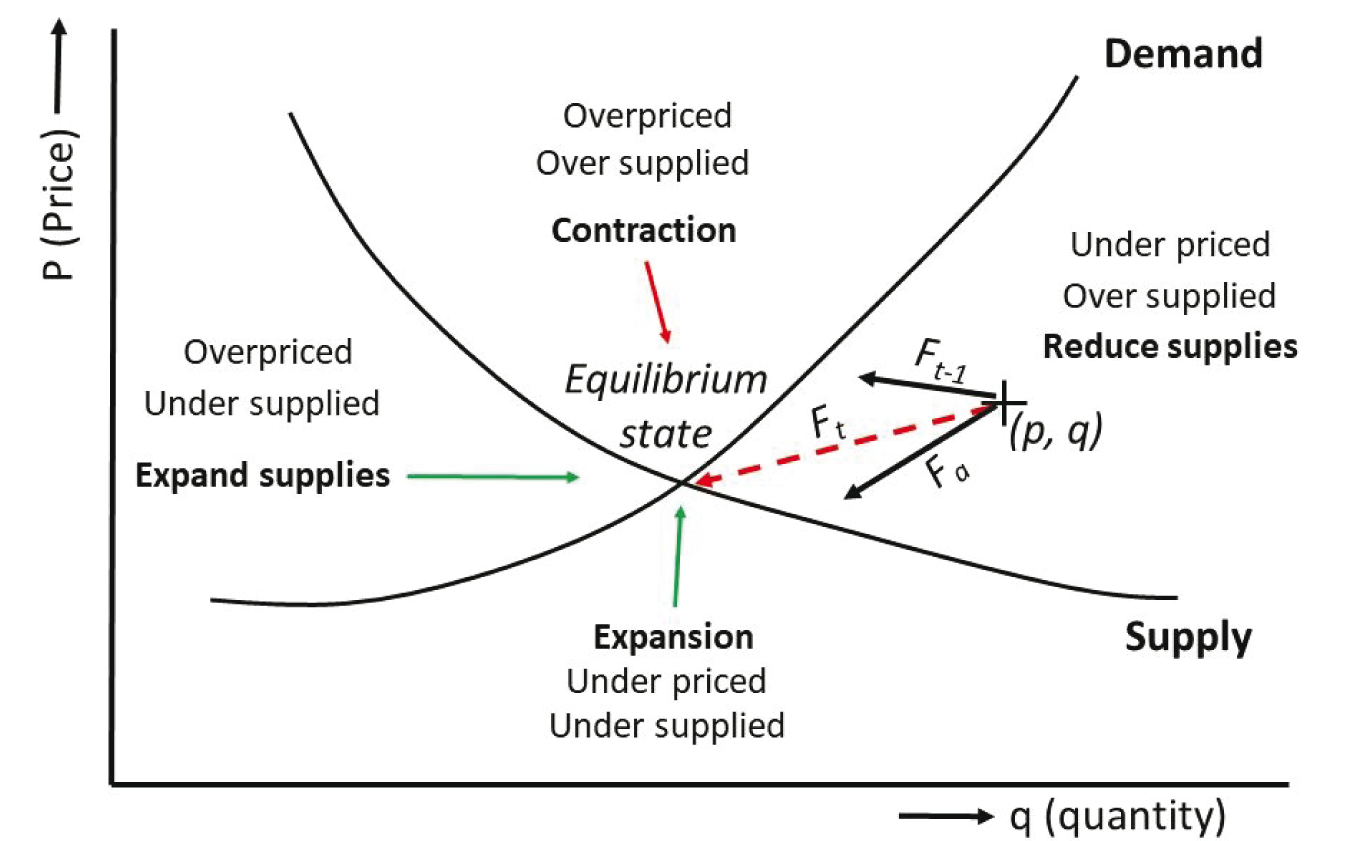
At the macroeconomic level, p may be a price level as the average of current prices across a stated basket of all goods and services and q is the total amount of goods and services produced in a given time. For a year’s trading of a nation-state, R = gross domestic product (GDP).
Economic Power
When FEW is traded, then economic work (W) is done at a point in att space at time t. In turn, this triggers some physical work to make and move goods and services in physical space s = (x, y, z). The momentum of a trade is h = m × v, where m is the FEW of the trade and v is the rate of change of the distance R (velocity) through time in the att space. The velocity of R can be estimated from the time series of R versus t, for example, by using a finite difference technique (Figure 2).
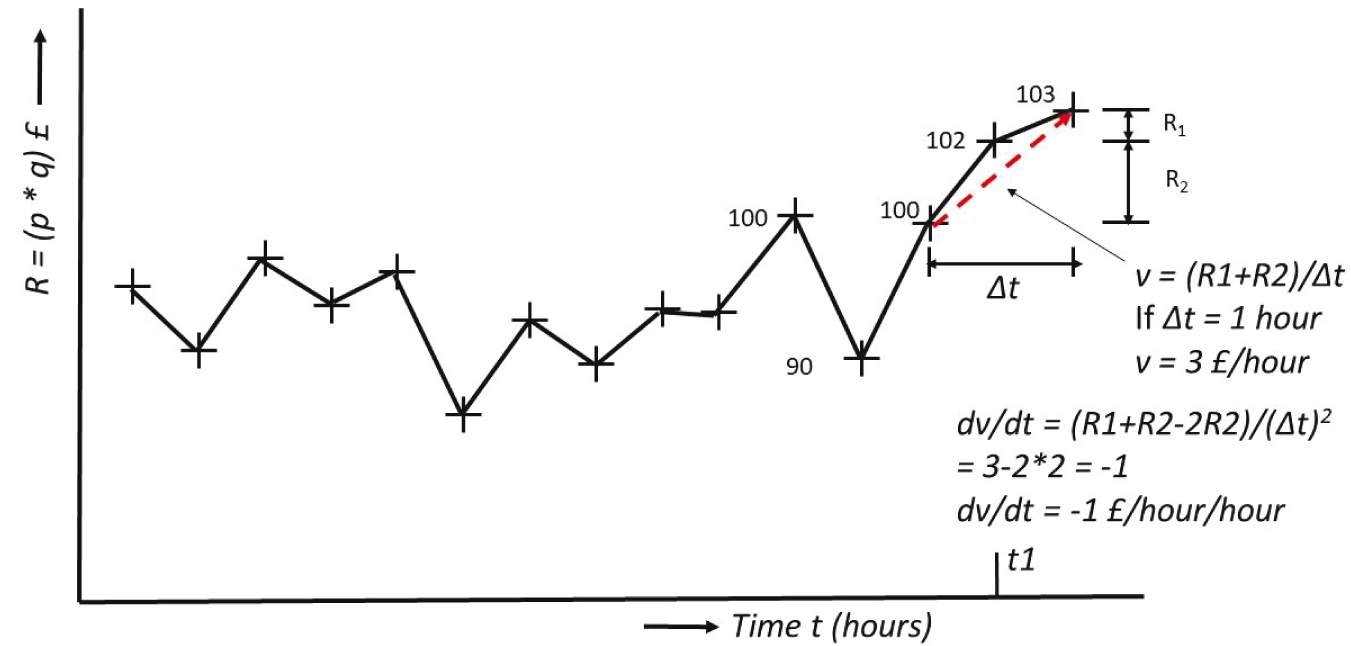
The internal force generated F is the rate of change of momentum F = dh/dt = d(m × v)/dt = d{m × dR/dt}/dt = {m × d2R/dt2 + (dR/dt) × (dm/dt)}.
If dm/dt is the rate of inflation (i) (i.e., the rate of change of worth) and c is the acceleration of m through att = R space, then c = d2R/dt2 and F = m × c + v × i.
If m is constant, then F = m × c, which provides a direct analogy with Newton’s Laws. In mechanics, the velocity (v) is called the potential of the exchange process in which the force F flows.
Economic work W is the force F times the movement s = ∫v dt of the FEW in the R space, so W = F ∫v dt = F × s and is the manifestation of trade. Economic power P is the flow F times the potential v, and so P = F × v = v × {m × c + v × i} and expresses the capacity to influence change through economic work. It is the rate at which economic energy E is changed.
Economic energy E is ∫P dt = ∫v × {m × c + v × i}dt and if m is constant (i = 0, no inflation), then E = m ∫{ d2R/dt2}dt = mv2/2 and directly analogous to physical kinetic energy (i.e., energy due to movement).
Modified Newton’s Laws
This kind of analogy leads us to suggest a modified set of Newton’s Laws for economic systems. The Laws are not laws as ‘absolute truth’ in all contexts but guidance to help us understand the contextual behaviour of a dynamic process of exchange that progresses:
along its current path unless acted on by a set of forces. The First Law of Financial Flow is that the velocity of a unit of financial exchange value (m) is constant unless acted on by a force. with a rate of change of velocity that is proportional to the force. The Second Law of Financial Flow is that the force is proportional to the rate of change of financial momentum. to a new state, as action (demand) forces are responded to, met or countered, by reaction (capacity) forces, which sometimes may be unforeseen and unintended. The Third Law of Financial Flow is that economic demand is met or countered by economic capacity.
There are two more forces we need to include. These are forces from induced delays to flow—storage of flow through flexibility, elasticity and lack of liquidity in the system and forces from the dissipation of energy by friction and damping—wasted energy from financial barriers such as tariffs and bureaucratic procedures.
Therefore, in general, F = m{dv/dt + cv + L ∫v dt, where mdv/dt is called a capacitance that captures the amount of stored potential, cv is the force from dissipated energy and L ∫v dt is called an inductance that captures the amount of stored flow. Interestingly (Varoufakis, 2017) describes debt as a form of inductance when he writes ‘debt is … like an elastic band holding everything together, capable of stretching during bad times to prevent the systems from breaking’.
Net Worth
We assume that the purpose of each financial entity is to maximise its net worth (assets minus liabilities) since this is a measure of the wealth of an entity. The field of economic forces has therefore to be extended to include not just revenue but a complex mix of all the elements of GDP such as consumption (C), government spending (G), investment—both public and private (I) and net exports (NX). The field also has to include current assets such as cash reserves, non-current assets such as property and equipment, current liabilities such as creditors and bills and non-current liabilities such as long-term loans and bonds. All of these in turn depend on interest rates (r) and taxes (T) and economic and fiscal policies.
When the only form of FEW is currency as cash, bank deposits and other liquid instruments, then the sum is M the total money supply of the currency issuer (a nation state). The issuer can create more currency as deems necessary to finance debt liability yet avoid inflation and unemployment. Entities that are currency users (banks but not central banks, companies and individuals) must settle all debt or cease trading.
Currency issuers and central banks use a number of tools to control the economic forces that influence investment, inflation, consumption, liquidity, unemployment and growth. These include:
The contributors to the changes in net worth create an economic momentum h = m × v, where v = d(att)/dt but att is now a field containing forces moving in multiple dimensions of worth (Figure 3).
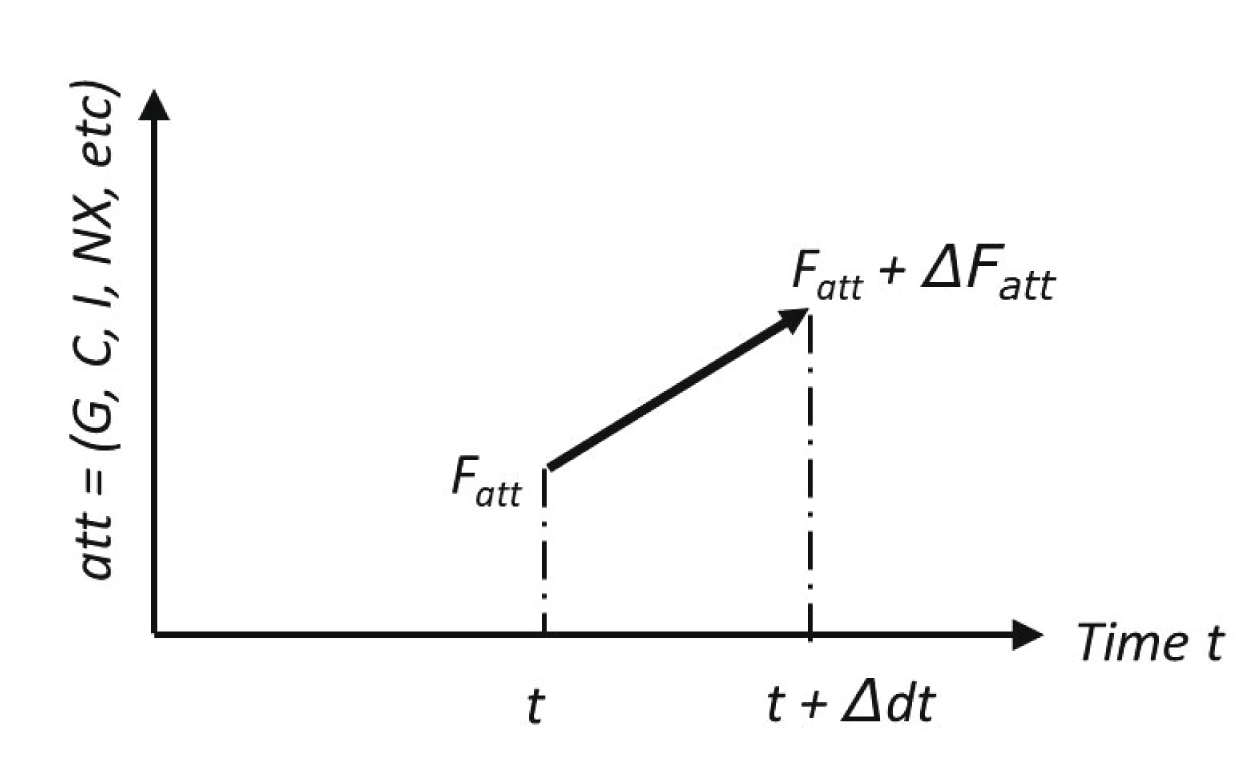
Each contributor is a dimension or axis of the field (and hence of any vector in the field) if it is orthogonal to all other axes. The test of orthogonality is independence. This means that it is possible to move along an axis without changing the others. (It may be helpful to visualise this by comparing it to the physical space (x, y, z), where it is possible to move along the x-axis without changing y or z because x = constant is a possible state. This does not preclude other relationships such as y = x + z).
If we assume that at least some of the major contributors to net worth are orthogonal (e.g., it is possible to vary G without varying C or NX and I—which is not to say these factors are unrelated), then we can calculate economic forces as component vectors resolved along each axis—as long as the factors are additive. We can then combine them to get a complex resultant vector if we so wish.
For example, the economic momentum of consumption C is hC = mC × vC resulting in force of consumption FC = dhC/dt. More generally, if we write the force from all assets as FA = ∑Fa = dha/dt where a = (C, G, I, NX), then FA is the vector sum of all Fa.
Likewise, the economic liability force is F l = m l (dv l /dt) and the economic net worth force is Fw = mw(dvw/dt) = Fa - Fl.
How to Interpret Economic Force?
The concept of an economic field is suggested as an aid to a more accessible understanding of the forces that drive changes in economic systems. For example, the forces interact in typical scenarios as follows. If the internal force driving net exports is too low, then we need to apply an external force to push up investment. If the internal force pushing up consumption is too high, then we need to apply an external force down on investment to reduce supply. If the internal force pushing up income is too high, then we need to apply an external force to push up investment to increase supply and consumption. Traditionally, forces leading to increased growth increase income/capita and improved standard of living and reduced poverty levels. In turn, these encourage investment and increased demand but again with a risk of inflation if demand exceeds capacity. Likewise, raised interest rates reduce demand but make investing more expensive. Taxes take money out of systems and hence lower energy levels unless countered by government spending. Quantitative easing adds money and lowers debt to increases lending and investment also with the risk of inflation.
However, there are some differences between field analysis as presented here and traditional economics. For example, terms such as overheating (inflation and unsustainable growth) are not equivalent to high levels of economic energy. Indeed, high levels of economic energy and power (the rate at which energy is changed) imply a vibrant and successful economy. More importantly, an assumption that growth is necessary for economic well-being ignores the wider meaning of worth as we now explore. The details of the mathematical treatment of fields are perhaps of lesser importance than the concepts. The analysis does not change any of the basic relationships already held by economists. Rather, it may act as a ‘springboard’ to find ways of managing crucially important aspects of worth beyond those of finance. Aspects that are currently ignored to the detriment of the quality of human life on earth.
The Need for Change
The growing urgency of the challenges such as those posed by climate change, possible pandemics, pollution, poverty and loss of biodiversity has brought sharply into focus the need to consider and account for our wider values and worth which is not necessarily financial. As Carney (2020) recently observed, society has, unfortunately, come to embody Oscar Wilde’s old aphorism: ‘knowing the price of everything but the value of nothing’. These values include all forms of capital—natural, human and social. Various attempts are being made to extend financial accounting to green economics and accounting (Leach et al., 2019). Inequalities of wealth, highlighted on the COVID-19 pandemic, are also manifest in the growth of top incomes and the dominance of unearned income. Disparities in the worth of work are manifest in the low pay of care workers compared to city bankers. Exploitation of the natural world is manifest in climate change, pollution and loss of biodiversity. Excessive inequality, exploitation, discrimination and inappropriate use of power (particularly when corrupt) tend to lead to weaker economic performance with feeble aggregate demand, inequality of opportunity and lower public investments such as in public transportation, infrastructure, technology and education. Industrial relations, labour market institutions, welfare and tax systems that are independent of productivity are at the heart of dealing with these issues.
Obligation
Trading is an exchange of equivalents, which carries an obligation on all parties to act in good faith and with a duty of care. An obligation is a binding promise, contract or sense of duty. Good faith and goodwill are to act on accordance with our values of legitimate standards of trust, honesty and upheld by the law. Settle (1976) argues that obligations are an underived social relation—that is, an obligation cannot be analysed in terms of some other concepts more basic than it and from which it can be derived. He sees an obligation as a root reciprocal moral principle for any society of more than two autonomous rational beings. It is a principle found in the ‘golden rule’ of all religions and expressed in the Bible as—do unto others as you would have them do unto you (Luke, Ch. 6, v 31). Settle quotes John Dewey as pointing out that no genuine moral principle prescribes a specific course of action. But he points out that they do require a particular attitude and respect, such that we can try to imagine what it is like to ‘stand in the shoes’ of another and they also make clear what is not to be done.
Values are the things we hold as important in the way we live. In short, the worth of what is the ‘good’. Values determine our personal priorities such as education, well-being, honesty, truthfulness, loyalty, open-mindedness, consistency and our corporate values such as sustainability, efficiency, creativity, ingenuity and innovation. To act with good faith is to act reasonably which implies that consent is not withheld by any of the parties unreasonably—depending on context. Under the law of tort, a duty of care is owed by each one of us towards any other to adhere to a reasonable standard of behaviour that will do no harm. It is an expression of the social contract by which we live and work together. As we have learned the importance of our natural environment, we have realised we also owe a duty of care to the planet and all of the natural world. Natural assets for an entity are part of the commons and are of three kinds:
used but taken for granted and not accounted—such as air and water quality. Damage reparation should be set against income but often is not; used, recognised and accounted as delivering FEW ecosystems services; and used and positive for the commons but FEW detrimental to the entity. For example, eagles on a grouse shooting estate are an asset to the commons but a cost to the estate if it kills grouse.
I postulate that the equivalents exchanged in trading could be a value expressed as the worth of obligation (TWO), such that TWO entails FEW. Furthermore, although TWO is exchangeable, it should not be not tradeable in the same way as FEW and there should be no market for TWO that is not FEW. That is because TWO is a ‘bigger idea’ than FEW with an importantly different moral stance from that of economic utility. Whereas utility is the usefulness and degree of satisfaction of a consumer’s choice, TWO is centred on a set of obligations that a financial entity has to the natural world and to those aspects of our human and social world that are beyond FEW. The idea that utility can be the basis of moral choice (Hirsh & Galinsky, 2018) is flawed since it assumes that ethical choice depends on usefulness rather than a duty of care for the natural world and others.
However, TWO obligations are not necessarily reciprocal. Although we human beings have obligations to nature—it has no obligation to us. Nature will do what it does regardless. It takes no account of human sensibilities, but we need to treat it carefully because we are part of it. We take for granted the air we breathe and the water we drink—they are too important to be valued as FEW. Of course, there are ecosystems services to which we apply FEW such as utility companies that collect, store, clean and distribute water to our taps. The water collected by the utility companies is free but delivering potable water to our taps is not. Likewise, the worldwide scandals of poverty, inequality and social deprivation are too profound and all-encompassing to be valued as FEW. Indeed, it can be argued that they derive from an improper use of FEW that we need to correct.
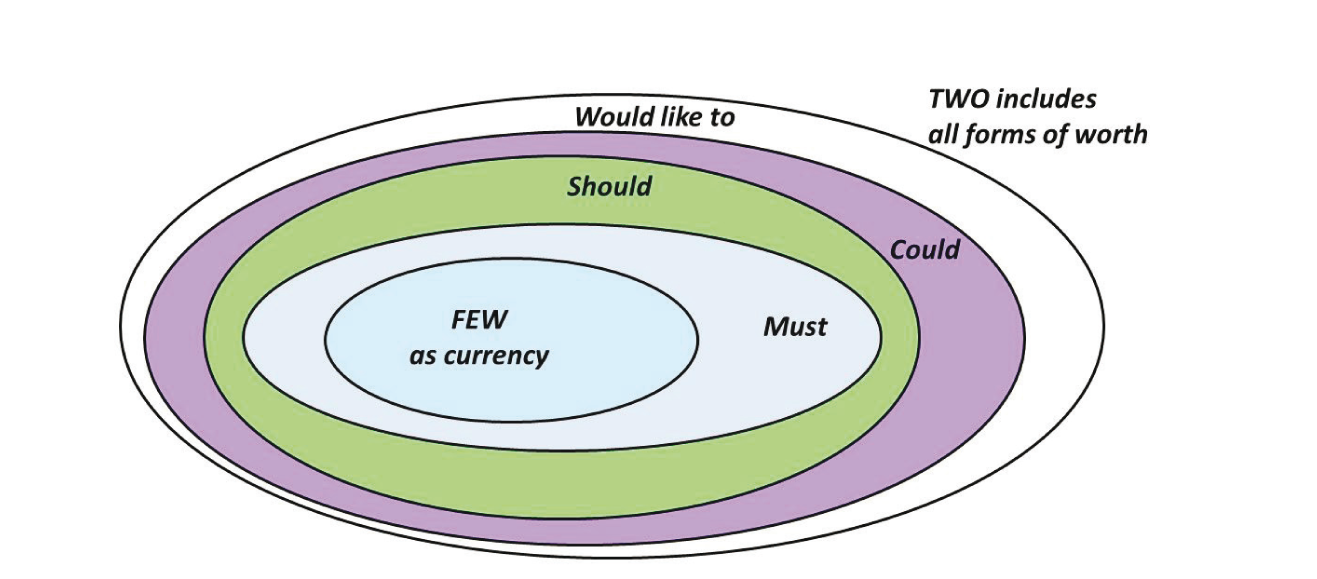
The natural capital we take for granted but which is essential for life on earth has to be measured by some other metric. We need a metric that does not depend on trade-offs susceptible to the tragedy of the commons or the prisoner’s dilemma (King, 2017). A new unit of TWO has to capture the degree or amount of worth of the moral obligations we owe to each other and to the natural world. I propose that metric should be a new unit of obligs. An oblig is a way of capturing the amount of the substance of the ‘stuff’ that moves around in a social field of obligation forces. In other words, as we bargain and trade with each other and our environment, we make commitments to exchange that which we consider, at the time, to be equivalents. When we trade by only exchanging FEW, then TWO obligs become de facto units of currency as $ or £ and their reciprocal legitimate benefits as goods and services, as a special case (Figure 4).
In effect, TWO connects value (as financial worth) with values (as that which we consider important in the way we live) as Carney (2020) advocates. TWO takes us away from inward-looking selfish individual usefulness to outward-looking collaborative obligation that entails a much wider set of values than finance.
Are Obligs Utopian? How Should We Measure Them?
Our present market society is failing us at least because it (a) does not recognise intangibles and our obligations to each other and to natural world, (b) is contributing to extreme weather events and (c) assumes that no one works except for a reward. Change requires nothing less than a complete overhaul of our value system. In a liberal democracy, the ultimate worth is the dignity and freedom of the human being. The essence of man is activity in pursuit of a rational conscious purpose, and the realisation of this essence is seen to require both freedom and equality. The question then arises ‘How should we exercise power for the common good?’ I agree with Macpherson (1965) who pointed out that It is a mistake to see our goal as the pursuit of maximum material possessions rather than purposeful creative activity. We must strive to balance the good with useful changing values to promote human dignity above material possession perhaps, above all, to reduce inequality and poverty. This will require a new type of political and cultural leadership (see later discussion).
For TWO obligs to be useful in practice and not utopian, we need a way of measuring them. There are a number of alternatives which include (a) voting, (b) devising and using algorithms, (c) transferring individual decisions to elected or appointed others, (d) trading or (e) other methods yet to be devised by further research.
Our choice must depend on what collective future we want and our system of values. Given the loss of life and physical and economic damage due to climate change that we are beginning to see right across the world (wild fire, flash floods and pestilence), the stakes are high. I have already ruled out trading. Algorithms are useful but necessarily incomplete and potentially could have dangerous unintended consequences even if those limitations are constantly monitored. Currently, we transfer decisions to elected or appointed people as the practical implementation of voting for most liberal democracies. Of course, individuals, elected or otherwise, cast their votes for many complex reasons. These include selfish short-term interest, the common good, an expression of frustration or broad agreement, support for a person or idea and the prevention of particular consequences with which they disagree. There are many complex other reasons such as prejudice. Most of us recognise that the problems of voting systems are many, including who decides the system and who should have a vote. Is it realistic to think that a population reduced to poverty and starvation will vote to consider climate change? People who feel threatened militarily or economically find it difficult to resist nationalistic ideologies. People can also sometimes change their minds very quickly.
Despite all of these drawbacks, voting is a basic expression of the will of the people in a liberal democracy and the best means we have for exercising power for the common good (Buchanan, 1954). To quote Churchill (1947),
Many forms of Government have been tried, and will be tried in this world of sin and woe. No one pretends that democracy is perfect or all-wise. Indeed, it has been said that democracy is the worst form of Government except for all those other forms that have been tried from time to time.…
Dollar voting (Wikipedia, 2020) is the idea that every dollar spent is a vote for what is wanted. Unfortunately, it is fundamentally flawed because spending is constrained for all sorts of reasons—mainly budgets. Buchanan considers that voting is preferable to market choice when individuals need to be motivated because it incentivises greater participation in social decision-making. Through voting, we may be able to bring out the ‘best’ in people and help them to take more account of the wider public interest as well as that of the natural world. However, as Buchanan points out, voting will only produce consistent rational social choices if ultimate social goals are agreed. This need not imply a planned economy as characterised by Hayek but rather a world in which charismatic leaders argue a set of values that will create the consensus needed to avoid human catastrophe of epic proportions. In the twenty-first century, we have such a goal. Never in the history of the human-race have we had a need to get behind an ultimate social goal than managing the effects of the almost inevitable climate changes that threaten life on earth as we know it. Many scientists think that the melting of glaciers has gone past the tipping point. We need our political leaders to articulate and define our social goals much more motivationally in order to change all of our behaviours. Extreme weather events, such as flooding and forest fires, are already bringing suffering and misery to many people. Loss of biodiversity, large-scale destruction of property and infrastructure will become more regular events as the effects ‘kick in’. Now is the time to motivate and collaborate our obligations towards life on earth.
For this reason, I believe that FEW and TWO have to be measured and accounted for distinctly and separately in all transactions. Doing so will also avoid ethical issues such as allocating a price to a human life or to an entire species facing extinction.
If we use voting to measure obligs, then each individual vote could proportionally contribute to an oblig. For example, a 90% vote might confer 90 obligs. Four logically entailed anchor points to inform voting for TWO suggest themselves. They are must, should, could and would like to make an obligation (Figure 4). Using these criteria, we can allocate a percentage vote or range of votes to each one and allow intermediate assessments. For example, 90%–100% of a vote could be interpreted as a must obligation—one that is a necessity or is required by law, 70%–90% of a vote is a should obligation—one that is a strong expectation, 40%–70% of a vote is a could obligation—one that is a possibility, 10%–40% is a ‘would like to’ obligation—one that is an intention or inclination and finally, 0%–10% of a vote represents no intention to fulfil an obligation. If simple ranges are insufficiently rich to capture the subtleties of the voting system, then the vote could be interpreted using fuzzy sets or an Italian Flag (Blockley & Godfrey, 2017). The advantage of the latter measure is that it recognises what King (2017) calls radical uncertainty. This is the deep uncertainty of unknowns that are not covered by deterministic and probabilistic models with little to no recognition of the future events that are either unanticipated or unintended and unforeseen surprises. The Italian flag method explicitly allows for incomplete votes that are ‘don’t knows’.
But who should vote? The constitution and size of the voting population must depend on the context. One alternative is to legally require our elected and appointed representatives to attach votes to all public decisions—including public accounts. Another approach for national and international issues such as global climate change is to take a large sample size representative of the whole world. For smaller entities such as banks, companies and local government authorities, the voting population could include shareholders, customers, employees or stakeholders as deemed appropriate. At the level of individual decisions, people could make judgements by effectively allocating internal votes. Of course, these may well be much more variable and certainly personally subjective but hopefully based on personal experience and available evidence. Other approaches based on group decision-making, such as weighted scoring, the Delphi Method or the Nominal Group Technique (Management Study HQ, 2021), could emerge from further research.
Using TWO in Trading
Can TWO help facilitate trading that includes natural (environmental), human and social capital? First, it is clear that traditional trading is just one part of the trading of obligations. All assets and liabilities and net worth carry an amount of TWO—some expressed as FEW but much of it beyond the scope of FEW (Figure 4) despite the efforts of the protagonists of green economists (Natural Capital Finance Alliance, 2020). Our aim is to maximise net worth over all obligations
The problem is highly complex because the social field of obligations is multidimensional with multiple interdependent interactions. Although we may be able to identify dimensions for specific cases (such as CO2 emissions or city air pollution), the task of naming a general set is not feasible. Nevertheless, in almost all cases, indices have been developed to summarise the totality of particular factors. For example, Putnam (2001) has used data of volunteering, voter turnout, attendance at public meetings, serving on committees and other forms of civic engagement to form an index of social capital. Other indices combine data from health, education, leisure and safety surveys. Clearly, all of these measures will be deficient in some way if the purpose is to calculate an absolute measure that covers all situations because significant systemic uncertainties about future shocks are unknown and unpredictable. There is also no single agreed definition of the terms on we are relying—even the terms human, social and natural capital. The emphasis, however, should not be on completeness or truth in all contexts, rather it is an engineering approach of evolutionary progress that allows us to improve as we strive to reach our goals (Blockley, 2020). The methods we adopt have to be as objectively testable as they can be, adaptable and flexible and not fragile or brittle because we want to avoid sudden shocks. In other words, the key ingredient is resilience.
For example, let us examine our joint obligation to look after our natural capital—our stock of natural resources. The obvious ones include the quality of our air, water, soil and production of food. Less obvious ones range from carbon sequestration, climate regulation, the role of forest and saltmarshes in flooding to the effects of experiencing nature on our mental and physical health. Natural capital assets are not entirely lacking in FEW. Support ecosystems services are the benefits to humans from healthy well-functioning ecosystems (communities of interconnected organisms). The list of ecosystem services is very long, but there have been studies to create tools to identify them (e.g., European Commission, 2003; European Commission, Environment, 2008; EVRI, 2020; Leach et al., 2019; Natural England, 2018; Network Rail/Balfour Beatty, 2017). Leach et al. classified the assets into four hierarchical levels. The first level is abiotic and biotic. Abiotic is divided into functional, non-renewable and physical. Biotic is biodiversity—the variety of plant and animal life in a particular habitat such as coastal, ocean and land areas. Land areas may be desert, tundra, grasslands, wetlands, woodlands and farmlands. Biodiversity is the complex web of life and the variability among living organisms within and between species and ecosystems. Loss of biodiversity has and is being estimated in many ways. A number of databases are being developed such as EVRI (1997) and Review of Externality Data (European Commission, 2003). Unfortunately, the lack of congruence between the many different metrics is confusing for policy makers and the public alike. Natural England (2018) with DEFRA have produced a practical metric for projects typical of engineering approaches to problems of great complexity. They use a unit of biodiversity as a nominal measure of the distinctiveness, condition and size of a habitat. Distinctiveness is scored as high, medium or low. Condition is assessed good, moderate or poor. The area of a habitat is measured in hectares (h). These empirical measures are effectively assumed as being independent by calculating biodiversity units as bd = distinctiveness × condition × hectares with units of bd/h. Network Rail/Balfour Beatty (2017) have used this measure before and after an intervention to record change.
If we assume that the field of biodiversity obligation is the single biodiversity unit bd/h, then the biodiversity force is m × dbd/dt, where m is the degree of obligation to deliver changes in obligs. The force is measured in units of obligs bd/h. The balance sheet (Figure 5; or a separate IN/OUT account, c.f. Income/Expenditure Account) will show present biodiversity levels as an asset balanced against a liability.
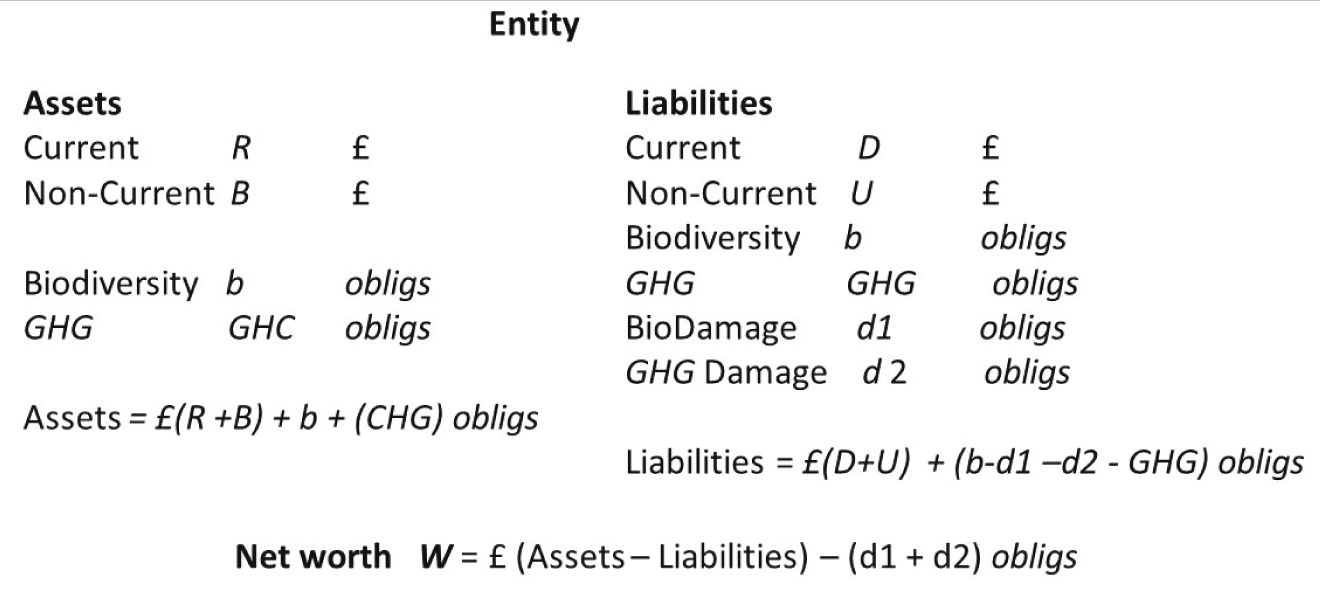
If the level is unchanged by the interventions from a given project, then there is no loss of obligs. However, we are aware that biodiversity is being lost on a national scale. It is incumbent on any financial entity to survey and estimate biodiversity loss (and preferably biodiversity gain if enhanced) and to have those figures audited just as financial accounts are audited and the results recorded on a balance sheet. National and international voting should pressurise regulators to require such records.
If there is some level of damage to biodiversity, then it would be shown as a loss of obligs as a liability that effectively reduces the net worth of the entity as measured in obligs.
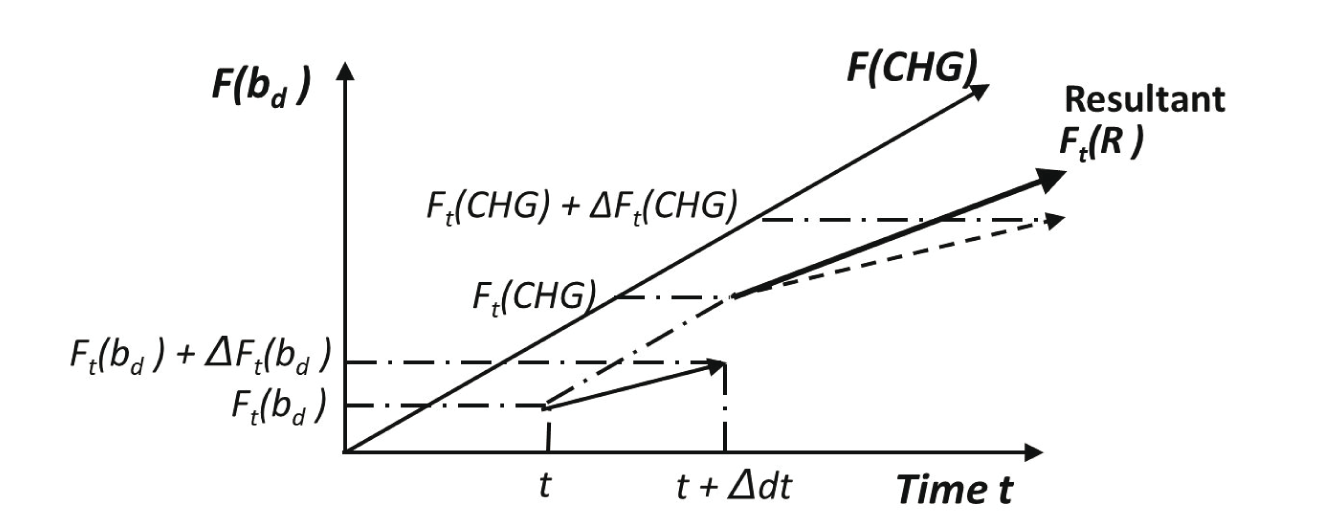
In such a manner, we can consider, for example, carbon emissions where the obligations field dimension is greenhouse gas emissions GHG = activity data × emission factors (UK Government, 2020). Activity data are measured, for example, as kWh of electricity or gas, litres of fuel or tonnes of waste. Emission factors are precalculated to convert activity data into CGH emissions.
In general, if we have n-orthogonal dimensions of the force obligation field, then the field space R = {r1, r2, r3, …, rn}, where r = {b, GHG} contained in R.
Then, R = f × r, where f is the matrix of transforming factors of vectors r through the obligation field containing vector forces F (Figure 6).
Conclusions
Economics and Engineering have much in common since both are concerned, at least in part, with making decisions to act, based on evidence from many sources including science. Following Mariotti, three interpretations of this relationship—economics for engineering, economics and engineering and economics as engineering have been identified. The first is pragmatic engineering management to aid decision-making. The second recognises peer disciplines with cross fertilisation. The third adopts engineering epistemology with policy orientation to solve practical problems.
The growing urgency of the challenges posed by climate change, possible pandemics, pollution, poverty and loss of biodiversity has brought sharply into focus the need to consider and account, in economic systems, for our wider values and worth, which is not necessarily financial. The purpose of the ideas presented here is to suggest ways in which an engineering perspective can shed light on these challenges to economics.
It is important to not equate rationalist constructivism with an engineering mentality. The former is a belief in a socially autonomous human reason capable of designing civilisation and culture which rejects tradition and convention and requires rational justification of values. An engineering mindset is that of a practical problem solver—one who skilfully originates or contrives. Engineers do not believe that they can design everything—especially civilisation and culture and do not reject tradition but they do understand the importance of values and see their work as contributing to the flourishing of the human race. They recognise the incompleteness of knowledge (including science) and treat all theory as models of the real world created to help them make better decisions. Engineering products evolve in a similar process to scientific knowledge and societal order.
A systems thinking approach that sets the ‘hard’ engineering of physical systems within ‘softer’ human and social systems has been used to analyse economic trading and expand it to include natural, human and social capital in a non-financial form.
The approach is based on a new theory of obligations in a force field of human interactions. An obligation is an underived social relation and, it is suggested, is a root moral principle for any society. The analysis is based on an analogy between gravitational and electromagnetic fields of physical forces with fields of human interactions. Obligations, it is suggested, are the ‘stuff’ of a human/social field of interactions analogous to gravitational ‘mass’ or electromagnetic ‘charge’ in a physical field of interacting processes.
The engineering task at the root of the analogies is the design and development of a system of interacting parts to maintain and control the internal flows so as to deliver some useful purpose. For example, engineers design bridges to span rivers and hence initiate new economic activity between regions. To do this, scientific knowledge is necessary but not sufficient and the role of social science in engineering is underdeveloped and often unacknowledged. The lack of understanding has been exposed by engineering failures attributable to human and organisational errors and unintended consequences.
I have postulated that new economic systems should be designed (as engineers design) to maximise TWO to include a wide set of natural and social assets such as biodiversity, air quality and reduced inequality. TWO entails FEW and is exchangeable but should not be not market tradeable. This is because TWO is a ‘bigger idea’ with an importantly different moral stance from that of economic utility.
Critics may argue that measuring and exchanging TWO other than by market trading is utopian. Clearly, TWO requires us to adopt a very different value system. The imperative for this change is the growing urgency of the need to tackle climate change. The change in values has to come through effective, indeed charismatic, political and cultural leadership.
The central idea of the analogy between physical and social fields of interaction between ongoing processes is that a force is a capacity to change the rate of change of progress of a process in a field. A field (f) is a region or space of attributes (att) of processes categorised as why, how, who, what and where. Processes interact through a flow of forces to move in (att). The velocity of the changing trajectory of a process in (att) is called a potential. The attribute of a process that represents how much ‘stuff’ (m) is moving and how quickly (velocity v) is mass in a gravitational field, charge in an electromagnetic field, currency such as £ and $ in a financial field and obligs in a field of obligations. An asset is ‘something with worth for which an entity is responsible including all forms of natural (environmental), human, social and financial capital. An equilibrium state is one that is ‘on the right path’ towards meeting the objectives (why attribute) of a process.
The degree to which a process is ‘on track’ towards an objective is measured as FEW currency in a financial field and quite separately as TWO obligs in an obligation field. TWO obligs can be recorded on a TWO balance sheet and an IN/OUT (c.f. income and expenditure) account in a manner quite similar to traditional accounts.
Four anchor points for judging the level of TWO obligs are whether an obligation has the weight of must, should, could or would like to have commitment.
Whereas FEW currencies can be traded in a money market, TWO obligs are based on a set of moral principles which, in a democracy for the big issues such as climate change and inequality, should be agreed by common consent.
For example, if a nation-state places maximum worth on being carbon neutral by 2050, then it has to create a (set of) process(es) with a collective objective (why attribute) of creating a balance of demand and supply of renewable energy by that date. The number of negative obligs presently attached to the net worth of an entity (because these forms of capital are currently largely ignored) should reduce over time according set subobjectives down to a net level of zero. Indeed, by adding positive obligs (such a planting trees), the net worth of an entity could increase and hence help improve the quality of life of its people.
The set of subobjectives may include reducing greenhouse gas emissions by at least 70% compared to 1990 levels by 2030. Of course, there will be many other subobjectives. If, at any time (t), we are not ‘on track’ to meet an objective or subobjective, then the rate of change (velocity) of the process is insufficient and we will need to identify, generate and apply new forces (F) to get it back on track.
The main steps in identifying these forces are (a) capturing the type, nature and contextual worth of the asset and liabilities for an entity and processes measured as TWO obligs, (b) understanding and making quantitative estimates where possible of the potential that drives the flow of forces and impedances to it and (c) using the analysis to design strategies and tactics required to maximise net worth.
These suggestions are, of course, only ideas and will need extensive further work such as identifying potential barriers to working with obligs and how voting systems could be implemented in practice, if they are to be refined, developed, quantified and tested in prototype.
Footnotes
Acknowledgements
This article has benefitted from detailed comments and suggestions from an anonymous referee.
Declaration of Conflicting Interests
The author declared no potential conflicts of interest with respect to the research, authorship and/or publication of this article.
Funding
The author received no financial support for the research, authorship and/or publication of this article.