




Abstract
This article discusses the role of the British control of India in the rise of Britain and Europe as well as in the convergence in incomes within the Atlantic economy in the late nineteenth century. Britain was at the apex of the world economy throughout most of the nineteenth century. The article argues that the emergence of Britain as the apex economic and political power depended on her control over India. This control of India then enabled Britain to pursue a set of policies that were of critical importance, both for the convergence in incomes within the Atlantic economy and the rise of Europe. The thesis advanced here can be viewed, depending on one’s prior position, as being either complementary to or alternative to the views of many of the protagonists of the divergence debate in the literature.
Introduction
‘Europe’ and European offshoots have been the dominant influences in the world economy until very recently. And while there may be a shift currently under way towards Asia, Europe and European offshoots still have per capita incomes much higher than those in China and India (with India’s per capita income being considerably lower than that of China). The purpose of this article is to examine the role of the British control of India in the so-called great divergence—the long-term divergence in growth, productivity and living standards between the Occident and Orient—as well as in the convergence in incomes within the Atlantic economy. This last refers to the fact that in the late nineteenth century, 1 many ‘poor countries in the European periphery tended to grow faster than the rich industrial leaders at the European centre, and often even faster than the labour-scarce countries overseas in the New World’ (Aghion & Williamson, 1999, p. 105), and there was a convergence in living standards within this group of countries in the Atlantic world 2 (even as there was a divergence in income between the Occident and Orient).
As is well known, a number of explanations have been put forward to explain the rise and dominance of Europe. The main focus of most of these explanations has primarily been on the period between 1500 and 1800. One group of explanations has looked at factors internal to Europe, with various protagonists arguing variously, for example, that ‘western religion, culture or institutions’ were uniquely excellent, and that any or all of these together explain the rise and dominance of Europe (see, among others, Landes, 1998; North, 1981; North & Thomas, 1973; Tawney, 1926; Weber, 1905). However, as Pomeranz (2000, p. 16) has pointed out, a major problem with these Europe-centred stories is that ‘there is little to suggest that Western Europe’s economy had decisive advantage before 1800, either in its capital stock or economic institutions’ compared to those in (many other) comparable regions in Asia (the Yangzte delta in China, Kanto plain in Japan or Gujarat in India).
Another group of explanations has focused on various forms of colonial extraction (including on the interactions between colonial extraction and domestic institutions) (see, among others, Acemoglu, Johnson, & Robinson, 2005; Frank, 1978; Wallerstein, 1974–1980; Williams, 1944). In an important contribution, Pomeranz went beyond the usual arguments in this context to argue that access to coal and the ‘ghost acreage’ that Europe derived from the New World were of critical importance. ‘The slave trade and other features of European colonial systems’ in the New World ‘enabled Europe to exchange an ever-growing volume of manufactured exports for an ever-growing volume of land-intensive products’ (Pomeranz, 2000, p. 20). Together, coal and the New World allowed Europe to grow along resource-intensive, labour-saving paths (in contrast to the core of East Asia’s economy which was forced along labour-intensive, resource-saving paths that led to an ecological impasse).
It has also been argued that the Industrial Revolution (IR), founded as it was on labour-saving mechanical technology, was more likely to take off in areas where labour was relatively more expensive (see, among others, Allen, 2009; Habakkuk, 1962; Rosenthal & Wong, 2011). Allen, in particular, has argued that the IR was the result of Britain’s high wage economy. It is also, of course, possible to argue that capital-using, labour-saving innovations are more likely to appear if the supply of capital increases. Indeed, we shall argue below that this is precisely what happened in Britain at the time of the IR due to the transfer of wealth from India to Britain. We shall also argue that India made Britain a more saving and investing country.
There have also been debates about when exactly the so-called great divergence started. Pomeranz thought that the divergence started around 1800, while Broadberry (2013) has argued that it started around 1500; Shui and Keller (2007) believe that China and the West were at similar levels of development around 1800, while Parthasarathi (2011) thinks that India was at par with the West until 1750 or so. Jones (1981, 1988) too inclines towards a later start to the great divergence. This disparity of views shows that there can be no easy agreement about when the ‘great divergence’ started. However, it is worth bearing in mind that little if any real per capita growth can be discerned in Britain before 1830. Also, that European industrialisation was very limited before 1860.
The key consideration here, however, as Mokyr (2003) has pointed out, is that growth was sustained in Western Europe after the IR, instead of petering out, as in the previous episodes of growth, and that the gap in income between Western Europe and Asia had become huge by 1900. This places a particular onus of responsibility for historical change in the period after 1750 or so. Mokyr (2005) has argued that technological development played the critical role here. Sustained technological progress was the key to the ‘great divergence’, and Britain was the leader in economic applications of new technology. According to Mokyr, the West produced useful knowledge at the time of the IR, and conditions were right for the continued growth of this useful knowledge. To quote Mokyr, ‘the technological breakthroughs of the period prepared the ground for the economic transformation that made the difference between the West and the Rest’ (Mokyr, 2005, p. 19).
In this context, it should first be noted, as Mokyr himself acknowledges, that pure science itself played a very little role in economic development until towards the end of the nineteenth century. Instead, it is technological developments which were the important influences. But then technological developments do not take place in a vacuum; they take place in pursuance of profits and when people see opportunities for rewards from innovating. When an economy is in an expansive frame and/or undergoing major structural changes, challenges and opportunities open up for successful technological advances to take place. (Subsequently, these technological developments themselves may, of course, lead to further profit opportunities and technological advances.)
Be that as it may, it will be a major argument of this article that the British advances in India from the mid-eighteenth century onwards released expansive forces for the British economy and subsequently for European economies and their development. The economic destiny of Europe from the late eighteenth century was shaped by the early industrialisation in Britain which then spread to a few countries on the European continent (and then to the USA). Britain was at the apex of the world economy throughout most of the nineteenth century. It will be argued that the emergence of Britain as the apex economic and political power depended on her control over India. This control of India then enabled Britain to pursue a set of policies that were of critical importance, both for the convergence in incomes within the Atlantic economy and for the ‘rise of Europe’. It is this which made the difference between the West and the Rest in the nineteenth century. The thesis advanced here can be viewed, depending on one’s prior position, as being either complementary to or alternative to the views of many of the protagonists of the divergence debate referred to above.
India’s Direct Contributions to the British Economic Development
This section focuses on India’s direct contributions to the British economic development. These can be usefully discussed under the following headings: the transfer of wealth from India to Britain; the role of the Indian army in furthering British economic, military and political interests; the role of India as a ‘captive’ market for British goods; the role of India’s China trade in furthering British economic development and global influence; and last, but not the least, the role of India as a source of labour for other British tropical colonies. We briefly elaborate on each of these contributions below.
Transfer of Wealth from India
Adam Smith referred to the East India Company (EIC) as the body ‘for the appointment of plunderers of India’ (Smith, 1776, Book V, Chapter 1, Part iii). Extortion and plunder were common as the Company acquired political strength in parts of southern India and dominance over Bengal. Huge amounts of wealth flowed into the pockets of Company servants, from ‘presents’, from collusive contracts with officials of Indian rulers and through the pressures that were exerted to make internal trade favourable to the English buyer or seller. And after 1765 when the Company acquired from the Mughal Emperor the cession of the diwani (the management and collection of the revenue) of Bengal, this solved the problem of the export of bullion from Great Britain (to obtain Indian goods): it paid for the merchandise bought by the EIC. The Company, in other words, used Indian revenue to buy goods in India (and later in China) to be exported to Britain. The aim essentially was to transfer wealth from India to Britain.
There have been several estimates of the drain of wealth from India to Britain. Furber (1948, p. 304) set out his formulation of the drain as follows: ‘the only true drain resulting from contact with the West was the excess of exports from India for which there was no equivalent import’. Furber estimated this drain to have been £11.8 million over the period 1783–1792 (at current prices), that is, an average of £1.3 million per annum. Other estimates of this drain include Maddison’s (1971) estimate of £100 million for the period 1757–1815; Hamilton’s (1919) and Sinha’s (1956) estimates of £34.5 million and £38.4 million, respectively, for the same period of 1757–1780; Burke’s (1981) estimate of £1 million per year for the 4 years ending 1780; and Habib’s (1974) estimate of well over £2 million for 1789–1790. A rigorous recent estimate is that by Cuenca Esteban (2001) for the period 1772–1820 whose figures show the ‘arguably minimum transfer’ from India to Britain—in the balance of payments sense—reaching a peak of £1.01 million annually in 1784–1792.
What were the effects of this drain from India on the British economy? A major effect would appear to have been that this Indian transfer enabled Britain to liquidate its foreign debt in critical years before the French wars. The transfer also helped Britain to generate a current account surplus necessary for foreign investment. There had been a growing Dutch investment in British government (and other British) stocks. ‘This Dutch investment had grown rapidly in each of the eighteenth-century wars down to 1763, did not grow at all in the war of 1776–83, and most importantly this debt of £25–30 million was rapidly liquidated in a few years after 1783’. Davis (1978, p. 55) was the first to suggest that ‘Indian wealth supplied the funds that bought national debt back from the Dutch and others, first and temporarily in the interval of peace between 1763 and 1774, and finally after 1783, leaving Britain nearly free from overseas indebtedness when it came to face the great French wars from 1793’. By 1800, it is believed that Britain had an external surplus of £10 million (see Feinstein, 1978; Imlah, 1958; see also Cuenca Esteban, 2001). Cuenca Esteban’s (2001) re-construction of British Balance of Payments over the period 1772–1820 supported Davis by showing that without the Indian transfers, Britain would have required mounting foreign borrowing during this period to seemingly unsustainable levels after 1809. In Cuenca Esteban’s re-construction ‘the gap between “actual” debts or credits abroad and “counterfactual” foreign indebtedness 3 widens exponentially from £87 million in 1802 to £114 million by 1807, and to £170 million by 1815’ (Cuenca Esteban, 2001, pp. 67–68).
If we remember that during the eighteenth-century wars, Britain followed a ‘blue-water’ strategy—a strategy which involved giving huge subsidies to allies on the continent to fight land wars against the French, while the Royal Navy protected the British Isles from invasion and harassed French trade—it would appear that Cuenca Esteban was right to conclude that ‘without the accumulated credits from India transfers since 1757, Britain’s financing of land warfare during the French wars would have been compromised’ (Cuenca Esteban, 2001, p. 58).
In a subsequent paper, Cuenca Esteban (2007) expanded his previous work to include the re-export of Indian goods from Britain. British trade inflows from re-exports of Indian commodities alone most frequently doubled, and at times tripled, those arising from net Indian transfers including government flows. As Esteban says, ‘the total net credit on “trade and services excluding India” could not have sustained Britain’s war expenses in Continental Europe since 1793’ (Cuenca Esteban, 2007, p. 167).
It should also be noted in this context that Esteban’s estimates were based on trade statistics, but clearly a large part of the Indian wealth came clandestinely or in the form of treasures and diamonds that did not appear in the trade statistics. For one, there were war indemnity and forced loans; Tipu alone paid £3.5 million in coins and bullions to the Company at the end of the war in 1792 (Siddiqi, 1995, p. 19). For another, as already mentioned, there were tributes and ‘presents’ by the princely states. It is thus clear that the drain of wealth from India can only have been much higher than any estimates based on the trade statistics alone.
Be that as it may, as we have noted, Britain is believed to have had an external surplus of £10 million by 1800. It is difficult to see how this surplus would have appeared without the Indian transfer. Britain ‘passed from being a debtor to being a creditor nation’, and Cuenca-Esteban’s estimates place the decisive turning point in the late 1790s. ‘In subsequent years, British net gains on trade and services would have compounded, for the first time, with positive returns on investment’ (Cuenca Esteban, 2007, p. 168). 4
Indian transfer would thus appear to have been making possible foreign investment by the British as early as the 1790s. This was important for domestic economic stability, for from the mid-1820s, in particular, Britain came to depend upon rapidly increasing returns on earlier investment (in Europe, North America and the Middle East) to provide a continued current account surplus and to hold imports of raw materials at a level that would maintain domestic employment (Cain & Hopkins, 2001, p. 91). As will be discussed below, the British invested heavily in foreign countries throughout the nineteenth century, and this had profound significance for the evolution of both the British and the world economy. The genesis of the British foreign investment in the nineteenth century can thus be seen to lie in the transfer of wealth from India to Britain in the early years of the Company rule. Later too, as the nineteenth century progressed, the Indian connection would prove vital for the continued foreign investment by the British, as India became a major market for British exports and as India continued to contribute massively to income from services. These will be discussed in due course.
Indian transfer and control of India also—in a number of different ways—made Britain a more saving and investing country. Most of the imports from India during this period, as it were, were obtained more or less free. 5 So some of the income generated domestically in Britain which would have been spent on imported goods otherwise could now be saved and some of the savings exported as capital. Further, EIC’s control of India directly generated income for the government (in the form of taxes and customs revenues) as well as for the members of the public. As the Company used more and more of the Indian revenue to purchase goods for export to Britain, both directly and via China (India’s China trade will be discussed below), the Company’s annual payments of customs duties in London rose sharply. The Company, for example, was able to make payments of over £1 million on customs and tea duties in 1786–1787 alone. This rose to £3 million a year during 1820s, mainly in the form of tea duties (more on this later; see Bowen, 2006).
So the tax revenue was higher as a result of the Indian connection. This tax revenue was in a very important sense generated because the EIC had control over the Indian revenue. It is also clear that the government expenditure too would have had to have been very much higher without the control of India, for the Indian revenue, as we shall see, paid for a large part of the British army, British merchant ships and sailors and all of the Indian army, all of which furthered British trade and commerce. So the control over India had positive impacts on both the public and private savings.
Finally, we may refer here to the argument that was advanced by O’Brien (1982) regarding the contribution of commerce with the periphery to aggregate capital accumulation in Britain. O’Brien provided an estimate of profits accruing to British shipping firms, bankers and commissioning agencies, and insurance companies from their involvement in trade with the less developed regions of the world during the late eighteenth century (1784–1786 to be precise). He put the figure at approximately £5.6 million. He relied on Davis (1978) for his figures that imports from the periphery were about £10.50 million during this period. Total gross investment during the period was £10.30 million. During this period, the aggregate savings rate was between 12 per cent and 14 per cent, and assuming that savings rate from these profit income to be 30 per cent, O’Brien concluded that contribution of these profits (resulting from trade with the periphery) to aggregate capital accumulation would be only about 15 per cent or so, and he concluded that ‘for the economic growth of the core, the periphery was peripheral’ (O’Brien, 1982, p. 12). Inikori (2002) has subsequently suggested that imports from the periphery around 1800 were about double O’Brien’s estimate. More importantly, in the context of the present discussion, O’Brien completely missed the point that of the £10.50 million of imports from the periphery during 1784–1786 that he cites (from Davis), nearly 50 per cent (£4,952 million according to Davis’ calculations) came from Asia, most of which were bought with the Indian revenue directly or indirectly. In other words, O’Brien ignored the transfer of wealth from India to Britain. He also ignored the customs and tea duties that resulted from the control of India. If the transfer of wealth from India is added to O’Brien’s estimates of profits from trade with the periphery, the contribution of periphery to aggregate capital accumulation in Britain during this period, using his methodology, could be, depending on one’s assumptions, as high as 70 per cent or even higher. In these terms alone, the periphery instead of being peripheral would appear to have been central to the British economy and economic development during this period.
The Contributions of the Indian Army
Seizure of the Indian revenue made it possible for Britain to build up in India one of the largest standing armies in the world. Indian tax payers paid for the expenses not only of the Indian troops but also of regiments and detachments from the British regular army that served in India.
As early as 1766, the Company had maintained an army of 32,379 soldiers, of whom 9,443 were Europeans of various nationalities (Richards, 2006, p. 25). By 1781, the army had quadrupled in size to 124,000 of whom 23,000 were Europeans—many of the latter Royal Army British troops. In 1847, about 33,000 of the 140,000 British regular army troops were stationed in India. By 1851, the pre-rebellion army in India totalled 289,529, of whom 49,408 were British regular troops. After the rebellion, the Indian sepoy was at no time to outnumber British troops in the subcontinent by more than two to one, but this was not always adhered to. In 1881, the Indian Army numbered 69,647 British troops and 125,000 sepoys, compared with British and Irish forces, at home of 65,809 and 25,353, respectively. In other words, there were more British troops stationed in India at Indian tax payers’ expenses than British troops maintained in Britain at British tax payers’ expenses.
The Indian Army was used not only to pacify the subcontinent itself, but after 1790, it was increasingly employed to forward British interests elsewhere, which directly or indirectly protected Britain’s commercial interests and furthered British trade and influences. The campaign against the French in Egypt in 1789 and the seizure of the Cape of Good Hope in 1795 and 1806 anticipated what was to come. The highly profitable timber trade was forwarded by the defeats of Burma (1824—26 and 1852). In the 1840s and 1850s, the intervention of the Indian Army in China widened the entrée of British trade into valuable Far Eastern markets. The ambit of Indian power is described by the movement of her troops: to, as already mentioned, China in 1839, 1856, 1859 and 1909 (the last during the Boxer Rebellion); to Persia in 1856, to Ethiopia and Singapore in 1867, to Hong Kong in 1868, to Malaya in 1875, to Malta in 1878, to Afghanistan in 1838 and then again in 1878, to Egypt in 1882, to Burma in 1885, to Nayasa in 1893, to the Sudan and Uganda in 1896, South Africa in 1899 and Tibet in 1903 (cf. Bowen, 2006). Indian tax payers paid not only the expenses of both Indian and British troops in India but also some fractions of the costs of Indian and British troops used in these imperial adventures. The Indian Army provided the means of intimidating and, if needed, ‘crushing the resistance of Asiatic rulers who obstructed British influence and trade’. As Robinson and Gallagher put it, ‘Between them, the Sepoys and the Royal Navy guarded the commercial empire throughout the eastern seas and the Pacific’ (Robinson & Gallagher, 1961, p. 13).
The story is not complete without putting the annual expenditure of the British Army in the wider context of the total annual expenditure of the UK. Wong has provided an analysis of the composition of the UK gross expenditure during the period 1835 to 1860 (Wong, 1998, Table 14.14, pp. 353–354). The average annual UK gross expenditure during the period was £59.25 million. The largest component of this expenditure was the payment of interest on the public debt, amounting to an average of £28.9 million per year. The second largest item of expenditure was the expenditure on ‘Army and ordnance’ at £10.5 million or almost one-fifth of the total UK gross expenditure, with the expenditure on the Navy coming third at £7.3 million. Other items of expenditure were very small in comparison (with ‘Law and justice’, e.g., coming fourth at £1.92 million.) It is obvious that the expenditure on ‘Army and ordnance’ would have to have been very much higher if Britain did not have the control of the Indian revenue but wanted to maintain the same sort of overseas commitments. The Indian Army, paid for by the Indian revenue, was politically, financially and strategically of immense importance to the British. Without the Indian Army and the Indian base, the penetration of China would have been difficult and the so-called informal empire difficult to establish. As has been said, without the Indian Army, Britain would only have been a naval power, with it she became a continental power.
India as a ‘Captive’ Market for British Goods and British Trade Surplus with India
As the interest income from investment abroad became available to some significant extent from the mid-1820s (see discussion above), the need to transfer capital from India by tribute declined. India would now become the cornerstone of the free trade policy to be pursued by the British. A fraction of Home Charges 6 would continue as tribute, but keeping Indian markets open for British goods and generating trade surplus with India would become key British policy goals.
Foreign markets played a very important—some would say a decisive—role in early British industrial expansion. By the end of the eighteenth–century, domestic exports accounted for about 13 per cent of the GDP, and by the end of the 1870s this had risen to about 22 per cent and thereafter they averaged between 16 and 20 per cent until the First World War. For the major industries, foreign markets were even more important. The cotton industry exported over half the total value of its output at the beginning of the nineteenth century and almost four-fifths at the end, while the iron and steel industry exported about 40 per cent of its output from the mid-nineteenth century (see, in particular, Hobsbawm, 1968).
India was to become over time an increasingly vital market for British exports, especially for cotton goods. In the early part of the nineteenth century, most of the markets for cotton goods were in the USA and Latin America. As tariffs rose in the USA and Europe after the end of the Napoleonic wars, India began to emerge as a prominent market. ‘Sales to India were responsible for three-tenths of the increase in cotton exports between 1830 and 1850, by which date the subcontinent absorbed 18.5 per cent of all cotton piece-goods sent abroad’ (Cain, 1999, p. 34). By 1860, nearly 40 per cent of total British exports consisted of cotton textiles, and India absorbed 40 per cent of Britain’s total exports of cotton goods. The British policy in India, however, was aimed not only at keeping Indian markets open for British cotton textiles but also at preventing India’s emergence as an export competitor (Kenwood & Lougheed, 1992, p. 66).
The importance of cotton for the British economy and British economic growth should not be underestimated. By 1810, it had overtaken wool to become Britain’s single most important source of industrial value-added, a position it retained until the very end of the nineteenth century. It was the largest single industry by a substantial margin. By 1850, there were 331,000 factory workers in cotton spinning and weaving in 1,923 mills. There were about another 150,000 cotton workers outside of factories and a further 31,000 dyers and calico printers. 7 Even as late as 1880, over 80 per cent of the world’s cotton exports came from Britain. To Rostow, cotton represented the original leading sector in the first take-off. Without doubt, the captive Indian market was of vital importance for the continued growth of this industry. If India had been an independent country, India in all probability would have protected her own cotton industry. Britain’s political control of India was of paramount importance in the context of the growth of the cotton industry in Britain.
India was also an important market for machinery (£4.5 million out of £33.6 million in 1913) and locomotives and railway carriages (£2.2 million out of £7.0 million in 1913).
In 1870, India took nearly one-fifth of total British exports. ‘Between 1870 and 1913 India rose from third to first place among Britain’s export markets’ (see Moore, 1999). By contrast, India’s share of Britain’s imports fell to about 10 per cent around the turn of the century. Britain’s favourable trade balance with India was hugely important, for India maintained a trading surplus with countries in Asia and Europe (and the USA) that enjoyed surpluses with Britain, and this was to prove to be of great importance for the evolution of the world economy.
Britain, because of her free trade policy (British free trade policy is discussed below), was a major importer of manufactured goods from the new industrial countries, with whom she developed substantial deficits. But she was also the chief exporter of manufactured goods to the less developed countries and had substantial surpluses with them, particularly with India. 8 Without her surplus with India (and to a much lesser extent with China and the Straits Settlements, with her surplus with China and the Straits Settlements also, as we shall see in the next section, resting on her Indian foundation), Britain would not have been able to settle her debts with the new industrial nations, and ‘presumably would have been forced to abandon free trade’ (see Latham, 1978, p. 70). The USA and industrial Europe, in particular Germany, were able to continue their policy of tariff protection only because of Britain’s surplus with India. Without this Indian surplus, Britain would no longer have been able to subsidise their growth (Latham, 1978). Indeed, before the First World war ‘the key to Britain’s whole payments pattern lay in India, balancing as she probably did more than two fifths of Britain’s total deficits’ (Saul, 1960).
But how was India able to sustain the massive debt that she had on her transactions with Britain? India’s trade deficit with Britain was more than offset by her surpluses with Europe, the USA and particularly Asia. Europe and America’s import of primary products from India far outweighed their export of manufactured goods to India, where British goods were already entrenched. But by far the largest surpluses for India originated from Asia, mainly from China. This surplus with China was of overwhelming importance and was mainly due to the export of opium. India also exported cotton yarn to China, but it was opium that was the dominating item. Ceylon, Thailand and the Straits Settlements also provided useful surpluses for India. The Straits Settlements, like China, were a victim of the opium trade. Additionally, the Straits Settlements also imported rice from India, to feed their Indian migrant workers, as indeed did Ceylon. (Thailand too imported rice from India). We discuss the magnitude and significance of Indian migrant workers in the section after the next. It is to a discussion of India’s China trade that we turn in the next section. As we shall see, India’s China trade was of great importance to Britain and the evolution of the world economy in a number of different ways.
India’s China Trade 9
The import of tea, in particular, and to a lesser extent, the import of raw silk from China were to become of great importance for the British economy and the British lifestyle in the eighteenth and nineteenth centuries.
The take-off in demand for tea began early in the eighteenth century, with the EIC importing over 2 million pounds of tea between 1713 and 1720. Growth continued to be spectacular in each of the subsequent decades, with imports of 8.9 million pounds in the 1720s, 11.7 million in the 1730s, 20.2 million in the 1740s and 37.4 million in the 1750s.
Up to 1784, tea duties ranged from 75.9 per cent to 127.5 per cent ad valorem and such high duties encouraged smuggling. To undercut the smugglers and to encourage the consumption of ‘legal’ tea, duties on tea were reduced from 119 per cent to 12.5 per cent ad valorem by Pitt’s Commutation Act of 1784. The effect was spectacular. In 1784, just under 10 million pounds of tea had been sold, but the amount increased sharply to almost 15 million pounds the following year, and sales topped 20 million pounds in 1795. With minor breaks, the steady increases continued, reaching over 85 million pounds in 1854. Almost all of the tea came from China. 10 Moreover, increasing sales (and sales of better quality tea) meant that government revenue did not suffer greatly in the long run, and pre-1784 levels of revenue income were restored by 1794 before they then rose sharply, as progressively higher rates of duty were charged during the wars against France, and rising to 100 per cent and more in the first years of the nineteenth century. The duty was not reduced, however, after the Napoleonic wars.
As mentioned earlier, the Company was able to make payments of over £1 million in customs and tea duties in 1786–1787 and upwards of £3 million a year during the 1820s. During the period 1835–1858, tea duty made up an average of 20.95 per cent of the UK’s entire customs revenue or 8.68 per cent of UK’s gross revenue (Wong, 1998, p. 347). The significance of this can also be gauged from another comparative perspective: by noting that the revenue from tea duty alone would have covered two-thirds of the UK government’s average annual expenditure on the navy (at £7.3 million) during this period or about half of the average annual expenditure on ‘Army and ordnance’ (as discussed earlier; see also Wong, 1998, p. 355).
In addition to the income from tea sales and contributions to the treasury, tea trade generated large amounts of invisible incomes. Shipping, insurance and other services all generated employment and income. Tea drinking indeed had become a part of the fabric of the society. With milk and sugar added (sugar obtained from the West Indies colonies), tea supplemented the poor diet of factory workers. Not only the factory workers but all classes of the British society developed the habit of drinking morning and afternoon tea. Tea drinking also had an important influence in reducing the high mortality rates. In England, in the first decades of the eighteenth century, the death rate had risen sharply and exceeded the birth rate. This rise of the death rate historians attribute partly to the growth of drinking cheap gin instead of beer (Trevelyan, 1942, pp. 341–344). Gin drinking was encouraged by throwing open the distilling trade and by placing on spirits far too light a tax. It was only as the appalling social consequences of drinking gin—so eloquently captured in Hogarth’s delineation of the ‘horror of Gin lane’ contrasted with the ‘prosperous Beer street’—became apparent that the Parliament moved in 1751 to tax the spirits highly and undertook policies to limit the consumption of gin. Also, after the middle of the century, tea drinking became a strong rival to alcohol consumption in all classes, and after 1780, ‘the death rate went down by leaps and bounds’. While this decline of the death rate was also due to many other factors, a change in drinking habits did play its part.
Apart from tea, the other major item imported from China was raw silk. By the mid-nineteenth century, the imported Chinese raw silk accounted for a little over half of all the raw silks imported into the UK. A significant proportion of the raw silk imported was re-exported, mainly to Continental Europe and the Americas. (e.g. in 1857, the UK bought nearly £7 million worth of silk from China, 18 per cent of which was re-exported) (Wong, 1998, p. 362).
The China trade was clearly important for the British economy. At first, Britain struggled to maintain the trade as China would accept only silver as payment, and this was viewed with great concern in this age of mercantilism. After the conquest of Bengal, however, a part of the Bengal revenue could now be used to cover the purchases of Chinese goods at Canton. EIC bought raw cotton in India (with the Indian revenue) to export to China and for a period also remitted silver to China from India. Most importantly, however, opium grown in Bengal became the source of what was to prove the Company’s most profitable means of financing the lucrative Chinese tea trade. The Company assumed monopoly rights for the purchase of opium in 1773. State-licensed peasant farmers in relatively small areas in Bengal and Bihar grew opium for a fixed price for the government. Nearly all of the opium grown was exported to China, with some going to the Straits Settlements.
When In 1800 the Emperor of China issued an edict prohibiting the importation of opium, the EIC—to continue the trade—initiated the practice of publicly auctioning the Bengal opium in Calcutta to private traders, who then smuggled it to Canton, obtained silver from the Chinese, handed them to the EIC to purchase Chinese goods and to use the surplus silver elsewhere, and in return obtained bills of exchange from the EIC payable in London or in India. Later, ‘significant revenue was also derived from levying charges after the establishment of the Malwa Opium Agency in 1823, on the so-called Malwa opium, which was grown in the independent princely states of central India but passed through British territory at Bombay’, when it was smuggled to China (Wong, 1998, p. 390).
Often, the value of opium imported into China by private British traders was considerably higher than the total value of the two major exports, tea and silk. For example, in 1833–1834, US$11,618,716 worth of opium was smuggled into China, while the value of the two exports amounted to only US$4,141,753 (see Wong, 1998, p. 374). Since the Company could not use all the surplus silver, it resorted to smuggling the precious metal out of China against a Chinese prohibition. In 1839, China enforced its prohibition of the importation of opium by destroying at Canton a large quantity of opium confiscated from British merchants. The British responded by sending a large contingent of the Indian Army. Two opium wars followed (first in 1839–1842, the second in 1856–1860). The upshot was that China was opened up for trade, a regime of fixed tariffs was imposed upon the Chinese, Hong Kong was ceded to the British and importation of opium was legalised.
As noted, the Company’s China trade generated large trade surpluses for the Company. For example, in the last 7 years of the Company’s monopoly of China trade—the Company’s monopoly of China trade ended in 1834 11 —‘while the United Kingdom had an average annual deficit of about £2.76 million in its bilateral trade with China, the Chinese had an average annual trade deficit of about £4.59 million with the Company’ (Wong, 1998, p. 373). Later, the Indian surplus with China would increase even further as China was opened up and the quantity of opium exported increased. Indeed, in the 1830s and 1840s, opium brought in over 25 per cent of all India’s export earnings. In the 1850s, this rose to 31 per cent and it held its own at over 20 per cent through the 1860s and 1870s (Richards, 2002, p. 164).
From the days of the early EIC government in eighteenth-century Bengal until the end of the Raj, opium revenue ranked in importance just behind land revenue and salt monopoly. Official revenue returns came mainly from either profits or fees on opium exports. As a percentage of the total Indian government revenue, opium revenue rose from 4 per cent in 1790s to plateau in the period 1850 to 1880 at 16 per cent or over (Richards, 2002, p. 155).
Opium was vital for the Company’s hold on India. Without the extra revenue provided by opium, the expansion of British rule in India would very probably have been greatly constrained. As the Company continued its expansion in India, its debt continued to grow year after year (Wong, 1998, pp. 386–387). The debt service as a percentage of revenue, however, continued to remain lower for the Company than for the other competing powers in India at that time. In the decade of the Third Anglo-Maratha war (1817–1818), for example, debt service as a percentage of revenue for the Company fell from nearer 20 per cent to 12 per cent (see Roy, 2013; Sykes, 1859), even as this rose for the competing powers. In terms of the British expansion in India, debt servicing was not a problem because the opium revenue more than covered it (see Wong, 1998, Table 16.2, pp. 387–388). Indeed, as has been said—not without justification—that as a result of the opium trade, China got the opium, British the silver and India the Raj. 12 And to the extent that India’s trade surplus with China was important for balancing India’s trade deficit with Britain and to the extent that this was important for the evolution of the world economy in the nineteenth century—we shall see later that this indeed was the case—then the opium trade would appear to have been at the very centre of the evolution of the world economy in the nineteenth century.
India as a Source of Labour for Other Tropical Colonies
Emigration from India to any large extent started in the 1830s. The first group of Indian indentured labourers was sent to Mauritius in 1834, the year when slavery was abolished in British colonies. Indian indentured labourers were soon after introduced to Jamaica, British Guiana, Trinidad, Granada, St. Luicia, Natal and Fiji. Indian indentured labourers also worked in plantations in Ceylon and Straits Settlements and more were brought to East Africa from 1896 to construct and maintain the Uganda Railway. Less formally, many others migrated to Ceylon and Burma: in Ceylon to coffee and tea plantations, in Burma to rice plantations. Overwhelmingly, large numbers went as labourers but some also went as traders, clerks, etc. Most worked on British controlled plantations under British managers and supervisions (see Northrup, 1995).
An estimate of Indian overseas labour emigration over the period 1834–1924 has been provided by Northrup (1995), who puts the number at 6.5 million (indentured at 1.4 million and those free of indenture at 5.1 million). The effects of this Indian emigration on the Indian economy are likely to have been negligible. India’s population in the mid-nineteenth century was about 250 million. Number of emigrants as a proportion of the total population was quite small. The six and half million or so of Indian emigrants can be compared with the British overseas emigration of the nineteenth century: between 1815 and 1914, about 22.6 million individuals left the British Isles. British population (at 14.1 million in 1820 and 26 million in 1870) was, of course, considerably smaller than India’s. Also, the fruits of Indian labour (except their wages) mostly accrued to British businessmen and traders, not to India.
While the impact of the Indian emigration on India was small, the economic effects on the destination countries and Britain were quite considerable. In the West Indies, immigrant labour proved to be an important element in the survival of many West Indian plantations in the years ahead and ‘by 1870 the immigrants had helped to sustain a substantial degree of prosperity in these colonies’ (Heuman, 1999, p. 485; see also Ward, 1999).
So far as emigration to Asian countries was concerned, Indian immigrant labour was vital in helping to make Burma the rice bowl of the Southeast Asia, with greater part of the immigrants to Burma being employed in the rice mills. In Ceylon, Indian labour was equally vital in coffee and tea plantations. Coffee exports from Ceylon to Great Britain increased sevenfold between 1845 and 1870. With disease wiping out much coffee production in 1876, many planters shifted to tea cultivation and this resulted in equally profitable export trade. Similarly, Indian emigration to the Straits Settlements was critical to its development. Malaya bordered on the shortest sea route between India and China and was to become important strategic and economic assets for the British over time. The Indian labour became indispensable for plantation agriculture in Malaya. Indian labour also constituted an overwhelming number of workers in rubber stations. Furthermore, Indians played a prominent, often dominant, role in almost every phase of development of the modern transport and communication system, particularly the rail, road and telecommunication networks (see Sandhu, 1969).
What were the effects of all of these developments on the British economy? In judging the overall impact of this Indian emigration on the British economic growth, the following would appear to have been the most significant ones. First, the Indian emigration indirectly enabled Britain to cover a larger part of her trade deficit with the new industrialising countries by her trade surplus with India than would have been the case otherwise: for, as we have already noted, India developed trade surpluses with both Ceylon and the Straits Settlements (with both of whom Britain had deficits) and this enabled India to offset some of her trade deficits with Britain. As we shall see below, Britain’s trade surplus with India was important for the maintenance of the British free trade policy and sustained overseas investment by the British, and both of these were important for the growth of Europe and European offshoots. While India’s China trade did play the dominant role here, Indian immigrant labour also played a not too inconsiderable role.
The second important point to make is that most of the surplus produced by the Indian emigrant labour accrued mostly to those who would save and invest. Also, there were huge ‘invisibles’ incomes associated with the trade resulting from the output produced by the Indian emigrant labour and these accrued to bankers, insurers, shippers and merchants in London, Glasgow and Liverpool; in other words, again to those who would mostly save and invest.
Finally, of course, increased incomes in the countries where the Indian emigrants went expanded the market for British manufactures and provided employment for many British people, both directly and indirectly.
So the contributions of the Indian emigrant labour to the British economic growth would appear to have been quite considerable. All of these also indirectly helped cementing further the free trade tendencies in the City (more on this below).
Evolution of the World Economy in the Nineteenth Century
The above Indian contributions were clearly of great importance for the British economy at various times and over time. We now turn to discuss what appears to us to have been the two main features of the evolution of the world economy in the nineteenth century, Britain’s central role in that evolution and the Indian foundation of those British policies which were of critical importance for the rise of Europe and the convergence in incomes within the Atlantic economy.
Overseas Emigration from Europe and the Expansion of International Trade
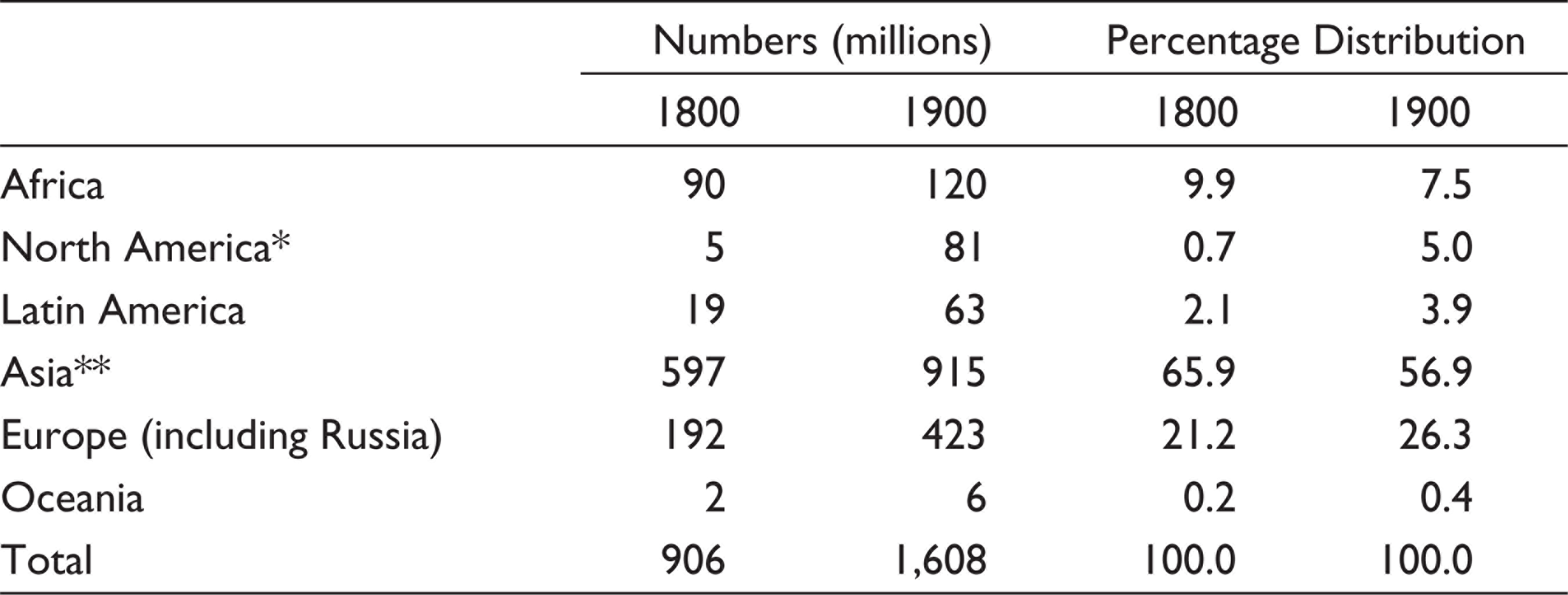
The evolution of the world economy in the nineteenth century was characterised by a very rapid expansion of international trade and mass migration of people from Europe to extra-European destinations. In the nineteenth–century, population in Europe grew considerably faster than in the rest of the world except for those areas settled by European emigrants. Between 1800 and 1900, the population of Europe and Asiatic Russia increased from about 192 to 423 million (with the percentage distribution of Europeans in the world population increasing from 21.2% to 26.3%, see Table 1). The permanent emigration overseas of about 50–60 million Europeans meant that the natural increase of population in Europe, particularly in the second half of the century, however, was much higher.
There is no single explanation for the rapid increase in European population in the nineteenth century. The most important reason was probably the decline in the death rate faster than that in the fertility rate. Economic changes then occurring in Europe offered little possibility of absorbing this huge increase in the labour supply and overseas emigration became vital in releasing this great pressure of numbers.
Prior to the 1860s, overseas emigrants were mainly from the British Isles and Germany. Over the period 1815–1914, the British Isles was the principal source of supply of people, accounting for approximately 37 per cent of the total outflow from Europe, with an estimated 22.6 million people leaving the British Isles during this period. Within the British Isles, it is in Ireland in particular that emigration at crucial stages was critical in providing an escape route from extreme deprivations. Famine overwhelmed Ireland in the years 1845–1847, and in the space of a few years, the country lost about a fifth of its population by emigration, starvation or disease. (The population of Ireland in 1788 is estimated to have been 4.4 million; in 1841, it reached 8.2 million; and by 1911, it had fallen back to 4.4 million).
Growth and Percentage Distribution of World Population, 1800–1900
As in Ireland, in Germany too emigration was crucial in relieving population pressures at critical stages. Population growth in the second half of the eighteenth century in Germany was already substantial, but this continued to be the case in the early decades of the nineteenth century. There were major crop failures in the 1840s. In the first wave of mass migration between 1845 and 1858, approximately 1.3 million Germans emigrated overseas, and between 1864 and 1873, a further million emigrated overseas. Emigration reached its peak in the year 1881: 4.9 per thousand of population.
For the Scandinavian countries, overseas emigration was of even greater importance. Sweden experienced in the late sixties a Malthusian crisis not too dissimilar to what Ireland had faced in the forties and fifties, and 120,000 Swedes emigrated overseas. The next big outflow was in the eighties and amounted to as much as 60 per cent of the natural increase. There were also big outflows from Norway and Denmark. In Norway, between 1865 and 1914, the outflow amounted to over two-thirds of the natural increase. This was a bigger proportion of the total population than in any other country of Europe except for Ireland, and, after 1890, Italy.
In Italy, the census of 1871 showed that already by that year there were some 270,000 Italians registered as living in foreign countries—some 155,000 in Europe and 86,000 in Latin America. As population continued to increase and the economy continue to falter, the number of Italian migrants continued to increase from 170,000 per year in 1890s, to 373,000 per year from 1900 to 1909 and an extraordinary 507,000 per year from 1910 to 1914. During the final years before the war, emigration averaged approximately 14.3 per thousand of the population; had it not been for a substantial increase in the number of Italians returning from overseas, Italy’s population would actually have declined as a result of emigration (cf. Milward & Saul, 1977).
It is obvious from the discussions above that emigration was of huge importance in relieving acute pressures at critical times in all of these countries. As Thomas (1973, p118) wrote, ‘It is arguable that three outstanding contribution of European labour to the American economy—1,187,000 Irish and 919,000 Germans between 1847 and 1855, 418,000 Scandinavians and 1,045,000 Germans between 1880 and 1885, and 1,754,000 Italians between 1898 and 1907—had the character of evacuations’. Without the escape route provided by emigration, all of these countries would have found it extremely difficult to grow out of underdevelopment.
It is also important to remember that the structural change that accompanied growth and industrialisation in European countries (many would argue that the structural change was an essential part of growth) would very probably have resulted in major social upheavals in the absence of the opportunity for mass migration. As North (1961a, p. 200) wrote, ‘The exodus of people under the stresses of the structural changes that accompanied industrialisation and the relocation of economic activity with the expansion of an international economy was an important part of the ability to succeed in such economic shifts without political disorganisation. Certainly, international migration contributed to the relatively peaceful character of the century between 1815 and 1914’.
As one would expect, European overseas emigration had significant effects on ‘labour markets at home, raising real wages, improving living standards, and eroding the poverty of those who stayed behind’ (see, among others, Aghion and Williamson, 1999, p. 143; Taylor & Williamson, 1997). The effects on the receiving countries too were, of course, quite enormous. In the nineteenth century, half of Europe’s migrants went to the USA, most of the remainder went to Canada, Australia, New Zealand, South Africa, Argentina and Brazil. By 1914, US population, which in 1800 had consisted of about 5 million people, exceeded 100 million. Without any of the costs of rearing and training them, the US labour force was augmented hugely as a result of immigration.
So far as Australia, Canada and New Zealand are concerned, the nineteenth- and twentieth-century migrants mostly accounted for the labour necessary to settle and develop these countries. In Latin America, Argentina was an immigrant country par excellence. By 1914, foreign born in Argentina represented 30 per cent of the population—a figure far higher than that for the USA. All these ‘new’ overseas countries depended on the countries of the western Europe for markets and supplies of capital. They in turn provided markets for manufactured goods. International trade expanded. In 1830, the sum of worldwide exports accounted for 6.2 per cent of global output, this had risen to nearly 11 per cent by 1873 and 14 per cent in 1913, a height not reached again until 1978 (see Ortiz-Ospina, Beltekian, & Roser, 2019).
As we shall see below, British invested heavily in these ‘new’ countries. Interactions of British investment, mass migration from Europe and expansion of international trade then allowed many poorer countries in Europe to catch up, in terms of living standards, with the richer countries within the Atlantic economy. Williamson and his collaborators, in particular, have forcefully argued that the convergence among these groups of countries between 1850 and 1914 was overwhelmingly due to the open economy forces of trade and mass migration, with closed economy forces such as technological catch-up, human capital accumulation, etc., playing relatively much less important roles. Emigration raised real wages and living standards in countries of outmigration, while immigration, ceteris paribus, lowered real wages in immigrating countries overseas.
Much of the emigration from Europe and expansion of international trade, however, would not have been possible without the involvement of British capital; British overseas investment facilitated and was facilitated by overseas emigration. Additionally, Britain’s continued adherence to free trade and the usage and strength of sterling as a de facto international currency were also of critical importance in this context. It is to a discussion of these British policies and actions in the nineteenth-century economic arena that we turn next.
British Overseas Investment, British Free Trade Policy and the ‘Sterling’ Standard Regime
Consider first the huge overseas investment undertaken by the British and its consequences. It has been estimated that between 1815 and 1830, British overseas investment amounted to between £76 million and £88 million. By 1854, this had risen to between £196 and £235 million. The real sharp rise began in 1855. The cumulative net total of British overseas investment crossed £1 billion in 1875, £2 billion in 1900 and reached £4 billion in 1914 (see Crouzet, 1982).
As a proportion of gross national product, the net total of overseas investment on an annual basis had averaged slightly below 2 per cent in the years 1811–1850, but thereafter, the rate climbed to stabilise at an annual average of 5.2 per cent of GNP between 1870 and 1913. No country before or since has invested so much of GNP abroad. In 1914, Britain owned 43 per cent of total international investment, leaving France, which was second, far behind with 20 per cent.
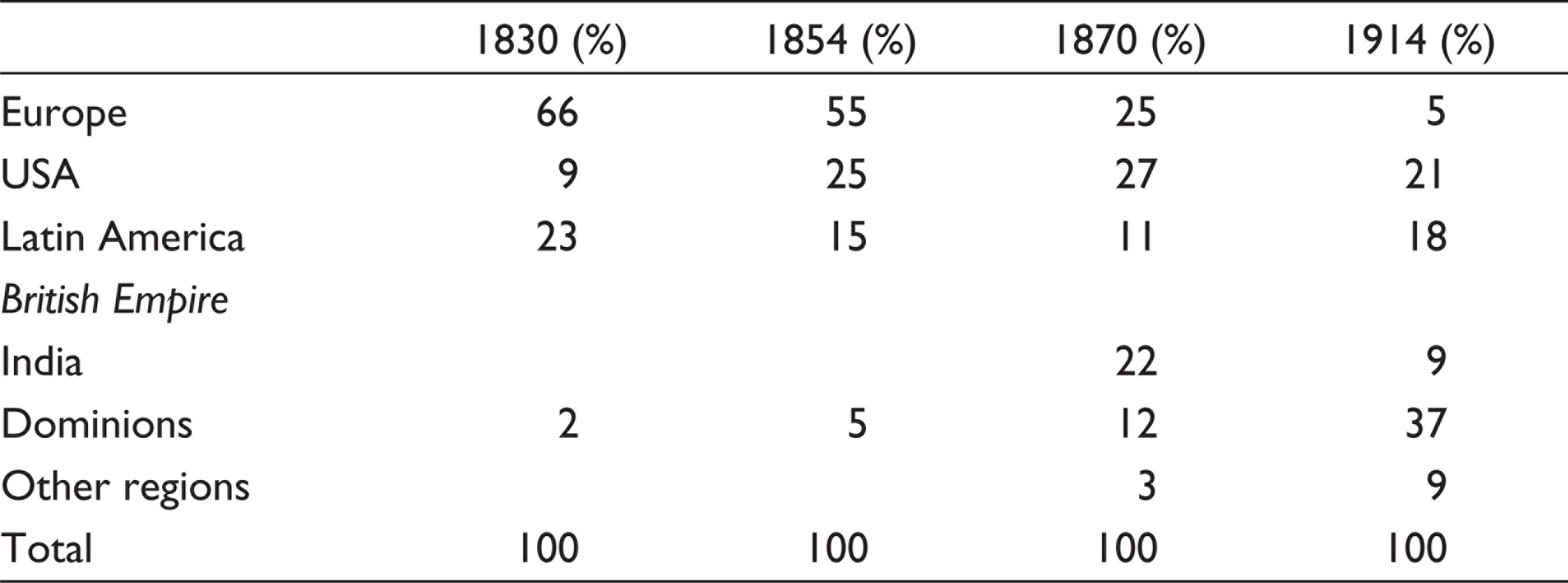
Indeed, it is possible to argue that the French foreign investment to any significant extent became possible only after the British adopted free trade (see below). The unfettered access to the British market then enabled the French to increase their exports to a level that generated a current account surplus necessary for foreign investment. Besides, the French invested mainly in other European countries, while the British invested increasingly in overseas territories. Table 2 shows the geographical distribution of British overseas investment. The ‘new countries’, that is, the Argentine, the USA and the four white-populated dominions, had the biggest share. It was Latin America which in all received most English capital between 1820 and 1914, but between 1865 and 1914, it was the USA. Overall, India did not receive much. She was an important recipient after the 1857 Rebellion, when the British investment went mainly into railway construction, at a guaranteed 5 per cent interest rate charged against the Indian revenue. Railways were constructed mainly with the military purposes in mind.
British Foreign Investment, 1830–1914 (regional distribution)
Most of the British overseas investment was in the form of passive portfolio investment for the financing of railway construction and other social overhead capital projects, mainly in the form of dock and harbour facilities. All of these contributed to a massive lowering of the transportation costs and expansion of international trade. Trade expanded especially with the primary producing countries of the world, Britain and then newly industrialising countries exchanging staple manufactures for foodstuffs and raw materials. The ‘new’ countries, as we have already seen, grew with the emigrant labour from Europe. The huge British investment both facilitated and was facilitated by this emigration. Without the British overseas investment and the British market, the volume of this emigration would have been very much lower as also the growth of the areas of expanding settlement.
British overseas investment was also important for the underpinning of the fact that there were no major monetary crises in the long nineteenth century. These years preceded and then coincided with the ‘high summer’ of the international gold standard, a period which witnessed the final triumph of gold as the basic means of settling international indebtedness. Many attributed to this the fact that there were few monetary problems during this period. This, however, would be an oversimplified view.
From the middle of the nineteenth century, if not earlier, what we had was not really gold standard, but what might be more accurately described as the sterling standard. Sterling was the principal medium of international exchange, with gold only being transferred between countries as a balancing item. Sterling was a currency of unshakeable strength and in liberal supply due to the structure of Britain’s balance of payments. Theoretically, the fact that Britain had a current account on a continual surplus could have given rise to serious adjustment problems elsewhere in the international economy. This did not occur, however, because of the sustained flow of overseas investment from Britain and because of the country’s continued adherence to a policy of free trade. The annual net outflow of funds from Britain more or less matched the current account surplus. Britain, therefore, did not amass large gold reserves with the result that the borrowing countries were relieved of the deflationary adjustments that would have been required under a pure gold standard regime. This again contributed to an expansion of international trade.
British adherence to free trade policy was also very important in this context. In Britain, Corn Laws were abolished in 1846 and the Navigation Laws repealed in 1849. In his budgets of 1853, 1860 and 1861, Gladstone introduced measures which completely freed British foreign trade, and Britain steadfastly adhered to free trade until 1913. 13
British free trade fulfilled a dual function in the context of the sterling standard regime. First, open access to the British domestic market meant that borrowing countries could service their international debts by exporting to Britain. Second, free trade played a key role in the developing network of worldwide multilateral settlement and enabled the USA and industrial Europe to finance their purchase of primary products by exporting manufactures to Britain. Many of the new industrial countries followed industrialisation under protective barriers, and it was important that they had unfettered access for their manufactured goods to the largest market in the world, and it was also important for these countries that they could trade with and draw on raw materials from the countries where the British had invested. Germany, in particular, would have suffered greatly from an abandonment of the British free trade, for, among other reasons, she had no colonies of any substance. Germany also, as we have seen, greatly benefitted from the fact that the Germans could emigrate in such large numbers to the ‘new’ overseas countries (see more on this later).
The Indian Foundation of British Policies
We have seen above that the British overseas investment, open access to the British market and the usage of sterling as a de facto international currency in combination were of critical importance in shaping the nineteenth-century world economy. We shall now argue that without the British political and economic control of India, the British overseas investment would have been very much lower, the so-called gold standard regime unsustainable and the maintenance of British free trade policy impossible or extremely difficult.
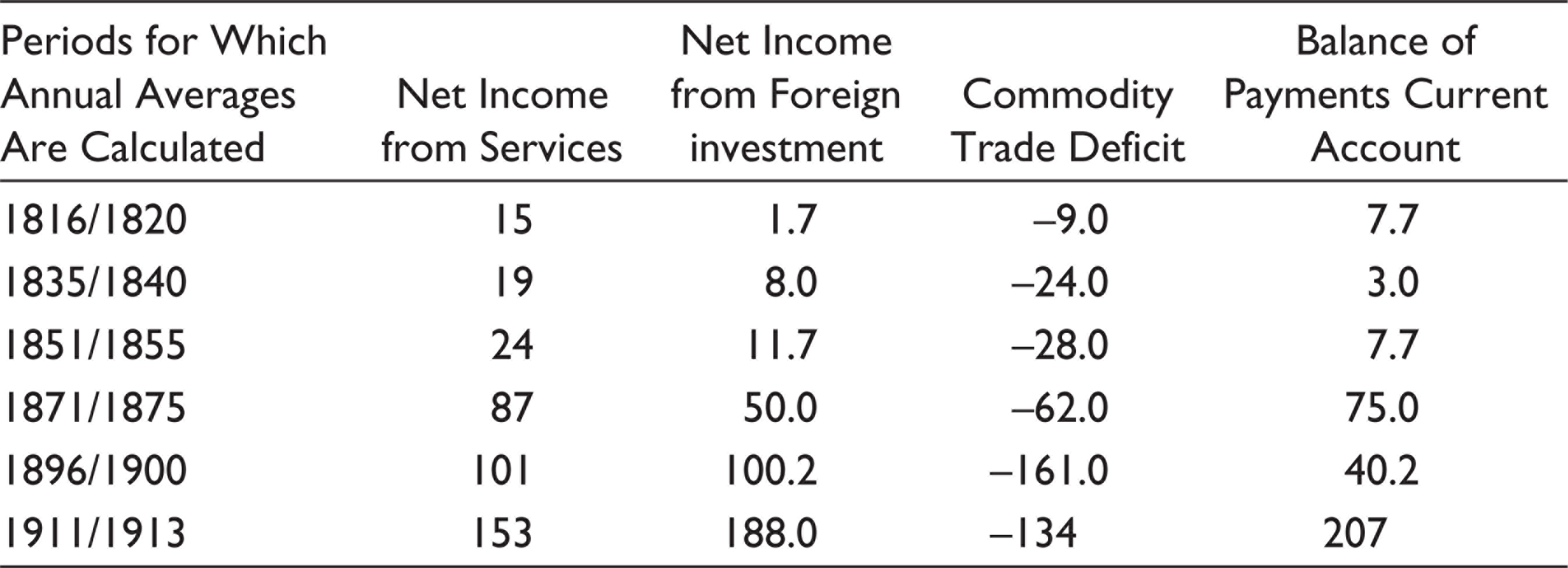
Consider first the case of British overseas investment. To be able to export capital more or less continuously, a country needs to generate surplus on the current account on a more or less continuous basis. Throughout the nineteenth century, and already during the eighteenth, Britain’s visible trade was in deficit (see Table 3). As we have already noted, she had sizeable surplus with India, but overall her trade was in deficit and without this Indian surplus, her deficit, of course, would have been much greater. 14 The visible trade deficit, however, was more than covered by her (large) invisible earnings.
The invisible earnings can be divided into two components: the first is the net income from services, and the second is the net income from foreign investment. Consider first the net income from services. Recall that the net income from services (usually known as invisible exports) consists of the earnings resulting from shipping, insurance, banking activities, commissions on re-export trade, tourism, activities/repatriated profits of trading houses and agencies in foreign countries, and transfer of funds by emigrants
Visible Deficit and Invisible Earnings, UK, 1816–1913 (annual averages in millions of £)
There can be no doubt that the political control of India was instrumental in generating a very large proportion of the net income from services. There was obviously, first the transfer of funds by the British personnel in India. Second, India’s external trade came to be almost exclusively controlled by British merchants. India’s exports had been rising from the mid-nineteenth century, and India’s export values grew fivefold between 1870 and 1914. ‘British merchants at Indian ports, principally Calcutta, marketed India’s exports generally as well as British imports to India. One-tenth of the entire trade of the British Empire passed through India’s seaports, more than a third of the total Empire trade outside Britain. The pivotal role of British merchants in India’s world trade enabled them virtually to monopolise its shipping, insurance, and international banking activities’ (Moore, 1999, p. 441). Also, India’s China trade and the wider ‘informal empire’ generated large incomes from services. These would have been impossible to achieve without the Indian base and the Indian Army. Indian labour emigration to tropical colonies also helped generate large services income.
Equally, invisible expenses would have been much greater without the control of India, for, as we have already noted, the Indian Army, paid for by the Indian taxpayers, was widely used to further British trade and commerce. Also, as already noted earlier, expenditure on ‘Army and ordnance’ was the second most important item of British government expenditure (after interest payment on public debt), and if the Indian tax payers were not paying for the expenses of the India Army (including the British troops stationed in India) and its use for imperial purposes, the British government expenditure on army and ordnance would have to have been much higher. Indian revenue also paid for the expenses of some of the British diplomatic missions abroad.
So without the control of India, net income from services would have been very much lower. Commodity trade deficits, however, would have been very much higher, for an independent India, in all probability, would have protected her cotton industry.
So far as the second component of the invisible earnings—the net income from foreign investment—is concerned, the genesis of this foreign investment, as we have already noted, lay in the transfer of wealth from India in the late eighteenth century and later, subsequent, rapid rise in capital exports can also thus be seen to be dependent crucially on the political control of India. Without the captive Indian market, the use of the Indian Army and the Indian transfer, the volume of British overseas investment would have been very much lower. It is also worth remembering, as we have already noted, that India also made Britain a more saving and investing country.
Similarly, it is possible to argue that without the control of India, Britain’s continued adherence to free trade would have been extremely difficult, if not impossible. Consider why Britain continued to adhere to a policy of free trade. The City and the financial interests, of course, had no interest in protection. They wanted a greater volume of trade, for a greater volume of trade meant a greater volume of invisible earnings. ‘Britain’s financial and industrial lead was so great that opening an area to outside influences by treaty was often sufficient to ensure that British trade and finance, rather than any rivals’, would be paramount in that region’ (Cain & Hopkins, 2001). The expansion of the British influence and commerce beyond the territorial empire in China and South East Asia and in the Middle East and the rest of Africa was highly facilitated by, if not entirely dependent on, the Indian base and the Indian Army. (We have already discussed the case of China and its significance. In the Middle East, Britain became Egypt’s main foreign trade partner, particularly in the second half of the nineteenth century, and there were penetrations elsewhere too, including Turkey and Persia.)
So far as the manufacturing interest was concerned, the most important industry—the cotton manufacturing—felt no need for protection so long as the Indian market remained open to them, and new markets could be opened through the imperialism of free trade (with, one may say, the help of the Indian base and the Indian Army).
And agriculture could be allowed to decline in Britain with less political and social turmoil than on the Continent because the manufacturing and the financial sectors were so much more important than agriculture in Britain. (Agricultural sector in Britain had declined to employ only 23% of workers in 1871; in France, the figure was about 50%.) Further, the British were able to emigrate in huge numbers to Australia, New Zealand and Canada. ‘Given the close relationship between Britain and these primary producing countries, British overseas investment in these countries was in a sense almost tantamount to investing in the primary sector of the British economy itself’.
Finally, and in a very important sense, India indirectly overcame the foreign tariff barriers for the British economy. While the British manufactures faced protectionist barriers in the USA and continental Europe, Indian exports to these countries faced little tariff barriers. Therefore, so long as the Indian market remained open to British manufactures, Indian exports to these countries indirectly overcame foreign tariff barriers for the British economy. As Kenwood and Lougheed (1992, p. 98) put it, ‘Britain was able to absorb large quantities of foodstuffs, raw materials and manufactures from highly protected countries without having to increase her exports to these countries because of India’.
It would thus appear that if Britain did not have the possession of India, Britain’s continued adherence to free trade would have been difficult, if not impossible; the total volume of British overseas investment would have been very much lower (if not negligible or non-existent) as would have been the volume of emigration from Europe (and in-migration into European offshoots). The sterling too in these circumstances would have been unable to fulfil the crucial role that it played in maintaining international monetary stability. The volume of international trade would have been considerably lower. Britain was at the centre, indeed the driver of the world economy in most of the nineteenth century and it is her Indian possession that enabled her to do so. British policies, based on her Indian foundation, contributed to bringing about a convergence in incomes between the richer and poorer European countries on the one hand, and between the ‘old’ and the ‘new’ Europe on the other, while at the same time contributing to bringing about a divergence in incomes between ‘Europe’ and the Rest.
British Control of India and Aspects of the French, German and American Economic Development
We have argued above that Britain’s political and economic control of India was central to the establishment of an international economic order in the nineteenth century that was profoundly influential for the growth of both the ‘old’ and the ‘new’ Europe. Some of the aspects of Britain’s interrelationship with India can also additionally be discussed in some more country-specific ways. We look at some of the relevant aspects of the French, German and American economic development in this context.
French Economic Development
The French economic development in many ways paralleled that of the English in most of the eighteenth century and the French were not that far behind the English in terms of economic development (see, among others, Crouzet, 1990). However, the Revolutionary and Napoleonic wars were to prove highly inimical to France’s own economic development.
After the return of peace, France could export by finding a niche where the British were not already dominant. They concentrated on different industries to those of the British, but which often involved finishing British semi-finished goods. They also concentrated on exporting ‘luxury’ or high-quality goods, usually involving a considerable proportion of hand labour, to rich clientele in English-speaking countries. Much of the raw materials for many of these items came from areas of new settlements, such as Argentina and Australia (which, of course, grew with British investment and European immigrant labour).
The other important earner for France became the financial income accruing from the export of capital. However, as we have already noted, the French foreign investment to any significant extent became possible only after the British adopted free trade. For French capital, the years 1850–1870 were the expansionary period par excellence (cf. Cameron, 1952, 1961; Caron, 1979). Later, when France’s traditional exports came up against, particularly American and German protectionist tariffs, it was important for the French economic development that Britain continued as a free trading nation (cf. Crouzet, 1990).
German Economic Development
Opportunities for overseas emigration in large numbers throughout most of the nineteenth century as well as the availability of foreign capital at crucial times (from both Britain and France, with France’s overseas investment, as we have noted, being greatly dependent on British policies) and unfettered access to the British markets were all of great importance for the German economic development and industrialisation.
The safety valve of overseas emigration was particularly important for the German economic and political development. As population continued to grow, agriculture was in no position to absorb the increase in the labour supply. Employment in handicrafts continued to grow in Germany even as it sharply declined in France. Nearly 66 per cent of the cotton weavers in Germany in 1875 were still handloom weavers and household-based industries in rural areas (such as clock making, wood carving and toy manufacture) had continued to grow as a source of livelihood well into the early 1870s (cf. Milward & Saul, 1977). Certainly, in the absence of mass migration, real wages and living standards for many would have remained repressed in Germany for a very long time. Had it not been for British investment in ports and infrastructure and trade routes lowering transportation costs, German economic development and living standards would have suffered greatly.
Britain also invested in a number of key German industries, such as railroads, textiles and energy supply. The development of the German railroad system between 1834 and 1849 was of particular significance for the German industrialisation. The cheap long-distance transport which the railway provided was essential for making profitable investments in heavy equipment and machinery needed to develop deep mining and establish a large-scale metallurgic industry. Much of the initial development in Ruhr mining and the metal industry took place with the participation of foreign capital (both British and French) and enterprise. Railway building also directly stimulated the iron and engineering industries.
Germany also, as we have noted earlier, would have been hurt most from an abandonment of British free trade policy, the continuation of which policy depended, we have argued, on British political and economic control of India.
Economic Development of the USA
So far as the American economic development is concerned, emigration from Europe, capital from Britain, availability of slave labour to do the backbreaking work on southern plantations all played important roles in early American development. In the nineteenth century, it was the demand for raw cotton—as North (1961b) has forcefully argued—which was the most important proximate cause of the expansion of the American economy. After 1815, raw cotton accounted for roughly half of all American export value. British demand for raw cotton to feed its booming mills allowed the American South to specialise in the production of this one export crop. By 1860, as we have already noted, nearly 40 per cent of Britain’s exports were cotton textiles. A total of 75 per cent of the cotton that supplied Britain’s cotton mills came from the American South. Southern cotton production generated export revenues which were then used by the American East to purchase foreign capital, and thereby to specialise in non-agricultural production. Cotton income also stimulated economic growth in the Northeast through sales of manufactures to the American South. The Northeast and the South, in their turn, provided a growing market for Western grain and livestock, providing purchasing power to the food exporting West. Without industrialisation and rapid population growth in the Northeast and the South’s demand for food, specialised grain farming and livestock production in the West would have progressed less rapidly. In short, cotton helped to tie the country together.
Cotton would thus clearly appear to have played a major role in American economic development in the nineteenth century, and the British demand for American raw cotton would appear to have been very important in this context.
Now it is highly likely that the British demand for American raw cotton would have been much lower and her cotton industry much smaller if she did not have a captive and open market in India for her cotton goods, for an independent India—as we have said previously—would, in all probability, have protected her own cotton textile industry and used her own raw cotton, instead of importing them from America.
British capital would also appear to have played an important role in the transformation of the American economy in the nineteenth century. Although foreign investment financed less than 6 per cent of total investment spending in the USA between 1799 and 1900—the American domestic savings rate was quite high throughout (most) of the nineteenth century—inflows occurred at critical points and financed projects of crucial importance for the transformation of the economy. Foreign investment played important roles in transportation projects such as canals, turnpikes and regional railroads. In the years 1815–1840, foreign investment accounted for 20 per cent of capital formation; between 1869 and 1876 they accounted for 15.5 per cent; and between 1882 and 1893, a little over 10 per cent (see Thomas, 1973). Britain was the dominant source of foreign investment in the American economy. And as Goldsmith (1966) wrote, ‘If the United States had been limited to domestic saving, the growth of wealth would certainly have been slower until near the end of the nineteenth century … because these imports were concentrated in crucial areas of growth, and particularly because without them the development of the American railroad system, probably the main economic achievement of the second half of the nineteenth century, would have slowed down considerably’.
The volume of emigration to America was also very large during the nineteenth century as we have already noted. All in all, it would thus appear that in the case of all the three countries considered, Britain’s Indian connections had major and significant economic consequences, in addition to the global effects already considered.
A Concluding Note
In this article, we have tried to highlight those features which seem to us to have been mainly responsible for the divergence between the ‘West’ and the Rest in the nineteenth century. The great battle for supremacy in the eighteenth century was to be between France and Great Britain. During the Revolutionary and Napoleonic wars, the British were able to endure the costs of war better than the French. In Britain, the proportion of total tax revenue required to service the national debt had risen from 32 per cent in 1740 to 66 per cent in 1782 (Brewer, 1989, p. 117). ‘After 1763 it was feared that the cost of servicing the debt had outstripped the nation’s capacity to raise taxes and that a national bankruptcy might ensue’ (Brewer, 1989, p. 124). It was this fear which led the government to add to the revenue by taxing the American colonists, with catastrophic consequences. Fortunately for Britain, at about the same time, the transfer of wealth from India became available, and Britain was free of external debt to face the Revolutionary and Napoleonic wars. And Britain’s position continued to be bolstered by the Indian transfer and other financial returns accruing from the possession of the Bengal revenue (including, as we have seen, customs and tea duties). By contrast, France’s position continued to deteriorate, owing to the costs of wars. Indeed, it would only be a slight exaggeration (if that) to say that the British success during the Revolutionary and Napoleonic Wars rested on Indian transfer and Indian connections. Subsequently, the Royal Navy and the Indian Army would combine to underpin the British power in the world (indeed, as early as 1791, the Indian Army and the Royal Navy together had evicted Napoleon from Egypt). It is India which made Britain a pre-eminent economic and military power and it is British policies, resting on her Indian foundation, which made the difference between the West and the Rest.
Footnotes
The author declared no potential conflicts of interest with respect to the research, authorship and/or publication of this article.
Funding
The author received no financial support for the research, authorship and/or publication of this article.