Prevalence of vitamin C deficiency and its association with stroke risk among U.S. adult population: A cross-sectional analysis spanning 15 years with over 13,000 participants
Restricted accessResearch articleFirst published online July, 2025
Prevalence of vitamin C deficiency and its association with stroke risk among U.S. adult population: A cross-sectional analysis spanning 15 years with over 13,000 participants
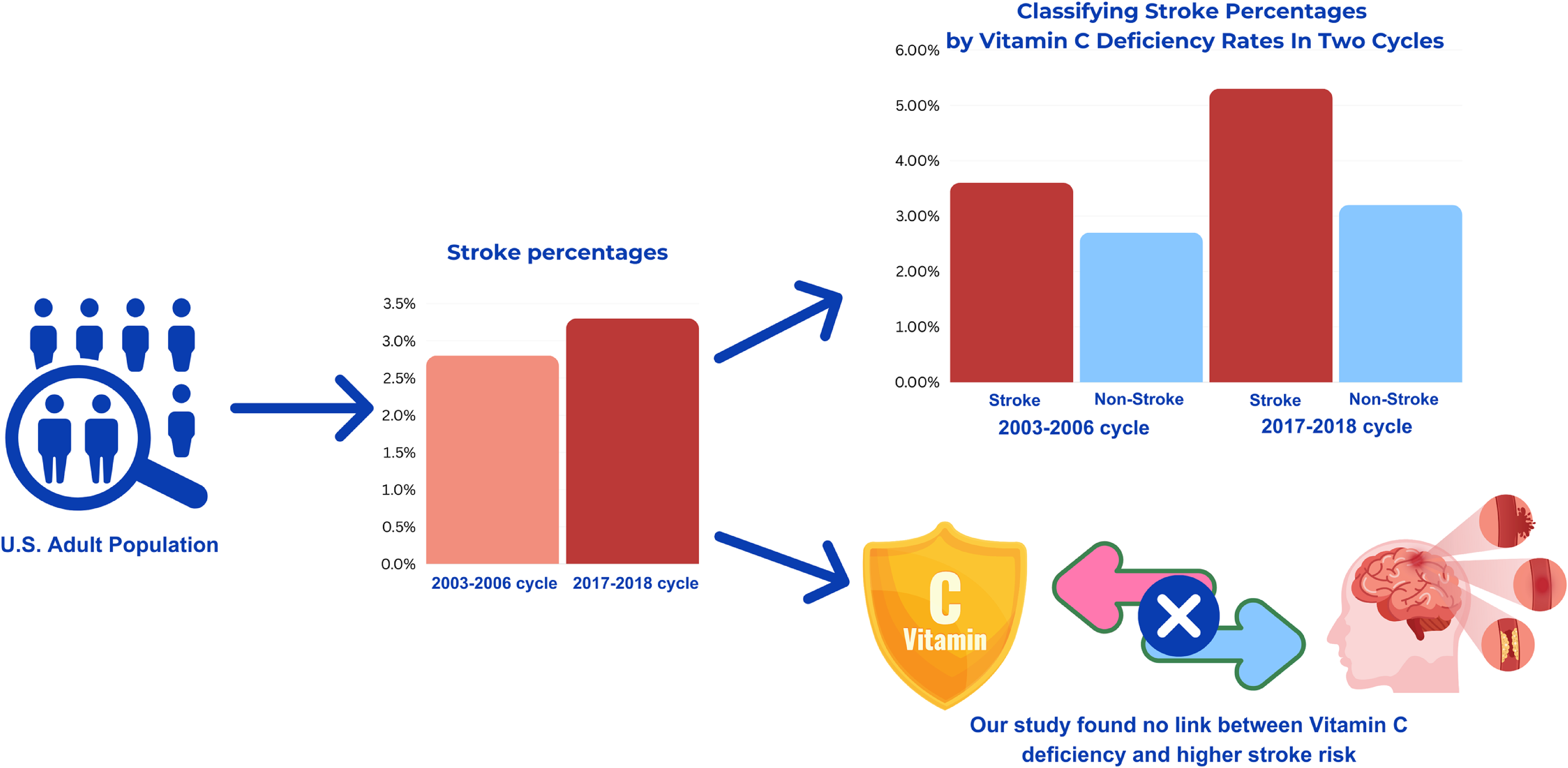
Background: Stroke presents a significant global health challenge. Despite its potential for cardiovascular protection, the role of vitamin C (VTMC) in stroke risk remains contentious. Aim: This study aimed to assess VTMC deficiency in stroke patients and its association with stroke risk. Methods: We analyzed data from 13,339 adults aged 20 and above in the National Health and Nutrition Examination Survey (NHANES) between 2003 and 2018, excluding those with missing serum VTMC and stroke status. We assessed the VTMC deficiency (<11.4 µmol/L) and stroke incidence association using multivariate weighted logistic regression, adjusting for demographics, BMI, medical history, smoking, and dietary VTMC intake. Results: Stroke rates in the NHANES cycles 2003–2006 and 2017–2018 were 2.8% (95% CI [2.3–3.4]) and 3.3% (95% CI [2.7–4.2]), respectively. VTMC deficiency was more common in individuals with a history of stroke, with rates of 3.6% (95% CI [2.2–5.8]) and 5.3% (95% CI [3–9.1]) compared to 2.7% (95% CI [2.3–3.3]) and 3.2% (95% CI [2.5–4.1]) in the nonstroke population. Nevertheless, VTMC deficiency was distinctly prevalent across diverse demographic and health-related subgroups. Multivariate analyses invalidated any statistically significant association between VTMC deficiency and stroke risk across all employed analytical models within both time intervals. Conclusions: Our study does not support a link between VTMC deficiency and increased stroke risk in U.S. adults. Substantial uncertainties persist regarding the use of VTMC for stroke-related oxidative stress, dosage, and delivery methods, requiring further clinical trials. Healthcare providers should carefully consider its prevalence in specific subgroups.
AscherioARimmEBHernánMA, et al. (1999) Relation of consumption of vitamin E, vitamin C, and carotenoids to risk for stroke among men in the United States. Annals of Internal Medicine130(12): 963–970.
3.
BenzieIF (1999) Vitamin C: Prospective functional markers for defining optimal nutritional status. Proceedings of the Nutrition Society58(2): 469–476.
4.
ChanPH (2001) Reactive oxygen radicals in signaling and damage in the ischemic brain. Journal of Cerebral Blood Flow & Metabolism21(1): 2–14.
5.
ChenGCLuDBPangZ, et al. (2013) Vitamin C intake, circulating vitamin C and risk of stroke: A meta-analysis of prospective studies. Journal of the American Heart Association2(6): e000329.
6.
DennisM (2000) Nutrition after stroke. British Medical Bulletin56(2): 466–475.
FanJHeckmanNEWandMP (1995) Local polynomial kernel regression for generalized linear models and quasi-likelihood functions. Journal of the American Statistical Association90(429): 141–150.
9.
FangYZYangSWuG (2002) Free radicals, antioxidants, and nutrition. Nutrition18(10): 872–879.
10.
FormanHJZhangH (2021) Targeting oxidative stress in disease: Promise and limitations of antioxidant therapy. Nature Reviews Drug Discovery20(9): 689–709.
11.
FreiBEnglandLAmesBN (1989) Ascorbate is an outstanding antioxidant in human blood plasma. Proceedings of the National Academy of Sciences of the United States of America86(16): 6377–6381.
12.
GaleCRMartynCNWinterPD, et al. (1995) Vitamin C and risk of death from stroke and coronary heart disease in cohort of elderly people. Bmj310(6994): 1563–1566.
13.
GariballaSEHutchinTPSinclairAJ (2002) Antioxidant capacity after acute ischaemic stroke. Qjm95(10): 685–690.
14.
GBD 2019 Stroke Collaborators (2021) Global, regional, and national burden of stroke and its risk factors, 1990–2019: A systematic analysis for the global burden of disease study 2019. Lancet Neurology20(10): 795–820.
15.
HeFJNowsonCAMacGregorGA (2006) Fruit and vegetable consumption and stroke: Meta-analysis of cohort studies. The Lancet367(9507): 320–326.
16.
HirvonenTVirtamoJKorhonenP, et al. (2000) Intake of flavonoids, carotenoids, vitamins C and E, and risk of stroke in male smokers. Stroke31(10): 2301–2306.
17.
JohnstonCSTaylorCAHamplJS (2000) More Americans are eating “5 a day” but intakes of dark green and cruciferous vegetables remain low. Journal of Nutrition130(12): 3063–3067.
18.
LeeSHMooreLVParkS, et al. (2022) Adults meeting fruit and vegetable intake recommendations - United States, 2019. MMWR. Morbidity and Mortality Weekly Report71(1): 1–9.
19.
LiYSchellhornHE (2007) New developments and novel therapeutic perspectives for vitamin C. Journal of Nutrition137(10): 2171–2184.
20.
MyintPKLubenRNWelchAA, et al. (2008) Plasma vitamin C concentrations predict risk of incident stroke over 10 y in 20 649 participants of the European prospective investigation into cancer–Norfolk prospective population study. The American Journal of Clinical Nutrition87(1): 64–69.
21.
MyungS-KJuWChoB, et al. (2013) Efficacy of vitamin and antioxidant supplements in prevention of cardiovascular disease: Systematic review and meta-analysis of randomised controlled trials. Bmj346: 10.
OuyangYBStaryCMWhiteRE, et al. (2015) The use of microRNAs to modulate redox and immune response to stroke. Antioxidants & Redox Signaling22(2): 187–202.
25.
PowersCDSternbergMRPatelSB, et al. (2023) Vitamin C status of US adults assessed as part of the national health and nutrition examination survey remained unchanged between 2003–2006 and 2017–2018. The Journal of Applied Laboratory Medicine8(2): 272–284.
26.
RabadiMHKristalBS (2007) Effect of vitamin C supplementation on stroke recovery: A case-control study. Clinical Interventions in Aging2(1): 147–151.
27.
SchleicherRLCarrollMDFordES, et al. (2009) Serum vitamin C and the prevalence of vitamin C deficiency in the United States: 2003-2004 national health and nutrition examination survey (NHANES). American Journal of Clinical Nutrition90(5): 1252–1263.
28.
TangXLiuHXiaoY, et al. (2022) Vitamin C intake and ischemic stroke. Frontiers in Nutrition9.
29.
TaylorCAHamplJSJohnstonCS (2000) Low intakes of vegetables and fruits, especially citrus fruits, lead to inadequate vitamin C intakes among adults. European Journal of Clinical Nutrition54(7): 573–578.
30.
ViraniSSAlonsoABenjaminEJ, et al. (2020) Heart disease and stroke statistics-2020 update: A report from the American Heart Association. Circulation141(9): e139–e596.
31.
WuLXiongXWuX, et al. (2020) Targeting oxidative stress and inflammation to prevent ischemia-reperfusion injury. Frontiers in Molecular Neuroscience13.
32.
YochumLAFolsomARKushiLH (2000) Intake of antioxidant vitamins and risk of death from stroke in postmenopausal women. American Journal of Clinical Nutrition72(2): 476–483.
33.
YokoyamaTDateCKokuboY, et al. (2000) Serum vitamin C concentration was inversely associated with subsequent 20-year incidence of stroke in a Japanese rural community. Stroke31(10): 2287–2294.
Supplementary Material
Please find the following supplemental material available below.
For Open Access articles published under a Creative Commons License, all supplemental material carries the same license as the article it is associated with.
For non-Open Access articles published, all supplemental material carries a non-exclusive license, and permission requests for re-use of supplemental material or any part of supplemental material shall be sent directly to the copyright owner as specified in the copyright notice associated with the article.