




Abstract
The purpose of this content analysis was to ascertain what nutrition advice or information is freely available on a global scale through each National Governing Body (NGB) webpage. In total, 52 NGBs and the International Federation of Gymnastics (FIG) were identified based on the FIG November 2022 world rankings for both male and female athletes in all disciplines. Concluding observations were that publicly available nutrition advice is limited across the global gymnastics platforms. Conflicting advice was also identified within some organisations surrounding the weighing of gymnasts for hydration purposes and some macronutrient discrepancies thus, potentially impacting the clarity of the message for the reader. Based on this content analysis recommendations for future practice include providing clarity and provision of tools to measure hydration, dietary recommendations should be clear and specific, and a more centralised approach to standardise advice and publicly available information.
Introduction
Gymnastics is a highly skilled aesthetic sport involving a large training and competition load (Dallas et al., 2017; Kaur and Koley, 2019; Sweeney et al., 2018). As a result of these high demands, appropriate nutrient intake for training, competition and recovery is paramount to ensuring successful athletic performance and maintaining good health (Dallas et al., 2017). Although it is generally accepted that athletes need appropriate fuelling, there is a question as to whether gymnasts or their support personnel are aware of recommended energy requirements and how or where they should seek information to support this (Dallas et al., 2017; Juzwiak and Ancona-Lopez, 2004). Many factors contribute to the importance of meeting energy requirements in gymnasts such as energy expenditure, training load and the relative age of the gymnasts (Fogelholm et al., 1995; Goulart et al., 2022; Kawano et al., 2002; Purcell, 2013). However, consistently in the literature gymnasts display lower energy intakes than reported energy expenditures (Fogelholm et al., 1995; Kawano et al., 2002), implying an energy deficit of between 300 and 700 kcals which can have a detrimental effect on performance (Cupisti et al., 2000; Gifari et al., 2020; Matsushita et al., 2019). One of the potential barriers for gymnasts consuming optimal intakes could be the influence of key athletic support personnel. Coaches spend a large portion of time with their athletes, particularly at the elite level, and are responsible for the gymnast, their training and squad selection (Torres-McGehee et al., 2012). It is therefore unsurprising that coaches naturally become a key contact point for athletes to seek information and support (Slater et al., 2003). Additionally, as gymnasts begin intensive training at a young age, their parents will likely have primary responsibility for their dietary intake (Gjaka et al., 2021). Parents provide an environment in which children relate to food (Scaglioni et al., 2008). However, it has been reported in the literature that parents would like to enhance their nutritional and well-being knowledge, which suggests that they might feel ill-equipped to support their children with their sport specific needs (Gjaka et al., 2021; Thomas et al., 2012).
If an athlete, coach, parent or guardian were to look for nutrition information, a logical place to look in the first instance would be the member National Governing Body (NGB) webpage. Therefore, it is important to review what information is offered by gymnastic NGBs to understand whether the information is aligned with the literature, and what each NGB considers important for their athletes to optimise health and performance. The purpose of this analysis was to ascertain what nutrition advice is freely available on a global platform for gymnasts.
Methods
A content analysis was used to extract the data (Harwood and Garry, 2003; Kleinheksel et al., 2020). In the first instance, the International Federation of Gymnastics (FIG) world rankings were consulted including all Olympic disciplines, trampoline, artistic and rhythmic gymnastics disciplines for both male and female gymnasts. A list was created of all the world ranked gymnasts, and a search strategy was developed by identifying the NGBs where the gymnast was involved. National Governing Body webpages were located either by searching manually or looking through the FIG webpages. When a webpage was found, it was first translated to English through Google Translate if it was a non-English speaking country. The webpage was navigated manually, and search terms were used to ascertain nutrition information. The search terms included: nutrition, food, meal, diet, carbohydrate, protein, fat, hydration, supplements and vitamins and were typed in both in English and the language of the webpage. If items came up that were unable to be translated, these were excluded from the synthesis. The search terms were discussed amongst the review team and deliberately chosen for simplicity, hoping to replicate what a coach, gymnast or parent might look for. If an NGB's webpage could not be found, this was recorded as information inaccessible. If an NGB's webpage was found but there was no information accessible regarding nutrition, these were still included in the synthesis. Two researchers completed the search to minimise the risk of missing data and were cross-checked to ensure the data was aligned.
Results
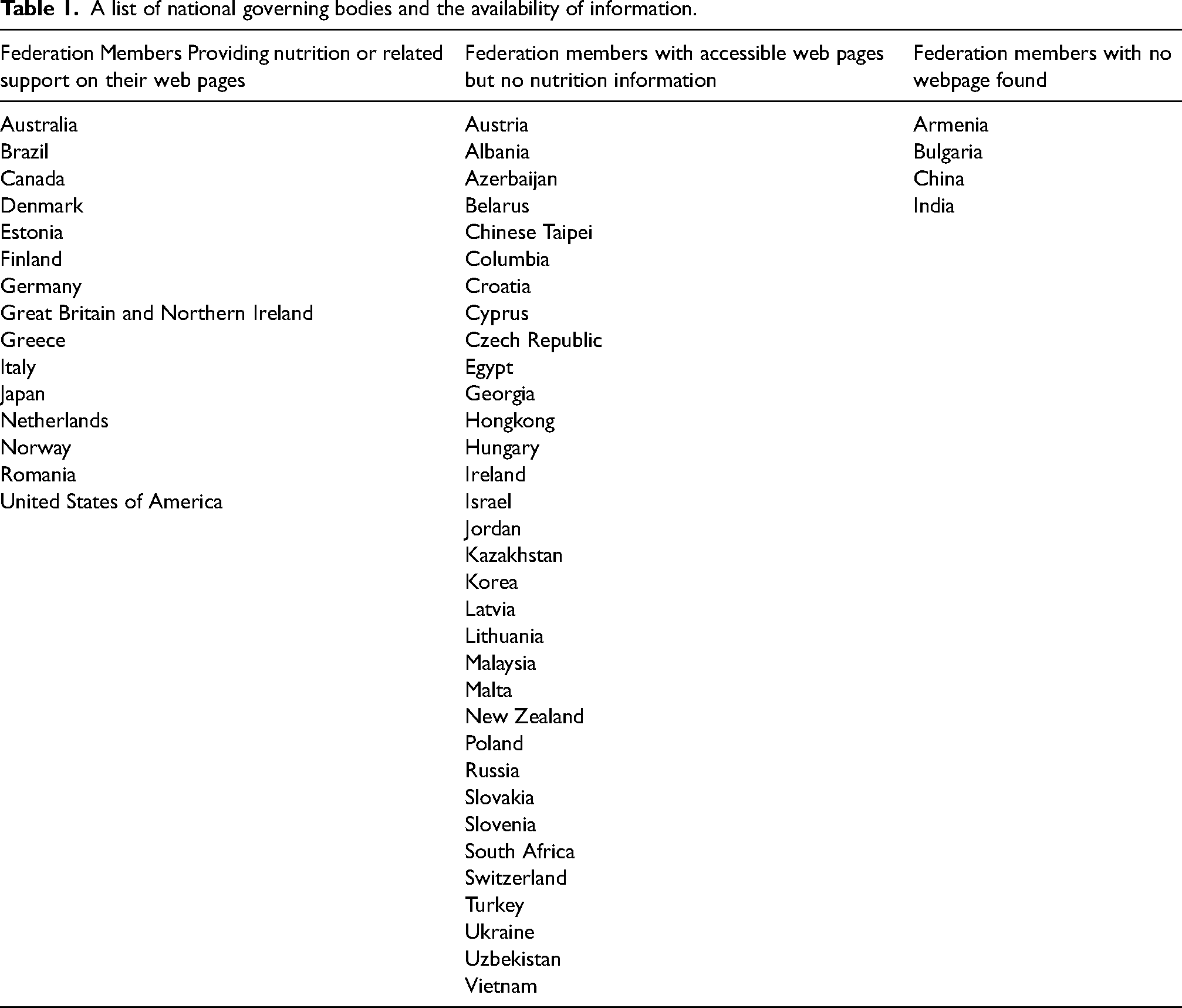
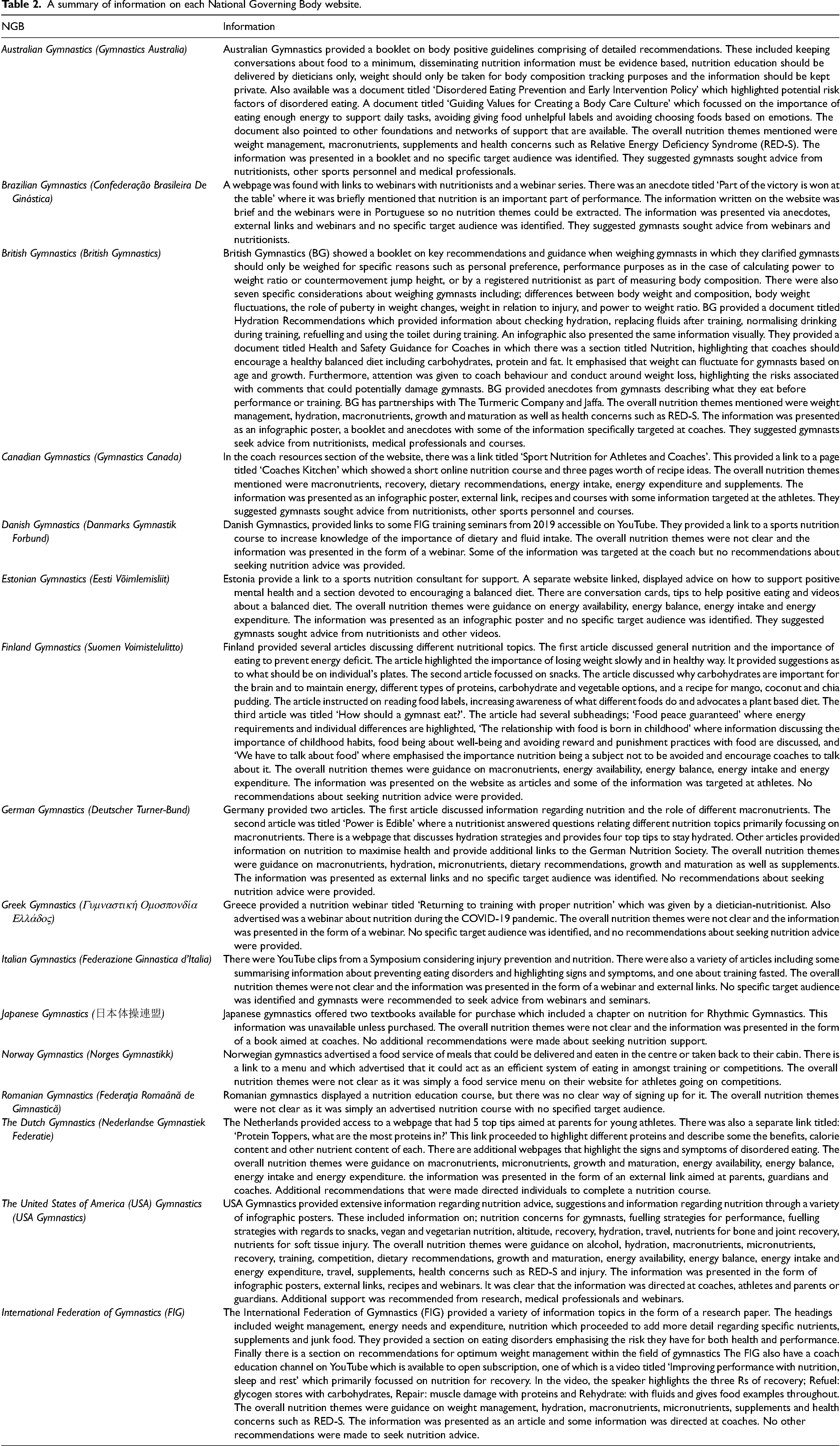
Fifty-two governing bodies were included in the search, 48 of which we could access a website and 15 had information regarding nutrition (Table 1). Table 2 provides a summary of the nutrition related information on each website. The most frequent types of content were macronutrients (8), energy intake/expenditure/balance/availability (6), supplements (5), growth and maturation, hydration, micronutrients, RED-S (4), weight management, more general dietary advice (3), training/recovery/competition (2), alcohol and injury (1). The information was portrayed via a webinar/seminar/course, recommended external links (6), infographic/poster (4), booklet, anecdote and recipes (all 2). Most of the information was not targeted at a specific audience, but some NGBs had resources directed at coaches (6), athletes (3) and parents (2).
A list of national governing bodies and the availability of information.
A summary of information on each National Governing Body website.
Findings
The purpose of this study was to ascertain what nutrition advice is freely available to gymnasts, coaches and parents or guardians on a global platform using lay search terms. Although there was a variety of nutrition information found across different NGBs, it also appeared that free public nutrition advice is limited and sometimes conflicting across the global platforms.
Out of the eight NGBs to mention macronutrients, five different NGBs, including the FIG (America, Germany, United Kingdom, The Netherlands, FIG), made more detailed references, but only USA Gymnastics provided specific recommendations. The recommendations provided by USA Gymnastics were detailed and provided diagrams to make information clear. The information provided by USA Gymnastics was lower than literature recommendations for carbohydrates (by 2 g.kg.bw−1) and higher for protein (by 0.3 g.kg.bw−1) (Bonci, 2010; Cotugna et al., 2005; Dallas et al., 2017; Desbrow, 2021). The remaining NGBs, including the FIG, provided some detail about the function of macronutrients and why they are important, but they did not discuss any specific recommendations. For example, British Gymnastics encouraged athletes to consume ‘appropriate’ amounts of macronutrients, however, there was no information or advice as to what ‘appropriate’ amounts are.
Conflicting information, or at least information that would benefit from further clarity, was evident on some websites. This might, at times, be due to translation issues, but one example was Germany's NGB which provided two articles discussing nutrition one of which highlighted a food first approach, emphasising the importance of obtaining protein from natural sources, and then in brackets wrote ‘no shakes’. In another article titled ‘Power is Edible’, there is a comment from a nutritionist saying ‘I definitely believe in protein in the shake area’. Whilst this comment is also accompanied by discussions about the importance of this alongside a healthy diet, it could be open to misinterpretation. Furthermore, the Netherlands NGB provided some in-depth advice about different carbohydrates encouraging the consumption of mostly slow-releasing carbohydrates and avoiding simple carbohydrates. Where this is a widely accepted healthy option, it also omits information about the benefits provided by the FIG which says that quick releasing carbohydrates can be useful for recovery or quick bursts of energy (Binder, 2013).
Another area of potential conflict was around hydration. British Gymnastics provided an in-depth document describing the importance of hydration alongside an infographic to display the information visually. The USA also provided a detailed infographic with the addition of specific fluid recommendations which are concurrent with the America College of Sports Medicine guidelines (Thomas et al., 2016). However, the complication with these recommendations is they focus largely on body weight to determine the volume of fluid losses. The FIG actively discourages the regular weighing of gymnasts due to the stress it places on them and the reinforcing unhealthy narratives around body weight (Binder, 2013). Therefore, providing recommendations that require body weight monitoring might not be the most effective way to measure hydration in gymnasts.
A final example of potential conflict relates to the search function within the NGB websites. Most of those containing a search function searched only within the site itself. However, others had a different hosting platform that returned external hits at the top of the list (Brazil, Canada, Egypt) ahead of those within the site. These were often links to supplement companies, weight loss organisations or food boxes which may or may not include appropriate advice and guidance. This is also unhelpful as NGBs could be seen as recommending a variety of services some of which might not be appropriate for gymnasts.
There was a wide range of other information provided by different NGBs surrounding nutrition. Some information was detailed but did not appear specific to gymnastics (e.g., Finnish Gymnastics). Other information provided recipes and was more specific to coaches (e.g., Gymnastics Canada, BG). The information specifically targeted at coaches was not only detailed but also potentially useful for athletes and parents. However, as it was titled for coaches, it might mean that other parties would not look or read the information assuming it is not for them.
Summary
In summary, some NGBs provided more information than others, with few providing specific guidance on nutrient intakes. This could leave readers feeling reassured about the role of certain nutrients but also unsure as to how much they should be eating of each macronutrient. Some organisations provided advice that would benefit from further clarity, or advice in conflict with the FIG recommendations, which might lead to confusion. Furthermore, guidance provided around hydration focussed on weight related guidelines, which could be difficult to enact, particularly with the concerns around overemphasis on weight within the gymnastics community. Therefore, to provide effective support for the gymnastics population, clear guidelines and support should be available to ensure optimal energy availability, health and performance.
Limitations
The retrieved results are limited to the terms used to search the websites, and it is possible that information might have been missed. Therefore, whilst we might not have a definitive list of content, any content missed is likely difficult to locate by other website users too. Google Translate was used to interpret webpages and translate search terms meaning no reference point was given to confirm the validity of the webpages. Some NGBs provided PDF style documents that could not be easily translated, therefore, nutrition information might have been excluded due to translation barriers. Some NGBs might have included a member paywall which potentially prohibited information being sought. Finally, it should be acknowledged that some NGBs might keep their nutrition information private for competitive reasons.
Recommendations
Dietary recommendations: A lot of general guidance was found among the NGB websites, with most seeming to stay away from providing specific dietary recommendations. More specific advice, as to how much of each nutrient should be consumed, would provide additional essential information to enable athletes to achieve optimal energy availability. Alternatively, NGBs could signpost their members to relevant professionals such as dieticians or nutritionists, for additional and specific support.
Hydration: Hydration guidelines were only present from a couple of NGBs and some of those referred to guidelines relating to weight which could only be possible through regular weighing of gymnasts. This is actively discouraged by the FIG and other NGBs (USA, Australian and British Gymnastics) due to the risk of over-emphasising weight changes and fluctuations. Therefore, clarity around measuring hydration status and the provision of tools would benefit the gymnastics community.
Centralised advice: Some of the advice present among NGBs was conflicting or contradictory to the FIG recommendations. Therefore, the gymnastics community would benefit from a centralised nutrition platform approved by the FIG to give clear guidance to all athletes, coaches and parents.
Website search hosting: NGBs should be aware of any external links that feature at the top of search lists ahead of hits on their own website, as these may be accessed ahead of their own quality assured content.
Footnotes
Acknowledgements
The author is grateful to all those who have worked with me, to establish an interesting and thought-provoking paper. For their time, wisdom, and patience the author is immensely thankful. Particularly to my supervisor, for his patient and committed checks of the data and support throughout.
Author contributions
The primary author formulated the research question, and the study design, carried out the study, analysis of the data, interpreted the findings and wrote the article. Significant support was provided by supervisors throughout the process through the development of the methods, refining the research question and completing a secondary check of the information. All other authors provided advice regarding editing, format and intellectual input into the data synthesis and writing of the manuscript.
Availability of data and materials
This paper is a collection of data accessible to the general public. All information was freely available at the time of writing.
Consent to publish
I, Jessica Riman, give my consent for this paper to be published in the Journal of Nutrition and Health.
Declaration of conflicting interests
The authors declared no potential conflicts of interest with respect to the research, authorship and/or publication of this article.
Ethical statement
This study was a collection of information already publicly available, therefore ethics were not applicable.
Funding
The authors received no financial support for the research, authorship and/or publication of this article.
