




Abstract
This paper aims to investigate the effects of new public management reforms on human resource practices of a public organization in Jordan, a Middle Eastern country in the developing world. The data was collected from fifteen purposeful semi-structured interviews in the Greater Amman Municipality (GAM), one of Jordan’s biggest public organizations. The data was analyzed using thematic analysis (i.e., a coding technique). The findings revealed the challenges and gaps in Human Resource (HR) practices from gaps in implementing New Public Management (NPM) reforms which weakened the performance of the public organization. The discussion and conclusion are presented at the end.
Keywords
Introduction
In recent times, scholars have paid greater attention to the performance of public organizations through the implementation of new public management (NPM) reforms and have also evaluated the performance development of public servants due to the strong emphasis on delivering good public services to the public (El-Ghalayini, 2017; Thompson, 2017). Performance of public organizations may be defined as all public services, programs, or goods delivered and controlled by public entities to serve the public (Jamaludin, 2015; Mahmoud et al., 2020). In general, NPM reforms are identified as any practice, activity, or method introduced and implemented into public entities to maximize the process of public service delivery (Dunleavy et al., 2006). In other words, NPM reforms are determined as a set of characteristics, practices, or themes adopted in public entities to deliver public services in a superior way (Lodge & Gill, 2011). On the other hand, human resource management (HRM) is defined as a distinctive approach to managing and regulating the workplace, achieving a competitive advantage and quality in performance through the strategic deployment of a highly qualified workforce, using an integrated bundle of managerial activities (i.e., practices) and regulations (i.e., policies) to orient the efforts of the workforce towards performance (Budhwar et al., 2019; Dahie & Mohamed, 2017). In response, HR practices and policies are used to manage and regulate workforce performance from the time they enrolled in an organization until the time they left their jobs (Boon & Verhoest, 2018). Scholars have debated on the fields of services delivery and HRM of public organizations in developed and developing countries (El-Ghalayini, 2017; Thompson, 2017). However, scholars have stated that the implementation of NPM reforms differs from one country to another, which creates different approaches to HRM and performance of public organizations (Leisink & Knies, 2018). Further, the implementation of NPM reforms in several developing countries is imperfectly and inconsistently implemented, generating problems not only in HRM (Mahmoud & Othman, 2021) but also in the process of public services delivery (Ramos & Milanesi, 2020; Ukeje et al., 2020).
Hence, this paper aims to investigate the effects of NPM reforms on HR practices in Greater Amman Municipality (GAM), a public organization in Jordan. Although public organizations spent approximately $13 billion in the years from 2013 to 2018 on public services in the fields of public health and transportation, these public services were weak and unsatisfactory, particularly in GAM. The main reasons behind the problems related to public services are several gaps in implementing NPM reforms and the poor performance of public servants (JESC, 2018). Scholars have discussed that the implementation gaps of NPM reforms are the crux of the challenges and gaps in HR practices and poor public services (Ahenkan et al., 2018; Bhiwajee & Garavan, 2016; Errami & Cargnello, 2018; Nyamori & Gekara, 2016; Siddiquee et al., 2019; Tioumagneng & Njifen, 2019; Vu et al., 2019). Moreover, if the prevalent HR practices and policies are insufficient to manage, motivate, develop, and maintain the best servants, public organizations will experience poor performance (Boon & Verhoest, 2018; Budhwar et al., 2019; Khumalo, 2018) because the performance of any public organization relies mainly on the skills, qualifications, and competencies of its servants (Busara, 2016; Gooderham et al., 2018; Rowland & Hall, 2012).
Therefore, this paper aims to investigate the effects of NPM reforms on HR practices. Accordingly, this paper is organized into five sections. The first section presents the literature review. The second section highlights the research methodology. The third section reveals the findings. The fourth section provides the discussion and the fifth section offers the conclusion.
Literature Review
NPM Reforms
The implementation process of NPM reforms differs from one context to another (Leisink & Knies, 2018). It has been observed that the implementation of NPM reforms in the developing world, in particular, is affected by the macro-level environment, including the economies of the governments (Mussagulova & Van der Wal, 2019; Vu et al., 2019), the pressures of international organizations (Errami & Cargnello, 2018; Ustuner & Yavuz, 2018), the agenda and political reforms of the various parties (Guga, 2018; Ukeje et al., 2020). Moreover, many developing countries failed to implement the NPM reforms at the micro level. On the basis of this failure, scholars have stated that the implementation of NPM reforms is typically a dead letter (Ramos & Milanesi, 2020). In addition, servants do not deal with the NPM reforms as a new approach for managing and operating public organizations to improve and develop service delivery (Ikeanyibe, 2016). It weakens services, reduces stakeholder satisfaction (public and staff), and creates a relationship of mistrust between public organizations and their public (Guga, 2018; Powell-Jackson et al., 2019; Ukeje et al., 2020).
The NPM concept refers to three components, namely incentivization, competition, and disaggregation (Dunleavy et al., 2006). The incentivization component refers to specific rewards rather than general rewards for performance, using a flat salary scale for the commitment shown by the servants to specific values in an organization (Miller, 2000). The competition component refers to public entities seeking to recruit the best public servants who are highly motivated to provide superior services (Hood, 1995; Le Grand, 2003). The disaggregation component refers to a division, decoupling, or subunits of public entities towards a broader mission which focuses on public service delivery and enhances performance results and accountability (Dunleavy & Hood, 1994). The idea is that granting a free hand to public units would strengthen central control of performance results by the top management (Pierre, 2000). More specifically, the governments enumerate on the services that would be delivered while the sub-units identify how these services would be delivered (Osborne & Gaebler, 1992), thereby giving HR the autonomy to deliver these public services efficiently within public organizations (Suhail & Steen, 2018).
These three components of NPM have translated into several reforms. They are: (1) characterization that refers to the post-bureaucratic competitive government to obtain more flexible ways of delivering services, (2) the citizen-state relationship that interprets the required entitlements in this relationship to empower the public about services, (3) accountability relegated to those who receive these services like customers who need to be satisfied, (4) dominant focus or guiding principles that relate to performance results, (5) professional relationship between deliverers and receivers, (6) system of delivery that adopts private sector thoughts in division or divided public entities into sub-units, (7) performance objectives that focus on managing performance inputs and outputs, (8) role of public participation that gives community feedback on the public services delivered (Turner et al., 2019; Ugyel, 2014), and (9) performance management, a key significant NPM reform that modernizes and delivers public services superlatively (Bianchi & Xavier, 2017).
Primarily, the gaps in implementing the NPM reforms involve inefficiency, ineffectiveness, bureaucratic issues, lack of autonomy, irresponsibility, lack of transparency, weak accountability, poor legal framework, weak HRM role, and poor public participation (Bobe et al., 2017; Errami & Cargnello, 2018; Mahmoud & Othman, 2021; Vu et al., 2019). More specifically, factors like ineffectiveness, inefficiency, low quality, weak HRM, weak accountability, and irresponsibility have resulted in an inability to achieve goals, goals and jobs ambiguity, poor organizational practices, deficit of competencies and skills, and performance management system weaknesses (Ahenkan et al., 2018; Gupta et al., 2018; Mostafa, 2016; Mussagulova & Van der Wal, 2019; Siddiquee et al., 2019). To add to these, factors like corruption, bureaucracy, lack of autonomy, and poor legal framework have resulted in centralization activities, servants’ dissatisfaction, weak HRM role, unethical practices (e.g., wasta, cronyism, sentiments, quota system, and collusion), and lack of organizational alignment (Bhiwajee & Garavan, 2016; Errami & Cargnello, 2018; Mussagulova & Van der Wal, 2019; Shaheen et al., 2017; Ukeje et al., 2020; Ustuner & Yavuz, 2018). Consequently, the mentioned gaps in implementing NPM reforms may weaken HR practices and policies such as performance appraisal, training and development, motivation (i.e., motivational initiatives), workforce management, succession management, and policies regulating these HR practices (Ahenkan et al., 2018; Ikeanyibe, 2016; Nyamori & Gekara, 2016; Siddiquee et al., 2019; Vu et al., 2019; Ustuner & Yavuz, 2018). In addition, scholars have emphasized that these HR practices and policies concerning the implementation of NPM reforms in the developing world should be studied within the purview of public organizations (Mahmoud & Othman, 2021).
HRM (HR Policies and Practices)
The NPM concept played a vital role in moving HRM from a routine role to a strategic one by empowering public organizations to adopt strategic decisions in the field of HRM and establishing activities that would have a long-term effect on the performance of servants (Leisink & Knies, 2018). Accordingly, HRM should be integrated and aligned with organizational strategies based on HR policies (Gooderham et al., 2018). However, scholars have elaborated that HR policies of public organizations stem from government regulations, labour relations, and management ways (Edgar et al., 2016). HR policies of public organizations are committed to administrative roles and high levels of centralization roles which hinder the flexibility and productivity of reforms (Boon & Verhoest, 2018; Brown, 2004). In addition, most problems of HR practices are a result of management ways and organizational contexts such as bureaucratic models and centralized roles (Budhwar & Mellahi, 2016) because the HR policy, which regulates HR practices, originated from government regulations and legislation, which also regulate public organizations (Edgar et al., 2016). Thus, the linkage between HR policy and government regulations may generate traditional and old-fashioned HR practices (El-Ghalayini, 2017).
Performance Appraisal
Appraising employee performance is one of the oldest managerial practices and is widely used to evaluate and gauge employee performance (Prasad, 2015). It is defined as an agreement between managers and employees at a formal meeting to clarify positive and negative aspects of the employees’ performance, improve their strengths and address their weaknesses to achieve the expected performance of employees so that organizational goals are achieved (Armstrong et al., 2014; Longenecker & Fink, 2017). Performance appraisal is related to motivation (i.e., performance reward), training and development, employees’ promotion in their career path, and other practices that are related to employees’ transfer, recruitment, and all other activities of employees’ affairs towards organizational performance (Kim & Holzer, 2016; Wang et al., 2019). In addition, performance appraisal is used for development and evaluation purposes (Jackson & Schuler, 1995). The formal performance appraisal helps in performance planning, establishment of performance management systems, training and development programs and in explaining the mechanisms for obtaining the expected results of performance (Longenecker & Fink, 2017). Performance appraisal is a tool for formal monitoring and tracking of employee performance towards improving organizational performance (Antwi et al., 2016). Overall, performance appraisal is classified as administrative type and developmental type. Administrative type uses when performance appraisal evaluates the employees’ performance to control and direct efforts toward organizational performance. Developmental type uses when performance appraisal develops and empowers the employees’ capabilities and uses the results of performance appraisal to design training programs and take decisions related to enhancing the employees’ performance (Bayo-Moriones et al., 2021).
Scholars have stated that there are two orientations of performance appraisal in public organizations, namely, behaviour orientation and result orientation. Behaviour orientation focuses on employees’ behaviour at the workplace. Result orientation focuses on the employees’ results while employee behaviour is considered unimportant. The preferred orientation is the behavioural orientation because of two main issues related to the cognitive component, namely values and culture (Budhwar & Mellahi, 2016; Yeganeh & Su, 2008). Moreover, scholars have emphasized that the quality of performance appraisal of public organizations has mainly relied on the degree of authority distance. If authority distance is low, public servants are more likely to express their thoughts openly during the appraisal process. For instance, they will participate positively in goal setting and all decisions related to developing their skills and competencies. But if authority distance is high, it is likely to make performance appraisal more difficult for open discussion on developing skills and competencies, and contributing to performance improvement (Harbi et al., 2017). However, Aghaz et al. (2017) have stated that performance appraisal of public organizations encounters several challenges in developing countries. These challenges are loyalty, trust, and friendship. Most public managers rely on subjective judgment in appraising their employees (Yegaueh & Su, 2008). Furthermore, El-Ghalayini (2017) has elaborated that performance appraisal in public organizations lacks clarity in the setting of performance indicators and there are ambiguous measures to gauge servants’ performance towards goals and indicators objectively. In contrast, the relationship between employees and their managers is based on distrust and public servants believe that there is favouritism and injustice in the appraising process. However, scholars have stated that servants with high levels in the public sector are likely elicited higher performance ratings due to their political skills and social similarity (Kwon, 2020).
Motivation
Motivation is determined as all kinds of compensation, rewards, benefits, incentives, and other payment conditions that are related to monetary conditions from an organization to its employees for their effort and contribution towards fulfilling its strategic goals (Hur, 2018). In other words, motivation is a set of monetary values to motivate and reward employee behaviour that aims to attain specific goals. These are used to generate three issues, namely human behaviour direction, behaviour strength, and behaviour persistence, towards a set of goals and indicators (Selvanathan et al., 2016). Further, motivation in public organizations is affected by several factors such as individual characteristics, job characteristics, work characteristics, and external environment characteristics. These factors may determine the method to implement and shape motivation. However, many public organizations are dependent on one or two criteria (i.e., monetary or non-monetary) to implement the motivation process. The most popular criterion in public organizations is monetary incentives (i.e., compensations and rewards) (Perry & Porter, 1982). Scholars have stated that motivational initiatives in public organizations point to all monetary and non-monetary benefits given to public servants for their contribution and effort to achieve specific goals. The benefits could be in the form of salaries, incentives, health and social insurance, and other benefits in lieu of their efforts. The most important are the monetary benefits that are the most critical aspect from the servants’ viewpoint (Zarychta et al., 2020). Thus, public organizations should design their jobs in a way that would align with their goals and indicators and ensure that motivational initiatives are activated which may lead to efforts to improve performance (Tampu & Cochina, 2015). In other words, motivation is identified as a process to determine how servants may be rewarded and compensated for their contribution to improve performance at the workplace (Thomas et al., 2016). In response, motivation should be fairly granted, and it should be valuable and meaningful to motivate servants’ performance towards organizational performance (Napitupulu et al., 2017). Several studies have supported the significant role of rewards and compensation in affecting the performance of public organizations (Benati & Coccia, 2018). Scholars have pointed out that rewards are granted in several public organizations in the developing world based on subjective criteria rather than competencies, the salary scales based on seniority rather than qualifications and skills, and that there is a lack of transparency in the reward and compensation system (Aghaz et al., 2017).
El-Ghalayini (2017) has argued that motivation is the most important concern of public servants. They often feel dissatisfied with the rewards and compensation offered. This is perhaps the main reason that weakens the performance of public organizations, given that compensation in public organizations is granted on the basis of seniority. In contrast, Benati and Coccia (2018) have disclosed that compensation and other benefits are not paid to the servants based on clear procedures and could be an outcome of financial and managerial corruption. These challenges weaken the performance of public organizations. This viewpoint seems to disagree with the ideas discussed in the literature. Scholars have stated that reward systems should be designed based on organization structures, job descriptions, and work priorities (Markova & Ford, 2011). It should be designed based on the organizations’ strategies that may hold a form of policy, guiding principle, structure, and procedure. These are used to fix a healthy structure of reward system that may offer and ensure proper levels of payment, benefits, and other forms of motivation, which would help improve and develop the performance of public servants in public service delivery and also reduce corruption (Ritz et al., 2016; Quansah, 2013).
Training and Development
Training and development programs are considered investment programs and activities that help improve employee performance from the organization’s perspective (Gerrish, 2016). Scholars have defined training and development as programs that address weaknesses, reinforce strengths, add new skills and competencies, and provide other developmental methods to achieve organizational goals (Aziz et al., 2016). Literature has classified training and development into two types, namely, internal and external training. Internal training occurs within organizations from managers to employees owning all resources and experiences for this process. External training occurs for employees outside organizations imparted by other organizations specialized in the training and development field (i.e., outsourcing) (Phillips & Gully, 2015). According to Huang (2001), when an organization consists of subunits, training and development programs should be designed with the organizational strategy and structure in mind, including all processes in each administrative unit. Scholars have stated that there are several issues relating to training and development, such as identifying training and development needs, a training and development plan, training and development objectives, methods to deliver training and development programs, implementing training and development plans, evaluating training and development programs, and documenting results. These are essential issues to design and regulate training and development toward specific goals (Chauhan et al., 2016; Phillips & Gully, 2015). Further, training and development need to include learning and quality aspects which are mainly aimed at improving employee performance towards achieving organizational performance (Asfaw et al., 2015; Khan et al., 2016). Getha-Taylor et al. (2015) have stated that the practice of training and development plays a role in improving public organizations’ performance, as a tool to continue a developmental and investment process towards improving performance. The importance of training and development in public organizations involves understanding how public servants manage changes that occur within organizations based on their external environment, historical and union issues, resource allocation, regulations, culture, budget, and public interests (Getha-Taylor et al., 2015; Gooderham et al., 2018). Therefore, it is important to focus on the quality and quantity of training and development programs because goals and indicators may contain multiple aspects deemed to achieve public satisfaction in line with their interests (Arnaboldi et al., 2015).
Accordingly, scholars have stated that the main challenge of training and development in the developing world is the inclination to imitate the training and development programs of the developed world. Also, training and development should be integrated and designed based on the work public organizations do (Aghaz et al., 2017). Moreover, technological advancements are not extensively used in the training and development of public organizations, which means there are weaknesses in the training and development process which is reflected in their quality and lead to poor public services (Madichie & Nyakang’o, 2016). In addition, there is an urgent need to ascertain the training and development needs, skills and competencies. Based on the changes in the external environment, the training and development programs need to be adjusted to fulfil the training and development objectives (Ghebregiorgis & Karsten, 2006). Scholars have argued that conducting training and development without a specific plan may result in choosing unfit servants for certain programs. In addition, external training and development programs could be limited to senior employees because of regulatory conditions like legislation, which may lead to delivering these programs to unfit servants in public organizations (Al Karim, 2019). El-Ghalayini (2017) has observed that many public organizations do not link training and development programs with performance results. However, it is vital to link these programs with performance appraisal because the results of training and development programs are related to performance appraisal to gauge the performance progress and improve public service delivery. Training and development programs should be developed to empower public servants to fulfil jobs and forecast future workforce needs. Furthermore, these programs are tools to implement succession planning to develop employees who would occupy critical positions (i.e., leadership positions) in public organizations (Getha-Taylor et al., 2015).
Workforce Management
Workforce management is defined as a process that offers valuable requirements in a workplace from a workforce for delivering public services (Goodman et al., 2015). Mayo (2015) has stated that workforce management is a strategic process to achieve alignment between HRM and strategy orientations to achieve specific goals by analyzing the current workforce and forecasting the future workforce to achieve better performance. In the same vein, workforce management is a vital element of the competitive advantage concept that directly refers to the organizations’ performance by assessing the metrics which identify the value of the staff’s contribution to their positions to improve performance (Mayfield et al., 2016). Scholars have argued that workforce management depends on a large set of data and formulae that cover national trends and correctly forecast workforce flows in public organizations. It is also important for public entities because they depend on formal training and qualifications (Goodman et al., 2015). Scholars have stated that workforce management is classified into four categories, namely, continuing shortage, temporary shortage, continuing surplus, and temporary surplus. Organizations should use these categories to control staff flow (Ketchen et al., 2017; Phillips & Gully, 2015). In addition, public organizations need to balance workforce shortage and surplus because workforce management is a combination of time and cost in changeable environments (Harper et al., 2013). There is considerable emphasis on the significant role that this practice plays in affecting the performance of public organizations as the main practice of HRM practices, and it is critical in contemporary issues such as workforce ageing and shortage of skills, competencies, and qualifications; therefore, this practice should focus on a strategic role in supporting future needs for continuous improvement (Colley & Price, 2015). Scholars have stated that workforce management focuses on two main issues: organizations should own a good structure and organizations should own good employees in the right jobs to achieve enhanced performance (Khumalo, 2018; Stokker & Hallam, 2009).
Furthermore, workforce management is important to improve the performance of public organizations as identified by the US National Academy of Public Administration (NAPA) on the basis of five main aspects. These are (1) it should set in place, human resource strategies (HRS) which consist of the workforce as a major resource to achieve strategic goals, (2) it should be able to understand competency gaps to become capable of achieving goals, (3) it should offer the best solutions to close any competency gaps, (4) it should offer regular and clear information to help in making informed decisions that are related to public servants, and (5) it should work to provide the right resources which are required to be accountable for the responsibilities to achieve performance (Al Wahshi, 2016; Roh, 2018). Moreover, scholars have stated that workforce management is a formal HR plan that includes several activities to manage a workforce, such as staffing, internal and external recruitment, addressing workforce needs, and retraining based on strategic requirements to achieve their goals (Ketchen et al., 2017; Mayfield et al., 2016). In the developing world, workforce management is one of the toughest practices of HR within public organizations. When organizations face problems concerning workforce management, it weakens public service delivery to the public. Scholars have described these problems under two aspects: workforce ageing and obtaining and improving human capital (Goodman et al., 2015). Thus, public organizations should focus on knowledge and workforce information related to the public. Most importantly, HRM should possess an overview of skills shortage, surplus, redeployment, and retraining to fulfil public organizational strategy, using a staffing process, including internal and external recruitment and the transfer of servants (i.e., job mobility) (Goodman et al., 2015; Ketchen et al., 2017).
Succession Management
Succession management is determined as a successful job transfer from one person to another, especially in small organizations which have limited positions (Mokhber et al., 2017). Succession management is defined in large organizations as a systematic process of finding, assessing, and developing leadership skills and competencies to improve organizational performance (Jarrell & Pewitt, 2007; Phillips & Gully, 2015). Cragun and Wright (2017) have argued that succession management is a tool to fill a critical role, which is developed in leadership positions. It is a vital tool to manage organizations as it ensures the continuity of leadership using developmental activities oriented towards achieving strategic goals and indicators (Alvani et al., 2016). In public organizations, it is referred to as all developmental activities to close the gap in leadership vacancies of public positions (Chiocchio & Gharibpour, 2017). Replacement plan is defined as a plan to determine short-term or long-term backup that aids qualified and skilled employees to take up responsibilities in critical leadership positions (Leland et al., 2012; Phillips & Gully, 2015). Accordingly, there are two types of replacement plans, namely, short-term and long-term. The short-term plan focuses on finding backup successors for a short time, for instance, to cover vacations or cases of ill health. The long-term plan, on the other hand, focuses on finding backup successors for a long period of time not to fill only absence for long periods but also in the case of other sudden losses like death (Friedman, 2017; Rothwell, 2011). Therefore, succession management aims to fill job positions, implement strategy, and achieve strategic goals and indicators in public organizations (Chiocchio & Gharibpour, 2017).
In response, public organizations are required to be capable of continuously delivering services to the public, as well as developing servants’ skills and competencies over time. Public servants adapt to unexpected changes and absences, fulfil public expectations, and reinforce the ability to work in changeable environments (Chiocchio & Gharibpour, 2017; Friedman, 2017). The NAPA has recommended that public organizations integrate their succession management with their strategic plans and give them more attention like other HR practices (Kim, 2003). Likewise, the U.S. Government Accountability Office (USGAO) has also recommended that top managers should be trained, empowered, and rewarded to achieve efficient performance (USGAO, 2006). Several public entities fill their positions without developmental programs for their servants (Chiocchio & Gharibpour, 2017). However, executive succession practice has a critical effect on the performance of public organizations. This relationship is limited by internal and external constraints related to public organizations and on whether those successors are internal or external. Internal constraints refer to responsibilities that involve bureaucracy and centralization. External constraints refer to government legislation and revenues (Durst & Bruns, 2016). Furthermore, it is important to link succession management practice with a replacement plan in which the nature of public services relies excessively on the availability of the successor. Public organizations cannot implement strategies before hiring successors identified by their characteristics, skills, and competencies in replacement plans (Durst & Bruns, 2016; Lynn, 2001). Moreover, scholars have stated that succession management is included in seven roles, namely recruitment, staffing, personnel affairs, promotion, orientation, performance management, training, feedback like coaching, and service motivation (Rothwell et al., 2015).
In general, about 10%–15% of organizations must appoint new executive managers yearly because of retirement, exchange, resignation, and ill health, while organizations are not always ready for this. Therefore, scholars have said that efficient organizations can find successors because they can hire and help them to develop skills that can be moved to new roles (Harrell, 2016). Moreover, succession planning can help organizations to solve two major problems related to organizational performance, namely understanding the external challenges and opportunities affect the performance and unravelling levels and types of critical skills for achieving the performance (Jackson & Jensen, 2021). Thus, the fact is that the performance of public organizations relies mainly on servants’ performance (Busara, 2016; Gooderham et al., 2018), so these organizations need to evaluate servant’s performance through performance appraisal to use it in career development activity and build an effective succession planning toward improving the performance of public organizations (Ali et al., 2019).
Methodology
Scholars with qualitative research familiarity have assured that a qualitative case study with an interpretative approach is used to explore a widespread phenomenon based on its contextual conditions (Saunders et al., 2009; Yin, 2003). This paper has adopted a qualitative case study to interpret the GAM’s phenomenon in Jordan, which investigates the effects of NPM reforms on HRM. In addition, the qualitative case study enables the interview method as a direction to collect fruitful primary data (Merriam, 2009; Morris et al., 2018). Accordingly, this paper has conducted fifteen purposeful semi-structured interviews with GAM’s participants as an accepted size for qualitative sampling (Mason, 2010).
Moreover, probing questions are important in semi-structured interviews to generate valuable conversations about the current phenomenon. Such questions are important to create and motivate narrative scripts for the analysis process (Merriam, 2009). Therefore, the authors have asked several probing questions during the interview to study and interpret the effect of NPM reforms on HRM in GAM regarding the challenges and gaps in HR practices. The data was then analyzed using the thematic analysis technique to build the research findings.
Lastly, the qualitative findings from the coding technique should be trustworthy, using triangulation and member-checking tools to own transferable, credible, dependable, and confirmable findings (Cohen et al., 2007; Creswell, 2012; Golafshani, 2003; Merriam, 2009). Therefore, the findings have been triangulated and checked by internal and external experts in the field to be trustworthy.
Findings
The findings revealed a keyword related to the HRM field in public organizations concerning the implementation of NPM reforms. This keyword is presented in five themes and ten sub-themes. First, the challenges and gaps in the performance appraisal consisted of two sub-themes, namely, the challenges of performance appraisal and the gaps in performance appraisal. Second, the challenges and gaps in motivation on performance consisted of two subthemes, namely, the challenges of motivation and the gaps in motivation. Third, the challenges and gaps in training and development on performance consisted of two sub-themes, namely, the challenges of training and development and the gaps in training and development. Fourth, the challenges and gaps in workforce management on performance consisted of two sub-themes, namely, the challenges of workforce management and the gaps in workforce management. Fifth, the challenges and gaps in succession management on performance consisted of two sub-themes, namely, the challenges of succession management and the gaps in succession management, as shown in Table 1.
The Themes, Subthemes and Codes of the Effects of Challenges and Gaps of HR Practices on Performance.
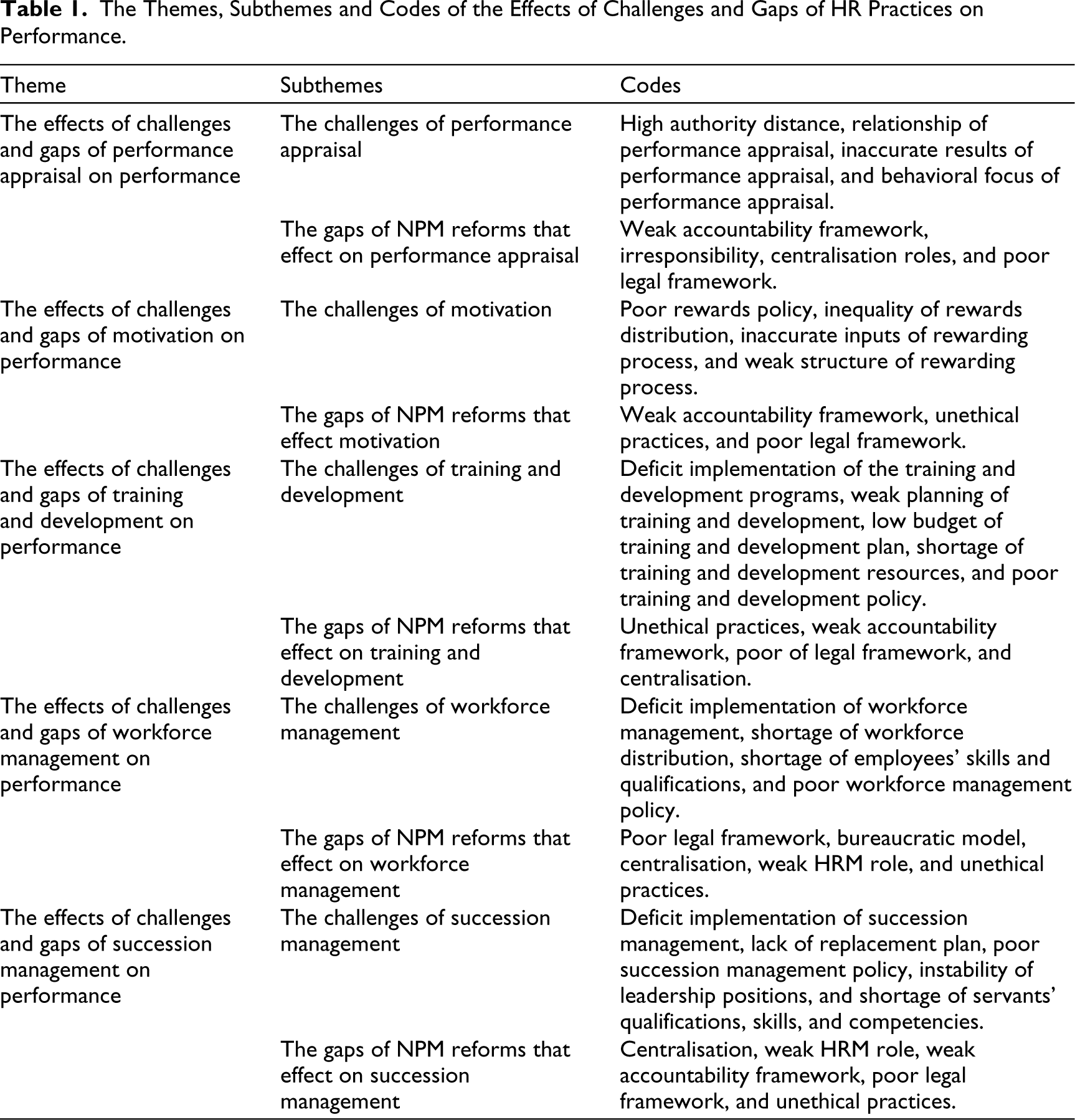
The Effect of Challenges and Gaps in Performance Appraisal on Performance
The first theme is the effect of challenges and gaps in performance appraisal on performance, which consists of two sub-themes, namely, the challenges of performance appraisal and the gaps in NPM reforms that affect performance appraisal.
The Challenges of Performance Appraisal
The challenges of performance appraisal are high authority distance, the relationships of performance appraisal, inaccurate results of performance appraisal, and behavioural focus of performance appraisal.
The first challenge is the high authority distance of performance appraisal:
[A] far authority exists in the appraising process of the employees’ performance,… My role in the performance appraisal process is limited in the lower levels (i.e., employees’ performance). [TTD-1, TTD-2, TTD-3, TTD-4, & TTD-5, 2020]
Based on the participant’s responses, the performance appraisal suffers from a high distance of authority that weakens the servants’ performance towards GAM’s performance.
The second challenge is the relationships of performance appraisal:
[T]hey give the rates based on their beliefs, relationships, and impressions,… most of the appraisal processes based on relationships such as kinship, friendship, and favoritism,… the appraisal results are going to relationships. [HRD-1, HRD-2, HRD-3, HRD-4, HRD-5, & HRD-6, 2020]
Performance appraisal suffers from factors based on relationships such as friendships, kinships, and favouritism that weaken servants’ performance towards GAM’s performance.
The third challenge is inaccurate results of performance appraisal:
[W]e, unfortunately, see high results of the employees’ performance and low results of the directorate’s performance. [TTD-2 & TTD-5, 2020]
The results of performance appraisal are inaccurate when the results of the employees’ performance are high while the organization’s performance results are low. These results are described as ambiguous due to the content of the performance appraisal, which makes the results of the performance of the public servants inaccurate and thereby weakens GAM’s performance.
The fourth challenge of performance appraisal is the behavioural focus of performance appraisal:
[T]he performance appraisal form is mainly focus on the behavioural aspects of the employees’ performance and it gives minor attention to the operational and duties achievement. [TTD-1, TTD-3, TTD-4, & TTD-5, 2020]
The performance appraisal content is focused on the behavioural aspect of servants’ performance. In other words, a major portion of the performance appraisal content assesses servants’ interactions and behaviours (i.e., 70%), due to which the operational aspect that mainly relates to goals and indicators may get neglected. In this way, the performance results are inaccurate and can weaken GAM’s performance.
The Gaps in NPM Reforms that Affect Performance Appraisal
The gaps in NPM reforms, such as weak accountability, irresponsibility, centralization roles, and poor legal framework affect performance appraisal:
[E]ach of centralization activities and lack of accountability work to weaken the performance appraisal and they might make the authority distance high,… the centralization activities by the management, lack of accountability, and legal framework weaknesses are mainly affecting the appraisal process through making the appraising distance high and fostering relationship-based factors such as friendships and kinships. [OED-1 & OED-2, 2020]
The gaps in the legal framework, accountability, responsibility, and autonomy (i.e., decentralization roles) are significant gaps in NPM reforms that affect performance appraisal. These gaps are the main challenges of performance appraisal, such as high authority distance, relationships based on performance appraisal, behavioural focus on performance appraisal form, and inaccurate results of performance appraisal.
The Effect of Challenges and Gaps in Motivation on Performance
The second theme is the effect of challenges and gaps in motivation on performance which consists of two sub-themes, namely, the challenges of motivation and the gaps in NPM reforms that affect motivation.
The Challenges of Motivation
The challenges of motivation are a poor rewards policy, the weak structure of the reward process, inequality of rewards distribution, and inaccurate inputs of the reward process.
The first challenge is a poor rewards policy and a weak structure of rewarding:
[T]hese motivational aspects are internally granted in the GAM’s context and the directorate’s context in particular without standing on solid ground (i.e., regulations, procedures, system, and structure). [PWAS-1 & PWAS-2, 2020]
The poor rewards policy and weak rewards structure are the main challenges that affect motivational initiatives. More specifically, although the proper wages and job title rewards are granted based on clear policy and structure, the rewards for effort and contribution to the performance suffer from an unclear basis in the distribution process. This is harmful as it can demotivate servants and negatively affect GAM’s performance.
The second challenge is the inequality of rewards distribution:
[T]his budget is distributed unfairly,… we can see that these rewards are granted to the same persons repeatedly. [HRD-1, HRD-3, HRD-4, & HRD-5, 2020]
The rewards are unfairly granted and not according to the servants effort and contribution which demotivates the servants’ and affects GAM’s performance.
The third challenge is inaccurate inputs of the rewarding process:
[T]he performance of the employees’ results is almost similar, and the appraisal form orients towards behavioural aspects and not towards indicators’ aspect. Therefore, the rewards are not granted fairly. [TTD-1, TTD-2, TTD-3, TTD-4, & TTD-5, 2020]
Inaccurate results of the performance appraisal create problems in motivational initiatives. Similar results of performance appraisal generate an ambiguous vision in distributing rewards for servants’ efforts and contributions, which weaken the performance.
The Gaps in NPM Reforms that Affect Motivation
The gaps in NPM reforms, such as unethical practices and poor legal framework affect motivation:
Several cases related to the rewards distribution are confirmed that the interventions by the GAM council members,… the council members’ interventions due to the kinship or other benefits,… the performance-pay initiative in the directorate context faces similar facts, including kinship-based, friendship-based, interventions, and favouritism towards certain employees (i.e., wasta). [OED-1 & OED-2, 2020]
The gaps in ethical practices and legal framework are prominent gaps that affect motivation. Unethical practices, including relationships, wasta, interventions, favouritism, corruption, and poor legal framework are the reasons for the challenges of motivation, such as poor rewards policy, weak rewards structure, inequality of the rewarding process, and inaccurate inputs of the rewarding process. Also, these challenges and gaps in motivation weaken servants’ performance, which badly affects GAM’s performance.
The Effect of the Challenges and Gaps in Training and Development on Performance
The third theme is the effect of challenges and gaps in training and development on performance, which consists of two sub-themes, namely, the challenges of training and development and the gaps in NPM reforms that affect training and development.
The Challenges of Training and Development
The challenges of training and development are deficit implementation of training and development programs, weak planning of training and development, low budget of training and development plans, shortage of training and development resources, and poor training and development policies.
The first challenge is deficit implementation of training and development programs:
The internal and external programs have not undergone pre-evaluation and post-evaluation,… only a few numbers of the planned programs are implemented and delivered … the real needs of these programs are away from the planned programs. [OED-1 & OED-2, 2020]
Deficit implementation of training and development describes several challenges, including the training and development programs that are not studied and reviewed, improper inputs such as performance appraisal results, and delivering programs out of plan. In addition, the training and development plan is a dead letter as there are new programs added during the year. These programs are not used for the purpose of improving and addressing GAM’s performance, they do not undergo pre-evaluation and post-evaluation, and the overseas programs are delivered only to certain servants. Moreover, these challenges prevent and cancel most of the intended programs and take away the servants’ right to attend the required programs for developing and addressing their performance towards GAM’s performance.
The second challenge is weak planning of training and development:
The main problems in the content, budget, material, and quality,… spending more on the development and professional programs with neglecting the core programs that address the weakness points that related to the core goals and indicators. [TTD-1, TTD-2, & TTD-3, 2020]
The training and development plan suffers from weaknesses in terms of inputs, budget, time, quality and content, which weaken the delivered programs. These programs are also useless when it comes to improving and addressing servants’ performance towards GAM’s performance.
The third challenge is the low budget for training and development plans:
[T]he budget of training and development is low when compared to GAM’s sectors and their directorates. There’s general budget for the entire GAM’s bodies without allocating for programs, projects, or initiatives. [PWAS-1 & PWAS-2, 2020]
The budget for training and development planning is low. Also, there is no budget allocation for the sectors or directorates based on their duties. The low budget for training and development and the absence of budget allocation results in the servants’ missing the chance to develop and address their performance towards GAM’s performance.
The fourth challenge is shortage of training and development resources:
[T]raining materials such as programs and trainers are poor,… the training centre is lacking qualified and skilled trainers for the training and development programs and it does not include suitable classes and tools for the training process. [PWAS-2, 2020]
The shortage of training and development resources is another challenge to training and development, such as a shortage of materials, trainers, halls, and tools. Thus, training and development programs suffer from low quality which impacts improvement and development of servants’ performance towards GAM’s performance.
The fifth challenge is poor training and development policies:
The delivery of training and development programs are interpreted in general and broad sentences,… the civil service system and HR policies for organising employees’ affairs include specific statements and limitations preventing in making training programs comprehensive. [PWAS-1 & PWAS-2, 2020]
Training and development policies are poor. Training and development policies contain general sentences, conditions, and limitations, which make training and development limited to certain servants (i.e., senior servants) and unavailable the comprehensive way to deliver internal and external programs, which, in turn, weaken servants’ performance towards GAM’s performance.
The Gaps in NPM Reforms that Affect Training and Development
The gaps in NPM reforms, such as unethical practices, weak accountability framework, poor legal framework, and centralization affect training and development:
[T]he problems of training and development programs are the result of the lack of management control alongside centralization practices,… the wasta and interventions, including kinship and friendship are also took critical role in providing the overseas and external programs,… training and development programs suffer from the management’s control weaknesses, centralization, lack of organized regulations. [PWAS-1 & PWAS-2, 2020]
The gaps in the legal framework, accountability, autonomy, and ethical practices, such as wasta, interventions, and relationships are the reasons behind the challenges of training and development, such as deficit implementation of training and development, weak planning of training and development, low budget of training and development, shortage of training and development resources, and poor training and development policies. These challenges and gaps in training and development weaken servants’ performance towards GAM’s performance.
The Effect of Challenges and Gaps in Workforce Management on Performance
The first theme is the effect of challenges and gaps in workforce management on performance, which consists of two sub-themes, namely, the challenges of workforce management and the gaps in NPM reforms that affect workforce management.
The Challenges of Workforce Management
The challenges of workforce management are deficit implementation of workforce management, shortage of workforce distribution, shortage of employees’ skills and qualifications, and poor workforce management policies.
The first challenge is deficit implementation of workforce management:
[T]he activities of the workforce management process are experiencing an implementation deficit because of management power and central role believing that the workforce management plan is a pointless document,… There’re no responses for filled documents in the workforce management plan, including staff’s demands (i.e., needs), the staff’s surplus, and recovery of the retirement or turnover cases. [TTD-1, TTD-3, TTD-4, & TTD-5, 2020]
The deficit implementation of workforce management is a prominent challenge of workforce management. There is a deficit implementation of workforce management and its activities, including managing surplus and shortage, distribution, recruitment, retraining, mobility (i.e., transfer), redeployment, and retirement. In other words, there is no action or response for dealing with workforce management activities. This creates chaos in servants’ performance towards GAM’s performance.
The second challenge is the shortage of workforce distribution:
Although there are enough employees, this sector still asks to hire more employees. No clear overview of the current shortage or surplus,… the strategy of HRM in GAM is a dead letter. [HRD-1, HRD-3, HRD-4, & HRD-5, 2020]
The shortage of workforce distribution is one of the critical challenges of workforce management. There are several problems related to the shortage of workforce distribution like an unclear vision of staff shortage and surplus, no strategy for managing human resources, chaos of workforce distribution, surplus staff and no action taken about it, neglecting the control on managing surplus and shortage that deviates from the workforce management plan, shortage in staff quantity, and no response to workforce needs. These may reflect on GAM’s performance.
The third challenge is shortage of employees’ skills and qualifications:
It is sad to note that there’s a shortage of the directorate’s staff,… there’s a shortage in the staff quality and quantity. [TTD-2 & TTD-3, 2020]
The shortage of servants’ skills, competencies, and qualifications is a challenge for workforce management. The units suffer from a shortage of quality and number of employees which weaken GAM’s performance.
The fourth challenge is poor workforce management policies:
I believe that these issues are due to legal weaknesses such as HR policies and weak procedures in the system that we use to deal with employees’ affairs. [TTD-1 & TTD-2, 2020]
The weakness of HR policies that are used to regulate servants’ affairs is another challenge for workforce management. There are problems with staffing and recruitment procedures and criteria. In addition, the weakness of procedures that are used to deal with servants’ affairs may create problems in their performance towards GAM’s performance.
The Gaps in NPM Reforms that Affect Workforce Management
The gaps in NPM reforms, such as poor legal framework, bureaucratic model, centralization roles, weak HRM role, and unethical practices affect workforce management:
[T]he challenges of workforce management are due to weak regulations,… HRM does not have the authority to move and transfer the staff,… Only the management owns the decision to do so,… this central role of the management is due to the old fashioned management way,… there’re cases of interventions and wasta, especially, by the council members. [TTD-3, 2020]
The gaps in ethical practices, autonomy, post-bureaucratic model, HRM role, and legal framework are the main gaps in NPM reforms that affect workforce management. These gaps are the reasons for the deficit implementation of workforce management and its activities, shortage of workforce distribution, shortage of servants’ skills and qualifications, and poor workforce management policies. The challenges and gaps in workforce management are the reasons that weaken servants’ performance towards GAM’s performance.
The Effect of Challenges and Gaps in Succession Management on Performance
The fifth theme is the effect of challenges and gaps in succession management on performance. This consists of two sub-themes, namely, the challenges of succession management and the gaps in NPM reforms that affect succession management.
The Challenges of Succession Management
The challenges of succession management are deficit implementation of succession management, lack of a replacement plan, poor succession management policies, instability of leadership positions, and shortage of servants’ qualifications, skills and competencies.
The first challenge is deficit implementation of succession management:
In fact, the succession management plan is a dead letter and there is no clear way to do so. [TTD-4 & TTD-5, 2020]
The deficit in the implementation of succession management and more so, no commitment to the plans, are the challenges to succession management. The succession management plan is a dead letter in which no action is taken by the management to use this plan to fill leadership positions in GAM.
The second challenge is the lack of a replacement plan:
[W]e see several qualified employees with qualifications, who are well trained, and exhibit high performance but they do not get included in the replacement plan,… the replacement plan is empty of successors,… no response from the managers to give us feedback. [HRD-1 & HRD-6, 2020]
The second-row plan (i.e., replacement plan) is not activated. The replacement plan is not used to fill leadership positions. Further, the assistant director position, for example, is eliminated in the job’s description which ignores the second-row plan in filling leadership position. This generates problems in GAM’s performance.
The third challenge is poor succession management policies:
The current problems in the leadership positions are due to the regulations’ insufficiency. [HRD-1, HRD-2, HRD-3, HRD-4, HRD-5, & HRD-6, 2020]
Succession management policies are poor as they are not used to fill leadership positions. The policies do not cover the entire process of filling leadership positions. It also contains lacunae which leave decision-making in the management’s hands and leads to missing high-performance efforts from qualified servants.
The fourth issue is the instability of leadership positions:
[T]he leadership positions suffer from dominant roles by the management that make these positions instable with a lack of strategic focus. [TTD-3 & TTD-5, 2020]
Leadership positions are unstable and changeable. This weakens the strategic focus on GAM performance.
The fifth issue is a shortage of servants’ qualifications, skills and competencies:
[T]here’s no commitment to this plan, especially, by the directorate’s heads and the job descriptions are weak and miss certain specific qualifications for some jobs,… and most of these jobs require specific qualifications and skills that the staff does not have. [OED-1 & OED-2, 2020]
The paucity of qualifications, skills, and competencies in leaders and servants is a critical challenge for succession management, and one of the reasons that makes it difficult to fill leadership positions based on their job description. There are no qualified servants to take the lead. Leaders are not skilled and competent to lead the units, which, in turn, weakens GAM’s performance.
The Gaps in NPM Reforms that Affect Succession Management
The gaps in NPM reforms such as centralization roles, weak HRM role, weak accountability, poor legal framework, and unethical practices affect succession management:
[T]he reasons behind succession management challenges are weak legal context, centralization roles, lack of HRM role, and weak activation of HR activities and functions,… The power of interventions and pressures by council members on the management is the primary method to fill positions…, that generate kinship, friendship and favouritism (wasta)…, the weaknesses of the legal context like the policies of HR and civil service system may allow such interventions and make the wasta as a method to fill the positions by the management. [OED-1 & OED-2, 2020]
The gaps in autonomy, accountability, poor legal context, HRM role, and ethical practices are the main reasons that generate the challenges of succession management, such as deficit implementation of succession management, lack of a replacement plan, poor succession management policies, instability of leadership positions, and shortage of servants’ qualifications, skills and competencies. In addition, these challenges and gaps in succession management weaken servants’ performance towards GAM’s performance.
Discussion
From the findings of the paper, the effects of the challenges and gaps in HR practices on performance are presented. These are the effects of challenges and gaps in performance appraisal on performance, the effects of challenges and gaps in motivation on performance, the effects of challenges and gaps in training and development on performance, the effects of challenges and gaps in workforce management on performance, and the effects of challenges and gaps in succession management on performance, as depicted in Figure 1.
The Challenges and Gaps of HR Practices.
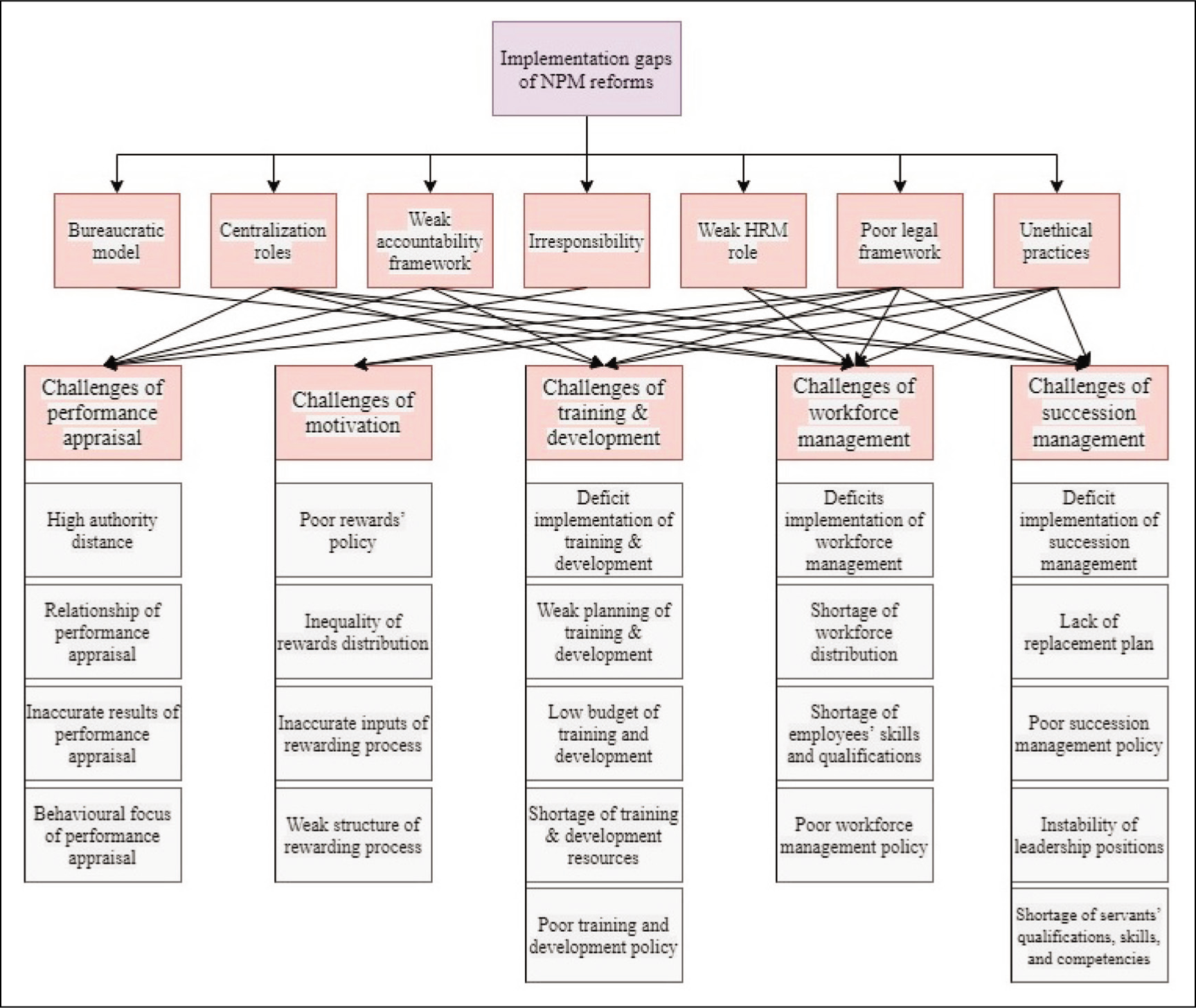
Scholars stated that HR practices of public organizations encounter challenges and gaps (Budhwar et al., 2019). More specifically, the implementation of NPM reforms varies from one country to another. This is a key aspect of shaping HRM (Leisink & Knies, 2018). Thus, the gaps in NPM reforms are the main reasons for generating the challenges and gaps in HR practices of public organizations (Ahenkan et al., 2018; Errami & Cargnello, 2018; Ikeanyibe, 2016; Siddiquee et al., 2019; Tioumagneng & Njifen, 2019; Turner et al., 2019; Vu et al., 2019; Ustuner & Yavuz, 2018). Therefore, the challenges and gaps in HR practices require to be investigated (Mahmoud & Othman, 2021).
The Effects of the Challenges and Gaps in Performance Appraisal on Performance
The challenges of performance appraisal that affect GAM’s performance are high authority distance, relationships of performance appraisal, inaccurate results of performance appraisal, and behavioural focus of performance appraisal. In addition, the gaps in performance appraisal are from the implementation gaps in NPM reforms such as weak accountability, irresponsibility, centralization, and poor legal framework. These gaps are the main reasons behind the challenges of performance appraisal. The challenges and gaps of performance appraisal are critical in managing servants’ performance which weakens GAM’s performance.
Concerning the challenges of performance appraisal in public organizations, scholars argued that the challenges of performance appraisal are the relationships of performance appraisal (El-Ghalayini, 2017), neglecting objective criteria (Wang et al., 2019), and high authority distance (Fryer et al., 2009; Harbi et al., 2017). However, scholars stated that performance appraisal in public organizations should be related to strategic goals and indicators (Thompson, 2017). In addition, the content of performance appraisal in public organizations focuses on behavioural aspects which is preferable (Budhwar & Mellahi, 2016; Yeganeh & Su, 2008). However, scholars reiterated that behavioural aspects neglect objective criteria which are related to strategic goals and indicators (Arnaboldi et al., 2015; El-Ghalayini, 2017; Johari & Yahya, 2016), which may be the reason for relationships, loyalty, and distrust between managers and employees during performance appraisal (Aghaz et al., 2017). Thus, the behavioural focus of performance appraisal and inaccurate results of performance appraisal are also critical challenges of performance appraisal in managing servants’ performance towards improving the performance of public organizations.
The implementation gaps of NPM reforms generate several challenges for performance appraisal thus weakening the criteria of public servants’ performance assessments (Ikeanyibe, 2016; Mahmoud & Othman, 2021; Osei-Kojo, 2017). More specifically, the implementation gaps of NPM reforms such as deficit of management control on performance results (i.e., weak accountability), irresponsible unit or servant on performance results (i.e., irresponsibility), taking orders from top to bottom (i.e., centralization), and weaknesses of regulations, rules, and procedures (i.e., poor legal framework) are the crux of the challenges of performance appraisal, such as high authority distance, relationships of performance appraisal, inaccurate results of performance appraisal, and behavioural focus of performance appraisal.
The Effects of the Challenges and Gaps in Motivation on Performance
The challenges of motivation that affect GAM’s performance are poor rewards policy, inequality of rewards distribution, inaccurate inputs of the rewarding process, and the weak structure of the rewarding process. Moreover, the gaps in motivation are from the implementation gaps of NPM reforms such as poor legal framework and unethical practices, including relationships, wasta, interventions, favouritism and corruption. These gaps are the main reasons for the challenges of motivation. Furthermore, these are the prominent challenges and gaps in managing servants’ performance which weaken GAM’s performance.
Motivational initiatives should be prepared based on individual, job, work, and external environment characteristics using monetary criteria to encourage employees’ performance towards organizations’ performance (Perry & Porter, 1982). Accordingly, most of the challenges of motivation are related to the consequences of inequality of monetary compensation that weaken organizational performance. Scholars have discussed that the significant concern of the staff is about equal distribution. They recognize that there is an inequality in the distribution of rewards which distracts their performance (Benati & Coccia, 2018). In addition, rewards are granted based on subjective and seniority criteria rather than competencies and skills and this demotivates the employee and impacts the performance of the organization (Aghaz et al., 2017).
Most importantly, all rewards and compensations granted should be based on clear procedures (i.e., policy) but this is not the case in most public organizations (Benati & Coccia, 2018). Rewards and compensation need to be distributed based on organizational structure, job description, and work priorities (Aghaz et al., 2017; Markova & Ford, 2011) and designed as a strategy which takes the shape of a structure (Ritz et al., 2016). Lastly, public organizations should grant and distribute rewards and compensation for meeting specific goals and indicators (Tampu & Cochina, 2015).
In addition to the inequality of the rewards distribution and poor rewards policy, the most significant challenges encountered by the motivation of public organizations are inaccurate inputs and weak structure of the rewarding process. These challenges of motivation in managing servants’ performance in public organizations are critical in fostering the inequality of compensations which weakens public organizations’ performance. On the other hand, NPM gaps generate challenges of motivation, such as insufficient rewards, salaries, and compensation as well as a relationship-based reward system (Mahmoud & Othman, 2021; Tioumagneng & Njifen, 2019; Vu et al., 2019). However, relationships such as friendships and kinships, corruption, favouritism, interventions, and wasta (i.e., unethical practices), as well as poor regulations, policies and procedures (i.e., poor legal framework) are prominent gaps in NPM reforms. They are the result of poor rewards’ policy, inequality of rewarding distribution, inaccurate inputs of rewarding process, and weak structure of motivation in public organizations.
The Effects of the Challenges and Gaps in Training and Development on Performance
The challenges of training and development that affect GAM’s performance are a deficit implementation of training and development, weak planning of training and development, low budget for training and development, shortage of training and development resources, and poor training and development policies. The gaps in training and development are on account of implementation gaps of NPM reforms such as weak accountability, poor legal framework, centralization roles and unethical practices, including wasta, interventions and relationships. These gaps are the main reasons for the challenges in training and development. Training and development are critical in managing servants’ performance towards GAM’s performance.
Scholars elaborated that training and development programs encountered several challenges. For example, the programs suffer from imitation (Aghaz et al., 2017). Also, these programs experienced weak technological inputs and the budget for training and development is also low (Madichie & Nyakang’o, 2016). Other challenges are offering training and development programs without a specific plan, and professional programs being delivered only to senior servants, due to limitations in regulations and procedures. In addition, training and development programs are delivered without linking them with the performance of the organization (El-Ghalayini, 2017). Training and development programs should consider all resources such as trainers, tools, courses, money, and halls (Getha-Taylor et al., 2015; Gooderham et al., 2018). Several issues should be taken into account in training and development, such as the need for training and development, the objectives, the choice of proper methods to deliver the training and development, training and development implementation, training and development evaluation, and documentation of the results (Chauhan et al., 2016; Phillips & Gully, 2015).
Therefore, the significant challenges of training and development are not only weak planning, low budget and poor policies but also a shortage of training and development resources and deficit implementation of training and development such as inexact inputs of training and development, weak commitment to the training and development, and lack of pre-evaluation and post-evaluation. On the other hand, implementation gaps in NPM reforms generated challenges in training and development, including a shortage of qualifications, competencies and skills (Guga, 2018; Mahmoud & Othman, 2021; Powell-Jackson et al., 2019). Also, a deficit of management control (i.e., weak accountability), weak regulations, policies and procedures (i.e., poor legal framework), unprecise and broad procedures in the regulations which central in management hands (i.e., centralization), and wasta, interventions and relationships (i.e., unethical practices) are the gaps of NPM reforms which are the reasons for a lack of proper training and development.
The Effects of the Challenges and Gaps in Workforce Management on Performance
The challenges of workforce management that affect GAM’s performance are deficit implementation of workforce management, shortage of workforce distribution, shortage of employees’ skills and qualifications, and poor workforce management policies. Gaps in workforce management are a result of implementation gaps of NPM reforms such as centralization roles, poor legal framework, bureaucratic model, weak HRM role, and unethical practices such as interventions, relationships and wasta. These gaps are the main reasons for the challenges of workforce management which are important in managing servants’ performance, which weakens GAM’s performance.
Scholars emphasized that workforce ageing and the shortage of servants’ qualifications, competencies and skills are the biggest concerns of workforce management (Colley & Price, 2015). Workforce management should fulfil goals and indicators, understand the gaps in competencies, provide the best solutions to close competency gaps, provide regular and clear information to help take informed decisions that are related to employees’ affairs and provide the right resources required to be accountable for the responsibilities to improve the performance of the organization (Al Wahshi, 2016; Roh, 2018). Further, workforce management includes several activities such as managing surplus and shortage, staffing, internal and external recruitment, workforce distribution, redeployment, and retraining according to requirements to achieve organizational goals and indicators (Ketchen et al., 2017; Mayfield et al., 2016; Phillips & Gully, 2015).
Scholars agreed with the critical challenges of workforce management, including workforce ageing, problems of developing employees’ skills, qualifications and competencies, weak workforce planning, shortage of skills, qualifications and competencies, favouritism during recruitment, weaknesses of the staffing system, political and union pressure and poor commitment to workforce plan and its activities such as managing surplus and shortage, workforce distribution, retraining, and redeployment (Aghaz et al., 2017; Goodman et al., 2015; Ketchen et al., 2017). In addition, it is stated that weak regulations and procedures (i.e., poor policies) which regulate workforce management are also significant challenges in public organizations. Moreover, the implementation gaps in NPM reforms are the crux of the challenges of workforce management, including weak workforce distribution and poor HR policies (Ahenkan et al., 2018; Mahmoud & Othman, 2021; Osei-Kojo, 2017; Siddiquee et al., 2019; Ukeje et al., 2020). Top-down decisions which are highly centralized in the hands of the management (i.e., centralization), weak regulations, rules and procedures (i.e., poor legal framework), reactive and limited role of HRM (i.e., weak HRM role), rigorous commitment to regulations in a hierarchy structure (i.e., bureaucracy), and wasta, interventions and relationships are also critical gaps in NPM reforms. These are the reasons for deficit implementation of workforce management, shortage of workforce distribution, shortage of employees’ qualifications, competencies and skills, and poor workforce management policies of public organizations.
The Effects of the Challenges and Gaps in Succession Management on Performance
The challenges of succession management that affect GAM’s performance are the deficit implementation of succession management, lack of a replacement plan, poor succession management policies, instability of leadership positions, and shortage of servants’ qualifications, skills and competencies. Gaps in succession management are a result of implementation gaps of NPM reforms such as centralization roles, weak HRM role, weak accountability, poor legal framework, and unethical practices including wasta, interventions and relationships. These gaps are the main reasons for the challenges of succession management. In addition, these challenges and gaps are critical in managing servants’ performance which weakens GAM’s performance. Scholars stated that most public organizations fill their critical leadership roles without developmental programs and activities and without committing to a clear plan (Chiocchio & Gharibpour, 2017). Further challenges are from bureaucracy and centralization which limit the implementation of succession management (Durst & Bruns, 2016). In addition, several organizations fill leadership positions without using a replacement plan (Durst & Bruns, 2016). There are discrepancies in the promotion system, problems in career path development, and favouritism in filling leadership positions (Goodman et al., 2015). In addition to the deficit implementation of succession management and lack of replacement plan, there are other challenges to succession management, including instability of leadership positions, poor succession management policies and shortage of servants’ skills, qualifications and competencies of public organizations.
The gaps in NPM are challenges of succession management, such as problems of leadership stability and weaknesses in servants’ skills, qualifications and competencies (Gupta et al., 2018; Osei‐Kojo, 2017; Mahmoud & Othman, 2021). Further, the central power in the hands of the management (i.e., centralization), weaknesses of management control (i.e., weak accountability), limited role of HRM (i.e., weak HRM role), weak regulations, rules and procedures (i.e., poor legal framework), and wasta, interventions and relationships are gaps in NPM reforms relating to the challenges of succession management, such as deficit implementation of succession management, lack of replacement plan, poor succession management policies, instability of leadership, and shortage of servants’ qualifications, skills and competencies of public organizations.
Originality of research in this paper is in terms of the implementation role of NPM reforms that affect HR practices and policies of public organizations. Post-bureaucracy affects workforce management. Autonomy affects performance appraisal, training and development, workforce management and succession management. Accountability affects performance appraisal, training and development and succession management. Responsibility affects performance appraisal. The HRM role affects workforce management and succession management. The legal framework affects performance appraisal, motivation, training and development, workforce management and succession management. Ethical practices and values affect motivation, training and development, workforce management and succession management. In addition, these NPM reforms affect the performance of public organizations (i.e., public services). In other words, these reforms affect HR practices for managing servants’ performance and public services towards shaping the performance of public organizations.
Conclusion
This paper investigates the effects of the challenges and gaps in HR practices in managing servants’ performance which contributes towards the performance of public organizations. There is considerable evidence that NPM reforms are critical for shaping HRM and performance of public organizations, not to mention the significant relationship between HR practices and performance. Therefore, this paper is a unique investigation that studied the challenges and gaps in HR practices towards achieving better performance of public organizations in relation to NPM reforms. The findings reveal the challenges of HR practices towards achieving improved performance and the effects of NPM reforms on HR practices.
This paper helps the people at the helm including policymakers, HR managers and practitioners not only in GAM but also in public organizations in the developing world. It helps them address the challenges and gaps in HR practices concerning the implemented NPM reforms. It adds new knowledge in terms of the effects of NPM reforms on HR practices in public organizations. However, it is not free from limitations. This paper has limited scope and generalization. On the one hand, despite the similarity of public organizations working under the Jordanian government, this paper focuses on only one organization. Hence, more investigations into other public organizations in Jordan and developing countries are required for future research. On the other hand, this paper investigates only five practices of HRM. Other HR practices could be considered in future research. It is pertinent to mention that empirically testing the relationships between NPM reforms and HR practices will be beneficial to generalize the findings and provide accurate results.
Footnotes
Declaration of Conflicting Interests
The authors declared no potential conflicts of interest with respect to the research, authorship and/or publication of this article.
Funding
The authors received no financial support for the research, authorship and/or publication of this article.