



Abstract
This essay takes up an eventful moment that occurred in 1740 in the port city of Pondichéry, located on the southeast coast of India. In a battle between the Arcot kingdom and the Marathas, when the Nawab of Arcot was killed, the latter’s wife fled to Pondichéry seeking protection from the allied French governor, Benoît Dumas. Studying an eye-witness account alongside other reports on, or references to, this incident and its context written contemporaneously and in later centuries, this essay shows how historians through the ages have distorted France’s position in eighteenth-century India. By presenting Governor Dumas implicitly as the quintessential French honnête homme, a prominent European trope from the seventeenth century prolonged in French nationalistic discourse since that time, many accounts conflate French and British positions in India, overstate France’s footing in pre-colonial India, and/or elide the strong, syncretic Indo-Persian culture that linked India to a non-European world. Such factors can exert what I want to call an ‘archival effect’ on scholarly use of materials documenting French presence in India, which, paradoxically, haunt versions of Indian nationalism today.
Colonial national archives have been used by historians of different persuasions to find historical insights that previous researchers using the same documents might not have done. The interdisciplinary field of Postcolonial Studies relied on colonial archives to imaginatively access perspectives that are ostensibly absent from them. Postcolonial historians and theorists notably exposed the ways in which such archives are consolidated through procedures that silence the voice of the colonized and thus replicate the colonial relationship, while Subaltern Studies historians excavated sources beyond written and official archives to access non-elite voices within postcolonial national historiography. For his part, studying colonial fiction and other discourses, the Palestinian/American thinker and literary critic, Edward W. Said, went so far as to claim that European representations of the Orient had little to do with ‘the real Orient’ out there, while he showed that an imaginary Orient was made real through the collusion of a range of discourses, all held together with and through the power that ‘the West’ shored up over the lands it dominated.
To what extent have these intellectual and political efforts resulted in remembering, methodologically, that archival texts are ‘representations’ and not ‘natural depictions’ 1 in our efforts to undo the effects of colonial dynamics? How do we work through the conceptions within archives that are predicated on the skewed relationship that colonizers had with the peoples they subjugated and that became ‘silently invested’ 2 in the very architecture of archives? What does it mean to ‘decolonize the archive’, 3 a phrase that suggests dissatisfaction with the achievements of ‘postcolonial’ approaches? This archival 4 study of the portrayal of the so-called elegance of a Frenchman in pre-colonial India underscores the continued value of tackling the assemblage itself, rather than merely the artefacts, of the archive identifiably related to the historical moment in question. It is, thus, what I want to call a study of the archival effect 5 that tells on both contemporary scholarly work and political positioning closer to the reality on the ground. Scholarship referred to in the pages ahead that investigates France’s relationship with India has, in the last decade, offered a relatively new set of texts and historical characters on which we might draw in studying the subcontinent before the British Raj. The decade has simultaneously been rife with calls to decolonize our praxis in not just academic institutions but in museums, the press, politics and daily life. Paradoxically, in India, the last decade has seen rising intolerance for, and a systematized quelling of, anything considered extrinsic and not encompassed in a pre-colonial version of ‘Bharat’, one that, from such a perspective, ‘India’ slanders. 6 Drawing in the broader academic and activist push to complete the task of decolonization, the essay remains cognizant of a Hindu-minded Indian populist movement that locates today’s challenges in what it considers an outmoded middle-class based on secularism and a sense of cosmopolitanism, which are seen as a vestige of colonialism. It further suggests that cultural and political articulations of the honnête homme, referring to the well-rounded, educated man who was taken as the perfect symbol of French chivalry, might surreptitiously linger on the stage of contemporary Indian politics.
France and Britain in India: Not Equals to Be Rivals
On the 25th of May 1740, the recently widowed Princess of Arcot presented herself at Valdaur (Valaduvur), the only open gate of the coastal city of Pondichéry (also written as Pondichéri or Pondicherry), the others being closed on order, due to the surging crowds fleeing the Maratha invasion coming from further north. 7 The princess was seeking refuge in this French city in southern India after her husband, the Nawab of Arcot, Dauost Ali-Khan (Dost Ali Khan), had been slain in battle by the Marathas five days earlier in what is today’s Chittoor district. 8 The Nawab had been tricked: one of his officers, bribed by the Marathas, allowed the latter access via the narrow and steep path to Arcot, which the officer had been charged with guarding. The minute the Nawab knew the approaching army was, in fact, the enemy, he mounted his elephant and led the army against them. The Nawab himself eventually succumbed to gunshots and fell from his elephant. 9
Moving from the period marked by the presence of various East India Companies in the Indian subcontinent, which is the context for this essay, to governance by the British Crown brought many changes that led to imposed and systematic attempts at uniformity and standardization of the official language. Such changes led to the formal erasure of evidence of the diverse and everyday engagement of Europeans with Indians during the period in question and, more gradually, to an attrition of the methods for doing so. Treating an even earlier period than the one described at the start of this essay (1740), one critic claims that in India, ‘the imperial dimension’ of France’s ‘commercial project’ was ‘central to the company’s development’. 10 France’s imperial project might have been a wishful desire in that nation’s Company employees, but it was not credibly in play in those early players’ actions. 11 Accounts that wittingly or unwittingly project France in a dominant position in India in the early eighteenth century tend to (a) simplify the relationship of the French with Indians, (b) generalize France’s colonial expansion in other parts of the globe to the situation in India and (c) blur the distinction between France’s position in India and that of Britain. 12
It wasn’t until about Governor Dumas’s time that French administrators became political appointees: Even the taking of the cities of Yanaon (1723) and Mahé (1725) by the French really occurred in skirmishes that had to do with establishing trade. When France won Karikkal (1739), its ambition to rival the British in India was still far from realistic. 13 Historians have pointed to the implicit sovereignty in the company ventures of the British at this time. 14 This argument is somewhat quickly picked up by others to claim that ‘the French in Pondichéry were engaged in an effort to transform the spiritual, cultural, and political landscape, alongside their attempts to insert themselves into established commercial exchanges’. 15 Inner conflicts were rife amongst the small French population, such as we see with the French Jesuits in Pondichéry and Madurai, the two main missions in south India. 16 The idea that the French could transform the landscape replicates colonial assertions of superiority that could only be ratified retrospectively by referring to domination elsewhere in the nineteenth century. Archives emerge as sites of epistemological and political anxiety, as Laura Anne Stoler has remarked. 17 Voltaire, whose keen observations of France’s overseas activities shall be evoked in this essay, commented that their previous failed attempts at establishing a company showed that ‘French ingenuity was not as well suited to these undertakings as the careful and thrifty character of the Dutch, and the daring, resourceful, and tenacious spirit of the English’. 18 Even later in that century, France’s fall to Britain soon after Napoleon’s apparent success in Egypt and with its developing chaos seen in the coup d’état of the 18th Brumaire, prevented an alliance that might have become these latecomers’ greatest foothold in India: with the Mysore kingdom’s Hyder Ali and then his son, Tipu Sultan. A British administrator concluded that ‘perhaps it is not convenient for France to send an expedition to India, as it must depend upon the prospect of peace, more or less distant, with the English’. 19 The notion that in the early eighteenth century, ‘[o]nce established in India, the Compagnie des Indes, like other European charter companies, administered towns, made laws and dispensed justice, minted money, commanded troops, built fortifications and supported conversion efforts’ 20 does not hold up and is, in fact, tempered by the actual study by this critic that reveals, instead, a complicated web of dependency. Rather than viewing ‘sovereignty’ as ‘an import from Europe’, 21 we might recognize that ideas of sovereignty had to be left on Indian shores by disembarking Frenchmen as they encountered the reality of Indian ruling powers and their spheres of influence and sovereignty. It is not possible to equate what the French were doing on the ground with what the British were engaged in at the same moment in India in the early eighteenth century, 22 whereas it might apply to Newfoundland, where France actually had supremacy over the British and the territory was in danger of being lost. 23 If Napoleon might have wished to change the course of France’s history in India and that it were ‘the ultimate object of [his] expedition to Egypt’, as suggested to British intelligence, there would be no way to accomplish this without cooperation from the Marathas. The British were sure that rumours regarding continued collaboration of the Marathas with Mysore were baseless. 24
France gained Pondichéry from the Dutch through the settlement in Ryswyk in 1697. Isle de France (Mauritius) and Bourbon (Reunion Island), situated between the Cape of Good Hope and the subcontinent and often administered together, were given over by the royal government to the East India Company. It was once a sizeable French population that enlivened the islands in the 1720s when France had a veritable base on the route to India and some control of the sea approach. 25 The French East India Company—first the Compagnie Royale des Indes Orientales under Colbert and then merging with other branches in 1719 to become the Compagnie Perpétuelle des Indes under John Law and then the Compagnie Française des Indes—had a tumultuous history with periods of near bankruptcy at the end of the seventeenth and into the eighteenth centuries. 26 At the time the French governor received the Princess of Arcot in Pondichéry, France’s future in India might have been, albeit fleetingly, looking up, but Pondichéry was nothing more than a modest settlement. 27
Another critic has argued that ‘[t]he encounter between France and India in the eighteenth century was shaped by France’s relationship with Britain’. 28 While this might be held reasonable from a European perspective, there is a necessary perspectival shift that this article brings: granting that ‘India became as much a locus for exploring British alterity and assessing French national interests as it was for engaging with the inhabitants of the subcontinent’, 29 we will better understand the broader reality on the ground and bring greater heft to the second part of the statement than is evident in much scholarly work. Marsh’s fine study targets the ‘lacuna’ in French history of the loss of India, which involved a colonial rival. Although Marsh mentions a triangulation of a discursive relationship—France–Britain–India—by her own account, in her reading ‘the trope of India was employed not as means of imposing and maintaining colonial power, but rhetorically to oppose another colonizer: France’s European rival, Britain’. 30 Marsh chooses to begin her story with Dupleix’s recall in 1754. Focus on this French hero as the starting point replicates the archival effect that we want to counter here. British–French rivalry in south India in the mid-eighteenth century as the main site of struggle was built up in French accounts, and it glides into British recollection well into the nineteenth century to reveal itself as a concerted European projection. In the end, recollection of that period through Dupleix is preferable even for British historians because, from this perspective, it ‘dispelled the awe of native authority, and proclaimed to all the world that the European was the destined successor of the proud Mogul and the fiery Mahratta’. 31 Dumas’s predicament between two warring Indian factions mitigates Dupleix’s accomplishments, which are often presented as singularly achieved through his diplomatic and military genius. 32 Moreover, alliances between the French and Indians often occurred in conflict amongst the French themselves in India and, to a lesser degree, in conflict with the British or even, in reality, the Indians. And while there is a critical aspect to the study of colonialism in India through the use of French archives, it seems that the purpose explicitly served is to ‘reap the benefit of a valorization of [critics’] position as commentators on French history and culture from the outside’. 33 It is my view that the ‘counter-narrative to the grand récit of the British domination of the subcontinent’ established by critics such as these, done by ‘inserting a French voice into a story invariably perceived, by English- and French-language postcolonial critics and historians alike, as an anglophone metanarrative’, 34 is insufficient. The aim here is to undo the archival effect resulting in a perception of the period as a more generically European metanarrative.
In Pondichéry, the French Jesuits, who had first established a seminary in Surat in 1692, had been preceded by their own kind (Jesuits) from Portugal, Germany and Italy. 35 Thus, with a longer history in India than French Company employees behind them, they more deftly manipulated the governor, Dulivier, seeking to stop Hindu celebrations that would take place on Sundays or any other days there were Christian festivals. As a result, around 1714, local artisans, weavers, fisherfolk and others fled the Pondichéry area in protest. Dulivier was forced to withdraw the ordinance that the Jesuits had managed to get him to issue in order to bring back the local population that had left. 36 Jesuit fathers championed the natives while the Capuchins sided with whites. Europeanized natives and mixed-race people. 37 Conflicts amongst Dumas in Pondichéry, Labourdonnais in the Indian Ocean islands and Dupleix in Chandranagore broke out owing to their personal interests. 38 Voltaire, keenly following colonial happenings from France, remarked that ambitious but unremarkable Frenchmen rose up in the colonies where ‘competency is rare but essential’, 39 thus expressing France’s disappointing place in the colonial advancement.
Further back in time, in 1504, the Portuguese, sent by King Manuel and represented by Admiral Lopo Soares of Albergaria, were quick to recognize that their future lay not in negotiating with the most powerful Kerala king, the Zamorin of Calicut, but rather in fuelling the generations-long bitterness of the Cochin rajah, who had fewer privileges than the other area royals. 40 During these skirmishes, the Portuguese targeted Egyptian ships and traders from Mecca, who enjoyed good relations with the rajahs of Kerala. Christian Europe, long before the colonial period in India, was cleverly constructing Arabs and Muslims as a common enemy, allying with willing (and less powerful) Indian rulers to exclude Muslim trade and destroy those networks. In fact, Vasco da Gama began bombarding Calicut when the Zamorin refused to expel ‘Mahommedans’ from the city. He captured the Zamorin’s messenger bearing gifts. Rejecting this friendly advance, the Portuguese were ordered to brutally execute the welcoming party. 41
However, by the time the various East India Companies were trying to establish themselves more permanently in India towards the end of the seventeenth century, this earlier brutal approach was no longer viable due to the consolidation and strength of the Mughal Empire. Hence, we notice a very different approach and the use of European ceremony and courtly deference commensurate with those of the prevailing Indo-Persian and other local cultures in the exchanges of this later period. 42 Europeans were also judged in the way they performed ceremoniousness in local interactions and the play of power. 43
This quick backstory serves to shift scholarly perspective on eighteenth-century India: (a) it complicates the notion that ‘Frenchness’ was being constructed mainly in opposition to ‘Englishness’; (b) it draws attention to how European trading powers, often under the aegis of East India Companies, had to encounter serious conflicts, negotiate and enter into agreements, with Indian rulers to establish their ports, build forts, and be granted trading agreements; and (c) it illuminates the networks India enjoyed in the Arab world and Persia well before Europeans arrived on the subcontinent, thus decentring the archival effect of filtering the context of pre-colonial India through evidence from the later colonial presence. While these might seem reasonably evident aspects of the early eighteenth-century reality in India, they tend, nevertheless, to be elided in current scholarship, particularly when privileging French archival documents, even as these are read against British histories. Focusing more broadly on key moments of high European achievement in India, historians have also tended to overstate the importance of individuals in the history of the relationship of Europeans with the area. ‘Heroes’ such as Vasco da Gama did not act alone. The latter had enlisted the help of Indian pilots through the king of Melinde, in today’s Kenya. For one Indian historian, ‘[Dupleix’s] glory is based entirely on the historical results that followed, for which he was hardly responsible’. 44 Some scholars seem less affected by historians’ effort, since Foucault, as Michelle T. King notes, ‘to recognise how acts of producing, organising, and classifying archival documents constitute forms of knowledge in and of themselves, while archival collections as a whole constrain the types of histories made possible and impossible through them’. 45 The current essay illuminates this effect in a modest frame by pursuing how French chivalry through the honnête homme trope exerts a particular pressure on our perspective from deep within the lesser-studied, more recently popular, French archives on India. As we have already seen, historians using French documents often get caught up in the French–British rivalry story, which is less relevant and sometimes inaccurate when treating early eighteenth-century India.
Governor Dumas: An Honnête Homme in India
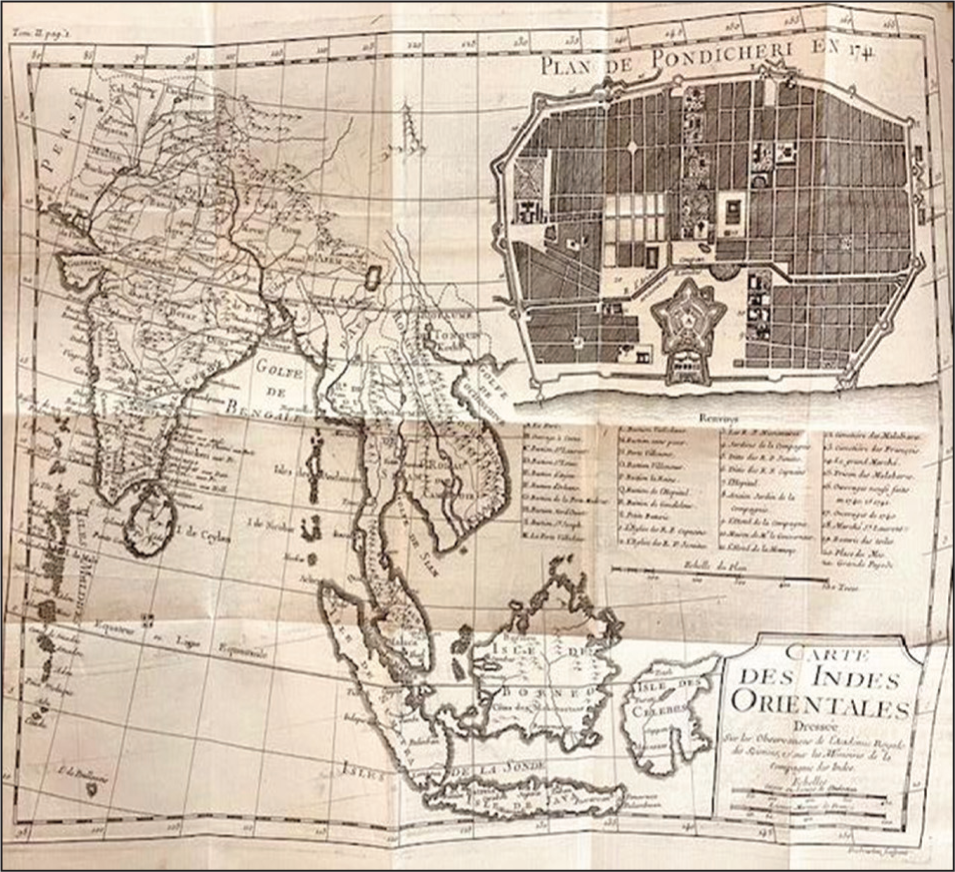
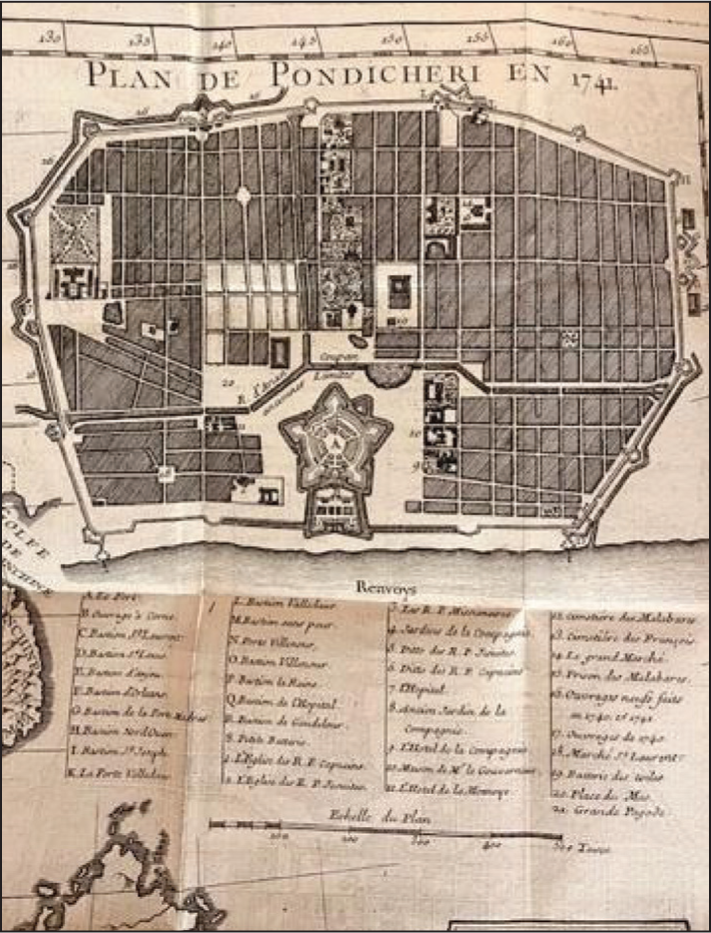
Benoît Dumas was the governor of Pondichéry from 1735 to 1740. When the widowed Princess of Arcot arrived at the gates of his city (see Figure 1), he faced a dilemma. In accepting the princess, the governor would be tempting the Nawab’s enemies, the Marathas, to plunder his city for the spoils and to turn against him. If, on the other hand, the Jesuit author of the letter describing these events wonders, Sabdar Ali Khan, the princess’ son, were to be victorious, would the new Nawab ever forgive the French for not giving them shelter in such a pressing situation? 46 In a soon-legendary gesture for French and Francophile historians, the governor decided to open his doors and offer the Princess of Arcot protection, adhering, as some accounts were to suggest, to French notions of honour and chivalry once associated with medieval knights and then recast in the concept of the honnête homme. 47 For Voltaire, writing in the late 1750s on the culture of nations, the saving grace of the Middle Ages was the concept of chivalry, whose principles were ‘honor, generosity, along with gallantry’. 48 The opposite of the honnéte homme might be the petit-maître. The Encyclopedia quotes what ‘M. de Voltaire’ said about the petit-maître: ‘the most ridiculous species that, with smugness, crawls upon the surface of the earth’. 49 Dumas’s gesture is portrayed as combining justice and generosity in the tradition of the Italian courtier, after whom the French honnête homme was modelled. 50
Map of India with Pondichéry and other ports with the European ‘owners’ indicated and inset map of Pondichéry from Guyon, l’Abbé. Histoire des Indes Orientales, anciennes et modernes. Vol. 2. Paris: Butard, M DCC XLIV. np.
Inset Map of Pondichéry showing the Valdaur Gate (K) from Guyon, l’Abbé. Histoire des Indes Orientales, anciennes et modernes. Vol. 2. Paris: Butard, M DCC XLIV. np.
Letters were exchanged between the Marathas and Governor Dumas, though it is not clear how the Jesuit priest read these letters, nor how he had access to them. However, the latter portrays Dumas as a superbly cultivated actor who soothes the angry Maratha, Raghuji Bonsle, by telling him that if it had been the Marathas who found themselves in a situation requiring French protection, he would have been similarly obliged to grant it as a cultivated man. 51
The Marathas did not invade Pondichéry in the end: They were fighting another battle against Chanda Saheb in Trichinopoly with the help of the Nizam of Hyderabad, who had longstanding animosity towards Chanda Saheb. 52 As the Indian-born Robert Orme, first official historiographer to the British East India Company, writes, the ‘Marattoes detached 2000 men’ to intercept Burra Saheb who came to Chanda Saheb’s help in Trichirapally, while 1,500 men had to be deployed against Saduk Saheb, who approached from Dindigul. 53 Even the French historian and geographer Henri Castonnet des Fosses, writing years later in the nineteenth century, confirms that the Marathas entered into negotiations with the Nawab’s family because they were also aware that the Nizam of Hyderabad was preparing to attack them with 2,000 men. Beyond this, the British from the Coromandel Coast (East Coast) were an additional and imminent threat to be considered. 54 In sum, it was more pressing for the Marathas to defend themselves from attacking enemies than to show their discontent with the French for sheltering their enemy’s family or to plunder Pondichéry. Despite this evidence, the effect of the archive still throws up Dumas as the epitome of French chivalry for accepting the princess.
The dominant French view of Pondichéry’s narrow escape from being razed to the ground by the Marathas for this governor’s gesture mythologizes the moment, Dumas’s diplomacy, and France’s position in India by anchoring Dumas as a benign and generous, superior human being, an honnête homme willing to risk his city for the sake of chivalry. And this ‘effect’ is far-reaching: A Canadian missionary writing a textbook in the late nineteenth century relies on these sources and sums up Dumas’s escape from the Maratha wrath: ‘Raghuji, awed by the firm attitude of Dumas, and bribed by a gift of French liqueurs, eventually left him unmolested’. 55 In this account, although Raghuji had the upper hand and likely exercised magnanimity, the motif of the honnête homme incarnated by Dumas gives the latter the innate fortitude of the righteous French chevalier, and it spills well beyond the French archives into the public culture of Canada, itself in a nostalgic relationship with France following the Treaty of Paris (1763), which ended the Seven Years’ War and by which Canada’s French holdings were ceded to Britain.
At the time of these skirmishes in south India, the northern Mughal kingdom had just begun disintegrating after Nader Shah’s invasion of Delhi in 1739. Although France faced competition from the British East India Company, and despite the presence of less powerful Europeans, there were other consequential enemies: the Marathas to begin with, and then the Portuguese in Malabar, who were well established further north and had a great stake in this area. Europeans experienced strong dissidence from the local Mappillas, one of the oldest Muslim populations in India. Muslims of an older ilk, in fact, represented the most pervasive impediment to European advancement in this southern area, and their networks joined up with the Mughal kings within India and gave continuity to older trading networks beyond the subcontinent. 56
Castonnet attributes the treachery of the Hindu prince who served Nawab Dost Ali Khan (he leaked information to the Maratha enemy) to his hatred of Muslims––the Nawab was a Muslim. To Castonnet, the bribe the treacherous prince received was not lucrative enough for the double-crossing. Castonnet’s black-and-white nineteenth-century interpretation relies on the well-nourished British preparation of the ground, and it contradicts the way Muslim rulers largely favoured expediency and often sided with the British or Hindu princes in protecting their own interests while being willing to go against other Muslims. 57 There was a complexity of relationships amongst Indian rulers and a fluid way in which Hindus and Muslims at all levels of society, in many aspects of life, and in governmentality in particular, participated in constituting a fairly widespread and complex Indo-Persian culture. 58 This syncretic culture becomes evident and is understood by historians to be influenced by Akbar’s evolving thought and consequent actions, particularly from 1570, which was characterized by his seeking to understand the ‘details of other faiths’. 59 Indo-Persian culture dominated linguistically, artistically, culturally and in governmentality. 60 When the Europeans, bathed in the mentality of Europe arrived in India, they found that ‘[u]nlike the truly divided world of seventeenth-century Europe, Muslims and Hindus wore the same clothes, took service in the same armies, allied across religious lines, and formed trade and credit networks spanning both [Hindu and Muslim ruled] sorts of states’. 61
It therefore makes sense that the French traveller, Abraham Hyacinthe Anquetil-Duperron, translated the Hindu Upanishads from a Persian, rather than Sanskrit, version that had been translated by (or for) the Mughal emperor Shah Jahan’s son, Dara Shukoh (1633–59).
62
In complete disregard for this reality, Castonnet illustrates a tendency shared by other European historians of the nineteenth century looking back at this time, such as Joseph Michaud (1767–1839), for whom ‘the armed doctrine of Mohammed replaced, in a large part of India, the peaceful doctrine of Brahma’.
63
These historians pushed past the archive and evidence in their francophilia for contemporary history to view the eighteenth century through that purposefully constructed narrative. Castonnet first introduced the story about the Nawab of Arcot going to his death because of the Hindu–Muslim divide, and he cited the same passage that the Jesuit letter-writer had evoked in an earlier century:
Never had a battlefield offered a more awful or terrible spectacle. Everywhere one looked, all one saw was wounded and raging horses and elephants, lying pell-mell with officers and soldiers, trying in vain to pull themselves out of the bloody morass where they were trapped and trampling the edges of the piles of cadavers and the wounded whom they ended up crushing by their fall, or smashing into smithereens with their teeth and their trunks.
64
While there is no doubt that Hindu–Muslim and other conflicts existed in south Asia, the former was far from always being the primary motivation for decision-making amongst Indians: power and control were far more lucrative, something that European historians preferred to ignore as they cast themselves easily as the quarrelling masters of the subcontinent, reducing all other conflict as being religiously motivated! The archival effect of this European-assembled archive allows for the facile generalization of religiously motivated alliances along the Hindu–Muslim fault line furthered by the British. But its earlier avatar, I suggest, was the motif of the chivalrous honnête homme thrown up in the archive that gave France its benign and well-meaning role in India.
Providing further detail, Castonnet writes that Dumas consulted with the town’s Council, presenting them the pros and cons of accepting the Princess of Arcot, although he did not have any doubts himself regarding the right thing to be done. 65 Further, Castonnet elaborates on the developing situation, claiming that ‘all the citizens of Pondichéry loudly approved the decision that had been taken. Gratitude was the dominant emotion, all spoke with one voice’. 66 There is no indication regarding what other source Castonnet consults, more than a century later, to provide these further details. His report appears to embellish Abbé Guyon’s eighteenth-century account by exalting Dumas even further as the ‘national’ hero of the day, the ideal, chivalrous Frenchman. It aestheticizes eighteenth-century events in India, giving them a moral unity (‘all spoke with one voice’) that resonated with the climate in France, which there was saturated by this time with a nationalist feeling set against an anti-German sentiment (Germany being declared, in the Reichsgründung, in 1871) following the Franco-Prussian war. According to Castannet’s report, the Mughals of Arcot who entered Pondichéry were impressed by French ‘perfect order’ in the city and were ‘charmed’ by the conversations they had with Dumas; they ‘were soon overpowered by his influence’. 67
It is perhaps no coincidence that Castonnet’s vocabulary here mirrors so closely Charles Baudelaire’s poem, ‘L’Invitation au voyage’ [Invitation to the Voyage] published in the notorious, and initially banned, collection Fleurs du mal (1857) some thirty years prior to the appearance of Castonnet’s history of India. In Baudelaire’s well-known poem, an ambiguously evoked woman (my sister, my child) is invited to go on a voyage far away, where the poet’s spirit finds ‘charm’ in the sun and sky and where ‘tout n’est qu’ordre et beauté, / luxe, calme et volupté’ [All is order there, and elegance, / pleasure, peace, and opulence]. 68 These lines sounded once again in Paris in the 1870–71 compositions for the poem by Emmanuel Chabrier and the enigmatic Henri Duparc 69 whose influence coincided with Napoleon being dethroned and the Third Republic declared. Early in the Third Republic, France formally established the Eastern colonies in Polynesia and Indochina, stirring up the memory of a definitively lost but now even grander India, known as the ‘Raj’.
The fact is that the earlier period, in which Governor Dumas veritably faced his dilemma, was one where the French nation identified itself boldly and confidently in literature, art and culture as distinctly ‘French’: somehow unadulterated in matters of taste and distinction. 70 And even British seamen such as Lord Nelson considered ‘a knowledge of French’ to be ‘absolutely necessary’ for the seamen he claimed could not ‘be a good officer without being a gentleman’. 71 More broadly, Europeans found different ‘national’ versions of taste and morality, even with internal debates and quarrels and differential views of the Greco-Roman heritage. 72 But this history ultimately also served to distinguish them from what they considered less evolved civilizations with which they were obliged to rub shoulders in their global adventuring. Our effort still remains to dismantle the effects of that orientation to the world that we often adopt in our cultivated and pervasive scholarly practice based on what we take to be archivally based truths.
Both a self-possessed notion of Frenchness grounded in seventeenth-century culture that was taking shape in the eighteenth century and a newer nostalgia, in Castonnet’s lifetime, in the nineteenth century, for the lost opportunity for empire in India colour this historian’s report.
73
As one critic has cogently stated:
The seventeenth century literary field is the ultimate embodiment of France’s génie national. It is frequently touted at the end of the nineteenth century as the period that is the most ‘French’ […]. The study of […] French classical models will produce a ‘man of taste’ and l’honnête homme […] who become models for French citizens in the nineteenth century.
74
In the early part of the eighteenth century, the seventeenth-century notion of the honnête homme was a prominent subject of discussion in French culture, and it greatly influenced Montesquieu, Dubos,and the marquise de Lambert, who were among this motif’s most influential critics. 75 Even later in the eighteenth century, Voltaire, d’Alembert and Diderot still held to the notion of the ideal cultural being as a cultivated, educated, honnête homme, a morally correct and socially connected man of distinction and judgement, whose actions were rational, gracious, understated and without egotism. Accounts in the archive, such as those by the anonymous Jesuit writer, or the historian Castonnet writing in the next century, tend to cast Dumas as an honnête homme, characterized by culture, distinction, chivalry and wit that were unique to France. 76
Developing this idea of the French nation’s superiority that is represented by the specimen provided by Dumas, Castonnet suffuses his account with national pride, writing that the Arcot royals:
[r]ealized they could count on our loyalty. Furthermore, the asylum we were granting to Daoust-Ali-Khan’s widow was, for us, a great honor. A prince had been defeated, his army disbanded; his widow and children had taken refuge in French territory, under the protection of our flag. This constituted a form of recognition of the superiority of our country, and our prestige must have been felt and increased from the perspective of the Indians. (251)
The desire for France’s prestige in India was felt much more acutely in France in the nineteenth century, when this European nation was out of the picture in the subcontinent and when Castonnet was writing, than in Dumas’s Pondichéry in 1740, when France was one of several European powers jostling for trade and more in India. The Pondichéry-born (1843) French Indologist and Tamil scholar, Julien Vinson gives voice to the regret experienced by Frenchmen who had a direct sense of India’s potential for France’s empire long after it had been lost. He writes: ‘(O)ne can only deplore bitterly the ineptitude of Louis XV’s ministers, who prevented France from accomplishing the glorious role that she seemed destined to play’. 77
Britain was, in fact, not France’s main obstacle, and the French were not as much in control of the situation between warring Indian powers as they are portrayed to be. Indeed, France barely qualified as a colonial power in India. Even several decades later, in 1774, Comte Duprat, who was Governor of Mahé, another south Indian territory, had little effect as he clashed with Srinivasa Rao, Haider Ali Khan’s trusted general. Duprat tried to play the intermediary between the Calicut Zamorin and Tipu Sultan’s father, Hyder Ali: ‘Do you want our friendship? Do you not want it? […] [If you block the French citadel in Calicut] I will consider it a declaration of war that I will fight unto my last drop of blood…’. 78 Duprat’s posturing revealed his lack of real military and political power, and he was chased back to Mahé, while Hyder Ali easily ousted the Zamorin. 79
Before the glorified days of Dupleix in India, 80 as early as in 1736, Dumas had successfully gained the right to mint rupees, pagodas and fanams [small gold coins, often associated with the Travancore mints] in Pondichéry, making a profit worth ₹400,000 for the Compagnie des Indes. 81 Consequently, Dumas became a ‘nawab’, a title that no European had ever held. 82 France saw itself allegorically through Dumas as a chivalrous presence in India because, for example, ‘he therefore [due to his chivalry] received the princesses not as defeated fugitives, but with the greatest pomp’. 83 Recounting Dumas’s eighteenth-century imbrication in the complex web of power in India in terms of chivalry, while sometimes contradicting the facts on the ground, France’s archive has managed to produce the effect of casting its own encounter with India with a sense of style, largesse and generosity despite ongoing brutalities of French colonialism elsewhere in Asia and Africa that were occurring at the same time.
Dislodging the Archival Effect of French Chivalry in India: The Stakes for India Today
Colonial India is most often associated with the British Raj as the latter is acknowledged as one of the longest and most profitable examples of economic exploitation in world history. 84 Preceding the proper colonial period, the Indian subcontinent (and other soon-to-be colonized regions) was a place of exploitation as well as one of experimentation, newness and possibility. The French Jesuits had been sending back books (the Vedas, Upanishads, and other Sanskrit texts), having translated, printed and bound them in India since about the end of the seventeenth century. 85 The unfortunate case of the false Ezouravedam, a made-up text presented as a translation of a Sanskrit original by mischievous Jesuit clerics, became a source Voltaire eagerly seized to write admiringly of India. The indiennes (textiles from India) used in furnishings and fashion 86 complemented the aesthetic and scholarly value of Indian manuscripts as well as the particular accumulation of such manuscripts by Jesuit priests. 87 Other philosophers and thinkers of the time sometimes used these materials to denounce colonialism, even raising up distant civilizations as superior. 88 France’s eighteenth-century Indian adventures translated into literary and artistic expression beyond the scope of this essay, and they left an indelible mark of desire in the French imaginary that lasted much longer than its ephemeral colonial presence in India. 89
Immediately following the revolutionary period in France, India was transformed, in historical discourse, into a myth along the lines of Montesquieu’s utopian land of the Troglodytes. Before their fall, these creatures had everything they could need and, in perfect unity, defended one another from jealous enemies. 90 Joseph François Michaud, the historian who lived the end of France’s glory in India, for example, evokes this kind of mythical status with reference to pre-colonial India: ‘The riches that the inhabitants of India (Industan) enjoyed soon made other peoples jealous’. 91 Even though his work tracks the Mysore Empire’s heights, Michaud builds up India’s relationship with France less as constituting the ties with a former territory than as a somewhat revered friendship, perhaps in a modified form of Montesquieu’s myth, and the land itself as one that commands awe for its resources and self-sufficient culture.
By the end of the nineteenth century, French India is more definitively evoked with nostalgia: as the prize lost to the British. Julien Vinson, the grammarian and linguist of Indian languages, who was born in the late nineteenth century in Pondichéry, writes that ‘there is no doubt that India would have progressed much more in our hands over a century, than in the hands of the British, [who are] mercenary, pietists, and monarchist’. 92 When Vinson resurrects the term ‘piétiste’ to scorn the British, then, he is likening them to France’s newer Germanic rival, as monarchist, backward and violent. Vinson, who was a great lover of India (the land where he was born and where the ties of his family harked back to the glory of French presence in India), also manages, like other nineteenth-century historians enamoured of France, to elide French barbarism and cruelty in its African and Creole colonies in his own times. Omitted in these later accounts is also the open brutalism practised by France in Asia itself, with Vietnam being subjugated by Napoleon III’s offensive, around mid-century.
Dumas and Europeans who entered India before him experienced the domination of the Mughal rulers; the British East India Company, memorably, had to apologize to Aurangzeb under humiliating conditions and pay a hefty fine for trying to blockade ports. 93 Dismantling this instance of ‘French chivalry’ in India as performed by Governor Dumas, or as it was told by historians of various periods, necessarily takes France out of the French–British dialectic that dominates the nostalgic, nineteenth-century version of France’s position in India in the preceding century; it mitigates the relevance of singular stars of French history such as Dupleix or even the earlier Pondichéry governor, Dumas; and it reveals the complexity of power relations in eighteenth-century India. Europeans establishing trade relations had to compete with others from their continent, but, more importantly, they had to penetrate already existing networks that linked India to the Arab world and to Persia long before Europe supposedly discovered ‘East’ India. Trade between Sind and Hadramawt and Oman could even be seen as creating a unified region rather than as we might understand it today: as trade across regions. 94 Muslims—as the British and later French East India Company and other Europeans, such as the Dutch and the Portuguese, penetrating the subcontinent realized—were an intrinsic and crucial part of a formidable and older trade network with the Indian subcontinent and beyond. They enjoyed deep relationships with the area as both locals over centuries of generations and as commercial visitors, but were construed as outsiders by Europeans. This framing could provide a moral and political dimension to Europeans back home as their nations’ expanding colonial vision grew in the Indian subcontinent and required legitimization. For this reason, indigenous Muslims are often presented in a variety of later European texts as outsiders first, and barbaric next, in relation to presumably autochthonous Indians. 95 This tendency was soon converted into the premise upon which France’s position in India was distorted, as we have seen; at the same time, it enabled the evolving motif of French chivalry, which, in its turn, produced an archival effect traceable through the ages. Its remnants are not separate from contemporary public discourse in India. In this reading, but much more broadly, one of the justifications for consolidating colonial power used variably by different Europeans was that India needed to be saved from an Islamic threat to what was proposed as a purer Hindu civilization, which was more authentic to India. This rhetoric became implicated in the discourse of prominent Indian Hindu thinkers in the lead up to Indian independence, and India is in the throes of managing that rhetoric—and its turbulent consequences—in the public sphere today. 96 There is an amnesia at play, disadvantaging the tightly-knit Indo-Persian culture, which was systematically undone by the British as they strengthened the Raj. Muslims presented, to any or all of the European hopefuls in the days of the multiple companies vying for trade and more, a destabilizing double in imperial possibility, an alternate rich and ancient civilizational anchoring, with a separate but recognizable (book-based) religion—all elements that somehow came to be used to establish, argue or imagine European superiority. 97 The subtext of the greatness of European cultures, articulated in the chivalry of the honnête homme, for example, aligns very quickly with the condemnation of Europeans’ real impediment: Muslim rulers and networks within a syncretic culture. Today, the ambiguous, if not contentious, positioning in nationalist discourse of the identifiably Muslim population to the Indian nation-state 98 is challenged by the majoritarian government, while the state seeks validation of its characterizations of Indian Muslims by having recourse to archival documents and contemporary historical work on eighteenth-century India. The innate superiority and righteousness of autochthony in the national hierarchy are at the heart of Hindu nationalism. By pushing beyond the archival effect of important motifs such as the honnête homme and narrative tropes like French chivalry, for example, their consequences appear as an elision of the complex resistance to Europeans from Indo-Persian society before and through the Mughal kingdom’s decline. Such a critical effort, alongside privileging a body of existing work that corrects the largely prevailing (surreptitiously or unconsciously) Eurocentric view of pre-Raj India, 99 produces an alternate effect by repositioning Muslims as constitutive of subcontinental culture. Indian Muslims thus emerge as an essential and often indistinguishable component of the historically verifiable amalgam that transforms their status both discursively in the archive and politically in the nation-state. There is a different option than that of succumbing to the archival effect bolstering Eurocentrism in which other foreigners were required to liberate the genuine India from Muslims, all of whom become linked to descendants of invaders, coming from, vaguely, the Middle East. 100 It becomes historically and analytically more viable—and perhaps more accurate—to reject a fissuring identification of (and even by) Muslims as essentially non-Indian or distinct, which produces them discursively as perpetual enemies of the state, thereby rejecting the very core of colonial discourse in India. Breaking down the artefact of the honnête homme as putting pressure on the structure of the archive that produces its image easily reveals French chivalry as an effect of the larger process of establishing the sophistication and goodness of the French. Therefore, Indian Muslims might first be recognized as diverse within today’s political landscape, owing to different histories of arrivals from Persia and the Middle East from the seventh century onwards. Such a decolonial view illuminates their different histories of integration: for example, the Mappilas of Kerala versus the Mughals of Delhi. Muslims were constitutive of the Indo-Persian culture that European traders, missionaries and mercenaries encountered. Their alienness could then emerge only by adopting and regenerating the archival effect of European documentation and representation aimed at presenting a courtly, civilized and sophisticated specimen of European origin that must be seen as part of European struggle to function in what was a volatile and difficult landscape. Themes such as chivalry with motifs like the honnête homme provided Europeans viable, familiar and authoritative narratives which obscured their struggle for survival and now incite overstatement regarding their presence (in the case of the French) in pre-colonial India as seen in the first part of this article. They provided codes of behaviour which were couched in the familiarity of the honnête homme, while today the Hindu-Indian becomes the other side of the same coin, giving the lie to India’s accomplishment of what Walter D. Mignolo, among others, proposes as embracing ‘decoloniality’: an epistemic reconstitution. 101 A discussion of decolonial (rather than decolonizing) processes in India exceeds the scope of this essay, but in closing, suffice it to remark that Quijano’s formulation of the ‘coloniality of power’, 102 and the development by the decolonial theorists of the concept of a ‘colonial matrix of power’ provide insight into the strategies used by the dominant political parties in India to provide a national narrative. Thinking decolonially rather than thinking about decolonization (which is not precluded when attempting the former) are two different but related matters. Placing Muslims as ‘always already’ outsiders, intruders and ‘others’ within the Indian state (whether to ostensibly protect them as a minority, ask for their vote, or denigrate them) replicates the coloniality of power that also inheres in the motif of the honnête homme, which generated a version of the French governor of Pondichéry within imperial France’s purview. The negativity enduringly attached to the Indian Muslim derives from the same structure of thinking that validated the British Raj as it did the chivalrous Frenchman, despite the latter’s ultimate failure in India. The particularity of this cultural motif, imbued as it was with a unique version of proud humility, often served to keep face in situations where Europeans experienced degradation or needed to recover from impasse in the world of eighteenth-century India that was unruly and unknown. If the particularity claimed for French colonial presence in India is interesting at a scholarly level and worth pursuing, it should also serve to alert us to the importance of resisting the same seductions which the broad European narrative of the French in India performed. This has been a modest attempt to respond to that challenge.
Footnotes
Declaration of Conflicting Interests
The author declared no potential conflicts of interest with respect to the research, authorship and/or publication of this article.
Funding
The author disclosed receipt of the following financial support for the research, authorship, and/or publication of this article: The author disclosed receipt of the following financial support for the research, authorship, and/ or publication of this article: Archival research for a larger project from which this essay draws was supported by the Margaret E. Deffenbaugh and LeRoy T. Carlson Chair funds (Wellesley College) and the Edward W. Said Chair funds (UCLA).