




Abstract
This study empirically investigated the impact of strategic human resource (HR) capabilities, HR inducements and their influence on the line manager’s commitment and internalization of HR practices. The results indicate that perceived strategic capability and HR inducements positively influence satisfaction with HR practices. Furthermore, satisfaction with HR practices has a positive relationship with line managers’ commitment and HR internalization. This study uniquely examines the association between perceived strategic capability, satisfaction with HR practices, HR inducements, line managers’ commitment and HR internalization in the Indian context. The study highlights the necessity of creating a perception among employees that their organization has proper strategic HR capabilities and effective HR inducements.
Executive Summary
Line managers are essential for implementing human resource (HR) practices into action, but many organizations struggle with inconsistent execution due to limited commitment and weak internalization of these practices by line managers. This study examines how line managers’ perceptions of the HR function’s strategic capability and the inducements provided through HR practices influence their satisfaction with HR, and how this satisfaction leads to greater commitment and internalization. The study uses survey data from line managers working in various sectors in India, such as manufacturing, services, banking, information technology and consulting. Based on social exchange theory and human capital theory, the research tests a conceptual model to understand these relationships. The findings show that when line managers believe the HR function is strategically strong and receive fair and supportive inducements— such as training, career development and rewards—they feel more satisfied with HR practices. This satisfaction then increases their commitment to HR responsibilities and helps them internalize HR values more deeply. The results highlight that satisfaction with HR practices is an important link between HR capability, HR inducements and line managers’ behaviour. Interestingly, factors such as age, tenure, HR department size and HR managers’ experience do not have a significant impact on satisfaction. This suggests that effective and well-designed HR systems are more important than individual or organizational characteristics. The study offers useful guidance for organizations that want to strengthen their HR implementation. It stresses the need for HR departments to build strategic trust, clearly communicate their value and provide inducements that align with the practical needs of line managers. When line managers are satisfied with HR practices, they are more likely to be committed and internalize these practices, which ultimately improves the effectiveness and longterm success of HR management.
Every organization has different functions, and its managers are typically called line managers. Line managers handle operations or industry-specific services (Fu et al., 2020). They may not be directly involved in HR-related policy formation, but are essential stakeholders in implementing HR practices and executing them successfully (Khilji & Wang, 2006). However, the major challenges faced by organizations are that line managers sometimes view HR practices as ineffective or unimportant. They may even fail to understand the true intent behind HR-related activities (Nishii & Wright, 2008), resulting in partial success or complete failure in implementing such policies. To gain credibility for their HR processes, organizations must help employees develop accurate perceptions of the strategic capabilities and benefits of HR.
Furthermore, firms must be fair and rely on a meritocracy culture through transparent HR practices to ensure a positive perception of HR inducements among employees. HR inducement provides competitive pay, appropriate training and development and career opportunities (Shaw et al., 2009). Additionally, employees will be more satisfied with HR processes and systems if they have a positive perception of HR practices. It helps line managers internalize, defend, advocate and remain dedicated to implementing HR procedures (Ulrich, 1998). Schuler and Jackson (2014) suggest that line managers should be accountable.
There has been a rise in line managers’ involvement in HRM (Anvari et al., 2024) largely due to delegation (Brewster & Larsen, 2000; Currie & Procter, 2001; Fu et al., 2020; Renwick, 2003; Schuler et al., 2001; Ulrich & Beatty, 2001). Familiarity with HR processes enables line managers to better support the objectives of the HR function. The focus of HRM research has also shifted from policy formation at the corporate level to the de facto implementation of policies by line managers (Fu et al., 2020; Nishii & Wright, 2008).
This study examines the influence of perceived strategic HR capability and HR inducements on line managers’ commitment through the internalization of HR practices. The study empirically investigates these relationships using survey data. The next section outlines existing research on the relationships among the variables, followed by the methodology, results, discussion and conclusion. The article concludes by outlining its limitations and offering suggestions for future research.
LITERATURE REVIEW AND HYPOTHESIS DEVELOPMENT
Prior studies (Brewster & Larsen, 2000; Conway & Monks, 2010) support the transfer of HRM functions to line managers. The rationale is cost reduction, enabling a more comprehensive HRM approach, delegation of HRM responsibility to the most responsible managers, swift decision-making and serving as a substitute for HR outsourcing (Brewster & Larsen, 2000). Further, it highlights three dominant themes in the HR literature relevant to line devolution. First, the line manager’s involvement in HRM, for which the HR should be fully integrated into the company’s actual work and held liable for organizational success (Ulrich, 1998). Second, the necessity of a partnership among the triad of line managers, employees for HRM and HR managers (Schuler & Jackson, 2001); and third, mid-level managers’ strategic participation to allow experimenting freedom (Currie & Procter, 2001). However, the effective executive often fails due to a lack of commitment and ineffective internalization practices from line managers. They sometimes do not perceive HR capability and lack positive HR inducement. This research focuses on conducting an empirical analysis to understand the impact of how line managers’ commitment and HR internalizationare affected by the perceived strategic capability of HR and HR inducement through the satisfaction of HR practices. A conceptual model including these constructs has been proposed and then tested to understand the role of line managers in HRM.
With businesses vulnerable to ‘corporate liposuction’ (Whittaker & Marchington, 2003), responsive middle management is essential for responding to continuous changes (Ulrich, 1998). Devolving responsibility to the line managers disburdened the HR from steering monotonous nonstrategic work (Cunningham & Hyman, 1999) and allowed them to engage in strategic business decisions. Also, e-HR adds rationale by freeing up line managers and letting them utilize that time for other purposes such as training (Watkins & Higginbottom, 2002). However, HR needs to build the correct perception by providing the right services to internal customers, namely employees. The quality services from HR will undoubtedly help line managers build the necessary trust, leading to satisfaction with HR practices because of a positive perception of HR capability.
According to the social exchange theory, it is ‘an economic analysis of non-economic social situations’ (Emerson, 1976). However, the limitation of this theory is that it restricts itself to only those actions that receive appreciation from others (Blau, 1964). When line managers receive adequate support from HR, they are more likely to implement HR practices effectively and manage their teams well. The proper exchange will undoubtedly help line managers to facilitate effective utilization of HRs. Human capital theory argues that employees’ learning capacities are equally valuable to provide the desired outcomes in terms of goods and services for a given organization (Lucas, 1990). Therefore, it is imperative to utilize the significant number of employees deployed in the core operations, who are considered line managers. The human capital theory purports that investment in the training and development of employees will facilitate organizational performance. Therefore, it is important to fully leverage human capital and maximize the value that individuals bring to the organization.
Line managers play a vital role in team supervision and have traditionally been central to organizational functioning. They are directly affected by HR practices and behave responsibly in the effective implementation of HR policies. Also, the employees approach their immediate managers for expert guidance and advice, even on personnel matters. Hence, it is essential to sensitize the line managers appropriately through the effective use of e-HR techniques and guidance manuals. Moreover, line managers conduct interviews as functional experts and handle the grievances of their subordinates. Managing people working under a line manager seems more straightforward, but managing them to their best potential is tricky. According to Renwick (2003), most of them take pride in managing their respective teams and their core work of supervising the operations (Hales, 2005).
Over the years, the personnel manager’s role has shifted from an administrative to a business architecture and partner-focused role. Thus, HR managers have started to exercise their responsibilities through participative management and are empowering line managers to implement new hiring methods, performance appraisals, career development, training needs identification and the provision of necessary monetary benefits as required. They have also started to develop a psychological contract among the managers, which gets translated into their performance (Schreuder et al., 2020). Today, line managers are deeply involved in key workforce processes, from notifying HR about staffing needs to overseeing resignations and exit procedures. (Schreuder et al., 2020). However, this change in role does not get ready acceptance from their colleagues and creates conflict in an organization (Tyson & Fell, 1992).
HR personnel are often discordant with commercial realities and business goals (Combs et al., 2006). They are, at times, perceived as a constraint for managerial autonomy in decision-making. Legal issues of negotiations with the union particularly unnerve line managers. Line managers also criticize HR managers for being slow and thorough to avoid uncertain outcomes (Cunningham & Hyman, 1999). Another primary criticism HR practitioners face is in enforcing theoretically sound policies that are difficult to implement or unsuitable for the organization. The HR function thus faces criticism for being both too interfering and too distant. These criticisms have increased the responsibility of line managers (Lowe, 1992). Line managers’ actions are more prone to suit business realism considering context (Lowe, 1992). Some experts have gone so far as to recommend downsizing or disbanding HRM (Delery, 1998; Sheehan & Cooper, 2011). However, the solution is to amalgamate HR practitioners as ‘business partners’ with senior management by tying them to business objectives (Ulrich, 1998). Thus, it highlights a significant relationship between line managers and efficient HR partnerships as a viable solution. This study aims to understand these linkages through an empirical investigation.
Perceived Strategic Capability of HR Function and Satisfaction
An advocate of the devolution strategy recommends that the organization benefit through quick decision-making, saving organizational cost and connecting the HR activities with other domains of regular management (Larsen & Brewster, 2003; Renwick, 2000). However, there are limited empirical studies on how perceptions of HR’s strategic capability influence line managers’ satisfaction, internalization and commitment.
In developing a progressive reputation among organizational line managers, HR units face significant hurdles. The managers from different functions in the organization devalue HR functions as a low-grade, supportive role that could be outsourced to save costs (Caldwell, 2003; Prieto & Pérez-Santana, 2014). As a result, HR managers are perceived as service providers and politically correct professionals who are affected by top management (Ferris & Judge, 1991). Boselie et al. (2009) suggest that companies should establish and preserve the notion that HRM is important and crucial. Political action might contain identifying different threats that the HR section can manage (Tang et al., 2017), highlighting the HR individuals’ achievements (Galang & Ferris, 1997), or developing a participative approach in HR decision-making (Tsui, 1990). Prior research indicates that symbolic actions by top management, such as visibly communicating the HR department’s concern for employees and its role in managing organizational resources, can strengthen perceptions of HR’s strategic importance (Galang & Ferris, 1997). Such symbolic support from top management also signals the HR department’s commitment to meeting stakeholders’ expectations (Lopez-Cabrales et al., 2017).
Emphasizing an intentional HRM strategy may not help create a pleasant experience in exchange for various responsibilities. Hence, it is important to understand employees’ experience while practising those HR policies (Gratton & Truss, 2003; Tang et al., 2017). Various studies have found that, because of inconsistency in execution as well as varied individual-level cognitive schemes, managers do not find alignment in the intentions, perceptions and implementations of HR strategies (Edgar & Geare, 2005; Khilji & Wang, 2006; Kuvaas, 2008; Wright & Haggerty, 2005). It is therefore imperative to foster a favourable perception of the HR department’s capabilities through appropriate measures. This is likely to positively influence satisfaction with HR practices and enhance line managers’ commitment to implementing these practices and cultivating organizational culture. Thus, we propose the following hypothesis:
H1. Perceived strategic capability (PSC) of the HR function has a positive and significant impact on satisfaction with HR practices.
Satisfaction with HR Practices and HRM Function Inducement
HR inducements provide a proper way for employers to offer career growth, make commitments, assign responsibilities, provide extensive training and development and offer adequate compensation and rewards. Yet studies show limited agreement between HR and line managers on these issues, highlighting a gap in shared understanding and expectations. Hutchinson (1995) noted that while HR managers often engage in discussions with line managers and aim to work collaboratively, challenges arise when line managers misunderstand the purpose of HR practices or undervalue HR’s contributions. This disconnect can make it difficult for HR to function effectively as a strategic partner (Allen & Boynton, 1991).
In their study, Agarwal and Gupta (2018) present empirical evidence of a collaborative relationship between line managers and personnel, suggesting that a line manager will play a different role than their functional role. The appropriate role sharing between HR and line managers will help each other achieve their respective goals (Poole & Jenkins, 1997). Most managers are confident about this alteration, and there is little evidence to suggest that it caused worry.
Cunningham and Hyman (1999) observed a tendency to involve line managers in HR functions. They found that reallocation of duties helps line managers appreciate and satisfy HR practices. Thus, we hypothesize:
H2. HR inducement (HRInd) positively and significantly impacts satisfaction with HR practices.
Role of Control Variables in Satisfaction with HR Practices
An organization’s capabilities are partially an output of the resources at its disposal. Earlier studies have established that prior knowledge of managers influences the competency of the team (Kor, 2003). Previous studies have also demonstrated that the HR managers’ attributes influence their attitudes about HRM practices (Björkman et al., 2011; Sancho et al., 2018). HR managers possess expertise and implicit knowledge gained from relevant experiences, which impact their ability to perform several responsibilities.
In decision-making, knowledge and experience assist HR managers (Ben-Gal, 2019; Murphy & Southey, 2003) and positively impact the decisions made by the HR department (Reichel et al., 2009). In the HR domain, prior knowledge supports the performance of HR managers and influences effective HRM practices. Therefore, the HR manager’s experience was considered as a control variable.
HR managers are often criticized for their inability to understand the business and effectively link business realities to HRM strategies (Guest & King, 2004). To increase HR managers’ competencies, gaining experience in other functions and working closely with different functions over a substantial period plays a significant role (Kelly & Gennard, 2000) and promotes enhanced business understanding. Research suggests that HR managers who have had the opportunity to discharge responsibilities beyond HR functions have more knowledge of HRM from a ‘user’ point of view (Björkman et al., 2011). Over time, employees begin to accept the policies in their true sense and appreciate the HR practices. Research suggests that employees’ perception of HR practices influences their behaviour (Kehoe & Wright, 2013). Factors such as gender, experiences of HR managers, HR departmental strength, employee tenure and employee age have been taken as control variables (Figure 1).
Research Model.
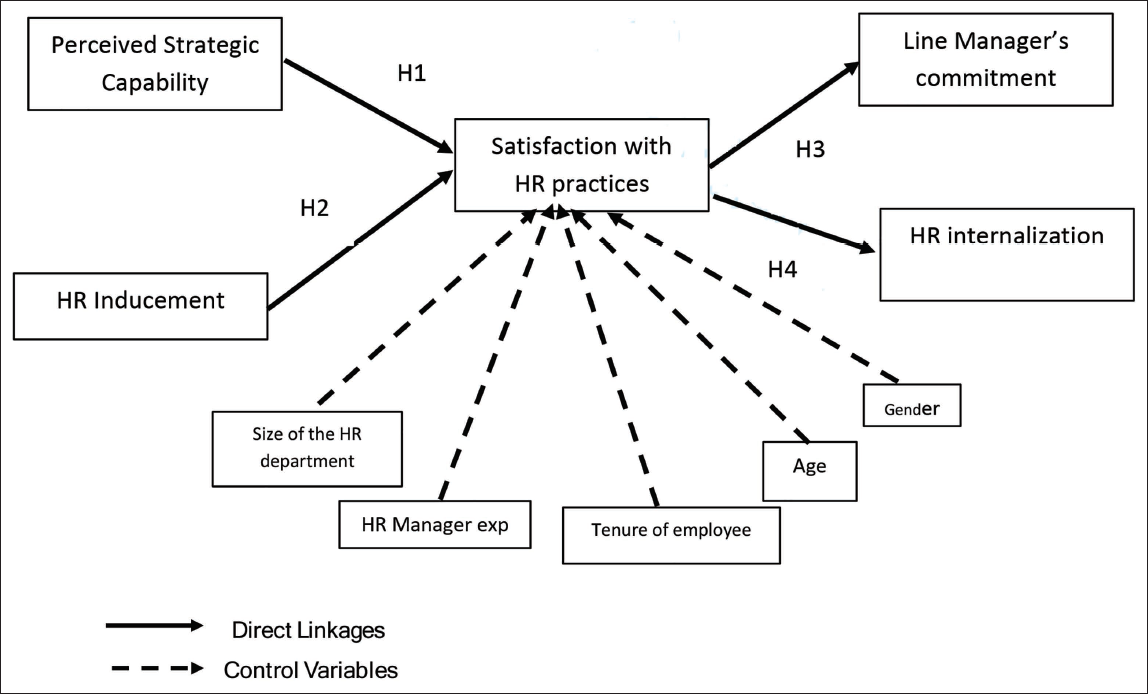
The sample for this study was obtained from various organizations. Hence, it was difficult to standardize variables like age, the strength of the HR department, employee tenure and HR managers’ experience. This made it pertinent to control variables related to the strength of the HR department, the experience of the HR manager and employee tenure. Figure 1 shows the control variables through dashed lines towards satisfaction with HR practices (SHP).
Line Managers’ Commitment and SHP
As described by Stewart (1963), line managers are employees who administer all responsibilities to achieve the assigned objective for a given organization. Dalton (1959) defines that a manager’s role includes much uncertainty in making decisions in unforeseen situations; hence, it would be advisable to select managers who can balance organizational and personal needs. According to Drucker (1974), a management job has five basic operations: organizing, setting purposes, communicating and motivating, people development and measurement.
According to Mintzberg and Quinn (1998), general work includes routine jobs such as ceremony and ritual, soft information processing and negotiations. Though, as per Leicester (1989), line managers may be excellent and skilled in their technical roles, but may not be able to handle people’s issues most effectively. The reasons might vary from person to person, depending on their preferences and orientation. Some line managers have been compassionate towards people-related issues, while some may have deep concerns about the task (Blake & Mouton, 1966). Most of the time, line managers have given utmost importance to their work and have never explicitly been asked to care for their subordinates. Additionally, the satisfaction and acceptability of existing HR practices increase line managers’ commitment, which strengthens the bond between line managers and their subordinates. Hence, we hypothesize that:
H3. SHP positively and significantly impacts the line manager’s commitment.
SHP and Internalization of HR Practices
For any organization, it is essential to internalize the HRM practices that are influenced by SHP (Kostova & Roth, 2002). A uniform set of HR practices ensures less confusion. Employees perceive a stable organization amid global expansion when the organization can focus on its HR practices. Storey (1992) suggests that the line manager’s involvement helps bring better results, but it creates a threat to the personnel manager. To overcome this, middle-level line managers are designated in a new role as ‘business managers’. Storey (1992) asserts that such developments involve active participation from the management and managers in defining HR policy at the senior management level. Most of the time, HR professionals function as internal consultants where line managers have been delegated customary HR strategies. For devolution, the primary rationale was not cost reduction but to improve the accountability of local management. Hence, we hypothesize that:
H4. SHP has a positive and significant impact on HR internalization.
METHODOLOGY
Participants and Procedure
Data were collected through both online (Google Form) and offline surveys from August to December 2024. Respondents were required to have at least two years of experience in any functional role. We received 171 usable responses out of approximately 552 invitations, resulting in a 36% response rate. The low response rate could be attributed to the COVID-19 pandemic, during which many employees were adjusting to their new workplace norms. Moreover, the sample was diverse, encompassing respondents from various sectors, including consultancy, banking, manufacturing, electronics and communications, the textile industry, fintech, energy and mining, banking and insurance, agriculture, pharmaceuticals, IT services, education and service organizations. The gender representation includes 34% female and 66% male respondents. In terms of education, 89% were postgraduates, 10% were graduates and 1% held doctoral degrees.
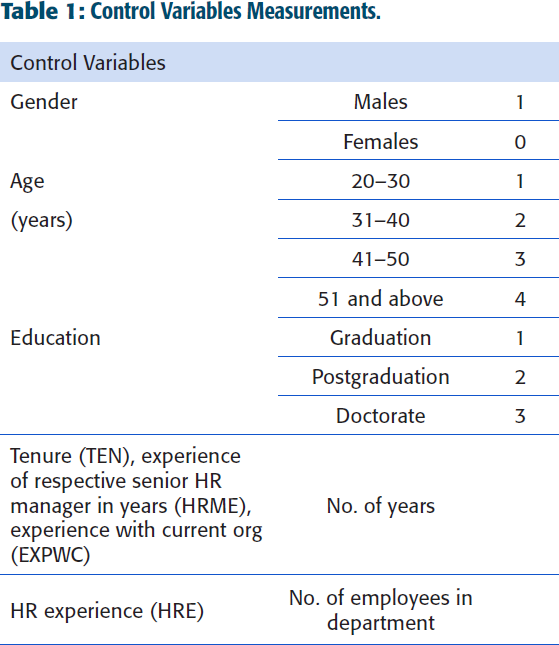
To minimize potential confounding effects, several demographic variables were included as control variables in the analysis, particularly in relation to SHP. These included age, tenure, education, gender, the HR manager’s experience and the size of the HR department. Age and education were recorded as categorical variables—age was grouped into four brackets (20–30, 31–40, 41–50 and 51 years and above) and education was categorized as graduation, postgraduation and doctorate and treated as an ordinal variable (Table 1a). Tenure (TEN), the experience of the respective senior HR manager in years (HRME) and experience with the current organization (EXPWC) have been captured in years and treated as continuous variables for consistency with the dataset. Binary variables such as gender were coded as 0 = female and 1 = male to ensure statistical clarity. These variables were used solely as controls in the structural model, as shown in Table 1.
Control Variables Measurements.
RESULTS
Evaluation of Measurement Model
SmartPLS, a component-based structural equation modelling tool—more precisely, partial least squares— was used in the study. Appropriate measures are offered by SmartPLS to guarantee the calibre of the structural and measurement models. Cronbach’s α was used to evaluate internal consistency to ascertain dependability, and all values are considered acceptable, as seen in Table 1b. The composite reliability (CR) values are also higher than 0.7 (Chin, 1998; Dhir & Dhir, 2020; Dhir et al., 2020). As Cronbach’s α might occasionally overstate or underestimate the reliability coefficient, CR is seen as a better indicator of internal consistency (Raykov, 1998). However, the average variance extracted (AVE), CR and Cronbach’s α values are all within reasonable bounds. According to Hair et al. (2020), an acceptable AVE value is greater than 0.5, which indicates that the construct adequately captures variance from its indicators. According to Hair et al. (2020), AVE represents the shared variance between the construct and its indicators. Table 2 indicates that the model is suitable for additional investigation.
Construct Validity and Reliability.
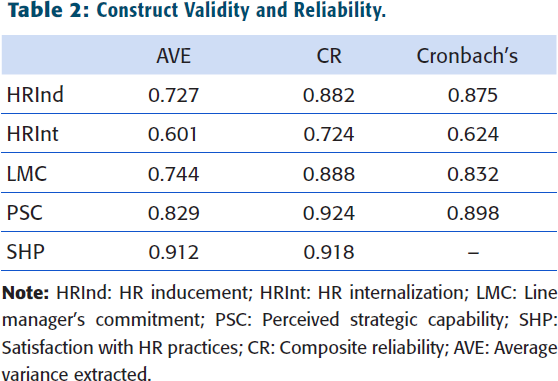
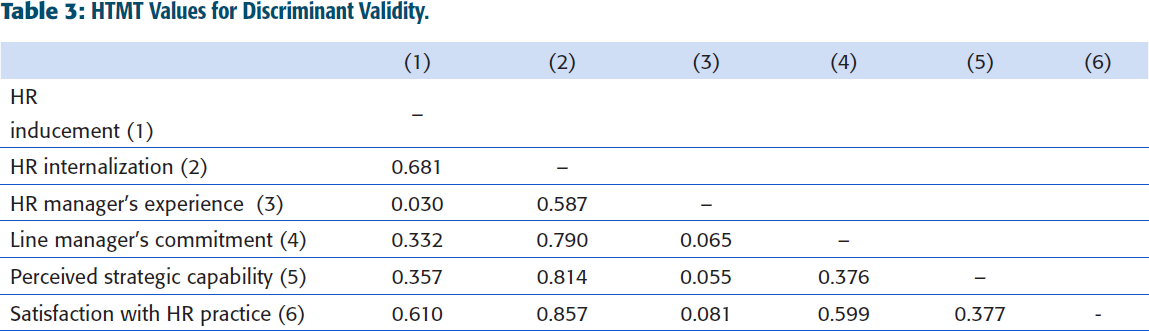
Table 3 presents the zero-order correlations among the constructs and confirms discriminant validity, indicating that each construct is conceptually distinct from the others. This assessment involves comparing the square root of each construct’s AVE with its correlations to other constructs; the square root should be greater (Garson, 2012). As shown in Table 3, this condition is met for all constructs, supporting adequate discriminant validity. According to the Fornell–Larcker criterion, discriminant validity is established when a construct’s AVE square root exceeds its shared variance with other constructs (Ab Hamid et al., 2017).
HTMT Values for Discriminant Validity.
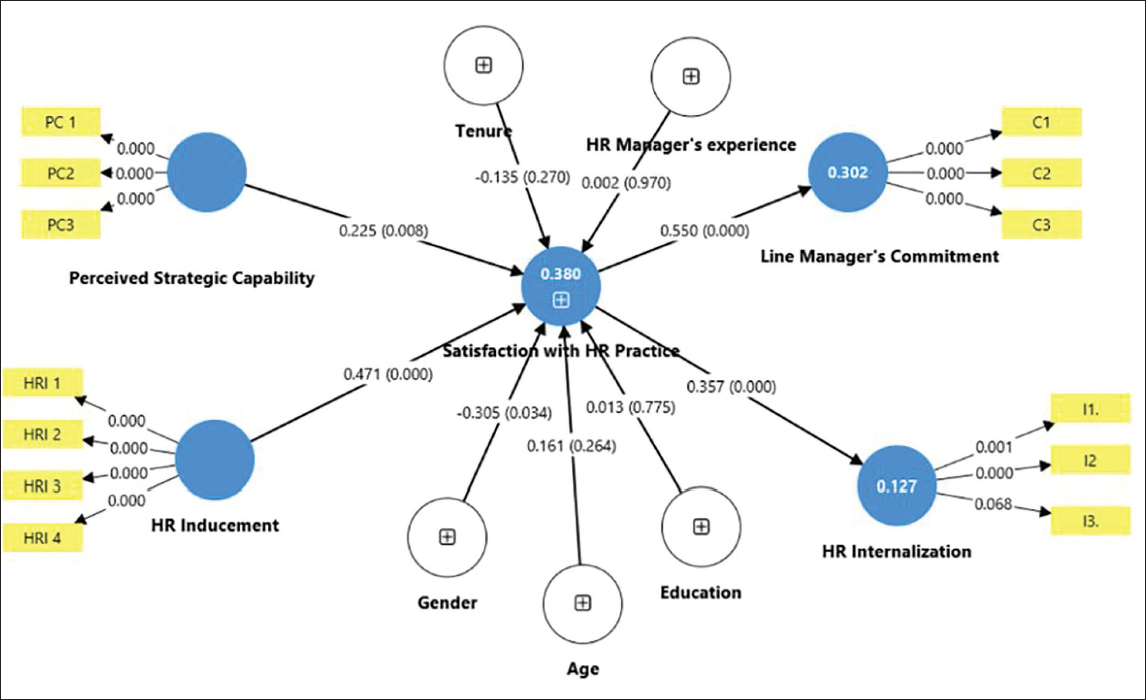
SmartPLS also provides research models with significant paths and path coefficients, as shown in Figure 2 and Table 4, respectively. Bootstrapping produces t-values, where a score above 1.96 indicates significance at the 95% confidence level (p < .05) (Figure 2). The values shown in Figure 2 represent the path coefficients, and the values in circles represent the R-squared. All the path coefficients have been significant, and exogenous variables have been positively related to the proposed endogenous variables. Table 4 presents the results of hypothesis testing based on the structural model. All four proposed hypotheses are supported, indicating statistically significant relationships among the variables.
Path Coefficient Results.
Path Coefficient.
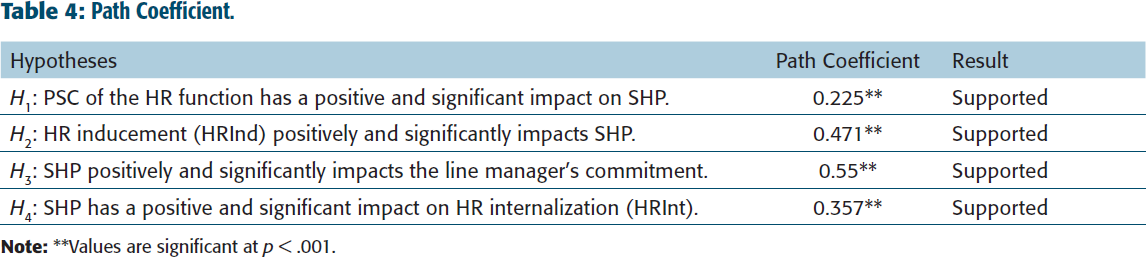
H1 indicates that the PSC of the HR function has a positive and significant effect on SHP, with a path coefficient of 0.225. This suggests that when HR is seen as strategically capable, line managers tend to be more satisfied with how HR functions. H2 reveals that HR inducement, meaning the incentives and resources provided by HR, has a strong positive influence on SHP.
The path coefficient here is 0.471, showing a stronger effect than PSC and again, the relationship is highly significant.
In H3, SHP is found to positively impact LMC, with a substantial path coefficient of 0.55. This indicates that when line managers are satisfied with HR support and systems, they are more likely to feel committed to their HR-related roles. Finally, H4 confirms that SHP also significantly affects HRInt, with a path coefficient of 0.357. In other words, greater satisfaction with HR leads line managers to more deeply internalize and align with HR values and practices. All results are significant at the p < .001 level, reinforcing the strength and reliability of these findings.
Structural Model Assessment
The structural model, composed of multiple interrelated regression paths, was evaluated based on the strength and significance of its path coefficients—a standard approach in model assessment (Hair et al., 2020). Multicollinearity was examined using variance inflation factor values, all of which remained below 3, confirming no multicollinearity concerns. Additionally, the predictive relevance of the model was assessed using the cross-validated redundancy index (Q2). According to Tenenhaus et al. (2005), a Q2 value above zero suggests the model has sufficient predictive capability. In this study, all Q2 values surpassed this threshold, confirming the model’s relevance (see Table 5).
Structural Model Indices.
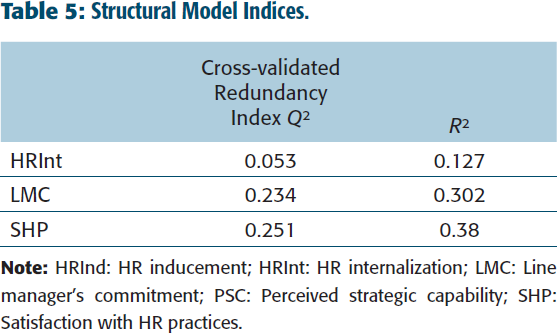
Additionally, R2 measures the percentage of variance explained by the model for each endogenous construct. In this study, the R2 values for key outcome variables are 0.380 for SHP, 0.302 for LMC and 0.127 for HR internalization (HRInt). These values indicate moderate explanatory power for SHP and LMC and a low yet acceptable level for HRInt, supporting the overall adequacy of the structural model (Hair et al., 2019).
The values for the redundancy index should be more than 0 to obtain predictive relevance. Also, it demonstrates more than 50% explained variance, which is pretty much acceptable. Several variables, such as age, tenure, HR manager’s experience and size of the HR department, were measured as categorical variables that have also been loaded to SHP to check if there is any confounding effect. However, the results show that these variables are insignificant on SHP.
DISCUSSION
Organizations can only achieve sustained success when employees, especially those in managerial roles, are satisfied with the appropriate execution of HR practices. Recently, the role of line managers has gained importance due to the increased devolution of HR work. In this research, we aimed to establish how key HR management characteristics, specifically PSC and HR inducement, help line managers feel satisfied with HR practices, which facilitates line manager involvement concerning their commitment and internalization of HR practices. Well-established and consistently executed HR practices not only reinforce a culture of accountability but also strengthen the credibility of the HR function. In this context, devolution becomes more than just task redistribution, it becomes a mechanism to engage line managers in driving meaningful organizational change. These findings are consistent with Sikora (2022), who emphasizes that line managers are more likely to commit to and internalize HR responsibilities when they perceive HR as strategically competent and feel supported in implementing these practices. Strategic alignment and trust in HR thus emerge as critical enablers of line manager engagement in HRM.
Based on the data collected from line managers across approximately 50 multinational companies, we investigated how their SHP can be enhanced, and how this satisfaction translates into their internalization and commitment towards HR responsibilities. These findings echo recent insights by Kim et al. (2025), who emphasize that, when HR systems are perceived as strategically embedded and aligned with broader organizational goals, line managers are more likely to trust those systems, feel satisfied with HR practices and internalize HR responsibilities more readily. This article also focuses on the line managers’ significant role in creating successful HR partnerships. We found a positive relationship among PSC, HR inducement (HRInd) and SHP. Also, a positive and significant relationship was found among SHP, LMC and HRInt. The study results also highlight the role of control variables such as age, the experience of the HR manager, tenure of the line manager and size of the HR department as insignificant factors on SHP, supporting hypotheses H1, H2, H3 and H4 of the present study. It means that organizations should introduce clear and well-defined HR practices to serve the internal customers, regardless of the HR managers and their experience in the given organization. Hence, the organizations ensure that their systems and processes are sustainable and not person-centric.
Nevertheless, prior HR experience permits an HR manager to positively influence line managers towards HRM. Consequently, line managers are more inclined to revert to HR managers who are just one level above or at the same level in the line hierarchy. Therefore, the unnecessary distance in terms of communication between the line manager and the HR department should be reduced. Further research exploring the impact of a negative relationship between HR and line managers is recommended. The findings of this study support the hypothesis that the HR function’s PSC has a positive influence on line managers’ commitment and internalization due to SHP.
Furthermore, control variables such as age, size of the HR department, HR manager’s experience and tenure of employees have been insignificant in the research findings. The study highlights the link between HR inducement and line managers’ commitment and HR internalization through SHP. The HR managers’ specific characteristics influenced line managers to consider the HR manager’s experience and the distance between the employee and the HR manager. This research highlights the characteristics of HR managers and line managers, which could support organizations in developing their HRM processes by increasing the consistency, consensus and distinctiveness (authority) of their HRM practices (Tang et al., 2017).
Implications of the Study
The study has attempted to apply the learnings of social exchange and human capital theory in the context of line managers. It becomes imperative for organizations to strengthen the social exchange among their managers and fully utilize their human capital to achieve a committed workforce. The necessity of HRM processes within any organization is well established. The requirement is to develop a support system for HR managers so that the benefits percolate to employees without increasing the burden on the HR manager. This necessitates developing a successful model on the functioning of HR, identifying the role of HR strategic capability and its linkage with line managers’ commitment and involvement through SHP. The findings of the study address the role of HR department strategic capabilities and HR inducements, which help line managers not only understand but also exercise HR practices with the right intent. This highlights the inclusion of line managers in the successful execution of HR practices and translates into their involvement and commitment towards the success of the organization. The empirical model of the study provides a functionally sophisticated working methodology between HR and the line manager to address the concerns better.
LIMITATIONS AND FUTURE RESEARCH
The limitations of this study are recommendations for future research. Firstly, the connection between effective HR management and line managers’ involvement in terms of their commitment and internalization was explored in this study. So, a broad pattern of practices can be investigated by future researchers to bridge this gap (Combs et al., 2006). Also, they can investigate other factors that influence line managers’ involvement.
Secondly, since this study has proposed explanatory mechanisms, future research studies can investigate generalizing similar outcomes at the corporate level. Finally, this study has examined the effects of HR managers’ characteristics (in terms of experience), which can in future research be accompanied by what they do (behavioural variables) to construct a comprehensive understanding of HRM processes and the nature of the relationship they share with line managers.
Footnotes
DECLARATION OF CONFLICTING INTERESTS
The authors declared no potential conflicts of interest with respect to the research, authorship and/or publication of this article.
FUNDING
The authors received no financial support for the research, authorship and/or publication of this article.

e-mail:
e-mail:
e-mail: