




Abstract
The digital revolution has significantly contributed towards the growth of online retail, and logistics play a pivotal role in the online retail loop. This study utilizes the dynamic capability view theory to understand the role of anticipating and seizing opportunities, innovative practices, environmental pressures and logistics 4.0 on the performance of an organization. The study utilizes a mixed-method research approach wherein focus group discussions were conducted prior to the quantitative study. A mediation was observed on the two attributes of the dynamic capability view theory, whereas no mediation was observed for the third attribute. The study adds to the knowledge on logistics capabilities and has important managerial implications.
Executive Summary
The digital revolution has significantly contributed towards the growth of online retail, and logistics play a pivotal role in the online retail loop. This study utilizes the dynamic capability view theory framework to understand the role of anticipating and seizing opportunities, innovative practices, environmental pressures and logistics capabilities on the performance of an online retail organization. The study utilizes a mixed-method research approach wherein a series of focus group discussions were conducted with the experts from prominent online retail organizations. These focus groups generated insights into the changes in logistics practices in the retail sector and their impact on performance of the organization. Additionally, these discussions provided factors which influence the performance of a retail organization. The themes generated from these focus groups were then used as a base for theoretical concepts. In the second phase, a quantitative study was carried out on the concepts critical for a retail logistics organization. The results indicated that anticipation of opportunities and seizing of opportunities are directly linked with the performance of an online retail organization. The logistics capabilities demonstrated a mediation between anticipating opportunities and firm’s performance and between seizing opportunities and firm’s performance. The environmental factors do not impact the performance of an organization in the retail sector. The study adds to the importance of logistics capabilities as an additional element of dynamic capability theory in the online retail sector. The study has some important managerial implications for online retailers to focus on anticipation of opportunities, seizing the opportunities and enhancing logistics capabilities for improvement of performance.
Keywords
The rise of online retail has become phenomenal in the last decade, particularly post COVID-19. This new method of retailing, which in its nascent stage started with online selling of books (Amazon), has gained new heights, and now all types of products are available through online retail platforms (Kebah et al., 2019; Tatham et al., 2017). Products ranging from convenience products such as groceries to shopping goods such as fashion garments and electronics are available online. Even speciality products such as cameras or unsought products such as medicines are delivered through online retail channels. Digital revolution, availability of mobile networks, smart mobile handsets and a robust online payment mechanism such as Paytm or UPI have significantly contributed towards the growth of online retail (Kumar & Ayodeji, 2021). Online retail offers a basket of benefits to customers like purchase convenience, saving time, ease of returning items, comparison of multiple products, etc., because of which many customers have shifted to online purchase platforms post COVID-19 (Kebah et al., 2019; Veiga et al., 2024).
This growth of online retail is unstoppable and is likely to multiply manyfold in the future (Kumar & Ayodeji, 2021). Though some retail activities such as placing orders or making payments digitally can be done using online platforms, the basic link of delivering goods in the process of retail transactions remains in physical mode. Thus, logistics play a pivotal role in the completion of this online retail loop (Bag et al., 2020). The digital revolution has catapulted traditional logistics operations to the next level, but the question remains whether the logistics capabilities of a retail organization contribute towards the performance of online retail organizations (Riley & Klein, 2021). This article critically studies the mediating role of logistics capabilities in improving performance of an online retail firm in the view of the dynamic capability view theory (DCVT).
In today’s competitive world, an organization’s logistics capabilities can assist in collecting data from all stakeholders (Bag et al., 2020, 2021). The information availability and generation of meaningful management insights are key in making strategic and tactical decisions (Winkelhaus & Grosse, 2020). Online retail gained eminence, particularly after COVID-19 (Roggeveen & Sethuraman, 2020). The growth of the online retail sector in the last few years is due to improved logistics processes. Although logistics procedures in online retail companies have sustainability concerns, new digital technology may be able to address these issues (Strandhagen et al., 2017; Witkowski, 2017). A number of strategic decisions are required in an online retail business, such as capacity decisions, customer service level requirements, delivery performance, financial investment and lowering of cycle time (Lambert et al., 2011). The tactical decisions in the online retail sector can be forecasting demands, improving dispatch performances, reducing cycle time, efficient scheduling of dispatch, managing warranty cost, estimating cost of return goods and reducing disposal cost (Lambert et al., 2011; Schoenherr & Speier-Pero, 2015).
Some authors have studied the effect of anticipating opportunities on the performance of an organization in the biotech sector (Nieuwenhuizen & Lyon, 2011), indicating a relationship between these two variables. Rational learning and socio-ecological factors are important in anticipation of opportunities, which ultimately lead to innovations (Ramos, 2013). Use of contemporary technologies plays a pivotal role in anticipation of opportunities (Roth et al., 2013). Once opportunities are identified, seizing them needs agility and the use of modern technology (Rahman et al., 2018). Support from young online communities helps in seizing opportunities (Wagner et al., 2017). Once opportunities are anticipated, development of innovative practices is instrumental in creating competitive advantage (Amling & Daugherty, 2020; Lagorio et al., 2022).
In the process of anticipating and seizing opportunities, environmental considerations must be addressed for sustainable development (Baah et al., 2021; Graham et al., 2018; Liu et al., 2018). In the past, studies on these aspects were carried out in the automobile, engineering and biotech sectors (Agrawal et al., 2015; Nieuwenhuizen & Lyon, 2011). There is a need for a comprehensive study in the retail sector on the role of anticipating opportunities, seizing opportunities, innovative practices and logistics 4.0 on the performance of an organization. We thus propose the following research questions.
RQ1: What is the role of organizational capabilities in anticipating, seizing, adoption innovative practices and environmental pressure on the performance of online retail organizations?
RQ2: What is the impact of logistics 4.0 on the performance of online retail organizations?
UNDERLYING THEORIES
Resource-based view (RBV) theory or resource advantage theory was proposed in the early 1990s by a number of authors (Cavusgil et al., 2007) for a variety of businesses. This theory provides a managerial framework for making decisions under uncertainty and to achieve competitive advantage. To handle competition, a company needs to develop dynamic characteristics such as adaptability, absorption and innovation. The processes in an organization can then be refined, recreated or reconfigured to handle competition (Wang & Ahmed, 2007).
DCVT is a variation of the RBV theory. A number of researchers have defined DCVT; however, the most suitable definition in the context of this research is: ‘Dynamic capabilities that can be used to first anticipate and shape opportunities and threats (sensing); second, seize opportunities; third, maintain competitiveness by improving, integrating and defending (reconfiguring); and, fourth, reconfigure the firm’s tangible and intangible assets as necessary’ (Teece, 2007). The dynamic capabilities of a firm, like identifying and grabbing new opportunities and reconfiguring internal processes using the internet of things (IoT), can improve its ability to handle rapidly changing external challenges and maximize competitive advantage by sustainable practices (AL-Khatib, 2023; Felsberger et al., 2022; Singh et al., 2022).
Researchers have used DCVT in their research in the past (Gruchmann & Seuring, 2018; Reuter et al., 2010). However, the application of DCVT in online retail is yet to be studied. DCVT is used by researchers in the past with the addition of relevant new dimensions like assessing net enablement, absorption capability of an organization, innovation capability component, entrepreneurship variable (Basiouni et al., 2019; Lawson, 2001; Wang & Ahmed, 2007; Wheeler, 2002; Zahra, 2006). Organizations need to move beyond traditional RBV and DCVT variables and emphasize innovations, resilience and collaborations with partners to remain competitive (Dovbischuk, 2022). Dynamic capability variables, such as building and reconfiguring internal and external environments, are antecedent to logistics capabilities. Innovations in dynamic capabilities help in improving logistics services and enhance a firm’s performance (Chen et al., 2019). Logistics operations are considered as a higher order dynamic capability variable enabled by the lower order variables such as technological, organizational and environmental capabilities.
The technological and environmental capabilities have a strong influence on logistics capabilities, which in turn significantly improved the firm’s performance (Bag et al., 2020). Organizations involved in logistics can build dynamic capabilities such as anticipating, seizing and innovation using digitalization and strategic partnerships (Fellenstein & Umaganthan, 2019). The logistics service providers can utilize DCVT elements such as anticipating, seizing and innovative practices to prevent product delivery delays and take proactive and reactive actions (Özcan et al., 2024). A direct link between logistics flexibility and elements of DCVT (anticipating, seizing and innovative practices) was observed in the case of a Swedish fashion retailer. Thus, dynamic capabilities were found to be the foundational drivers for logistics flexibility (Sandberg, 2021). Organizations involved in logistics operations need to focus on dynamic capabilities to continue innovations for improving performance (Wasik et al., 2023).
As the current research is on online retailing, which involves sending physical goods to customers, logistics capabilities of an organization become an integral dimension of online retailing. So, the present study explores whether logistics capabilities enhance a firm’s performance using basic dimensions of DCVT.
LITERATURE REVIEW
Anticipating Opportunities
Anticipation is a process of realizing beforehand the dynamic capabilities of any organization (Chatterjee et al., 2022). An organization can sense future opportunities through a systematic process of sensing, seizing and reconfiguration (Jayarathna et al., 2023). In the case of online retailing, a strong customer–supplier collaboration is the first step for the identification of opportunities. This collaboration can be on multiple dimensions such as improvement of product or process, reduction of environmental impact, reduction of logistics cost, etc. (Jayarathna et al., 2023). A creative methodology such as the future action model, is often useful in anticipation of opportunities, which leads to innovation (Ramos, 2013). Ripanti and Tjahjono (2019) highlighted anticipation of opportunities and change management in closed-loop logistics for smooth flow of materials, optimization of change and coping with dynamic problems in logistics. In the case of logistics service providers, Kucukaltan et al. (2022) emphasized knowledge resources and human capital as key factors for identifying, anticipating and leveraging the opportunities. The early identification of opportunities in the retail sector can help in early planning for a competitive advantage. On the other hand, poor anticipation of opportunities may result in poor decision-making by retailers and logistics companies (Beckers et al., 2018). The logistics capabilities offered by online retailers directly influence the purchase attitude and intentions of young consumers. Retailers need to anticipate and seize opportunities and carry out innovations on a regular basis (Riley & Klein, 2021).
In the past, some authors have studied the role of anticipation of opportunities in sectors such as the biotechnology or engineering sectors (Nieuwenhuizen & Lyon, 2011; Roth et al., 2013). While organizations are retailing online, they might miss out on anticipating opportunities which might adversely affect their performance. So, a study is required to enhance the understanding of the anticipation of opportunities in the online retail sector. In our research in the online retail context, we therefore propose the following hypothesis.
H1: The firm’s capabilities in anticipating opportunities have a positive effect on the performance of the firm.
Seizing Opportunities
Once opportunities are anticipated, organizations need to seize these opportunities. Early adopter organizations often seize opportunities better than late adopter organizations, but they also take higher risks. This risk appetite of an organization is instrumental in early seizure of opportunities (Rahman et al., 2018). Organizations need to take a measurable and calculated risk for success (Rahman et al., 2018). A quick online communication among various stakeholders using modern information technology helps in seizing opportunities (Wagner et al., 2017). A factual supply chain knowledge coupled with basic managerial and functional logistics-related skills is helpful for faster seizing of opportunities (Tatham et al., 2017).
Some organizational competencies such as agility and digitalization contribute to logistics effectiveness and help in seizing opportunities, mitigating risk and improving responsiveness (Wagner et al., 2017). Adopting new tools, such as IoT and the use of cloud platforms, is further helpful in seizing opportunities (Rahman et al., 2018). Use of community platforms helps capture customer sentiments and obtain an early signal for seizing opportunities. Organizations can leverage the insights obtained from community platforms for improving decision-making about alteration of strategies (Wagner et al., 2017). The functional skills may not be so important for online retailers, but generic skills such as relationship with customers and accurate forecasting of demand are important in seizing new opportunities. Broader management capabilities such as problem-solving, forecasting and collaboration are effective in seizing opportunities (Tatham et al., 2017).
Online retailing in developing nations such as India is a relatively recent phenomenon, and while organizations are retailing online, they might miss out on seizing opportunities which might adversely affect their performance. Therefore, our study in the online retail context proposes the following hypothesis.
H2: The firm’s capabilities in seizing opportunities have a positive effect on the performance of the firm.
Innovative Practices
In the context of online retailing and logistics, innovation can be through technology, new services, better processes and newer business models (Lagorio et al., 2022; Petrenko et al., 2018). In the retail sector, innovation can be grouped into three categories: adaptability, speed of delivery and adoption of new business models (Amling & Daugherty, 2020). The external environmental factors such as technological innovation, governmental policies and changes in social trends strongly influence online retailers (Kardes et al., 2021). Technological innovations such as IoT sensors, radio frequency identification (RFID) consignment tracking systems and developments in blockchain technologies contribute to the evolution of online retail management (Amling & Daugherty, 2020). Some other innovations, such as data-centric management practices, telecommunication connectivity and the use of analytical tools, further helped in the growth of online retail (Lagorio et al., 2022). However, further innovations such as system integration and interoperability need to be developed further to support smooth online retailing (Lagorio et al., 2022). The future focus on innovation in online retailing can be done in areas such as delivery speed, adaptability of the online retailing system and development of newer business models in logistics and online retailing areas (Amling & Daugherty, 2020). Environmental support helps a great deal in supporting innovation (Baah et al., 2021). Three key environmental contributors for innovation in the logistics sector are omnipresent mobile connectivity, dynamic low-cost labour and governmental support (Amling & Daugherty, 2020). The following hypotheses are proposed in this context.
H3: The firm’s capabilities in adopting innovative practices have a positive effect on the performance of the firm.
H4: The firm’s capabilities to handle environmental pressures have a positive effect on the performance of the firm.
Logistics Capabilities
Logistics in the early 1950s was a term generally referred to the movement of military goods (Chang et al., 2022; Li et al., 2021). The change in customer needs can be addressed by smart logistics or sustainable logistics processes referred to as logistics 4.0 (Winkelhaus & Grosse, 2020), which automates the flow of commodities forward and backwards. It involves a system-based approach for information flow and physical movement of goods from source to destination and vice versa. In case of logistics processes, decisions like inventory levels, physical goods routing decisions, reduction in time for collection of goods, etc., can be enhanced with logistics 4.0 (Lambert et al., 2011). Logistics 4.0 can yield benefits such as improved flexibility, enhanced responsiveness, faster speed of forward goods delivery, faster return of goods in case of reverse logistics and prognostic analysis of information for further process corrections (Dubey et al., 2019; Russell & Swanson, 2019).
Logistics 4.0 aims at the use of online real-time information for improving delivery (Lee & Shin, 2008). Therefore, the use of technologies such as cyber physical systems, the IoT, cloud computing and big data analytics is essential for the success of logistics 4.0 (Winkelhaus & Grosse, 2020). IoT is a platform to equip physical objects with unified sensors connected to a network. This helps in the collection of real-time information for analysis and decision-making (Aryal et al., 2020; Hopkins & Hawking, 2018). In supply chains, it is frequently utilized to improve internal and external integration, visibility, controlling inventory and assessment of risk (Ben-Daya et al., 2022; Castelo-Branco et al., 2019). Logistics 4.0 can be divided into three sub-components: integration of IT systems inside an organization, horizontal integration among partnering organizations and cross-linking of stakeholders (Strandhagen JO et al., 2017; Strandhagen JW et al., 2017). The organizational capabilities of an organization can be a combination of human resource capabilities, management capabilities and information technology utilization capabilities (Aral & Weill, 2007; Hamister et al., 2018; Pan et al., 2019; Schmidtke et al., 2018).
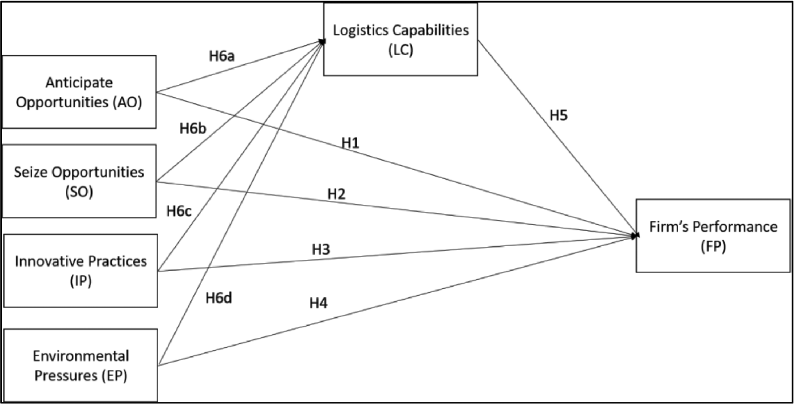
In this research, anticipating opportunities, seizing opportunities, innovative practices and environment were taken as independent variable and their effect on an online retail firm’s performance was studied. Even in online retail, physical exchange of goods is involved, which requires a mechanism to deliver goods from the retailer to the consumer. Although all four independent variables are expected to be directly related to the dependent variable (firm’s performance), smoother and efficient logistics may improve a firm’s performance. Innovative technologies in logistics can include automation, robotics, RFID, IoT, big data analytics, cloud computing, use of blockchain, digital twins’ simulation, etc. (Björklund & Forslund, 2018). Organizations use these technologies independently or in combination, depending on the nature of the business. An investment in an integrated digital ecosystem may help in the improvement of innovations in the logistics sector (Lagorio et al., 2022). Sustainable logistics innovation requires proper selection of individuals, development of key performance indicators and balancing speed, complexity and inclusivity (Björklund & Forslund, 2018). Innovation in logistics capabilities requires involvement at the top level for strategy formulation and at the bottom level for effective execution (Cui et al., 2010). An absence of a conducive environment may result in a lack of innovation in logistics. In the past, Yanginlar et al. (2024) established the mediation role of logistics 4.0 for e-commerce marketing capabilities of an organization. However, the role of logistics as a mediator using the dynamic capabilities view theory was not studied in the context of online retailers. In this article, we attempt to study the mediation effect of logistic 4.0 capabilities on online retailers. Thus, we propose the following hypotheses.
H5: The firm’s logistics capabilities have a positive effect on the performance of the firm.
H6: The firm’s logistics capabilities mediate between:
firm’s capabilities in anticipating opportunities and firm’s performance
firm’s capabilities in seizing opportunities and firm’s performance
firm’s capabilities in adopting innovative practices and firm’s performance
firm’s capabilities to handle environmental pressures and firm’s performance.
METHODOLOGY
Research Design
We chose a mixed-method research approach tailored to our study objectives. In recent years, mixed-method research has gained popularity as it blends qualitative and quantitative data within a single study (Al-Ansi et al., 2021; Dawadi et al., 2021; Geremew et al., 2024; Harrison et al., 2024; Wu et al., 2023). Dawadi et al. (2021) pointed out that mixed-method research combines qualitative and quantitative methodologies and incorporates various elements such as perspectives, data collection, analysis and inference techniques to achieve a more thorough and validated comprehension. The underlying assumption of the mixed-method research is that the synergy between qualitative and quantitative data yields richer insights compared to using either in isolation (Dawadi et al., 2021).
Harrison et al. (2024) categorized three robust mixed-method designs: convergent, explanatory sequential and exploratory sequential. For our study, we opted for the exploratory sequential design wherein we conducted a qualitative analysis followed by a quantitative approach. This choice aligns with the exploratory sequential design’s suitability, which enables researchers to address the question of how quantitative findings can elucidate qualitative results (Harrison et al., 2024).
Qualitative Study
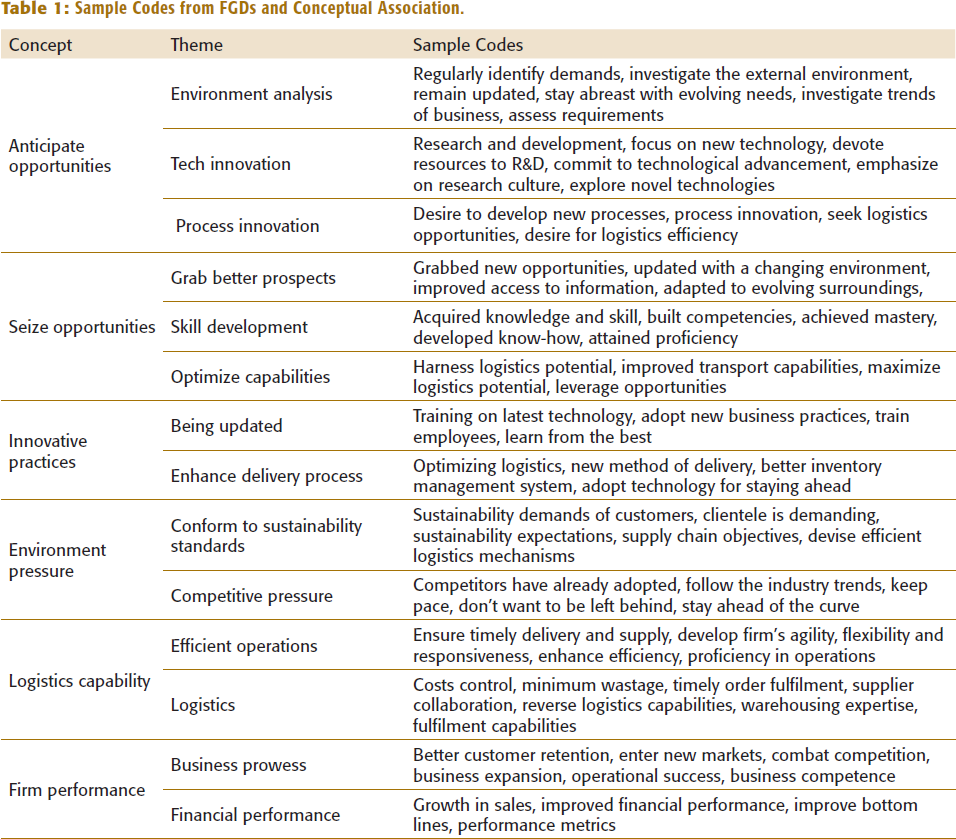
We conducted three separate focus group discussions (FGDs) in different cities, involving 10 participants in the first, 8 in the second and 11 in the third FGD. The participants were the operations and supply chain managers of prominent apparel retail organizations (Pantaloons, Shopper Stop, Big Bazaar, Lifestyle, Reliance Trends, etc.). We initiated the FGD by inquiring about the changes in logistics which have taken place in the retail sector. The participants were also required to discuss the impact of these changes on the firm’s performance. Additionally, we prompted participants to discuss the factors that influenced their organization to enhance their logistics capabilities. During the FGD, our participants displayed a range of opinions about the driving factors and the importance of enhancing logistics capabilities. We collated the discussion points and generated sample codes which were further categorized under broad themes. Thereafter, we linked the themes generated to theoretical concepts (Table 1) and prepared the conceptual framework (Figure 1).
Sample Codes from FGDs and Conceptual Association.
Conceptual Model.
In FGDs, a variety of responses were observed. Some respondents emphasized that organizations need to remain updated with the changing pattern of the market, while some other respondents suggested that identification of demand and an in-depth analysis of demand is necessary for anticipating future opportunities. In their opinion, future opportunities can be identified by scanning the external environment and closely observing changing demand patterns. A number of respondents advocated that investigation of changing demand patterns will also help organizations in the identification of evolving needs and in the assessment of future requirements. The role of technological innovations was also voiced by many respondents in the process of assessing the external environment and opportunities.
Some respondents held an opinion that organization culture oriented towards taking calculated risks will help in the acceptance of newer methods for logistics deliveries and in grabbing new opportunities. This cultural shift needs to be supported by improved information availability to the employees, organizational support in acquiring new knowledge and building skills. Participants in the FGD expressed that employee training on new technologies and innovative practices can harness logistic potential, improve transportation capabilities and maximize logistic potential.
Many respondents indicated that adoption of new business practices is crucial for better performance of the organization. Some respondents voiced concerns about the volatility of demand and suggested close working with clients to make demands more realistic and sustainable. Customer expectations management was also voiced as a key factor for predicting realistic demand patterns. Keeping a close eye on competitors was also suggested by most respondents, as it will help counter the external challenges and reduce the risk of being left behind. In fact, a few respondents suggested to remain ahead of the competition, thus stating the need for a very strong management information system.
A smaller set of respondents voiced the need for a flexible and responsive logistics system to increase proficiency in operations, to control costs, to minimize waste and for the timely fulfilment of orders. Respondents also suggested an effective collaboration with all partners in the supply chain and an active management of warehouse capacities for achieving flexible logistics systems.
The FGDs were also conducted around assessing the firm’s performance and business prowess. Respondents opined that it can be obtained by better customer retention, entry into new markets, expansion of the business and effectively handling competition. Continuous growth in sales was suggested as a key factor in improving the bottom line and organizational performance.
Research Design
For the quantitative study, we followed a convenience sampling method and reached out to 280 managers of prominent retail outlets with online presence. In this study, three items on anticipating opportunity, three items on seizing opportunity and three items on innovative practices were adopted from Khan et al. (2020a, 2020b, 2021), Teecee et al. (1997, 2007) and Teecee and Pisano (2003). Three items on environmental pressures were adopted from Winkelhaus and Grosse (2020). The four items on logistic capabilities were adopted from Barreto et al. (2017), Hofmann and Rusch (2017) and Winkelhaus and Grosse (2020). The firm’s performance was measured using items developed by Wamba et al. (2017). The details of the research instrument used for the study are provided in the Appendix.
FINDINGS
Exploratory Factor Analysis
The gathered responses were subjected to principal component analysis with Varimax rotation using SPSS 21. The significance of Bartlett’s test of sphericity (χ2 = 764.55; p < .001) and the satisfactory KMO value (.902) was established. Six factors were extracted through rotation, explaining 70.9% of the variance. Moreover, the rotated component matrix indicated that items loaded significantly on their respective factors, demonstrating suitability for further data analysis.
To address common method variance (CMV), we implemented both statistical and procedural measures as recommended by Podsakoff et al. (2003) and Kock and Lynn (2012). Procedurally, we selected items from previously validated scales to measure our constructs and ensured simplicity to prevent CMV resulting from question misinterpretation. Statistically, we conducted Herman’s factor test, indicating that CMV is not an issue if a single construct explains less than 50% of the total variance. Our exploratory factor analysis, employing principal component and Varimax rotation, revealed that the first factor accounted for only 20.16% of the variance. Additionally, our full collinearity test, following Kock and Lynn (2012), indicated that all variance inflation factors (VIF) values were below the threshold of 3, thus confirming that CMV was not problematic in our study.
Confirmatory Factor Analysis
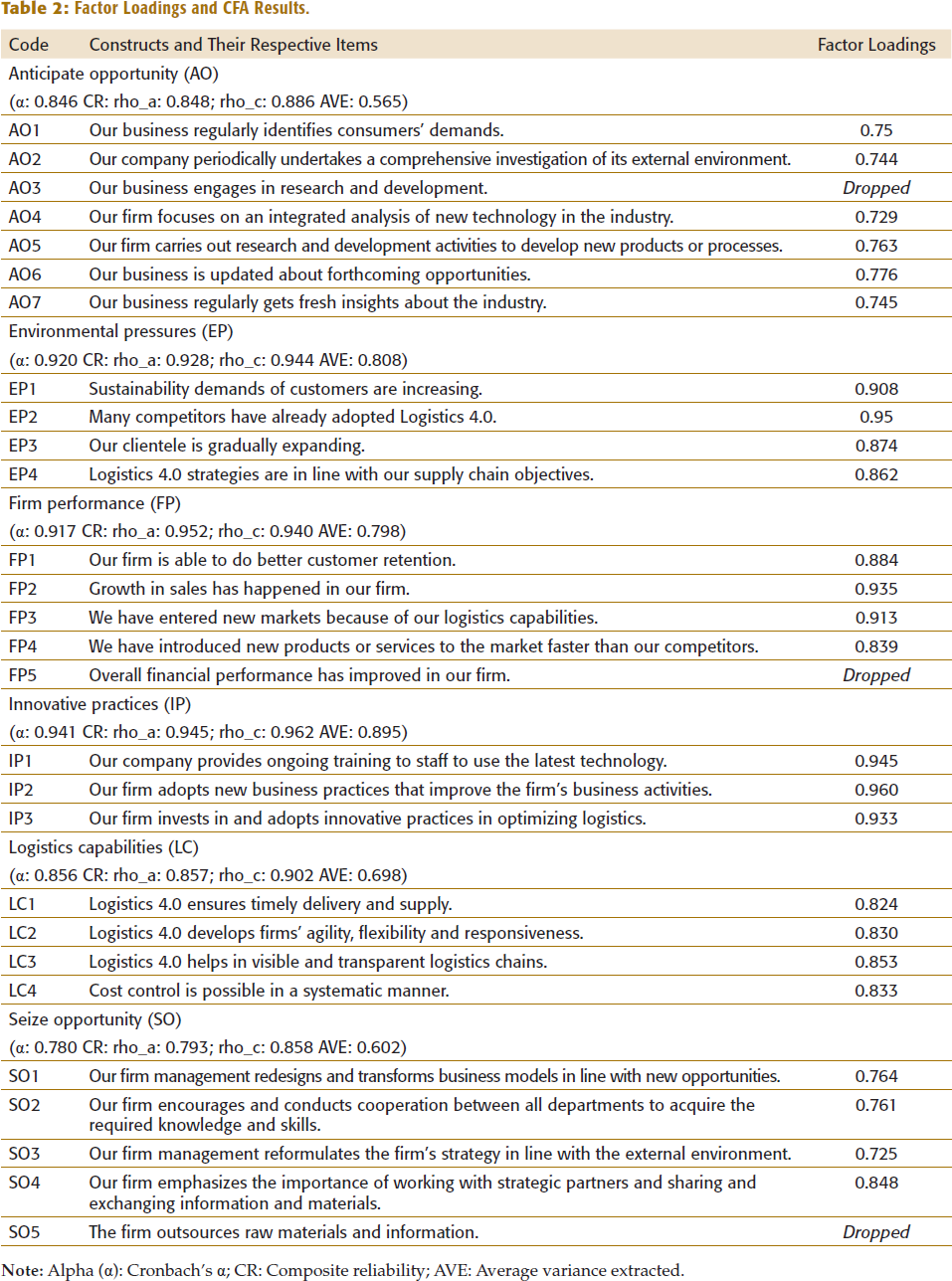
We conducted a confirmatory factor analysis to assess the appropriateness of item loadings on specific factors. During this analysis, we excluded item AO3 (related to anticipating opportunities), SO5 (associated with seizing opportunities) and FP5 (pertaining to firm performance) owing to low factor loadings <0.7. Prior studies have recommended that items with low factor loading can be excluded from the model to refine the instrument and improve construct validity (de Barros Ahrens et al., 2020; Heale & Twycross, 2015; Mata-López et al., 2021; Tentama & Anindita, 2020).
No other items were excluded for the remaining constructs in our study. Furthermore, our overall model, where all factors were correlated, demonstrated satisfactory fit indices, including χ2 = 764.55, χ2/df = 2.601, GFI = 0.901 (>0.90), AGFI = 0.950 (>0.90), NFI = 0.901 (>0.90), CFI = 0.900 (>0.90), RMR = 0.06 (<0.08) and RMSEA = 0.07 (<0.08).
To validate our measurement models, we assessed the reliability of items by examining their loadings. All seven factors derived from the exploratory factor analysis exhibited internal consistency reliability values exceeding 0.7 (Cronbach’s α). Additionally, the composite reliability (Joreskog’s rho) exceeded 0.7, and the average variance extracted (AVE) values were all above 0.5, ensuring sufficient convergent validity (Dijkstra & Henseler, 2015; Hair et al., 2019; Park & Kim, 2021) (further details in Table 2).
Factor Loadings and CFA Results.
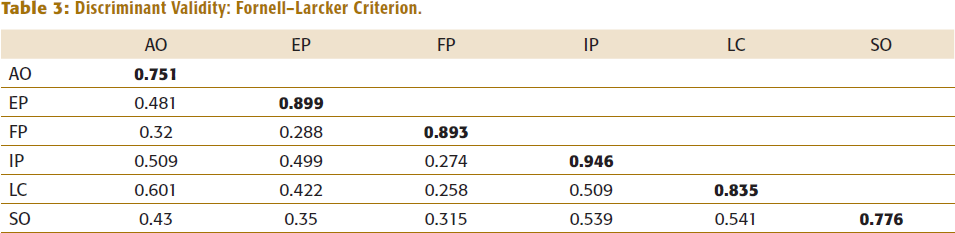
We evaluated both the discriminant and convergent validity of the constructs in accordance with the guidelines proposed by Hair et al. (2019). To assess discriminant validity, we applied the Fornell-Larcker (1981) criterion. Specifically, we examined the square root of the AVE for each construct (highlighted in bold along the diagonal in Table 3). We observed that these values were greater than the correlations between the constructs, thus meeting the criteria for discriminant validity as per the Fornell–Larcker criterion.
Discriminant Validity: Fornell–Larcker Criterion.
Structural Model
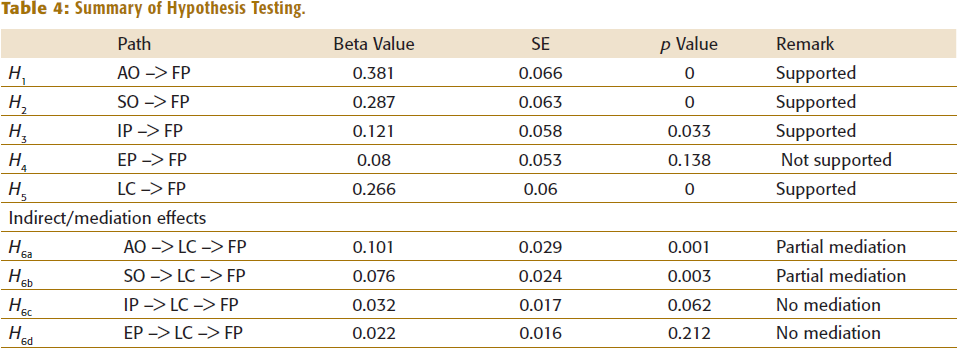
While assessing the structural model, we first checked for the collinearity among constructs by observing the VIF. We found that none of the VIF values crossed the upper threshold of 3 (Hair et al., 2019). We, therefore, infer that there was an absence of a collinearity problem in our data. The values obtained for the model fit: χ2/df = 2.601; GFI = 0.901; AGFI = 0.950; NFI = 0.901; CFI = 0.900; RMR = 0.06 and RMSEA = 0.07 all indicate a good fit of our structural model as per the generally accepted criteria (Hair et al., 1998, 2006; Hu & Bentler, 1999). Table 4 depicts the results obtained for the conceptual model.
Summary of Hypothesis Testing.
DISCUSSION
This research generated an impactful outcome for logistics organizations. Three items initially selected in the instrument were not supported, namely SO5: The firm outsources raw materials and information; FP5: Overall financial performances have improved in our firm; and AO3: Our business engages in research and development. So, these items were dropped.
All hypotheses were accepted except H6d (the relationship between environmental pressure and logistics capabilities). This indicated that a firm needs to build logistics capabilities irrespective of environmental pressure variation. This can be termed as a proactive strategy to manage firm’s performance. In case of mediation effects, logistics capabilities did not mediate between innovative practices and firm’s performance and environmental pressure and firm’s performance. Environmental regulations and compliance are critical for sectors such as automobiles, consumer appliances and electronic products, as these products have some environmentally sensitive elements which need proper disposition (Gardas et al., 2018; Kumar & Putnam, 2008; Ravi & Shankar, 2017). So, these sectors employ adequate logistics practices to handle environmentally sensitive elements (lead batteries, heavy metals, etc.). This is in contrast with the online retail sector, which does not handle environmentally critical products, which might be the reason for no significant mediation effect between environment and online retail in this study. On the contrary, the relationship between anticipating opportunities and seizing opportunities with firm’s performance was mediated by logistics capabilities. Thus, the better the logistics capabilities, the better a firm’s approach towards anticipating and seizing opportunities.
In the entire research, environmental pressure did not show a relationship between logistics capabilities and firm’s performance. The term ‘environment’ was first introduced by Carter and Ellram (1998) for transportation, packaging and purchasing, etc. and was supported by many researchers (Agrawal et al., 2015; Alshamsi & Diabat, 2015; Jindal Sangwan, 2013). ‘Environment’ can be divided into two sub-categories: the natural environment and the business environment. Managing the natural environment was a major factor in studies on sectors such as the paper industry (Ravi & Shankar, 2006), electronic products (Rahman & Subramanian, 2012) and steel (Giannetti et al., 2013), where disposal of hazardous waste was a major factor. In contrast to these sectors, we find it insignificant for the Indian retail sector because damage to the natural environment is irrelevant in the context of logistics activities.
A mature business environment has fierce competition, which compels an organization to explore innovative practices. The Indian online retail market is still in an emerging stage, so the environment is not competitive enough to exert pressure to improve logistics capabilities or innovative practices. The results may differ in the case of mature online retail markets in the Western world.
IMPLICATIONS
Theoretical Implications
The present study is based on the DCVT, a successor of the transaction-cost, resource-based and knowledge-based theories (Kapoor & Aggarwal, 2020; Teece, 2007) and is more contemporary in current times. While DCVT focuses on the accumulation of resources to combat challenges, it has a major criticism of under-specified constructs and conceptual ambiguity (Kapoor & Aggarwal, 2020). Another limitation of DCVT is that it has measurement challenges, that is, dynamic capabilities of any organization or sector are difficult to measure. Yet another criticism of DCVT is that it has a causal ambiguity; in other words, it is difficult to derive a relationship between dynamic capabilities and firm performance. Our study contributes by adding specific and measurable constructs for online retailers using basic concepts of DCVT. Our article also establishes a direct relationship between dynamic capability constructs and firm’s performance in the freight logistics sector.
The effectiveness of DCVT is context specific, or it varies from one sector to another and depends on a firm’s environment. So, an additional construct of EP was also considered in this study for the logistics sector. Past studies indicated that the environment has an impact on the performance of a firm (Jiang et al., 2022). However, our study contradicts their findings, particularly for online retailers in India. Many retailers encourage employees to explore creative solutions to customer problems. Competitive firms in India may pose similar environmental challenges in the future.
Our study also contributes to the application of DCVT with some additional constructs for the logistics sector. While previous studies exemplified the use of DCVT in the supply chain sector, this study explores the mediation role of logistics capabilities on firm’s performance for online retailers. A mediation was observed on the two attributes of DCVT, that is, anticipating opportunities (and seizing opportunities, whereas no mediation was observed for the third attribute, that is, innovative practices, as well as for the new variable environmental pressure.
Results of this study also resonated with a study on innovative practices in the DCV model by past researchers on the counts of innovative practices (Kim et al., 2015). In the past, technical innovations, financial innovations, radical innovations organizational innovations, etc., were studied based on theories such as RBV and dynamic capability framework. The present study adds innovation in the logistics sector for dynamic capability.
The novelty of our investigation also lies in qualitative research and information collection from experts in the online logistics sector, which helped us modify pre-existing constructs of DCVT. This study thus generated a new set of constructs for future studies on online retail and similar sectors.
Managerial Implications
This research can provide immense value to online logistics organizations. First, organizations can invest in areas such as the adoption of IoT, use of AI in predicting demand and purchase behaviour, and develop strategic partnerships with suppliers and retailers for efficient inventory management. The organizations need to showcase environmental responsiveness since in the near future, sustainability issues will be paramount for organizations to make a meaningful impact on customers and society at large. Using digital technologies such as augmented reality in online retail can reduce product returns, facilitating customer satisfaction and loyalty and help reduce logistics-related expenses. These improvements in logistics capabilities will lead to greater agility and sustainability.
Online retailers can benchmark against industry leaders to adopt efficient systems to anticipate opportunities and seize them well in advance to create a competitive edge for themselves in the industry. Human resources need to be trained in their skill sets and competencies to learn and adopt newer technologies. Crowdsourcing is another innovative way of generating ideas for developing efficient logistics systems.
LIMITATIONS AND SCOPE OF FUTURE STUDY
The study has several limitations that should be noted. First, the mixed-method approach, while providing comprehensive insights, included a limited number of FGDs with a relatively small sample size. While qualitative studies build better instruments and enhance interventions, their generalizability or transferability to other contexts, groups or settings is limited (Almeida, 2018; Curry et al., 2009; Loomis & Maxwell, 2003). This is a limitation of this study, and more focus groups can be used by researchers in the future, and analysis could benefit from triangulating data with more diverse qualitative sources.
Secondly, the convenience sampling method used for the quantitative study relied on managers from prominent retail outlets with an online presence, potentially overlooking diverse perspectives from less prominent or purely physical retail entities. Moreover, the study’s scope was limited to the Indian retail market, which is still in an emerging stage and may not fully represent the dynamics of more competitive and mature online retail markets elsewhere, potentially affecting the applicability of the findings to those contexts. In mature markets, customer perception of the reputation of the retailer, along with the capability of a retailer for order fulfilment, was observed to be important in online retail. Logistics capabilities are an important factor in order fulfilment in mature markets. A similar need was not seen in emerging markets (Qureshi et al., 2009). The number of online retailing firms has a direct relationship with the online retail market, particularly in developed countries (Andreev et al., 2022). Consumers explore multiple values in a product while purchasing it, like utility value, enjoyment value, perceived risk, experiential value and then develop an attitude towards the product. These values differ across developed and developing countries, and so a different approach towards logistics practices (Kumar & Ayodeji, 2021). In some Middle Eastern countries, the strong appeal of physical malls resulted in the detraction of consumers from online shopping, making logistics redundant (Seetharaman et al., 2017). The key drivers of online retailing in India are convenience, time saving, price competitiveness, rapid growth of mobiles and networks, emergence of nuclear families and ease of online payment (Khanna, 2017). Further studies can be undertaken on these lines.
Lastly, the research did not demonstrate a relationship between environmental pressure and logistics capabilities, which may require further examination in industries where environmental factors are more relevant.
Footnotes
DECLARATION OF CONFLICTING INTERESTS
The authors declared no potential conflicts of interest with respect to the research, authorship and/or publication of this article.
FUNDING STATEMENT
The authors received no financial support for the research, authorship and/or publication of this article.

e-mail:
e-mail: