




Abstract
The present research aims to understand the moderating effect of workplace spirituality and individual spirituality on the relationship of job satisfaction and job-related stress. About 345 bank employees working in India participated in research. The research hypotheses were tested using structural equation modelling by applying the bootstrapping technique. Findings revealed that spirituality moderates the relationship between job-related stress and job satisfaction in a positive way. Employees, employers and policymakers can benefit from the results, which provide empirical evidence of the effect of workplace spirituality and individual spirituality in mitigating the effects of job-related stress on job satisfaction.
Executive Summary
Chardin said, ‘We are not human beings having a spiritual experience. We are spiritual beings having a human experience’. However, chaos surrounds most of us, whether in organizational or personal life, which makes us forget our true selves. Spirituality is believed to bring meaning to this chaotic world, thus providing a sense of community and a purpose in life events; once connected with our inner self, we become satisfied. As satisfaction is an important facet for organizations and individuals, it is interesting and important to understand how individuals’ spirituality and workplace spirituality can bring in satisfied employees by alleviating the stress associated with jobs. Therefore, the present study delineates the moderating effects of individual spirituality (IS) and workplace spirituality (WS) on the relationship between job-related stress (JRS) and job satisfaction (JS). The study is based on the theoretical background from job-related tension theory given by Kahn et al. (1964). Data for the analysis were collected through a convenience random sampling technique. The survey was conducted on 345 employees of banks working in Delhi, NCR, Haryana and Punjab. To test the validities and hypotheses, the partial least square-based structural equation modelling (PLS-SEM) was applied. Results from SEM confirmed that both IS and WS work as moderators for the relationship between JRS and JS. Thus, providing meaningful work, sense of community and aligning values of organization and employees help improve the relationship between JRS and JS in the context of enhancing satisfaction related to job. Moreover, employees who have a connection with self, portraying individual spirituality, tend to be satisfied with their jobs. These findings will provide a background for employers and policymakers to instil awareness and invest in such activities, which help individuals to unwind.
Keywords
The workplace is an abode where we spend at least one third of our time in life. We fulfil the ambitions of our life through our work. Norms of the workplace are changing with the advent of practices such as work from home or telecommuting, where the environmental factors of the workplace affecting the employees have also altered. The only thing that has remained constant is the tension related to one’s work or job. Tension refers to a fundamental concept in physics, which when referred to humans becomes stress, explained by Selye (1974) as a ‘non-specific response of the body to any demand of change’. Water and Ussery (2007) defined it as ‘an adverse reaction that people experience when external capabilities exceed their internal capabilities’. Nayak (2008) stated that any individual experiences stress whether they identify with it or not. A person may experience stress in any situation or place such as at home, at work, in school or in any other context. This indicates that stress comes in numerous forms; one among them is job-related stress, which is the stress that individuals experience because of some inherent characteristics of their job. Experiencing stress in a job impacts job satisfaction, work performance and productivity of employees (George & Zakkaria, 2015; Kumar & Kumar, 2014; Rahman & Zanzi, 1995).
Over decades, organizations have been trying to come up with ways by which they can mitigate the negative effect of stress on employees as it affects individuals’ mental and physical health adversely. Employers are creating spiritual organizations where they provide their workers with a strong sense of purpose by focusing on individual development, building trust and creating a sense of community among them (Naeem, 2020). Making the workplace spiritual does not mean organizing religious practices; rather it refers to acknowledging that each one of us has an internal life that requires nourishment, which takes place in the context of community (Poole, 2009). The present study focuses on how workplace spirituality (WS) and individual spirituality (IS) help in dealing with job-related stress (JRS) and lead to improved job satisfaction (JS).
Spirituality needs to be distinguished from religion, as religion is termed as a firm belief, whereas spirituality relates to connectedness (Marques et al., 2007). Mitroff (2003) also noted that religion is characterized as close-minded and does not include those who have different beliefs.
Researchers and theorists define spirituality at different levels and in numerous ways; according to Rego and Pina e Cunha (2008), spirituality comes from having individual ideals and philosophy towards life, not by following a belief system or religion. Further, spirituality is described as a sense of having a meaning and purpose in life, acknowledging that a supreme power governs the universe. It refers to achieving a sense of direction and satisfaction by doing what benefits self and others (Altaf & Awan, 2011; Mitroff & Denton, 1999a). Each individual affirms to be spiritual in their own unique way. When these individuals join organizations, they tend to bring these spiritual traits to the organization. Still, when we talk about spirituality at workplace, it takes a slightly different form.
Workplace spirituality is a phenomenon that emerged in the early 1920s, with people attempting to practice their spiritual principles at work (Daniel, 2014). Ashmos and Duchon (2000) outlined WS as ‘recognition that employees have an inner life that nourishes and is nourished by meaningful work that takes place in the context of community’. Krishnakumar and Neck (2002) highlighted that WS results in benefits such as creative ideas, personal satisfaction, honesty and trust, all of which contribute to improved organizational performance. Workplace spirituality is found to create an association between employee and organization, so many organizations are instilling WS as a nourishing tool (Garcia-Zamor, 2003). According to Mclaughin (1998), the important elements of spirituality include providing sense and purpose, and it is believed that only those organizations will survive who fulfil these criteria.
Organizations can create a spiritual workplace by engaging in fair and just practices such as employee development practices, employee personal values, respect for employees, respect for diversity in cultures, impartial behaviour from senior employees, employee participation in decision-making, etc. (Gupta et al., 2014).
It is evidenced that employees are more satisfied and devoted in workplaces where spirituality is respected (Chawla & Guda, 2010; Daniel, 2015). Organizational commitment is related positively to spirituality and negatively to the intention to quit (Milliman et al., 2003).
As the backbone of the country’s financial system, banks play a crucial role in India’s economic development. Many modern banks offer various financial services and products outside traditional banking, such as life and general insurance, mutual funds, investment banking, stock broking services, custodian services, consumer finance, etc. Technology, banking practices, government policies and industry structure have contributed to India’s banking industry’s dramatic transformation in recent decades. As the rise of technology has facilitated the growth of mobile and internet banking services, the banking sector is currently enhancing its customer service and upgrading its technical infrastructure to meet the needs of its clients and to give themselves an edge in the market. Approximately 150,1000 people were employed with banks as of March 2023, as reported by an article in Business Standard (Lele, 2023). Management of human resources in banks calls for attention as the number of factors can trigger stress among employees, such as workload, their performance and their perception of their capabilities to handle the job, etc. (Holmlund-Rytkönen & Strandvik, 2005), making stress an important concern for all in organizations (Kelloway et al., 2008).
Workplaces have their own characteristics that display different stress levels depending on the kind of organization one is working in. Some industries are more stressful than others; for example, manufacturing firms, where at least some aspects are standardized and public dealing is less, are thus found to be less stressful as compared to the service sector, where dealing with public is an essential part of the role. The banking industry is one such high-stress industry. Economic rise and decline, globalization, policy shifts, recession, fierce competition and growth in banks have all contributed to a substantial change in the banking sector in India. In order to move with the pace of economic changes, banks have to make efforts to provide quality service, be innovative and provide convenience and speedy service to the customers. Ultimately, the human resources in the banking sector experience pressure to work efficiently and effectively. These factors make employees in banking organizations more stressed and dissatisfied with their jobs.
The focus of the present study is on how specific job-related factors such as performance in terms of an individual’s evaluation of their job done, their compatibility with their supervisor and how well they are capable of managing their workload, handling the authority/responsibility/relationship influence the job satisfaction of employees. The perception of an individual in handling issues when things go against their will is a factor that must be dealt with care as it ultimately affects both work life and personal life. The study focuses on understanding whether the involvement of an individual, at any level, in any spiritual activity brings peace to them, thus leading to better job attitudes. In addition, it also focuses on how an organization can help an employee to be at peace with oneself. Further, the study empirically tests whether spirituality, both individual and workplace, can work as a mechanism to deal with stress. Spirituality is an important facet, not only for individuals but also for organizations. We, as researchers, have come across very few studies highlighting the effect of spirituality in organizations, showing their direct impact on different workplace attitudes. Thus, the current research attempts to understand if workplace and individual spirituality can directly influence the connection between job-related stress and job satisfaction, which has yet to be thoroughly investigated. Moreover, the indirect effects of spirituality (individual and workplace) as a whole have not been studied at all in prior studies. In addition, none of the prior research has looked at the overall indirect impacts of spirituality (individual and workplace). This study intends to bridge the gap and provide insights into how spirituality can be a tool to enhance the satisfaction of employees towards their organization.
The novelty of the present research lies in understanding the impact of both the levels of spirituality, which we have not come across in the previous research literature. Thus, we attempt to answer the following research problem empirically:
Does workplace and individual spirituality help in alleviating the levels of job satisfaction among employees in the banking sector by moderating the relationship between job-related stress and job satisfaction?
THEORETICAL UNDERPINNINGS
The present study takes clues from job-demands resource theory, which postulates that as the job demands increase, there will be stress or burnout; however, the level of stress would depend on the resources provided (positives/negatives) to accomplish the job. In the case of the present study, the focus is on the psychological resources that an organization can provide in the workplace by creating a peaceful environment. In addition, it also focuses on individual resourcefulness in the context of the ability to handle stress. Another important theoretical foundation for the present study is the wellness literature, which states that the functioning of humans is a holistic interweaving of the body, soul and spirit (Addis, 1995). The spiritual dimension of humans is considered as an innate component of human functioning that acts to incorporate the other components (Bensley, 1991; Dunn, 1961).
LITERATURE REVIEW AND HYPOTHESES DEVELOPMENT
Job-related Stress and Job Satisfaction
In the service sector, job satisfaction plays a vital role, because it is thought that only happy staff can make their customers happy. Job satisfaction is an important part of human resource management. Understanding job satisfaction means to know about the emotional state of employees arising from appraisal of their job (Locke, 1976; Spector, 1997).
Sen (2008) reported that stress causes depression, anxiety, irritation and tiredness, as well as lower self-esteem and work satisfaction. School principals felt occupational stress, and they were found not satisfied with their jobs in a research conducted by Darmody and Smyth (2016). Haji Hasin and Omar (2007) observed that audit staff in organizations were experiencing occupational stress, and this stress promoted among them the intention to leave. Ahsan et al. (2009) showed that occupational stress was adversely related to job satisfaction. According to another study, employee productivity is negatively affected when employees are under stress, yet job satisfaction is positively affected when employees are satisfied with their work (Halkos & Bousinakis, 2010).
Borg and Riding (1991) found stress is prevalent among teachers, and those who were experiencing more stress were less satisfied and reported greater absenteeism. Jagdish (1987) noted that occupational stress arising from various job dimensions causes negative attitudes towards the job. Kumar and Singh (2011) conducted research on IT employees and found that though the employees were highly motivated, they were moderately satisfied with their jobs. Tentama et al. (2019) in their study on educational support staff found that work stress and workload at the same time affect job satisfaction significantly. Lee and Lee (2020) conducted a study on nurses with a sample of 62 each in two groups. In one group, a negative correlation was found between job satisfaction and stress. In light of the evidence, we framed the following hypothesis:
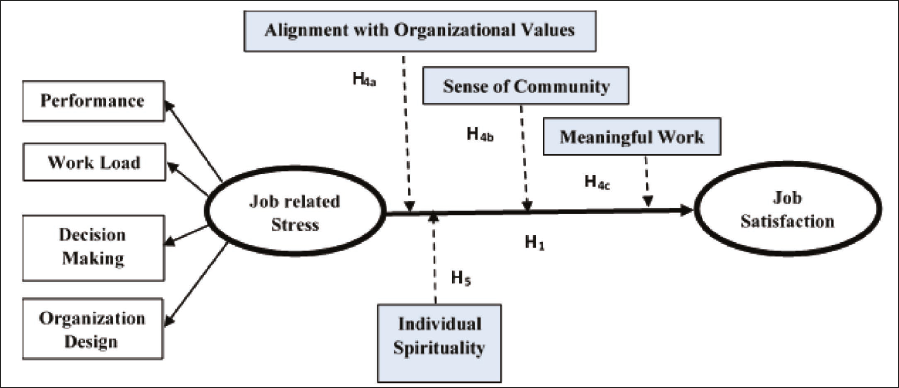
H1: Job-related stress has a negative influence on job satisfaction.
Spirituality and Job Satisfaction
A person’s spirituality has a positive effect on how one works and eventually on the business (Milliman et al., 2003). Research findings state that organizations having high levels of spirituality engage in positivity, trust, regard for each other and low levels of stress (Giacalone & Jurkiewicz, 2003; Thomson, 2000).
It is pertinent to mention here that the present study takes into account two different concepts of spirituality: WS and IS. For the present study, the theoretical foundation of WS is based on the dimensions given by Milliman et al. (2003): first, at the personal level, in reference to individuals’ work in an organization; second, at the group level, where it acknowledges how individuals relate to or sustain in group activities in organizations; and finally, at the organizational level, where it appreciates how an individual relates to the organizational values and goals and how much they feel connected to the organization.
WS refers to ‘the effort to find one’s ultimate purpose in life to develop a strong connection to co-workers and the other people associated with work, and to have consistency (or alignment) between one’s core beliefs and the values of their organisation’ (Mitroff & Denton, 1999b).
WS encompasses three dimensions: meaningful work (MW), sense of community (SC) and alignment with organizational values (AOV). MW means ‘having a deep sense of meaning and purpose in one’s work’, SC means ‘having a deep connection to, or relationship with others’ and AOV means ‘experiencing a strong sense of alignment between their personal values and their organisational mission’ (Milliman et al., 2003).
In the context of India, WS impacts other aspects, such as that reported by Garg et al. (2022b), where they report a negative relationship between workplace spirituality, ostracism and inclivity among employees working in Indian public sector oil and gas companies. Garg et al., (2022a) found a negative relationship between workplace spirituality and stress among university teachers in India. Garg and Saini (2024) predicted job attitudes such as innovative work behaviour. Jalan and Garg (2022) demonstrated the importance of WS as a tool for relieving occupational stress, thus affecting the performance and becoming a guiding tool for Indian police personnel.
Among healthcare and pharmaceutical employees, the concept of job satisfaction was more understandable when associated with WS (Abbas et al., 2020; Zaidi et al, 2019). Iqbal et al. (2020) revealed that workplace spirituality moderated the relationship between total quality management and job satisfaction. Belwalkar et al. (2018) found that WS leads to greater job satisfaction and better organizational citizenship behaviour in the Indian banking sector. Gupta et al. (2014) proved that all three dimensions of WS, as well as compassion, improve job satisfaction. WS also exhibits a favourable association with satisfaction and commitment (Chawla & Guda, 2010). A strong positive link exists between the three dimensions of WS and job satisfaction (Baskar & Indradevi, 2020; Hassan et al., 2016; Rashidin et al., 2020; Van der Walt & De Klerk, 2014).
IS refers to ‘personal relationship or experience with God or the divine that informs an individual’s existence and shapes their meaning, purpose and mission in daily life. It does not need go encompass religion, nor does it by nature exclude religion’ (Roof, 2015). This means that every individual has a characteristic of spirituality, which may differ in the magnitude of manifestation, which reflects their connection with a supreme power. This characteristic enters along with them in the workplace when they join the organization and echoes in their way of doing work. For the present study, we focused on the theoretical underpinnings given by Underwood and Teresi (2002), who comprehended the spiritual experience of individuals on a day-to-day basis and made a clear distinction regarding the extraordinary involvements one may have in life.
The main focus of IS for the present research is on how one feels and thinks oneself to be strengthened, joyed and blessed by being spiritual. Pawar (2017) found that IS plays an important role in building WS. Lazar (2010) found a positive correlation between spirituality and job satisfaction of nurses in Israeli hospitals. Individual spirituality, according to Pawar (2009), showed no link with work attitudes. Wulandari (2014) indicated that job satisfaction was favourably affected by IS. Choerudin (2014) revealed that spirituality was favourably connected with performance and job satisfaction. On the basis of the literature, we postulated the following hypotheses:
H2: WS dimensions have a positive influence on job satisfaction.
H2a: MW has a positive influence on job satisfaction.
H2b: SC has a positive influence on job satisfaction.
H2c: AOV has a positive influence on job satisfaction.
H3: IS has a positive influence on job satisfaction.
Workplace Spirituality and Individual Spirituality as Moderators Between Job-related Stress and Job Satisfaction
Research reveals that spirituality operates as a possible moderator between job stress and job satisfaction. Altaf and Awan (2011) claimed that job overload is caused by stressors including long hours, pressure to work additional hours and fewer vacations or breaks; on the other side, a spiritual work atmosphere has a positive effect. The addition of WS to the existing connection moderates this relationship.
Pawar (2009) found that workplace spirituality is related positively with work attitudes, and IS moderates the connection between the two. Kumar and Kumar (2014) explored the association between work stress and health in India and found that WS works as a bridge between unfavourable stress–health links. Pawar (2018), in his findings, indicated considerable support for the direct effects but not for the moderating effects. In addition, it was found that organizational spirituality had a stronger association than employees’ individual spirituality with workplace spirituality. According to Piryaei and Zare (2013), WS favourably influenced work attitudes including job satisfaction and organizational commitment. Furthermore, they discovered IS mitigates this association. Chand and Koul (2012) revealed that WS, organizational emotional ownership and job satisfaction are negatively correlated with job stress. They highlighted that WS emerged as the strongest predictor to coping with job stress. Meitasari et al. (2018) found that WS moderates the relationship between job stressors and job satisfaction. With these highlights, we framed the following hypotheses:
H4: WS dimensions moderate the relationship between job-related stress and job satisfaction.
H4a: MW moderates the relationship between job-related stress and job satisfaction.
H4b: SC moderates the relationship between job-related stress and job satisfaction.
H4c: AOV moderates the relationship between job-related stress and job satisfaction.
H5: IS moderates the relationship between job-related stress and job satisfaction.
With the help of literature, a conceptual model shown in Figure 1 was prepared and tested empirically. Based on the model, the present study seeks to answer the aforementioned question in a statistically significant manner, by creating the following objectives for the study:
Proposed Research Framework.
To study the underlying relationship between job-related stress and job satisfaction.
To study the contributory relationship between workplace spirituality and individual spirituality with job satisfaction.
To study the moderating effects of workplace spirituality and individual spirituality on the relationship between job-related stress and job satisfaction.
RESEARCH METHODOLOGY
Sample and Procedure
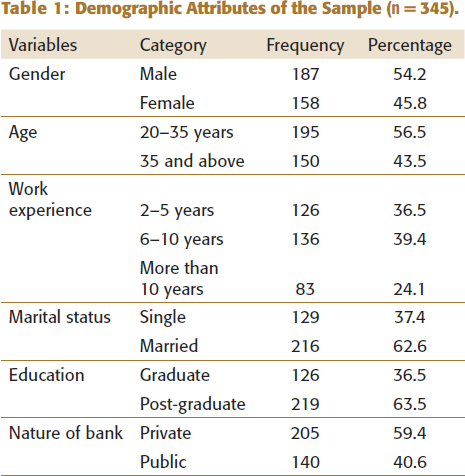
The study was conducted on public and private banking sector employees working in Delhi, NCR, Haryana and Punjab. Convenience sampling was used in the selection of banks, and random sampling was applied in the selection of employees. An electronic questionnaire (Appendix A) was also sent to branch managers and head offices. A total of 500 questionnaires were distributed through online and offline modes. We received 345 questionnaires in total (with a response rate of 69%). The study is cross-sectional and follows an exploratory cum descriptive research design. In the current study, the sample size was determined using the inverse square root method proposed by Kock and Hadaya (2018), which is suitable for normal and non-normal data. The demographic attributes of the sample are shown in Table 1
Demographic Attributes of the Sample (n = 345).
Measurement Scales
The present study uses standardized scales to measure the following constructs:
Job-related stress (JRS): Job-related Tension Index (JRTI) designed by Kahn et al. (1964) consisting of 15 items
Workplace spirituality (WS): A 20-item and 7-point Likert scale by Milliman et al. (2003)
Individual spirituality (IS): Daily Spiritual Experience Scale (DSES) (Underwood & Teresi, 2002) consisting of 16 items
Job satisfaction (JS): 18 items and 5-point Likert scale by Brayfield and Rothe (1951)
First, at the personal level, in reference to individuals’ work in organizations; second, at the group level, where it acknowledges how individuals relate to or sustain in group activities in organizations; and finally, at the organizational level, where it appreciates how an individual relates to the organizational values and goals and how much they feel connected to the organization. Bank employees have to manage teams, communicate with high-value customers, accept and collect deposits, etc. These tasks show the interconnections between individuals, groups and organizational activities that the bank employee have to deal with to perform well. Second, the reliability and validity of the scale have been well established both in the Western context and in the Indian context (Jalan & Garg, 2022; Pandey et al., 2009; Saxena et al., 2020). Moreover, the three dimensions of workplace spirituality highlighted by Milliman et al. (2003) have a deep connection with Indian spiritualism, as reported by Pandey et al. (2009), Pardasani et al. (2014), Saxena et al. (2020) and Srirangarajan and Bhaskar (2011). These qualities of the scale made it an appropriate measurement tool for the researcher.
Moving towards individual spirituality, the scale used for the present study focuses on an individual’s perception of involvement with the transcendent and takes into account only that phenomenon which an ordinary person has in their day-to-day experience. Second, the scale has been validated in other Indian studies, such as Pawar (2009). DSES (Underwood & Teresi, 2002) consists of 16 items. The items in the scale such as ‘I feel God’s love for me directly’, ‘I feel deep inner peace or harmony’ and ‘I experience a connection for all life’ identify an individual’s inner connectivity with the transcendent. The job satisfaction scale by Brayfield and Rothe (1951) was used as it is well established and validated a number of times in Western and Eastern contexts, such as Sultana et al. (2017), Gazi et al. (2022), Khaleque and Choudhury (1984) and Chaudhury and Banerjee (2004). The item’s formation is both reverse and straight, which gives a somewhat accurate picture of the job attitude.
Job-related stress instrument designed by Kahn et al. (1964), which consists of 15 items, posits the items which match with the job characteristics of bank employees. The items deal with the workload, authority, responsibility and decision-making, which are crucial for bank employees. It is also validated in other Eastern studies, such as Bashir and Ramay (2010).
RESULTS
The analysis begins by exploring the factors of job-related stress by applying exploratory factor analysis where KMO for factor structure of JRS was 0.91 and the Bartlett test of sphericity was significant. The four factors, namely performance, workload, decision-making and organizational design, were formed, which accounted for 69% variance in the construct (JRS). These factors are named similar to the factor structure of Job-related Tension Index (Dominguez & Scherer, 1998; Rogers et al., 1994), as the results matched. Second, the analysis includes validating the measurement model and higher order of job-related stress. Third, the analysis is done by validating all other variables, such as WS, IS and JS. Then, the structural model was validated and the moderating effects of WS and IS on the relationship between job-related stress and job satisfaction were confirmed. Data analysis was done using the partial least square (PLS) method and Smart PLS version 3.2.7 software.
Common Method Bias
Harman’s single-factor test ensured that there was no issue of common method bias as the single component explained less than half the variation, which was 35.95%. This means that all responses were bias-free (Podsakoff et al., 2003).
Assessment of Reliability, Convergent and Discriminant Validity for the First-order Construct
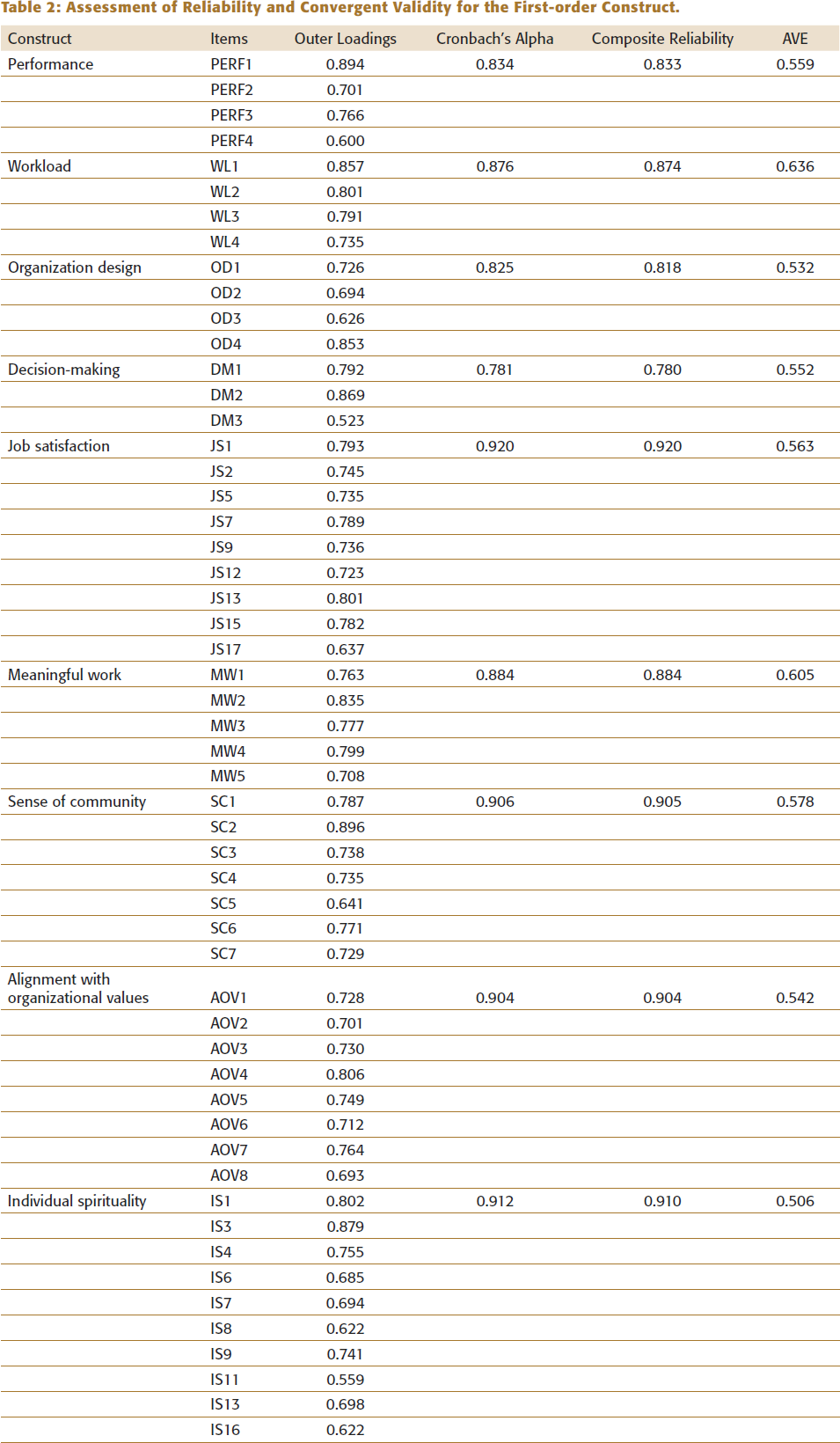
Values of Cronbach’s alpha and composite reliability (CR) are considered internal consistency reliability. Cronbach’s alpha and CR scores vary between 0.780 and 0.920 in Table 2. These values are well over 0.70, indicating high reliability for all measures (Hair et al., 2014). To assure convergent validity, the outer loadings and the average extracted variance (AVE) must be at least 0.50 (Chin, 2010). In this study, all outer loadings of the first-order construct and AVE are above the minimum required value, as shown in Table 2. Prior to that, several items were removed with loadings less than 0.5 to establish convergent validity.
Assessment of Reliability and Convergent Validity for the First-order Construct.
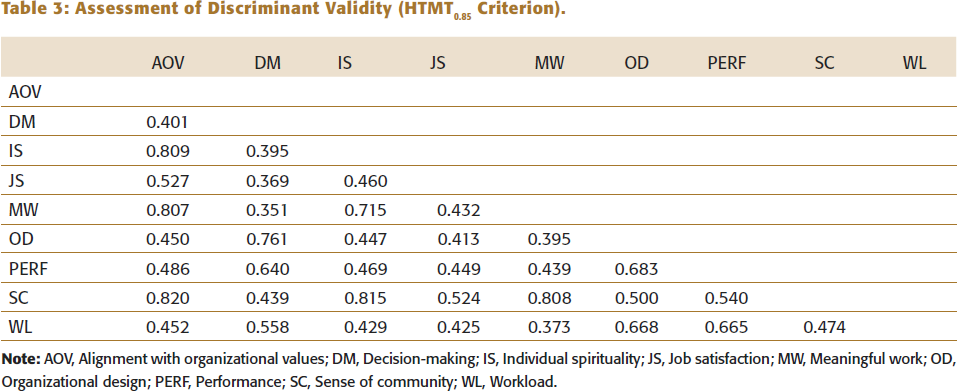
The heterotrait–monotrait ratios (HTMT) were used to check the discriminant validity (Henseler et al., 2015). Discriminant validity was proven since the correlation between each pair of constructs was below the requisite 0.85 (see Table 3).
Assessment of Discriminant Validity (HTMT0.85 Criterion).
JRS as a Higher-order Construct
A higher-order (reflective–reflective) construct of job-related stress was assessed using a disjoint two-stage technique in this study. In this technique, the latent variable scores from the PLS algorithm for lower-order constructs (performance, workload, organizational design and decision-making) are kept and then used as indicators for the higher-order construct (job-related stress) (Sarstedt et al., 2019). As seen in Table 4, the higher-order construct is reliable and convergent.
Assessment of the Second-order Measurement Model for JRS.

Structural Model Evaluation and Determination of R2 and Q2
With the establishment of the measurement model, the hypothesized relationship was examined through the structural model. To investigate multicollinearity, we also performed a collinearity test employing the variance inflation factor (VIF). All constructs exhibited VIF values under 3 (Hair et al., 2019), varying from 1.56 to 2.73, implying that there were no issues with collinearity across the existing constructs.
In the current study, the bootstrapping technique with 5,000 subsamples was used to test the relevance of path co-efficient (ß) and suggested hypothesis in the structural model. Table 5 reports the results where all the five hypotheses proposed and tested were supported. Findings revealed a substantial negative association between job-related stress and job satisfaction (ß = −0.456, t = 9.287, p < .000).
Structural Model Evaluation and Determination of R2 and Q2.
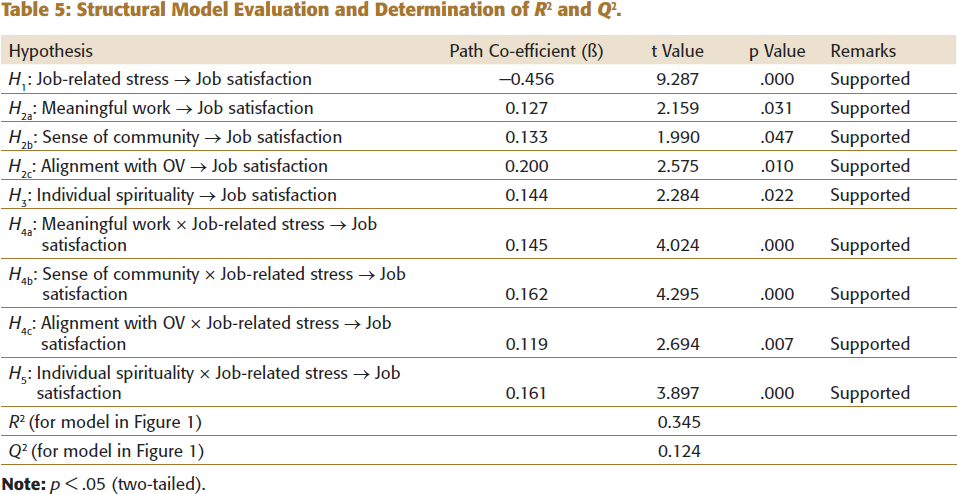
Furthermore, all three workplace spirituality aspects had a substantial beneficial influence on job satisfaction, having t values larger than 1.96 and significant, indicating that H2a, H2b and H2c are supported. H3 is supported by evidence that spirituality helps improve job satisfaction. Additionally, there are also statistically significant moderating effects of workplace and individual spirituality. Results showed that three workplace spirituality aspects significantly moderated the link between stress at work and job satisfaction, confirming hypotheses H4a, H4b and H4c.
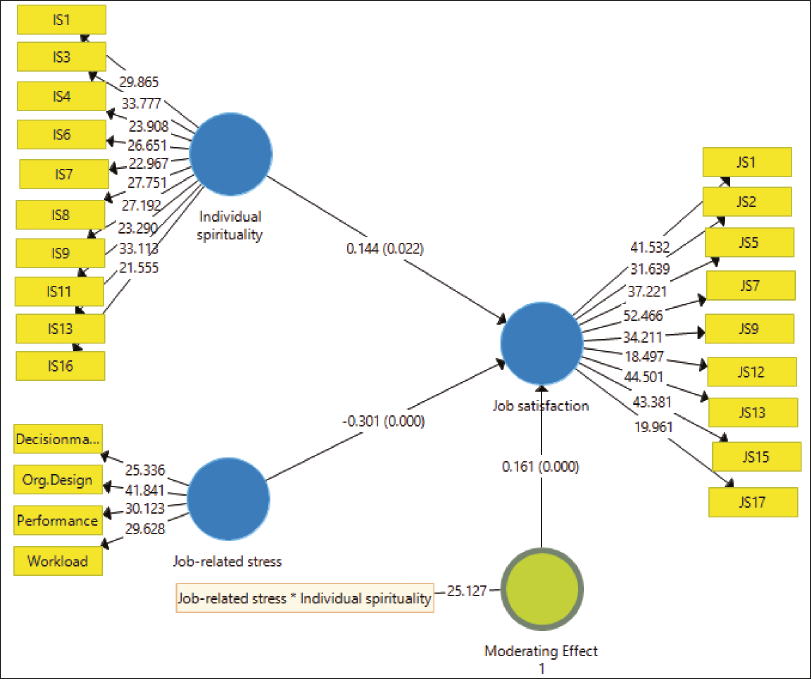
In addition, individual spirituality also moderates the relationship of job-related stress and job satisfaction, which verifies H5, as shown in Figure 2.
Moderating Effects of Three Dimensions of Workplace Spirituality.
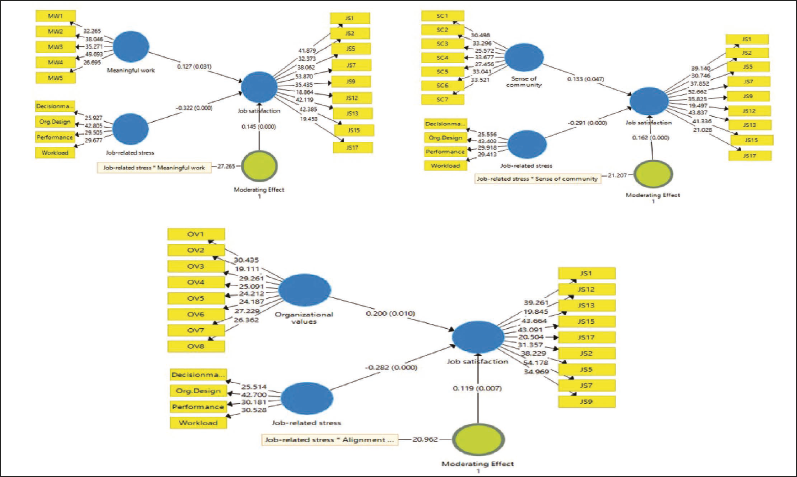
In order to statistically establish and prove the moderating effect of WS and IS, the R2 for the relationship was calculated directly between job-related stress and job satisfaction, which was found to be 27%. However, when the moderators were included in the model, this percentage increased from 27% to 34.5% (Table 5, Figure 3).
Moderating Effect of Individual Spirituality.
In addition to this, to establish the predictive significance of the model, blindfolding process with an omission distance of 7 was applied and the Q2 was determined (Geisser, 1974; Stone, 1974). The value of Q2 must be larger than 0 (Chin, 1998). The present model exhibited a value of 0.124, indicating that the model is predictively valid (Table 5).
The findings of the present study are in congruence with the findings of Lazar (2010), Wulandari (2014) and Pawar (2017) regarding the association of IS with JS. Similarly, the association of WS and JS in the present study was found to be in congruity with Belwalkar et al. (2018). Indian banking professionals work under utmost pressure and long working hours, where they have to handle the personal data of their customers and manage relationships with their customers. Sometimes they have to meet the financial targets too. All these job demands lead to stress. Knowledge professionals must realize that there is a requirement to have a transcendent consciousness for uniting one’s personal values and professional targets (Pradhan & Jena, 2016; Sandra, 2015). The results of the present study highlight that individual as well as workplace spirituality can impact the satisfaction of bank employees when they are under stress.
IMPLICATIONS FOR THEORY AND PRACTICE
Theoretical Implications
Undoubtedly, working in a bank is a demanding job that requires time, meticulousness, strict adherence to rules and regulations as well as maintenance of relationship with customers. Studies have highlighted that stress from job demands can hinder the overall well-being of employees. From a theoretical standpoint, the study provides insights into understanding how workplace resources, in terms of psychological factors, can be a great source of satisfaction among bank employees based on the job-demand resource model (Llorens et al., 2006) and enriches the existing literature. Moreover, it supplements the human wellness literature as the results show that spirituality, whether individual or workplace, impacts the relationship between stress and satisfaction by lowering stress and providing a mechanism to deal with job stress, finally resulting in wellness.
Additionally, only Meitasari et al. (2018) highlighted the moderating role of WS in the Western context. This research highlights the role of both individual and workplace spirituality together, which has not been considered in earlier research, thus demonstrating that both workplace and individual spirituality significantly moderate the relationship between job-related stress and job satisfaction. This indicates that spirituality buffers the negative effect of job-related stress on job satisfaction. Therefore, when stress interacts with spirituality, the negative relationship between job-related stress and job satisfaction weakens. The results pave the foundation for theorists to delve into understanding more immaculately the different spiritual dimensions of workplace and individual personality that go hand in hand to bring positive results for an organization.
Practical Implications
Additionally, making changes to the work culture by inculcating some important WS dimensions in the banks at the micro-level can make the employees more tolerant and patient towards handling stressful situations that they come across during work hours. Thus, this tolerance will reduce stress and make them more adaptive towards the work environment, which in turn will make them satisfied with their job. Third, the findings hint that using spiritual practices such as meditation, spiritual lectures, collective silence time for introspection and similar other techniques at the workplace can bring synergistic effects towards satisfaction of employees, especially those with a high level of individual spirituality. This synergistic effect can be highly beneficial for the banking sector in connecting employees with themselves and their surroundings, thus reducing unnecessary costs and providing a competitive advantage. Finally, the policymakers need to understand the importance of aligning individual values with organizational values. They must work on bringing a sense of community among employees by creating family-friendly policies that enable employees to see themselves as an important part of community they are working in. Thus, having a spiritual workplace will help employees move towards a path of holistic development and wellness.
LIMITATION OF THE STUDY AND SCOPE FOR FUTURE RESEARCH
First, the present study takes into account overall job satisfaction and individual spirituality. However, dimensions of job satisfaction, such as financial or non-financial, may be segregated and taken into account by future researchers. Similarly, dimensions of individual spirituality (or their involvement in some kind of spiritual intervention such as meditation) may be considered by future researchers. Further, in the case of workplace, spirituality dimensions specific to the Indian context such as swadharma and loksangraha can be inculcated to understand WS. Second, the generalizability of data might not be possible as it is a confined study based on a particular area in India, namely the northern region; future researchers can expand their area of sampling and also add some cross-cultural context to the study. Third, the same study could be simulated to other stressful jobs to understand its applicability and strengthen the idea behind it.
CONCLUSION
Understanding and utilizing the smoothening effects of workplace spirituality and individual spirituality has always intrigued researchers, academicians and employers in an organizational context. The present study focused on this aspect, by examining the moderating role of workplace and individual spirituality on the relationship between job-related stress and job satisfaction among bank employees in the Indian context. With the application of PLS-SEM, all the hypotheses were supported. The various dimensions of a person’s workplace, their harmony with the organizational groups and congruity with organizational mission and goals alleviate the stress and bring in satisfaction. Moreover, an individual’s thought process and feelings regarding individual relation with the supreme harmonize their behaviour with the workplace, thus moderating the relationship between job-related stress and job satisfaction.
Footnotes
DECLARATION OF CONFLICTING INTERESTS
The authors declared no potential conflicts of interest with respect to the research, authorship and/or publication of this article.
FUNDING
The authors received no financial support for the research, authorship and/or publication of this article.

e-mail:
e-mail: