




Abstract
Abhishek has spent most of his life working for a public enterprise, Bharat Sanchar Nigam Limited (BSNL), engaged in providing telecom services. As he nears his silver jubilee with BSNL, a hard decision of whether to opt for Voluntary Retirement Scheme (VRS) is thrust on him. Looking back at his career, Abhishek has several positive takeaways and believes he has more than a decade to offer his beloved organisation. However, Abhishek is also cognizant of many factors that structurally push him toward the singular alternative of separation, and the degree of volition in his decision appears strangulated.
As Abhishek sat perplexed on a cool breezy morning in his dilapidated office, he tried to put into perspective his career of around two and a half decades with Bharat Sanchar Nigam Limited (BSNL), a public company engaged in providing telecommunication services (BSNL, 2020). After joining as an entry-level officer in 1995, he had served in around ten different postings, all constrained within the same secondary switching area. Abhishek credited BSNL with whatever he was today. Through varied challenges, the organization taught him multi-faceted technical, conceptual and human skills. Simultaneously, he viewed his contribution to BSNL positively and placed himself within the top quartile of its workforce.
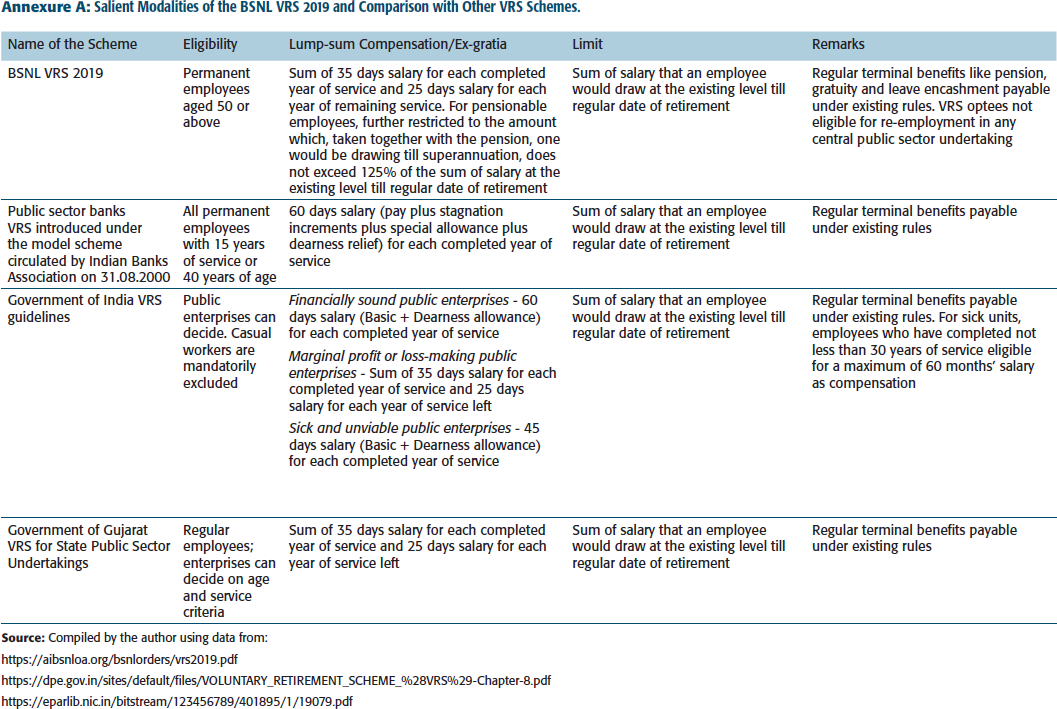
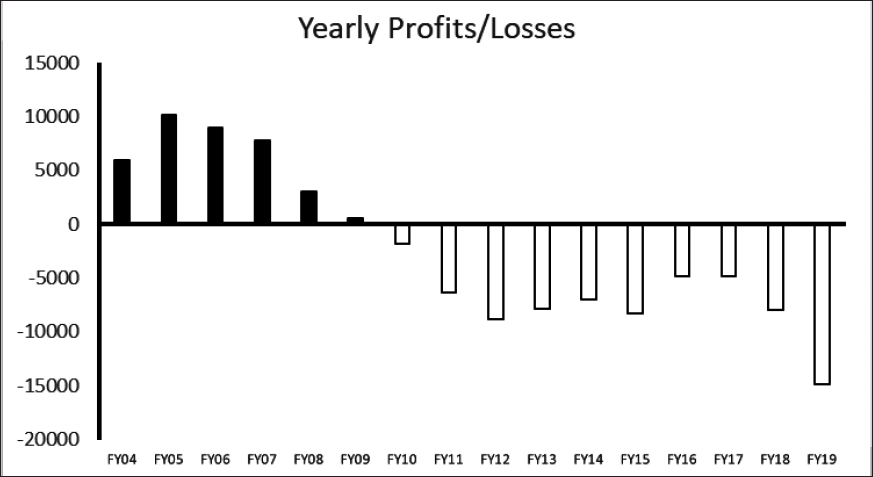
While his career had progressed satisfactorily, things were difficult for the last few years. BSNL had been in losses for over a decade (Abraham & Jain, 2020), impacting not just employee benefits but broader aspects of the work environment, resources, customer service and public perceptions. This tension had escalated since the announcement of the BSNL Voluntary Retirement Scheme (VRS) 2019, wherein all employees aged 50 and above as of 31 January 2020 (irrespective of the length of service), were given the exit option as per the benefits scheme, popularly known as the Gujarat model (BSNL, 2019). He was to celebrate his 25th work anniversary on 21.02.2020; however, he now knew that it might not become a reality. Further, while terms like voluntary and option were coined as the operative keywords here, Abhishek’s mind wavered between the dialectical limits of volition and compulsion concerning the prospect at hand. The address by the company’s chief managing director (CMD), Mr Purwar, wherein he virtually exhorted eligible employees to take this first and last opportunity for an exit, deepened his scepticism at how voluntary the scheme was (AIBSNLEA, 2019).
Somehow, he felt he was part of a broader story. While his colleagues were often calculating the payoffs and making their assessments of how beneficial the VRS was, Abhishek could not engross himself in the numbers (ref Annexure A). Instead, he wanted to see whether a larger scheme of things was at play. He started thinking of the Indian public sector story and the impact of economic reforms therein. He was also cognizant of various public and private entities that had adopted VRS as a workforce rationalization tool. Abhishek often found himself baffled by how employees seemed to be the first resource to be done away with when there was an emphasis on human capital across sectors. He started working on connecting the dots.
PUBLIC SECTOR IN INDIA
The roots of India’s development lie in a massive infusion of state capital and the creation of a dominant public sector. Envisioning a mixed economy and planned development, the second industrial policy of 1956 was the harbinger of India’s public investment programme (Das Gupta, 2017). Economic planners foresaw the state’s role in building infrastructure, setting up new financial institutions, and coordinating and expanding production. Public-owned enterprises were envisaged to become the ‘commanding heights’ of the economy while providing socially desirable goods and services at subsidized rates. Specifically, the 1956 policy reserved 17 industries for the public sector. Twelve other industries were progressively sought to be brought under state ownership (Das Gupta, 2017).
However, the might of the public sector started dwindling in the 1980s. A gradual process of deregulation and private participation began, which further saw a massive push with the economic reforms initiated in 1991 (Nagaraj, 2006). While the narrative of competition, modernization and efficient allocation of resources held sway, the impact of global economic forces, interstate diplomatic pressures and policy diffusion from capitalistic societies cannot be denied. Still, it is worth noting that even after 15 years of the onset of liberalization and disinvestment, the public sector contributed to more than a quarter of India’s GDP as of 2006 (Nagaraj, 2006).
The performance of public sector entities has always been a topic of contention. Significant scholarly works have argued for both sides of the story (e.g., Kumar, 2000; Sikorski, 1993). The debate is further hardened by the multiplicity of objectives facing public enterprises. Should financial yardsticks be the sole or significant evaluation criterion, or should broader social contributions also be factored in? The proponents have touted strategic goals, huge investments, long gestation periods, infrastructural requirements and geographically scattered and often unviable operations (Kumar, 2000). In contrast, naysayers emphasize inefficiencies, bloated workforce, opportunity costs of capital and suppression of market forces, among other things (Sikorski, 1993). Successive Indian central governments appear to have sided with the latter perspective, with policies favouring large-scale disinvestment, often to strategic domestic or foreign entities.
THE INDIAN TELECOM SECTOR
If there is one sector that depicts the fruits as well as perils of market-based reforms, it is the telecommunications industry of India. On the one hand, it is a classic success story, being a service provider to 1.2 billion consumers and, deservedly, the second-largest telecom market (as of 2018) globally (Anand & Singh, 2021). Champions of market reforms cite the affordable price structures of the Indian telecom market as evidence of the public policies’ success (Parsheera, 2018). Indeed, the average tariffs have been very competitive and remain relatively low despite recent periodic rises. The future also appeared promising, given that the overall teledensity is skewed by higher numbers in some services, such as mobile telephony. A large segment of the population still had no internet connection. Services like fixed broadband were meagerly penetrated and offered enormous scope moving forward (Parsheera, 2018).
On the flip side, the sector has seen frequent and disjointed policy changes, favouritism to specific players, scams, poor service quality, and inadequate return on capital for incumbents. Experts (e.g., Sutherland, 2016) have documented how ad-hoc policy measures and lack of role clarity between different wings of the government resulted in negative perceptions of prospective foreign entrants. In the initial reform years, the Department of Telecommunications was the policymaker, licensor, largest service provider and regulator, indicating an apparent conflict of interest. Further, even after regulatory and oversight bodies like the Telecom Regulatory Authority of India (TRAI) and the Telecom Disputes Settlement and Appellate Tribunal (TDSAT) were established, substantial allegations of bribery and undue favours continued (Sutherland, 2016). The 2G spectrum scam entailed vital issues like lack of transparency and objectivity, licenses issued to ineligible entities and loss to the exchequer (Parsheera, 2018). Further, as incumbents face financial difficulties amid the structural requirement of fast-changing technology and recurring capital requirements, service quality has not been able to match expectations.
The year 2016 marked a decisive turn for the sector with the entry of Reliance Jio. An entrenched heavyweight corporate house across various sectors, it had nothing short of market leadership as the aim. Towards that goal, supported by huge economic might from other businesses, it began offering a completely free service, which was extended under different names and guises for ten months (Gadgets360, 2017). The incumbents complained against the predatory pricing individually and under the banner of the Cellular Operators Association of India (COAI), but regulators and the government either did not intervene or appeared to be too easily pacified by the new operator’s responses. Notwithstanding the disruption caused by the pricing strategy and the wider impact on the sector’s growth, Reliance Jio’s success continued. Expectedly, the industry consolidated, with some operators going bankrupt and a few merging with bigger players. The amalgamation of two significant players, Vodafone and Idea, settled the waters somewhat in 2018. On the tariff front, the average price of one Gigabyte of data fell over 30 times, and the average wireless data usage multiplied over 25 times between 2015 and 2019 (Anand & Singh, 2021).
As of the present, an immediate cause of concern for the government was the industry structure. From 14 telecom service providers in 2015, the sector had reached a state of four operators, including the public player. Among the four, the future of Vodafone Idea (VI) has been in limbo ever since the Indian Supreme Court decided against multiple telecom operators in the adjusted gross revenue dues case. The financial implication of this judgement on VI was 530 billion rupees. The company publicly stated that it would cease to be a going concern if some form of relief was not granted regarding the amount it owed and its payment schedule (Anand & Singh, 2021). With the public operators also in perpetual losses (Parsheera, 2018), it appeared that India’s telecom sector had lost its lustre and was in deep financial distress.
BSNL—A MAMMOTH GIANT TO A TINY FISH
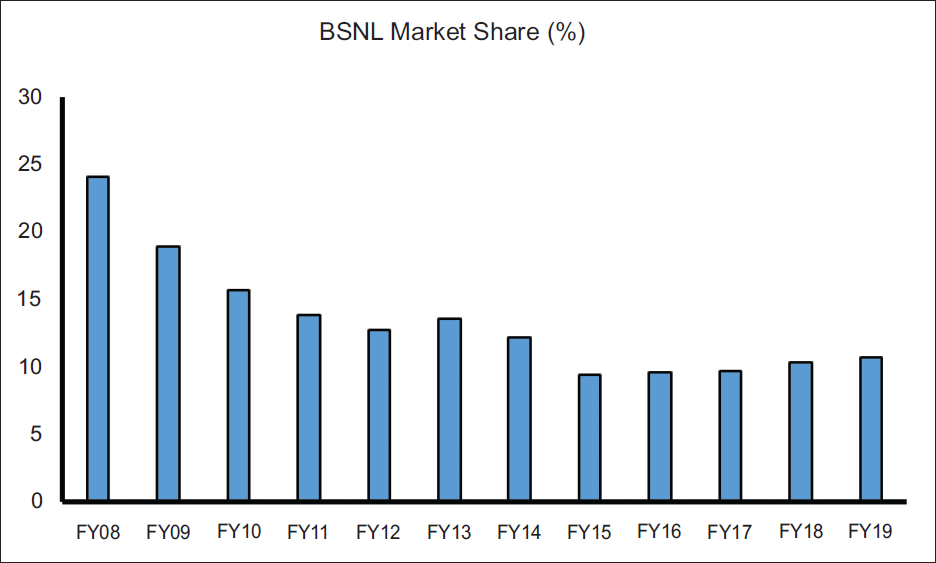
The genesis of BSNL lay in the need to separate policy-making from operations, as the telecom sector opened to private participation in the 1990s. BSNL was carved out from the Department of Telecom Services (DTS), the operational wing of DOT, in 2000 as a public limited company 100% owned by the Government of India. Initially a provider of only wireline services, it evolved to offer multiple services, including 2G mobile services (2002), wireline broadband (2005), 3G mobile services (2009), enterprise data services like leased lines (2013), among others (BSNL, 2020). It offered several additional services like Fibre to the Home broadband, data centres and long-distance services. Once considered a natural monopoly player, BSNL had seen many ups and downs in terms of industry structure. Further, while it had expanded its bouquet of services, its market share had fallen steeply before stabilizing somewhat over the last few years. As of 2020, it was a distant fourth in customer numbers and catered to just over 10% of the overall subscriber base of the country (Annexure B). Over the years, it also turned a full circle on profitability (Annexure C).
While critics wrote its performance off, citing reasons such as high staff cost, inefficiency and corruption, Abhishek also lamented that BSNL had done little to change organizational structures, norms, working conditions and overall culture after corporatization (Abraham & Jain, 2020). Efforts to improve customer interface and facilities were on but appeared slow and often insufficient. Despite the clarity that service-related benchmarks require an agile organization, internal working policies and timelines showed little change. Further, even after more than a decade, BSNL still did not have transparent or consistent HR policies, which often caused consistent rifts with employees, strikes and avoidable litigation.
Still, Abhishek was convinced that not all problems were internally attributable. One legacy challenge was the scope of operations and the viability thereof. As a public service provider, it was supposed to cover every nook and corner of the country. Understandably, the cost of service operations tends to be high in rural and remote areas. The financial support given by the government in lieu of these services was initially curtailed in 2005 and later stopped in 2011 (Abraham & Jain, 2020). Second, license and spectrum allotment policies concerning public operators demonstrated unpredictability and lack of level-playing field. Besides the broader issue of whether scarce resources like spectrum should be auctioned or awarded at pre-determined prices, BSNL and Mahanagar Telephone Nigam Limited (MTNL), the other public service provider, were subjected to more peculiarities. In 2010, when the 3G and Broadband Wireless Access (BWA) spectrum was auctioned, private players could choose and bid for selective license areas. Instead, public operators were asked to pay the highest bid price for all the territories served by them (Abraham & Jain, 2020). BSNL paid over 160 billion Rupees, a blow many consider too severe, even after a decade (Abraham & Jain, 2020). Further, this appeared as a double whammy since public operators were neither free to bid selectively nor given the right to choose a price they were willing to pay. Third, Abhishek felt little had been done to counter government interference and administrative delays in BSNL (Abraham & Jain, 2020). The telecom sector being an intrinsically innovation-led space, regular transitions to newer technology were imperative. In BSNL’s case, such attempts were often marred by bureaucratic hurdles and red tape.
ECONOMIC REFORMS AND MANPOWER RATIONALIZATION
The economic reforms and associated structural transformations have had significant implications for the Indian labour markets. First and foremost, while inclusive growth and expansion of employment opportunities were aimed, employment growth had consistently decelerated, forcing experts to term the Indian story as a ‘jobless growth’ (Motkuri & Naik, 2018). Herein, the liberalization process was seen as a natural call for substituting capital for labour. Shedding human resources through exit policies became a legitimized route towards this endeavour (Jenkins, 2010).
Further, the narrative of efficiency has implied enhanced engagement of contract labour, often in similar roles as the on-roll workforce. More broadly, competition induced by globalization and free trade has exhorted the state to encourage the efficiency of private industry myopically, wherein traditional checks and balances like labour regulations and interests have been presumed to be roadblocks and, accordingly, gradually sidelined. Similarly, liberalization experiences across national boundaries have shown that the informal sector workforce, which receives no contractual benefits and is the most vulnerable, has invariably grown (Motkuri & Naik, 2018).
An interesting aspect of this transition was the withering away of initial scepticism of political policymakers as to the public sentiment regarding workforce reductions. Experts cited such sentiment as the reason why the first stage of reforms spared labour laws from any tinkering (Jenkins, 2010). However, the political stance changed towards being seen as decisive reformers for multiple reasons. First, the target voter base has shown to be largely unaware of economic reforms, even after more than a decade of their initiation (Kumar, 2009). Second, over time, either the public perception turned indifferent to the rightsizing phenomenon, or the concerned became too small a minority to have an effect on the democratic majority. Third, even if the voters wanted to express their anguish against the parties that encouraged reforms at the cost of jobs, they could not because both the principal political contenders at the national level, that is, the Bharatiya Janata Party and the Indian National Congress espoused reforms to an almost equal degree (Kumar, 2009). The glamour of capitalism could also have reinforced the death of any significant opposition to such jobless growth. Markets brought new choices and the narrative of abundance, which the burgeoning middle class and the electronic media lapped up. Further, the aggregate employment numbers appeared to have disguised behind the minuscule percentage of corporate jobs that paid hefty salary packages and the growth narrative, thus, got institutionalized.
HISTORY OF VRS IN INDIA
Voluntary retirement and separation schemes were authorized by the government to provide an alternative workable mechanism since the procedure for retrenching under the Industrial Disputes Act 1947 was legally cumbersome. While the formal initiation of voluntary retirement scheme (VRS) in the public sector can be traced back to the 1980s, instances of it in the private sector can be traced to even before that, for example, National Carbon Company, a unit of Eveready Industries India, introduced its first such scheme in 1975 (Basu & Datta, 2010). Still, VRS became ingrained in the common knowledge and psyche only when Indian public sector banks introduced the same on a collectively massive scale. The proponents of VRS cite technological changes, restructuring needs, competitive challenges, efficiency concerns, reduced revenues or cost overruns as some of the rationale for it (Maheshwari & Kulkarni, 2003). Though Abhishek appreciated these arguments, he was uncertain whether VRS was the right or the only way. Indeed, some banks reported an improvement in per-employee revenues and profits. However, several analyses instead problematized the outcomes of VRS in relation to the above goals. They revealed how it incentivized performers to leave rather than the targeted ‘deadwood’ (Waraich & Bhardawaj, 2009). More generally also, the performance improvement thesis was far from perfect since a majority of organizations did not report any such benefits (Maheshwari & Kulkarni, 2003). Particularly in information-intensive sectors, the inability to realize targeted gains could lie in the loss of precious tacit knowledge as experienced people leave (Waraich & Bhardawaj, 2009).
Additionally, Abhishek also found in several instances that VRS entailed arm-twisting rather than volition, wherein threats like harsh transfers and biased performance appraisals were adopted by management. In the case of Bharat Aluminium Company Ltd (BALCO), more than a third of VRS takers cited management pressures as the reason for opting (Mukul, 2007). He also read about the detrimental effects on employees who opt for separation and those who stay on. The latter’s morale drops, as well as their loyalty to the organization. For the former, beyond the economic and career impact, there are social consequences. They almost invariably articulate a diminished patriarchal and societal identity (Maheshwari & Kulkarni, 2003).
Further, Abhishek wondered if VRS was aimed only at staffing rationalization, why were almost all previous instances of it being offered in public entities preceded or succeeded by privatization or closure? For example, in the case of BALCO, the first VRS was offered within four months of privatization, with three more instances to follow in the coming years (Das, 2013). Similarly, Modern Foods sold to Hindustan Unilever offered VRS just after the change of ownership (The Tribune, 2001). In Hindustan Machine Tools, VRS immediately preceded the closure of operations of its three units (Abraham & Jain, 2020). Amidst these complexities, he also pondered the possible impacts of the precarious condition of one of the private operators on the future of BSNL and MTNL and whether the VRS offer had anything to do with such sectoral dynamics.
His Career
Being an engineering graduate from one of the premier institutes after the IITs, Abhishek had multiple options across private and public employment. His mind wavered for some time between his different choices. Abhishek curated a set of decision-making criteria for making the selection. He eventually chose BSNL based on family considerations as it offered the possibility of a workplace relatively closest to his hometown, at least for some years. Abhishek was initially posted within 50 Km of his hometown, and his future postings more or less maintained this spatiality.
When Abhishek joined, he had some idea of the pros and cons of public service. Abhishek believed he was opting for better initial remuneration, job security and work–life balance while sacrificing higher career growth and potential earnings. He also had some apprehensions regarding the working climate. Though some perceived disadvantages turned out to be accurate, Abhishek learned to be pragmatic over the years and concentrated more on the positive aspects. His work offered a mix of technical application, inter-organizational exposure and public dealing and the societal setting he lived in also respected public employment in general. Abhishek firmly believed that any job is a mutual contract between any organization and an individual, and while it was fair for an employee to offer constructive feedback, one should move on to other organizations rather than continuously crib if the situation was too negatively perceived.
Having joined as an entry-level executive, he had got one functional promotion in his service basis his seniority. Abhishek’s engineering batchmates had risen multiple ranks in their corporate ladder, with most of them having changed employers more than once over the years. While Abhishek was quite uncertain about his future, he did believe that time was not up to hang his boots. Though he had a good blend of technical and managerial competence, Abhishek was unsure whether he would find it easy to enter or get a fair opportunity in the private sector, given perceived barriers to mobility from public to private employment.
The Decision
Basis his reading over the past few days, Abhishek now believed that voluntary retirement schemes, which began with Indian public sector banks, had spread like magic across industries and sectors. No one in Indian society seemed concerned about VRS, except those directly affected, case after case. Further, despite its widespread occurrence and many commonalities, Abhishek found his organization’s case somewhat unique. VRS incidents, as he had read, were aimed at separating a reasonably low percentage of the total workforce. Further, these schemes were often limited to a segment of employees based on several factors, such as skills, qualifications, experience, or performance. BSNL looked at separating around one-tenth of a million people in one go, more than half its workforce. Second, there were no limits to the scope of the VRS offer, i.e., no targeting of employees on skills, qualifications, experience or performance.Abhishek wondered how could such a large-scale reduction be seen as a rationalization.
He was also perplexed at why BSNL continued to hire a fresh workforce, almost contiguous to the VRS offer. Abhishek recalled recruitments within the year at different levels and across functions (Tahsin, 2019). If selective requirement was the rationale, why not selective separation now? Abhishek also disagreed with the argument that BSNL had a bloated workforce. Since BSNL ran a network including different technologies, last-mile connectivity and fixed-line exchanges, workforce figures had to be seen in that light. His thoughts also came back to the fundamental issue of the degree to which the BSNL VRS was perceived as voluntary. BSNL staff had been working in the toughest conditions for years, and the worsening showed no signs of abetment. Executives posted in field units had been spending from their salaries to manage the network. Apart from that, contractual workforce reduction and non-payment of wages to even the leftovers, public complaints, societal indifference, and whatnot? When an organization employs everything in its control to make an environment conducive to only one type of conduct and response, the element of choice fades away. Apart from attendant conditions, the scare that was being made as the scheme was in progress—last revival chance, restructuring post-VRS and large-scale transfers. No wonder the degree of volition looked faded.
On the personal front, he saw his career as a persistent dream for growth and advancement. In the thoughts of gratuity, benefits and the Gujarat model, he was worried about an abrupt end to his career, as also of thousands like him. Not all of them who would leave could be inefficient and lethargic. Many of them would have toiled hard and spent endless nights restoring or maintaining the BSNL network. Abhishek also felt that those who opt for VRS faced at least two imminent challenges- the sudden receipt of sizeable money and excessive contemplative time. The monetary calculations appeared attractive, and why not? Most of his colleagues, including him, were middle-class citizens, never having seen that kind of money in their lifetimes. In this phase of life, when money was inevitably needed for family requirements like marriage and education, VRS was hard to let go of. However, he remembered reading real exemplars when the amount that looked princely evaporated within a short span of time, and what remained was grief and repentance. VRS also implied a lot of free contemplative time, perhaps before one is ready.
Abhishek was also surprised at the ‘organization’s complete lack of post-VRS planning. He could not see anything going on in that regard at any level of the organization. He had read about a plan of outsourcing everything within three months of VRS over the whole nook and corner of the country, which seemed outlandish, given the process timelines of public procurement. His own SSA lacked even the human resources to process the VRS and pension papers of the applicants. BSNL appeared to have forgotten customers and its vast network for another day. The more he thought, the more doubts he came up with. However, irrespective of what decision he would eventually take for himself, he was convinced that in the garb of a golden handshake, BSNL as an organization was celebrating its own demise.
Annexure A: Salient Modalities of the BSNL VRS 2019 and Comparison with Other VRS Schemes
Footnotes
DECLARATION OF CONFLICT OF INTERESTS
The authors declared no potential conflicts of interest with respect to the research, authorship and/or publication of this article.
FUNDING
The authors received no financial support for the research, authorship and/or publication of this article.
