




Abstract
The existing research examines the impact of social media electronic word-of-mouth(e-WOM) adoption on green purchase intention and investigates the mediation effect of attitude and subjective norm between e-WOM adoption and green purchase intention. The theory of reasoned action and the information adoption model has been combined to study this. Data was collected from 228 respondents and analysed through partial least squares structural equation modelling (PLS-SEM). Results revealed partial mediation of green purchase attitude and subjective norm exists in the relationship between e-WOM adoption and green purchase intentions. The research focuses on green purchase intention therefore, it benefits the environment and marketers of green cosmetics.
Executive Summary
Social media has enabled a diverse change in communication methods across the globe. Numerous people seem to think electronic word of mouth (e-WOM) on social media is a reliable source of product knowledge, and users also share information about green products on this platform. Due to the upsurge of environmental issues, researchers have specifically focused on examining the purchase intention of green cosmetics. The primary purpose of current research is to investigate the impact of social media e-WOM adoption on green purchase intention. To accomplish this purpose, the impact of perceived e-WOM usefulness, trust and perceived e-WOM credibility is examined on e-WOM adoption by consumers. Afterwards, the influence of e-WOM adoption is examined on green purchase attitude and subjective norms. Then, the impact of attitude, subjective norm and e-WOM adoption on green purchase intention is investigated. With this, green purchase attitude and subjective norm are investigated as the mediating variables between e-WOM adoption and green purchase intention. Lastly, the effect of age and gender are investigated as control variables on purchase intention. To accomplish the existing study, the theory of reasoned action (TRA) for green purchase and the information adoption model (IAM) for e-WOM adoption are combined. The questionnaire method is used. Statements of all constructs are adapted from previous literature in which statements of perceived e-WOM usefulness and perceived e-WOM credibility are adapted from Tien et al. (2019) and those of trust are adapted from Farzin and Fattahi (2018). Statements of e-WOM adoption are adapted from Kala and Chaubey (2018); green purchase attitude and subjective norm are from Paul et al. (2016); and green purchase intention is adapted from Erkan and Evans (2016). The data have been collected from 228 respondents from Northern India. Partial least square–structural equation modelling (PLS-SEM) is used to analyse data. After applying PLS-SEM, results revealed that perceived e-WOM usefulness and trust have a significant positive influence on e-WOM adoption, whereas e-WOM credibility has no significant impact on e-WOM adoption. Results also show that e-WOM adoption has a significant positive influence on green purchase attitudes and subjective norms. Green purchase attitude, e-WOM adoption and subjective norms have a significant positive influence on green purchase intention. Outcomes also revealed that partial mediation of green purchase attitude and subjective norm exist between e-WOM adoption and green purchase intention. Control variables (age and gender) have no significant influence on green purchase intention. Consumers are undoubtedly technology-oriented today, so they use social media to share information about green cosmetics. Since the study is related to environmental preservation (focusing on the purchase intention of green cosmetic products), it therefore has implications for the environment as well as for marketers of green cosmetic products.
Keywords
The current technology-enriched era has revealed social media as a superior form of communication that has provided numerous benefits to rapid knowledge sharing. Social media is characterized as an internet-based application with accessibility, interoperability (information sharing) and interactivity (two-way communication) for the users (Kaplan & Haenlein, 2010; Park et al., 2021). Social media is recognized as the most persuasive force in this present time to shape the attitude and behavioural intention of consumers (Park et al., 2021; Wang et al., 2012). This area of paradigm has attracted various academicians to research this sector.
Social media is a prominent platform that enables the smooth exchange of product information by consumers through electronic word of mouth (e-WOM) (Cheung & Thadani, 2012). Jain et al. (2016) stated that e-WOM came as a new concept where people started to use internet platforms as a medium for information exchange. It is now acknowledged as one of the most powerful marketing tools in companies (Bickart & Schindler, 2001; Erkan & Evans, 2016; Zhang et al., 2010). While there are numerous kinds of e-WOM, that is, e-WOM by customers, e-WOM by celebrities, e-WOM by influencers, and so on, the existing research specifically emphasizes customer-to-customer e-WOM or customer-generated e-WOM. Consumers connect by leaving comments and exchanging knowledge regarding product usage experiences, allowing prospective consumers to make knowledgeable purchase choices (Park et al., 2021).
Consumers have better alternatives for environmentally harmful products due to innovative substitutes for these products made by companies known as green products. Green products are characterized as energy-efficient, minimally packaged, recycled, packaged in recyclable material and so on. Although there are numerous categories of green products, the current study is focused on green cosmetics. Before purchasing green products, consumers seek information from other customers through online reviews. With the initiation of the internet, the reliability and effectiveness of WOM content have increased manifold (Cheung & Thadani, 2012; Jain et al., 2016), that is, e-WOM. It is considered a more reliable source of information than the persuasive messages created by the companies (Farzin & Fattahi, 2018; Gruen et al., 2006; Jain et al., 2016). As a result, it inspires researchers to scrutinize the effect of e-WOM adoption on green buying intention.
Numerous past comparable studies employed the IAM (Abedi et al., 2019; Ismagilova et al., 2019; Tien et al., 2019; Zhu et al., 2016) and TRA (Copeland & Zhao, 2020; Erkan & Evans, 2016) but to the best of researchers’ familiarity, there has not been any study related to green cosmetics in which the information adoption model (IAM) and TRA are combined and a mediation analysis of attitude and subjective norm has been investigated between e-WOM adoption and purchase intention.
MOTIVATION AND SIGNIFICANCE OF THE STUDY
People spend a reasonable amount of time in the social networks they have created with others through social media. On these networks, people share their feelings, thoughts, experiences, and so on, about green cosmetics that become e-WOM, which is helpful for consumers in making purchase decisions wisely. The adoption of consumers in purchase decisions by e-WOM motivated the researchers to work in this area. Additionally, environmental preservation through buying green products too inspired the researchers. In the current scenario, there is an urgent need to work in areas that are helpful in environmental protection due to the rise of ecological challenges.
Although the literature reflects the association between e-WOM adoption, purchase intention and purchase behaviour, no single study has studied the attitude and subjective norm as mediators. The researchers were unable to find any research where gender and age were taken as control variables in e-WOM and purchase intention’s framework. The earlier studies have considered the attitude of consumers towards e-WOM information, but the attitude towards green purchases has not been explicitly studied in the e-WOM context. These additions to the existing research model will provide a novel contribution to the literature.
The current research would be helpful for marketers of green cosmetics to make strategies for capturing market share. The study is significant from an environmental protection point of view because it focuses on green cosmetics.
The main goals of the present study are (a) to inspect the influence of perceived e-WOM usefulness, trust and perceived e-WOM credibility on e-WOM adoption; (b) to study the impact of e-WOM adoption on green purchase intention via the mediation effect (attitude and subjective norm); and (c) to examine the influence of control variables, namely gender and age, on green purchase intention.
LITERATURE REVIEW
Theoretical Framework
The TRA states that the intention to indulge in certain behaviours is considered the best predictor of those behaviours. The theory indicates that the intention of a person shows a chance of engaging in a particular behaviour (Fishbein & Ajzen, 1975, 2010). The TRA states that
the more positive a person is about a certain behaviour and the more he/she perceives that the behaviour is accepted by his/her important ones like friends, family, or society, the more likely it is that they will form the intention to engage in that behaviour. (Fishbein & Ajzen, 1975, 2010)
The IAM was keened out by Sussman and Siegel (2003), and it explains how individuals adopt information for framing intentions. It also explains actions on the communication platforms.
According to Copeland and Zhao (2020), consumers’ purchase intentions are affected by peer influence. Yusuf and Busalim (2018) mentioned that consumers’ purchase intentions are influenced by e-WOM. According to Park et al. (2021), e-WOM is influenced by information credibility, attitude towards e-WOM, innovativeness, website quality engagement and values, that is, personal and functional value. Previous research was conducted using TRA (Ajzen & Fishbein, 1975). Besides, an IAM was also used in the social media arena by eminent scholars (Erkan & Evans, 2016; Tien et al., 2019).
Consumer attitude, subjective norms and perceived behavioural control affect green purchase intention (Copeland & Zhao, 2020; Sun & Wang, 2019). While subjective norms have a major positive impact on customer purchase intent, a study showed subjective norms had minimal impact on green product buying intent even though attitude plays a big role (Paul et al., 2016). Client purchase behaviour was positively influenced by positive e-WOM. People seek product information in the pre-stage, compare brands in the intermediate stage that includes e-WOM, and share their experiences with others in the post-stage, which generates more e-WOM (Chaiken & Eagly, 1976; Jain et al., 2016). Researchers looked at certain factors in the IAM, such as perceived e-WOM usefulness, perceived e-WOM credibility and e-WOM adoption in conjunction with TRA, and discovered that perceived information usefulness had a momentous influence on e-WOM adoption (Tien et al., 2019). Trust is also studied because a previous study by Alfina et al. (2014) stated that trust has a substantial optimistic bearing on client purchase intentions.
Although no previous study has surveyed attitude and subjective norm as mediators between e-WOM adoption and purchase intention, the current work is being conducted to fill the research gap. This research investigates mediation analysis of attitude and subjective norm between e-WOM adoption and purchase intention. TRA states attitude and subjective norm determine behavioural intention (Erkan & Evans, 2016). Control factors such as gender and age are also examined here.
Conceptual Model
e-WOM Adoption
The exchange of content among people has become easier through social media, where people exchange information through photographs, written texts and videos. Erkan and Evans (2016) stated that e-WOM appears more enticing and entertaining because of its aesthetically richer content. On social media platforms, users express their presence consciously through online posts about green products or unconsciously through liking products.
Perceived e-WOM Usefulness
Intention for information adoption is predicted by the perceived utility of that information (Sussman & Siegel, 2003). Quality information is regarded to be more valuable for consumers, and they can use it in their purchase decisions (Lin & Lu, 2000). Consumers obtain information through e-WOM and analyse it for better comprehension (Zhu et al., 2016). The perceived utility has a substantial bearing on e-WOM adoption (Tien et al., 2019). Therefore, researchers hypothesize in this context.
H1: Perceived e-WOM usefulness has a significant positive influence on e-WOM adoption.
Trust
On social media platforms, customers’ confidence in other customers has a favourable impact on e-WOM adoption (Erkan & Evans, 2016). Acceptance of knowledge is determined by the amount of trust customers have for those who have created it (Awad et al., 2008). People trust customer-generated content more than company-generated information (Erkan & Evans, 2016). Trust plays a noteworthy part in encouraging individuals to share information, judgements and opinions regarding any product (Al-Debei et al., 2015; Huang et al., 2014). Therefore, researchers hypothesize:
H2: Consumer trust as a member of social media platforms has a significant positive influence on e-WOM adoption.
Perceived e-WOM Credibility
Credibility in e-WOM is defined as how receivers accept the information. Tien et al. (2019) found that perceived e-WOM credibility is affected by e-WOM. It is hypothesizing:
H3: Perceived e-WOM credibility has a significant positive influence on e-WOM adoption.
Green Purchase Attitude
This study considered a well-known theory of purchase behaviour, that is, TRA, which takes into account the attitude towards purchase, subjective norm and purchase intention. People’s judgement of any particular thing is known as ‘attitude’, and it refers to a psychological construct that has the potential to impact behaviour (Ngah et al., 2018). Individuals’ favourable or unfavourable evaluative judgements determine whether a specific activity is performed or not (Ha & Janda, 2012). Therefore, researchers hypothesize:
H4: e-WOM adoption has a substantial positive influence on green purchase attitude in the context of social media. H5: Attitude of consumers has a noteworthy positive influence on green buying intention in the context of social media.
Subjective Norm
Subjective norm explains the influence of an individual on the other member’s behaviour. It is described as ‘the impact of individuals who are near or important to the person, such as close friends, relatives, co-workers, or business partners’, and it is also a determining variable of behavioural intention (Paul, 2016). Previous research revealed subjective norm had a favourable effect on purchase intention (Ha & Janda, 2012; Khare, 2015; Paul et al., 2016). Therefore, it is hypothesized:
H6: e-WOM adoption has a significant positive influence on the subjective norm. H7: Subjective norm has a significant positive influence on green purchase intention.
Green Purchase Intention
Following the above-mentioned hypotheses, one relationship is also investigated, in which the impact of e-WOM adoption on green buying intention is evaluated. Previous studies revealed some association between online product reviews and online buying intentions (Lee & Shin, 2014). The influence of e-WOM adoption on purchasing intent is positive (Fan & Miao, 2012; Tien et al., 2019). Therefore, researchers hypothesize:
H8: e-WOM adoption has a substantial positive influence on green purchase intention.
Mediation of Attitude and Subjective Norm
The current research studied attitude as a mediator in the middle of e-WOM adoption and purchase intention. According to Hamouda and Tabbane (2013), attitude acts as a mediator between e-WOM evaluation and product purchase intention. Similar to mobile functionality, subjective norm is thought to be a mediator between consumer happiness and mobile functionality (Sun et al., 2020). Desrichard et al. (2007) investigated attitude and the subjective norm as mediators of past conduct, age, parental supervision and the intention to break driving regulations. As a result of earlier research that considered attitude and subjective norm as mediators, researchers investigated attitude and subjective norm as mediators between e-WOM adoption and purchase intention in the social media context.
H9: Green purchase attitude mediates the relationship between e-WOM adoption and purchase intention.
H10: Subjective norm mediates the relationship between e-WOM adoption and purchase intention.
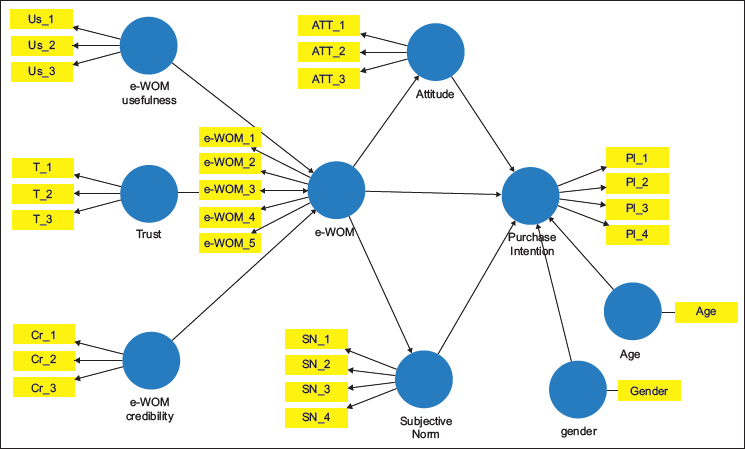
A conceptual model is framed on the factors that are researched, as indicated in Figure 1.
Conceptual Model.
RESEARCH METHODOLOGY
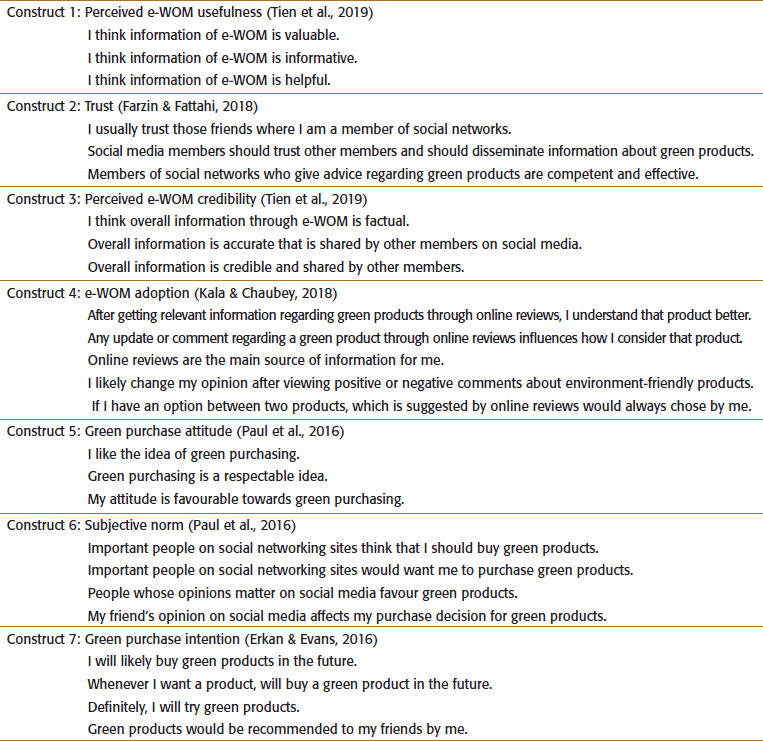
Quantitative cross-sectional research has examined the association between e-WOM adoption and green purchase intention. With the help of a questionnaire (Appendix 1), social media e-WOM and green purchase intention data have been collected. To accomplish the objectives of the study, people who use social media platforms are selected because they are the key contributors to the existing study. Snowball sampling techniques are employed in Northern India for data collection. A questionnaire was designed for the survey, and the statements in it were derived from previous literature. The current study is specifically focused on green cosmetics. The researchers used PLS-SEM in the existing study. For finalizing sample size, a sample size 4–10 times the number of questionnaire statements was ideal. Therefore, a sample size between 100 and 250 is needed (Hinkin, 1998; Moorthy et al., 2021). A total of 270 questionnaires were dispersed, of which 228 usable responses were taken for further analysis. The questionnaire items were graded on a Likert scale ranging from one (strongly agree) to five (strongly disagree). The questionnaire consisted of the following constructs: Perceived e-WOM usefulness comprising three statements and perceived e-WOM credibility comprising three statements were adapted from Tien et al. (2019); statements of trust were adapted from Farzin and Fattahi (2018) in which three statements were included. Statements of e-WOM adoption were adapted from Kala and Chaubey (2018), in which five statements were included; attitude towards a purchase in which three statements and statements of the subjective norm in which four statements were included were adapted from Paul (2016). Afterwards, statements of green purchase intention were adapted from Erkan and Evans (2016) and four statements were included.
EMPIRICAL ANALYSIS
Descriptive Statistics
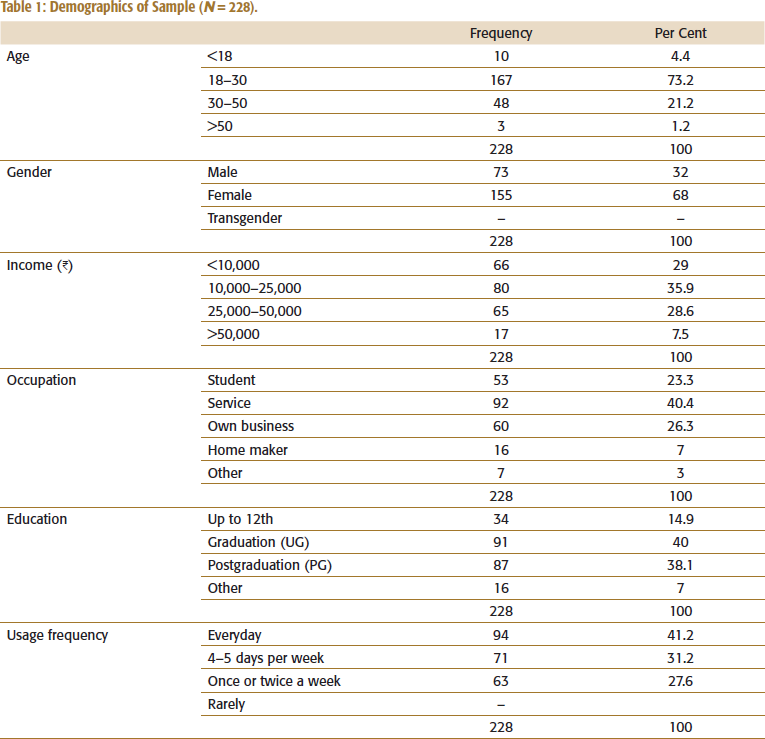
The sample profile (Table 1) shows data about respondents to the study, of whom 68% are female, 40.4% are in the service category, 73.2% are between the age groups of 18 and 30, 78.1% are in the undergraduate (UG) and postgraduate (PG) category, 35.9% are in the income group of ₹10,000–25,000, and 41.2% use social media daily.
Demographics of Sample (N = 228).
Measurement Model Assessment
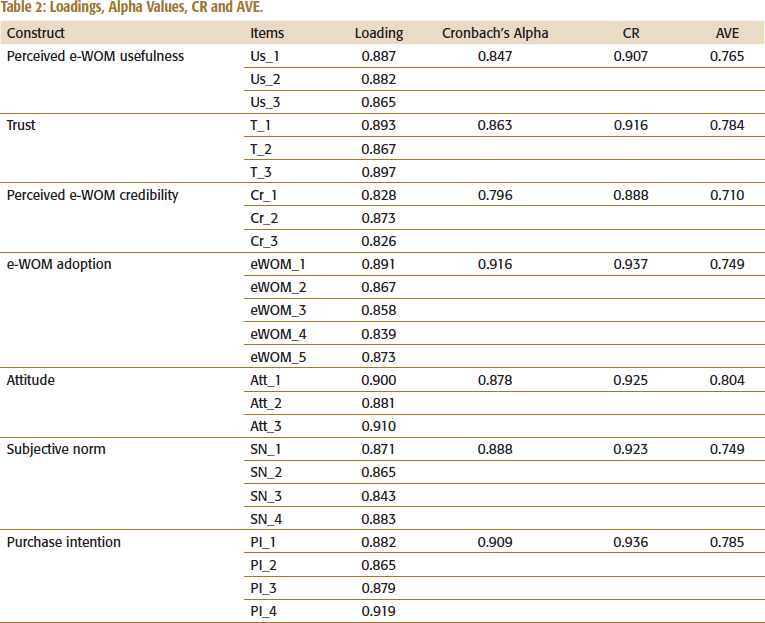
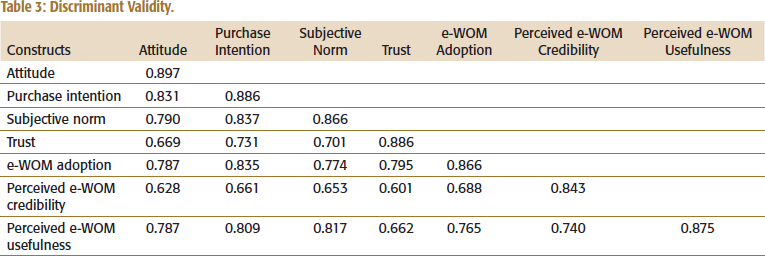
This segment included the item loadings of all constructs. Cronbach’s alpha for reliability is reported. Under convergent validity, reported heads are composite reliability (CR) and average variance extracted (AVE). To check discriminant validity, Fornell and Larcker criterion is utilized. Cronbach alpha’s value is more than 0.70, demonstrating strong construct reliability (Shiva et al., 2020). Hair et al. (2019) stated, ‘when the value of CR is greater than 0.70 and the value of AVE is greater than 0.50, constructs have shown high converging validity’. According to Fornell and Larcker’s (1981) criterion, ‘diagonal values of the square root of AVE are bigger than inter-item correlation values, demonstrates discriminant validity’. Item loadings, alpha, AVE and CR values are shown in Table 2, while discriminant validity scores are shown in Table 3. The outcomes revealed that the model is appropriate for the structural model evaluation employed in the final analysis.
Loadings, Alpha Values, CR and AVE.
Discriminant Validity.
Structural Model Assessment
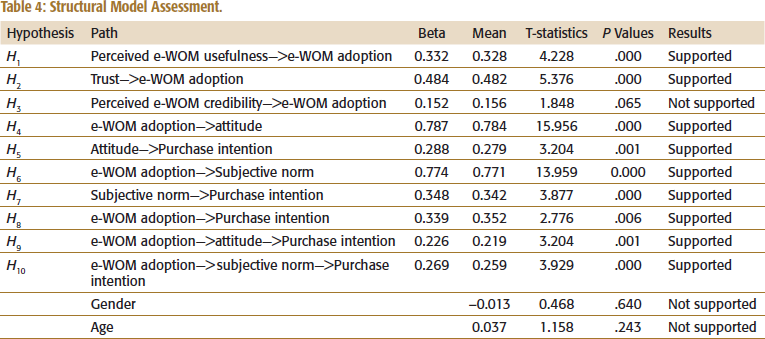
Researchers used a bootstrapping procedure using 5,000 bootstraps to find constructs’ influencing power through p-values. The variance inflation factor was less than five (Hair et al., 2017). Figure 2 displays endogenous construct, that is, purchase intention has 82% coefficient of determination (r2). In behavioural sciences, r2 = 0.20 is sufficient (Rasoolimanesh et al., 2017; Shiva et al., 2020). The present model is fit since the standardized root mean square residual value was 0.05, which was less than the limit of 0.08 (Henseler et al., 2016). Structural model assessment results under Table 4 display that e-WOM adoption has a strong impact on attitude formation (b = 0.787, p <.05) supporting H4, e-WOM adoption to the subjective norm (b = 0.774, p < .05) supporting H6, then trust in e-WOM adoption (b = 0.484, p < .05) supporting H2, subjective norm to purchase intention (b = 0.348, p < .05) supporting H7, e-WOM adoption to purchase intention (b = 0.339, p < .05) supporting H8, H1 is supported by perceived e-WOM usefulness to e-WOM adoption (b = 0.332, p < .05), H5, that is, attitude to purchase intention is supported by (b = 0.288, p < .05), whereas H3 is not supported, that is, perceived e-WOM credibility to e-WOM adoption (b = 0.152, p >.05).
Structural Model Assessments.
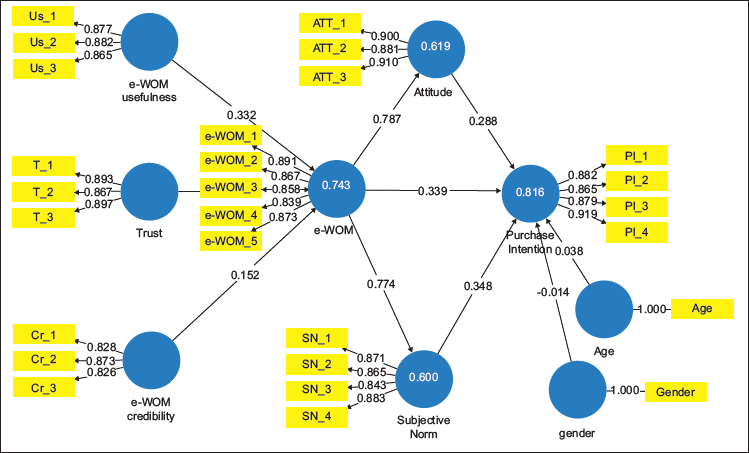
Structural Model Assessment.
Apart from aforementioned, f2 for the effect size is also reported. Results showed weak effect size of attitude to purchase intention (0.132) and e-WOM credibility on e-WOM adoption (0.039). Moderating effect size has been found subjective norm to purchase intention (0.202), e-WOM usefulness to e-WOM adoption (0.162) and e-WOM adoption to purchase intention (0.199). A strong effect size is found of trust to e-WOM adoption (0.487), e-WOM adoption to attitude (1.627) and e-WOM adoption to the subjective norm (1.497). Table 5 provides the data for r2 and q2, where r2 denotes the coefficient of determination and q2 denotes the predictive relevance.
Outcomes of R2 and Q2 Values.

According to Shiva et al. (2020), ‘In SEM models, a value larger than zero for Q2 indicates that the route model has predictive significance for a specific reflecting endogenous latent variable’, and in the current research model, all values of Q2 are above 0.35, which indicates substantial predictive relevance.
Gender and age, used as control factors, had no effect on purchase intention because the results were not significant at the 5% level. As an outcome, control factors had no significant impact on the current research model. The mediation effect of attitude has shown momentous significance at the 5% significance level, with a VAF value of 0.40 indicating partial mediation of attitude. Subjective norm is also investigated as a mediator between e-WOM adoption to purchase intention. The results indicated a VAF value of 0.44 at the 5% significance level for mediation analysis of the subjective norm, showing partial mediation exists. The output of the mediation analysis is presented in Table 6.
Effects.

DISCUSSION
Previous literature revealed perceived e-WOM usefulness, trust and perceived e-WOM credibility as some of the factors that influence e-WOM adoption and perceived usefulness and trust have a strong effect on e-WOM adoption. These conclusions are in corroboration with Tien et al. (2019) and Farzin and Fattahi (2018), whereas perceived credibility had no effect on e-WOM adoption, which contradicts Tien et al.’s (2019) findings. This research examined TRA and the IAM, as well as another dimension, namely, trust. Although previous research employed the TRA and IAM as a framework for measuring green purchase intention, the current research has combined both these models into one. The inclusion of the new construct of trust and examination of the mediation effects of attitude and subjective norm for e-WOM to green purchase intention are the authors’ contributions.
Research on e-WOM communication is bulky and disjointed. In this study, we concentrated on green cosmetics purchase intentions and connected the preceding studies based on social communication works. Grounded on the social media e-WOM literature, we recognized and concise variables related to the crucial aspects of e-WOM. Researchers projected an integrative structure for examining the influence of numerous factors that affect e-WOM adoption. Along with this, the effect of e-WOM adoption and the TRA elements are investigated on green purchase intention. The current research is made up of seven vital constituents: perceived e-WOM usefulness, perceived e-WOM credibility, trust, e-WOM adoption, attitude towards purchase, subjective norm and green purchase intention. As revealed previously, unlike traditional WOM, e-WOM communication holds extraordinary promptness of transmission and allows multi-directional interactions of data among conversationalists and receivers. Therefore, the appropriate root, namely, the platform where individuals discuss information, is what distinguishes e-WOM from traditional WOM. Information about consumers will be collected and kept in a vast database, further improving the reflectivity and approachability of e-WOM data.
CONTRIBUTIONS
The current research proposes an inclusive summary of the existing position of information within social media e-WOM. We blended the outcomes of the literature. This research progresses our familiarity with e-WOM communication. First, we conducted an in-depth scrutiny of the literature in the sphere of e-WOM communication. Numerous variables associated with social media communications were recognized and categorized. Second, variables related to IAM and TRA were combined. Third, after collecting data from the consumers, the effect of perceived e-WOM usefulness, trust and perceived e-WOM credibility on e-WOM adoption is examined. The influence of e-WOM adoption, attitude and subjective norm on green purchase intention is examined. Forthcoming studies might use this structure as a foundation to see how the characteristics of other variables could impact green purchase intention in the context of social media e-WOM. We encourage other scholars to ascertain theories from varied disciplines and to apply them to research on how other crucial variables affect e-WOM adoption on social media and green purchase intention.
MANAGERIAL IMPLICATION
Companies are increasingly recognizing social media as a strong tool for advertising their products. This study’s conceptual approach focuses on gaining insight into customers’ green purchase intentions (purchase intentions determine purchase behaviour), which is proven to have good predictive relevance. The findings revealed that e-WOM adoption has the highest momentous optimistic influence on attitudes towards the purchase of green cosmetics, followed by subjective norm and e-WOM adoption has a positive impact on buying intention. As a result, companies should pay more and more attention to the e-WOM content regarding green purchases because e-WOM was found to have a highly noteworthy positive influence on consumer attitude formation and purchase intention. The study also focuses on green purchases, which make a significant contribution to keeping the environment cleaner. This is beneficial for both the environment and the health of consumers and society.
MARKETING IMPLICATIONS AND INSIGHTS FOR MARKETERS
The current study provides information about the determinants of e-WOM adoption, which is a strong determinant that affects the purchase intention of consumers. With this understanding of e-WOM, marketers would become knowledgeable about what consumers think about green cosmetics. The current research has shown that e-WOM adoption by customers determines purchase intention; therefore, marketers should be capable of providing the best-quality products to customers because these customers affect the purchase intention of other customers through e-WOM. Marketers can build effective strategies by acquiring information about the dynamics of e-WOM on social media because e-WOM has no expiry date; once it has been published, it continues to influence consumers years and years after publication. Therefore, marketers should focus on strategies that generate more e-WOM. The current study will also help marketers employ review sentiment analysis through e-WOM to know about consumers’ impressions of their brands. Marketers should motivate the users through some campaigns to share their usage experience and satisfaction with products on social media platforms so that widespread e-WOM can be generated. Marketers should provide complete information about the benefits of green cosmetics. Through e-WOM, marketers could also get information about what people are thinking about the environment, the functional value of green products and the price of green products. Along with this, marketers could gain knowledge about the characteristics of consumers through e-WOM, and it would be helpful for them in making advertisements according to them. Marketers could build personalized strategies to target customers. Marketers can also monitor the competitor’s brand’s e-WOM (Farzin & Fattahi, 2018), which could be helpful for them to improve their products as much as they can and would be helpful for consumers also. Marketers of green cosmetic products might use the current research to promote green cosmetic purchases.
RESEARCH LIMITATIONS AND FUTURE RESEARCH AGENDA
The study has flaws, and further researchers can help to improve it in numerous ways. This study was done solely in Northern India; however, future researchers can extend the findings to other locations in India and outside India. The current research could also be enhanced by adding some new components, allowing more predictors for e-WOM adoption. A comparative study on this topic, including other countries, can be done to infer results.
Appendix 1: Questionnaire on Social Media e-WOM and Green Purchase Intention.
Footnotes
DECLARATION OF CONFLICTING INTERESTS
The authors declared no potential conflicts of interest with respect to the research, authorship and/or publication of this article.
FUNDING
The authors received no financial support for the research, authorship and/or publication of this article.
e-mail:
e-mail: