




Abstract
The standard data envelopment analysis model aimed to maximize the efficiency scores using the most favourable input/output weights. In two-stage network structures, the presence of intermediate undesirable measures leads to a distinct domain of weight restriction study. In the presence of undesirable intermediate measures and equipped with non-cooperative game theory, this study developes a joint weight restriction approach to derive a common set of weights. Concurrently, the overall efficiency of the system can be evaluated. Numerical instances of 34 OECD countries in 2012 have been presented to elucidate the details and applicability of the proposed method.
Executive Summary
The conventional data envelopment analysis (DEA) is designed to assist each decision-making unit in selecting its most favourable input/output weights, enabling the units to optimize their performance. Additionally, the performance of different units is attained through the use of different sets of weights. As a result, comparison and ranking of units on a common basis seem such a considerable challenge. The object of common weight restriction is more highlighted in the literature when the subject toys around a network structure process. The two-stage production process normally considers the desirable intermediate measure. In many real situations, the intermediate measures consist of desirable and undesirable outputs. On these occasions, the challenge of a common set of weights has attracted the research attention. Among major approaches for analysing two-stage network assisting DEA, non-cooperative game theory is in our scope. Equipped with this perspective for analysing the two-stage network structure, the motivation of this article is to derive a common set of weights in two-stage systems with undesirable intermediate measures. Despite numerous advancements in this area, the present study introduces a model based on a joint weight restriction approach, addressing two critical issues. First, the proposed weight restriction approach aims to generate the possible minimum amount of undesirable intermediate output in the first stage. Second, the second stage optimizes its performance while keeping the first-stage efficiency at its current quantity. Concurrently, the individual and the overall efficiencies can be at hand in implementing the proposed model. Further, the proposed model generates positive weights and prevents weight dissimilarity. To elucidate the details and applicability of the proposed model, a comparison with existing models has been demonstrated through an experimental data set. The comparison can facilitate the enhancement of even more robust methods for addressing the challenges.
Keywords
According to the World Commission on Environment and Development, pollution levels have increased while resource scarcity remains. Consequently, this challenge and pressure have led to a growing interest in the use of efficiency and productivity management with regard to undesirable and pollutant outputs. To achieve this goal, parametric and non-parametric techniques have been applied in production theory. DEA, pioneered by Charnes et al. (1978) and extended by Banker et al. (1984), has recently made a substantial contribution in analysing undesirable outputs. DEA is a non-parametric technique for evaluating the relative efficiency of a set of homogeneous decision-making units (DMUs) by using a ratio of the weighted sum of outputs to the weighted sum of inputs, subject to the condition that this ratio does not exceed one for any DMU. Also, conventional DEA models determine a set of weights such that the efficiency of a target DMU relative to the other DMUs is maximized. This flexibility in the selection of input and output weights often causes more than one DMU being evaluated as efficient, leading to the inability to be fully discriminated. Furthermore, the set of weights will typically be different for the various DMUs. Also, the input and output weights may not be most favourable to themselves. As a possible answer to reduce this flexibility, a common set of weights has been suggested for efficiency evaluation in the background of applying DEA for efficiency evaluation. The idea was first developed by Ganely and Cubbin (1992) and Roll and Golany (1993). To derive a common set of weights, several approaches have been proposed in the DEA literature. For example, Hashimoto and Wu (2004) proposed a DEA-CP (compromise programming) model which aims at seeking a common set of weights across the DMUs by combining the DEA and the compromise programming of Kao and Hung (2005), also proposed a similar compromise solution approach for generating common weights under the DEA framework. Wang et al. (2009) suggested ranking DMUs by imposing a minimum weight restriction, which also produces a common weight for the DMUs to be compared. Wu et al. (2010) proposed a procedure for deriving a common set of weights based on satisfaction degree. Pourhabib et al. (2018) proposed a weight restriction approach to generate a common set of weights. The approach was conducted from two viewpoints. Their first contribution was proposing a single lower bound to restrict all weights. Although the proposed model is always feasible and optimal, it is always positive. In the second perspective, the weights are restricted separately. The proposed model was feasible and always obtained dissimilar positive weights. In the above-mentioned studies, a DMU is commonly modelled as a single process that transforms inputs into outputs. In real-world occasions, apart from consuming inputs and producing desirable outputs, the DMUs also generate undesirable outputs. In real occasions, joint production of desirable and undesirable outputs creates difficulties in the measurement of overall performance in two-stage network structures. Cook et al. (2010) have presented four categories in two-stage structure studies. Liang et al. (2008) employed the concept of the leader–follower approach to characterize a two-stage network structure. As far as we are aware, there are different DEA-based works that consider undesirable variables in network-structured production systems. It is worth noting that different proposed approaches can handle this situation through the assumption of an appropriate technology. For example, Lozano et al. (2013) presented a directional distance function network DEA approach that takes undesirable outputs into account and applies it to evaluate the efficiency of 39 Spanish airports. Maghbouli et al. (2014) employed cooperative and non-cooperative game theory to assess the relative performance of two-stage network structures. It should be pointed out that the existing papers in the DEA literature have widely employed envelopment structures to analyse two-stage structure systems in the presence of intermediate or final undesirable factors. Kiani Mavi et al. (2019) proposed an alternative approach to find the common set of weights in a two-stage network DEA based on goal programming to detect the effects of both eco-efficiency and eco-innovation in the presence of undesirable inputs, intermediate products and the outputs by the context of big data.
Afsharian et al. (2021) reviewed some DEA approaches employing a common set of weights. Interestingly enough, the proposed DEA models in the literature employ centralized management scenarios. In the context of the two-stage production system, Li et al. (2022) proposed a novel DEA approach for measuring the eco-efficiency of two-stage structures with undesirable intermediate measures. In another effort, Chu and Zhu (2021) developed a novel method that first projects the intermediate measures and then applies the multiplier DEA models to evaluate the overall and divisional efficiencies allowing weight flexibility for intermediate measures. With a glimpse into CO2 reduction and energy consumption, Madadi et al. (2022) suggested moving a DMU from the current frontier to the frontier with better efficiency conditions, then employing the weak disposability axioms, the combined DEA and goal programming technique found the appropriate reallocation model. Despotis et al. (2022) considered a dual role for intermediate measures, as both consumer and producer. The proposed approach is expressed on multiplier and envelopment forms under constant and variable return-to-scale assumptions. For further research and different perspectives, we may refer to Namin and Khamseh (2022), Thi Le Hang Nguyen et al. (2021), Koronakos et al. (2021), Mozaffari et al. (2021), Omrani et al. (2022), Song et al. (2022) Kiaei and Kazemi (2019) and Liu et al. (2015). Modelling two-stage production systems with intermediate undesirable outputs is an important and interesting subject in the context of DEA. The motivation of this study is the application of the joint weight restriction method for searching a common set of weights. Compared with various DEA-based approaches in the past that served centralized management scenarios, this article speaks about the multiplier format of network DEA. The structure of the proposed method emphasizes undesirable intermediate measures. Since the before-mentioned approaches apply the envelopment models, the main contribution of the study is employing the issue of the multiplier format of DEA in two-stage network structures with undesirable intermediate measures. Another attribute of the proposed approach with the multiplier DEA-based format includes the restriction of all weights with a single lower bound. Also, compared with previous studies which follow the centralized perspective in analysing network structures, this article proposes the leader–follower game theory to assess the relative overall and divisional performance of the DMUs.
PRELIMINARIES
Assume that there are n DMUs and each
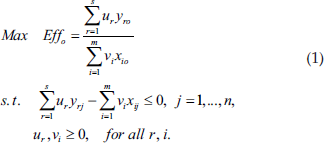
In evaluation with CCR model (1),
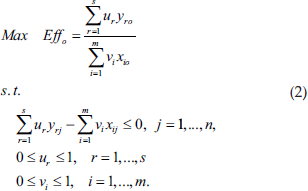
Theorem 1. There exists a scale of data that causes model (1) to be equivalent to model (2).
Proof: Assume that
As Theorem 1 claims, the resulting score is the best attainable efficiency level for each DMU. However, there are some shortcomings. First, the efficiency score of different DMUs obtained by different sets of weights may not be comparable. Second, with reference to the flexibility in the selection of weights, there is the possibility of the existence of more than one efficient unit. Hence, all DMUs cannot be discriminated. Pourhabib et al. (2018) developed a nonlinear and feasible model for joint weight restriction. Their model generates a set of common weights by setting the bounded weight variables. The model has the following format:
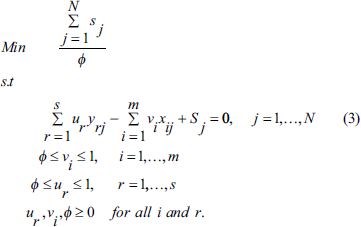
The objective function minimizes the ratio
A NON-COOPERATIVE WEIGHT RESTRICTION APPROACH IN THE TWO-STAGE PROCESS
In this section, a two-stage decision process is addressed. In this two-stage structure, the intermediate measures consist of desirable and undesirable outputs. Consider a two-stage production process as shown in Figure 1.
Two-stage Process of
.
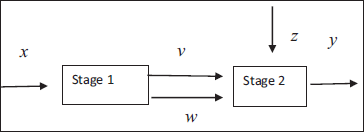
Suppose again that there are
In what follows, a weight restriction approach introduced in the previous section is executed in this two-stage decision process. An interesting area where a common set of weights DEA approaches can be applied is the efficiency measurement of multi-stage organizations which generally employs the centralized approach. This article grasps the idea of measuring two-stage network structures in the presence of intermediate undesirable outputs, with respect to leader–follower game theory. Because the common set of weights is applied to each observation under consideration, this article employs a non-cooperative management scenario. The major advantage of the approach is summarized as follows. The first stage is conducted in a format that generates the smallest allowable amount of undesirable intermediate measure, and, therefore, provides a common set of weights applying the multiplier format of the joint weight restriction approach. Having fixed the efficiency of the first stage represented by the optimality of the first stage, the second stage is solved with a multiplier DEA-based weight restriction approach. Besides the case outlined above, equipped with non-cooperative game theory, the leader and follower preferences raise a question. In this case, the leader determines the most efficient status and based on the optimal solution of the leader, the follower identifies its optimality. Without loss of generality, assume that the first stage is the leader and the second stage is the follower. In the first step, one needs to recall the smallest allowable amount of undesirable intermediate outputs. According to Kao and Hwang (2020), fixing the amount of desirable outputs at the current level, the minimum amount of undesirable factors which can be allowed to generate is
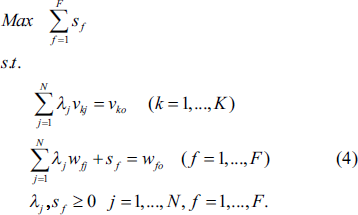
By plugging the first-stage outputs
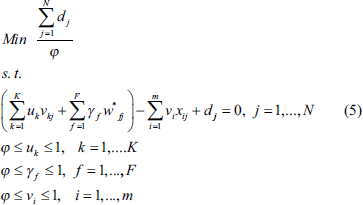
Employing model (5) provides strictly positive common set of weights for the first stage. Looking closely to model (5), using slack variable
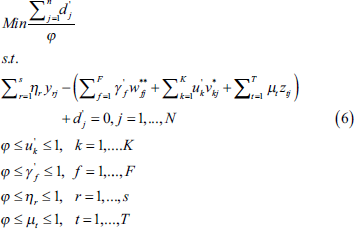
In the above model (6), the optimal adjusted solution of the first stage, that is,
NUMERICAL EXAMPLE
The practicability of the proposed weight restriction methodology in a two-stage process is highlighted by a real data set consisting of 34 OECD countries in 2012. The data set is taken from Kiani Mavi et al. (2019). Table 1 reports the data set.
Data Set for OECD Countries.
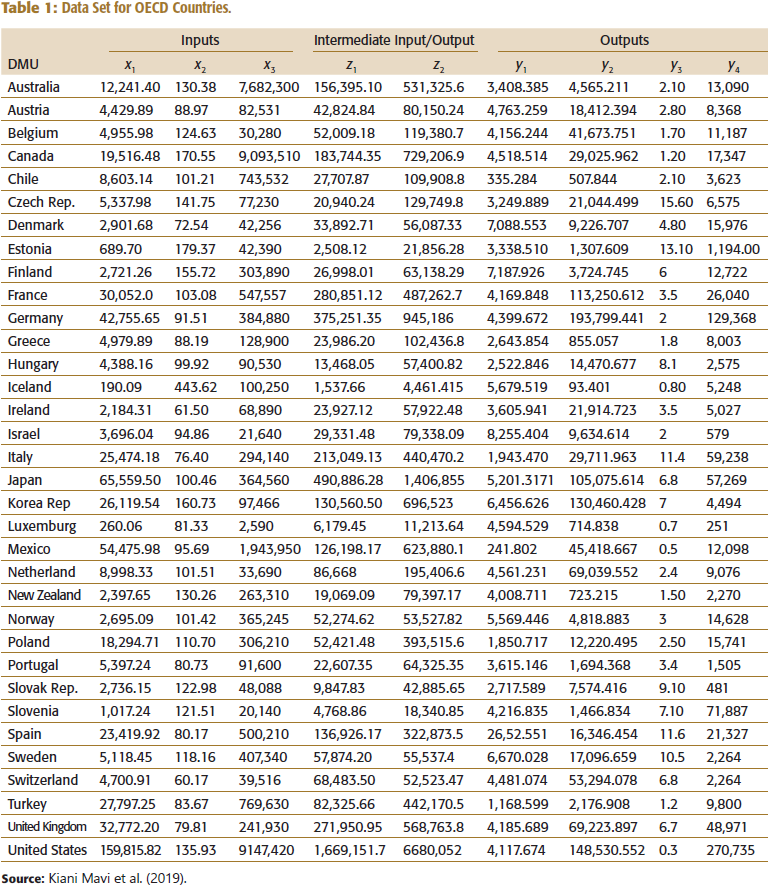
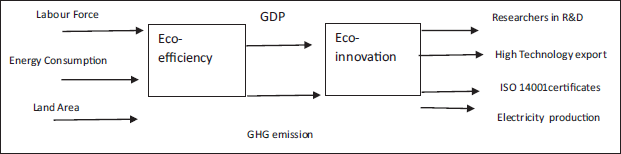
Employing the proposed weight restriction approach for airport performance, the process is considered a two-stage structure. The first stage is called eco-efficiency, and the second stage is related to the eco-innovation process. The inputs and outputs are recorded as follows:
For the first stage, there are three inputs, which are characterized by the total labour force (x1), energy consumption (x2) and land area (x3).The outputs of the first stage consist of both desirable and undesirable outputs. The only desirable intermediate measure is GDP (v1). The undesirable intermediate factors are total green gas emissions (CO2 equivalent emissions) (w1).The second stage employs no external inputs. Since the undesirable output of the first stage did not leave the first stage, the second stage employs the whole outputs of the first stage without using any external inputs. The output of the second stage or the final outputs are characterized as the number of researchers in research and development (y1), high technology export (y2), ISO 14,001 certificates (y3) and electricity production from renewable sources (y4). Figure 2 depicts the process as a two-stage network structure.
Two-stage Process of Eco-efficiency and Eco-innovation.
To assess the common set of weights, the first stage, or the eco-efficiency stage, is assumed as the leader. For handling intermediate undesirable outputs of the first stage, employing model (4), the smallest allowable amount of undesirable intermediate outputs is calculated. Applying the triple
Efficiency Score for the First Stage and Second Stage with Proposed Approach.
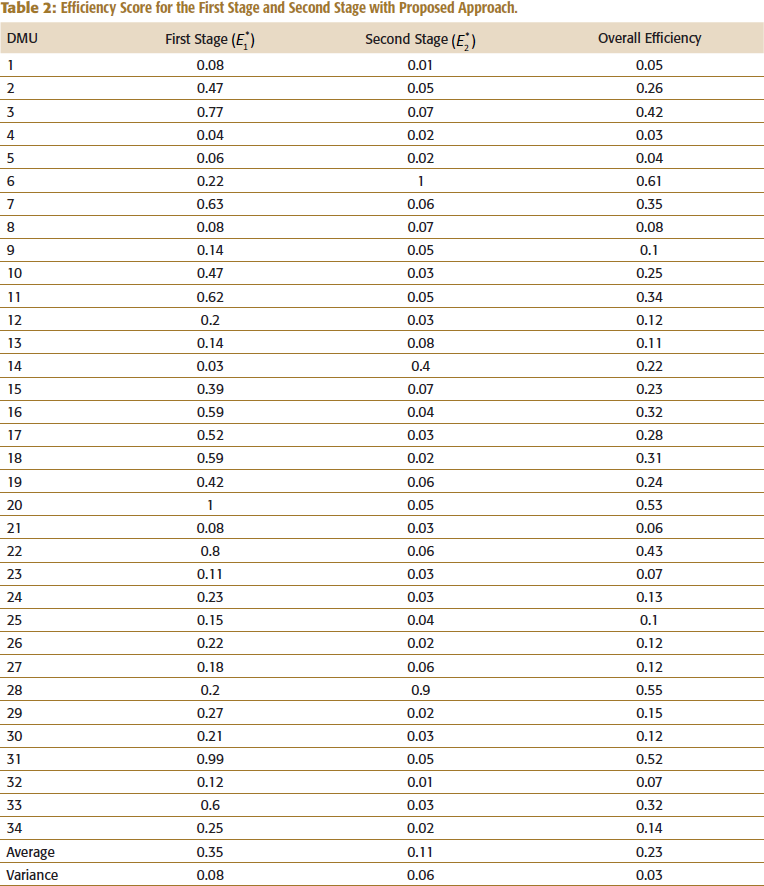
As Table 2 shows, when the first process is leader, there is only one efficient unit, that is, unit #20. As model (5) admits, the common set of weights is positive in terms of inputs, intermediate desirable and adjusted undesirable output. Intermediate undesirable output has not left the process. Therefore, the second stage fed up with optimal solutions of the first stage (both intermediate desirable and undesirable measures). The second stage employs no external input and by using the optimal solutions of the first stage can produce final products. As the third column of Table 2 reports, keeping the efficiency of the first stage unchanged, in the second stage, there is one efficient unit, unit#6, in the second stage. The last column of Table 2 shows the overall efficiency of the whole system, while the intermediate measure has transformed. The overall efficiency can be calculated by employing the formula
The Generated Weights of Kiani Mavi et al. (2019) and the Proposed Approach.
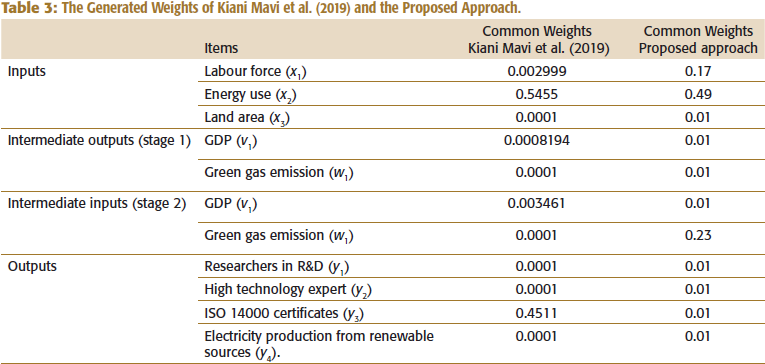
For more comparison, the last column of Table 3 represents the weights generated by the proposed weight restriction approach. Employing the third column of a common set of weights, the results of the goal programming method proposed by Kiani Mavi et al. (2019) for this case study are summarized in Table 4.
Efficiency Score for the First Stage and the Second Stage with Kiani Mavi et al. (2019).
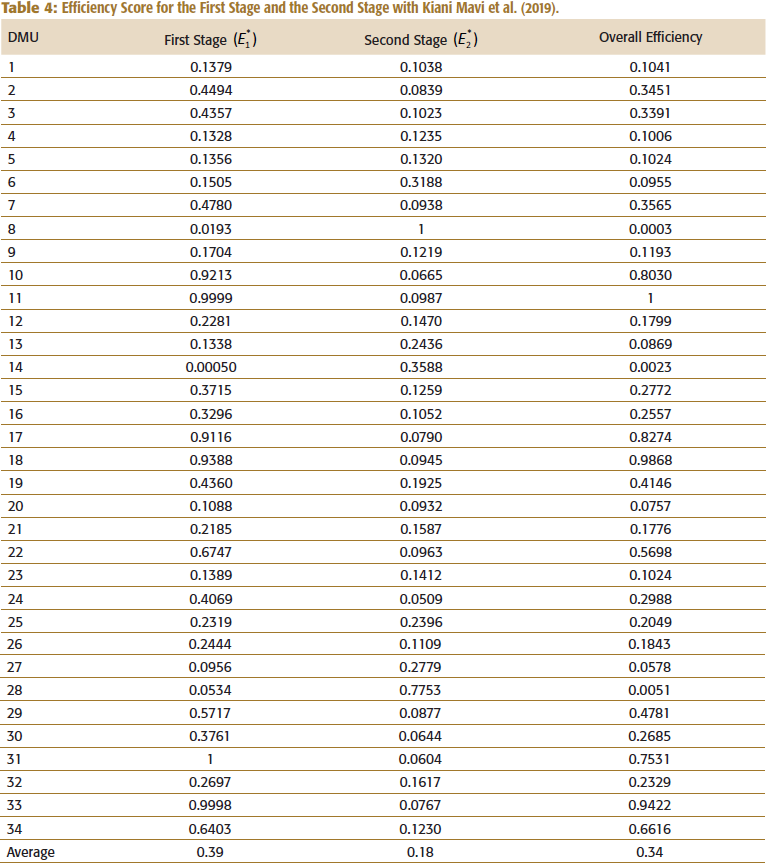
As Table 4 shows, the Kiani Mavi et al. (2019) method illustrates one overall efficient unit, #unit11. In addition, in the first and second stages, unit#31 and #8 are recorded as efficient units respectively. To compare the results of these two different approaches, the number of efficient units in the first stage and second stage is equal. In both approaches, it was recorded as one efficient unit. But our proposed method with a weight restriction perspective reflects no overall efficient unit. Statistically speaking, the average of overall and divisional efficiencies in the latter approach is greater than the former approach. This is due to the difference in using various perspectives for a two-stage network structure. The employed non-cooperative approach preserves the first-stage efficiency unchanged. In the latter approach, the cooperative point of view is employed. Taking a look at the common weights generated by the approaches in Table 3, Kiani Mavi et al. (2019) generate the lowest weights in comparison with the proposed approach. Furthermore, for the second input and the third final output the weights with Kiani Mavi et al. (2019) are recorded as 0.5455 and 0.4511. In the proposed approach, the generated weights are depicted as 0.49 and 0.01. From the common weight results of Table 3, it seems that the proposed approach can be regarded as a more suitable one for this application. Since the generated weights are not close to zero as the counterpart approach acts. The proposed approach determines three positive weights with a high deviation of zero assigned to the first, and second input for the first stage and the undesirable input for the second stage, that is, 0.49, 0.17 and 0.23, respectively. The counterpart approach achieves two weights with a similar deviation of zero. The second input for the first stage with a weight assigned of 0.5455 and the third final output with a weight assigned of 0.4511. From the efficiency evaluation from the results of Tables 2 and 4, our approach generally does not generate higher overall and individual efficiencies for each unit. It can be seen that the proposed approach adopts the overall efficiency as the average of the two stages’ efficiency. Based on the above comparison, none of the units are efficient in employing the proposed approach of non-cooperative theory. That is, all the countries need to adjust for better performance. Moreover, our approach generates a pair of divisional efficiencies for each unit. Utilizing the proposed method for finding a common set of weights with a leader–follower perspective, this method can detect the pseudo-inefficiency in a two-stage process. That is, the inefficiency is spread over the system, and the existing methods in the literature ignore it and may overestimate the efficiency score. Hence, the proposed common set of weights may detect the pseudo-inefficiency and ensure that the existing envelopment models may overestimate the efficiency score
CONCLUSION
Aiming at determining a common set of weights, considerable attention has been paid to two-stage network analysis. The existing studies on a two-stage network structure just consider envelopment models of DEA. Furthermore, when the intermediate measure consists of desirable and undesirable, the existing approach did not employ multiplier models. The proposed approach generates a common set of weights which is more acceptable to all DMUs and more convincing to those making decisions in practical applications. This article introduced a joint weight restriction reduction for generating a common set of weights in a two-stage network structure. The contribution of this article is applying a non-cooperative game theory in determining a common set of weights in the presence of both desirable and undesirable intermediate measures. An illustrative example of 34 OECD countries revealed the applicability of the proposed method.
Footnotes
ACKNOWLEDGEMENT
The authors would like to thank Professor Alireza Amirteimoori and Professor Dimitrrios Sotrios for their motivation and support.
DECLARATION OF CONFLICTING INTERESTS
The authors declared no potential conflicts of interest with respect to the research, authorship and/or publication of this article.
FUNDING
The authors received no financial support for the research, authorship and/or publication of this article.
NOTES
E-mail:
E-mail: