




Abstract
E-learning in the context of Industry 4.0 and the outbreak of the COVID-19 pandemic has transformed traditional education. However, the smooth transition from face-to-face education to e-learning remains a challenging task, given concerns about e-learning quality. This study aims to explore the quality criteria and the adoption of e-learning via the spherical fuzzy analytic hierarchy process (SF-AHP). The extended technical acceptance model is used as a theoretical framework for constructing quality in an adoption hierarchical model. The input data derived from in-depth interviews of 20 experts in the field and the SF-AHP calculator have generated the priority weights of quality criteria in the model of e-learning adoption. The findings confirm the role of three major criteria, in order of importance, as follows: system, resources and core factors. The results highlight system factors as most crucial, including aspects such as governmental policies and institutional leadership, which are essential for setting a conducive environment for e-learning. Resource factors are ranked second, emphasizing the importance of IT applications, human capital and facilities to support e-learning infrastructure. Core factors, though ranked lower, are vital in ensuring the effectiveness of e-learning through course materials, instruction, and learner support. The weights of 14 sub-criteria have further shed light on policies to promote e-learning quality and its adoption. The implied priority of each weight a valuable guideline for the stakeholders’ actions to reach the targeted goals under the constraint resources.
Keywords
The United Nations’ sustainable development goals and the action programme for 2030 have highlighted the need for quality of education which would facilitate learning for people anywhere, anytime with the aim of lifelong learning (Amador et al., 2015; González García et al., 2020; Latorre-Cosculluela et al., 2021). The goals and action programmes set by the United Nations for education take place in the context of the knowledge economy and especially the fourth industrial revolution that has been transforming education. Learning based on digital technology has brought important changes to education. The current trend is the shift from traditional teaching and learning to e-learning, a method currently developing at a rate which has never been seen in history, given the COVID-19 epidemic which forced 1.5 billion students and 63 million schools around the world to switch to online courses instead of traditional classroom instruction (Crawford, 2021; Crawford et al., 2020; Martín-SanJosé et al., 2015; Valverde-Berrocoso et al., 2020; Yakubu & Dasuki, 2019).
Regardless of the circumstances, the Vietnamese Communist Party typically pushes the shift of the educational process from mainly knowledge acquisition to human capital transformation (Van Trang et al., 2019). Learning optimizes critical thinking and best practices for labour market adaptation. The Vietnamese Government also issued Directive No. 16/CT-TTg of 4 May 2017 on strengthening the access to the Industrial Revolution 4.0. The Ministry of Education and Training issued Document No. 1891/BGDDT-GDDH of 5 May 2017, to direct the human resources development of higher education institutions (Nguyen et al., 2020; Pham & Tran, 2018). After that, the project to improve the quality of higher education in the period of 2019–2025 has been approved by the government. E-learning set the groundwork for the Government’s Resolution No. 49/CP of 4 August 1993, and the Government’s Official Document No. 9772/BGDDT-IT of 20 October 2008, on Strategic Planning for Information and Communication Technology Development (ICT), as well as the priority of information technology (IT) application in education (Pham & Ho, 2020; Pham & Tran, 2018). Moodle Vietnam was introduced in 2005 after the launch of the
LITERATURE REVIEW
E-learning
E-learning began in the 1980s (Alsalhi et al., 2019; Weiss et al., 2006). Various researchers try to define e-learning based on clear criteria. For example, Selim (2007) considers it as teaching and learning electronically, along with administrative measures to reinforce teaching and learning in an internet environment; the author offers further clarification to the provision of training by electronic means. Eze et al. (2018) shared this view when mentioning those computer- and internet-based activities that support teaching and learning both in the classroom and remotely. Horton (2011) also argued that e-learning is the use of IT and computers in learning. The American Association for Training and Development views e-learning more broadly, considering web-based learning, computer-based learning, virtual classrooms and digital learning are examples of e-learning applications and procedures (Alfailakawi, 2021; North et al., 2021; Sanga et al., 2018; West & Berman, 2001). Most of these applications are sent over the Internet, local networks (LAN/WAN), audio and video, satellite broadcasting, interactive television and CD-ROM. Similarly, e-learning is defined as the delivery of education (all activities connected to instruction, teaching and learning) by electronic conventional methods such as the internet, intranet, extranet, satellite television, video, audio or CD ROM (Kayal & Das, 2017; Koohang et al., 2009).
Cheng (2011) shares the view that online learning is electronic learning, seeing it as a tool that uses computer network technology such as the internet, local networks and extranet platforms to deliver learning instruction to users. Likewise, according to Lee et al. (2011), e-learning provides an information system that can integrate a wide range of teaching materials (via audio, video and text media) communicated via e-mail, live chat sessions, online discussions, speeches, questions and exercises. The majority of e-learning definitions mentioned above are focused on technological aspects. However, using exclusively technological conditions to define e-learning is insufficient; rather, a constructive nature should be provided, not only a procedure but also a transformation, including the protocol with which the equipment is involved in the process of building knowledge via the process of connection (Lim & Zailani, 2012). Therefore, a specific level of interaction must be included as a feature in the definition of e-learning.
Furthermore, support for e-learning is noted by Afacan Adanır et al. (2020) with e-learning as online interaction with learners. As such, e-learning is seen as learning that takes place mostly (if not entirely) online and provides asynchronous learning (in terms of space and time). At the same time, e-learning is understood as a creator, where the person learns to create value when connecting to the network and through discussion interaction. The definition of e-learning includes pedagogical factors such as online exchanges between students and faculty, online exercises, discussion sessions and supportive e-mails that provide opportunities for students to work with their own space and time in accessing a large amount of knowledge on the internet (Jin, 2011; Miguel et al., 2021; Wei & Johnes, 2005).
Online learning or e-learning is a form of transformation, changing from teacher-centred (traditional learning) to student-centred education (modern form). This is a form of learning which students are responsible for their education via self-directed education (Koch, 2014; Lin, 2019; O’Connor & Larkin, 2019). With e-learning, self-orientation is essential to outcome achievement. Moreover, due to the difficulty of arranging common time and places for study, teaching through online learning changes the role of teachers, they become instructors/mentors in this new digital environment. Odunaike et al. (2013) mentioned two key actors in online learning that are faculty and students with roles that differ from traditional learning methods. With student-centred online learning, students can actively learn with their own space and time. Khan (2005) is considered the most comprehensive definition because it covers both aspects: technology and pedagogy. E-learning is an innovative method to provide anybody, at any time, with a well-designed, student-focused, interactive and assisted learning environment. It makes use of the characteristics and resources of multiple digital technologies, as well as other types of learning, to create an open, flexible and dispersed learning environment (Al-Qahtani & Higgins, 2013; Alizadeh et al., 2020; Salarzadeh Jenatabadi et al., 2017; Shaikha & Fatma, 2017; Shurygin et al., 2021).
Education Quality
Quality is a relative concept, depending on the beliefs of different stakeholders (Clewes, 2003; Garg & Kaushik, 2019; Shukla & Garg, 2016; Zafiropoulos & Vrana, 2008). In higher education, stakeholders such as students, employers, teaching or non-teaching staff, the state, inspection agencies and professional workers have different criteria for quality (Mizikaci, 2006; Welsh, 2021). To assess the education quality, state management agencies rely on criteria to evaluate students and lecturers, such as the passing rate, drop-out rate, duration of completion of the programme and the academic skills of teaching staff. Faculties focus on learning, teaching and the research environment when ranking the quality of education, while employers value the ability of students after graduation (Jones et al., 2014; Mattern, 2016; McKinley et al., 2021; Pillai et al., 2012). In general, previous studies have synthesized the definition of quality into the following seven groups: (a) quality is excellence, (b) quality is in line with the objectives (i.e., the product or service meets the set objectives or pleases customers), (c) the quality is worth the value for money (efficiency), (d) quality conforms with the standard, (e) the quality is a defect equal to zero, (f) the quality is the conversion value and (g) the quality is the reaching the threshold (Campbell & Rozsnyai, 2002; Doherty, 2008; Harvey, 1998). The definition of ‘quality is suitable for use at a minimum cost’ is governed when discussing quality in higher education, especially in e-learning.
E-learning Quality and Learners’ Adoption
From a learners’ perspective, e-learning adoption is explained by Fishbein and Ajzen (1977, 2011) theory of reasoned action (TRA), based on subjective attitudes and standards with the assumption that humans are reasonable, use available information in a system (i.e., implicitly or explicitly) to form a behavioural intention (Fishbein & Ajzen, 2011). In this way, humans can alter or govern their behaviour by inferring the cause that leads to a certain action. The TRA model uses five structures to predict behaviour: behavioural beliefs, attitudes, normative beliefs, subjective standards and behavioural intention. Based on the TRA model, Davis (1985, 1989) proposed a technology approval model (TAM) featuring two variables: easy-to-use perception and usefulness perception, both of which affect user attitudes and intended use. Ease-of-use perception positively affects usefulness perceptions; usefulness and ease-of-use positively affect attitudes to use; perceived usefulness and attitude to use positively affect the intended use (Hsu & Chang, 2013; Parameswaran et al., 2015; Tan, 2015).
The existing cause-and-effect relationship between these variables has been confirmed by several studies (Amornkitpinyo & Wannapiroon, 2015; Kuo & Yen, 2009). Usefulness perception means that users believe that the use of technology will improve their performance, while the ease-of-use refers to the belief that using the technology will mitigate effort (Davis, 1989; Huang & Lin, 2020; Özgen et al., 2021; Teo et al., 2008). The perception of ease-of-use of a system is considered to affect the usefulness of technology (Ros et al., 2015). Both ease-of-use and awareness of usefulness have an effect on the use of technology. TAM has been applied in many studies focused on acceptance of online learning systems, online learning communities, wireless LAN (local network), personal digital assistance (PDA) and blended learning (Chang, Hajiyev, et al., 2017; Gerhart et al., 2015; Hassanzadeh et al., 2012; Humida et al., 2021; Liu et al., 2010; Xia et al., 2018). The results of these studies show that TAM can effectively predict and explain users’ acceptance of IT. While awareness of usefulness and the ease-of-use are key drivers for an individual to accept and use IT, other external variables can also affect the user’s acceptance of IT (Le, 2021; Moon & Kim, 2001). Venkatesh and Davis (2000) found a direct effect of perception on behavioural intention independent of the intermediary role of attitude to use. They proposed a technical acceptance model (TAM2) with a more detailed explanation of the reasons why users find a useful system at three points in time: before deployment, one month and three months after implementation, respectively. TAM2 hypothesized that users mentally assessed the suitability between important goals and performance to form awareness of the usefulness of the system by using the system as a basis (Venkatesh & Davis, 2000). Prior studies have confirmed that TAM2 works well in both voluntary and compulsory environments.
The TAM2 model emphasizes the role of quality in the intended use, namely that e-learning quality drives the choice of this method (Niousha et al., 2021). According to Sahney et al. (2003), the quality of education has a certain role for customer choice. Indeed, students are increasingly aware of their rights, as well as their desire to achieve the optimal level of time and money they have invested in education. The quality of teaching and the capacity of students to meet the market needs are the top criteria that interest customers. Therefore, educators need to pay attention to the relevance of the programme to bring satisfaction to customers. Quality is the basis for building trust, prestige and brand position in society, thereby affecting the choice decisions of students. Quality assurance can be discussed and analysed in the following ways: self-assessment, best-practice matching and external quality monitoring. External quality monitoring is a common way although self-assessment is often integrated in the process. There are many models that ensure quality and each country can choose and develop the most suitable model.
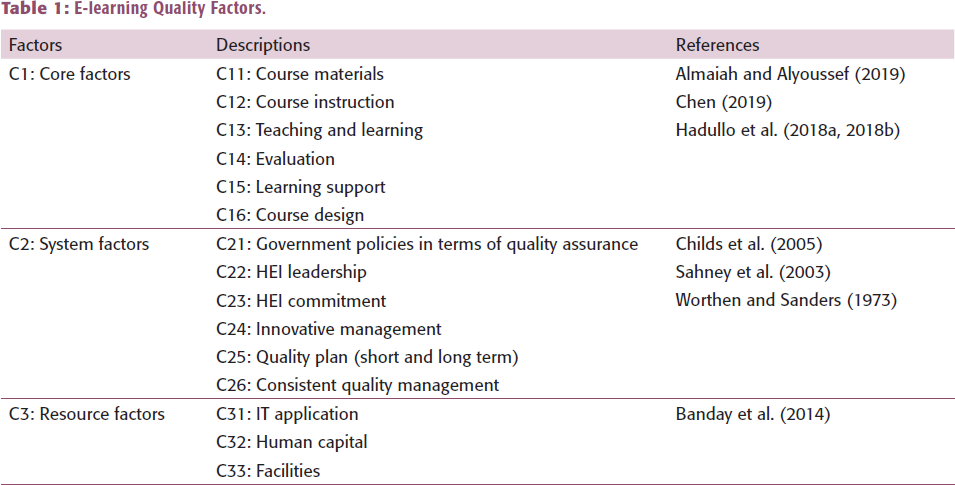
In Vietnam, the quality of higher education is a top priority, and thus needs to be achieved in the context of constraints such as relevance, costs, equity and international standards (Nguyen et al., 2021). As social and technological trends alter the landscape of global higher education, role of distance education steadily increases and happens to meet the quality criteria of conformity to the purpose of use at a minimum cost. Thus, the challenge to quality assurance will be to build capacity at every level. Quality assurance models in e-learning are developed based on the Worthen and Sanders (1973) evaluation model, considering the characteristics of e-learning, including four factors: (a) learning materials, (b) services, (c) quality assurance process and (d) institutional policy. Course design, course content, evaluation and instructors’ and learners’ characteristics are among the quality issues that challenge e-learning adoption in developing countries (Almaiah & Alyoussef, 2019). Szili and Sobels (2011) suggested the application of a constructivist approach in designing courses to align the learning outcome and teaching and learning activities to achieve the targeted quality. In addition, the integration of multimedia with appropriate content and instructional methods has been shown to motivate learners (Chen, 2019; Hadullo et al., 2018a). Lastly, proper Internet of Things integrated assessments are critical for the measurement of learning objectives (Farhan et al., 2018). In general, the products, such as the role of learning materials (e.g., multimedia materials, courses) and the quality of training of students (e.g., graduation number, pass rate, capacity) are emphasized in the literature.
Services, including academic counselling, feedback, guidance, academic progress support, career guidance, as well as provision and management of learning centres, have been confirmed in the findings of Hadullo et al. (2018b). It is also evidenced that administrative support and instructor professionals influence e-learning quality and its adoption. Sharma et al. (2017) concluded that service quality is the most important predictor for e-learning quality. Policies, funding, infrastructure and culture with support processes for both products and services, including conveying systems, books, school schedules and quality assurance processes are added to the literature review of quality factors in e-learning (Childs et al., 2005; Sahney et al., 2003; Worthen and Sanders, 1973). Finally, the resources are examined as it is expressed through the strategy, vision, culture of the organization, employee attitude and commitments (Banday et al., 2014).
RESEARCH METHOD
The spherical fuzzy analytic hierarchy process (SF-AHP) method was used in this study. First, the analytic hierarchy process (AHP) method allows decision-makers to gather knowledge from experts in the field, combining objective and subjective data within a logical hierarchy. This approach also provides decision-making with an intuitive, logical judgement approach to assess the importance of each component through the process of comparing each pair. In addition, it combines the qualitative and quantitative aspects of human thinking. ‘Qualitativeness’ is expressed through a hierarchy, while ‘quantitativeness’ is found through the description of evaluations and preferences expressed in numbers used to describe a person’s assessment of all invisible and tangible physical problems, which can describe emotions or the intuition driving human evaluation. Furthermore, the quality of education in general, and the quality of e-learning, in particular, often pose uncertainty, fuzziness and difficulty in evaluation. Therefore, the AHP is combined with spherical fuzzy sets in this approach. SF-AHP has been used to express ambiguity and uncertainty in expert judgements. Overall, this is an approach highly appreciated by the research community thanks to the outstanding advantages of being objective in evaluation and ratings while excluding subjective factors and feelings assessment in the condition of incomplete information. The SF-AHP technique is divided into many steps, which are detailed in this section (Gündoğdu & Kahraman, 2020b; Kahraman et al., 2020).
E-learning Quality Factors.
Linguistic Measures of Importance Used for Pairwise Comparisons (Gündoğdu & Kahraman, 2020a; Kahraman & Gündoğdu, 2020).
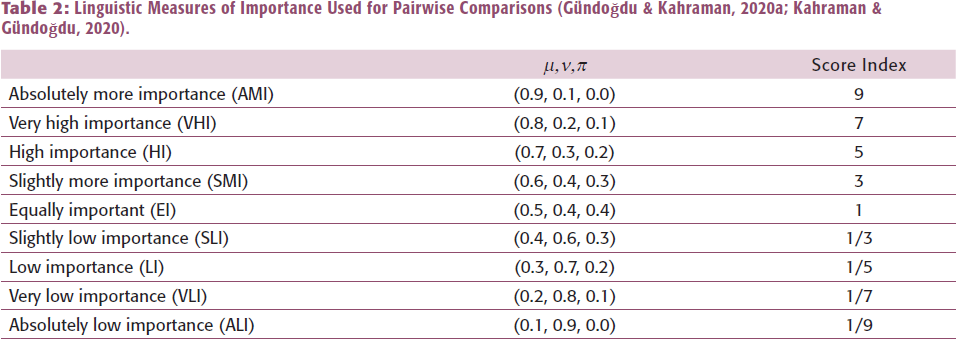
The score indices (SI) in Table 2 are calculated using Equations (1) and (2):

for AMI, VHI, HI, SMI, and EI

for EI, SLI, LI, VLI and ALI
where


FINDINGS
In this study, 20 experts in the field, including six researchers of e-learning, six researchers on education, and eight researchers and practitioners on quality and quality assurance in education were selected based on the following four criteria: (a) expertise and experience in the field, (b) willingness to participate in the survey, (c) availability for the survey and (d) communication capacity. Table 3 summarizes the demographic data of the participants in the sample.
Summary of Experts’ Information.
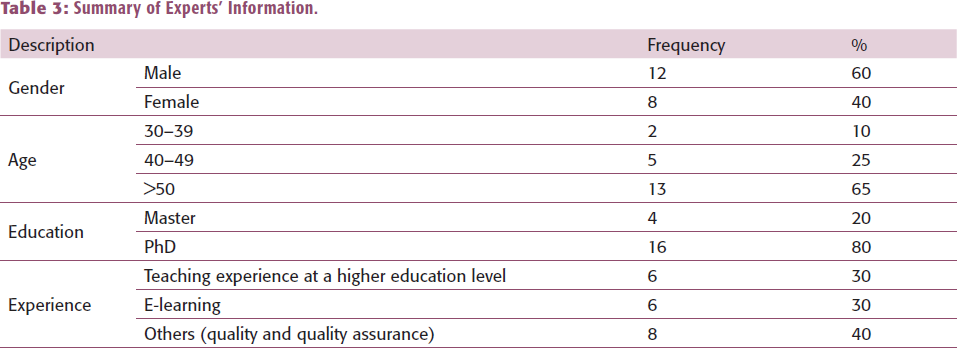
The proportion of experts categorized by gender in the interview does not reflect much difference with men (60%) and women (40%). The majority reach the age over 50 years old (accounting for 65%), education level of PhD is dominant (80%), meeting the conditions to ensure experience, as well as professional knowledge. Based on the results of the literature review in Table 1, discussion details with experts are designed. Paired comparisons from expert surveys were used as inputs for the priority weight calculation of e-learning quality factors in the SF-AHP model.
Findings confirm the first priority of system factors, followed by resources factors and core factors of e-learning quality as illustrated in Table 4. System factors share the highest weight of 0.3898. The roles of institutions, including governmental policies and higher education institutional governance elements, are emphasized. In fact, Higher Education Institution (HEI) external element is superior to its internal ones through the diversification of HEI sub-factors.
The Priority of E-learning Quality Factors.
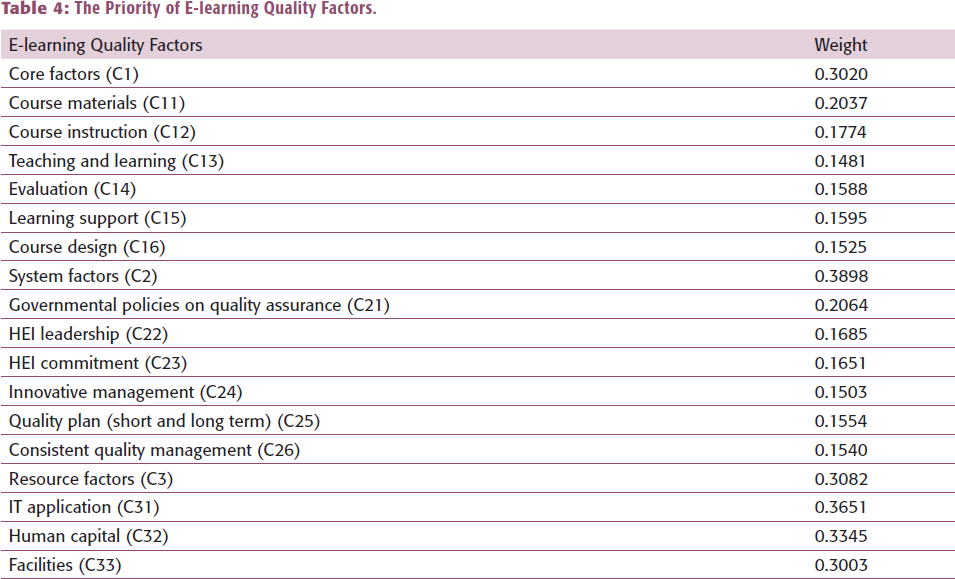
Resource factors are ranked second with the weight of 0.3082 as shown in Column 2 of Table 4. Specifically, IT application significantly contributes to the resource factors with the highest proportion of 0.3651, followed by human capital (0.3345) and facilities (0.3003).
Core factors are inferior to both system and resource factors, but their role is still confirmed with a share of 0.3020. The further exploration of core factors shows the priority of course materials (0.2037) compared to the other sub-factors. Course instruction is the second nudge (0.1774), followed by learning support (0.1595), evaluation (0.1588) and course design (0.1525). The last ranked sub-factor is teaching and learning with a weight of 0.1481.
DISCUSSIONS
The findings confirm the role of three major factors, in order of importance, as follows: (a) system, (b) resources and (c) core factors. In addition, the weights of 14 sub-factors have further shed the light for policies to promote e-learning quality and its adoption. Regarding system factors, the importance of both internal (leadership, commitment, management and plan) and external (governmental policies and contextual elements) efforts are empirically evidenced in the context of Vietnam. Our findings are in line with previous studies on e-learning by Andersson and Grönlund (2009), Ali et al. (2018), Basak et al. (2016), Ghoreishi et al. (2017), Khan (2005) and Noesgaard and Ørngreen (2015).
At the macro-level, e-learning quality assurance is generally understood as a system of policies, practices, processes and standards that were built and developed to monitor or improve the quality of e-learning training programmes. Quality assurance of e-learning is a relatively new phenomenon, which comes from the need to provide transparent and cost-effective information about this mode of training to stakeholders. This mode of training places emphasis on the quality of higher education institutions, training programmes, learners’ outcomes and output standards of e-learning compared to traditional training (Jung & Latchem, 2012). Our study further complements the literature by exploring the sub-components of the system factor. To meet the requirements of governmental policies and achieve higher education institutions’ leadership capability, relatively important components regarding commitment, planning and management are ranked to indicate a quality framework that incorporates the involvement of top management to employees. Improvements in continuous quality can only be smoothly operated embedded in the culture of HEI quality established and promoted by institutional leadership through inspiring mechanisms (Bouranta, 2020; Knight & Trowler, 2000). Competent leadership positively influences staff performance and the whole institutional system to track the targeted goals. An engaging environment is to be created under the helm of a highly committed leader so that short-term and long-term plans can be effectively and consistently deployed.
The second is resource factors which directly influence the quality education of higher education institutions. Among the resources, IT application shares the highest portion. IT literacy may promote the teaching and learning process, which results in qualified learners’ outcomes. Chen and Tseng (2012) regarded computer anxiety as an important barrier for e-learning adoption voiced from both lecturers and learners. The next sub-criterion is human resources. Lecturers’ qualifications contribute to the quality of teaching and learning as a conducive learning environment may not be available without credentialed teachers motivating learners (Chang, Fu, et al., 2017; Sarrico & Alves, 2016; Yekefallah et al., 2021).
Infrastructure and technology accessibility facilitate the e-learning system, which is the main motivation for assuring quality and the successful operation of higher education institutions. Infrastructure, technology and accessibility are ease of access to the e-learning system, which is considered the main agent of quality and leads to the successful pedagogy of institutions (Dadzie, 2009; Fallon et al., 2013; Mukred et al., 2018). Cheng (2011) realizes that solid infrastructure and technology have a positive impact on the attractiveness of the training institution and more investment capital flows from other investors in the educational institutions. Many researchers argue that professionals, managers and policymakers in for-profit and non-profit organizations benefit from the advances of the newest educational technologies and practices in online learning (Bose, 2004; Liang & Ma, 2004). The areas of IT were identified optimizing the delivery of efficient and cost-saving continuing education and training. However, two concerns unilaterally affect decisions to participate in online learning at both the national level in general and in educational institutions in particular. With this result, our study emphasized the hidden, yet significant sub-factors in the resource dimension.
In terms of core factors, course materials reach the highest priority. High-quality learning resource is a vital condition for e-learning system and its educational quality (Pons et al., 2015; Vesin et al., 2018). Given the flipped learning features of e-learning, course materials, course instruction, learning support and evaluation are among the top priority. The criterion that most strongly affects students’ learning results through the e-learning system is the frequency of use. Therefore, educational institutions should encourage students to use the e-learning system in their programmes to improve their academic results. The strongest impact on the use of e-learning reported by students is the support of the university which is also considered a significantly successful factor for the e-learning system (Al-Fraihat, Joy, & Sinclair, 2020; Cidral et al., 2018; Kim et al., 2019). Therefore, when evaluating the quality of e-learning, how to perform the support services for students enrolled in the online educational programmes is in the accreditors’ interests.
CONCLUSION
The educational Industry 4.0 has opened the chances for e-learning to meet the needs of the learning society. The COVID-19 outbreak has been a catalyst for e-learning booming. However, the challenged task for its quality and adoption still remains. This research has come with the fuzzy AHP model of priority criteria for e-learning performance in Vietnam. Our study reaches the following conclusions. First, the most critical component of e-learning quality is systems, followed by resources and core factors. Second, both local and global weights of the quality criteria and sub-criteria are the basis for policy implications focused on enhancing e-learning quality and its adoption in Vietnam. However, the limitation still exists in our study. The classification of e-learning quality criteria and its adoption model much relies on our context, given the expertise of our experts in the sample. Therefore, a larger sample size in future research is essential.
Footnotes
ACKNOWLEDGEMENT
The authors acknowledge the funding provided by the Vietnam National Foundation for Science and Technology Development (NAFOSTED) for this research.
DECLARATION OF CONFLICT OF INTERESTS
The authors declared no potential conflicts of interest with respect to the research, authorship and/or publication of this article.
FUNDING
The authors disclosed receipt of the following financial support for the research, authorship, and/or publication of this article: This research is funded by the Vietnam National Foundation for Science and Technology Development (NAFOSTED) under Grant Number 503.99-2020.04.