




Abstract
This article delves into the critical role of learning agility in the Indian context. It specifically explores how an organizational learning culture (OLCu) fosters an employee’s ability to learn and adapt—their learning agility—which ultimately translates into improved firm performance. Employing a cross-sectional research design, the study gathers data through self-administered surveys from over 313 employees working in hardware service firms within the Indian IT sector. Path analysis is then utilized to analyse the collected data and unveil the underlying relationships. The findings unveil a fascinating interplay between OLCu, learning agility and firm performance. The study suggests that OLCu acts as a catalyst, fostering a work environment that encourages continuous learning and development. This, in turn, fosters employee learning agility. However, the research also reveals that learning agility plays a mediating role, meaning it partially explains the effect of OLCu on firm performance. In simpler terms, while a strong OLCu is crucial, it is the employee’s enhanced learning agility that truly unlocks the door to improved firm performance. This research offers valuable insights that can empower organizations in the Indian IT landscape. By nurturing a vibrant OLCu, companies can equip their employees with the tools and support they need to become more learning agile. This agility translates into a workforce that can readily adapt to new technologies, evolving customer demands, and a dynamic business environment. Consequently, firms can expect greater innovation, improved service delivery, and, ultimately, a significant boost in overall performance. This research also contributes significantly to the existing body of knowledge. It adds a fresh perspective to organizational learning theory by highlighting the crucial role of learning agility as a bridge between OLCu and firm performance, particularly in the Indian IT sector.
In recent years, scholars have paid more attention to managing and learning external information sources for survival and thriving in the rapidly changing dynamic environment (Ghobakhloo & Fathi, 2019; Puthusserry et al., 2020). Previous literature has highlighted that learning new knowledge is associated with the increased overall performance of the firm, and thereby the firm can create a competitive advantage in a chaotic environment (Ghobakhloo & Fathi, 2019; Inkinen, 2016). Learning can be defined as the acquisition of novel information and the ability to execute that information in the organization to enhance performance (Chen, 2017; Pudjiarti & Darmanto, 2020). From the organizational perspective, learning is crucial for businesses to make them more creative, innovative and competitive (Salem et al., 2018). Moreover, learning provides a way for organizations through which they can be able to survive and thrive in the market in the long run (Choi et al., 2016). As a result, organizations today require eager and willing employees to learn new things to adapt and respond to changes in the environment efficiently and effectively (Tripathi et al., 2020). In other words, for an organization, learning agile employees are the primary concern in addressing the dynamic market changes that can help improve an organization’s performance.
From an organizational learning perspective, organizations are believed to have a learning culture because it facilitates knowledge-sharing systems that directly promote learning within an organization. And, it also motivates employees to learn, enhancing organizational performance (Inkinen, 2016; Oh, 2019). Extensive research from a wide range of multidisciplinary perspectives devoted to understanding organizational learning culture (OLCu) has revealed that an organizational culture embedded with a learning system is now developed as a critical management context (Bae & Grant, 2018; Oh, 2019). Although both OLCu and learning agility play a vital role in improving the performance of an organization (Felipe et al., 2020; Salehzadeh et al., 2017). Furthermore, no study has investigated the relationship between learning agility and firm performance in the presence of OLCu, making this study one of a kind.
A resource-based perspective contends that ‘the possession of strategic resources provides an organisation with a golden opportunity to develop competitive advantages over its rivals’(Barney, 2018, p. 12).In the same vein, the current study has used OLCu, which has been identified as a critical source to improve organizational performance. The information technology (IT) industry has been chosen for this quantitative study since India is a preferred source of hotspot hub for global IT services (Gope et al., 2018; Jain et al., 2019). Overall development and frequent introduction of new technology in the market is the foremost challenge of this very industry. Learning has the utmost importance to respond to the novel changes emerging in the business environment, which is still unexplored concerning the association of OLCu and learning agility on firm performance, particularly in the Indian IT industry (Tripathi et al., 2020).
Thus, to report this gap in the literature, the authors propose to study the association between OLCu and learning agility. This study also aims to ascertain the mediating effect of learning agility in the relationship between OLCu and firm performance in an Indian context. The following three research questions have been addressed in this study to accomplish the purpose: How does the OLCu influence learning agility? How does OLCu influence firm performance? And does learning agility mediate between OLCu and firm performance?
THEORETICAL BACKGROUND
Organizational Learning Culture
A complicated procedure that nourishes novel information and can modify the function is known as organizational learning (Antunes & Pinheiro, 2020; Rezaei et al., 2018). It is a traditional approach where employees and organizations both experience a behavioural change (Martínez-Costa et al., 2019). Organizations incorporating a learning culture into their system allow employees to create, acquire and transmit information and skills. Learning culture also aids in changing behaviour in order to disseminate new information and gain a better understanding of an organization (Oh & Han, 2020; Pantouvakis & Bouranta, 2017). Thus, an organization with a learning culture should first acquire knowledge, then elucidate its meaning before implementing it among employees.
Organizational learning has also emerged as an essential and obscure notion of organizational culture because of the inclusion of several approaches. There are several ways to define organizational learning along with its several characteristics. Previous studies explained organizational learning as ‘continuous testing of experience and its transformation into knowledge available to the whole organisation and relevant to their mission’ (Senge, 1990, p. 7). On the other hand, Martínez-Costa et al. (2019) defined organizational learning as a fundamental concept that aids in acquiring and interpreting information, as well as changes in behavioural and cognitive aspects that impact organizational performance.
Learning Agility
DeMeuse et al. (2010) defined learning agility as an essential construct for improving an organization’s long-term leadership. Learning agility can predict future individual performance because it has proven to be the most accurate predictor (DeMeuse et al., 2010). Lombardo and Eichinger (2000) explained learning agility as the eagerness and aptness of an individual towards learning novel attributes when exposed to different and new situations in the environment.
Yadav and Dixit (2017) demonstrated that employees could produce novel competencies through learning agility, particularly when exposed to different situations. The construct of learning agility comprises four factors: people agility, change agility, mental agility and results agility (Gravett & Caldwell, 2016).
Firm Performance
Firm performance is the extent to which an organization conveys its objectives and goals (Tajvidi & Karami, 2017). Pratono (2018) defined firm performance as a task-attainment procedure by employees within a firm. A firm performance can be measured either by a subjective scale or by an objective scale. Shafiq et al. (2019) demonstrated that an accumulation of subjective and objective procedures could be utilized to prevent defects. ‘Market share, sales, customer satisfaction, employee satisfaction, and profitability’ are usually used as measures of subjective performance; on the other hand, objective performance indicators are ‘return on earnings and return on assets’ (Chowdhury et al., 2019, p. 14). Till the date, in order to measure business performance, no single universally accepted procedure has been found, in spite of several frameworks’ evolution proposed by numerous researchers.
Linking OLCu and Learning Agility
Due to the frequent changes in the market, an organization must sharpen its skills and learn to respond to the changes quickly and effectively (Lin & Huang, 2020; Tripathi et al., 2020). To respond to those changes, an organization requires employees equipped with learning agility. Previous studies have demonstrated that organizations with learning agile employees were getting 25% more profits compared to their market competitors. Therefore, learning agile employees is a primary concern for an organization nowadays (Tripathi & Kalia, 2024; Tripathi et al., 2020). Previous research has demonstrated that an organizational culture embedded with a learning system can integrate individual learning with organizational learning (Islam et al., 2014). Tripathi et al. (2020, p. 5) defined culture as ‘a metaphor about the organisations, as it is how reality is being shaped and is deeply rooted in day-to-day routines of a particular organisation’. Prior studies have also manifested that there is a significant influence of OLCu on readiness to take risks (Chowdhury et al., 2019), organizational learning activities (Oh & Han, 2020) and organizational agility (Felipe et al., 2016; Govuzela & Mafini, 2019). These studies indicate that there is a relationship between organizational learning the agility. Only a limited number of studies have explored the relationship between OLCu and agility, particularly learning agility in the Indian IT sector. Hence, this study assumes that:
H1: OLCu is positively related to learning agility.
Linking Learning Agility and Firm Performance
The essential characteristics of agility tend to recognize changes pertaining to the market. A positive and significant association has been found between agility and organizational performance (Carvalho et al., 2017; Chan et al., 2017; Pantouvakis & Karakasnaki, 2018). A study carried out by Ashrafi et al. (2019) on Korean small and medium enterprises explored the positive impact of agility on the retention of customers as well as on the performance of an organization. Research has also shown that agility can gain a competitive advantage while improving organizational performance. Similarly, Ahammad et al. (2020) suggested that an organization can create a competitive advantage through agility.
Further, Kale et al. (2019) also suggested that an organization can enhance performance by gaining a competitive edge with the help of making organizations agile. Holbeche (2018) and Pereira et al. (2019) also argued that agility positively and significantly affects organizational performance. Previous studies have discovered a link between agility and firm performance, but only from an organizational standpoint. However, no study has yet been conducted that examines the relationship between employees’ learning agility and organizational performance, particularly in the Indian IT sector. Therefore, the present study explores the association between employees’ learning agility and firm performance. Thus, this study hypothesizes:
H2: Learning agility is positively related to firm performance.
Mediating Effect of Learning Agility
In addition to the direct impacts of OLCu on learning agility and learning agility on firm performance, learning agility can also mediate between OLCu and firm performance (Figure 1). Few studies have attempted to investigate the mediating role of learning agility in the prior literature (Tripathi et al., 2020). Furthermore, a study carried out by Kale et al. (2019) on 112 large Spanish companies demonstrated the role of organizational agility as a mediator in the association of the application of knowledge and performance of an organization. This study also investigated the mediating effect of firm agility in the association between strategic IT alignment and the firm’s performance (Kale et al., 2019).
Hypothesized Model.
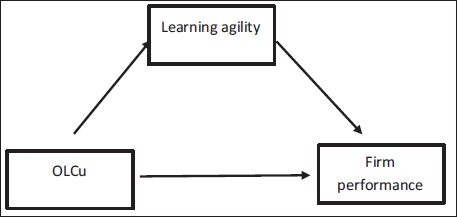
Martínez-Costa et al. (2019) demonstrated supply chain agility as a mediator in an association between absorptive agility and firm performance. In another study, Salehzadeh et al. (2017) argued an essential mediating role of strategic agility in the relationship between corporate risk management and organizational performance. However, no study has yet investigated the role of learning agility in mediating the relationship between OLCu and firm performance. Based on previous research, this study hypothesizes that learning agility may act as a mediator in the relationship between OLCu and firm performance. As a result, the following hypothesis is proposed:
H3: Learning agility mediates the association between OLCu and firm performance.
METHODOLOGY
Context and Sample
The present research study has utilized data collection between August 2019 to December 2019 from IT sectors, particularly hardware firms in Southern India. This study used a deductive approach because, in this approach, a researcher can study prior investigations and then develop hypotheses for their research based on previous investigations (Reyes, 2004; Tripathi et al., 2021). The targeted organizations were selected randomly, and an online-mode data collection approach was adopted to conduct the research study. The online mode was chosen because it allows the researcher to collect data from various sources quickly. First and foremost, the respondents for this study were recognized with the aid of social platforms such as Facebook and LinkedIn. The e-mail-invitation method was also utilized to recruit participants for an online survey. Prior studies have demonstrated that ‘working with an e-mail list of potential respondents, sending a follow-up invitation can help increase the response rate’ (Ritter & Sue, 2007, p. 10). The present study utilized some criteria to choose the potential respondents, such as (a) the respondents must be from IT organizations; (b) the respondents must be from hardware firms of IT organizations; (c) the respondents must be from Southern India and (d) the respondents must be middle-level and lower level executives.
Before preparing and sending a Google doc research questionnaire to the respondents, the present study identified the target respondents based on the selection criteria mentioned. To eliminate ambiguity, a brief introduction about OLCu, learning agility and firm performance was also given in the questionnaire before each set of the questionnaire. The English language was chosen as a medium of communication with the respondents. For data collection, the convenience sampling method was utilized. A total of 633 questionnaires were sent to the targeted respondents; with a response rate of 53.08%, 313 questionnaires were returned in a completed form (Table 1). Among 313 valid responses, 254 (81.21%) were male, and 59 (18.79 %) were female. The data had different age ranges such as 16 (5.19%) were 51–60 years of age; 42 (13.41%) were 41–50 years of age; 124 (39.61%) were 31–40 years of age and 131 (41.85%) were 20–30 years of age.
Respondents’ Demographic Profile.
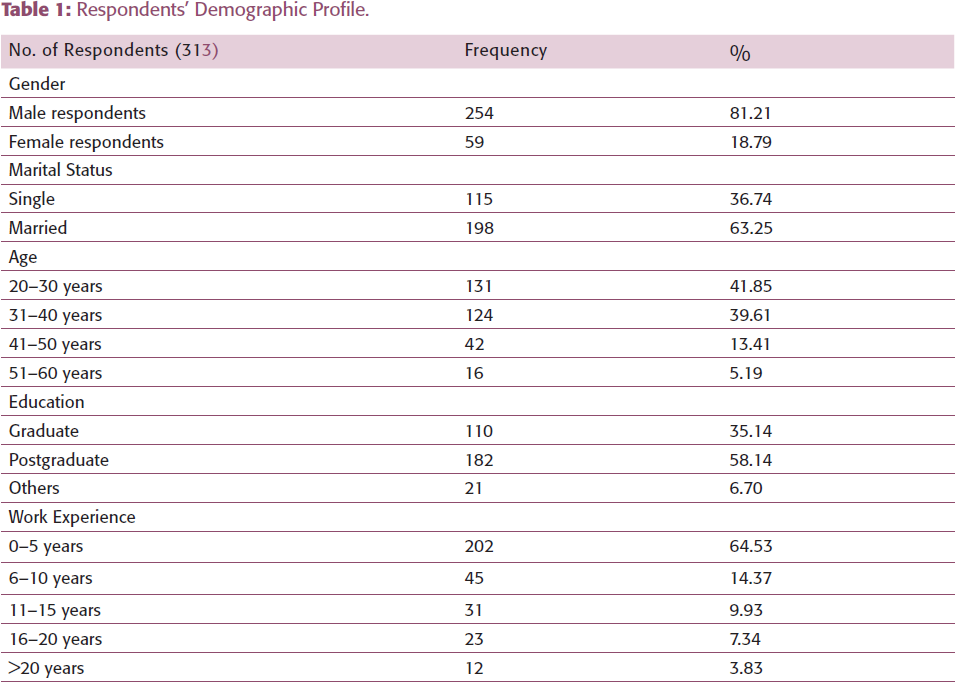
The participants were at different career stages: 202 (64.53%) had worked for 0–5 years; 45 (14.37%) had worked for 6–10 years, 31 (9.93%) had worked for 11–15 years, 23 (7.34%) had worked for 16–20 years and 12 (3.83%) had worked for more than 20 years. Keeping in view educational qualifications, 110 (35.14%) employees hold a graduate degree, 182 (58.14%) employees have a postgraduate degree and 21 (6.70%) employees hold other qualifications.
Measures
This study has used the self-reported questionnaire method (Paulhus & Vazire, 2007), in order to measure the variables such as OLCu, learning agility and firm performance as mentioned below.
Organizational Learning Culture
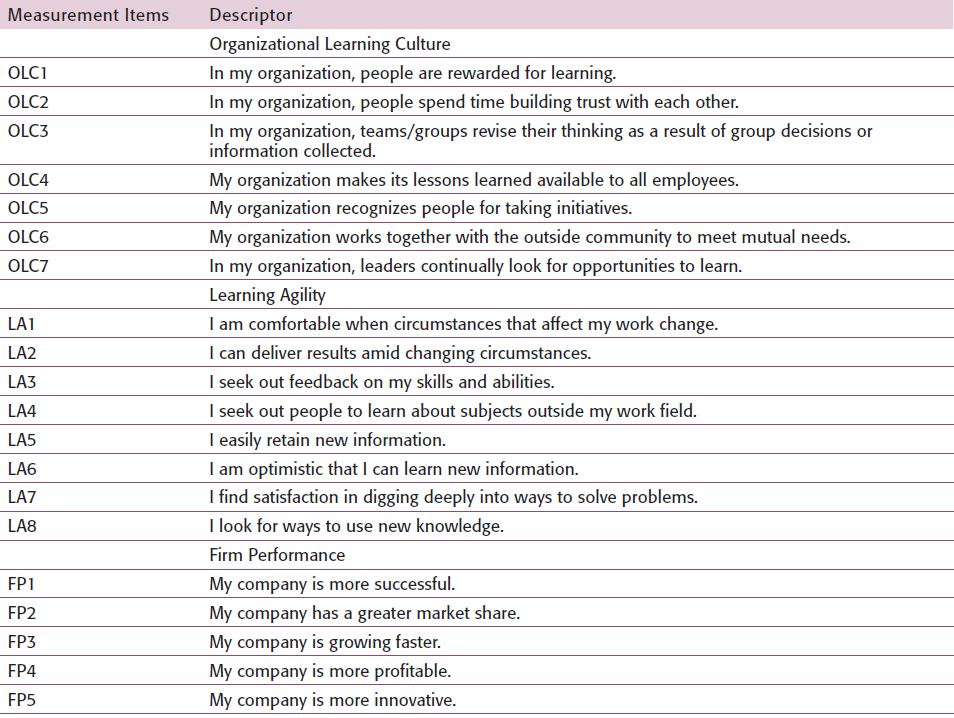
OLCu was assessed with the help of a scale consisting of seven items (Watkins & Kim, 2018). This measure emphasizes a few aspects such as continuous learning opportunities, dialogue and inquiry, team learning, systems to capture and share learning, empowerment, connectivity to the environment and strategic leadership for learning—all of which are required capacities for organizations to be capable of continuous learning and transformation (Watkins & Marsick, 1997). The sample item includes ‘My organization makes its lessons learned available to all employees’ and ‘My organization works together with the outside community to meet mutual needs’. The scale showed good reliability, and Cronbach’s alpha was 0.97.
Learning Agility
Learning agility was ascertained with the help of a scale consisting of eight items (Gravett & Caldwell, 2016). The sample item includes ‘I can deliver results amid changing circumstances’, ‘I seek out people to learn about subjects outside my work field’ and ‘I look for ways to use new knowledge’. The scale showed good reliability, and Cronbach’s alpha was 0.98.
Firm Performance
Firm performance was investigated with the help of a scale consisting of five items (Lee & Choi, 2003). The sample item includes ‘My company is more successful’ and ‘My company is more innovative’. The scale showed good reliability, and Cronbach’s alpha was 0.93.
Five-point Likert scale (1 = strongly disagree and 5 = strongly agree) was utilized to record the responses for the variables of this study. Cronbach’s alpha value for OLCu, learning agility and firm performance was higher than the threshold limit of 0.07 (Hair et al., 2019), further showing high reliability.
Control Variables
‘Control variables are factors that researchers include in their work to rule out alternative explanations for their findings (Schmitt & Klimoski, 1991, p. 31) or to reduce error terms and increase statistical power’ (Becker, 2005, p. 12). Therefore, as per the suggestions mentioned above by the authors, the present study utilized demographic variables such as gender, age, work experience and education level as control variables.
RESULTS
Descriptive Statistics
The descriptive statistics, namely mean, standard deviation (SD) and the inter-item correlation among variables, are shown in Table 2. To assess the data, SPSS 20 and AMOS 20 have been utilized. Also, to assess the path analysis, the present research has utilized PROCESS macro-model number 4, an SPSS computational tool (Hayes, 2013; Tripathi & Kumar, 2023). Confirmatory factor analysis (CFA) was used to confirm the factor structure. To utilize the CFA analysis, the values of model fitness were investigated to check the appropriateness of the data. It suggested a good model-fit as proposed by Anderson and Gerbing (1988), Hair et al. (2019), Hu and Bentler (1999), MacCallum et al. (1996), Tripathi et al. (2020) and Tripathi and Sankaran (2021). The values are as follows: χ2/df = 2.37, goodness-of-fit index = 0.91, root mean square error of approximation = 0.06, adjusted goodness-of-fit index = 0.90, comparative fit index = 0.98, normed fit index = 0.97, Tucker–Lewis index = 0.97, standardized root mean square residual (SRMR) = 0.06.
Descriptive Statistics.
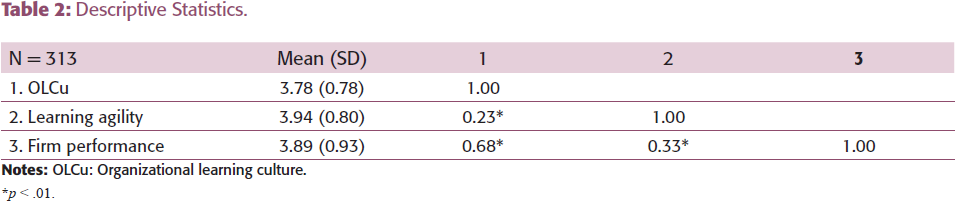
*p< .01.
The values for OLCu were in the range of 0.79 and 0.99, the values for learning agility were in the range of 0.85 and 0.99, and finally, for firm performance, the values were in the range of 0.72 and 0.99. The correlation values suggested that high convergent validity (Table 3) was found among all variables (Cable & DeRue, 2002; Hair et al., 2019; Tripathi & Dhir, 2023; Tripathi & Sankaran, 2021; Tripathi et al., 2020). Hence, the findings exhibit that the model possesses good adaptability.
The Values of Reliability and Factor Loadings.
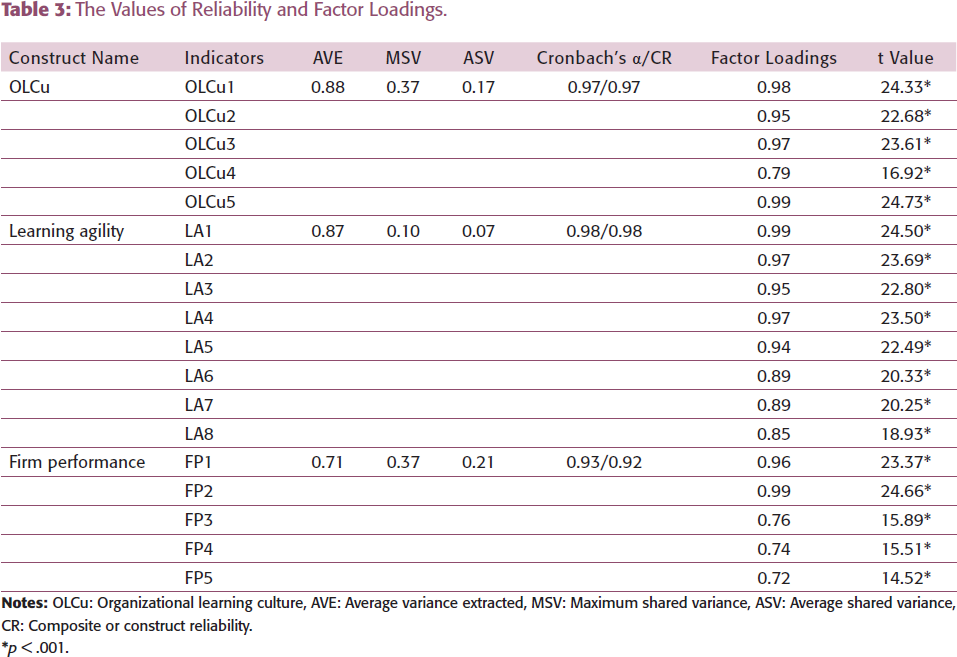
*p < .001.
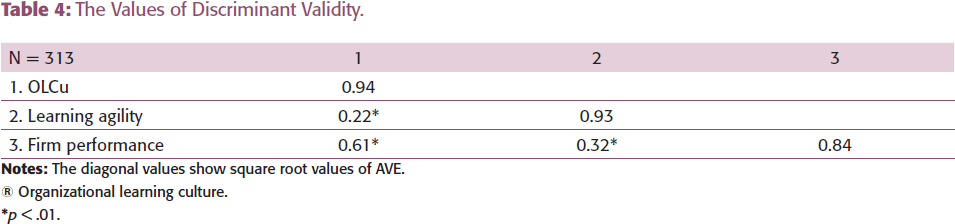
The square root of each construct’s average variance extracted (AVE) was determined to investigate the discriminant validity. Table 4 shows that the constructs have high discriminant validity because these values were higher than the correlation values proposed by Hair et al. (2019) and Tripathi et al. (2020). In addition, the high value of AVE, as compared to the values of average shared variance and maximum shared variance, validates the notion of discriminant validity (Hair et al., 2019). Further, the present study investigated the common method bias (CMB). When data collection is based on self-report estimation, and the same respondents provide responses for independent and dependent variables, the issue of CMB may be detected. The current study used the unmeasured latent method factor, also known as the common latent factor (CLF) method, to address this issue. Compared to other measures like the Harman single factor, the CLF method gives more precise results as proposed by previous researchers (Podsakoff et al., 2003; Tripathi et al., 2020).
The Values of Discriminant Validity.
® Organizational learning culture.
*p < .01.
As Podsakoff et al. (2003) suggested, comparing standardized regression weights was made using CFA by using CLF at one point and removing it at another. Since the reported values were lower than 0.2, further claiming that the present study is free from CMB issues (Gefen & Straub, 2005).
Hypotheses Testing
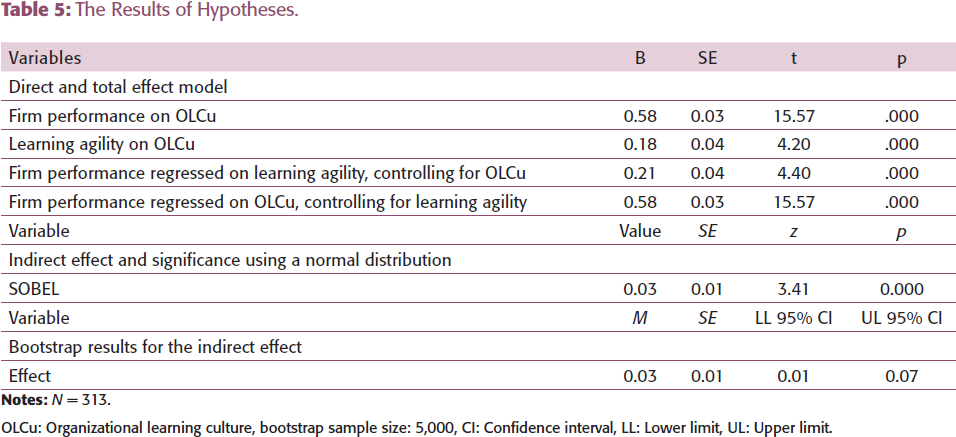
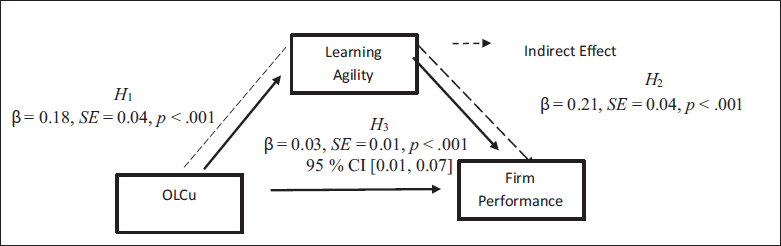
As Hayes et al. (2017) suggested, PROCESS is a more suitable and modern way of testing hypotheses than structural equation modeling (SEM) because of its ease of management and fewer complications. A complex procedure like mediation and moderation analysis can also be simplified using PROCESS. However, it does not provide any graphical diagram; it gives similar results to SEM. ‘PROCESS estimates all the statistics (path coefficients, t value, p value, standard errors, etc.) by implementing bootstrapping that facilitates inference using those statistics; this is not possible in all SEM programs’ (Hayes et al., 2017, p. 51). The Baron and Kenny (1986) approach is followed by the abovementioned method. The findings of each hypothesis are demonstrated in Table 5. The positive impact of OLCu was found on employees’ learning agility (β = 0.18, t= 4.20, at p < .001), which indicates H1 is confirmed. While controlling OLCu, a positive and significant relationship (β = 0.21, t = 4.40, at p < .001) was found between learning agility and firm performance, confirming H2. Further, as presumed in H3, the positive (0.03) and indirect effect between OLCu and firm performance was found via learning agility. Two-tail significant test values assume the normal distribution among variables; further, it indicates the value of indirect effect (Sobel = 3.41, p < .001), which is significant. In addition, since no zero was found between the lower confidence interval 0.01 (95% CI) and the upper confidence interval 0.07 (95% CI), the bootstrap analysis confirmed the findings of the SOBEL test. Furthermore, the findings also demonstrated that there is a direct effect of OLCu on firm performance (β = 0.58, t = 15.57, at p < .001) while controlling the construct learning agility. Therefore, the overall findings exhibit a partial mediating effect of learning agility in the relationship between OLCu and firm performance, confirming H1, H2 and H3.
The Results of Hypotheses.
OLCu: Organizational learning culture, bootstrap sample size: 5,000, CI: Confidence interval, LL: Lower limit, UL: Upper limit.
DISCUSSION
The outcomes exhibited a significantly positive influence of OLCu on the learning agility of employees, particularly in the Indian IT sector. It can be said that organizations embedded with a learning culture motivate employees towards learning agility. This finding indicates that with the help of an OLCu, employees will be more eager to learn for themselves and the organization. OLCu also helps develop capabilities within employees, such as dealing with diverse situations, various views, determination and logic towards change, willingness to enhance their skills and eagerness to disseminate knowledge, among others. Previous studies have supported that OLCu stimulates learning agility within employees, making them more agile towards learning something new (Tripathi et al., 2020). Organizational learning theory supports this view that a learning culture within the organization encourages employees to strengthen their skills, attributes, and knowledge and allows employees to respond to the challenges introduced in the market.
Second, as there will be an increment in employee learning agility, an organization’s performance will automatically be enhanced. When employees have learning agility, there will be no resistance to any novel changes introduced in the market. As a result, the new changes will not affect an organization’s performance because employees will be able to respond to the changes effectively and efficiently. Resource-based view also supports that OLCu is a critical resource to enhance a firm’s performance. The findings also revealed that learning agility predicts firm performance, implying that more learning agile employees will improve an organization’s performance by adapting and responding to new changes (refer to Figure 2). In addition, the findings exhibited that learning agility is a partial mediator in the association between OLCu and firm performance. It indicates that there is a direct and indirect impact of OLCu on firm performance via employee learning agility.
Structural Model Results.
The outcome of this study validated the study of Cegarra-Navarro et al. (2016) and Tripathi et al. (2020), who proposed that OLCu provides a way towards enhancing firm performance via learning agility that behaves as a partial mediator.
IMPLICATIONS FOR THEORISTS
This research intends to contribute two ways to the field of organizational behaviour and human psychology from a theoretical perspective.
As mentioned in the previous literature (Ashrafi et al., 2019; Chan et al., 2017; Inkinen, 2016), agility is a crucial element in improving a firm’s performance. In the study, Tripathi et al. (2020) stated that frequent changes in new technology are widespread in Indian IT firms, necessitating employees with high learning agility to respond to the changes efficiently and effectively. However, to my knowledge, no prior research has empirically examined the impact of learning agility on firm performance. Thus, the present study fills the void in this area. It adds value to the existing knowledge about the cognitive state of employees through which an organization can experience high performance in this competitive era.
Up to now, sparse studies have been done on empirical examination of learning agility, particularly in the Indian context (Tripathi et al., 2020). The current research study has also investigated the role of the organizational learning theory and resource-based perspective regarding the relationship among OLCu, learning agility and firm performance. Previous studies (Antunes & Pinheiro, 2020; Cegarra-Navarro et al., 2016; Kale et al., 2019) have also suggested that firms must foster OLCu to increase market performance to survive and thrive in this cutthroat competitive era.
Thus, the findings of this study can contribute to the existing body of knowledge by arguing that OLCu can help employees become more learning agile in the face of change, thereby increasing an organization’s competitive edge.
IMPLICATIONS FOR PRACTITIONERS
There can be an inclusion of OLCu as a crucial factor to be investigated by HR practitioners to improve the level of concentration among employees towards learning and disseminating new skills within the organization. If employees are nurtured in an organizational culture embedded with the learning system, they will be more focused on learning new skills, behaviours and knowledge. The novel knowledge will then be shared from one employee to another, building vital learning agility among employees. A firm’s performance is directly proportional to the employees; thus, the more learning agile employees, the higher the firm’s performance. Since the present study also found that OLCu positively impacts firm performance, the practitioners should bring a harmonious learning culture system that needs an hour in this current scenario to meet the novel changes. Organizations must also involve their employees in specific training and development sessions to boost their confidence and willingness to learn. A learning agility test can be included when recruiting employees; this procedure can provide a pathway to HR managers of large IT firms to recognize individuals scoring high on the level of learning agility and then put them suitably in an organization. The outcomes of this study also affirm that learning agility, together with OLCu, is crucial to enhance a firm’s performance in this competitive edge. This study can be a valuable insight for organizations, particularly IT firms, where learning a new skill is a prime concern to survive in the market.
LIMITATIONS AND FUTURE SCOPE OF THE STUDY
Like other studies, the present research also has a few limitations that are mentioned as follows:
This study is based on a cross-sectional design that is merely aimed towards Indian IT firms. As mentioned before, the particular attribute of the IT sector is its service-aligned culture and its flexible work behaviour. Because responses were gathered from only those employees working in the IT sector, generalization of the findings may be limited. Therefore, future studies with a larger sample size may be able to generalize the current study’s findings.
Furthermore, in this study, a few demographic variables have been taken as controlled variables, and hence investigation of these variables’ impact on study variables has not been analyzed. In the future, researchers may investigate these variables’ impact on other variables, providing several new aspects regarding OLCu, learning agility and firm performance.
The present research has been restricted to a few demographic variables. Therefore, future studies can take other pertinent demographic groups to explore the varied responses regarding OLCu, firm performance and employees’ learning agility.
In this research, the predominance of male respondents (81.21%) from the IT sector can be noticed. Future studies can take other sectors like hospitality sectors where the female proportion can be seen as higher than its counterpart.
The present research has been done with self-report measures that can raise issues of CMBs. However, the present study has utilized a post-hoc statistical technique, the CLF method, to eliminate the problem of CMBs. Future studies can use some a priori statistical approach to address the CMBs.
In this study, top-level executives have not been included due to unavailability. Therefore, the future study can be accomplished by taking responses from top-level executives such as C-suite executives that will provide an insightful and interesting result regarding exploring OLCu, learning agility and firm performance.
Finally, the quantitative method was used to investigate the relationships between OLCu, learning agility, and firm performance. As a result, future studies can utilize either qualitative or mixed methods to assess the rigour and robustness of the findings.
Annexure A
Footnotes
DECLARATION OF CONFLICT OF INTERESTS
The author declared no potential conflicts of interest with respect to the research, authorship and/or publication of this article.
FUNDING
The author received no financial support for the research, authorship and/or publication of this article.
e-mail: