




Abstract

CASE SYNOPSIS
The case talks about an initiative by Agarwal Packers and Movers Limited (APML), a family business enterprise operating in the highly competitive household relocation segment of the Indian logistics industry. The company created driver service kendras (DSKs) to provide Nidradaan: the Gift of Sleep to the truck drivers who ply the length and breadth of the country carrying cargo to the remotest places. The DSKs were the brainchild of Mr Ramesh Agarwal, mentor of APML. With years of experience in the industry, Mr Agarwal was aware of the appalling conditions under which truck drivers in India operate. Many studies have shown that Indian truck drivers face acute sleep deprivation, leading to physical, psychological and performance complications. APML’s own survey found that out of the 139,000 people who die every year in road accidents, 26,678 die of drowsy driving. Additionally, risky working conditions, meagre wages, unrealistic delivery schedules, prolonged absence from family and social life, harassment by officials and low social status discourage individuals from taking up the truck driver’s profession. As per the 2022 statistics, the number of drivers per 1,000 trucks is only 450, a drastic fall from 1982 when there were 1,310 drivers per 1,000 trucks. This creates losses to the tune of billions of dollars. Mr Agarwal believed it is important to ‘Save the Drivers, to Save the Industry’. He started the first DSK in 2012, in Jaipur, Rajasthan, spread over an area of 50 acres. It had 500 cots with clean bedspreads and blankets for the drivers to take proper rest, along with amenities such as truck parking, servicing and repair, hygienic food, bathrooms, toilets, medical facilities, laundry facilities, etc. APML’s intervention helped to differentiate it from its competitors and gain a competitive advantage in the trucking industry by motivating drivers, who are vital human resources in the trucking industry. Other logistic service providers also started emulating them. However, Mr Agarwal was worried that the ‘Gift of Sleep’ may not be the panacea to attract enough qualified drivers to the trucking industry. He was thinking about a wholesome solution to address the driver shortage facing the industry.
CASE ANALYSIS
The following issues concerning stakeholder management and the creation of shared value can be discussed based on the case:
How to understand issues affecting the industry? How to select an issue to address? How to create shared value while addressing an issue affecting the stakeholders? How to convert the value creation into a first-mover advantage?
LEARNING OBJECTIVES
At the conclusion of the case, the student should be able to understand how to prioritize issues and generate solutions that can be mutually beneficial for the corporation and society and generate a competitive advantage for the company.
Issues Affecting the Trucking Industry
Two-thirds of the nation’s cargo is transported by trucks, and the trucking industry remains one of the largest employers, providing jobs to drivers and cleaners, as well as auxiliary trade and employment opportunities to brokers, booking agents, people operating garages, loading and unloading operations, wayside facilities, etc. In this case, Exhibit 3 provides the structure of the trucking industry with the various direct stakeholders.
The industry is highly disaggregated, with low entry barriers for operators and drivers and cutthroat competition. Due to this, many unlawful and dangerous practices are prevalent, such as deflation of market rates, truck overloading, poor maintenance of trucks, use of low-quality spare parts, violation of traffic rules, corruption to escape penalties, etc. Other issues that plague the industry include poor vehicle technology, absence of wayside amenities, bad road conditions, unnecessary detention of vehicles at toll gates and complex legal frameworks involving multiple legislations. The truck drivers who are at the bottom of the industry structure bear the brunt of these issues. They endure risky working conditions due to the poor maintenance of the roads and the vehicles, meagre wages as many are illiterate and unqualified and cannot demand reasonable salaries, unrealistic delivery schedules that force them to drive for long hours without breaks, harassment by officials who force them to pay bribes, prolonged absence from family and social life, and low social status due to poor public perception.
Many of these issues are systemic and cannot be addressed without the cooperation of all the stakeholders involved in the value chain, which will take considerable time. However, some issues need immediate attention for the survival of the industry. One such issue is the declining number of drivers in the industry. The upsurge in e-commerce has increased the demand for trucking. However, the number of drivers per 1,000 trucks is only 450 (Exhibit 2 from the case). This means that the transportation industry is losing billions of dollars due to the idling of trucks, delays, cancellations and poor delivery to remote areas. This has the potential to create a vicious cycle as the increasing losses will further reduce the investments in the industry, affecting the well-being of the drivers who are the workhorses in the industry. Hence, the need of the hour is to develop a solution that attracts more drivers to the industry, helping to improve operational efficiency and profitability. This will create a conducive environment for additional investments which can positively impact the industry as a whole, including the lives of the drivers.
Selection of a Pertinent Issue
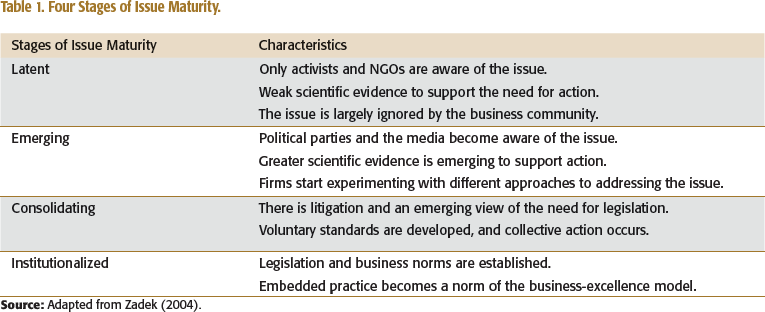
Addressing multiple issues in the industry, understanding how it impacts various stakeholders, and trying to proactively address these concerns are important for a firm. The framework created by Simon Zadek helps firms to evaluate multiple issues and identify the ones that pose the greatest opportunity or threat. He also suggests different ways in which firms can respond to the issues. A combination of the issue and the organizational response would determine the outcome for the firm. The four stages of issue maturity, according to Zadek are depicted in Table 1.
Four Stages of Issue Maturity.
The organizational responses to these issues may vary as shown in Table 2.
Organizational Response to Issues.
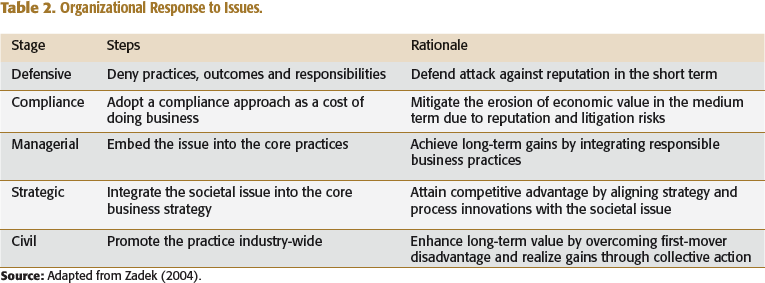
Figure 1 indicates the outcomes for firms based on the maturity of issues and the type of organizational responses. The maximum threat occurs if a firm takes a defensive stance against an issue that has become institutionalized. In contrast, if a firm promotes industry-wide adoption of standardized practices concerning an emerging issue, it stands to gain maximum economic and social value for its effort. Moreover, such firms can differentiate themselves in the eyes of those stakeholders for whom the issue is important.
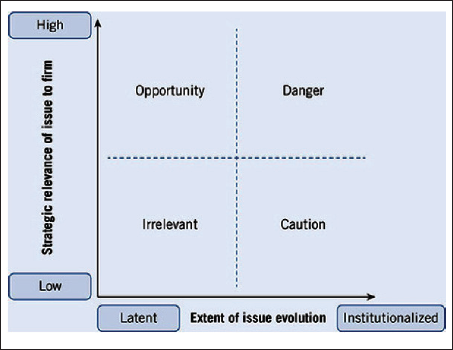
In the scenario presented in the case, APML is trying to address an emerging issue that has the potential to stifle the growth of the trucking industry. By becoming an early adopter of a solution that attempts to redress the appalling working conditions of the truck drivers, the firm is likely to create goodwill amongst the driving community, which would help to attract more drivers to the organization, thereby addressing the concern of underutilization of trucks.
Creating Shared Value Through Innovation
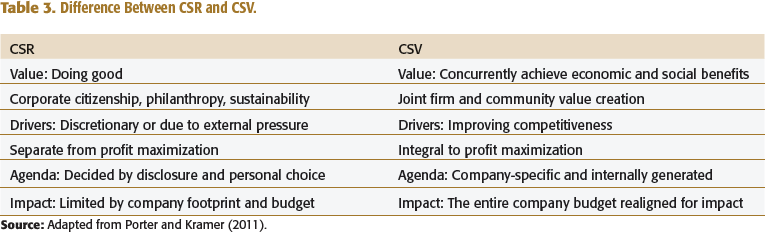
According to Porter and Kramer (2011), social harms and weaknesses create costs for the firm. Addressing these constraints through innovative operating methods and management approaches helps firms to increase their productivity and profitability. They put forward the concept of creating shared value (CSV), in which firms develop policies and operating practices that enhance their competitiveness while advancing the economic and social conditions in which they operate. Porter and Kramer differentiate between corporate social responsibility (CSR) and CSV, as depicted in Table 3.
Difference Between CSR and CSV.
Porter and Kramer identify three ways in which organizations can create shared value:
Reconceiving products and markets to meet societal needs especially those of the disadvantaged and under-served markets. Redefining productivity in the value chain by managing natural resource and water use, health and safety, working conditions and equal treatment in the workplace. Building supportive clusters of similar firms, related businesses, suppliers, service providers and logistical infrastructure while also drawing on the broader public assets in the surrounding community, such as schools and universities, clean water, competition laws, quality standards and market transparency.
Porter and Kramer argue that fair wages, safety, wellness, training and opportunities for advancement have a positive effect on productivity. For instance, many corporates baulk at the cost of employee health coverage. However, it has been proved that lost workdays and diminished employee productivity due to poor health cost more than the health benefits.
Mr Agarwal has taken a leaf out of Porter and Kramer’s playbook of shared value creation by setting up the DSKs for nidradaan. There has been sufficient evidence to determine that sleep deprivation and the resulting ill effects on the physical and mental well-being of truck drivers remain one of the major causes of poor enrolment in the profession and low utilization and productivity in the industry. APML’s studies have shown that nearly 20% of road accidents are caused by drivers dozing off at the wheel. By providing a safe and hygienic resting place for the drivers, APML ensures that the probability of accidents and resultant delivery disruptions are reduced, which benefits the company. Along with proper rest, the drivers can ensure proper maintenance and service of vehicles, which again reduces delays caused by breakdowns during long trips. The productivity enhancements that the company can achieve are more than likely to cover the expenses incurred in running the DSKs. At the same time, the goodwill created in the industry by such practices will attract more drivers to the company, ensuring better utilization of their trucks and more business for the company.
Convert Corporate Social Innovation into a First-mover Advantage
Some students may argue that the Indian trucking industry operates on lower margins by offering low prices to the customers, and service quality is only secondary for the client. In this context, APML incurring additional expenditure to run the DSKs is taking a hit on its margins as it may not be in a position to transfer the prices to the customers due to the cutthroat competition.
However, the company will be able to gain a first-mover advantage due to this intervention. As already seen, the issue is at a latent stage now and may soon become a major concern for the trucking industry due to the huge opportunity costs of not having enough drivers to operate the full fleet of vehicles. Both industry associations and regulatory bodies are likely to take more interest in this issue and force the trucking organizations to address it in a constructive way. At this juncture, APML being the first mover would be consulted to suggest best practices for adoption by the industry. The company may leverage its experience and give its recommendations, which can include many of the practices adopted at its DSKs. It creates a situation where the practices followed by APML for the welfare of its drivers become the industry norms and APML being the first mover can take advantage of this situation. Moreover, as everyone starts to follow these practices, their costs will also go up and many may be forced to transfer this increased price to the customers, thereby increasing the prices across the trucking industry. APML, which already has accounted for the DSK expenses in its operations, may be able to enjoy better margins than its competitors during this phase and will be able to offset the initial losses.
Epilogue
As discussed earlier, the judiciary has taken note of the plight of the truck drivers. A landmark judgment passed by the Patna High Court in the case of Sumit Kumar vs State of Bihar on 22 December 2020 and later a special leave petition decided by the Supreme Court made important remarks about the abysmal working conditions faced by the truck drivers. The courts opined that there is an immediate need to improve the conditions of truck drivers across the country. It is a matter of time that the truck industry will have to set up a code of conduct for driver welfare.
Organizations in other segments of the transportation sector have also started interventions for the benefit of truck drivers. For example, Tata Motors launched a programme called samarth aimed at addressing critical areas of well-being of drivers such as swasthya (wellness programme), sampatti (finance programme) and siksha (education programme) along with surakshit samarth (driver on wheel insurance).
Footnotes
DECLARATION OF CONFLICTING INTERESTS
The author declared no potential conflicts of interest with respect to the research, authorship and/or publication of this article.
FUNDING
The author received no financial support for the research, authorship and/or publication of this article.