



Abstract

The book portrays the biography of Parameswaran (Param) Iyer, an Indian Administrative Service (IAS) officer from the 1981 Uttar Pradesh (UP) batch. A substantial portion of the book is dedicated to his role as an administrator in the Swachh Bharat Mission (SBM), a flagship initiative of the Government of India (GOI).
The review is divided into the following three sections. Section 1 profiles Param’s career progression and choices. Section 2 elaborates on Param’s pivotal role in enabling SBM. Section 3 centres on abstracts from the book’s narrative, documenting reflections on career choices, progression and individual impact. The book also provides experience-based career advice for the general public, which is mentioned in Exhibit 1.
PROFESSIONAL ADVICE AS ARTICULATED BY PARAM IN HIS BOOK

SECTION 1: CAREER GRAPH OF PARAM
Param tried his luck with various professional opportunities in the hotel industry, journalism and professional tennis. Eventually, he was selected for the IAS, considering it an accidental occurrence. Param was assigned to the UP cadre and worked as a Trainee Officer in the Gorakhpur Division. Subsequently, he held positions like Sub-Divisional Magistrate (SDM) in the Dehradun district, General Manager (GM) of Uttar Pradesh State Transport Corporation (UPSRTC) and Joint Secretary (JS) in the Department of Environment (DoE) in the UP government (Exhibit 2).
TIMELINE OF PARAM’S CAREER
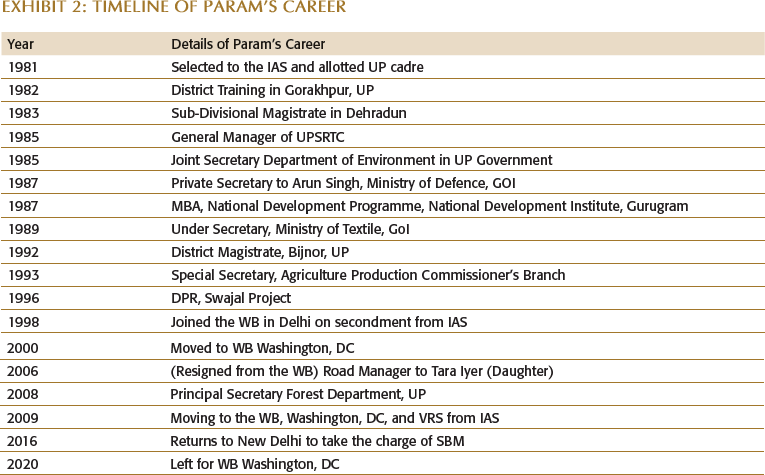
In his role as the JS of the DoE of the UP government in 1985, Param authored an opinion piece addressing the managerial challenges related to environmental issues in the country. He emphasized the importance of the government’s willingness to consider the opinions of others when formulating policy frameworks. However, this article was met with disapproval from the then-Secretary of the Ministry of Environment, GOI, T.N. Seshan. He advocated for strict action to be taken by the GOI against Param for expressing such views. Contrary to Seshan’s stance, the Chief Secretary of the UP Government chose not to pursue punitive measures against Param. Instead, the Chief Secretary encouraged Param to continue expressing his views and providing feedback to strengthen government policy options. Consequently, Param was reassigned to the role of Private Secretary to the Minister of Defence, Arun Singh, in the GOI. During a visit to the Minister, T.N. Seshan met Param and extended his congratulations for the opinion piece that Param had written regarding UP government policy matters(This incident serves as a reminder that public opinions are not fixed or absolute; they can vary based on an individual’s position and level of influence).
Param (born in 1959) enrolled in the Master of Business Administration (MBA) programme at the Management Development Institute (MDI), Gurugram in 1987. In 1989, Arun Singh, the Minister of State for Defence, resigned from the Government. Despite this, Param chose to remain in Delhi and not return to his home cadre in UP. In 1989, Param was assigned the position of Under Secretary (US) at the Ministry of Textiles. During this tenure, he successfully negotiated an international quota arrangement for textiles. The resolution was reached through an in-person, offline meeting with the relevant official in Canada. Param returned to the UP cadre in 1992 and was appointed the District Magistrate (DM) of Bijnor District, UP. He recalls in the book that one of his initial visible actions in Bijnor District was to return the multiple cars provided to him as perks for various ex-officio responsibilities. Param chose to retain only one car officially allotted to him as the DM. This decision countered the customary practice where politicians would offer expensive gifts to officers on festive occasions like Diwali. Param instituted a process that effectively discontinued such practices (Emphasis is on the values of honesty, simplicity and transparency that need to be communicated to the relevant community for a desired impact).
During his tenure as the DM of Bijnor, he effectively managed the law-and-order situation that arose following the demolition of the Babri Masjid. Additionally, he supervised the Total Literacy Campaign (TLC) promoted by the government and spearheaded community development initiatives focused on ensuring access to safe drinking water. In 1993, his responsibilities took an abrupt turn as he was reassigned to Lucknow and appointed as the Special Secretary (Spl. Sec) of the Agriculture Production Commission, within the Department of Rural Development (DoRD). In his capacity as Spl. Sec. in DoRD, he was tasked with preparing a detailed project report (DPR) for the Swajal project aimed at providing clean water. The budget allocation for the project was estimated at 4.5 billion (bn) ₹. The project was slated for implementation in two major districts of UP with the backing of the World Bank (WB). Notably, the project required beneficiaries to pay a nominal fee for utilizing its services, raising concerns about government approval for such conditions. To address these apprehensions, Param delivered a presentation to the Cabinet, presided over by the Chief Minister (CM). Despite reservations expressed by several politicians and ministers regarding the proposed nominal fee, the CM ultimately overruled their objections and sanctioned the proposal (This instance serves as a reminder that preconceived notions can be inaccurate and that pursuing honest efforts can yield favourable outcomes).
The Swajal project, implemented from 1994 to 1998, allowed Param to engage in rural drinking water and sanitation initiatives at the grassroots. Throughout this period, he was being considered for a position as the DM of Varanasi. Nevertheless, upon assessing the prospects within the clean drinking water and sanitation sector, Param chose to remain dedicated to the Swajal project (Spot an opportunity early).
Param applied for a job opportunity in the water and sanitation sector at the WB office in Delhi. He was seconded from the IAS to the WP on 15 April 1998. Param served at the WB’s New Delhi office from 1998 to 2000, during which time the UP government was one of his clients (The ability to manage conflicts is crucial in such situations). He had to adapt to the new work environment, where colleagues addressed him by his first name, the office was compact, there were no extravagances, individuals made their own coffee, and a flat hierarchy was in place. He also learned that leading through knowledge differs from leading through authority (Adaptability forms the bedrock of growth). The Swajal Project offered Param an opportunity to gain a firsthand understanding of the on-ground realities of rural development in water and sanitation. While working for the WB in Delhi, he honed his administrative and managerial skills, developing expertise in these areas.
According to Param, he considered relocating to the USA to offer his children the best opportunity for tennis training. Given his family’s shared interest in tennis and his father-in-law’s management of a renowned tennis club in Chennai, India, the idea appealed to him. Consequently, in October 2000, he made the move to Washington (Pursuing one’s passion whenever feasible and maintaining a work–life balance are non-negotiable. Family should rightfully be granted utmost priority).
As part of the WB operation, he attempted to implement the public-private partnership (PPP) model for promoting handwashing with soap. However, due to certain political reasons, this public health initiative faced obstacles and did not gain traction in Kerala, despite being one of the most literate states. Param gleaned a vital lesson from this experience: rural development projects and public health initiatives require support from both bureaucrats and the political system (Learning is a lifelong endeavour). In his role as a resource person at the WB, he authored several articles about water and sanitation, which significantly enhanced his visibility (Building a personal brand is advantageous).
In 2006, he decided to become the road manager for his children, assisting them in achieving success in their passion sport, tennis. Around May 2008, he returned to the UP cadre and was appointed as the Principal Secretary of the Forest Department. He felt that his expertise in water and sanitation was not being fully utilized by the government. In 2009, he returned to the USA to reunite with his family. This time, he opted for voluntary retirement and accepted a junior position at the WB in 2009 (Past legacies should not hinder the exploration of future opportunities).
Param was entrusted with overseeing water and sanitation initiatives in the Middle East and North African (MENA) region. His key role involved project identification and obtaining necessary approvals. This endeavour took him to various locations, including Egypt, Lebanon and Hanoi in Vietnam. During this time, he successfully formulated two projects and secured funding for their implementation. As a result of his accomplishments, he was promoted and subsequently relocated to Vietnam, followed by a move to Washington, DC, with another promotion.
In March 2016, Param was invited to serve as the Secretary in the Ministry of Water and Sanitation, GOI. This position gave him the unique opportunity to contribute to the world’s largest sanitation programme, championed by the Prime Minister (PM), Narendra Modi (Seize rare opportunities).
As the Covid-19 pandemic unfolded, Param was included in a high-powered committee tasked with managing logistics and supply chains for food and medicine. In June 2020, Param returned to the USA and rejoined the WB (Choose relocation when it offers the greatest advantage).
SECTION 2: ENABLING ROLE IN SBM
The SBM aimed to eliminate open defecation in 6,000 villages, liberating approximately 550 million people from this practice. The construction of around 100 million toilets was required, necessitating the acquisition of funding. A crucial aspect of this time-bound initiative was to induce behavioural changes among the targeted individuals. Param formed a team and devised a comprehensive daily monitoring mechanism, encompassing factors such as their active working days, remaining days in the contract, existing sanitation coverage in percentage (%) and the number of villages declared open-defecation-free (Innovative Dashboard).
SBM was predominantly perceived as a programme overseen by the PM, CM and DM. The effectiveness of the project varied based on the interest and dedication of the CM. The state of UP is a prime example of how a proactive CM can significantly influence the achievement of open defecation targets. The PM’s keen involvement in SBM was an added advantage and ensured the necessary budget allocation for the initiative.
DMs shoulder a considerable load of developmental responsibilities, potentially diverting their full attention from SBM. Consequently, Param, in collaboration with the Tata Trust, identified young officers named Zila Swachh Bharat Prerak (ZSBP) who would support the DMs in SBM implementation. These officers acted as the mission’s eyes and ears, offering innovative ideas and monitoring mechanisms to the DMs. The ZSBP initiative was implemented across all districts to aid the DMs in SBM (Aim to identify and resolve bottlenecks).
According to Param, celebrating successes is crucial to generating momentum in SBM. Approximately 60 districts excelled in terms of sanitation coverage. A WhatsApp group was established among these 60 DMs to facilitate communication and exchange of messages. Whenever a particular district achieved the open defecation-free status, it was celebrated. This approach fostered a healthy competitive atmosphere among the DMs. Furthermore, aspirational incentives, such as dinners and conversations with celebrities, were introduced to channel the energy of the DMs towards SBM (Promote healthy competition and reward achievers with appropriate incentives).
While the involvement of the PM, CM and DM is pivotal for SBM, initiating and securing support at the village level is equally important. Consequently, around six thousand (6,000) volunteers were identified and stationed in villages as SBM ambassadors. Their role was to facilitate change using innovative methods and help drive the SBM agenda.
Supplying funding for toilet construction and overseeing the actual construction process are indeed essential aspects. However, the fundamental necessity of SBM is to encourage people to utilize the toilets (Involving stakeholders or the ultimate users in the project is crucial).
The decision was made to implement the two-pit toilet technology for construction. To address the stigma surrounding the emptying of these two-pit toilets, Param and a high-powered team, took the initiative to personally empty toilets at different locations. This action aimed to demonstrate no shame associated with this process (Eliminate stigma, lead by example).
To ensure the effectiveness of SBM, community participation was recognized as crucial, and every effort was made to engage them. A brand identity and buzz were generated around the mission, with the PM himself serving as the brand ambassador for SBM. In approximately two-thirds of the Mann Ki Baat, a radio talk show, interactions with the public, the SBM mission was prominently discussed. The movie Toilet: Ek Prem Katha, starring Akshay Kumar, was produced to support the cause. Numerous public relations events in print media and opinion editorials were utilized to maintain the enthusiasm surrounding SBM. An international convention was organized in Ahmedabad to showcase the progress of the open defecation initiative (SBM) (A brand facilitates the implementation and adoption of an idea/product/service).
According to Param, four key elements contributed to the success of SBM: strong political leadership, public financing, collaborations with the WB and various other multilateral organizations, and active citizen participation (Identifying critical success factors is essential for institutionalizing the Project).
Leveraging the PM’s interest in the programme through Mann ki Baat communications played a significant role. Numerous suggestions related to SBM, including the logo and slogan, were put forth by the PM. Additionally, the PM proposed that the water and sanitation department identify 100 prominent tourist destinations and work towards making them open-defecation-free, thereby spreading the message widely. The PM emphasized that this initiative should evolve into a Jan Andolan (people’s movement), and the catchy phrase Satyagraha se Swachhagraha was coined. An impression was cultivated that a clean toilet is a point of pride for every household. The PM actively participated in 10 significant public events to promote SBM (Deploying the best ambassador is vital to encourage new products/initiatives/behavioural changes).
Often, a project like SBM draws substantial criticism due to its perceived proximity to the PM. Consequently, political dynamics began to play a detrimental role. Various vested interest groups and a committed press turned their focus towards highlighting aberrations, whether minor or major, within SBM. Param and his team effectively countered these challenges by presenting accurate and relevant data. In certain instances, a strategic decision was made not to engage with motivated comments (Counteracting criticism to the extent feasible).
Numerous initiatives were undertaken to assess SBM’s effectiveness based on ground realities. The National Annual Rural Sanitation (NARS) Survey was conducted over three consecutive years, revealing that 90% of communities had achieved open defecation-free status. Sustainability concerns linked to toilet usage habits and more were incorporated as part of this survey (What cannot be measured cannot be managed).
SECTION 3: REFLECTIONS
In this book, Param delves into the fundamental components of cultivating a potent, visible and triumphant career. The pivotal juncture in his professional journey emerged when he undertook the task of formulating the DPR for the Swajal project, earmarked for WB funding. This pivotal experience catalysed Param’s strategic career trajectory, propelling him into a realm of specialization within water and sanitation, diverging from his erstwhile role as a general administrator. Param astutely declined the offer to assume the mantle of DM in Varanasi, consciously electing to embrace his identity as a specialist. By skilfully harnessing his dual roles as a government officer and a WB affiliate, Param masterfully maximized his potential. He meticulously ensured that the shift(s) between his personal and professional spheres were executed seamlessly, allowing for a harmonious and impactful transition.
Param was employed by WB not merely due to luck but rather owing to his resolute determination to specialize in the field of water and sanitation. As the saying goes, luck materializes when diligent preparation intersects with opportune moments. Did Param undertake any substantial risks by opting to become a specialist? The answer is negative, as his position as an IAS officer remained secure, and he embarked on his assignment at WB, New Delhi, through deputation.
Param’s career is distinguished by an exemplary equilibrium between his personal and professional spheres. Relocating to WB, Washington DC, afforded him the opportunity to actively support his children’s pursuit of their passion—tennis. Furthermore, a meticulous examination of the book’s narrative implies Param’s unwavering focus on his personal well-being. Throughout his career, Param adeptly harmonized factors like remuneration, power, position and societal contribution, achieved through a dynamic progression of roles—shifting from a government servant to a project manager at WB, then back to a government role, and once again as a WB employee. This seamless transition between roles was facilitated by Param’s extended deputation period of over 12 years from his government service (Focus on your self-goals/objectives/aspirations).
Param defies categorization as either a career bureaucrat or a WB project manager/consultant; rather, he embodies a skilful fusion of both. The pinnacle of Param’s career lies in his position as Secretary, Department of Water and Sanitation, GoI. His lasting legacy stems from his significant contribution to the SBM, where his administrative support was pivotal while the project was under the explicit leadership of the nation’s PM (Impactful careers are a blend of several shades).
Param effortlessly transitioned from a career bureaucrat to a WB project manager, showcasing his flexibility. In pursuit of progress, he willingly assumed a junior role with the overseas WB following his initial assignment in WB, Delhi (Short-term compromises are the foundation for long-term accomplishments).
As Secretary in the Department of Water and Sanitation, Param’s insightful expertise facilitated seamless coordination between the PM, CM and DM for effective SBM execution. Operating as an outsider, he harnessed data-driven strategies in pivotal operations, fostering innovation, public engagement, team acknowledgement and DM empowerment for SBM implementation. His leadership, exemplified by action, eradicated obstacles and cultivated a prominent SBM presence (Impactful career is a combination of skills—knowledge and power).
Param’s career can be segmented into three phases: an UP-based career bureaucrat, a WB project manager and a national manager overseeing SBM. As a career bureaucrat, his influence remained localized to certain districts or, at most, the state of UP. Despite modest compensation, this role granted him firsthand insights into executing social projects on the ground. His position at WB extended his impact globally, aided by prolific articles that elevated his visibility, not to mention the appealing remuneration as a WB staff member. SBM emerged as a fortuitous opportunity, placing him in a leadership role for this high-profile mission. This chance enabled significant contributions to national social welfare, particularly public health. His heightened prominence stems from SBM’s impactful implementation (An eventful career would have multiple segments with varied consequences).
When Param recognized the potential in specializing, he faced three distinct choices. Firstly, he could have exited the government system and joined WB staff—a move demanding a significant risk tolerance. Alternatively, he could have spent a brief period at WB while adhering to the all-India Service structure, potentially stifling his ambition and contributions. The third option involved working within the system to pursue specialization. Param navigated these options astutely, taking full advantage of his privileges as an IAS officer during his extensive deputation. By orchestrating role shifts—government servant, WB staff in India, government servant, WB staff overseas and government servant—he adeptly balanced risks and leveraged opportunities, aligning personal, professional and aspirational objectives (Impactful career is a combination of blending seemingly conflicting choices).
It remains uncertain whether Param was compelled by a calling or embraced the opportunities that crossed his path. (It appears to be more of the second). While it would be difficult to generalize the experience of Param for career-related choices, the generic strategy is as follows:
Seize all encountered opportunities
Maximize internal objectives within the operational context
Progressing careers reshape priorities—profession, family, children, societal contribution
To craft an impactful career, one must be smart enough to forge opportunities and leverage the privileges in the system.
It is meaningless to debate whether the IAS officer should be a generalist or a specialist. Param has shown he can be a specialist in the government systems (Crafting a Career Strategy).