




Abstract
The global lockdowns owing to the Covid-19 pandemic have sparked attention in the relationship between financial strain, anxiety and suicidal thoughts among wage workers in India, the worst hit. This study was inspired by the lack of data on wage labourers’ financial strain, Covid-19 anxiety and suicidal ideation during the pandemic. This study is supported by the General Strain Theory, which states that economic or financial stress causes dissatisfaction, sadness and anxiety, which can lead to suicide ideation (Agnew, 1992). Wage labourers from Jammu and Kashmir (India) in the informal sector were studied. However, the sample frame was unavailable. Thus, the researchers used convenience sampling to choose respondents from all Kashmir valley districts. Questionnaire item count determined sample size. According to Hair et al. (1998), the sample size should be 10 times the questionnaire items. A sample of 395 wage workers was selected. Path analysis showed that financial strain causes suicidal ideation and anxiety (Covid-19), while wage workers’ worry leads to suicidal ideation. Financial stress and suicidal ideation are partially mediated by anxiety (Covid-19). These findings imply wage workers take specific steps to improve themselves and prepare for future crises like Covid-19. The survey found wage employees were hardest harmed by the pandemic. This experience shows that government, non-government organizations and religious communities are necessary and supportive. The government should provide food security and health insurance to wage earners in emergencies. For schemes, compensation and other benefits, the government should help workers to register with labour and employment organizations.
Future studies would seek to identify other pandemic-related factors that drive wage workers to suicide. In a crisis, revealing additional factors might help create wage-earning programmes. Further investigations in diverse situations are needed to derive context-specific findings to validate this study.
History documents that pandemics cause public health crisis and carry health (mental and physical) and economic implications. Uncertainties about the future, disturbances to social care, immense economic difficulties and experiences of diseases and death of family and friends, and fear of physical safety have all been related to extreme psychological distress that may increase the risk of suicide or contribute to an increase in suicide attempts as the ultimate solution to people (Cheung et al., 2008; Zandifar & Badrfam, 2020). The Covid-19 pandemic impacted millions of people around the globe. Nonetheless, it is expected that the effects of this virus would be much more devastating for wage workers in developing economies like South Asia. The Coronavirus pandemic brought disease and high mortality rates, social distancing, inadequate social support and a decline in industries leading to reduced working hours, suspended operations or shutdown. People, who work daily in industries, such as restaurants, hotels, retail and other service industries, are at greater risk of loss of earnings. Many of these jobs are held by employees with low incomes (Chetty et al., 2020).
In Jammu and Kashmir (J&K), a newly declared Union Territory of India has, 85.7% of males and 96.3% of females are working in the informal sector. It reflects that more than 85.5% of the workforce of the Union Territory works in the informal sector (Kalyani, 2015). In one of the studies on J&K, the majority of the sections have been found engaged in the informal sector. These workers mostly belong to socially and educationally weaker sections of society. It is challenging to pursue occupation mobility while working in the unorganized sector due to lower earnings and social stigma associated with the informal sector (Najar & Zargar, 2017). Recent findings indicate that the Covid-19 crisis is no exception, with its economic impact hitting hard on global mental health. In China, high levels of anxiety and depression were associated with worries about income, job, study or inability to pay loans (Li et al., 2020). Furthermore, people who lost their jobs during the pandemic expressed greater distress than those who were already unemployed before Covid-19 (Pierce et al., 2020). India is likely to face a job crisis because of the Covid-19 pandemic. Migrant workers and other workers in the informal sector are likely to be badly hit (ILO, 2020). The role of unpredictability, uncertainty, seriousness of the disease, misinformation and social isolation leads to stress and mental morbidity (Zandifar & Badrfam, 2020). Stress, anxiety and depression go hand in hand with the Covid-19 pandemic (Mohindra et al., 2020; Xiao et al., 2020). Historically, pandemics have been associated with significant psychological consequences, as evident in a recent article published in JAMA Psychiatry, which suggests that Covid-19 may lead to an increased risk of suicide among poor people (Xiang et al., 2020).
Financial strain results in slow control and high demand that is significantly associated with Covid-19 anxiety and suicidal ideation, along with an inability to meet expectations due to environmental stressors that are significantly associated with suicidal ideation. The precarious nature of labour jobs in India, mainly daily wage earners are at particular risk of losing their jobs and prone to the risk of getting trapped into extreme poverty. These labourers are excluded from labour protection and lack assistance and protection mechanisms. This situation gives rise to other problems, such as hunger, family separation and no alternative sources of jobs (Bahree, 2020). As is evident, lockdowns worldwide are causing unemployment, many marginalized workers are being forced into more unstable conditions without any security (United Nations, 2020). The present study, conducted in this background, was prompted by the fact that little is known about the relationship between financial strain, Covid-19 anxiety and suicidal ideation concerning wage labourers during the pandemic. This study is facilitated by the General Strain Theory that an individual experiencing economic or financial stress is more likely to experience frustration, depression and anxiety, which in turn leads a victim to have suicidal thoughts to end life (Agnew, 1992).
LITERATURE REVIEW AND HYPOTHESES DEVELOPMENT
The General Strain Theory is applied to the financial strain and suicidal ideation issues in this study. There are three major sources of strain, according to Agnew’s General Strain Theory (1992): (a) Economic goal blockage—there are three sub-dimensions to this, that is, the gap between aspirations and expectations, the gap between actual and expected outcomes, and the gap between outcomes and fair outcomes. (b) Economic loss—this includes the loss of a job, position, money and so on. (c) Exposure to noxious stimuli—this includes being alienated from one’s job, working in hazardous conditions and having a negative relationship with others. These three strain sources are linked to one another. Unemployment, for example, can be viewed as both an economic blocked goal and a financial loss. On the other hand, the 2019 Corona Virus Disease (Covid-19) has become one of the present generation’s key health crises. It has shown signs of psychological distress in societies across the globe (Sun & Zhang, 2016). Isolation brings fear of unemployment or work losses and provides perfect conditions for a mental breakdown impacting people from all countries, continents, races and socio-economic classes (Marasco et al., 2020; Yang & Ma, 2020). Whereas suicidal ideation is one of the main factors leading to suicide attempts and has been described as the degree to which a person wishes or desires to die by his own means and is indicative of the attempter’s level of seriousness (Zhao & Zhang, 2018). Suicide results from interactions of biological, individual and social risk factors in addition to the absence of protective factors such as financial instability. By viewing this assumption, Zhang (2016) reported various strain factors that influence suicide and that strain factors indirectly affect suicide, mediating psychological distress such as fear of existence (Crump et al., 2014). Studies have also established conflicting and competing stresses in the life of an individual (Meltzer et al., 2011), including interpersonal loss/conflict, financial trouble and physical illnesses usually precede suicidal behaviour (McFeeters et al., 2015).
Financial Strain and Suicidal Ideation
Financial stress is often conceptualized and operationalized by financial burden indicators and perceived economic pressure (Vinokur et al., 1996). Usually, the financial burden has a stronger correlation with suicide intention (Meltzer et al., 2011). Financial strain due to the coronavirus pandemic is unprecedented. Because of the Covid-19-related lockdown, workers have lost their jobs, finding no alternative employment as almost the entire economic system shifted online. As a result, high-grade financial insecurities and record numbers of job losses over the period hit them psychologically, along with economic devastation (Mann et al., 2001).
Illiteracy is another factor of insecurity in the deteriorating mental health of wage labourers due to their inability to find online opportunities to earn money to support their families. Educational attainment increases cognitive skills to solve problems such as productivity and alternate ways of earning that wage labourers usually lack. The inability to provide basic necessities to the family and disappointment is considered a driving force behind their suicide ideation. It is well known that about 90% of global suicides are attributed to people with mental health disorders such as depression (Mamun & Griffiths, 2020). Depression has been found to be the most proximal and the strongest predictor of adult suicide in many studies (Crump et al., 2014; Nock et al., 2009). Previous studies showed that economic difficulties, health problems and interpersonal conflicts planted suicidal ideation (Compton et al., 2005; Song & Ying, 2015). Additionally, social factors such as low interaction with each other for seeking help, increasing death rate due to Covid-19 and declining work opportunity rate may increase the strain (or stress) of suicidal ideation and suicide attempts (Amitai & Apter, 2012). Different circumstances have been reported in previous pandemics; for example, in Hong Kong, the suicide rate among the elderly rose during and after the 2003 SARS (Severe Acute Respiratory Syndrome) pandemic (Cheung et al., 2008).
H1: Financial strain is positively related to suicidal ideation.
Financial Strain and Covid-19 Anxiety
Financial events strain relationships among family members who face the prospects of an uncertain future and who must meet ends. Financial strain is one of the most common stressors in modern life, more prominently during Covid-19 pandemic. This economic fallout exposed wage labourers to financial struggles and hardships with overwhelming stress, taking a huge toll on mental and physical health, relationships and overall quality of life. Adverse financial recession has spilled with physical problems such as headaches, backache, ulcers, elevated blood pressure and increased levels of pain, resulting in anxiety and depression. The subjective perception of financial strain was found to be a greater predictor of poor health. Insufficient funds, for example, have been known to have a negative health impact (e.g., unpaid medical debt resulting in delayed or insufficient care and anxiety) (Turunen & Hiilamo, 2014).
A stressor is an occurrence or perception that can cause harm or pose threats or challenges, while stress is a negative experience correlated with danger, damage, or demand (Baum, 1990; Grable & Britt, 2012). Baum (1990) indicated that individuals vary in their emotional response (i.e., stress level) to stressors, and that people should adjust when there is still a stressor that dictates how it affects the person (Schulte, 2015). Greater the pressure, the higher the depression level (Zhang & Tao, 2013) and the anxiety one experiences (Zhang et al., 2014). The literature represents a robust and reliable association between greater financial burden and poor mental wellbeing. This study investigates how financial strain responses in the form of anxiety are linked to mental health in the presence of Covid-19 pandemic—that is, how people react to financial strain.
H2: Financial strain is positively related to Covid-19 anxiety.
Covid-19 Anxiety and Suicidal Ideation
Existing literature illustrates that financial crises, unemployment, homelessness and low-income elevate suicide risk, including mental illness, particularly major depression studied among celebrities, particularly in the United States (Norvilitis et al., 2008). Studies suggested that suicides tend to decline during economic prosperity, and increase during economic hardship in the young Chinese rural population (Hua et al. 2009). So, there is recognition of the intricate link between financial strain and mental illness, particularly with respect to suicide. Financial wellbeing plays a role in the context of suicide prevention. Socio-economic factors such as financial education, vocational rehabilitation, job retraining, increasing the minimum wages and improving homelessness services reduce suicide rates. On the other hand, clinical variables with financial strain predict suicide attempts regardless of psychiatric history. Whether financial strain instead serves as a proxy for underlying mental health problems like depression and anxiety disorders, especially panic disorder, is a topic of great debate in the literature (Vickers & McNally, 2004).
Psychological autopsy studies revealed that more than 90% of people who die by suicide have underlying mental disorders (Cavanagh et al., 2003). The source type of psychological distress was found to be significantly correlated with suicidal ideation (Liu et al., 2019; Zhang et al., 2017b), suicidal intent (Sun et al., 2015; Zhang et al., 2017a) and suicide attempt (Zhang & Li, 2011). However, mental disorders are highly co-morbid. Panic disorder (a type of anxiety disorder) and impulsive-aggressive traits predict the progression to suicide attempts as co-morbid factors. Therefore, co-morbidity needs to be considered with respect to financial strain and insecurities of wage workers’ mechanisms through which mental disorders lead to suicidal behaviours (Brent & Mann, 2005).
Under the shadow of the pandemic, few cases were recorded around the world where people took their own lives out of fear of getting infected by Coronavirus, social stigma, loneliness, depression, anxiety, emotional imbalance, economic shutdown, lack of adequate information, financial and future insecurities. Given that anxiety disorders, depression and impulsive aggressive behaviours often co-occur with psychiatric conditions leading to suicide ideation, less research has centred on anxiety in suicidal behaviour prediction (Kanwar et al., 2013).
H3: Covid-19 anxiety is positively related to suicidal ideation.
Relationship Between Financial Strain, Covid-19 Anxiety and suicidal Ideation
The three primary potential sources of strain proposed by General Strain Theory (Agnew, 1992) that lead to anxiety and suicidal ideation include economic goal blockage, economic loss and noxious stimuli, as discussed earlier. Economic goal blockage (loss of employment) would be further enhanced if it occurs concurrently with other strains such as loss of income, death of loved ones and critical medical emergencies. As a result, people who are under financial or economic stress are thought to be more likely to experience negative emotions like anxiety, depression and disappointment, which can lead to suicidal thoughts (Fiksenbaum et al., 2017; Stack & Wasserman, 2007; Zvolensky et al., 2016).
When financial difficulties are perceived as a threat, and the person feels unable to cope, one may experience anxiety and depression, which are linked to an increased risk of suicide (e.g., Assari, 2018; Fiksenbaum et al., 2017). Financial stress is a unique risk factor for anxiety and suicide in a variety of age groups, occupations and countries (Almeida et al., 2012; Duberstein et al., 2004; Wang et al., 2015), with those experiencing cumulative financial strains having a twenty-fold higher suicide risk than those without (Almeida et al., 2012; Elbogen et al., 2020). Therefore, during a pandemic, financial distress is not the stressor a person may feel. Anxiety or future apprehension reduced or no income puts pressure on fulfilling basic needs of the family leading to a person being emotionally drained. In other words, poor financial condition does not lead wage earners to have suicidal intent, but associated anxiety disorders (related to the Covid-19 pandemic) prompts suicidal ideation in them. Stressors are more likely to cause mental health problems. The feeling of distress lands workers in a state of discontentment. They use emotional-focus coping strategy, that is, suicidal ideation, as a solution because they feel unable to overcome environmental factors and this state of helplessness and hopelessness regarding the future leads to suicidal ideation (Assari, 2018; Dixit et al., 2020).
Covid-19-related research, in the early months of the pandemic, explains the financial consequences of the Covid-19 pandemic, which cause anxiety and are linked to suicidal thoughts, in line with domains of suicide risk factors proposed by others (Bryan et al., 2020; Fitzpatrick et al., 2020; Gratz et al., 2020; Gunnell et al., 2020; Reger et al., 2020). The mediating role of anxiety in the relationship between financial distress and suicidal thoughts/behaviour is consistent with previous research on the effects of financial distress on mental health and anxiety’s role as a suicide predictor (Handley et al., 2019). Hence, we conceptualize Covid-19 anxiety as a possible mediator of these effects.
H4: Covid-19 anxiety mediates the effect of financial strain on suicidal ideation.
RESEARCH METHODOLOGY
Estimation Model
Three variables—Covid-19 anxiety, financial strain and suicidal ideation—have been identified for this study. Anxiety (Covid-19) and financial strain are believed to be independent variables that could influence suicidal ideation. In this study, Covid-19 anxiety is assumed as anxiety sensitivity (AS) reflecting the fear of fear, linked to suicidal thoughts and behaviours. AS is defined as the extent to which an individual fears anxiety-related sensations because of misinterpretations that these sensations have negative ramifications that span cognitive, physical and social domains. AS cognitive concerns refers cognitive difficulties and the belief that lack of concentration will lead to going crazy. AS physical concerns refer to the belief that one’s anxiety-related physical symptoms (e.g., heart skipping a beat) are convincing evidence of impending poor health or death. AS social concerns refer to the belief that observable anxiety-related symptoms (e.g., trembling, sweating) will lead to social rejection (Taylor et al., 2007).
Structural equation modelling has been used to measure the extent that the model fits the data set and to test interrelationships between ranges of variables simultaneously. Intervening variable, that is, Covid-19 anxiety is acting as a mediating role between financial strain and suicidal ideation. First, the measuring model has been developed and validated, then the structural model has been evaluated, and different path estimates have been determined. The hypothesized relationship between the different variables is shown in the model (Figure 1).
Sample Selection
The population of the study includes wage labourers operating in the informal sector (unregistered) from the Union Territory of Jammu and Kashmir (India). However, the sample frame was not available. Therefore, the researchers adopted convenience sampling for selecting respondents covering all the districts of Kashmir valley.
The number of items found in the questionnaire determined the sample size (Bhat et al., 2023a). Hair et al. (1998) proposed the sample size should be 10 times the number of items in the questionnaire. Accordingly, the sample of 395 wage earners was taken. Of these, 10 were rejected due to insufficient or incomplete information. Data for the final analysis were collected in May 2020. A total of 385 questionnaires were, therefore, considered with a response rate of 95% for the final study. Despite the pandemic, a good response rate was achieved because the present sample of wage earners was largely and easily available as their survival was at stake. The two main difficulties faced by the researchers during data collection were the lockdown and illiteracy of the respondents. However, care was taken to make the respondents able to comprehend the questions by translating them to the local language of Urdu and Kashmiri. Respondents were also ensured confidentiality of their data.
Sample Characteristics
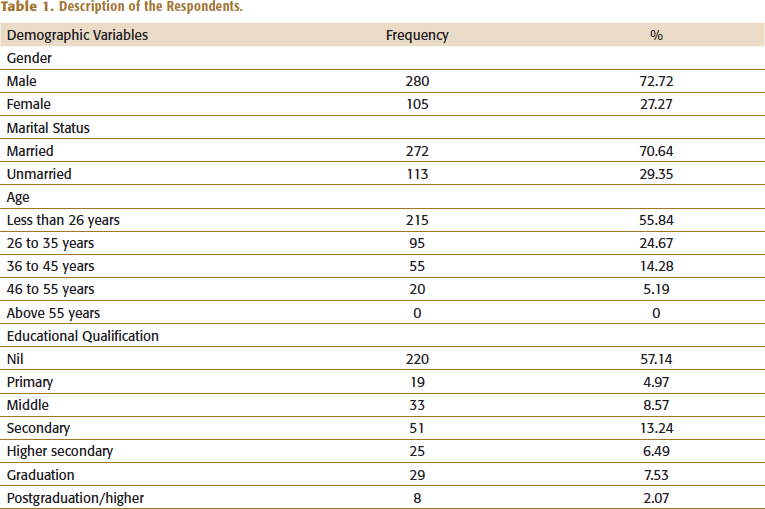
Table 1 exhibits the demographic characteristics of the respondents. As seen from Table 1, the sample comprised 72.72% male wage workers and 27.27% female workers. Males mostly dominate wage working population due to the gendered division of labour which views household chores as the sole responsibility of women. In addition, survey findings showed that 70.64% of respondents were married, and 29.35% were unmarried. The majority of the respondents engaged in wage-earning were under 35. Moreover, most of the respondents were illiterate though around 50% had completed either primary education or passed middle grade school.
Description of the Respondents.
Pre-testing of the Instrument
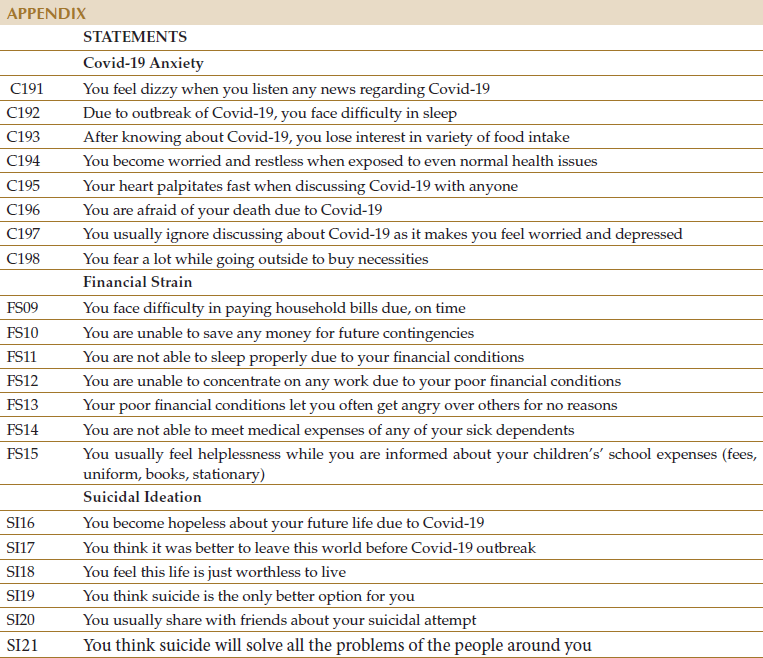
A comprehensive list of items corresponding to each dimension was drawn up based on five focus group discussions held in April 2020. The pilot survey consisted of 20 respondents in each group. Existing studies (Nock et al., 2007; Olatunji et al., 2006; Sears et al., 2014) were also reviewed to develop the questionnaire. Subject experts were consulted to verify the validity, logic and readability of the questionnaire (see Appendix). Pre-testing was carried out on 30 wage workers. In total, 21 items from the original set of 27 items were retained while the remaining were removed on the grounds of irrelevance and repetition. All the answers were reported on a Likert scale of five points, ranging from 5 ‘strongly agree’ to 1 ‘strongly disagree’.
To examine the reliability, item analysis was performed where inter-item correlations of all the dimensions were positively correlated, except one item related to Covid-19 anxiety (C195), financial strain (FS14) and suicidal ideation (SI17) each, that were removed. Further, positive item to total correlation and high Cronbach’s Alpha (above 0.80) indicated good reliability of the measurement scale (Carmines & Zeller, 1979).
Exploratory Factor Analysis
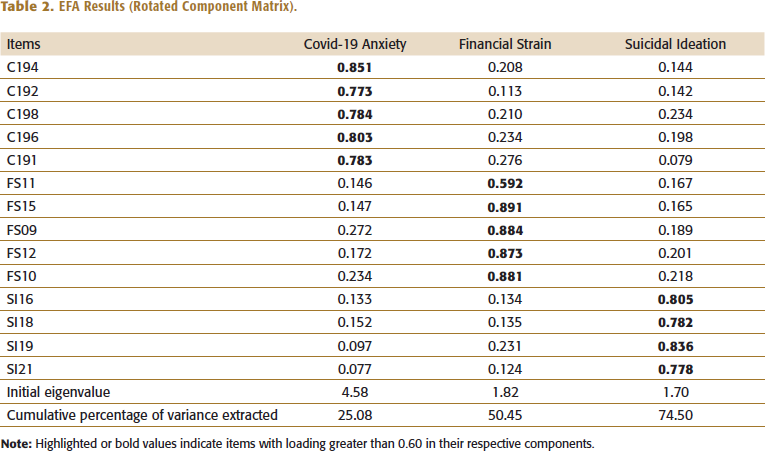
To test the relevance of items to the underlying constructs, exploratory factor analysis (EFA) using principal component analysis with varimax rotation was conducted on the data set collected from 100 respondents (Malhotra, 2003). As Hair et al. (1998) has suggested, the sample size of 100 or greater is sufficient to conduct factor analysis. The factor loadings of scale items, eigenvalues and percentage of variance for all the constructs after rotation are shown in Table 2. These three factors have eigenvalues of more than one with 74.50% of cumulative variance. The Kaiser–Meyer–Olkin sampling adequacy measure was found to be 0.811, and for Bartlett’s sphericity test, the approximate chi-square was 1012.22 with df = 67 and was significant at 0.05. Except for some items (C193, C197, FS13 and SI20) that were dropped because of their poor loadings in their respective factors and because of cross-loading issues, results showed all the items’ satisfactory loadings (>0.60) shown in bold. As also seen in Table 2, all the items met the required minimum value, thus supporting our measurement model’s reliability and indicating that the data set was sufficient for further study.
EFA Results (Rotated Component Matrix).
Confirmatory Factor Analysis
Confirmatory factor analysis (CFA) on 14 items related to Covid-19 anxiety, financial strain and suicidal ideation was also performed on the final sample of 385 respondents to confirm the dimensionality of measurements retrieved from EFA. Hair et al. (1998) suggested factor loadings above 0.70 as good, and above 0.60 as acceptable. After performing CFA, it was observed that chi-square/df = 2.23; Goodness of Fit Index (GFI) = 0.894, Comparative Fit Index (CFI) = 0.929, Root Mean Square Residual (RMR) = 0.050 and Root Mean Square Error of Approximation (RMSEA) = 0.081, indicating that all model fit indices are acceptable. All the items have loadings above 0.70, so all 14 items have been retained. Further path estimates (CFA loadings) of the measurement model for both dependent and independent variables which are above 0.60; average variance extracted (AVE) above 0.50 and composite reliability (CR) above 0.70, depicted in Table 3 indicate convergent validity as well as internal consistency. As the squared correlation between the latent variables does not exceed the variance extracted for each variable, discriminant validity is established (Bhat et al., 2023b).
Results of CFA and Reliability/Validity Estimates.
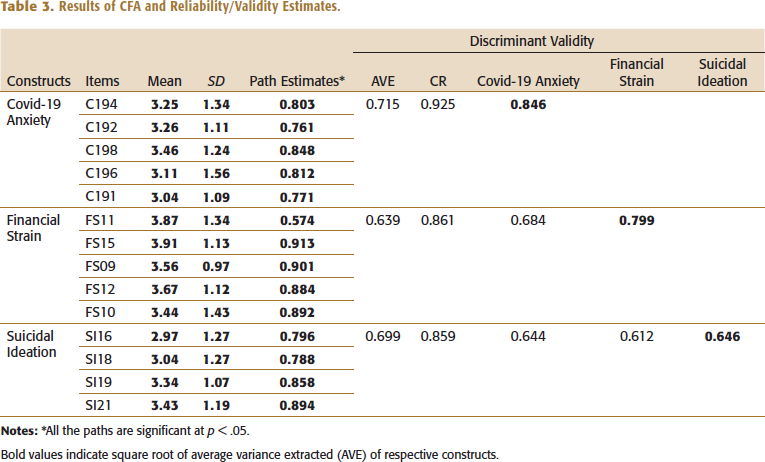
Bold values indicate square root of average variance extracted (AVE) of respective constructs.
RESULTS AND DISCUSSION
We began to define the model of the covariance system, which includes three sub-models of measurement and the structural relations between them. All three measurement models are uni-dimensional (Covid-19 anxiety, financial strain and suicidal ideation). The models comprise one exogenous (financial strain) and two endogenous factors (Covid-19 anxiety and suicidal ideation) and, therefore, involve a residual error. The study uses the maximum likelihood estimation approach to authenticate the findings and test the hypotheses with 2,000 sub-sample bootstrapping procedures. From the structural model shown in Figure 1, it is revealed that model-fit indices are within acceptable ranges.
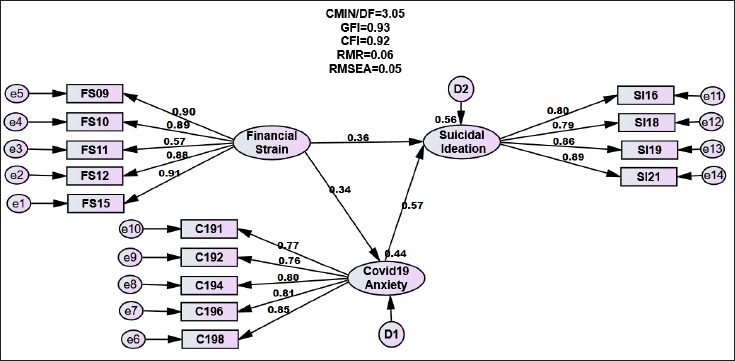
The hypotheses were tested by examining the standard regression estimates, critical ratios and level of significance (p value). As seen in Table 4, the financial strain →suicidal ideation path has a regression estimate of 0.36, a critical ratio of 8.46 significant at 0.01 and thus supports H1. In addition, financial strain →Covid-19 anxiety path has an estimated regression of 0.34, a critical ratio of 6.34 significant at 0.01, thus supporting H2. Following the same procedure, Covid-19 anxiety →suicidal ideation path has a regression estimate of 0.57, a critical ratio of 6.53 significant at 0.01, and supports H3. The coefficient of determination (R²) indicates that 0.56% of suicidal ideation is determined by financial strain and Covid-19 anxiety, and 44% of the remainder is explained by other variables not undertaken in the present analysis. As revealed by R², up to 44% of Covid-19 anxiety is determined by financial strain separately. Hence, financial strain among wage earners was found to be positively linked to suicidal ideation in the present study. It suggests that suicidal thoughts came to wage workers because of the financial strain they faced due to the lockdown and the pandemic. On the other hand, the pressure of financial strain enormously changes the cognitive structure of wage earners. It may create feeling of being unable to fulfil the family’s basic needs exacerbating Covid-19 anxiety leading to suicidal thoughts. The findings are supported by existing studies (Beghi & Rosenbaum, 2010; Sun & Zhang, 2016; Zhang et al., 2017a; Zhao & Zhang, 2018).
Results of the Structural Model.
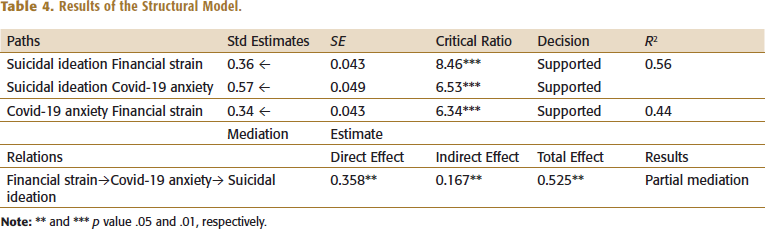
Mediation analysis was performed for testing H4 via bias-corrected percentile bootstrap with a confidence interval of 95% to get standardized results. Table 4 reflects that there is a substantial direct association between financial strain and suicidal ideation (p value = .000) as well as an indirect relationship by Covid-19 anxiety (p value = .000). In these situations, it is suggested that if both direct and indirect paths are significant, divide standardized indirect effect by standardized total effect, if the result is more than 50%, then there is proof of complete mediation, and if it comes less than 50% then it is regarded as partial mediation (Hair et al., 2010; Kline, 2011). Covid-19 anxiety thus partly mediates the effect of the financial strain on suicidal ideation. So H4 is accepted in part. The present study explains that the direct association of financial strain and income is not responsible for the occurrence of anxiety related to Covid-19. Still, there is a vicious cycle between financial difficulties and thought patterns. The link between Covid-19 anxiety and suicidal ideation has also been confirmed in this study. It indicates that many shadowed co-morbid factors are associated with the survival of wage workers, leaving suicide as the only solution for them. The results suggest that financial strain and anxiety are contributing factors to suicidal behaviour in this outbreak of Coronavirus. However, financial strain was found to be directly related to suicidal ideation, as Covid-19 anxiety alone is not correlated to suicidal ideation directly. These findings align with the studies conducted by Aquila et al. (2020) and Dar et al. (2017). The present study discovered that anxiety is compatible with the presented theoretical model fostered by general strain theory and appears to be a major predictor of suicidal ideation, with financial strain contribution.
CONCLUSION: SUGGESTIONS FOR POLICY AND RESEARCH
As evident from the study, wage workers were the worst hit during the pandemic. Learning from this experience, it is now clear that government, non-government organizations and religious societies have a vital and supportive role to play. The government should adopt a proactive protection mechanism offering food security and health insurance specifically to protect the wage-earning segment of the population in case of a crisis. Moreover, the government should facilitate registration of workers with labour and employment organizations for various schemes, compensation and other benefits.
Future studies would make ample efforts to identify some other causes that compel wage workers to find suicide as the sole option left due to the pandemic. Unveiling other causes would prove helpful in creating policies effective for the wage-earning segment, especially during a crisis. Further studies need to be conducted in different settings to draw context-specific findings to validate the findings of this study.
APPENDIX
Footnotes
DECLARATION OF CONFLICTING INTERESTS
The authors declared no potential conflicts of interest with respect to the research, authorship and/or publication of this article.
FUNDING
The authors received no financial support for the research, authorship and/or publication of this article.
e-mail:
e-mail:
e-mail: