




Abstract

Keywords
In a two-line letter, Bansal Pathways Pvt. Ltd, the concessionaire redeveloping the Rani Kamlapati (Habibganj) railway station in public-private partnership (PPP) mode, withdrew the year-old modification proposal to construct an additional podium at the station entrance (Bansal, 2018). The proposed 10,000 sqm podium, at a height of nine meters, would have enhanced the station’s grandeur, improved its aesthetics, and enabled seamless road access. The concessionaire had offered to construct the podium at no additional cost to the Indian Railways (IR) (Bansal, 2017).
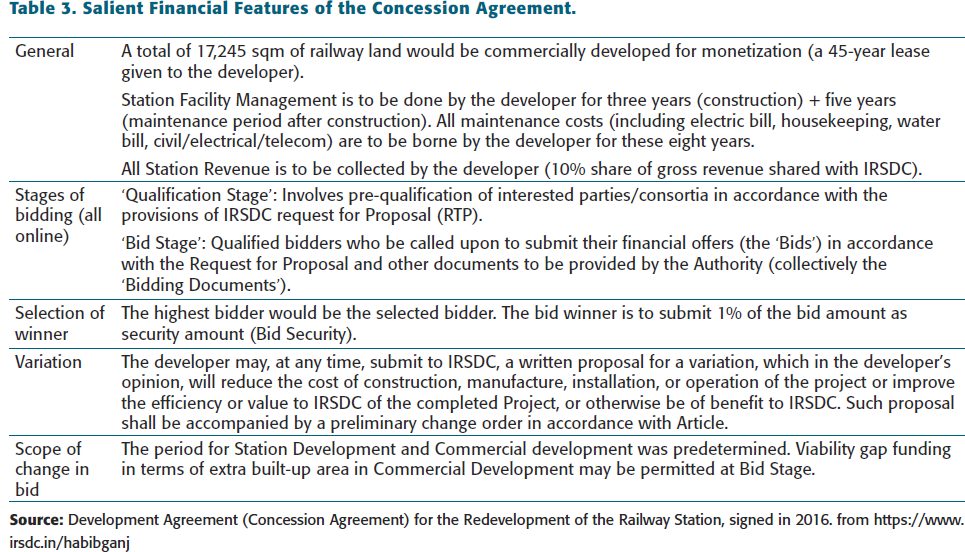
The railway station at Habibganj was the first station redevelopment project to be undertaken as a PPP project to rebuild railway stations like airports with world-class facilities (Sood, 2017). The redevelopment involved an investment of a billion rupees in the station by the concessionaire in return for the permission to undertake a ₹3.5 billion commercial development over 17,245 sqm of surrounding vacant railway land, with a built-up area of 1,13,494 sqm (Indian Railway Station Development Corporation [IRSDC], 2015).
The withdrawal of the modification proposal ended the ambiguity impacting the project’s progress. It reaffirmed the initially agreed project delivery timelines. At the same time, the non-inclusion of the podium construction inhibited the station from seamlessly integrating with other urban transport modes, now and in the distant future. The redeveloped station, the existing Bus Rapid Transit System (BRTS) corridor, and the proposed metro rail infrastructure would forever remain evidence of piecemeal and assorted urban transport developments.
Though the ambitious plan for the podium construction did not materialize, the concessionaire’s associated proposal to increase the built-up area for commercial use by 26,000 sqm remained approved (Bansal, 2017). While the concession agreement was flexible enough to accommodate changes leading to higher private value creation, it was relatively inflexible to accommodate changes that could result in increased public value. The PPP paradox of public losses-private gains had found its way into the first railway station PPP project in the country.
It’s a bad plan that admits of no modification.
- PubliliusSyrus, Roman slave, poet (100 BC)
IRS STATION REDEVELOPMENT
IR held a monopoly over rail-based passenger movement in India. In 2018, it carried over 23 million passengers per day and moved nine billion passengers (Ministry of Railways, 2019), proudly establishing itself as the lifeline of the nation. However, in the last half-century, it witnessed a sharp decline in the national passenger movement share (i.e., decreasing from over 30% in 1970 to 13% in 2004). With passenger transportation being a political mandate for IR, passenger fare increases had not kept pace with inflation and remained one of the lowest globally (BS Bureau, 2005). IR was known to cross-subsidise passenger transport by freight transport (Singh, 2016).
Simultaneously, IR was also aware of the need to improve passenger amenities at its railway stations. Railway stations played a critical role in passenger movement and had been subjects of under-investments over time (Garg & Chaudhary, 2017). Piecemeal improvement attempts had faced fund shortages and an inherent lack of long-term developmental focus. Despite numerous proposals for making railway stations world-class and adarsh(a Hindi world for ideal), the stations remained dirty, congested, and overcrowded, with minimal infrastructural improvements. Loss of human life during the stampede at Lucknow railway station in September 2002 (TNN, 2002) and Prayagraj railway station in February 2013 (PTI, 2013) showed the desperate need for station redevelopment. The stations of IR pale were in comparison to railway stations globally and newly developed airports in the country, which often exceed global standards (Agarwal, 2020). Overall, the railway stations of IR failed to meet the expectations of their customers on multiple fronts.
To bring a renewed focus on the up-gradation and redevelopment of the stations, the IRSDC was created in 2012 (IRSDC, n.d.-c) (
Events Leading to the Redevelopment of Rani Kamlapati Station.
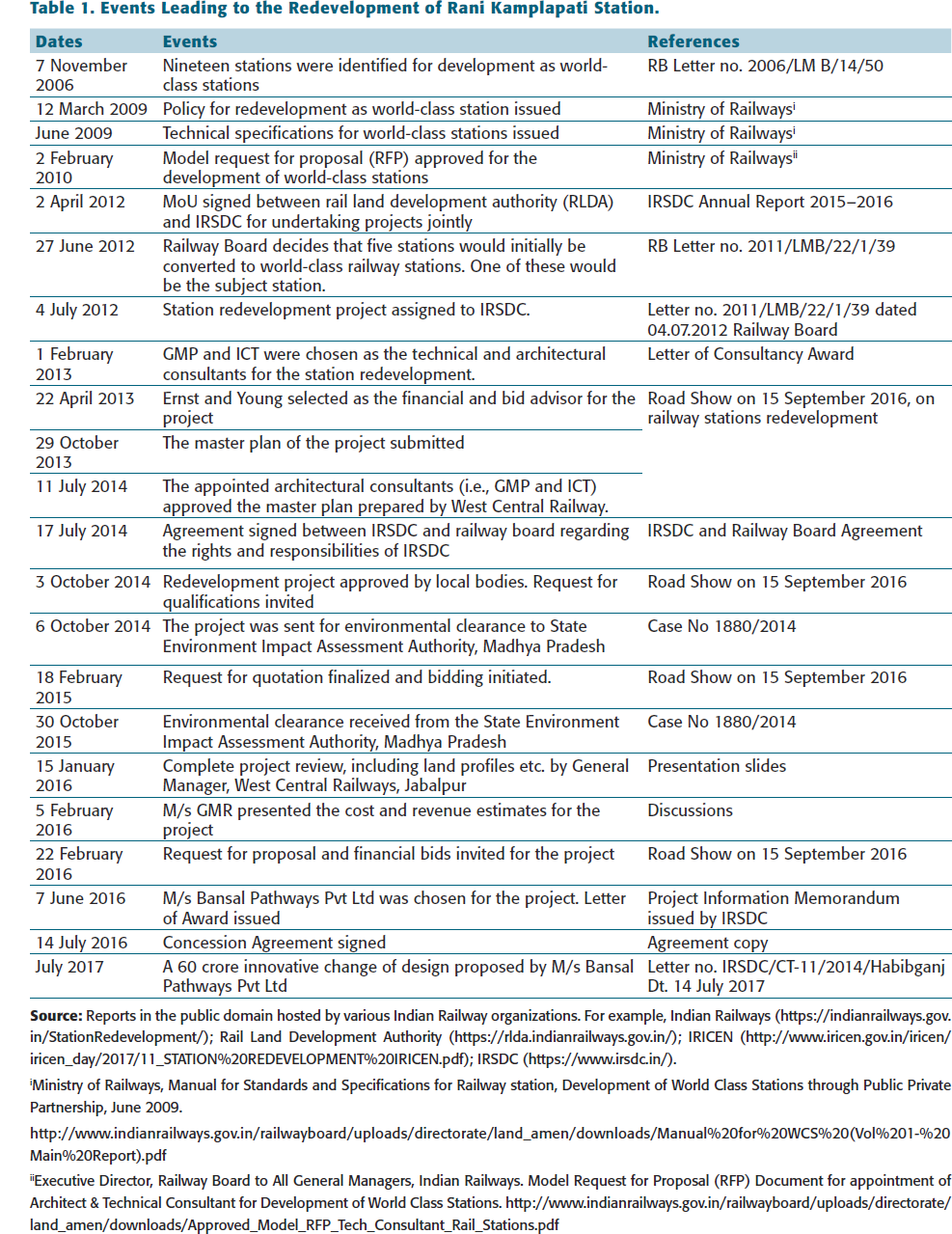
iMinistry of Railways, Manual for Standards and Specifications for Railway station, Development of World Class Stations through Public Private Partnership, June 2009.
iiExecutive Director, Railway Board to All General Managers, Indian Railways. Model Request for Proposal (RFP) Document for appointment of Architect & Technical Consultant for Development of World Class Stations.
Besides the redevelopment of Rani Kamlapati railway station, IR was also planning the upgradation of other stations. The Union Cabinet approved a proposal for revamping 403 railway stations across India in July 2015 (Khanna & Nanda, 2015; PTI, 2016a). This grand upgradation proposal envisaged redevelopment of railway stations at the cost of ₹280 billion, along with an investment of ₹680 billion in commercial redevelopment of 2,700 acres of railway land at railway stations. In 2017 IRSDC proposed the redevelopment of 23 railway stations on the PPP mode, using an innovative modified Swiss-challenge method for procurement (Garg & Chaudhary, 2017).
For IR, a major concern was the ambiguity around the labels of redevelopment, upgradation, and world-class. What did these terms imply, and were they different? To address this ambiguity, IR conceptualized the specifications of a world-class railway station (Ministry of Railways, 2009). To be viewed as a world-class station, a railway station would need to meet four conditions:
Separation of train boarding/deboarding areas from passenger waiting areas. Separation of arrival and departure areas. Provision of easy and hindrance-free access/exit (road) to people using the facilities. Provision of multi-commercial usage.
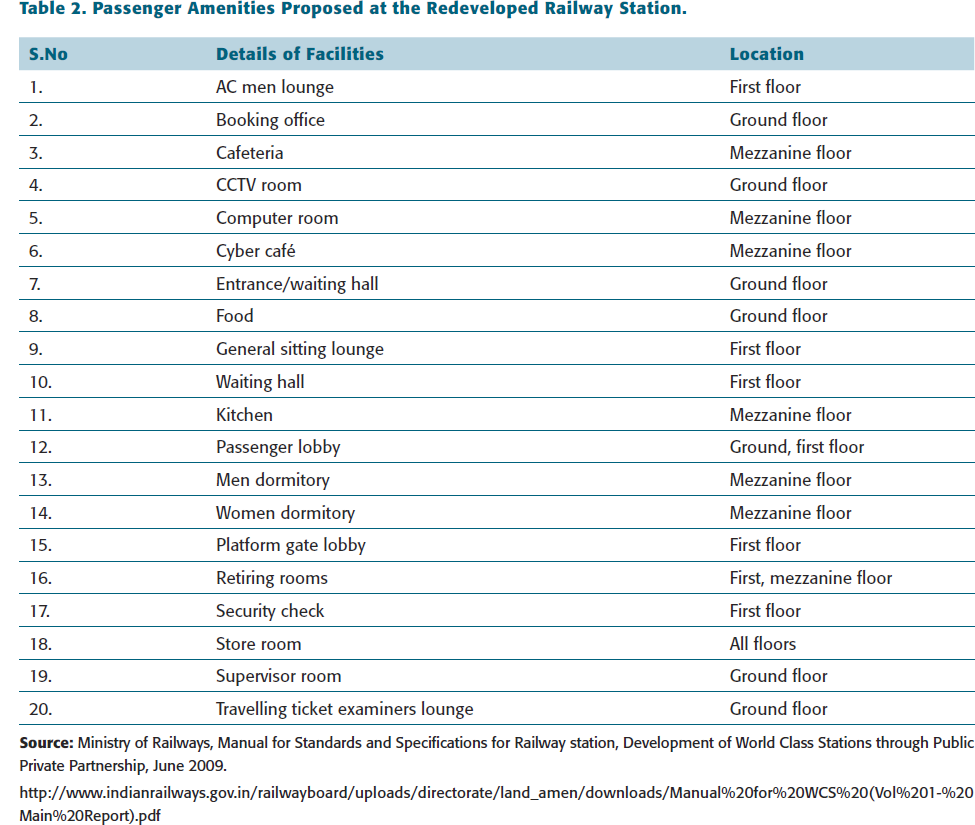
These conditions were supplemented with detailed standards and technical specifications (see Table 2 for the list of amenities to be provided at a railway station).
Passenger Amenities Proposed at the Redeveloped Railway Station.
RANI KAMLAPATI RAILWAY STATION REDEVELOPMENT
Rani Kamlapati station, originally developed as the Habibganj station, was one of the newer stations on the IR’s one-and-a-half-century-old network. Commissioned in 1975, it was the second station in Bhopal, the capital city of Madhya Pradesh. Inaugurated by the then Prime Minister of the country, Mrs Indira Gandhi, the first Shatabdi Express train was flagged off from this station on 14 November 1988. It had numerous strategic advantages. Located south of the Bhopal station, all southbound trains to and from Bhopal station pass through it. Located just five km from the central Bhopal station, the station developed in the Habibganj area was nearer to the newer government and private settlements in the city suburbs. With the city rapidly expanding to 10 km beyond of Habibganj area, the railway station was almost in the city’s centre. In 2014, the station catered to 0.26 million passengers daily (IRSDC, 2015). Of the total railway land of 27,093 sqm, the railway facilities occupied a mere 9,848 sqm, while the rest was lying vacant or encroached.
Plans for the railway station’s redevelopment had been frequently discussed at local, state, and national levels, so numerous development proposals existed. IRSDC was entrusted with the station on 4 July (TNN, 2014). To finalize a master plan and prepare preliminary designs for the station, IRSDC floated bids to appoint architectural and technical consultants. M/s GMP International Gmbh, Germany and M/s Intercontinental Consultants and Technocrats Pvt. Ltd., New Delhi, were awarded the consultancy work for ₹42.3 million in January 2013. The consultants brought extensive global experience in the design of railway infrastructure, having designed the Berlin-Spandau Railway Station, Germany in 1998 and the Tianjin West Railway Station, China, in 2011, besides hundreds of other iconic urban infrastructures (Projects - GmpArchitekten, n.d.).
The consultants considered numerous redevelopment proposals, including demolishing and reconstructing the existing building. However, demolition would have devalued the existing building, which was seen as an architectural symbol in the city. After extensive deliberations (TNN, 2014) and considering the specifications of a world-class station, the consultants proposed that the station be redeveloped with a 60-meter-wide overhead passenger concourse and two subways. The concourse and subway would connect the east and west sides of the station and provide unrestricted access to each of the six platforms at the station. The platforms would further connect to the concourse and subways by lifts and ramps while separating arriving and departing passengers with minimal crowding at the platforms. The passenger concourse would provide the departing passengers with a waiting area where they would have restaurants and shops. The arriving passengers could use the two subways and directly exit the station at both the east or west ends. Hence, the pickup and drop-off areas would separate on the roadside, providing hindrance-free access to the station (see Exhibit 1 for the proposal schematics). But they would be on the same level, allowing their intermixing. The consultants estimated the station redevelopment cost at ₹2.3 billion, for which it was decided to invite private firms to redevelop the railway station in return for commercial development rights on the railway land.
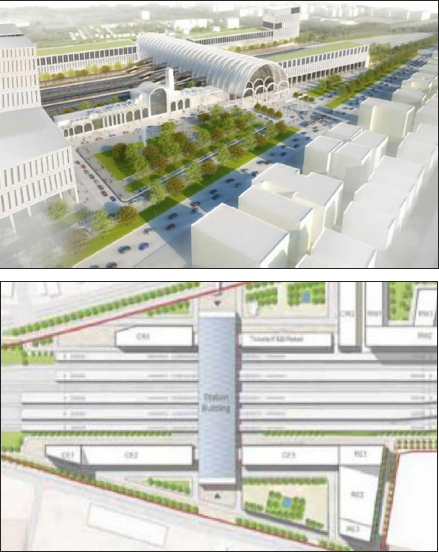
After extensive discussions, IR and IRSDC approved the master plans and preliminary designsprepared by the architects and consultants. M/s Ernst and Young were invited to conduct a financial analysis for the project and manage the bidding process. The financial analysis revealed that the commercial potential of of the designated vacant land railway land was insufficient to meet an investment of ₹2.3 billion required for station redevelopment. The plans needed to be scaled down on considering the macroeconomic development aspects like the city growth trajectory, availability of commercial space, the commercial potential of the railway land, growth prospects of the station, level of current rail traffic, and congestion on the roads leading to the station. A revised plan for ₹1 billion investment in the first stage was formulated, which could be financially supported by the commercial development of four land parcels. In the first stage, commercial development of four land parcels was proposed, with a 45-year lease period. To reduce station redevelopment costs, the width of the passenger concourse was reduced at different stages from 60 meters to 30 meters and subsequently to 10 meters, allowing for future widening, if needed. Exhibit 2 provides the finalized schematics for station redevelopment. These formed the basis for the IRSDC’s bid invitation for the station’s redevelopment (Sharma, 2017).
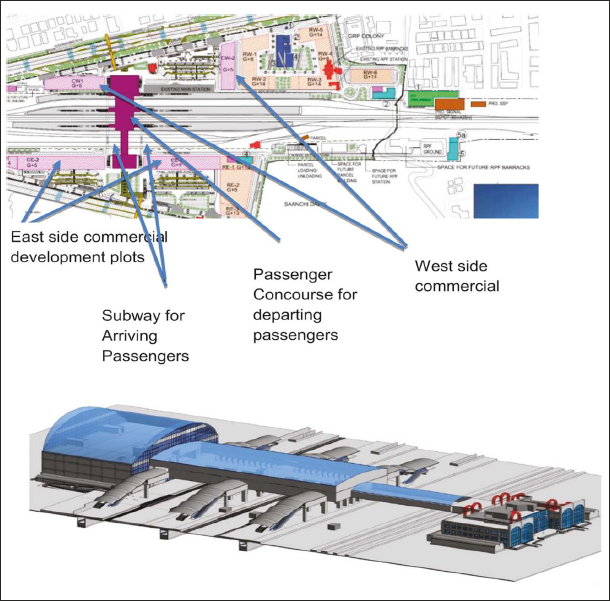
The redevelopment plan bundled two distinct parts, that is, mandatory development of the railway station and commercial development on railway land. The station’s mandatory development had a three-year construction period, with five years of post-commissioning operations and maintenance obligations. The redeveloped station would be transferred to IR free of cost at the end of the eight-year concession period. During the construction and operational period, the concessionaire would be responsible for all aspects of station management, except train operations, and entitled to all station revenues, except passenger ticket revenue.
As per their development plan, the station would have significantly upgraded facilities that would match global standards. For instance, all six platforms would have 100% cover, increasing it from the existing 30%, and all platforms would be provided with new antiskid flooring. The platforms would have access through escalators, elevators, and ramps, and they would be decongested by relocating all railway services to alternate locations. Further, the station would have dedicated areas for passenger pickup, drop-off, and parking. Designed to meet Gold Leed Standards, the station would be green in multiple ways, using solar panels for electricity generation and employing rain-water harvesting plants (Ministry of Railways, 2016). The streamlined and redesigned entries and exits would allow the station to be evacuated in under four minutes.
Commercial development, estimated at ₹3.5 billion, was permitted on a total of 17,245 sqm of land, allowing for 1,13,494 sqm of commercial space (to be built) with a floor area ratio (FAR) of 2.43 that was well within the allowable urban limit of three. Two of the identified land parcels lay on the west side of the Station (Commercial West [CW] 1 3436 sqm and CW-2 2896 sqm). The built area allowed on these was 20,616 sqm and 17,376 sqm, respectively. Two land parcels were located on the east side of the Station (Commercial East [CE] 1 1253 sqm and CE-2 5,158 sqm), and these were allowed built-up areas of 17,542 sqm and 30,848 sqm, respectively. Forty-five-meter height of construction was allowed, with 100% coverage area.
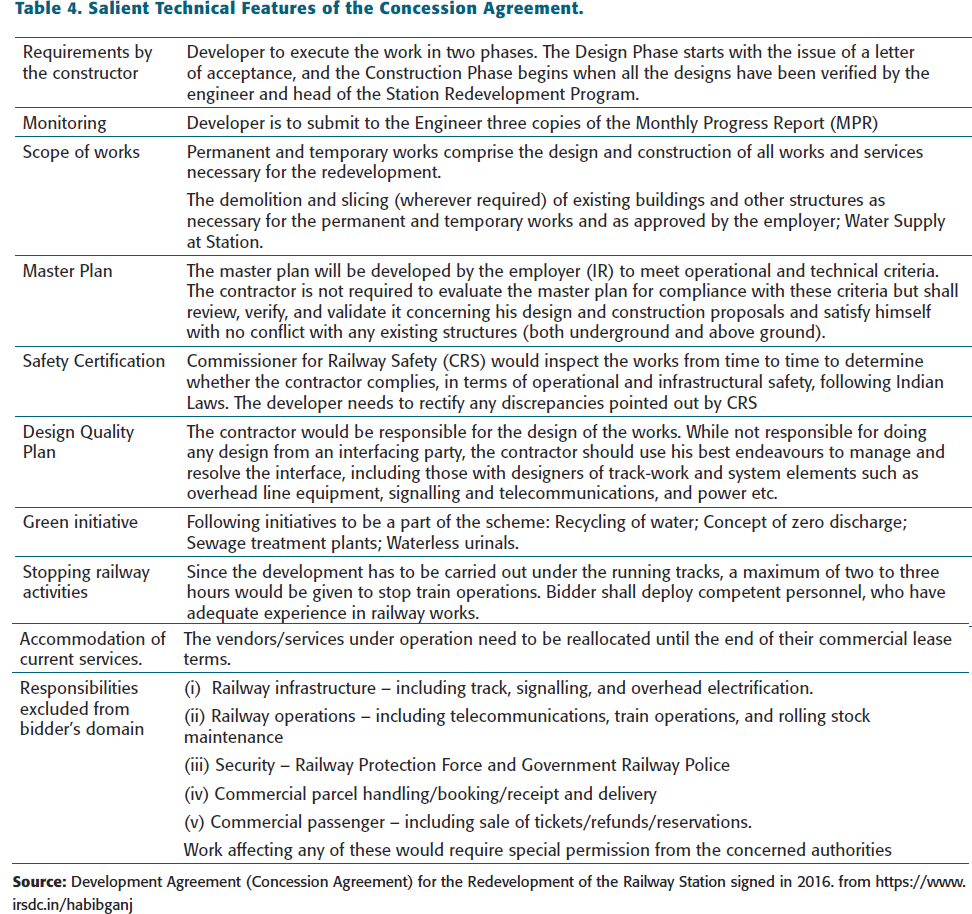
Tables 3 and 4 summarize the salient financial and technical features of the development and concession agreement, which ran into 1856 pages.
Salient Financial Features of the Concession Agreement.
Salient Technical Features of the Concession Agreement.
With an architectural, technical and financial plan in place, the bidding consultants, that is, M/s Ernst & Young, initiated three-stage bidding for the project, that is, qualification stage, request for technical proposal, and financial bid. Three firms showed initial interest in the project. The concessionaire for the Delhi Airport, that is, M/s GMR, was the largest firm to show interest in the project. A consortium of local business houses of Madhya Pradesh, led by M/s Bansal Pathways Pvt Ltd., also showed interest in the project, and so did the North India-based civil contractor, that is, M/s Ahluwalia Contracts India Limited. During the bidding stage, M/s GMR backed out, arguing that the project was too small for them. M/s Ahluwalia did not go ahead with the bid as they preferred participating in greenfield projects in North India, where many similar opportunities arose, such as the new Brijwasan Station near New Delhi. M/s Bansal Pathways, a part of the Bansal Group, remained the only bidder for the project. The Bansal group were pioneers in technical education in central India, and they owned and managed six engineering colleges and one pharmacy college. They were also a highly diversified group, with a presence across mining, steel bar manufacturing, construction, commodity trading, and also operating a news service and a 300-bed super speciality hospital. Over time, they expanded their geographic reach beyond Bhopal to the state of Madhya Pradesh, but they maintained a regional Central India tag.
For IR, the PPP mode redevelopment of the railway station was the first significant redevelopment initiative. It marked the culmination of a decade-long planning exercise and was expected to pave the way for redeveloping other railway stations on the IR network. As the project showcased the central government’s achievements in the rail sector, its progress was directly monitored by the Prime Minister’s office, making it a project of national importance.
PROJECT AWARD
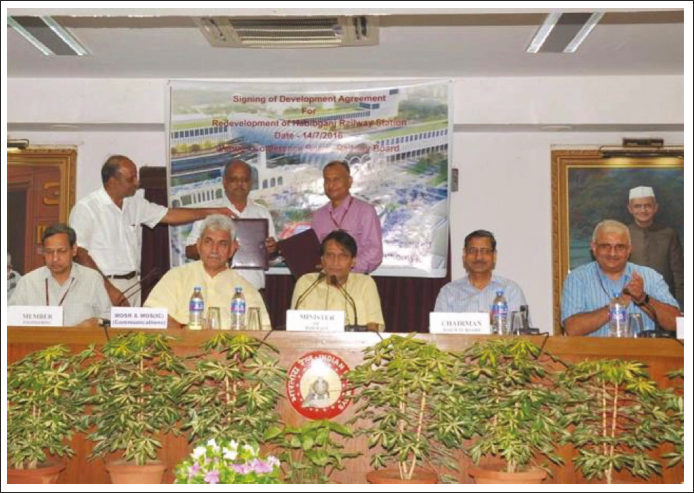
M/s Bansal Pathways Pvt. Ltd. was awarded the project on 7 June 2016. The contract agreement was signed a month later, on 14 July 2016, in the presence of the Railway Minister (please see, Exhibit 3). During the agreement-signing ceremony, the minister requested the concessionaire to take up the project as a challenge and complete it within two years(PTI, 2016b), suggesting squeezing the three-year construction period by a year. For undertaking the project, the bidder registered a special purpose vehicle, that is, M/s Bansal Pathways Pvt. Ltd. (hereon referred to as the concessionaire). The concessionaire subcontracted the construction activities to the construction arm of the bidder, that is, M/s Bansal Pathways Pvt. Ltd.
The Bansal group had a formidable presence in Central India. Their knowledge of Bhopal city, where they were headquartered, brought a unique local perspective to the transit-led urban redevelopment targeted by the station redevelopment. They appointed M/s AECOM, a global infrastructure and consultancy firm, to work out the architectural details of the mandatory parts of the project. M/s Bentel Associates International, an architectural studio specialising in commercial infrastructure, were appointed to design the commercial complexes. The assistance of a local architectural firm, M/s studio plus, was also taken periodically as its lead architect Mr Manoj Sharma had been associated with the original redevelopment conceptualization (2009), much before IRSDC had come on the scene.
The concessionaire decided to stage the construction. It prioritized mandatory station redevelopment, followed by commercial developments of the land parcels on the west side (i.e., commercial development of CW-1 and CW-2). The commercial development on the east side (i.e., CE-1 and CE-2) was to be taken up later. The staging, aimed at reducing project complexity, also partially reflected the downturn in the real estate market. The concessionaire wanted to test the market demand and secure cash inflows before committing to large equity investments and availing large project debt. IR handed possession of the site to the concessionaire on 1 March 2017, and physical work started in June 2017.
IRSDC appointed a nodal officer to monitor project progress and enable coordination between the concessionaire and IR. As per the contract, the concessionaire appointed M/s AECOM for detailed engineering designs after securing the approval of both IRSDC and IR officials. M/S AECOM, a reputed design engineer, was in the IR’s approved list of consultants; hence, they were well conversant with railway-specific safety and quality requirements. Project management was done internally utilising the concessionaire’s personnel.
THE CHANGE PROPOSAL
On developing the architectural plans for the new commercial complexes, M/s Bentel, the architects felt that by adding an extra podium in the mandatory portion, the connectivity of the two commercial complexes on the west side (i.e., CW-1 and CW-2) would become seamless. Simultaneously, the roadside traffic flow would also get significantly improved. They proposed changing the mandatory portion in consultation with M/s AECOM, M/s Bansal, Railways and IRSDC. After numerous informal discussions, the concessionaire submitted a formal proposal to add the extra podium (hereafter referred to as modification proposal) to IRSDC on 10 November 2017 (Bansal, 2017). Modifications were proposed in both the mandatory and commercial redevelopment plans. For the concessionaire, the proposal made business sense as the value of the commercial complexes with a 45-year land lease would be significantly enhanced due to seamless connectivity between them. Similarly, for IRSDC and IR, the proposal enhanced the urban traffic flows, integrating rail, road, BRTS and metro.
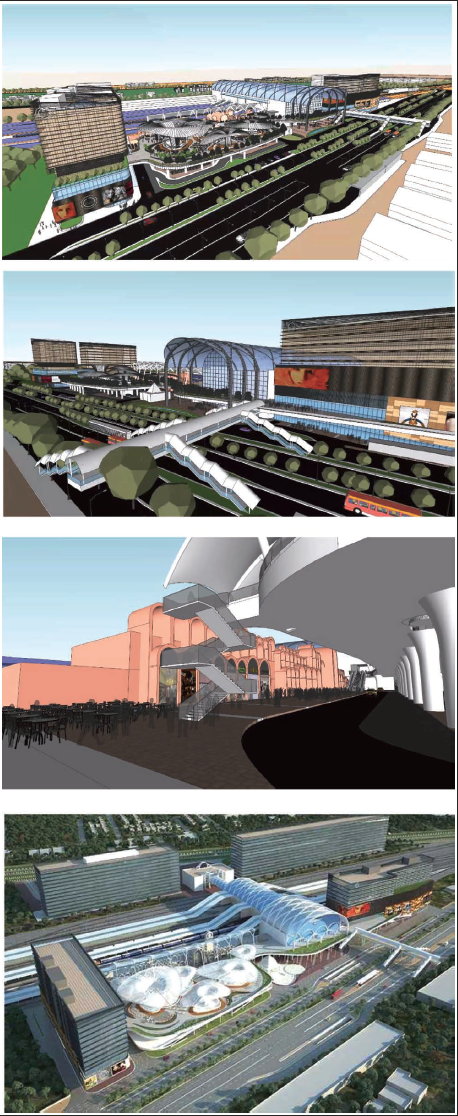
M/s Bentel proposed that similar to the vertical separation on the rail side, vertical separation on the roadside would dramatically ease access to the station. For this, a 9.34 m high elevated podium was proposed on the station’s west side. With a footprint of 10,393 sqm over the existing open ground-level parking (retained in the proposed design), it would allow vertical separation of the pickup and drop-off zones. It was also envisaged that in the future, the podium would enable the integration of the railway station with the upcoming metro rail station and the already operational BRTS. On the rail side, the podium would seamlessly integrate with the passenger air concourse, have skyway connections with the west side commercial complexes, and add to the station’s overall aesthetics and grandeur. Open-air rooftop restaurants were proposed on the podium roof, which would provide an alternative source of revenue for the concessionaire (Bansal, 2017).
As the elevated podium would stand over the existing ground-level parking, additional double basement parking of 12,423 sqm and 12,273 sqm, respectively, was proposed below the podium. These additional parking bays would allow for an additional mezzanine floor of 5455 sqm. Hence, the modification proposal would segregate the drop-off zones, that is, public vehicles drop-off on the ground floor, private vehicle drop-off on the mezzanine floor, and pick-up zone in the basement. This vertical segregation on the roadside would smoothen out both vehicular traffic and pedestrian circulation. The change would also allow the concourse to connect with the basements, ground, and mezzanine floors with escalators, staircases, and lifts through the podium, which was unavailable in the current design. However, as the elevated podium would cover the elevation of the existing and new buildings, it required a change in the master plan before it could be taken up. Exhibit 4 provides the artistic impression of the change plans submitted by the concessionaire (Bansal, 2017).
The modification proposal would add 30,515 sqm of covered station parking and circulation area. It would cost the concessionaire an additional ₹0.4 billion, with no additional financial burden on IR. The concessionaire expected that as the proposal involved extra basement parking, provision for rooftop restaurants, improved roadside linkages, and better station aesthetics would enhance the railway station’s long-term value, the required permissions would automatically follow. Hence, while proposing the changes, the concessionaire cited article 23.3.1 of the agreement, per which,
The developer may, at any time, submit to IRSDC a written proposal for a variation, which in the developer’s opinion, will reduce the cost of construction, manufacture, installation, or operating the project or improve the efficiency or value to IRSDC of the completed Project, or otherwise be of benefit to IRSDC. Such proposal shall be accompanied by a preliminary change order in accordance with Sub-Article 23.4 below and a confirmation that the variation would not result in any reduction to the standard or quality of the project or the performance of the developer’s obligation under the agreement. (IRSDC, 2014)
The concessionaire further requested changes in the plans for the commercial complexes (i.e., CW-1 and CW-2). While the existing plans were for structures with ground plus five floors, the concessionaire requested that it be permitted to build ground plus nine and ground plus eleven, respectively. The proposal aimed to increase the financial viability of commercial development by increasing the leasable/rentable area. For CW-1, three basements were proposed for parking instead of two, increasing the parking area from 10,177 to 15,256 sqm. Similarly, CW-2 would have three basements for parking instead of two, increasing the parking area from 9027 sqm to 13,540 sqm. With the modifications, the FAR would increase from 2.43 to 2.59 but remain well within the allowable limit of three. The development agreement clauses allowed for such changes. Clause 30.2.3 of the development agreement stated that the developer might propose to build an additional built-up area on the site in terms of any revision of FAR/FSI (Floor Space Index) by any government authority. The responsibility of taking all consultations/statuary approvals from government authorities/local bodies etc., for the revised proposal/ layout plan, would rest with the developer (Bansal, 2017).
The concessionaire agreed to pay the additional lease premium and the increased annual lease rent that the increased leasable area would attract, as per the development agreement clauses. As the leasable built-up area for CW-1 would increase to 31,093 sqm and for CW-2 to 33,384, they would draw a one-time additional lease premium of ₹90 million and ₹130 million, respectively. The annual lease rent would also increase to ₹27 thousand for CW-1 and ₹30 thousand for CW-2. The concessionaire agreed to all of these additional payments while preferring to defer the one-time lease premium (paying a 15% annum interest). The project manager concluded the letter requesting modification with the ʻhope that you find above in order and approve our proposal and advise us as per Clause 30.2.3 of Article 30 of the Development agreementʼ, which stated,
In the event that the developer proposes to build an additional Built-Up Area on the site in terms of any revision of FAR/FSI by any Government Authority, the developer shall be required to pay an additional Lease Premium and increased Annual Lease Rent for the remaining period of the term. (IRSDC, 2014)
Based upon formal and informal discussions with railways, local governments, concessionaires, metro and BRTS operators, etc. IRSDC granted in-principle approval to the modification proposal on 2 April 2018. It agreed with the concessionaire that the proposed modifications were technically, legally, and contractually feasible for implementation. Still, it argued that they would be subject to height clearance from the Airport Authority (as the height of commercial buildings would increase from 45 to 68 m), a new traffic impact study, compliance with construction, and safety standards, adherence to fire safety norms, and submission of a revised phase-wise commercial development plan (IRSDC, 2018).
In the meantime, on 6 December 2017, IR recognized IRSDC as the sole agency/authority for the approval of station master plans (Sood, 2017). Nevertheless, as the modification proposal entailed significant changes in the station’s layout, IRSDC approached Railway Board on 13 February 2018, to approve changes required to the master plan (MD and CEO IRSDC, 2018). IRSDC requested the ministry to convene a meeting of all stakeholders, take their views, and consider the proposal’s ratification, as the original master plan had been approved by it. Reminder letters were written on 12 March 2018, 28 March 2018 and 27 April 2018 (MD and CEO IRSDC, 2018).
By June 2018, almost two years had passed since the signing of the development agreement. The detailed drawings for the mandatory portion were yet to be finalized, as IR’s approval for the modification proposal lacked clarity. Under pressure from IRSDC to submit the design and drawings of the mandatory development, the concessionaire decided to withdraw its offer to build the elevated podium (Bansal, 2018). However, the change plan for the commercial development portion remained approved. The concessionaire communicated that it had complied with the conditions put forward by IRSDC on 25 July 2018, and proceeded with the construction as per the modified development plan submitted earlier.
After a significant delay in the project, some on account of COVID-19, the Prime Minister inaugurated the station and dedicated it to the nation on November 2021, during a visit to Bhopal. The station had been redeveloped per the design approved and finalized in the bidding documents (Singh, 2020).
UPDATE
In August 2023, the Prime Minister laid the foundation stone for the redevelopment of 508 stations as ‘Amrit Bharat Stations’ at an estimated cost of INR 244 billion (INR 24,470 crores). This was part of a larger plan to redevelop 1309 stations across the country, aiming to increase tourism, push economic activity in the nearby areas, and take the transformation of Indian Railways to a new height. The redevelopment would provide modern passenger amenities along with ensuring well-designed traffic circulation, intermodal integration and signage for the guidance of passengers while being inspired by local culture, heritage and architecture. However, as the redevelopment would be carried out in house and fully funded by government finances, this also signaled an end for the PPP-based station redevelopment experiment, of which Rani Kamlapati (Habibganj) railway station redevelopment was an example.
Footnotes
Notes
DECLARATION OF CONFLICTING INTERESTS
The author declared no potential conflicts of interest with respect to the research, authorship and/or publication of this article.
FUNDING
The author received no financial support for the research, authorship and/or publication of this article.
e-mail: