




Abstract
Social media platforms help brands connect with their customers online, and a social media -based brand community (SMBBC) enable brand attachments to particular brands. These brand communities enhance consumer relationships, increase customer advocacy, discover customer problems, and generate unique product and marketing ideas.
In the context of Social Identity Theory and SOR framework (stimulus-organism-response), the present study explored the influence of customer-centric elements (the four relationships) on an online brand community that affect and provoke members’ conscious brains to get into action. The study further examines the impact of SMMBC on brand trust and brand equity variables (brand awareness, perceived quality, brand association and brand loyalty) and, consequently, on customer response (purchase intention, response to brand extension and willingness to pay a premium).
A self-administered online survey was conducted to collect data on all selected brands. The brands were selected using a stratified sampling method, and the stratum used was the number of fans following the brands. The top three brands with the highest fan following from 15 sectors were picked. The study selected 384 final responses after the data screening procedure. SPSS version 26 and AMOS graphics were used for testing hypothesised relationship.
Exploratory factor analysis (EFA) was conducted to ensure that the selected scale items were appropriately loaded, followed by measurement model’s reliability and validity testing using Confirmatory factor analysis (CFA). The findings of SEM analysis conclude that customer-centric elements are significant determinants of the online brand community. The results also confirmed that strengthening SMBBC leads to higher brand trust and positively influences all brand equity dimensions. In addition, the research study found that positive brand equity results in favourable consumer responses.
This study contributes theoretically to past studies on brand community and customer response, mainly in social media. The findings are helpful for managers to design and manage their online brand communities effectively and to elicit more positive responses.
When customers are passionately connected to a brand and share this attachment with other customers, they form brand communities. Brand community refers to a forum in which the emotionally endowed brand members actively interact with each other. Muniz and O’Guinn (2001) defined a brand community as a specialized non-geographical entity built on structured social relationships among brand followers. Social media has developed into a vibrant platform for brand communities over the past couple of decades, forcing marketers to redirect their attention from offline brand communities they were previously involved into social media–based brand communities (SMBBC). Online or otherwise, marketers have successfully employed brand communities as an integral part of their brand-building strategy. A compelling case of the commitment to building an adoring brand community is the Harley-Davidson brand which in 1983 faced extinction but 25 years later was among the top-50 global brands with a valuation of US$7.8 billion, thanks to its Harley Owners Group (H.O.G.) (Fournier & Lee, 2009). Other successful multinational brands that effectively used brand communities to build their brands include Starbucks, Apple, LOreal, Lego, P&G, Golds Gym, Sony Play Station and even SAP. Many industries have given focal attention to social media platforms (Laroche et al., 2012) and have greatly influenced customer decision-making (Arekar et al., 2019), thereby benefitting firms (Icha & Agwu, 2015). Enormous reach, effective correspondence and lower cost of social media are the benefits that encourage organizations to become part of such platforms (Kaplan & Haenlein, 2010).
According to Fournier and Avery (2011), earlier academics considered online communities formed around companies as ‘uninvited crashers’ on social media. However, later studies revealed that SMBBC are essential predictors of customer behaviour as it influences brand loyalty and relationship quality (Habibi et al., 2016; Zaglia, 2013).
Brand communities benefit a brand in several ways; they strengthen the customer relationship, promote customer advocacy, identify customer pain points and provide a source to gather innovative product and marketing ideas. Social media platforms help brands connect with their customers online (Jain et al., 2018). According to Anderson (2005), brand communities allow the establishment of relationships with loyal customers and thus can be instrumental in generating innovative ideas. For instance, Lego uses creative ideas from its fan base for new product development. ‘My Starbucks Idea’ is another open innovation platform where fans actively participate in new product ideas. SMBBC members share information and experiences frequently, strengthening their relationships with brands, products, companies and other customers (Kim & Ko, 2012; Wu et al., 2015). Many studies highlight the impact of SMBBC on consumer purchase intention and brand relationships (Islam & Rahman, 2017; Jibril et al., 2019).
Brand communities benefit customers as well. Customers joining brand communities gives them a sense of identity and strengthens their relationship with the brand (Laroche et al., 2012; Zhang & Luo, 2016). Brands understand this and encourage customers to form relationships with the brand and among themselves. Gold Gym and Star Bucks provide a social link in their online brand community platforms and encourage their community members to meet and interact physically.
Inspired by some of the best online brand community examples (Brown et al., 2003), marketers are eager to learn how to synchronize and work with brand communities (Zhou et al., 2012). For the past two decades, academics have aggressively shared this interest with the online brand community (Kamboj & Rahman, 2017; Zhang & Luo, 2016). However, there are gaps in the current literature, of which three are relevant to the context of this study. First, Sierra et al. (2016) stated there is no consensus on the relationship sequence between brand community-related variables and marketing variables. This points to the need for an integrated model that depicts the antecedent–precedent roles of marketing and brand community-related variables. Second, According to Khanlari et al. (2015) and Brogi et al. (2013), the impact of SMBBC on brand trust and brand equity dimensions is not described directly. This is pointed out by Godey et al. (2016) and Ebrahim (2020) as well, who stated that the relationship between brand trust and brand equity dimensions (as perceived quality, brand awareness, brand association and brand loyalty) is not explicitly identified in the context of online brand community. Third, Habibi et al. (2014b) and Laroche et al. (2012, 2013) also stated that despite the significance of SMBBC, there are very few published results about their outcomes. The effect of SMBCC, brand trust and brand equity dimensions on customer response (purchase intention, brand extension and readiness to pay a premium) are still unknown, according to Goh et al. (2013) and Upadhyay et al. (2022). Taking into consideration these gaps in the current literature, the objectives of this study are as follows:
To develop an integrated model to explain the relationship between SMBBC and customer-centric model variables. To assess the impact of SMBBC on brand trust and brand equity variables (brand awareness, perceived quality, brand association and brand loyalty) and consequently on customer response (purchase intention, response to brand extension and willingness to pay a premium). An attempt has been made to further enrich the study’s findings to explain variations in marketing variables and customer responses based on users’ degree of involvement (high/low) in SMBBC.
CONCEPTUAL AND THEORETICAL BACKGROUND
Brand communities are based on ‘identification’, which can be explained by the social identity theory propounded by Tajfel and Turner (1979). A person’s sense of self-identity based on their group(s) is referred to as their social identity. Brand communities are social groups that give their members a sense of identity, making them identify with members within the group rather than those outside it. This social identity is important for members as they do not want to be excluded from the group but want to socially categorize themselves as in-group members. Social media allows members to seek a new social identity by actively participating in the virtual space (Graham & Greenhill, 2013). Here, consumers interact with other customers of the brand community to draw value and utility as they consume the same brand (Zhou et al., 2012). In brand communities, repeated interaction may foster the perception of belongingness and establish a sense of brand connection.
Another theory of relevance is the stimulus–organism–response (S-O-R) theory. In the S-O-R framework, the ‘stimulus’ in the present study is represented by customer-centric elements (the four relationships) that affect members’ conscious brains and provoke them to get into action. The brand community is posited as an ‘organism’ as it is a collective of individuals capable of stimulus processing. The ‘response’ relates to the outcome through behavioural changes (Loureiro et al., 2019). By strengthening the relationships, brand community members are exposed to several cues in the group processes that trigger a favourable customer response.
Social Media–based Brand Community
SMBBC are set up on social media platforms (Habibi et al., 2014). As theory indicates, a brand community is a ‘specific, non-geographically bound community that includes an organised arrangement of social relations among brand admirers’ (Muniz & O’Guinn, 2001). The very nature of an online forum makes it possible for social media communities to be much larger than traditional communities. Five characteristics distinguish SMBBC from traditional brand communities: social context, structure, size, content and narrative and many affiliated brand communities (Habibi et al., 2014).
Customer-centric Model of Brand Community
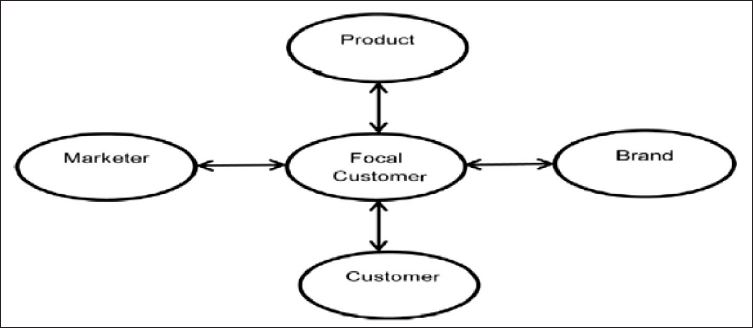
The earlier model of the brand community comprised a triad, namely, customer–brand-customer (Muniz & O’Guinn, 2001); nevertheless, McAlexander et al. (2002) further incorporated other units and made this model more customer-centric. In this model, the customer is positioned at the centre and comprises four relations: customer–other customers, customer–brand, customer–company, and customer—product (refer Figure 1). A common platform is created so that entities coexist: brand, customer, company, product and social media.
Brand Trust
Trust plays a cardinal role in establishing a long-term relationship by assuring transparency and interaction between community members (Mosavi & Kenarehfard, 2013). As per Morgan and Hunt (1994), brand trust creates an exchange between customer and brand. It is observed that when consumers perceive higher levels of trust in a particular brand in a social media–based community, it will enhance positive associations with the brand, which leads to a higher faith, commitment and brand loyalty (Gyori et al., 2017).
According to Shankar et al. (2003), if customers’ online experiences with brand communities are enjoyable and meaningful, it leads to brand trust. Here, brand trust is studied in the context of brand-consumer relationship marketing, as trust is essential in maintaining social exchange relationships (Platon, 2015).
Brand Equity and Its Antecedents
Brand equity is the value endowed by the brand into the product (Schivinski & Dabrowski, 2015). Customer-based brand equity (CBBE) refers to a set of brand assets and liabilities that are connected to a brand, its symbol or its name (Aaker, 1991). CBBE is built on the concept that a brand’s success is attributed to its consumers’ perceptions. It is based on the premise that the power of the brand depends on what customers have heard, felt, seen and experienced over time. Several authors have used scores on brand loyalty, perceived brand quality, brand awareness and brand associations for assessing CBBE (Buil et al., 2013; Wang & Li, 2012). This study focused on brand equity from customers’ perspectives (CBBE). The measures used in the study are brand association/ brand awareness, perceived quality and brand loyalty.
Perceived Brand Quality
Perceived brand quality is defined as a consumer’s assessment of a product or a brand’s overall supremacy (Zeithaml, 1988). In addition, Netemeyer et al. (2004) reveals that perceived brand quality comprises consumers’ value judgements on quality and reliability when compared with similar brands. It measures the brand’s functional performance, as customers professed, which can be enhanced by improving the quality of the product. Social interactions in brand communities allow customers to assess and form positive opinions, further affecting other consumers’ brand perceptions (Black & Veloutsou, 2017).
BRAND AWARENESS/ASSOCIATION
As per Keller (2003), marketers use brand recognition and recall tests to measure brand awareness. Brand awareness is related to the ability of consumers to recall a familiar brand while thinking of a specific product (Lin et al., 2014), and it strengthens the presence of the brand in the consumer’s mind (Su & Tong, 2015).
Brand associations describe knowledge, faith, feelings and emotions that brand community members link with the brand. It is related to the brand image ingrained in the members’ minds, such as symbols, brand ambassadors, images, etc. (Aaker, 1996).
Empirical evidence indicates that brand awareness and association can be combined into a joint dimension and named brand awareness/association (Yoo et al., 2000). This dimension precedes the formation of brand equity in the consumer’s mind and helps them at the point of purchase due to familiarity with the brand (Huang & Sarigöllü, 2014).
BRAND LOYALTY
Brand loyalty represents a firm assurance from the consumer to consistently re-purchase the brand and an eagerness to stay with it (Oliver, 1999). One’s attachment to a particular brand is referred to as brand loyalty, which is one of the essential dimensions influencing brand equity. Consumer brand loyalty is crucial for any company (Gounaris & Stathakopoulos, 2004). According to McAlexander et al. (2002), customers get hedonic and social benefits while enhancing brand loyalty by participating in brand communities. Empirical studies have affirmed that members of brand communities have a higher brand allegiance than non-members (Algesheimer et al., 2005). According to Wilimzig (2011), having a relationship with a brand community implies that you have some sort of loyalty towards the brand without considering community participation or their feelings. One of the best ways consumers express brand loyalty is by recommending their preferred brand to other members of brand communities through online platforms (Brodie et al., 2011).
Customer Response
As per Keller (2001), customer response mirrors the changes that may be impermanent or more long-lasting because of openness to promotions, where outcomes result from exposure to marketing communications. The responses may vary based on marketing activities, consumer insights, preferences or behaviour. Five consumer responses corresponding to brand equity get the consideration of researchers; these are readiness to follow through on a cost premium, mentality towards brand expansions, brand inclinations, purchase intentions and consumer loyalty (Ngan et al., 2019).
DEVELOPMENT OF THE MODEL AND THE HYPOTHESIS
Effect of Customer-centric Model on Brand Community
McAlexander et al. (2002) showed that online brandfest events attract many community members and result in high-context interactions between members and other elements of the brand community. During such interactions, product information, brand information, company information, consumer experiences and other valuable information are shared, reinforcing ties with the customer-centric model’s elements. Therefore, we propose the following hypotheses:
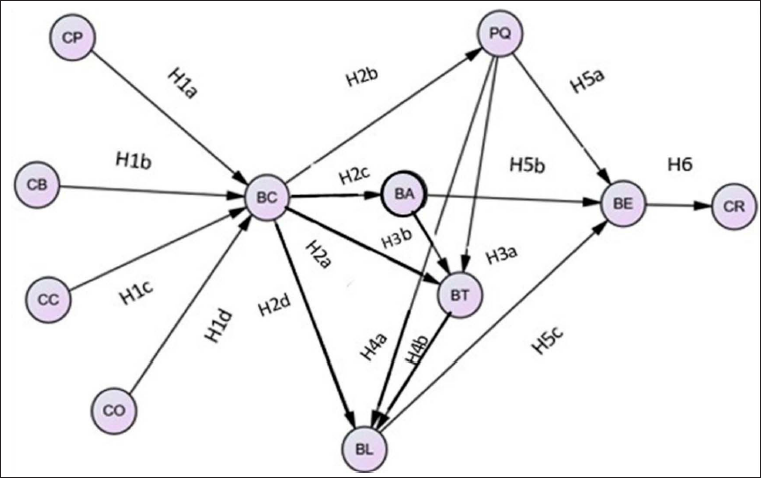
H1a. Customer–product relationship positively affects the SMBBC.
H1b. Customer–brand relationship positively affects the SMBBC.
H1c. Customer–company relationship positively affects the SMBBC.
H1d. Customer–other–customer relationships positively affect the SMBBC.
Brand Community, Brand Trust and Dimensions of Brand Equity
SMBBC consist of members who repeatedly interact and disseminate information about products or brands based on their experiences (Habibi et al., 2014). Repeated interaction among members helps to develop brand trust, reduce uncertainty and information-lopsidedness and to increase the brand’s predictability (Ba, 2001). According to Zhang et al. (2018), online communities develop a sense of collectiveness among members through brand engagements and heightened brand trust. Once trust is built, customers feel more comfortable and love the brand (Laroche et al., 2012).
Brand communities can potentially influence all the dimensions of brand equity (Bashir et al., 2020). It has been observed that SMBBC strengthen the brand equity dimensions; as community members, consumers discuss and share their frame of mind, opinions and know-how about the brand. This conversation through online brand communities enhances the association between the brand and the customer, increases the other customers’ brand awareness, and develops and modifies the overall brand quality perception (Brogi et al., 2013). Other research studies have found empirical evidence to prove that SMBBC influences brand relationships, brand loyalty and brand equity (Gyori et al., 2017; Madupu & Cooley, 2010).
Considering the above literature and discussion and the fact that these associations have not been tested in the framework of SMBBC, we propose the following hypotheses:
H2a: SMBBC significantly influences brand trust.
H2b: SMBBC significantly influences perceived quality.
H2c: SMBBC significantly influences brand awareness/association.
H2d: SMBBC significantly influences brand loyalty.
Perceived Quality, Brand Awareness/Association, Brand Trust and Brand Loyalty
Perceived quality positively affects trust and influences consumer preferences and purchase intentions (Chen & Chang, 2013). Past research recommended further developing the perceived quality to upgrade consumers’ trust in the brand (Tung & Suthinoparatanakul, 2019).
A brand’s presence on social networks is exceptionally utilitarian for illuminating customers and creating familiarity and brand awareness (O’Flynn, 2017). After achieving brand awareness, members start interacting, sharing information and communicating through word of mouth (WOM). This increased awareness and associations with the brand will substantially build trust in the brand with repeat purchase intentions (Bernarto et al., 2020; Bilgin, 2018). Hence, the following hypotheses in the context of SMBBC are proposed:
H3a: Perceived quality has a significant impact on brand trust.
H3b: Brand awareness/association significantly impacts brand trust.
If the brand’s perceived quality increases, consumers’ satisfaction level increases. Such consumers will stay loyal to the brand and also recommend this brand to other people (Souki & Goncalves, 2008). Brand loyalty is associated with consumers’ perceived quality and their certainty about the product quality. Similarly, consumers who strongly associate with a brand also have a high perceived quality, as these factors correlate. At first, brand awareness assumes an imperative part in creating brand equity, which leads to improvement in brand association and fosters a positive impression of brand quality and dedication (Pappu et al., 2005).
Trust facilitates long-term relationships (Anaya-Sánchez et al., 2020); consumers in online forums perceive more uncertainty in maintaining online relationships because trust building takes more time in the virtual world vis-à-vis the real world. Therefore, trust in the brand becomes vital for seeing long-term relations. Higher levels of trust in the brand will deliver a favourable perspective towards it (Kamboj et al., 2018). Past research has shown that brand trust is one of the main antecedents of consumer loyalty and re-purchase intention in an online community (Gibreel et al., 2018).
Consequently, the following hypotheses are proposed:
H4a: Perceived quality has a direct and positive impact on brand loyalty.
H4b: Brand trust has a direct and positive impact on brand loyalty
Brand Equity Dimensions and Overall Brand Equity
Brand association and brand equity relate because brand association heightens overall brand performance (Jayswal & Vora, 2019). As per Atilgan et al. (2005), brand association is one of the core factors in building brand equity. Likewise, it is depicted that brand association builds brand equity (Severi et al., 2014). Dennis et al. (2016) expressed that perceived quality and reputation cause sensations of connection, prompting fulfilling relationships and consequently developing brand equity. Most research measures loyalty by employing dimensions like WOM correspondence, buy intentions, price obtuseness and grumbling behaviour (Bloemer & Odekerken-Schröder, 2002; Ibrahim & Najjar, 2008). The effect of brand loyalty in the buyer’s mind helps retention and subsequently extends brand equity (Dada, 2021).
Yoo et al. (2000) fostered a multidimensional brand equity scale based on the investigation of Aaker (1996). The outcomes uncovered a solid relationship between brand loyalty, brand awareness/association and perceived quality. Consequently, it is deduced that brand equity can be made and extended by fortifying these three aspects. However, these associations have not been tested in the context of SMBBC. Hence, we propose the following hypotheses:
H5a: Perceived quality developed on social media significantly influence brand equity.
H5b: Brand association developed on social media significantly influences brand equity.
H5c: Brand loyalty developed on social media significantly influence brand equity.
Brand Equity and Customer Response
Over time, a firm’s performance is strongly influenced by positive brand equity and impacts consumers’ responses (Hoeffler & Keller, 2003). Studying the relationship between brand equity and consumer response is critical and problematic. However, most studies in this area believe brand equity favours consumer responses (Yousuf & Siddiqui, 2019). Our study explores three consumer responses: willingness to pay a premium price, positive attitude towards brand extension and purchase intentions. Studies also establish the positive association of brand equity with consumer brand preference and purchase intention (Bashir et al., 2020). According to previous studies, brand equity remarkably affects consumers’ mindset to pay price premiums (Netemeyer et al., 2004).
According to a survey conducted by Chiu et al. (2017), companies with high brand value also have a high success rate with their brand extension. The main reason for a successful brand extension is that consumer has high perceived quality towards such brands, and they feel that they can trust the new product launched by a well-known brand, even though they have less knowledge about that product (Milberg et al., 2010). Leveraging positive brand association from the parent brand to its extension validates that brand equity plays a crucial role in consumers’ response to brand extensions (Czellar, 2003). According to Senthilnathan (2012), there is a positive correlation between brand equity and customers’ purchase intention. Again, these associations have not been tested in the context of SMBBC. Hence, we propose the following hypothesis:
H6: Brand equity developed in the social media community significantly influence customer response.
Proposed Model with Hypotheses
Figure 2 displays the proposed research model for the study. The model indicates four formative constructs: customer–product relationship, customer–brand relationship, customer–company relationship and customer–other customer relationship, and brand community as the dependent variable. Subsequently, the impact of brand community on brand trust and brand equity dimensions is examined, following which consumer-based brand equity antecedents’ effect on customer response is investigated. The framework for this study is based on two distinct theoretical approaches: social identity theory and S-O-R theory (as explained earlier).
RESEARCH METHODOLOGY
This was a quantitative study using a survey method. Respondents were systematically chosen by following the steps as explained below:
Selection of Brands
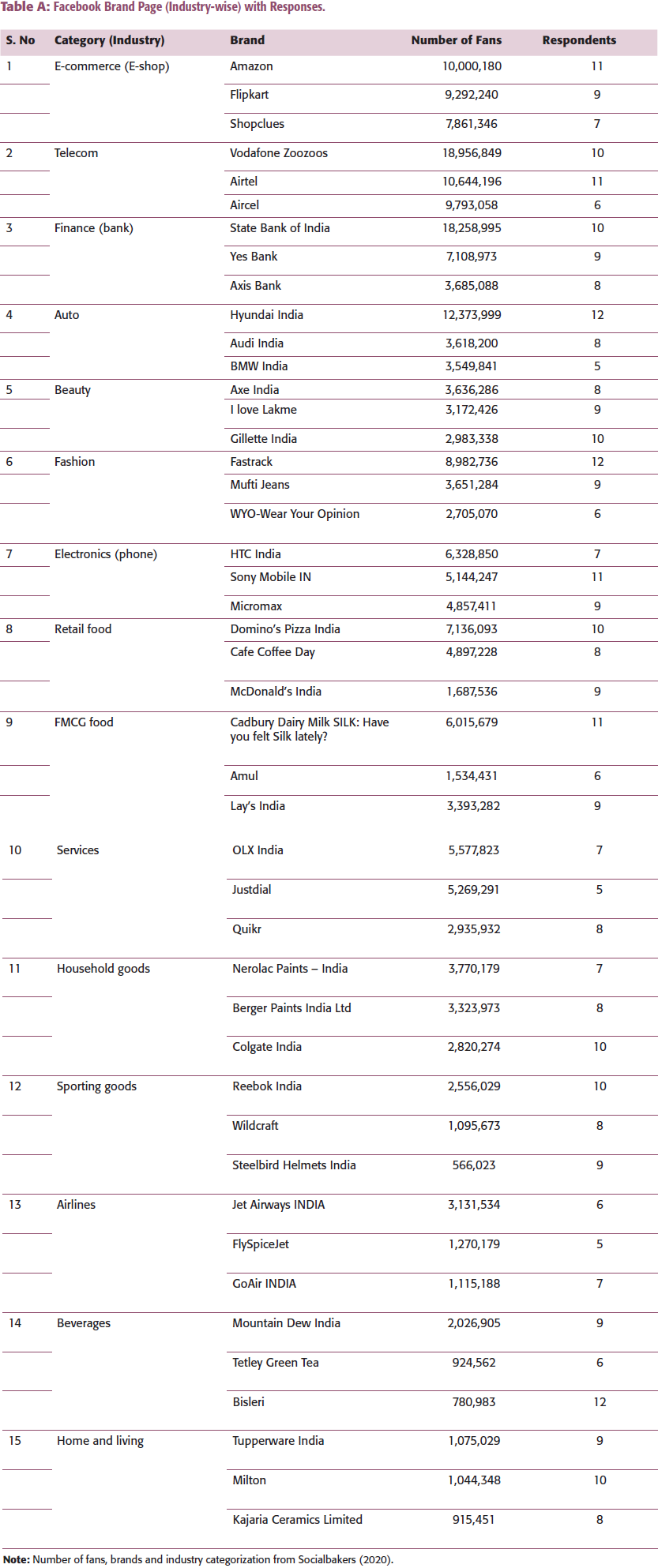
The research setting is brand communities on social media. The selection of brands is based on the criteria of the brands’ organic reach (number of fans) on the Facebook business page. Facebook was selected for the study since it had 1.79 billion active users and is considered an extraordinary forum to implement a social media strategy due to its cost-effectiveness. For collecting data on top brands, Socialbakers Analytics is used, which offers a software-as-a-service platform for social marketers. Socialbakers has classified Facebook brand pages into 20 industries or categories. For our study, 15 sectors are considered that includes e-commerce (e-shop), telecom, finance (bank), auto, beauty, fashion, electronics (phone), retail food, FMCG food, services, household goods, sporting goods, airlines, beverages and home and living (refer annexure, Table A).
The 45 brands selected from these 15 categories are based on Facebook statistics in India (active number of posts made in the last year). The target population for this study are Indian consumers who follow at least one Facebook brand page. The brands were selected using a stratified sampling method, and the stratum used was the number of fans following the brands. The top three brands with the highest fan following in each industry were picked.
Generation of Scale Items and Pilot Testing
We used past literature to generate the scale items in the initial phase. These scale items were adapted to suit the context of our research. Cronbach’s alpha was used to assess the reliability or internal consistency of the scale items. All the items were on a five-point Likert scale with a 1–5 rating: strongly disagree (1), disagree (2), do not know (3), agree (4) and strongly agree (5). These initial scale items were put forth to five academic experts for construct face validity. Experts were provided with construct validity definitions. Academic experts then evaluated each item concerning uniqueness, completeness and wordings that fit the construct definition. Certain items which did not fit the purposes were deleted. In the final stage, a quantitative pretest was conducted on 40 brand community members who belonged to one or more brand communities and the items that did not meet the study requirements were dropped. This questionnaire was again shared with experts for fine-tuning, and based on their feedback, the final questionnaire was finalized. There were 33 question statements and 11 constructs for the final study. The scale items were tried for reliability measures and brought about a Cronbach’s alpha of 0.905, which is good to utilize the recommended scales.
Data Collection
A self-administered online survey was conducted to collect data on all selected brands. Since the target respondents were familiar with the online environment, conducting an online survey was appropriate. The questionnaire was prepared using Google Docs forms, and a link was sent to the participants through instant messaging on Facebook brand pages.
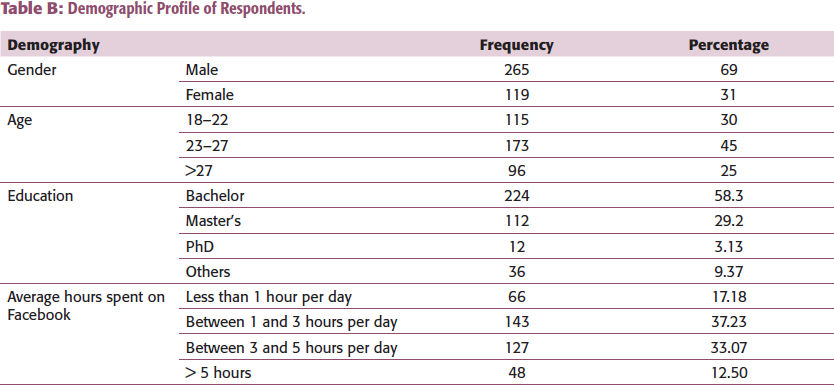
The invitation requested participants to share their opinion on using the brand community. The invite was posted regularly during the data collection period on the Facebook brand pages of 45 selected brands of different industries in India. Participants took approximately 15 minutes to fill up the questionnaire. Four hundred-five responses were collected from the Facebook brand page users, out of which 21 responses were incomplete, leaving 384 responses for structural equation modelling (SEM) and hypothesis testing for the final study (refer to Annexure, see Table B).
DATA ANALYSIS
Preliminary Data Analysis
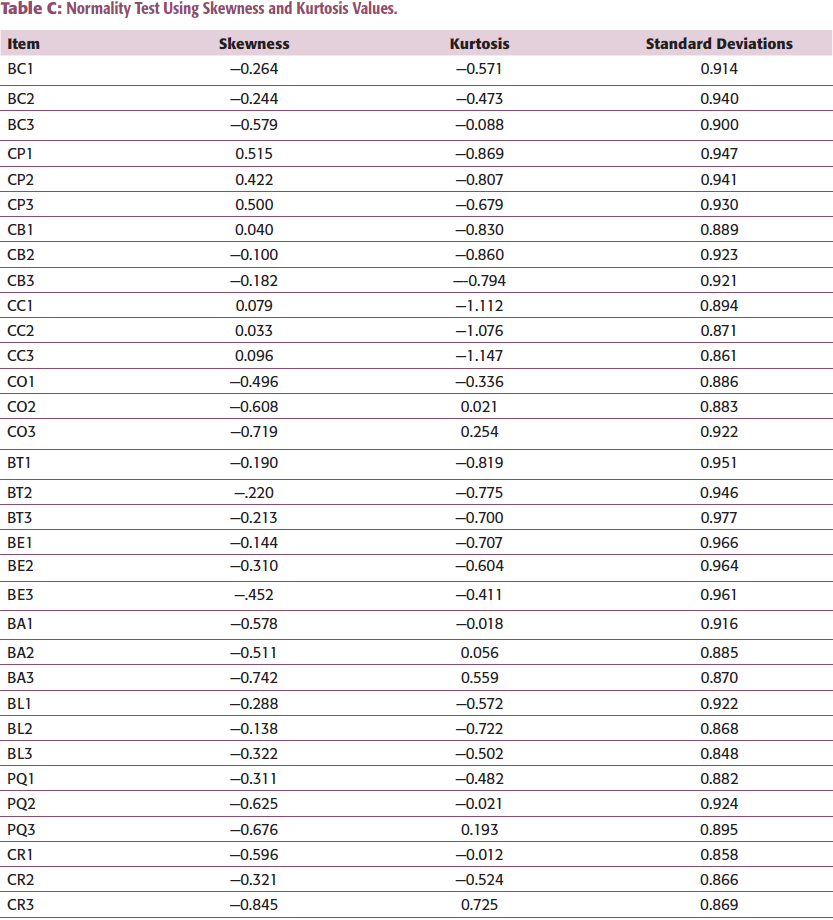
Preliminary data analysis examined the quality, accuracy, omitted data, outliers and normality test. The normality of the data was interpreted through skewness and kurtosis values, as Hair et al. (2010) suggested. The data values range between the cutoff criteria of +2 and −2 with standard deviations above 0.5, confirming that the data are normally distributed (see Annexure, refer to Table C).
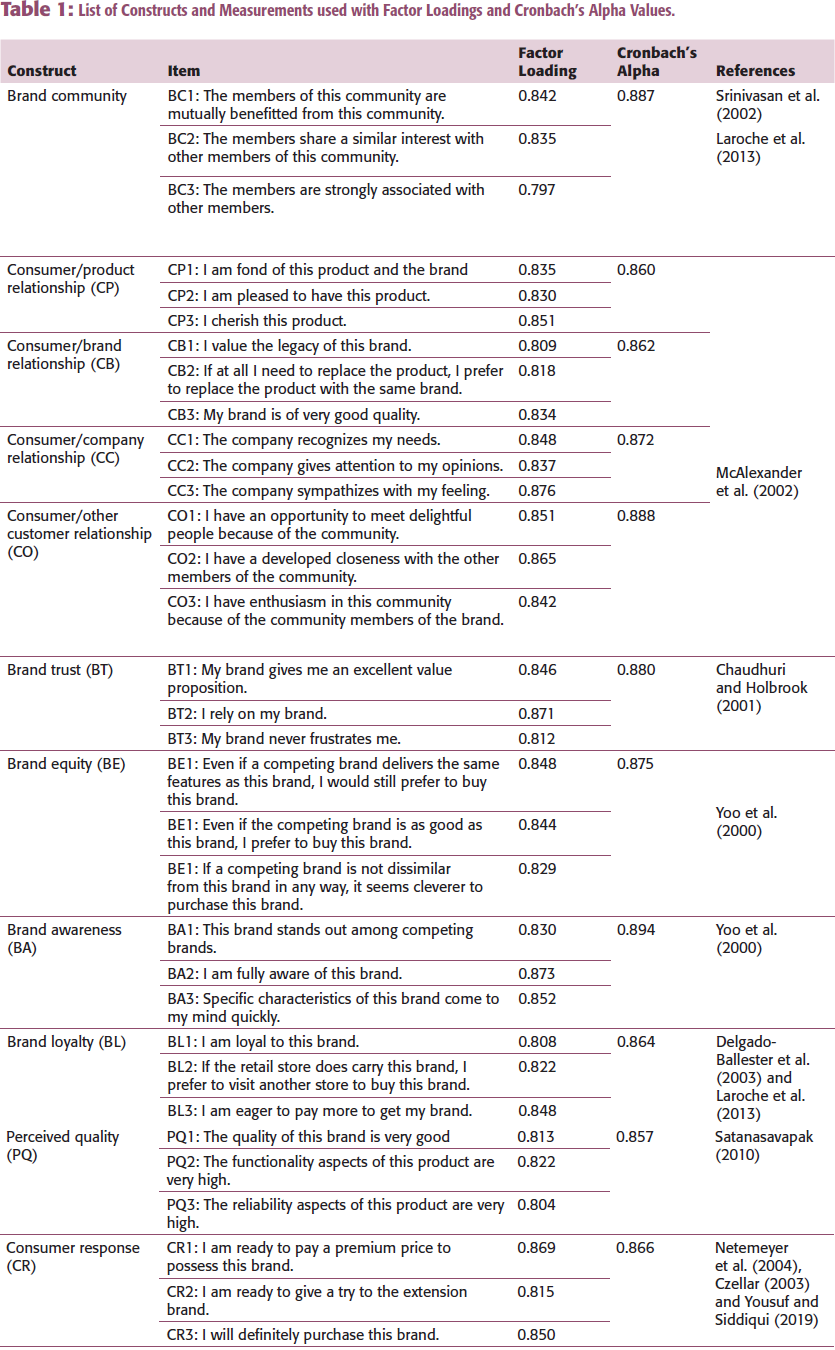
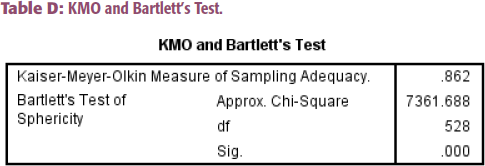
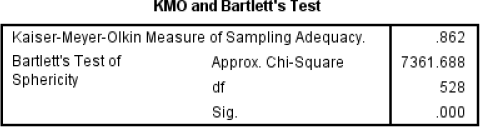
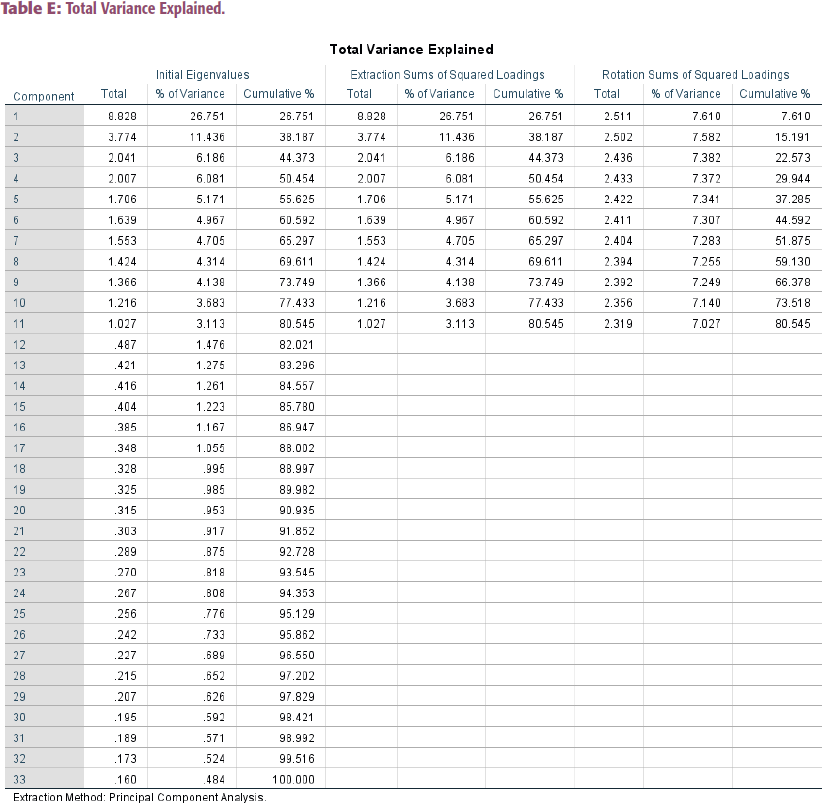
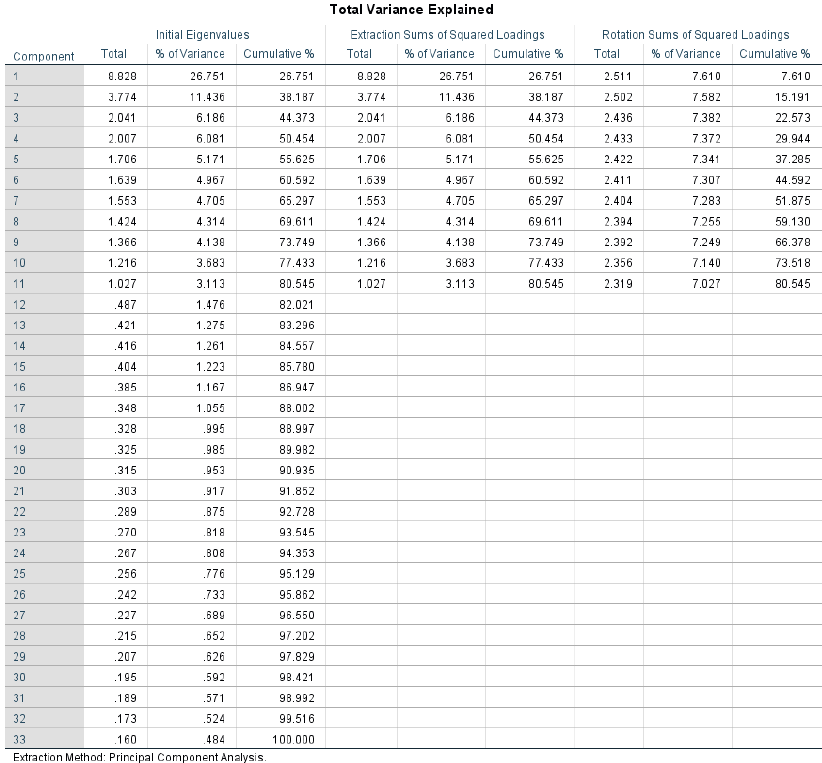
Before confirmatory factor analysis (CFA), exploratory factor analysis (EFA) was conducted to ensure that the selected scale items were loaded properly with a factor loading score > 0.5. No cross-loading was observed, as mentioned in Table 1. A high value of Kaiser–Meyer–Olkin (KMO), i.e., 0.862 and a small value of significance (<0.05) of Bartlett’s test of sphericity indicate that factor analysis is useful for our data. By conducting EFA, using principal component analysis with Varimax rotation, 11 factors were extracted with an eigenvalue greater than 1. The variance explained was 80.545 %, which is satisfactory for further research (refer to Annexure; see Tables D and E).
List of Constructs and Measurements used with Factor Loadings and Cronbach’s Alpha Values.
Confirmatory Factor Analysis
CFA was performed on 11 factors: brand community, customer-product relationship, customer–brand relationship, customer–company relationship, customer–other customers’ relationships, brand trust, brand awareness, perceived quality, brand loyalty and brand equity. Each construct had three items. While conducting CFA, all constructs were considered exogenous and correlated (refer to Figure 3).
CFA Model for Measurement of Scale Items.
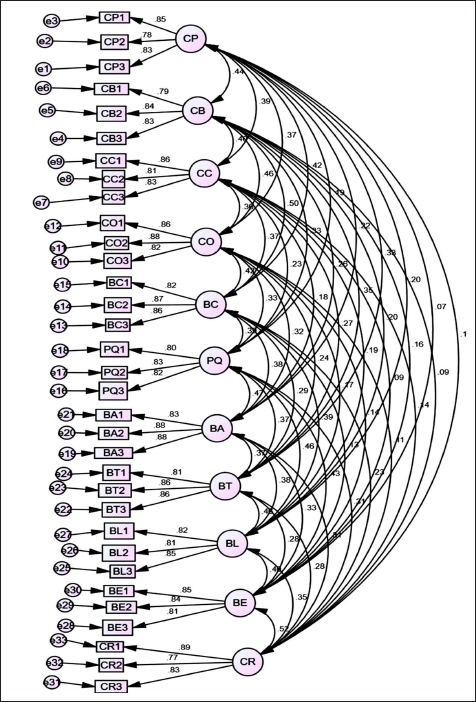
The fit indices of the measurement model are χ2 = 506.614, CMIN/df = 1.262; p = 0.015, RMSEA = 0.026, CFI = 0.985, NFI = 0.930 and AGFI = 0.898. The indices show that the proposed scale fits for estimation (Byrne, 2013; Hair et al., 2010).
Validity and Reliability Test
Campbell and Fiske (1959) proposed that discriminant and convergent validity were used to measure the scale’s construct validity. The other validity measure used was composite reliability.
The convergent validity can be measured by average variance extracted (AVE) and composite reliability (CR). The AVE value of all the items ranged from 0.646 to 0.742. Since AVE values are > 0.5, the convergent validity condition is met. The composite reliability measures are above the threshold level of 0.7. Thus, scale items exhibit internal consistency (Hu & Bentler, 1999).
The discriminant validity tests whether the measurement of constructs is unrelated. To satisfy this condition, the maximum shared variance (MSV) should be less than AVE. Since all the values of MSV are less than AVE, the discriminant validity condition is met (refer to Table 2). All standardized factor loading of each construct was greater than 0.7.
Composite Reliability, Convergent Validity and Discriminant Validity.
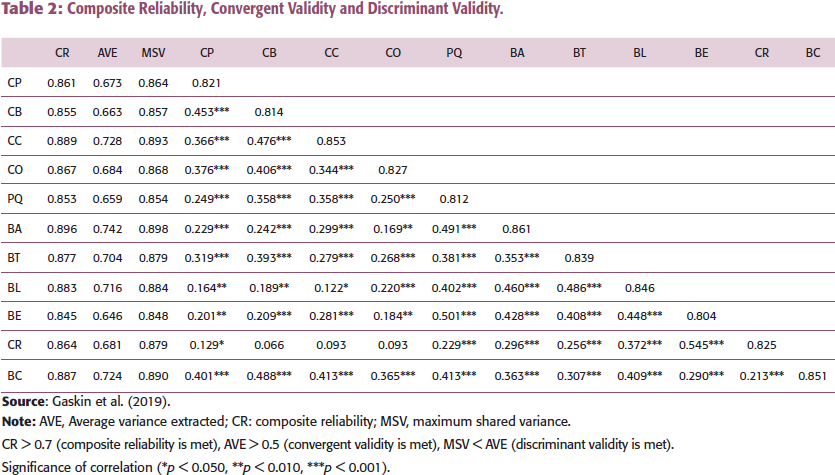
CR > 0.7 (composite reliability is met), AVE > 0.5 (convergent validity is met), MSV < AVE (discriminant validity is met).
Significance of correlation (*p < 0.050, **p < 0.010, ***p < 0.001).
Common Method Bias
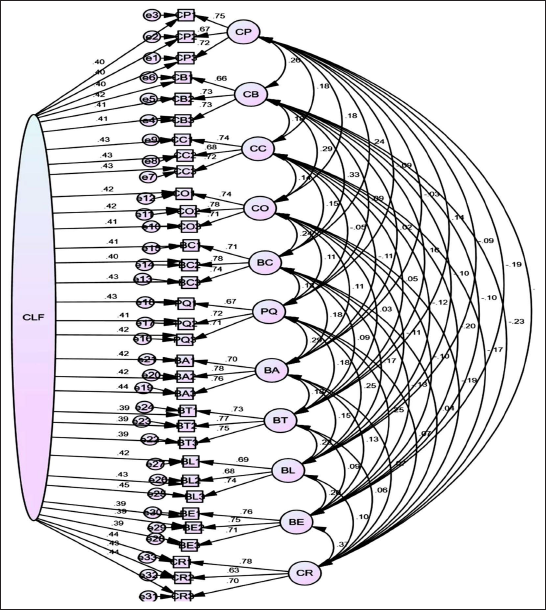
The existence of common method bias was examined because predictor and outcome variables were collected via a single instrument. A common bias test was conducted to decide whether method bias influenced the results of the proposed measurement model. Figure 4 shows the common latent factor (CLF) based model. Testing was done using the ‘unmeasured latent factor’ technique, as Siemsen et al. (2009) suggested. The standardized regression weight loads before and after adding the CLF show that the CLF, i.e., significantly impact none of the regression weights, and the deltas are under 0.200.
The CLF-based SMBBC Modelling on BE and CR.
Hypothesis Testing using SEM
SEM was performed using the maximum likelihood estimation method, the most utilized and favoured assessment method for testing hypotheses (Blunch, 2012). Each path’s standardized coefficient (β) value with a p-value was used as evidence for acceptance or rejection of framed hypotheses.
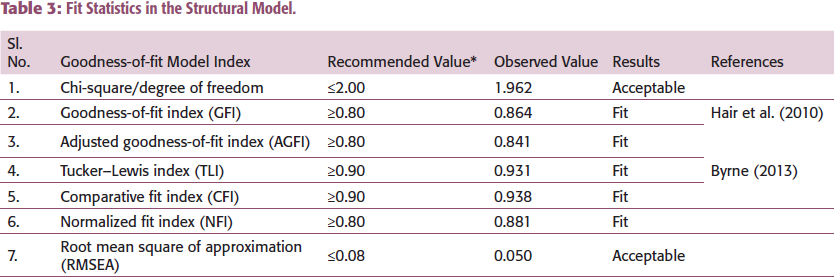
All the parameter estimates values of the SEM have critical ratio (CR) values greater than ±1.96, which gives enough evidence to reject the null hypothesis (refer Table 4). The fit indices of the measurement model are CMIN/df = 1.962; p = 0.000, RMSEA = 0.050, CFI = 0.938, NFI = 0.881 and AGFI = 0.841. The results indicate that the structure model fits prediction and interpretation (refer to Table 3).
Fit Statistics in the Structural Model.
Path Coefficients and Determination Coefficients of the Structural Model.
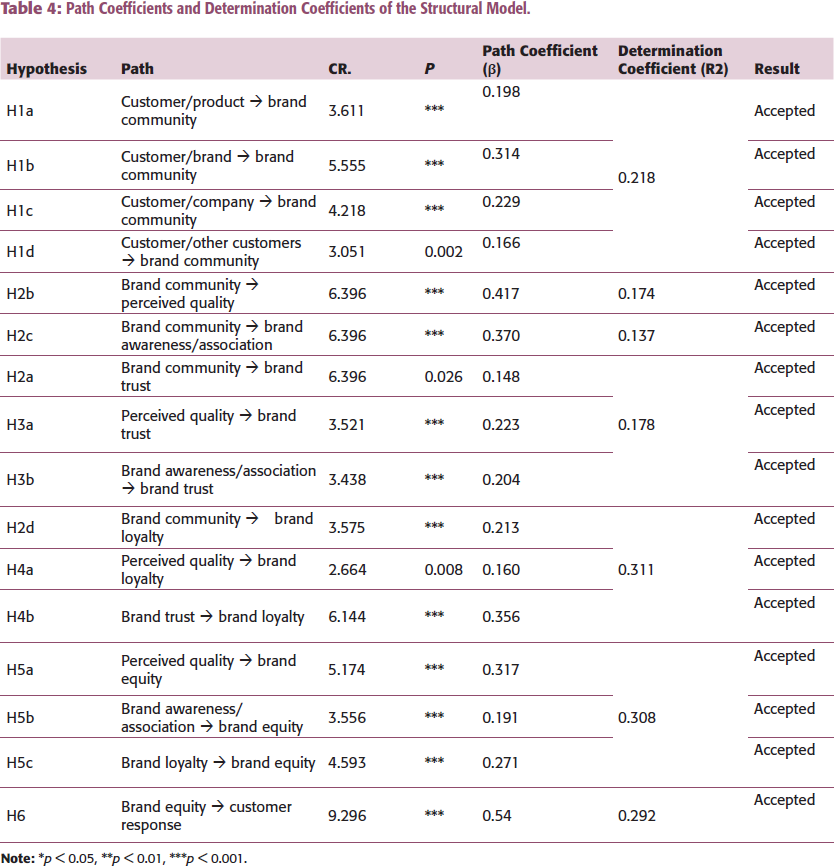
Data in Table 4 and Figure 5 reveal that customer-centric model elements significantly impact the SMBBC. The customer/brand impact on BC is highest with β = 0.314, followed by the effects of the customer/company relationships (β = 0.229), customer/product relation (β = 0.198) and the customer to other customers (β = 0.166) on SMBBC. All the relationship paths were significant (p < 0.05). Hence, H1a, H1b, H1c and H1d are supported.
Structure Equation Model for Hypothesis Testing.
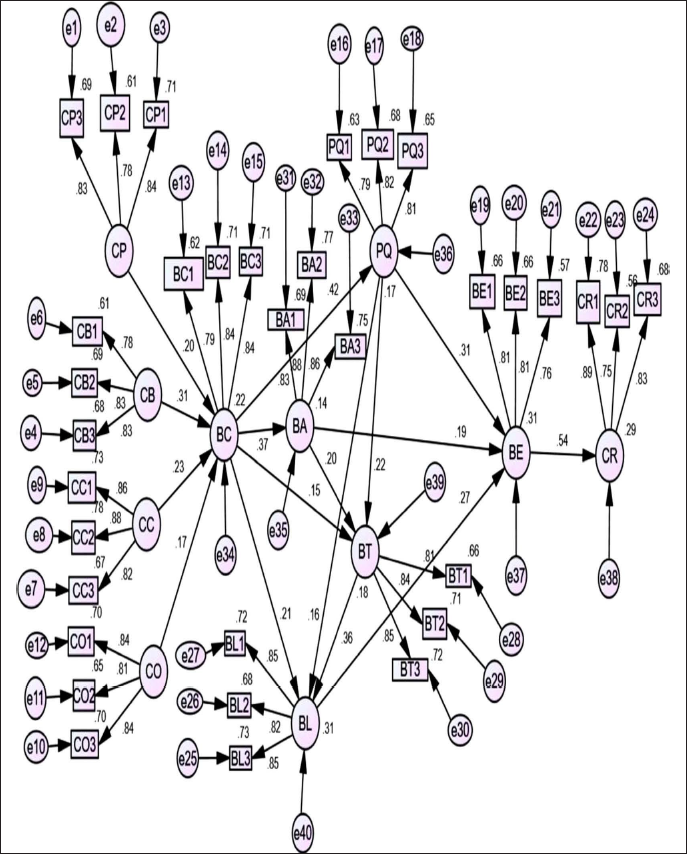
The impact of SMBBCon brand trust is positive and significant (β = 0.148, p < 0.05). Further, the SMBBC significantly influenced perceived quality (β = 0.417), brand association (β = 0.370) and brand loyalty (β = 0.213). The p values of the paths from SMBBC to all three dimensions of brand equity are less than 0.05. A t-value above 1.96 provides sufficient evidence to accept the hypotheses H2a, H2b, H2c and H2d.
For H2a and H2b hypotheses, the study has tested the impact of two dimensions of brand equity, i.e., perceived quality and brand awareness/association, on brand trust. The findings of the path analysis confirmed that perceived quality with β = 0.223 (p = 0.000) and brand awareness/associations (β = 0.204, p = 0.000) have a significant favourable influence on brand trust. Since the p values are less than 0.05, we accepted hypotheses H3a and H3b.
The study has also demonstrated the influence on brand loyalty. The results revealed that the impact of perceived quality is significant and positive on brand loyalty (β = 0.160, p < 0.05), and brand trust also influenced brand loyalty with the highest impact (β = 0.356, p < 0.05). All these data confirm the research hypotheses H4a and H4b.
In addition, the results demonstrated that brand equity is influenced by its antecedent dimensions, as the effect of perceived quality (β = 0.317), brand association (β = 0.191) and brand loyalty (β = 0.271) are positively significant (p < 0.05), supporting hypotheses H5a, H5b and H5c respectively.
Finally, the effect of CBBE on customer response was evaluated. It was found that brand equity positively impacts customer response (β = 0.54, p < 0.5). Hence, H6 is supported.
The brand community, perceived quality and awareness/association explained 17.8% (R2 = 0.178) of the total variance in brand trust. While brand community, perceived quality and trust explained 31.1% (R2 = 0.311) of the total variance in brand loyalty. The three antecedents of brand equity explained 30.8% of the total variance in CBBE. The brand equity developed through a social media–based community explains 29.2% of customer responses.
Comparing the High- and Low-end Activity Levels in the SMBBC for the Select Brands
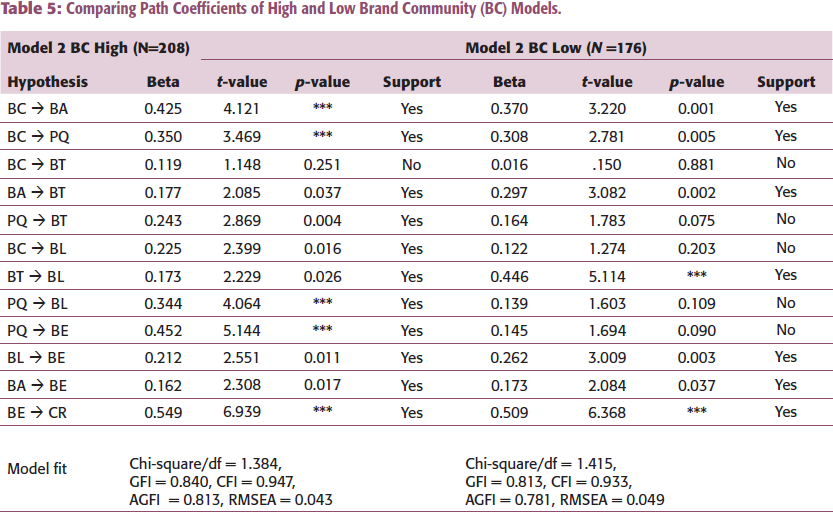
The study considered high- and low-end activity levels in brand communities based on the users’ activity. Brand community responses were measured using a five-point response scale where 1 = ‘strongly disagree’ and 5 = ‘strongly agree’. The data were divided into high and low by segregating all responses (384) around the mean of the brand community (mean BC1, BC2 and BC3). The mean value above 3.5 was categorized as a high-end activity level, and BC means value below 3.5 as a low-end activity level. Model 2 includes participants with a high end-user activity/involvement in the brand community (i.e., strongly agree and agree), constituting 208 responses. Model 3 comprises participants categorized into the low-brand community, forming 176 responses.
As mentioned in Table 5, the analysis revealed some similarities between model 2 and model 3, but there are differences between the models of the high- and low-brand communities. It can be inferred from the results that the high activity of users in the brand community significantly influences brand awareness/association (β = 0.425, p < 0.05), perceived quality (β = 0.350, p < 0.05) and brand loyalty (β = 0.225, p < 0.05). However, in the case of the low-end brand community, the impact is significant only for brand awareness/association (β = 0.370, p < 0.05) and perceived quality (β= 0.308, p < 0.05). Low-brand community activity cannot influence long-term relationships or brand loyalty.
Comparing Path Coefficients of High and Low Brand Community (BC) Models.
DISCUSSION AND FINDINGS
We have explored the effects of customer-centric model elements on SMBBC and the influence of brand communities on brand trust and brand equity, and, ultimately, consumer response for top Indian brands on Facebook.
The results of our research confirmed that the customer-centric model’s four components (i.e., relationship with product, brand, company and other customers) are significant in strengthening the brand community. The findings of our study uphold that by managing customer interpersonal bonds and enhancing community participation on social networks, companies can strengthen their brand community (Ho & Wang, 2020).
The present study explored the influence of SMBBC on brand trust and antecedents of brand equity, viz., perceived quality, brand awareness/associations and loyalty. It was found that SMBBC exerts a significant favourable influence on brand trust, perceived quality, brand awareness/associations and loyalty. These findings are aligned with the study results by Ra’d Almestarihi et al. (2021). Online marketing activities’ success depends on customers’ reactions, which rely on the information imprinted in customers’ minds about brands. Customers attached to the brand community tend to perceive the brand as high quality, show brand loyalty and exhibit higher brand associations/awareness by learning about the product/brand from other customers.
The results also revealed that perceived quality and brand awareness/association are two important antecedents for brand trust. These findings seem different from a previous study by Khanlari et al. (2015) but are consistent with the Bernarto et al. (2020) study. Further, perceived quality and brand trust is the antecedents for brand loyalty, and these findings align with the studies by Krystallis and Chrysochou (2014) and Alhaddad (2015).
In addition, the research study found that positive brand equity results in favourable consumer responses such as being ready to pay a premium price, trying brand extension and purchasing the branded product. This finding aligns with studies by Thomson et al. (2005), Aaker (1991) and Keller (1993). The outcomes from this research offer fundamental contributions and suggestions for electronic commerce, the scholarly world and practitioners.
Finally, user participation in BC is a critical determinant for variation in marketing variables and customer response relationships. The study confirmed that most relationships, such as perceived quality, brand awareness, loyalty, brand equity and customer response, are positive and significant when the activity is higher in the brand community. This finding concludes that the number of members is unimportant in BC, but their participation in community activities decides the brand’s or company’s positive outcome.
Contributions of the Study
Our research findings add to earlier studies that explore the relationship between the brand community and customer response, mainly in the context of social media. Existing research has advocated that SMBBC might be a precursor of a customer-centric model (Khanlari et al., 2015), brand trust (Habibi et al., 2014) and brand equity. However, most of these research studies have focused on the impact of BC on one or two marketing variables specific to one industry (Gyori et al., 2017: Khanlari et al., 2015). Departing from such studies, the present research modelled a nomological network that shows how a brand community influenced by customer-centric relationships developed in social media affects brand awareness, perceived quality, brand trust and brand loyalty.
Our findings, first and foremost, contributed to the body of knowledge in the following ways:
This review explicitly applies the findings on the precursors of customer participation in brand communities via social media. It confirms that CC, CB, CO and CP are significant determinants of BC involvement. The relationship with the brand has the most substantial impact on the brand community, followed by relationships shared with the company, product and other customers. As Kamboj and Rehman (2017) discussed, customers can participate more if they are interested in the brand, get more incentives and procure relevant information.
Second, the study confirmed the positive and direct impact of social media brand community on all the dimensions of brand equity (i.e., brand awareness/association, perceived quality and loyalty) and brand trust. Previous studies modelled the impact of online brand community on brand trust and brand equity dimensions through community markers (Laroche et al., 2012) and a customer-centric model (Khanlari et al., 2015); in contrast, this study corroborated these variables’ relationship with the brand community directly. These findings conclude that the SMBBC results in a positive community perception of marketing variables. Community members become more aware of the brand quality and develop associations with brands that reduce their ambiguity or fear of speculations on online platforms, resulting in trust and loyalty.
Third, regarding brand trust antecedents, the results show that brand community developed on social media, perceived quality and brand awareness/association increase members’ trust in a brand, which is in line with the literature (Bernarto et al., 2020; Nilowardono et al., 2020; Ra’d Almestarihi et al., 2021).
Fourth, our findings highlighted that brand loyalty is a consequence of perceived quality and brand trust developed in an online brand community, which is congruent with related conclusions from other studies (Kamboj et al., 2018; Martínez-López et al., 2021). These results confirmed that brand trust is the most important determinant of the long-term relationship of community members with brands. It is consistent with the Anaya-Sánchez et al. (2020) study.
Furthermore, loyalty and perceived quality, awareness/association with the brand directly and positively influence brand equity. In addition, brand equity is an important factor in the propensity of community members to pay a premium price, influence purchase intention and refer the brand to potential customers. Therefore, this study validates the direct relationship between brand equity dimensions and customer response for SMBBC members in one model.
Lastly, this study discloses that customers’ degree of participation/involvement in the online brand community can effectively differentiate between high- and low-end activity levels in brand communities irrespective of fan followers of the top brands. Our research shows that the higher the community involvement of customers/members, the higher the impact on marketing variables—perceived quality, associations, trust, loyalty, brand equity and positive customer response. This result is in line with Malinen’s (2015) study, and Wirtz et al. (2013) confirmed that consumer participation is considered critical to ensuring an online BC’s sustainability over time and the development of long-term relationships.
Managerial Implications
Brand communities impact brand trust, equity and consumer response to the brand. Marketers need to take cognizance of this fact and nurture brand communities. Customer-centric model variables positively influence brand communities. Marketers must consciously enhance customers’ relationships with the product, brand, company and other customers. There are several tactics to strengthen these relationships: the primary way of enhancing customer–product relationship is by increasing the product’s experiential value for the customers. This could be cognitive, hedonic, social or ethical. Experiential value positively affects consumer engagement, positively associated with brand loyalty and satisfaction (Nadeem et al., 2021). Equally important would be educating the customers on how the products can add value to their lives. Customer–brand relationships can be strengthened by making the brand more relevant and meaningful to the customers. This can be achieved through consumer feedback focusing on consumers’ lived experience with the brand and adopting suitable marketing programmes that would better their judgement and feelings about the brand. The customers’ relationship with the brand can be strengthened by showing the customers that the company cares about them. This can, of course, be done through corporate marketing tactics. Customers’ relationships can be enhanced by building a community spirit as H.O.G. does. When these customer-centric model variables, which are precedents to SMBBC, are strengthened, brand can have strong SMBBCs. As stated earlier, SMBBC positively influences brand trust and brand equity variables (brand awareness, association, perceived quality and brand loyalty), which positively influences customer response.
Given that the customers participate in SMBBCs to seek information, communicate and establish relationships (Martínez et al., 2016), marketers should provide suitable communication channels such as forums, chat and virtual events. Such forums can be actively used to keep the community members updated about the company’s products and brands in engaging ways like posting short videos, interactive graphics, chatbots, etc. Interactions among community members can be taken further by providing offline bonding platforms, as Starbucks does. Having an online brand community is not enough; active participation by members is critical in maintaining and making it exciting and vibrant. Marketers can encourage members to participate in forums actively (rather than being passive members) and become brand evangelists by providing incentives for sharing brand-related posts, playing brand-related online games, building brand-related hashtags, etc. Information sharing by marketers and among members should be focused on enhancing the brand’s perceived quality and building brand trust and loyalty. Brand trust is an important determinant of brand loyalty in the context of social media. Organizations should act honestly and responsibly to develop brand trust. To do this, organizations must deliver on their brand promises and sincerely address customer concerns. Providing authentic and helpful brand-related information, avoiding manipulation and suppression of negative content, and creating an atmosphere of free expression can also help build trust. Brand trust will help create brand loyalty; running loyalty programmes and other incentives can further strengthen it. This study revealed that brand trust and loyalty are precedents to consumer response, so marketers can influence consumers’ feelings and judgements of the brand by building trust and loyalty.
Finally, perceived quality, brand awareness/association and loyalty influence brand equity, strengthen customer response through brand extension, and influence purchase intention and referrals to others. As community members have invested time, effort or money in the brand, they are moist suited to give feedback and help companies understand what customers value about their brand. Accordingly, managers should provide users with tools to foster co-creation, dependability and positive WOM. For instance, users could be permitted to propose new plans and offer their viewpoints on products through an app that could incorporate a contest of ideas inside the online community. Likewise, customers can re-buy other brand items through direct admittance to the online shop and its list of products; and suggest products in online forums, blogs and scoring/proposal frameworks. Inspiring brand advocates who can share the brand’s value will help acquire satisfied customers and create a captivating community experience.
The findings of users’ participation in high- and low-end brand activity results are also important for managers to achieve strategic brand benefits. More members’ activities in SMBBC have a higher impact on the marketing and customer response variables. Therefore, it is required for managers to promote users’ participation in community activities.
Limitations and Future Scope
This research collects data from only one social media tool (Facebook), while other social media, such as Twitter and Instagram, are gaining popularity. This study can be extended to other platforms to validate the results. Second, brand communities differ on several dimensions, such as social context, temporality, geographical concentration and size, and these aspects impact community interactions (rich vs devoid) and affect results. Third, a study can be undertaken to find effective ways to handle unhappy customers, which may influence other customers and reduce brand equity. A cross-industry comparison can be conducted in the future to understand social media brand community influence on marketing variables according to industry type. Changes in online community consumer behaviour in the current context of a pandemic can be explored. Limitations of sample size and several brands considered for the study are some issues that may affect results. Instead of online surveys, one can conduct personal interviews to get more accurate results.
Conclusion
In conclusion, this research revealed that customer motivation to know about a particular brand/product or establish a relationship with the company and other customers results in active participation in the brand community. This SMBBC strengthens brand awareness/association, perceived quality, brand trust and loyalty. Further, members’ positive perception and association with the brand ensure their long-term loyalty, and these three measures affect brand equity. Finally, brand equity is the most important determinant of customer responses in the form of purchase and re-purchase intentions. Subsequently, marketers must develop the foundation of brand communities and improve buyers’ relations. Brand communities should be integrated within the brand and its marketing operations rather than viewed as separate entities. Brand communities developed on social media should be considered as partners to engage with rather than a perceived threat to the brand.
Annexure
Facebook Brand Page (Industry-wise) with Responses.
Demographic Profile of Respondents.
Normality Test Using Skewness and Kurtosis Values.
KMO and Bartlett’s Test.
Total Variance Explained.
Footnotes
Declaration of Conflicting Interests
The authors declared no potential conflicts of interest with respect to the research, authorship and/or publication of this article.
Funding
The authors received no financial support for the research, authorship and/or publication of this article.
E-mail:
e-mail:
e-mail:
e-mail: