




Abstract
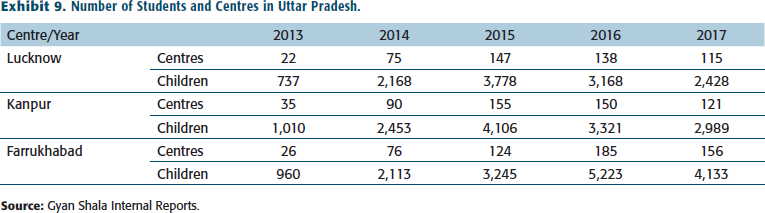
It was mid-morning when Ms Zalak Desai, the Chief Operating Officer of Gyan Shala (GS), approached Dr Pankaj, the CEO of GS, with the decision she had shared with the Lucknow team in the capital of Uttar Pradesh (UP). She said, ‘They are keen on expanding the classes, but I have asked them to go slow’. Dr Pankaj concurred with the decision. He said, ‘It is disappointing; even though we started Lucknow operations much later, other areas which were started along with Lucknow, like Farrukhabad (a city in UP), are doing much better. We had to close 121 centres in Kanpur (a city in UP) last year because it was not viable to operate there. We should focus on putting Lucknow operations back in place to avoid a Kanpur-like situation’. He admitted that putting Lucknow operations back in place is at the top of the agenda.
The GS team take immense pride in delivering quality education to poor slum children with learning outcomes comparable to those in elite private schools and that too, at almost a third of the cost per student incurred in government schools. Most of the expansions in the previous 18 years have been fairly successful, as shared by Ms Zalak Desai: ‘Our Patna team has the same level of enthusiasm as we had in our early start-up years of GS . The results also validate that’. She has been with GS since its inception and now heads the overall operations.
However, worryingly, the Lucknow operations had to be reduced from 138 centres and 3,168 students in 2016–2017 to 115 centres with 2,428 students, while the operations at Kanpur city had to be shut down. Uttar Pradesh is one of the largest states in India and has a huge number of children who need quality education. Dr Pankaj was keen on finding a solution to the Lucknow issue.
BACKGROUND
Primary education remains a key challenge in many developing countries, and the problem is more acute in rural areas and urban slums. In India, as per the 2011 census, there are more than 200 million children in the 6–14 age group who should be in school. The sheer number of children is a challenge; added to this is the quality of education that these children receive.
The government of India has made attempts to address the schooling problem in India by passing the Right of Children to Free and Compulsory Education Act in 2009, which makes education for all children in the 6 to 14 age group free and compulsory. The Act also makes primary education a fundamental right. The Act has improved the number of enrolments in schools. The number of schools in India far exceeds that of China, which has a comparable population, and the government has also been spending money to match world standards.
Apart from the enrolments and getting children into classrooms, the quality of education has remained a key concern. Various studies over the years have highlighted this. The Annual Status of Education Report (ASER), has shown that most learning goals are not being met. Data from the 2017 ASER report shows that 27% of all children in Grade 8 could not read a Grade 2-level text. Nearly 57% could not solve a three-digit by one-digit division sum (ASER, 2017). ASER is an annual survey to estimate children’s schooling status and basic learning levels for each state and rural district of India. The report results clearly reflect that the existing government schools have not been able to deliver on the quality of education. As a result, disillusioned parents are opting for low-cost private schools; in five years, private enrolment has increased by 17 million children, against a decrease of 13 million in public schools (The Economist, 2017).
Early Days
The Gyan Shala model of schools was started in Ahmedabad, the capital of Gujarat in 2000 with only ten classrooms. Today GS is present in seven cities and four states with close to 30,000 students. The idea originated from Dr Pankaj’s experience as a consultant working with large development projects like the BRAC Bangladesh and Grameen Bank. He realized that the schooling models that worked in countries such as Singapore and the Netherlands were not working well in India, and there was a need to develop a model that addresses the challenges in India. The detailed vision and mission of GS is provided in Appendix I.
The Model
The GS model relied less on the (limited) capability of the teachers to plan and teach, and more on a system of well-designed and standardized teaching material, pedagogy, and lesson plans. In this model, teachers could be trained to teach the standardized material across many classrooms, without much deviation. The teaching material was designed to put the child at the centre of learning and keep it activity-based so that the learning happens both through the activity and from the student’s peers. All this was done while keeping costs very low and quality very high—thus achieving two typically contradictory goals. This is in many ways tangentially different to how the traditional schooling system works (see details in Appendix II).
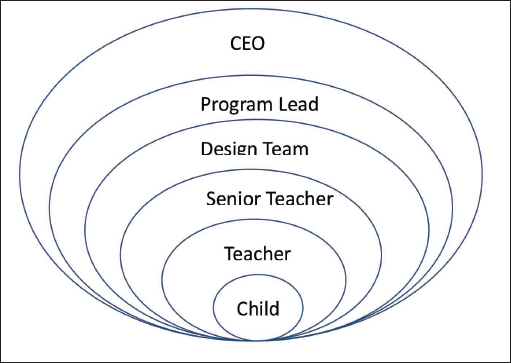
The key elements of the model are the material design team, distributed classrooms, teacher training, and the supervision system. Exhibit 1 describes the child centrality of the model.
At the heart of the GS model lies the design team, which develops a context-appropriate and content-rich series of class lessons that will hold students’ interest. They finalize the lesson plan for each day, prepare worksheets, and decide on group activities to be performed by children in the class for reinforcement. The team also prepares teacher guides about all tasks that teachers have to perform daily. This requires significant trial and error, and feedback from the field and experts.
The design team is separated by state (they operate in four states) and by the programme (refer Appendix III for details on GS programmes). A highly qualified team forms the backbone of the programme. The material is prepared after referring to a worldwide curriculum. For example, the team consults linguists to design learning material for languages. The basic tenet is to create material that supports the innate capabilities of the child to learn and keep updating this material regularly. As Ms Paras of the elementary programme design team shared, ‘We change at least 20%–25% of the material every year, based on the feedback we get from students and teachers’. Though the design team sit out of the head office in each state, they are in constant touch with the teachers and students. The members make at least four visits a month to the classrooms to get a first-hand feel of the difficulties in learning faced by the children and to make improvements.
The design team are also responsible for training the teachers, over one day each month, in conducting the sessions as per the design. This is intended to ensure that even teachers of average ability can translate the academic vision and plan of the design team into actual class practices (see details on training for teachers in Appendix IV).
The GS Classrooms
The classrooms are mostly rented single-room setups within the communities in which the child lives. There is no uniform for the classes, and the overall environment makes the student feel at home in the classroom. The teacher who teaches the child is also typically from the same locality as the child and is of a similar socio-economic background, which helps connect with the student and increases the child’s comfort level with the teacher. This ensures that the classroom and the context of learning are not alien to the student and makes it easier to convince parents to enrol their children.
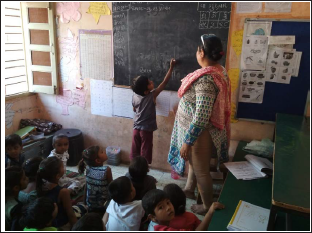
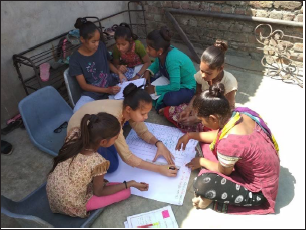
Classrooms are limited to 30 students to ensure the quality of learning. Each classroom has four sections; a different colour denotes each of the three sections and the fourth is a student corner. Sessions are broken down into 15 minutes each on various subjects. Each student group works on a different subject. The subjects are maths, language, environmental studies (EVS), and science. Photo 1 shows a typical classroom and photo 2 shows an activity been conducted in GS (Appendix V). The overall class duration is limited to a total of 3.5 hours and in many locations GS runs two shifts.
Growth of GS
What started as a small experiment in the slums of Ahmedabad, now has more than 1,269 classrooms with 30,333 children studying directly under the model. The elementary school programme (Grades 1–3) is the main programme, with the maximum number of students (26,897 in 1,106 centres), followed by the middle school programme (Grades 4–7) and high school programme (Grades 8–10) at 2,648 children in 126 centres and 788 students in 37 centres, respectively. There has also been a government school programme, an adolescent girls’ programme, and a computer-aided learning programme (see details of the programmes in Appendix III). Over the years, many state governments in Gujarat, Delhi, and Bihar have also adopted GS teaching material in their schools. Exhibit 2 outlines the number of children who have studied in various classrooms over the years.
Total Number of Centres and Children (2008–2017).

Execution of the Model
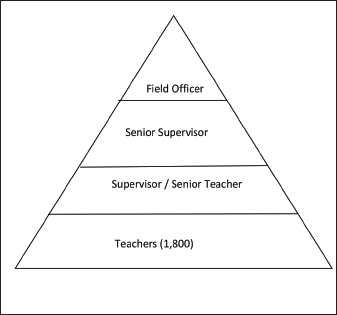
Execution of the GS model depends on effective monitoring and guidance of teachers. They are also extensively trained on a regular basis (see details in Appendix IV—Teacher Training). A field team consisting of supervisors, typically senior teachers, who guide and support the new teachers and help interface with the community. Usually, at the elementary level, there is one supervisor for every ten classes. At the intermediate level are senior supervisors who handle larger territories, and these are followed by field officers. Field officers are those who have spent a lot of time with the GS model. For instance, Ms Pragna Chavda, who handles half of Ahmedabad and has been with the organization since its inception. The detailed field structure is depicted in Exhibit 3.
Economics of the GS Model
One critical aspect of the GS model is the low cost of operations. The USP of the model is that it can provide quality education (learning) at a fraction of the cost of elite private schools in the country and even around the world. GS can also educate its students at a third of the cost of government schools.
As shared by Ms Zalak Desai, ‘The different teams handling different programmes (elementary, middle school, and high school) compete against each other to ensure that their per-student costs are lower than the others’. This is also a requirement as they operate in the poorest localities of the country, where the parents cannot afford to pay even the lowest of fees. For many years GS did not charge any fees, but today they charge a nominal ₹50–₹200 per child per month (refer Exhibit 4), though this covers only a very small proportion of the expenditure. As noted by Mr Ankith, the incharge of Lucknow ‘We started charging fees to move away from the idea of free, as many associate something which is given free with lower quality and once the parent pays a certain amount of money his responsibility towards the classes also increases’.
Yearly Average Cost per Child (2017–2018).

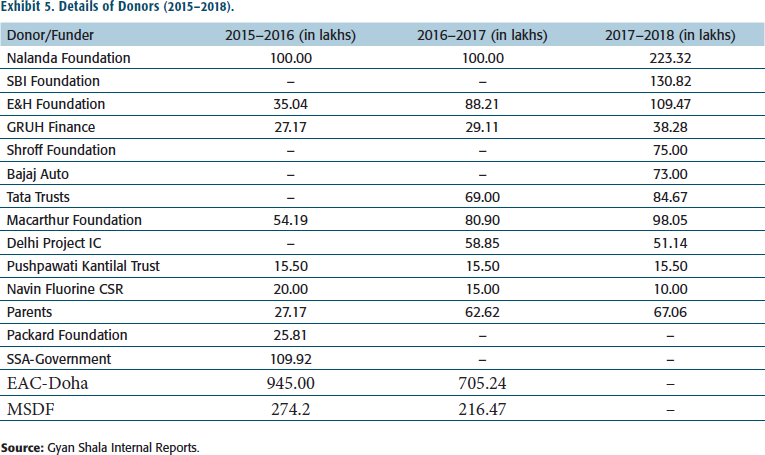
Details of Donors (2015–2018).
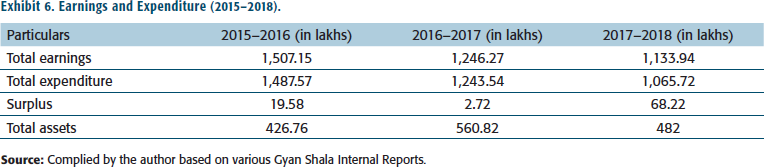
Earnings and Expenditure (2015–2018).
Performance of GS students
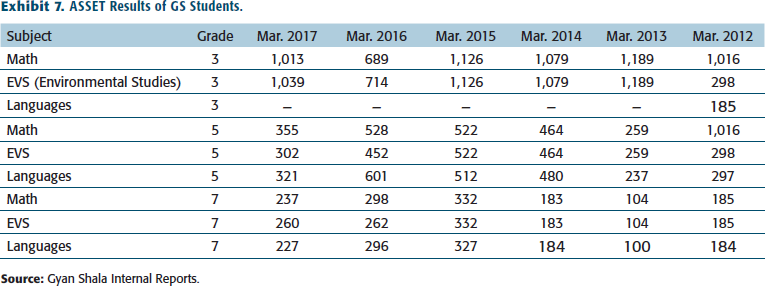
Over the years, GS management has held that the performance of students studying under the GS model needs to be evaluated by an independent external agency, and hence have engaged ASSET, which is a skills-based test that measures students’ conceptual understanding, and benchmarks schools’ performance at an international, national, and regional level. It is used to benchmark GS against the leading CBSE (Central Board of Secondary Education) schools in India. The ASSET results of GS students in Ahmedabad centres for 2012–2017 are shown in Exhibit 7. Other independent assessments by Educational Initiatives (EI–India); CfBT Trust (A school improvement organization based out of UK); and the Department for International Development (DFID), UK have also found that GS-educated students perform on par with, or better than, those in India’s best CBSE schools.
ASSET Results of GS Students.
Governance and Management at GS
Board of Governors.
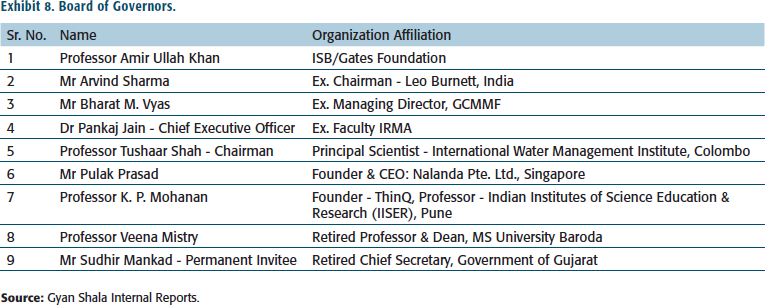
One of the key concerns of the board has been the need to appoint a successor to Dr Pankaj. The urgency for it has increased since Dr Pankaj turned 65 in 2016. Dr Pankaj too has also been seeking an answer to this issue but has so far been unsuccessful. However, he knows that this is a priority in the coming years.
LUCKNOW OPERATIONS
Lucknow’s operations started in 2013 and are now more than six years old. Unfortunately, GS management had to close many centres in Lucknow in 2017–2018. In Lucknow, only elementary classes run (i.e., only grades 1–3). The elementary school model adopted is the same as in other parts of the country, with the distributed classroom model spread across various slums in the city and the design team sitting out of the Lucknow office designing the curriculum. The number of centres across Lucknow, Kanpur, and Farrukhabad over the years is shown in Exhibit 9.
Number of Students and Centres in Uttar Pradesh.
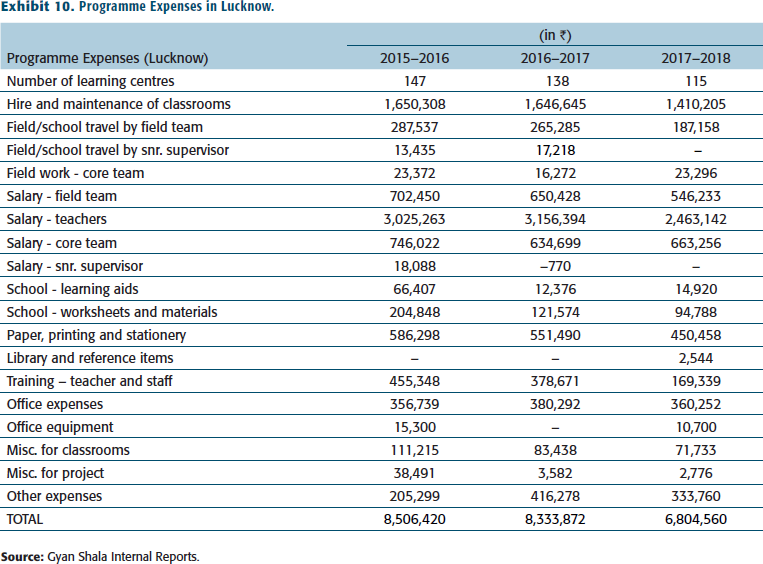
Programme Expenses in Lucknow.
Dr Pankaj shared, ‘Ahmadabad operates at a certain level, Patna is close to it, and even Farrukhabad is doing well. Lucknow is our weakest operation. The reason I can think of is the quality of the team we have there. The quality of management over the years has been much weaker than what we would have wanted. So, in a way, one could even say the top management of GS is also to be blamed because we could not get the right management team in place in Lucknow. Farrukhabad started at the same time as Lucknow and is doing much better on performance’.
One of the critical parameters on which GS focuses is the cost per student. For the year 2017–2018, the average cost per child per year for the overall elementary school programme was ₹2,979 versus ₹3,279 for Lucknow. This higher cost per child was a concern for the top management at GS.
The Lucknow team has also seen significant churn in recent years; this is uncharacteristic of GS, where, though the pay is not very high, people stay due to the quality of their work. The manager of Lucknow operations has changed twice in the last two years.
The number of classrooms in Lucknow has decreased from 150 in 2016–2017 to around 90 in 2017–2018. Dr Pankaj said, ‘We reduced the number of classrooms as they were not doing well. The kinds of problems that they faced included a sort of collusion; the classrooms which were rented in many instances belonged either to the teachers or their relatives. This leads to more problems, such as sub-optimal location decisions, because these will be based on the teacher, not the students’ convenience. Also, how can we ensure that the teacher will be present in the class all the time?’ However, Dr Pankaj also stated that the fault was partly with their supervisory system, as they failed to catch this problem early on. He said, ‘We do not allow the different stakeholders of GS, that is, teachers, supervisors, and the people whose properties are rented for the classes, to be in any relationship. Among the teachers, we normally do not allow a husband and wife to join us as teachers unless they go through very tough scrutiny’. Dr Pankaj admitted that bringing Lucknow operations on par with the rest of the operations in Ahmedabad and Patna was a priority.
The overall impact of the initiative on society is significant, both for the students who study and for the local teachers. One of the younger teachers in Ahmedabad shared that ‘My father says, “you should work for [GS] even if you are not paid any money; teaching is a noble profession. We feel proud when any guest comes to our home and [asks] what your daughter is doing, and we can proudly say she is a teacher”’. The model has shown positive results in places where GS has been operating for a long time, as teachers in Ahmedabad have had students returning to them many years after finishing their engineering and medicine courses to acknowledge GS as the reason why they have continued their studies. The teachers have acknowledged this as the most satisfying aspect of being part of GS.
When asked why Dr Pankaj prefers to work with the lowest strata of society, since with his expertise, he can always take the same model to a segment that can afford to pay and make GS a self-sustaining model, he stated that he wants to prove the model. He added that if the model works for this segment, then it will work with any segment. He shared his desire to influence policy at the state government level (since education is a state-level policy) and have a lasting impact on the education system rather than focusing on monetizing GS. Infact, the GS team is very proud that they are the only NGO programme mentioned as exemplary in the Government of India’s New Education Policy (2016).
Recognizing these priorities shared by Dr Pankaj, Ms Zalak Desai and her team regrouped with double the vigour to chalk out an action plan for the Lucknow GS operations.
APPENDICES
Vision
To become one of India’s most effective NGO programmes in order to address schooling quality gaps and to help India improve its ranking in social development indicators.
Mission
To evolve a total system solution model for quality school education on a nationwide scale, without any form of discrimination.
To initiate a systematic transformation in school education by measuring the improvements in learning levels, which is feasible by improving pedagogy practices and ensuring high accountability.
To implement the programme across a substantial scale, generating credible evidence of the impact in order to inform the overall policy formulation by the government.
Goal
To enable every child from poor urban and rural families to obtain a school education similar to that of children in elite schools.
Traditional Schooling System
In the traditional school system, the teachers are entrusted with the design of the learning tasks that children perform in class or at home. Typically, an independent state or national-level institution sets curriculum norms, and independent experts and writers provide the text books and teacher guides to assist the teachers and students. Teacher preparation involves specialist post-school training for 3–4 years at university, followed by some career development training. Schools are organized as small teams, headed by a principal or headteacher, while teachers have considerable autonomy in how they handle classes and the learning process of children.
Programmes Run by GS
Teacher Training
There are three kinds of training given to the GS teachers:
The training also serves as a platform where the teachers can exchange thoughts and share their difficulties. The design team members are also part of the training and they use feedback on what worked and what did not work to improve the content.
PHOTOS FROM GS CLASSROOMS
A Typical Class.
Activity-based Session.
Footnotes
DECLARATION OF CONFLICTING INTERESTS
The authors declared no potential conflicts of interest with respect to the research, authorship and/or publication of this article.
FUNDING
The authors received no financial support for the research, authorship and/or publication of this article.
e-mail: