




Abstract

Multi-level marketing (MLM), also known as network marketing (non-retailer channel), is supposed to touch ₹160 billion in the year 2021 (Shenoy, 2018) and is expected to grow at a significantly accelerated pace in the future. Some studies predict that by 2025 the turnover in India may touch closer to ₹600 billion (KPMG, n.d.). The unique aspect of this marketing activity is that the distribution channel is formed as a network of people who consume and can sell products directly to other end consumers. In the current exigent conditions prevailing around the world due to the COVID pandemic, which has caused a significant economic recession and personal distress to many due to job losses, this is an attractive opportunity for self-employment. It is hoped that such opportunities will help expand the role of this marketing channel further, particularly in India.
In many ways, the idea behind network-based marketing is to avoid over-the-line promotion of products and instead depend upon a network of motivated people to sell products (and also consume) to earn handsome discounts on consumption and commissions on the sale. Hence, marketing expenses are mainly directed towards sales commissions to direct sellers (also called consultants), and little is spent on advertising and other media communication vehicles.
HOW DOES MLM WORK?
Despite its significant presence in the retail transaction space, MLM is not a very familiar concept in mainstream marketing practice in India because of its low visibility, which is confined to the network of people involved in the activity. Besides, it is sometimes also confused with pyramid schemes (Sudhir, 2014), a practice that has negative perceptions and is banned in many countries, including India. Marketing literature focusing on this mode of selling products is limited (Bosley & Mckeage, 2015; Herbig & Yelkum, 1997; Koehn, 2001; Peterson & Albaum, 2007). Some papers highlight the risks of MLM being relegated to illegal pyramid schemes (Abassian & Safi, 2020; Krige, 2012; Mohammed, 2020; Vander Nat & Keep, 2002). However, given that it occupies a significant portion of the retail transactions in India and is expected to grow at a fast rate −13% (Shenoy, 2018) and provides self- employment opportunities to 5 million in India (KPMG, n.d.), a description of the practice will be very pertinent at the outset.
The direct selling of products is by the company recruiting direct sellers (consultants) who buy the product(s) at discounted prices (wholesale price). The goods are purchased for consumption and sold to other consumers at market price. The difference between wholesale and market prices is the profit earned by the direct sellers.
There is another dimension to the selling model that makes the business proposition to the consultant very attractive. Most MLM models also incorporate a referral system by which a prospective consumer of the consultant can be persuaded to be a consultant, whereby they buy directly from the company at wholesale price for their consumption instead of buying it at market price from the consultant. They are also initiated into the process of directly buying and selling products and earning profits for the goods sold.
The advantage of a referral system is that the referee gets a benefit for the volume consumed or sold by the person (s)he referred to the company as a potential consultant (also called a downline). Therefore, a ‘downline’s purchases from the company add to the volume credit that a referee (also called upline) gets, providing an additional source of income for the upline beyond he(r) own purchases’.
The advantage of a good referral system is that it can theoretically create a source of passive income for the upline based on consumption of the downlines (usually up to a pre-specified upper limit). Optimally, an upline may recruit all potential consumers of her direct selling market to become downlines and forgo the commission available from selling products to them and instead get a commission on the volume purchased directly from the company by them. Of course, she would still have to buy minimum volume, as determined by the company, for her consumption or direct sales. The downstream network may be a significant source of passive income if the downlines remain committed to buying the products from the same company. In fact, the downlines may further recruit their downlines, and in the process, the network gets deeper and well-entrenched. The process of building a fertile network-based retail model encourages many network partners to be self-reliant, encouraging entrepreneurship among the middle-class citizenry of the country.
Usually, one would expect that the commitment to the products remains strong so long as there are network advantages in building passive income opportunities. Hence, if the downlines are strong and entrenched, the commitment to the products is sustained. Some secondary advantages of maintaining strong networks, such as socialization and sense of organization citizenship, have been mentioned in past literature (Sparks & Schenk, 2006).
This does not mean that the quality of the products is not important. Most consumption of products will probably be maintained if the product retains an acceptable level of quality. Consultants in the network will usually endorse that products are of top quality, something hard to validate since they are also the interested party in the business. Hence, the assessment of the product quality can only be made by the leaves (the last tier) in the network, who do not benefit from direct selling of the products to others or, do not have the ability to make passive income based on consumption of their downlines.
PRODUCT BRANDING AND MLM: A COMPARISON WITH TRADITIONAL RETAILING
MLM provides a unique setting to re-evaluate the role of the brand in the context of the purchase. Unlike traditional retailing, where the roles of sellers and consumers are distinct, in MLM it tends to be blurred. Therefore, while true consumers evaluate available options in the marketplace and take decisions based on optimizing consumption utility (or maximizing expected gratification), buyers/resellers/consumers in the MLM business may have an added incentive to keep the consumption pipeline active since many of them benefit from the income generated due to the volumes consumed by themselves and also their referrals (downlines). Therefore, the total gains from consumption go beyond the utility of consumption of the product to the added benefit of income generation (Coughlan & Grayson, 1998). As mentioned earlier, there may also be some non-monetary benefits of being part of the network beyond the utility from consumption or the motivation for extra earnings.
This dimension is emphasized in the positioning of many MLM companies in India as well. One prominent network marketing company talks about azadi linked to the idea of creating self-reliant entrepreneurs (especially women) who profit by participating in its MLM. Similarly, for a considerable amount of time, Amway (the global icon of MLM) has promoted itself on the plank of creating entrepreneurs who believe in a great opportunity. In fact, consultant recruitment campaigns focus on the quality of the products and the opportunity to earn better than average remuneration (through hard work), which a normal job cannot provide. What is also interesting is that while most products are identified (by a name) but beyond the immediate network of consultants and end users, their recall in the market is almost nil. The brand value is largely driven by the basic product quality as assessed by the participants in the MLM network and the opportunity it provides to generate income. This is distinctly at variance with traditional retailing where the product or producer branding often plays an important role in influencing the commercial transaction.
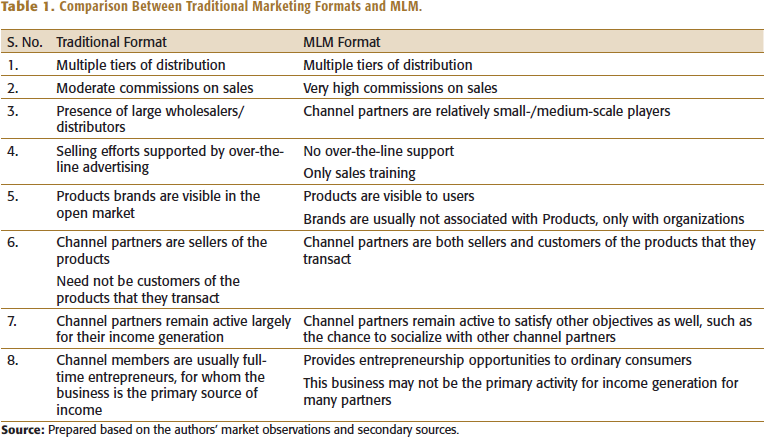
In summary, due to the lack of visibility in the open market (over-the-line promotion), most consumers who are not part of the network do not get exposed to these products (brands). This is a distinguishing feature of MLM, unlike traditional retailing, where consumers may be aware of brands but need not necessarily purchase them. Also, the consumers within the network are significantly driven into consumption through the lure of income generation (besides attractive pricing and quality). Hence, the role of the product in defining the brand consumed is somewhat diffused. Perhaps, an apt word in this context would be income-generating brands. The true competition in the brands is between the choice of being/not being a part of the network. If one chooses to be part of the network due to a positive assessment of the benefits (lower price, good core product and income generation opportunities and, organizational citizenship), she has no choice but to consume the products offered by the MLM company. A study in the western Indian state of Gujarat confirms that discounts given to consultants in the network on the purchase of products (both wholesale margins and volume discount) can go up to as much as 35% (proprietary study conducted by authors). MLM appeared to be a nascent turf for us to probe the motivation and sustenance of this business domain, especially in India, given the need for self-employment opportunities in the country. Table 1 provides a comparison between traditional retailing formats and the MLM retail format.
Comparison Between Traditional Marketing Formats and MLM.
Our objective was to assess MLM activities in the Indian markets. To do so, we decided to conduct a short exploratory survey. Our motivation was also to identify more concrete research issues on broader dimensions. The decision to focus on these dimensions was largely based on our conversations with the network partners and MLM organizations. The broad dimensions are:
What is the motivation for network partners to join the MLM network and their potential role in the network? How is the network developed by the MLM partners and how is recruitment of partners done? What ensures that partners sustain/maintain the MLM retail transactions? What type of products are sold in the network and why? What brands (product or network) are created in the context of MLM? What is the constitution of the brand? How can producers develop suitable economic incentives to motivate channel partners to sell their products better?
Many of these issues needed responses from network partners in the MLM domain to verify the actual state of business operations. We felt that data from the field were required to corroborate our hunches on the state of business and unravel newer insights. We hoped this exploration would identify more specific research issues that may feed into further enquiry in this area of marketing research.
EXPLORATORY RESEARCH
Our 12 in-depth interviews (details provided in Appendix A) were conducted in Ahmedabad, Delhi and Mumbai. Consultants (all independent entrepreneurs) associated with Amway, Tupperware, IMG, Oriflame, Modicare and Avon were contacted through a professional research agency. A couple of end consumers of MLM products were also interviewed. The broad areas of investigation are listed in the interview guide used for data collection (Appendix A). While the interview guide was developed basis the broad dimensions listed earlier, the researchers ensured that the respondents were given the liberty to deviate from the script to facilitate identifying hitherto unknown dimensions of the process, if any. Hence, the summary provided below is a mix of inputs from the guide questions, additional unstructured probing by the researcher and their observations during the discussions. The choice of the data collection centres was largely influenced by (a) the concentration of MLM activity, (b) diversity across regions (if any) and (c) the convenience of the researchers. Future studies will require a more representative sample of data collection sites.
Sampling for the Exploratory Research
Three criteria determined the respondent selection in this exploratory work:
Our preliminary assessment of the different roles usurped by network partners in India. We identified these through informal conversations with a network partner of a large MLM marketer with whom we had a brief professional engagement before initiating this research project. Our informal conversations with market researchers who have previously worked in this domain. The sample size was also influenced by our ability to find willing respondents to invest time in the depth interviews. Given the exploratory nature of the study, it was considered appropriate to work with the findings from this small sample. To ensure reasonably close representation of the market conditions, we chose to speak to a larger number of consultants (who form the majority of the channel partners) and a small number of Senior Directors, who are essentially channel managers and have significantly higher involvement in the trade and experience. We also spoke to some end customers who buy MLM products to ascertain their views about products and the retail experience.
A total of 12 in-depth interviews were conducted with the help of expert qualitative data collectors. The researchers were at the data collection site to observe and initiate follow-up discussions with the respondents based on the contents of the formal proceedings. The data were collected during 2019– 2020. In recent times, MLM has ignited new interest in two major areas:
Job losses due to the recession have led to an increased pool of potential consultants looking for self-employment opportunities and Certain health supplements sold extensively in the MLM networks have a higher propensity to sell due to the pandemic forcing people to seek protection against the virus (Hayes, 2021; Vesoulis & Dockterman, 2020).
None of these dimensions has a direct influence on the insights collected on the specified dimensions of this study.
Finally, as conventional retail outlets languish because of low footfalls during the pandemic, direct marketing has the potential to grow. However, much of the growth would appear in the touchless direct marketing transactions, which is not unique to MLM alone. We would expect that MLM may modify to incorporate touchless distribution to sustain itself, just as other retail channels are attempting to do so. There are some references to the same in the trade publications.
A synthesis of our findings based on the in-depth interviews and our informal market observations is presented below. Basis this small sample, it cannot be ascertained whether there are significant differences in observations across cities. However, top-line data (summary transcripts) from the in-depth interviews conducted in Mumbai and Delhi and Ahmedabad are available with the authors.
Interviews with MLM Sales Consultants in the Indian Market
The findings have been structured into a few specific anecdotal cases that highlight the experiences of various channel constituents and customers. In the latter part of this section, we shall summarize the major implications of the data presented in these cases.
Case A. Ms Shikha Agrawal, 30 years (Senior Director and Area Coordinator, Ahmedabad region, a large North India-based MLM company)
Shikha was a salesperson for a local consumer products company in a small town in southern Rajasthan for over five years. Aspirations to make it big professionally drew her to Ahmedabad eight years ago. However, she could not find a worthwhile job that would pay her bills and support her family back home in Rajasthan. Thinking back on her travails, she attributes her failures to the lack of proper educational opportunities in her formative years. Not to be put out by this roadblock, a chance encounter at a meeting of sales consultants of a large MLM company convinced her to take up self- employment as a route to professional success. She enrolled herself as a consultant for this organization. She spent the next three years working diligently (she claims on an average, 10–12 hours a day without a break), trying to sell the ‘company’s products to her neighbours’. Gradually the effort yielded significant success, and she expanded her coverage to a large part of western Ahmedabad. Her principal (MLM company) advised her to recruit additional consultants as a part of the referral system to expand business in the area. Initially reluctant to do so since it appeared that having additional sales consultant would cannibalize her business prospects, she soon realized that it was the wise thing to do to increase revenue and commission for herself. After all, how much can a single person do in terms of direct selling he mused. It makes much more sense to add people who could complement the selling efforts and increase income for all.
At the time of the interview, Shikha had grown to become the area stockist and coordinator for consultants in the western part of Ahmedabad. She partnered with an associate (Karan) to establish and manage the stockist operation. Karan had a similar story to Shikha, having grown up from being a small-town salesman to a successful entrepreneur. ‘I earn over a six-figure income every month’, stated Karan. He could not have imagined anywhere close to that income had he continued his professional course as a salaried salesperson.
Shikha attributes her success to the correct advice given by the MLM company, her hard work and dedication, the aspiration to earn a handsome income every month, and her independent views about life. However, the mention of the products she sold and their superior quality (or otherwise) was sparse. A large part of the conversation was about the network model that allowed her and many others to earn a decent income. Upon some prodding, she talked about the products she sold and that the health and general nutrition products were most sought after by her customers. A relatively short conversation on products yielded some insights into the quality aspects. Shikha was forthright in admitting that not all products were of top quality. But the fast-moving repeat purchase products (health and nutritional products) were most certainly high quality. That was the reason customers buy them repeatedly despite the higher prices compared to similar products in retail stores.
Shikha’s primary objective in her current role is to recruit as many consultants as possible under her to increase the coverage in her territory. She claims that the company has recognized her initial efforts at selling products directly by offering her the stockist’s role. Her income is generated due to the referral commission she gets from the numerous motivated consultants she has hired.
She (and Karan) has no regrets regarding the decision to be self-employed and believes that MLM companies provide great opportunities for people like them to earn higher incomes and raise their standard of living.
Case B. Ms Bonita Ray, 48 years (Consultant, South Delhi for an MLM company)
Bonita is a single parent raising her 17-year-old daughter in a lower-middle-class neighbourhood of Kalkaji. Penury and separation from her husband forced her to become an MLM sales consultant to supplement the meagre income she had from providing tuition to school children. Initially, her tuition clients (parents of children she tutored) helped by buying products out of pity. But as she recalled, the quality of the products she sold and her dedication to serving her clients well got her repeat business. Slowly, her original clients recommended her to their acquaintances, and the network of steady customers increased. Bonita does not actively recruit consultants and appears happy trying to sell the products to her customers, who are expanding steadily due to positive word of mouth.
She believes that providing good service, being honest and transparent and not seeking more than her fair share has led to building enough equity for her in the expanded south Delhi market. Her reputation as a tuition teacher has helped, but she has been careful not to aggressively cash in on that reputation for business opportunities. And as she stated, ‘good products from the company helped in creating a good business platform for her to sell’. Five years into this profession, she still counts on it to supplement her income from tuition. However, the investment of time in this activity has grown. Careful management of her reputation has meant that she has not created a negative perception associated with aggressive salespeople. Her tuition work grows, and so does her MLM sales.
If there is one regret that she has, it is about the erratic supply of products from the distributor, which sometimes causes a delay in serving her regular clients. She makes amends by stocking some of the products. However, her limited financial resources do not allow her to keep too much stock. She did mention that having the local stockist deliver at home would help immensely, but as a practice, that was not too common.
She described her selling activities as referral driven, from satisfied customers and very rarely did cold calls. Besides, given her role as a tuition teacher for children, it did not bode well to be seen as a pushy salesperson. Most of her products included beauty products and general nutritional supplements.
Case C. Ms Hiral Patel, 55 years (Consultant for reusable kitchen storage products, North Mumbai)
Hiral has been a consultant for over 17 years, with some breaks in between to take care of family responsibilities. This activity is not a primary income source but provides substantial disposable income to her. She is well-connected in her community and sells primarily among her contacts. As the business grew, she started giving newspaper inserts and WhatsApp messages to inform new and existing customers. Most of her sales are repeat in nature and only a few to new customers.
The idea of becoming a consultant struck her when someone came to sell similar kitchen items to her house. Given her long experience, sales happen regularly among regular customers and without much effort. However, she admits that that was not the case when she started. Most of her sales are over cash, and she rarely gives credit. Nor does she get credit from the company.
Her ambitions are limited. Selling is a pastime and a source of relatively easy money. But her aspirations are contained, and she does not want to expend more energy to build the business further.
The role of the company is limited to informing her about the availability of new catalogues and occasionally helping organize meetings among customers and consultants on new products and product usage. There was no persuasion by the company to achieve more sales targets. However, if specific targets were met in a year, the company would honour her with gifts, which she appreciated a lot.
Case D. Ms Bina Mehta, 60 years (Past Customer of kitch- en storage units, Mumbai North)
Bina lives in an upmarket housing society in North Mumbai with her physically challenged husband (who requires care) and a son, who recently started working as an Accountant in South Mumbai.
She used to buy storage products from a consultant who stayed in her housing complex. However, when the consultant relocated outside Mumbai, the relationship snapped. She stopped buying because there was no one to service her requirements. She found the storage units to be of good quality, and it was worthwhile, given their price and the service provided by the consultant to deliver at home. Also, a personal relationship with the neighbour who was the consultant ensured that the service was of high quality. ‘If a product had a fault, my friend would make sure the problem got rectified as quickly as possible’.
While her purchases have halted since her consultant friend relocated, the lady did mention that over the years, other consultants of MLM companies have approached her to buy their products. She would be open to considering buying some of these products if she is convinced that the quality is good. Most products that she purchased were with cash. No one was willing to give credit on purchases.
SUMMARY FINDINGS
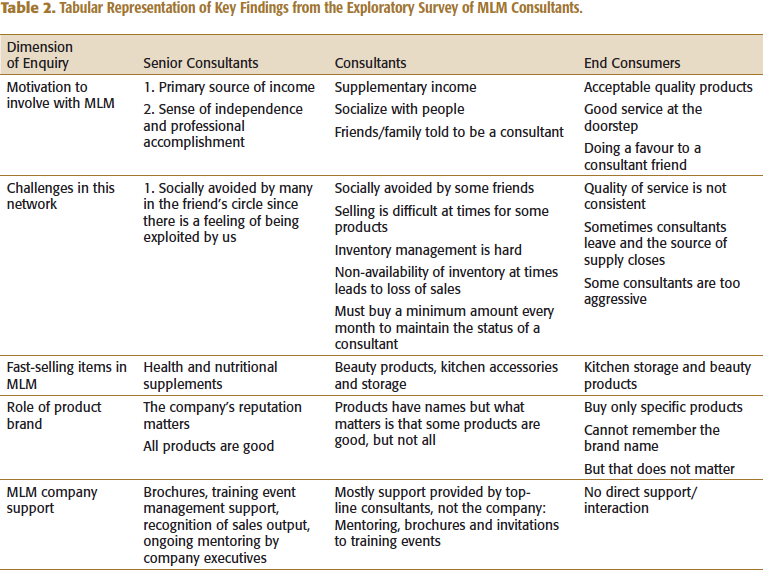
Basis these sample anecdotal cases, other interviews and secondary sources of information, we describe the major findings from our exploratory work. The summary is also provided in Table 2.
Tabular Representation of Key Findings from the Exploratory Survey of MLM Consultants.
Motivation to Participate in MLM for Channel Members and End Consumers
Senior directors and above (three respondents) refer to Case A: They are the closest in their work profile to a regular stockist of a mainstream retail distribution channel. The title of ‘senior director’ is given by the MLM company to recognize their valuable contribution to the marketing activities. However, they are not employees of the MLM company. The selling of products and network management is their responsibility and primary source of income. It is buffered by recruiting more downlines (increasing coverage) and increasing volume commitments from existing downlines (increasing depth of coverage). The breadth of coverage is more attractive than depth beyond a point since the volume discount scheme encourages having more direct downlines than indirect ones. Of course, indirect (lower tier consultants) downlines is a good way to increase passive income since the direct downlines are motivated to increase sales, too, as it supplements their income. Product selling is restricted to making a pitch for the quality of the product. The motive for them would be to broad base their downline network to prevent another stockist from entering the geographic territory they work in.
Consultants (seven respondents) refer to Cases B and C: This sample included homemakers or working professionals interested in supplementing their income/spare income by selling some household products in the vicinity of their neighbourhood. They are reconciled to using the products and meeting targets of direct selling/consumption. They support the claim of product superiority. The motivation to be active in this segment of consultants varies with a need for income, the extent of their social network and the motivation to exploit their social capital for economic wealth creation (Grayson, 2007; Kong 2003). Extrovert personalities who do not mind exploiting their social network for economic wealth thrive in this venture. Others may have networks ranging from average to flagging depending upon the network dysfunctionality trait. Trade literature describes the average consultant to be a woman, self-employed and believes that this profession leads to her self-empowerment. This was largely validated in our findings.
End Customer (two respondents) refer to Case D: The last node in a chain that consumes MLM products but has little motivation to further extend the chain by recruiting downlines. Usually, a person who has been persuaded (willingly at times) to buy products periodically by a friend who happens to be an MLM consultant. The consumer occasionally/frequently buys for various reasons such as (a) to manage the social capital with her network friend, (b) is convinced that the products that are being sold are of good value (price– benefit trade-off) and (c) values the convenience of home delivered products. Most end consumers continue to buy selective products over time as per their perception of the utility of the product.
Selling Competency
For products that are high-priced shopping goods and not actively sought after, a strong personal selling competency is required. Many MLM products fall under a category such as beauty products, health supplements and household consumables. However, the range of products across MLM organizations is diverse and includes low-value, fast-moving packaged goods too. Selling is primarily based on the description of the personal experience of the seller and a demonstration of the usage of the products. MLM companies invest significantly in providing training and interactive sessions for consultants to get them updated on the products, new products and usage. However, our observation is that those selling skills are heterogeneous across a large proportion of the (downline) consultants, especially when their motivations are varied.
Distribution and Logistics Operations in MLM
Most of the downline consultants we spoke with do not have a commercial space to operate and hence keep minimal inventory. They must visit the area stockist to replenish inventory, as required. A disadvantage of this system is that when the (end) consumer has a requirement, it must be ordered (especially for high- value items), and that causes a delay in replenishing demand.
Closure of downline retail operations can happen much faster since the consultants in the tiers have a small turnover and, therefore, may have a lower commitment to the business. As stated earlier, this is a secondary source of income for many consultants. The employment of self-motivated consultants is to help build a replica of viral selling (marketing), but it may not happen uniformly across the network. Hence, the recruitment of new consultants with appropriate motivation is an ongoing challenge for the major network managers (senior directors).
Recruitment of Consultants (Sellers)
For many consultants we spoke to, selling MLM products is a secondary source of family income. They are not professional sellers but do the activity as part- time employment, a hobby or in pursuit of quick cash. ‘Seller’s motivation is significant in determining the success of the venture’. Whether this motivation can be enhanced by adequate compensation is a moot point and a potential area of further research. More on this point is discussed in a later section of the paper.
Second, the ploy to catch part-timers into this selling trade is by selling them the idea of earning passive income through downline sales in the network. This was revealed in our conversations with the senior directors/stockists in our sample. For most, a significant reason to be in the network (and perhaps continue with the consumption of the products) is the income generation opportunity. A significant research question pertains to how much active selling of products happens versus active recruitment of downlines.
Third, what is the ploy to recruit new consultants (downlines)? Usually, in the MLM format, the downline network appears to be formed largely across friends and family circles, many of whom are part-timers. A reason cited to engage in the network is to connect with friends and family over meetings. How tenacious/ tenuous a network among friends/family when the friendship is being leveraged to establish a business relationship remains unclear (Grayson, 2007; Kong 2001) to us. There may be implications for the product marketers regarding the productivity of the network to bring business, as against acting as a conduit for social interactions.
Products Sold in MLM
As mentioned earlier, consumer products that require a high degree of selling skills (shopping goods) are the best candidates to be sold through a personal network, leveraging the social capital of the network. However, the products sold must also be of top quality to have a good perception of good value purchases.
The evidence from the market is that the MLM product portfolio is diverse. It ranges from shopping goods (cosmetics, general wellness, women’s wellness, jewellery, personal care) to regularly purchased household items (FMCG) to agricultural goods, kitchenware and healthcare products. Perishables are a category that is largely not available, and packaged FMCG food items are sparse. Many of the products sold are also perceived to be high priced though they are publicized to be value-for-money products.
Our study indicates that most consultants (that we spoke with) do not fall under the category of aggressive sellers. This is also partly supported by past research (Brodie et al., 2002). Hence, the best products to be sold may be the ones that do not require too much persuasion— products that have safe quality standards and are repeatedly purchased and necessities/staples that word of mouth and personal networks can sell without many qualms. If the product quality is maintained at an acceptable level, repeat buying is not difficult to sustain through the personal network (both for the consultant’s own and their consumer’s requirements). However, such products are not frontline items sold through the MLM network.
The preliminary data from the market survey reveal that while consultants have uniformly voiced the superior quality of the products they deal with, the end consumer response is varied. This is why certain products tend to have a more extensive network share compared to other products of equivalent quality vis-à-vis products available in mainstream retail outlets.
Role of a Product Brand
If the customer exercises his (her) choice of buying from a particular MLM network, the choice of the product option is imposed on him (her). There are a few second alternatives in a product category to evaluate and choose from. Hence, the brand (identity, visibility, uniqueness and consistency) is largely attributable to a specific MLM format (Modicare, Tupperware, Avon, IMG and Amway), not so much to the identity of a particular product available in the MLM format. Our conversations with customers and consultants confirmed this fact since no one emphasized product brands, they referred mainly to the manufacturer/marketer or the product category.
IMPLICATIONS OF THE FINDINGS
Several interesting insights seem to emerge from our research across three major cities in India and other secondary sources.
A significant number of downline consultants appear to be in the network to augment their income or participate with the intent to spend free time and socialize. Socialization may be an important motive behind getting hired as an MLM consultant. Whether this is the best way to exploit the sales potential in the market for the marketing organization is a moot point. The networks built up by recruiting downline consultants seemed to be significantly hinged on exploiting personal contacts. It is uncertain if personal contacts can be leveraged to maximize selling efforts. Products amenable to selling easily seem to be staples and regular refills. However, there are enough products in the portfolio that require hard selling and have high price points. Many consultants may not have the calibre to sell such products, given their motivation to be a consultant. Inventory supply is largely driven by individual consultants and their ability to service their downlines. Higher-tier consultants double up as stockists, but the distribution may not reach the tiers efficiently. Many consultants complained that servicing their customers on time was a challenge due to difficulties in accessing inventory from stockists. The role of the brand is diffused. There is a corporate brand that stands for various dimensions: (a) income generation opportunity, (b) social status through association and (c) post-consumption validation of product quality.
IMPORTANCE OF THE FINDINGS TO MARKETERS
While several issues make interesting research possibilities, selecting the right consultant seems to be an important driver in sustaining a healthy MLM business. Since network-based marketing is highly dependent on personal selling, it requires consultants with adequate motivation to invest efforts in direct selling and recruitment of equally motivated downline consultants to form a productive network. However, recruiting motivated downline sales consultants also enhances the risk of cannibalizing their direct-selling business since the downlines may compete for the same customers. Hence, designing an appropriate consultant commission structure is critical to ensure an optimal mix of direct sales and downline network development to leverage full market coverage. Often, consultants are satisfied recruiting downlines and administrating the network (Brodie et al., 2002) rather than spending time on direct selling. Without undue direct selling effort, the market volume sold due to a passive distribution network may remain sub-optimal.
How should sales commissions be devised to ensure optimal selling and downline network development? In the next section, we attempt to unravel the issues of consultant compensation in MLM as we see them and highlight the importance of designing appropriate commission structures to leverage the full potential of the marketplace.
ILLUSTRATIVE MODEL TO PROVIDE INSIGHTS INTO DESIGNING OF THE RIGHT CONSULTANT COMMISSION
We provide some insights into designing the right consultant commission by developing a simple and stylized analytical model. The purpose of developing this model is illustrative. It only highlights the issues stated in the previous section and utilizes a simplified scenario analyser to provide broad directions to MLM marketers in deciding on incentive schemes to improve the selling effort of the channel members.
We assume a notional market potential K for a fictitious product (given its assumed quality) and analyse what sales commission may be offered to extract the maximum market potential.
Supposing the volume % of total potential sold in any period by a typical network consultant through direct selling is y and, z is the volume sold by the downline network of a consultant. K is the potential volume that can be sold by the consultant in his network and is influenced by the value perception of the product sold. Assume that K is for a defined exclusive territory where the consultant and his downline network operate. In the real world, this may be a rational assessment of the product’s volume that can be sold, accounting for its quality vis-à-vis other options available in the market. While this may be a simplistic assumption, and usually, MLM companies do not assign exclusive territories of operation to their channel members, our observation revealed that most channel partners have a modest scale of operation and do not seem to have the capacity to expand beyond a limited geographic territory. Generally, this market size may be expanded to the entire nation without distorting the simulated results.
The total monetary compensation of the consultant in a period will be: a × K × y + b × z (where K is the total potential). We assume that the monetary income is the sole motivation of the consultant to remain active in the network. In this simplistic model, we ignore the benefits of socialization as past marketing literature has documented, and our studies have found evidence for the same.
a and b are the per-unit compensation for direct selling and network management, respectively. Of course, the consultant would have to make an effort to achieve this volume, and this effort is different for each of the units sold directly and separately through the network she has developed.
Let D(y, m, a, i) be the monetary value of the cost of direct selling of one unit of the product. D is an increasing function of the direct selling volume % y, implying an increased effort to sell more through this channel as the market is penetrated. It is also an increasing function in m (no. of downlines, also referred to here as network complexity), implying the cannibalization impact of competition from one’s downlines. It is a decreasing function of a, the commission for direct selling implying that motivation increases as commission rates are increased. We also include a heterogeneity factor, i, to account for differences in motivation across consultants, though we assume that all consultants recruited exhibit similar traits (assumption). However, the type of consultants recruited will have an implication on their overall motivation to sell the product. If most consultants have goals other than maximizing compensation through direct selling, the selling effort is so large that not enough effort would be expended by the consultant. We vary this effort component through the heterogeneity factor i. We assume a baseline cost of 0.3 monetary units 1 (at y = 10% and network coverage m = 1) and compare the changes in the per unit cost as selling effort increases or network coverage increases to this baseline cost.
Similarly, the monetary value of the cost (effort) of selling one unit item through the downline network is E(y,m,b,j). E is affected similarly as D by y,m and is reduced by higher incentive b. We also include a heterogeneity coefficient j to account for differences in consultant motivation. As in direct selling cost, we assume a network management cost of 0.1 monetary unit at the lowest level (y = 10% and m = 1)
Total Income per period earned by the consultant:
1. I = a × K × y + b × z – (D × K × y + E × z),
Such that:
2. K × y + z ≤ K (where K is the total sales potential for the product in a period)
3. z = ∑ K × (1–y)m × y (where m is the number of downlines – 1 … m)
The consultant income (I) is dependent on (a) volume of sales credited to her, (b) the compensation for selling and network management and (c) the perceived costs of selling and network management, which is influenced by consultant motivation. It is assumed in our model that downline consultants will receive lower volume credits as compared to uplines. In reality, if consultants are heterogeneous, it is possible for downlines to be more aggressive than the uplines in garnering direct sales volume. Although the credit for the same is also enjoyed by the upline in terms of accumulated network volume.
The downline sales volume, z may be divided among the m consultants equally or sequentially (as Formula (3) depicts).
The objective is to look for a, b so that K × y + z ≈ K and Income (I) is maximized for the consultant subject to:
4. m is such that the mth downline will have: K × (1–y)m > c (minimum available market potential to motivate a consultant to work)
5.1 ≥ y > 0 such that K × y > f (K × y – Direct selling volume cannot be less than the threshold quantity)
6. Each consumer consumes only 1 unit every period.
7. m < K (the maximum number of available consultants is lower than the sales potential K).
Aggressive consultants will sell directly to end consumers (at commission amount a per unit), and their network does not grow beyond a certain number of downlines (m), if at all. However, if the selling effort (D) increases significantly beyond a certain volume, they are motivated by a different commission amount (b per unit) to recruit downlines to address the sales potential that they find difficult to handle themselves. Downlines have similar commitments (although in reality, they may be heterogeneous) regarding network building versus direct selling.
The total profits earned by a consultant are a combination of the income generated actively and the volumes generated through the downline network. If the margins for direct selling are low and do not compensate for the selling effort, the motivation would be to establish a more elaborate network to increase passive income. This may be true with the downlines as well; hence, direct selling to end consumers will be far less. If the number of potential consultants (M) is far lower than the market potential K, the true market volumes will not be close to the anticipated sales potential of the product (K).
Whereas, if the commission on network building b is low compared to the commission on direct selling a, the consultant will spend most of the time selling directly and may not invest in network building. This may be the optimal strategy for the consultant. However, it may also not achieve the true sales target of K, if the cost of selling (D) exceeds the compensation for the consultant below the optimal sales volume (K).
Hence, it is important for MLM marketers to carefully formulate compensation policies for direct selling and network building to ensure the optimal selling and network-building effort by each consultant in the channel. This should go in conjunction with some control over the type of people who get recruited as downline consultants.
The end objective is to increase coverage of the actual sales potential by incentivizing consultants to expend the right effort in direct selling and network-building activities, maximizing their income.
RESULTS OF THE ANALYTICAL MODEL UNDER SPECIFIC ENVIRONMENTAL CONDITIONS
Building on the model described above, we developed some simulated results by assuming some market conditions related to demand (K), direct selling commission (a) and network management compensation (b). We also simulated some cost functions for direct selling
(D) and network management (E) basis some logical underpinning, as stated earlier and reiterated below:
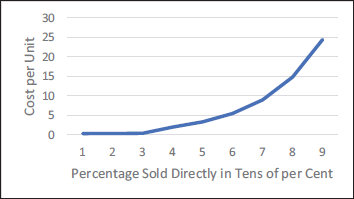
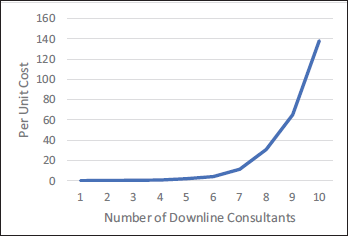
The cost of direct selling goes up as the direct selling amount increases—the effort to sell to more is high due to market saturation effects. The direct selling cost also increases with a higher number of downlines (since there is some competition from them which needs to be addressed). The direct selling cost is higher for consultants who regard this activity as a source of secondary income. Motivation to sell more is high with higher rates of commission, and hence the selling cost will be lower. Network management costs increase as the direct selling propensity increases due to increased cannibalization of selling opportunities. Network management costs increase with an increasing number of downlines since there is more coordination work. Network management cost is eased out to an extent if the commissions are higher.
Using the assumptions in the previous section, we create the theoretical cost relationship (D and E to selling effort y and m = 1 and network complexity m and y = 10%, respectively) as shown in Figures 1 and 2 respectively. The direct selling cost curves and the network management cost curves will shift upwards, as the number of consultants in the network increase (in D) and the direct selling proportion increases (in E), respectively.
Per Unit Direct Selling Cost (D).
Per Unit Cost of Network Management (E).
If all consultants (Tier 1 and the downlines) have similar characteristics (selling motivation) in our stylized environment, the percentage of total market potential captured by the network for different selling tendencies and network depth is given below in Table 3. This is computed using Equations (2) and (3).
Per Cent Coverage at Various Combinations of Selling Effort y and Downlines m (Illustrative).
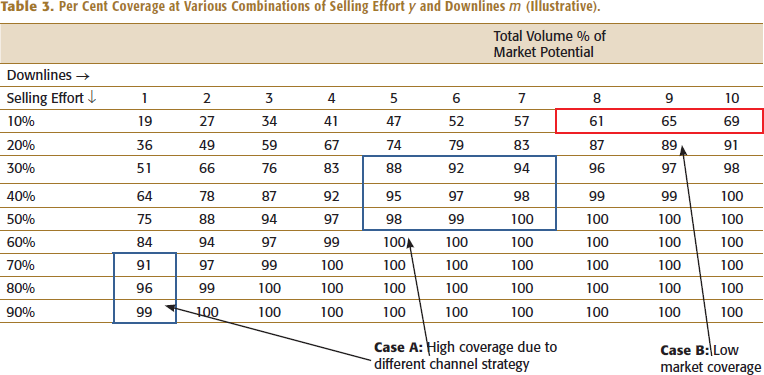
The point to be reiterated at this stage is that MLM companies would like their selling networks to drive optimal sales for their products so that the maximum potential is captured. In this instance, two possible feasible solutions are (a) low network depth (no or one downline, but maximum selling effort), which leads to over 90% of the potential market being covered and (b) moderate selling effort (30%–60% direct selling effort) but with an extended downline channel of 5–7 consultants leading to over 95% coverage (see Table 3, Case A).
It is therefore important for MLM organizations to carefully devise (a) consultant recruitment strategies to ensure optimal amount of direct selling effort and network management capability and (b) design direct selling and network management commissions to align income goals of consultants to achieve the desired selling coverage.
If the commissions are relatively low for direct selling, an inordinate effort may be given to increase the network (downlines), which may not achieve desired sales target (see low selling effort of 10% with large downlines of 8–9 consultants gives only a 65% coverage: Table 3, Case B). A similar situation arises if the consultants recruited have little passion for selling despite a strong incentive. This may yield a network of passive consultants satisfied with limited goals. Our brief market survey reveals that many recruitments of downline consultants and their motivation may not match these stated requirements for sales coverage. This may be a strong reason why despite reasonable quality (as confirmed by some), consumption of the products remains limited compared to equivalent products in the mainstream retail channels.
Next, we have made assumptions on certain direct selling and network commissions, effort costs of direct selling and managing downlines, and computed the income generated for the channel member using Equation 1. Income computations under different relative weightages of commissions (direct selling versus commissions through downline sales) were done. In Tables 4 and 5, we have standardized the baseline income (income at the lowest level of effort and downline consultants) to unit amount and reported the multiplier (increase) in income over baseline at other combination scenarios. 2 In some conditions, the multipliers computed, based on the assumed values of the inputs mentioned above, are too large to be realistic and hence are reported as not feasible alternatives.
Notional Income Increases (Decreases) as a Ratio of Baseline Income at Different Combinations of Selling Effort y and Number of Downlines m. Baseline Income Standardized to Unit Amount (Illustrative).
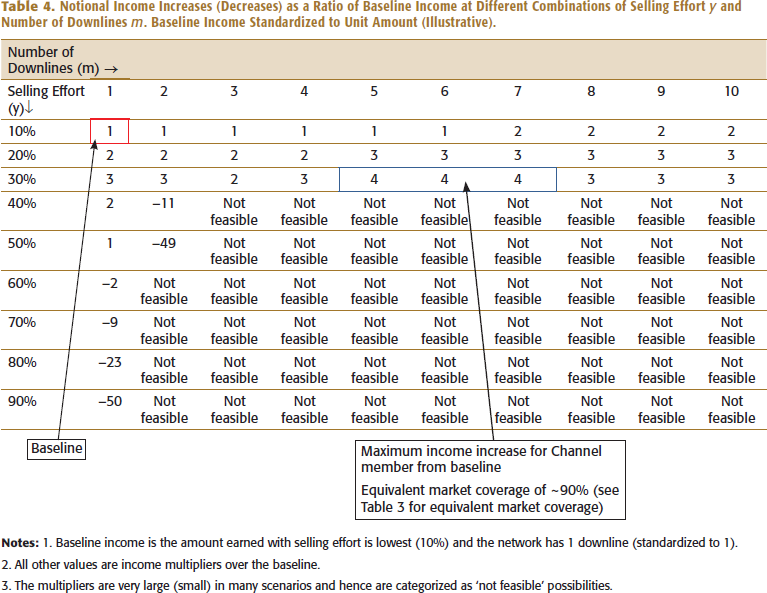
2. All other values are income multipliers over the baseline.
3. The multipliers are very large (small) in many scenarios and hence are categorized as ‘not feasible’ possibilities.
Notional Income Increases (Decreases) as a Ratio of Baseline Income at Different Combinations of Selling Effort y and Number of Downlines m, When the Relative Direct Selling commissions Is Increased by Over 150% Compared to Network Commis- sions (Illustrative).
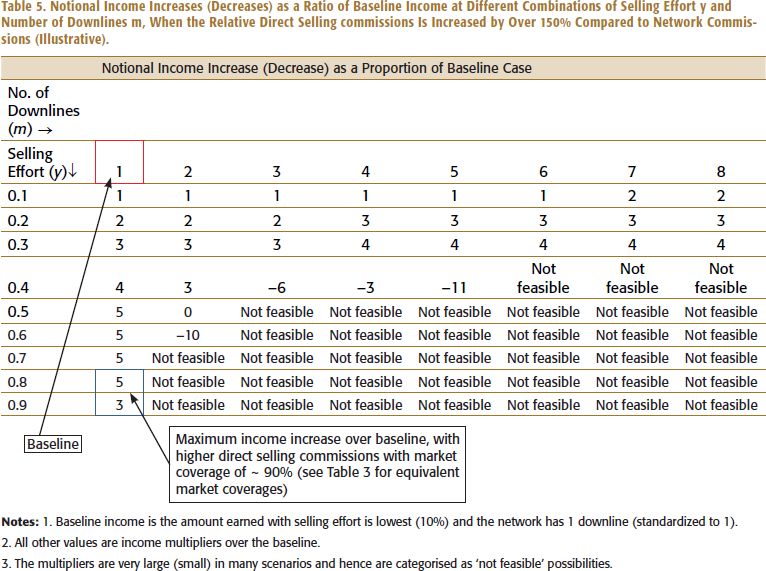
2. All other values are income multipliers over the baseline.
3. The multipliers are very large (small) in many scenarios and hence are categorised as ‘not feasible’ possibilities.
Table 4 identifies a situation where the income (I) for the Tier 1 consultant can be maximized at 30% effort and a network with 5–7 consultants (the income multiplier is the highest). If the direct selling commissions are increased significantly compared to the network sales commission, the consultant may be motivated to sell more volumes directly and not through the channel. In Table 5, we recompute channel members’ income multipliers under conditions where the direct commissions have been increased by over 150% compared to the network commissions. We see that the maximum income level for the channel member is achieved when (s)he sells directly. This is also the condition in which the market coverage is very high.
Similarly, one can argue that if the direct selling costs are relatively low (by recruitment of aggressive sellers), we may be able to get more direct selling than through the network (Tupperware and Avon have traditionally applied this strategy).
IMPLICATIONS OF THE SPECIFIC SIMULATED RESULTS
It is worth reviewing the main insights of the results presented above. Results in Table 2 imply that MLM marketers need to design their channel incentives so that consultants strike the right balance between direct selling and network development to (a) increase market coverage and (b) concurrently enhance their income. That is depicted in this model output (with prefixed parameters) as possible with 30% direct selling effort and 5–7 downline consultants. The actual incentive may change with the changes in the environmental parameters that drive the Income and sales coverage functions (Equations 1 and 2).
Deployment of consultant incentives without an assessment of its impact on motivation to sell may cause ineffective market coverage, as shown in Table 3. If the direct selling incentive is hiked up significantly for the consultant to exclusively try to sell directly and not through a network, the direct selling effort required to cover the market is extraordinarily high (over 70%). In many instances, that may not be feasible, leading to lower market coverage, something that the MLM marketer will not prefer.
FUTURE RESEARCH OPPORTUNITIES
The illustrative model in the previous section highlights the importance of designing the right commissions in the MLM channel matched to the motivation of the consultants. This has serious implications for channel strategy to be deployed by MLM organizations. Given that the objective of participating in the network may vary across individuals, it is unclear if the MLM marketers’ objectives of maximizing sales are fully achieved as consultants try to optimize their objectives. Hence, designing incentives that align organizational goals with the consultant’s goals is very important.
MLM is a direct selling initiative to sell products to end consumers as well as selling them the idea of joining the distribution network for income generation. The selling point for recruiting amateurs is the opportunity to earn income through a flexible work style and enhance a stream of passive income (income generated by sales done by others recruited by the consultant to join the network).
The profile of the potential consultant is the following (and confirmed by our exploratory study):
Someone who is attracted by the income generation opportunity through a flexible work schedule— someone who needs to augment their income and has time. This is a generic selling pitch for distributor recruitment. Someone who believes that (s)he has a passion for selling and sees this as a primary occupation. Apart from (1) and (2), it is the person who believes that the role of selling and distributing specific products is compatible with his (her) class identity/ status/stature in society.
It is important to study whether the actual consultant profile matches the direct selling goals of the MLM company. Our preliminary finding indicates that it may not always be the case. We believe this is a significant dimension for MLM marketers to evaluate in the context of future business enhancement. Consultants may have other reasons beyond income generation to participate in the network. However, such considerations, though important, do not have a direct economic benefit for business development for the organization.
Should networks be built by exploiting personal connections? What may be the potential for role conflicts in such recruitment? Literature points to the subtle transformation of perception from being useful to be used (Grayson, 2007). Identifying potential consultant profiles where such role divides are less would be worth identifying.
Finally, in our exploration, we did not find a significant role in product branding. Products sold in the MLM were perceived to be of good quality by the participants in the network (both consultants and end consumers). However, the products were associated with MLM marketing organizations (e.g., Tupperware and Herbalife), rather than by product names, unlike in the conventional retail markets where product brands often have a distinct identity vis-à-vis the organization that markets them. Whether the true sales potential of a good quality product is compromised in the process needs further examination.
CONCLUSION
MLM as a marketing model has modest references in literature. However, given the dynamics of the network and its potential in India, it throws up interesting dimensions of enquiry regarding the sustenance and development of a unique channel for selling consumer goods. As it continues to grow to occupy a significant share of the retail transactions in India, it would be interesting to ascertain if the potential is larger than its current size. It may have a significantly larger potential, given that conventional retail channels are being hampered due to the corona pandemic and the need for touchless transactions.
However, our limited assessment indicates that depending on a bunch of direct sellers, who sometimes may not be aggressive sellers, will impede business growth. The pandemic has also created a large pool of jobless people looking for self-employment opportunities. It is, therefore, important to ensure that the right consultant partners are recruited from this pool of employment seekers to grow the business aggressively.
Second, focusing on appropriate compensation structures to attract the best and most motivated talent to do direct selling and manage channels is very necessary for this model to proliferate. Marketing literature has largely dealt with the social aspects of network marketing. This article highlights an important facet that will determine the business significance of this network model in the long run. Additionally, we do not see evidence of product branding in this model. Perhaps, it is not important in this business model primarily driven by personal selling. However, product quality (perceived by the consumer) cannot be ignored in the long run. Marketers may have to pay attention to this matter if this channel of retail transaction must grow significantly in the future.
APPENDIX A
Depth Interviews: Broad Areas of Investigation Introduction to the Respondent (Major Dimensions)
Weekday and weekend routine Social circle Self-description Key accomplishments versus challenges Life goals/dreams Motivators/driving force Role models Understanding the nature of the business How did you make an entry into business?
Deep Dive into the MLM Business: Motivation to Join/Build Network/Incentives to Grow Business/ Business Operations
Awareness of the business Influencers in deciding on taking up this business Apprehensions regarding the business Growing the Business So, once you decided to join ‘MLM’, how did you go about joining? Did you attend any of their seminars/meetings meant for recruitment/ pre-joining events? What did you learn from these events? In hindsight, do you feel these seminars were useful or do you feel they did not portray the right picture of ‘MLM’? Today, would you recommend your family member/close friend to join any ‘MLM’? Why/why not? What are the key challenges that you have faced over time? How have you handled or overcome these hurdles? Do the company/seniors help you overcome these challenges? How? If managed by self only, how do you manage? What are some of the challenges you face daily in this business? What do you do to overcome these? Any challenges anticipated in the future? What aspects have been easy to set up with this business? How long has it taken to make your business profitable? What do you really like about your business? What about it keeps you going every day? What do you enjoy about being an entrepreneur? What do you dislike about running a business? What do you do to overcome this in your business? What are the highs and lows of your business? What have you done over time to make this business grow? Can you give me specific examples? Did the company help you make the chain below you? How? PROBE IN DEPTH Did the seniors help you make the chain below you? How? What did you do yourself to make a chain below you? How do you ensure that the chain continues at lower levels? What are the challenges that you face to ensure the continuity? What are you doing currently to ensure that your business grows consistently? What about your future plans? What do you have in mind in terms of business expansion in future?
Process
What are the processes you follow in your business? How do you procure products for your business? Direct from company Senior partner/level above me Does it vary by product? How? How do you plan your purchases? Tell me something about your inventory management … or do you buy as you receive orders? If plan purchases, how is forecasting done for the business? Can you buy on a credit or delayed payment basis? Why or why not? If buying at credit, then what is usually the credit period?
Customers: Who Buys and Why? What Do They Buy? What Is Easy to Sell?
Typical customers What are the payment methods you accept at home/ store and why? How do you generally communicate with your customers after they have bought something? Email, telephone, WhatsApp/Facebook/Twitter, others
Products
What products are sold/what else can be sold/what is easy to sell through MLM. Why/Why not? What would you ideally want to sell? Why?
Are these products known by ordinary customers/? Why do your customers buy it and not others (who prefer similar products available at the shop).
What will make the latter convert to MLM products?
What is the best way to sell these products? Do you think your customers will continue to buy MLM products? How can competition cannibalize your market, if at all?
Does your product(s) have a brand? Why would you call it a brand? How do you (and the company) maintain the brand? Are these brands (products) different from similar products available in the retail market? Why?
What more can be done in the MLM model to enhance the brands?
Marketing Channels Used to Sell Products
Can you please tell me what all channels you use for selling products do?
Probe:
Through websites such as Flipkart and Amazon. Through social media such as Facebook, WhatsApp and Instagram. Through personal contact/WOM Others Why have you selected these channels? What makes it suitable for your category? Which channel would be least effective to sell your products? Why? If using only one channel: What has restricted you from trying other channels? If multiple channels: What made you choose multiple channels? How has this combination of channels worked for you? Can you tell me the advantages and disadvantages of each? Among these which is the best channel to sell your products and why? Which channel is least effective to sell your products? Why? At the end of this interview, anything else that we have missed out? Anything that can help us understand the MLM business better? Follow-up question on branding in MLM to senior directors Follow-up question on incentives for channel partners to sell more than what they normally do?
Footnotes
DECLARATION OF CONFLICTING INTERESTS
The authors declared no potential conflicts of interest with respect to the research, authorship and/or publication of this article.
FUNDING
The authors received no financial support for the research, authorship and/or publication of this article.