




Abstract
Technology is becoming pivotal for firms while interacting with customers. While extensive research exists on how deployment of firm resources, such as technology, leads to competitive advantage (CA), research on the interaction between technology-led firm capabilities deployed at firm customer interaction and CA is limited. We theorize regarding a more effective approach to manage technology by looking at the effects of firm technology resource and capability deployment by a firm in the context of managing different dimensions of TRU at the firm–customer interface. We do so by considering two firm capabilities, namely, technology resource breadth utilization (TRBU) and technology resource depth utilization (TRDU). We use low involvement purchase (LIP) customer purchase context during three customer purchase stages, namely, pre-purchase, purchase and post-purchase to provide structure to the logic. We then build arguments on the relationship between the level of deployment of TRDU and TRBU and attainment of CA under different conditions. We propose testable propositions between TRBU and TRDU levels with CA attained and posit different kinds of relationship like positive, negative and inverted U-shaped relationships having inflexion points to contribute to the theorization in this area.
Keywords
Managing technology is a critical activity for the success of firms (Porter & Heppelmann, 2014); firms that do so successfully are more likely to gain CA. CA has been looked upon as resulting from intrinsic processes of an organization or external sources and industry structure (Barney, 2001). To develop an understanding of CA, the demand-based perspective of competitive strategy based upon the works of Ghemawat and Rivkin (1998) and Adner and Zemsky (2006) has been widely accepted. CA is achieved when a firm can generate a higher willingness to pay (WTP) from customers and/or reduce supplier opportunity costs for its products and services from suppliers. However, the process of obtaining CA through an appropriate technology in terms of organization customer interaction (Barley, 2015) received relatively little scholarly attention. The relative lack of research in this area is surprising given that firms are collections of resources (Penrose, 1959, p. 24). Also, the use of resources like technology is expected to lead to positive outcomes like customer satisfaction, increased market share, enhanced profitability and, therefore, higher CA (Lurie & Kohli, 2002; Slotegraaf et al., 2003).
Furthermore, CA has been researched primarily through customer judgments and actions on points of superiority in the marketplace (Day & Nedungadi, 1994, p. 32). Also, the advent of information and web-based technologies, including artificial intelligence, machine learning, augmented reality and others has led to an increased deployment of firm technology capability at the firm customer interface. Firm–customer interactions involve firm–customer dealings at the pre-purchase and purchase stages (Ramani & Kumar, 2008). Firm–customer interaction for this study involves searching for a product or service and purchasing the same (Heinonen, Jaakkola & Neganova, 2018).
In this article, we first review the relevant literature from a CA standpoint based on two perspectives. The first is a customer-centric point of view that looks at customers' costs (Tversky, 1972; Tyagi, 2004). The second is a firmcentric point of view that examines the difference between the opportunity cost for a firm to provide and deploy technology and the customer's WTP for that technology (Ghemawat & Rivkin, 1998). We aim to integrate the perspectives to develop testable propositions that advance the theory on and contribute to developing new theories on the management of technology that can generate CA. We focus on a particular aspect of technology within the overall business strategy of a firm—that of a firm's technology capabilities deployment in the firm's interaction with customers. We are addressing the level of technology deployed. The deployment of technology also involves elements of managing the technology (Shupe & Behling, 2006).
Our contribution builds on the existing stream of research in the following ways. First, we deliberate on the process regarding the deployment and management of technology at firm– customer interactions during the pre-purchase and purchase stages. Second, we explore the impact on a customer's WTP that leads to CA of the firm that had deployed the technology. We develop testable propositions on the impact of technology on the attainment of CA. We integrate resource-based view (RBV) (Barney, 2001) and dynamic capabilities view (DCV) (Eisenhardt & Martin, 2000; Teece, 2007) perspectives with the customer interface (Mathwick & Rigdon, 2004; Richins & Bloch, 1986).
CUSTOMER CONSIDERATIONS
In this section, we present various customer considerations.
Search and Evaluation Costs
Customers use technology to search and evaluate options and firms deploy technology to facilitate this process. Search costs and the present incumbents in the customer's consideration set determine alternatives that customers consider (Nedungadi, 1990). Priem (2007, pp. 225–226) suggests that retail firms can help reduce customer time for an activity implying that a reduction in search costs are useful for the customer. Also, it has been empirically found that in the case of online buying, ‘search cost is inversely correlated with search depth' (Zhang et al., 2007, p. 81). Organizations can, therefore, attempt to increase their CA by decreasing the customer search cost in the pre-purchase stage through appropriate technology management and deployment.
Web-based technologies and increased internet penetration have provided an increased scope for search and comparative evaluation of products and services for customers (Burke, 2002; Hendrix, 2014).The probability of selecting an alternative depends not only on its overall value but also on its relations with other available alternatives. So customers will use different evaluation processes depending on their involvement levels (Tversky, 1972). A firm gains CA by decreasing search and evaluation costs for the customer through the deployment of technology.
Purchase Transaction Costs
For every purchase made by the customer, she/he would incur transaction costs related to monetary and time factors along with hassle costs of visiting a store or shopping online and making a payment (Tyagi, 2004, p. 335). Reducing the effort for the customer increases value (Priem, 2007, p. 228). Purchase transaction costs should, thus, affect customer choice behaviour significantly. For example, technologies such as mobile payment systems can be deployed to reduce transaction costs of payment for customers (Kim et al., 2010; Schierz et al., 2010). Firms using technology that lowers transaction costs will lead to CA.
Purchase Involvement in Buying Decision
Since we are considering the deployment of technology at the customer interface, we need to account for a critical factor in customer behaviour, that is, the customer's level of involvement (Dolcos et al., 2011). Low customer involvement indicates minimal emotional responses and stakes attributed to a customer's purchase (Dolcos et al., 2011). The customer involvement level determines customer purchase intentions (Richins & Bloch, 1986, pp. 283–284), influences search quantity (Bloch et al., 1986) and moderates search behaviour (Mathwick & Rigdon, 2004). It is important to note that ‘search' is a significant contributor to customer costs of acquisition (Moorthy et al., 1997). Customer involvement level is also correlated to customers' WTP.
For this research, we consider an LIP context because it is a common context for firms and customers in terms of the number and value of transactions. Further, in this context, customers are mostly engaged with routine decisions. Often, customers in low-involvement purchases undertake purchase decisions through sub-conscious cognitive processes. New technologies can be a significant driver of customer behaviour and, therefore, of CA. This is in line with the work of scholars who have begun to look at the process of gaining CA (Priem, 2007; Rindova & Fombrun, 1999), thus, integrating resource-based and DCVs with the customer perspective (Barney, 2001).
Technology at the Firm Customer Interface and Its Implication Towards Customer Willingness to Pay and Opportunity Costs
From the firm's perspective, the use of technology in its interaction with its customers can occur across stages of pre-purchase and purchase (Cacioppo & Petty, 1982; Moorthy et al., 1997; Tyagi, 2004). It is important to remember that any firm, deploying technology, incurs costs (Doerr et al., 2006). In the pre-purchase stage, the customer searches and evaluates; the firm deploys technology to decrease these costs for the customer with appropriate technology design and product/service offerings (Ozer & Gultekin, 2015; Srinivasan, 1990).
At the pre-purchase stage, machine learning and artificial intelligence-based technologies are providing personalized recommendations to individual customers for products and services (Kumar, Rajan, Gupta et al., 2019). These personalized recommendations reduce the search period and search tasks that customers have to perform. This, in turn, makes customer decision-making easier (Zhang et al., 2018). At the purchase stage, the customer executes the purchase transaction (Jessie Chen-Yu & Kincade, 2001). Persuasive technologies nudge customers into making a purchase transaction (Faisal et al., 2018; Shao & Oinas-Kukkonen, 2018). At both stages, pre-purchase and purchase, firms interact with customers via a mix of technology capabilities that are deployed and managed (Ritter & Walter, 2003).
We use the term technology opportunity costs (TOC) (Dierickx & Cool, 1989) as a proxy for technology investments from the firm's perspective, and we argue that possession of relevant technology that is deployed at the firm–customer interface would drive up a customer's WTP (Adner & Zemsky, 2006; Steenkamp et al., 2010; Zeithaml, 1988) because of increased utility (at pre-purchase and purchase stage utilities) and lowering of customer side costs (search, evaluations, transaction costs). Relevant technology deployment at the firm– customer interface would thus create an increased difference between a higher willingness on the part of the customer and associated TOC on the part of the firm resulting in a higher CA (Adner & Zemsky, 2006; Ghemawat & Rivkin, 1998; Grant, 1991). According to Ghemawat and Rivkin (1998), a firm secures CA when the difference between WTP and TOC is positive. A firm gains CA when marginal increase in WTP (from increased customer benefits) is more than the marginal increase in TOC because of addition in firms' technology resources and capabilities. Thus, CA can be defined as the difference between WTP and TOC (Adner & Zemsky, 2006; Ghemawat & Rivkin, 1998). We now turn to two technology-centric firm capability variables to capture firm–customer interactions.
FIRM CAPABILITY: TECHNOLOGY RESOURCE UTILIZATION
Technology is a critical component of organizational resource (Grant, 1991). Firms deploy technologies to interact with customers for market research, search and evaluation, transaction and after-sales engagement (Berthon et al., 1999; Meuter et al., 2000). These technologies include web technologies, self-service technologies (Weijters et al., 2007), internet of things (IOT)/cloud services (Porter & Heppelmann, 2014), big data (LaValle et al., 2011), wearable technologies (Gao et al., 2015) and various others. Thus, we define technology resources as a set of firm resources that firms use to deploy and manage customer interaction at the pre-purchase and purchase stages. This is consistent with customer experiences in which personalization is also a key dimension (Tiihonen & Felfernig, 2017).
A firm's utilization of technology resources for value creation is classified as a capability from a dynamic capabilities perspective (Ethiraj et al., 2005; Lu et al., 2010). At these interfaces, technology-based interfaces directly interact with the customer (Bitner et al., 2000; Sawhney et al., 2005). We have named this technology resource utilization capability as technology resource utilization (TRU). We conceptualize TRU to be present in organizations in two forms—TRBU and TRDU. We conceptualize TRBU and TRDU technologybased firm resources that firms utilize as a capability via which we are attempting to address the level of technology deployed. However, we must point out that the deployment of technology also involves the management of technology. TRBU and TRDU are discussed in the next section.
Technology Resource Breadth Utilization
TRBU indicates the use and integration of different sets or baskets of technologies used for firm–customer interactions across the pre-purchase and purchase stages.
Consider Moovit, a provider of commuting facilities for daily transit users (Moovit, 2018). ‘Moovit's Smart Transit Suit', developed for Buenos Aires and Madrid, is aimed at providing solutions for commuters. Moovit integrates big data analytics (BDA)with various sensor technologies, artificial intelligence and cloud-based technologies (Ohnsman, 2018) by collecting 24/7 real-time data from commuters, public train and bus transport systems, bike and car shares the technical team of Moovit runs different technologies (BDA, AI and others) to help commuters in a city to move from one location to another on a real-time basis by finding the most appropriate route and mode of travel. This exemplifies TRBU.
In other words, TRBU indicates the range and nature of technologies a firm possesses and uses to conduct market research, evaluation and search and transaction and after-sales activities (refer to Figure 1).
Technology Resource Breadth Utilization.
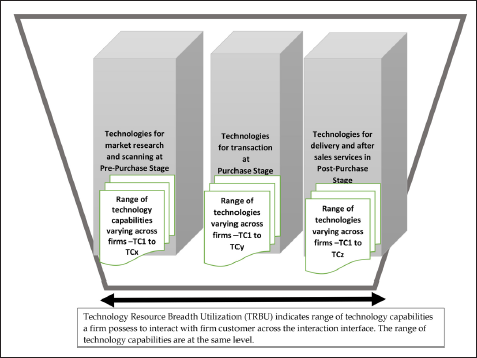
TRBU is, thus, the capability of a firm to use and integrate various different technology resources to carry out customer interactions (Brynjolfsson et al., 2002). It is a firm capability in action and involves both investments and costs (Doerr et al., 2006; Granstrand, 1998). These costs exist because of increased opportunity costs (Boer, 1998; Ghemawat & Rivkin, 1998), and we use the term TOC (Dierickx & Cool, 1989) as a proxy for TRU investments (TRBU and TRDU). We also argue that the possession of TRBU would drive up customers' WTP (Adner & Zemsky, 2006; Steenkamp et al., 2010; Zeithaml, 1988) because of increased utility (pre-purchase and purchase utilities) and lowering of customer side costs (search, evaluations, transaction costs). The presence of TRBU would thus create an increased difference between increased WTP and associated TOC, resulting in a higher CA (Adner & Zemsky, 2006; Ghemawat & Rivkin, 1998; Grant, 1991).
Technology Resource Depth Utilization
Specialized advanced technology can improve firm– customer interaction. Consider the credit card business in which a crucial feature is security against fraudulent transactions. The credit verification value (CVV) number was traditionally static but was made dynamic through the advanced technology developed by Oberthur Technologies (White, 2016). Oberthur Technologies' digital display, powered by a micro-thin battery on a credit/debit card, changes the CVV number about 12–72 times in a day based on an algorithm (Oberthur, 2018; White, 2016). Deploying this specialized advanced technology (TRDU) prevents fraudulent transactions. A firm that has deployed such advanced technologies for handling customer credit card payments security could drive-up value relative to its competitors (Grossberg & Gutowski 1994; Homburg et al., 2006).
Technology resource depth utilization, thus, indicates the utilization of a more advanced, or in-depth, technology. For example, screens that deliver information, transaction and consumption experience have evolved from CRT to LCD and LED, to AMOLED and OLED with an increasing level and depth of technology that leads to higher resolution and perception (refer Figure 2 for illustration). Technology resource depth utilization is the capability and use of advanced technology resources in higher or lower levels of depth at the customer interface. Technology resource depth utilization firstly contributes to building and influencing CA levels. The ability to utilize TRDU coherently for value creation by a firm is a capability from the resources-based view and dynamic capabilities perspectives and is a determining factor in the attainment of CA (Barney, 2001; Day, 1994; Eisenhardt & Martin, 2000; Ethiraj et al., 2005; Lu et al., 2010).
Technology Resource Depth Utilization.
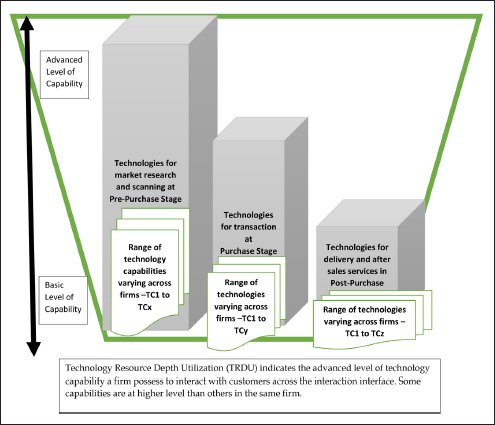
We focus on TRBU/TRDU deployed at a firm–customer interface. This is a demand-based perspective of a competitive strategy (Adner & Zemsky, 2006; Priem, 2007). Porter and Heppelmann (2014) and Siggelkow and Terwiesch (2019a, 2019b, p. 288) suggest that in the present-day context, all firms attempt to secure CA deploy technology. The present-day question is regarding the breadth and depth of the technology deployed (TRBU/TRDU). Firm technology capability is viewed as a strategic capability. Porter and Heppelmann (2014) indicate how smart and connected products are transforming competition, but the application of these technologies on firm–customer interface is missing in the literature. Similarly, Siggelkow and Terwiesch (2019a, 2019b) highlight how emerging technologies alter firm engagement with customers in the quest to attain CA. However, a technology-specific theoretical perspective regarding how technology is actually deployed and managed at firm–customer interface creates and sustains CA is absent (Porter & Heppelmann, 2014; Siggelkow & Terwiesch, 2019a). We focus on this specific research gap.
PROPOSITIONS
In this section, we develop propositions for technology resource breadth and depth utilization and relate them to CA. While building the propositions, we consider the LIP context in two stages, namely, pre-purchase and purchase. During the pre-purchase stage, the interaction is to understand the requirements of customers, their unfelt needs and pain points, customer trends, aiding customer search, evaluation on the offered product (through information on price, quality), and so on. Extensive search efforts by a customer could also lead to fatigue. The deployment of recommendation and persuasive technologies could reduce this negative aspect (Kumar, Rajan, Gupta et al., 2019; Kumar, Rajan, Venkatesan et al., 2019).
Customers' WTP increases at the pre-purchase stage because of an increase in customers' value (both perceived and derived) from the firm–customer interaction through a technology interface because of a multitude of factors, including ease of interaction and facilitation of evaluation, reliability of interaction, scope/range of interaction, availability of interaction facility, nature of information available, or any combination of the above. CA rises from a lower to a higher level as increasing levels of technology resource breadth and depth utilization can help customers realize the increased value in firm–customer technology interaction. Whenever a firm increases the level of TRBU/TRDU for the firm–customer interaction, it invests in technology hardware, technology software and updated technology. It is important to note that, had the firm not invested in higher levels of TRBU and TRDU, it could have invested in other value-creating propositions. CA is derived at the pre-purchase stage when there is a difference between willingness to pay (because of an increase in TRBU/ TRDU level) and technology opportunity cost (WTP minus TOC). When WTP equals TOC, there is no CA present. When TOC exceeds WTP, then there is no point for the firm to further invest in TRBU/TRDU as there is no value creation given that WTP minus TOC is negative. Inflexion points occur because the difference between WTP and TOC alters incrementally. In other words, the value of CA changes direction from one way to another at the point of TRBU and TRDU.
We present reasons that lead to inflexion in the impact of TRDU/TRBU on CA (as measured by WTP minus TOC). It is important to consider the factors that contribute to reducing customers' WTP for associated organizational TOC. Tracey et al. (1999) had pointed out that technology deployed in a firm improved customer satisfaction. However, there is a limit to which technology can create and enhance value due to the limits of the technology itself. Thus, TRBU/TRDU has limits to which it can contribute to improving a customer's experience in firm–customer interaction. This is the limit of a customer's capability to differentiate and value the increased benefits of a higher level of deployed TRBU/TRDU in firm–customer interaction. This is because of the physical sensory limits of the customer to perceive changes. Based on the seminal works of March (1978), Simon (1979) and Eisenberg (1995, p. 214), this occurs because the ability of an individual to process information and solve problems is constrained by limitations of computational ability, ability to calculate consequences, ability to organize and utilize memory, and the likes. We term this as cognitive limits that an individual may have. Researchers have documented the impact of cognitive load and overload (Iyengar & Lepper, 2000; Selten, 1990).
Beyond a certain point, the customer would be cognitively incapable of judging the improvement because of sensory cognitive limits. In other words, though a firm might incur more associated TOC (because of investments in higher TRBU and TRDU), it would not be able to drive up WTP. When a customer interacts with a firm, a series of iterative actions occur. Stewart (1998) had indicated that customers exhibit boredom. Barbalet (1999) suggests that individuals do not find meaning in an activity when they experience boredom. This leads to restlessness, loss of purpose (Kemper, 1978) and lack of enthusiasm (Suttie, 2014). This we have termed as ‘Impatience for Exploring'. TRBU/ TRDU enhances the number of features available for firm–customer interaction. However, beyond a point, a customer loses the enthusiasm to explore and utilize the additional features provided by TRBU/TRDU. Thus, though a firm might incur more associated TOC (because of investments in higher TRBU and TRDU), it would not be able to drive up WTP, and hence the additional deployment of TRBU/TRDU does not impact CA favourably.
Psychologically and physiologically, individuals exhibit habits (Duhigg, 2016). Increased TRBU and TRDU enhance customer experiences because of the increased width and depth of firm–customer interactions. However, even though more firm–customer interaction features are available because of increased TRBU and also deep firm–customer interaction features are available because of increased TRDU—habits may limit the extent of the customer's interaction with firms' technologies (Chiu et al., 2006; Assael, 1984). Because of habits, customers might not even reconnoitre and exploit the added features delivered by TRBU/TRDU. We have termed this as habitual behaviour. This has strong support in extant literature in psychology and neuroscience, indicating that individuals tend to move to habitual behaviours over time (Bargh, 2014). Thus, though a firm might incur more associated TOC (because of investments in higher TRBU and TRDU), it would not be able to drive up WTP and thus, extra deployment of TRBU/TRDU would not sway CA favourably.
Another factor we term holistic comprehension also contributes towards the WTP-supplier opportunity cost inflexion involving the additional deployment of TRBU/TRDU. Using a metaphor, customers are inclined to get the feel of the forest (the total of the bundle of experiences), not the individual trees (experience of features separately) (Solomon & Assael, 1987). Eisenberg (1995, p. 214) advocated that, generally, individuals make only adequate substantive decisions as opposed to best substantive decisions. Customers vet firm– customer interaction features as a whole. They do not vet individual features separately. Thus, customers in such cases would rather evaluate a firm–customer interaction holistically rather than think in terms of incremental and marginal benefits of incrementally added TRBU and TRDU. Thus, in such cases, a firm might incur more associated TOC (because of investments in higher TRBU and TRDU), but it would not be able to drive up WTP. Thus, holistic comprehension essentially represents cases where customers do not use attribute-based processing (or piecemeal processing based on individual features) but use holistic processing, which tends to be more memory-based (Rottenstreich et al., 2007). Thus, the addition of features because of incremental TRDU and TRBU does not result in an additional gain in CA.
In summary, inflexion points exist because of the factors mentioned, and the influence of TRDU and TRBU on a CA level changes direction beyond the inflexion point. Next, we discuss the propositions.
TRBU and Competitive Advantage in Low Involvement Purchase Context at Pre-purchase Stage
Buying grocery products, whether offline or online, is considered to be an LIP. This is because purchasing these items involves a lower level of effort, provides consumption gratification for a limited period and has a relatively low purchase price. In a physical store, customers must walk into a store to check available options. A customer has to physically travel (spend money, effort and time) to gather knowledge about a product. In the store, the customer can touch and feel the product wrapped within a package. Also, customers can ask the store attendants about the pros and cons of the product. In contrast, at an Amazon pantry which is a click-model grocery store, a customer buying groceries can look for items very easily, makes comparisons effortlessly and gets a close-up view of the items. Also, the customer can scan through customer reviews which describe the merits, demerits, best usage tips and a range of other points that the limited space available in a product package skin or brochure cannot achieve.
Along with customer reviews, the customer can also view cumulative customer ratings and can have his queries addressed in real-time (Huang & Lu, 2016; Petit et al., 2019; Rigby et al., 2013; Velasco & Spence, 2019). In an online store, many different technologies (360 videos, AI, user interface, etc.) lead to an immersive experience with more nuanced feelings. Each technology that is deployed provides a benefit to the customer without requiring the customer to travel to a store. Amazon pantry has a high TRBU compared to an offline store.
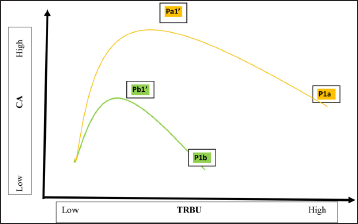
When TRBU is high, there are multiple technologies that the firm brings to create fruitful engagement with the customer at a pre-purchase stage. Customers, however, in the context of low involvement, would not be interested in exploring the many features of high levels of TRBU beyond a certain level. The effects of impatience to explore would also kick in. This implies that an increase in TRBU up to a point would lead to an improved perception through a reduction in search and evaluation cost. However, beyond a certain point, due to an unwillingness to separate and detail out or evaluate the impact of the individual technologies on his/her search and evaluation process, a customer's perception of the product (as viewed through TRBU) would reach a maximum level in driving WTP and then decline (after inflexion point Pa1 in Figure 3). Therefore, higher TRBU beyond a certain point would not lead to a decrease in search and evaluation cost and, therefore, increase CA for the firm. We, therefore, posit:
Pa1: There is an inverted U-shaped relationship between TRBU and CA at the pre-purchase stage.
TRBU and CA at Pre-Purchase and Purchase Stages for Low Involvement Purchases.
TRBU and Competitive Advantage in Low Involvement Purchase Context at Purchase Stage
Post search and evaluation, the customer would like to proceed with the purchase and complete the transaction. The customer would like to use relevant technology in completing the purchase. In the purchase stage, two major activities are performed—first, the actual payment takes place through a payment channel mode, and second, the customer is provided with an intimation regarding the payment completion. Customers also want that their payment instrument details are not compromised. The customer may also want facilitation with transportation and delivery, if applicable. TRBU, in this context, would encompass a firm-possessing technologies that facilitate payments, including internet-based purchase and banking, mobile internetbased purchase and banking, payment through digital wallets and the ease of making payments. Personal mobile devices help customers in search and purchase because both these activities can now be undertaken ubiquitously 24/7 (Wu et al., 2020; Zhang et al., 2018). Higher TRBU offers different payment channel modes and hastens the speed of payment completion. As TRBU increases, the customer may perceive an increase in the ease of doing the transaction up to a point. However, beyond a certain point, an increase in TRBU would lead to an increase in the TOC for the firm but not the WTP for the customer. Thus, beyond a certain point, an increase in TRBU would lead to a decrease in CA as (WTP-TOC) turns negative. Whether a payment transaction is completed in 1 second or 0.9 second due to an increased TRBU is immaterial. In addition, low involve purchases tend to repeat over time, and given the habitual behaviour of customers, they will pay less attention to increasing TRBU.
Importantly, since the customer has now made the purchase decision, she/he would come to the inflection point (from where a decrease in CA commences) much earlier than in the search and evaluation stage. This is because the customer is now impatient to complete the transaction, and higher levels of TRBU may stand in the way of completing the purchase transaction. Research in neuroscience supports this as the increased effectiveness of a stimuli decreases with increasing intensity of the stimuli (Dolcos et al., 2011). Thus, firms deploying TRBU would initially witness an increase in WTP relative to TOC (that is a higher level of CA) but beyond a point (inflexion point Pb1 in Figure 3), would register a decrease in WTP vis-à-vis TOC (that is a lower level of CA) at the purchase stage. Purchase activities are relatively better defined and narrower in scope than pre-purchase. Thus, TRBU would have more limited potency to augment CA. Thus, not only would P1b arrive before P but TRBU would also have a lower level of 1a
CA in purchase compared to pre-purchase (Figure 3).
Pb1: There is an inverse U-shaped relationship between TRBU and CA at purchase stage. The inflexion point Pb1 would arrive earlier than Pa1 and at a lower level of CA.
TRDU and Competitive Advantage in Low Involvement Purchase Context at Pre-purchase Stage
Buying physical books/movies is a low-involvement purchase (Floh et al., 2013). Earlier, customers travelled to a physical Barnes & Noble or Blockbuster store. But with Amazon Kindle and Netflix, customers can access a library of electronic books and movies at any time with a few clicks from the privacy of their homes or on the move. During the Barnes &Noble or Blockbuster era, customers had to visit a store to undertake search and evaluation. There were a limited number of physical books on display constrained by the physical store space. Amazon, Kindle or a Netflix library classifies books and movies respectively in genres as in a physical store (Barnes & Noble or Blockbuster), but the catalogued list is substantially larger as cloud-based technologies (high TRDU) are deployed, leading to more choices (McDonald & Smith-Rowsey, 2016).
Typically, customers in Barnes & Noble or Blockbuster could only take the help of the store personnel to get expert inputs for their search and evaluation. Present-day customers frequenting Kindle or Netflix can get reviews of books and movies from other users and look at the cumulative ratings. Deployment of higher TRDU has helped Kindle and Netflix secure reviews from past users over time. This allows customers to arrive at a choice more easily and quickly. Netflix and Kindle also monitor the viewing and reading data of users over time through the deployment of big data technologies like collaborative filtering along with recommendation and persuasive elements which represent TRDU.
These reading and viewing habits of readers, when analysed by machine learning and artificial intelligencebased algorithms, help Netflix and Amazon profile customers, thereby increasing the likelihood of new purchases. Thus, Netflix and Kindle store cumulative data of millions of customers over time to gain an in-depth understanding of the likes and dislikes of customers. The higher the TRDU, the more avenues open for customers to be aware of a wide range of service information at the pre-purchase stage attained through recommendation and persuasive technologies. The TRDU deployed by Netflix and Amazon helps reduce customer search and evaluation costs through enhanced personalization.
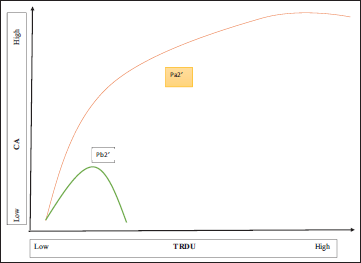
Higher TRDU leads to a lower required customer effort, so the relative WTP more should rise. Firm deployment of TRDU enhances customer's WTP as the customers get increased benefits from the added service details that help customers to arrive at a better decision with lower effort. Through added TRDU, however, associated TOC also increases. For LIP context, at the initial stages, as TRDU gets deployed, customers' search costs and evaluation costs reduce. At the initial stages, the beneficial effects that kick in are more pronounced as customers readily feel and utilize the higher TRDU. However, TRDU increasing CA occurs till a certain inflexion point Pa2'. At point Pa2', CA reaches peak value. Further post Pa2, as a firm in low involvement context increases TRDU, CA stabilizes and remains at a fixed value. This is because the customers' marginal utility derived at the pre-purchase stage gets saturated; beyond a certain level of TRDU, there is no further reduction in search and evaluation costs for the customer. Further, customers look for holistic comprehension. This happens because even though TRDU deployed by the firms provides deeper firm–customer interaction features, the customer may not use the higher TRDU features that support even more search and evaluation as his/her capacity to evaluate beyond a certain point is limited.
Moore and Zirnsak (2017) had advocated that while the visual system carries out a more or less exhaustive extraction of visual information from the environment, individual behaviour is driven only by the small subset of the most pertinent information. Amazon Kindle, or Netflix might deploy very high-end analytics, and yet, an average customer might not be able to appreciate such fine-tuned search results indicating the effect of holistic comprehension and evaluation. Thus, as March and Simon (1958, p. 94) have advocated, customers would look for satisfactory search and evaluation rather than the best. Thus, WTP minus TOC does not alter subsequently.
Pa2: There would be initially increasing relationship between technology resource depth utilization and CA at pre-purchase stage with an inflexion point beyond which CA will flatten.
TRDU and Competitive Advantage in Low Involvement Purchase Context at Purchase Stage
At the purchase step, firm–customer interaction is limited. Once a customer has decided to buy, TRDU has to facilitate the process and reduce any possible interference from any aspect of the previous search and evaluation. TRDU which helps to define this interaction better, would augment customers' WTP. The same logic as in the TRBU-purchase context is applicable here. As purchase activities are relatively more well-defined than pre-purchase, TRDU would have limited effectiveness to augment CA. Thus, not only would Pb2 arrive before Pa2, but also, there would be a lower value level of CA.
Pb2: There is an inverse U-shaped relationship between technology resource depth utilization and CA at purchase stage. The inflexion point would arrive earlier than purchase stage and at a lower level of CA. Pa2 and Pb2 has been depicted in Figure 4.
TRDU and CA at Pre-purchase and Purchase Stages for Low involvement Purchase.
MANAGERIAL IMPLICATIONS
Present-day reality depicts the continuous manifestation of emerging technologies in the process of gaining CA. Managers need to address two main aspects. First, managers need to ascertain what kind of technologies (machine learning, big data analytics, artificial intelligence, immersive experience, etc.) have to be deployed to decrease search, evaluation, and transaction costs. Hence, managers can think of deploying a wide array of technologies to interact with customers at the pre-purchase or purchase stages. This entails an aspect of TRBU, the set of different technologies being deployed. Alternatively, managers could think of deploying an advanced level of technology for better interaction with customers at the pre-purchase or purchase stages. This, as we noted, could also increase customers' WTP and help the firm attain a CA. This entails the aspect of TRDU carried out with a limited set of technologies being deployed at an advanced level. This theoretical narrative would help managers to ascertain the impact that the deployment of technologies (as manifested through TRDU and TRBU) has on the nature of customer interactions at the firm-customer interface and the resultant implications for CA.
CONCLUSION, LIMITATIONS AND DIRECTIONS FOR FUTURE RESEARCH
This article theoretically integrates literature from strategy, marketing and behavioural psychology to improve our understanding of the formation of CA in terms of firm technology capabilities at the firm customer interface. We illustrate how firm technology capability, as a dynamic process internal to a firm, creates CA through the firm's interaction with customers at the pre-purchase, purchase and post-purchase stages. Analysing this may help firms to design appropriate customer interfaces that are technology-driven processes with the help of requisite technology capabilities with appropriate TRBU and TRDU, leading to CA. We posit theoretical propositions in this article that suggest a rich agenda for future research. First, we have highlighted how firm technology capability (TRBU and TRDU) may either lower the cost of search, evaluation and purchase transactions of the customer or increase the customer consumption utility, which in turn leads to CA. We hope that researchers will take cognisance of this link and examine this relatively unexplored link between RBV and dynamic capabilities perspective on one side, and the customer buying and consumption process on the other, from a theoretical and an empirical standpoint.
This research should help advance the theory and practice of how CA develops from the customer interface. Incorporating this approach into RBV and dynamic capabilities tests may increase the robustness of the theory and provide a rationale for why almost half of all empirical studies on RBV do not find support (Newbert, 2007). Second, future researchers could also look at the differential impact of a particular factor, that is, standalone TRBU/TRDU, on the different stages of the customer purchase process. For example, does TRBU impact search cost more or the transaction cost? Third, an empirical study could be conducted, product category-wise, and the results could be compared between the market leaders and other players in the market to highlight the incremental benefit that market leaders gain by serving customers better through a suitable match between technology capabilities (with
TRBU and TRDU based actions) at the organization customer interface. Given the importance of technology in society, firms need to incorporate it into its interaction with customers. We expect that this research motivates researchers to do more theoretical and empirical work in this potentially fertile field of enquiry.
Footnotes
DECLARATION OF CONFLICTING INTRESTS
The authors declared no potential conflicts of interest with respect to the research, authorship and/or publication of this article.
FUNDING
The authors received no financial support for the research, authorship and/or publication of this article.