




Abstract

Keywords
INTRODUCTION
However, as shareholders, institutional investors and consumers comprehend and critique the social and ethical performance of corporate entities, businesses have been forced to promote efforts to achieve more socially responsible decision-making and mitigate their loss emanating from social reputation. 4 Business leaders everywhere see a positive corporate image as an absolute prerequisite for achieving strategic business objectives. 5 Therefore, a firms’ susceptibility to reputational risk is a key factor in influencing firms to improve sourcing practices. This is particularly so for many industries where employers do not seek to compete based on labour quality but simply seek to minimize costs, by subcontracting and employing casual labour. 6 For instance, the 2013 Rana Plaza collapse in Bangladesh strongly affected the reputation of organizations in buyer-driven retail production networks.
Therefore, many global firms have demonstrated increased willingness to assume responsibility for ameliorating their negative impacts. 7 Firms must not only deliver financial performance but must also pass the benefits to shareholders, employees, customers, and the communities in which they operate to gain a competitive advantage, attract talented workers, and investment. 8 They must abide by rigorous regulations and rapidly evolving standards while providing an adequate return on investment. 9 Towards this endeavour, civil society organizations (CSOs) have played a prominent role in the development of sustainable sourcing mechanisms by convincing prominent firms to subscribe to codes of conduct, multi-stakeholder initiatives, and international framework agreements (IFAs)10, 11 that monitor health and safety, child labour, abolish forced labour, freedom of association, collective bargaining, promote gender equality, improve working conditions, and provide a living wage. 12 Nonetheless, these voluntary initiatives have been criticized for replacing the capacity of governments to regulate business with private authority and allowing multinational firms to enhance their legitimacy through socially responsible labour practices. 13 Moreover, some evidence suggests that this approach has not generated sustainable improvements in the working conditions for workers and issues related to the control and enforcement of labour standards remain. 14 Therefore, some suggest that responsibility for protecting and promoting labour standards in global supply chains should be shared by private and institutional actors involved in the production and distribution processes. 15
Nonetheless, corporate social performance (CSP) investments usually come under intense scrutiny, and the managers responsible for them are expected to offer financial measures of the returns from these investments. 16 In this regard, some investigating the relationship between a firm’s CSP and corporate financial performance (CFP) find a positive CSP–CFP relationship.17, 18 Similarly, the relationship between the labour dimension of CSP (measured by labour reputation [LR]) and CFP shows that higher LR could cause greater economic returns. 19 Further, labour social responsibility (LSR), which is defined as all the voluntary labour practices of a company for the benefit of employees and not imposed by labour legislation, has a direct and positive relationship with its reputation. Thus, corporate reputation depends on the ability of the LSR strategy of the company to satisfy future expectations of stakeholders. 20
Further, Friede et al. (2015) 21 conducted an extensive systematic literature review and found that the relationship between environmental, social, and governance performance (ESGP) and CFP is well founded. Nearly 90% of the researchers reported a non-negative association, and a vast majority of studies reveal a positive ESGP–CFP relation. In addition, Zhao et al. (2018) 22 assert that a superior ESGP indeed spurs CFP of Chinese firms. More recently, using an extensive global data set, a recent study found a non-negative relationship of most of the ESG activities with CFP. 23 Therefore, firms have an incentive to invest in ESG endeavours.
In India, the ESG landscape is slowly evolving, with many companies now adopting ESG norms. 24 While the focus of the ESG integration practices has mostly been on the ‘E’ and ‘G’, the COVID-19 pandemic brought into focus the ‘S’. This colloquium presents a facet of this changing narrative focusing on the ‘S’ parameter of ESG. The Social Compact is a unique indigenously designed voluntary initiative to stimulate a positive change in Indian industry. It was conceptualized because of the migrant crisis during the pandemic, which brought the structural vulnerabilities and uncertainties of informal workers’ lives to public attention.
THE INDIAN CONTEXT
In their article, Jain, Puri, and Misra argue that the COVID-19 pandemic has led to a devastating impact on poverty levels and inequality for the most vulnerable groups, particularly the informal and migrant workforce. The ‘S’ pillar of ESG—which focuses on an organization’s practices vis-à-vis human rights, business ethics, diversity, and inclusion—was completely neglected until the pandemic highlighted the importance and necessity of a more ‘human-centric’ approach to business (see Bhargava and Forbes). The primary employers are far removed from their on-ground realities as the majority of the work is liaised out to a web of contractors and subcontractors (see Misra and Shah). However, as Varma and Bharadkar caution, it would be misleading to attribute the humanitarian crisis only to the pandemic. Precarity in terms of income, housing, and employment are entrenched features of migrant workers’ lives with parallel regimes creating confusion about the exact nature of entitlements (Patel, Joshi, Khuman, Premila, Anusha, and Anahita). Besides this, Pudumjee asserts that the informal labourers have no written contracts and lack local documentation, making them ineligible to access the public distribution system (PDS), public housing, and public healthcare. This gets accentuated, especially in the case of migrant women workers in construction (see Misra and Shah). The work of poor migrant women is often dismissed, underpaid, or unpaid, because of inequalities and discriminations due to their gender, caste, and tribe, interlinked with their lived experiences across employment, education, skill levels, and family status. Women lack social protection and welfare measures. They suffer food insufficiencies; shortfall in access to healthcare, water, hygiene, and sanitation services; severe setbacks to livelihoods; increased burden of unpaid work; rising gender-based violence; and various levels of discrimination (Jain, Puri, and Misra). Thus, most migrant labourers live an undignified existence. 25
DEFINING THE SOCIAL COMPACT
The philosophical foundation of the Social Compact lies in the idea that markets must be embedded in a social values that transcend the imperative of mere economic efficiency. It also shifts the onus of the business chains on to the principal employer who has the wherewithal to ensure consistent worker practices throughout the chain and are desirous of ensuring a strong reputation in local and global markets.
The Social Compact is a multi-stakeholder initiative that seeks to bring about an ethical transformation of Indian businesses to ensure greater dignity and equity for vulnerable workers and their families. 26 In this regard, CSOs along with employers have been instrumental in fostering the formation of the Social Compact that encourages dialogue, learning, and action. The Social Compact is not about monitoring and measurement but about interaction between CSOs and industry that provides a system of checks and balances, enabling the improvement in CSP. This dialogue also promotes learning and emulation rather than confrontation and sanctions. Thus, the Social Compact is an inter-organizational network that promotes collaboration between civil society and industry to adopt and strengthen socially sustainable mechanisms pertaining to their production chain and more equity through dialogue. For instance, Khanna and Shah state that the Social Compact enabled the coming together of forces hitherto opposed to each other such as Aajeevika Bureau and Centre for Social Justice (CSJ; NGOs) and few conscious employers such as Forbes Marshall, Thermax, and Godrej Properties Limited (GPL; businesses). Together, they helped shape the Social Compact as an initiative that generates concrete actions, systemic change, and convergence of universal principles. The initiative seeks to prevent the recurrence of the migrant labour tragedy that unfolded during the pandemic and address the vulnerabilities faced by workers in their ecosystems (also see Varma and Bharadkar; Anusha, Patel, and Shukla). Therefore, Pudumjee argues for living wages that enable a life of dignity for all informal workers and their families, health and social security cover, gender equality, safety against occupational hazards, upskilling and re-skilling, and access to government entitlements that they are eligible for but are unable to avail. This involves a co-solutioning which began with capturing a detailed assessment of corporate labour governance systems and practices regarding informal workers in company chains across sectors (see Varma and Bharadkar).
Further, the Social Compact does not propose to replace the state and its regulatory framework, but only complements and implements regulation-backed entitlements. For instance, James, Gandhi, and Sethi argue why the rule of law provided by the state is conducive for business as transactions are secure, compliance is valued, and there is recourse to remedy. The state’s role is to secure one’s interests and not impede legally permissive activity. A good rule of law system attracts foreign direct investment (FDI), which is particularly important for developing countries like India (Anusha, Patel, and Shukla).
In fact, the Social Compact overcomes the issues of voluntarism versus regulation that plagues other private codes of conduct by abiding by labour laws and helping informal workers access government schemes. In this regard, Mehra stresses that GPL has strengthened the compliance to integrate all applicable labour laws for the informal workforce along with robust mechanisms to audit these across sites. The Social Compact has helped to highlight issues such as gender parity and identify systemic and practical ways of ensuring this outcome across all their sites. Besides, worker entitlements and social protection programmes are a core focus for GPL’s corporate social responsibility (CSR) programmes, expanding its impact beyond operational sites. Similarly, one of the primary motives for ‘Papa Don’t Preach’ to join the Social Compact was to seek guidance and expertise regarding Indian labour laws, which would enable them to be a truly inclusive company from the start (See Nag, Tejani, Tejani, Sharma & Jain).
MEANING BUSINESS
Though positioned as voluntary, the Social Compact is driven by market necessities. The initiative seeks to advance the principle that a responsible business should be regarded as a successful one. 27 As a part of the corporate competitive strategy, it is imperative for organizations to protect their reputation and minimize risks of social violations. Thus, while granting ‘social legitimacy’ to organizations, it integrates social needs with those of the markets and thwarts protectionist pressures from countries in the north that may have social concerns related to labour. For instance, K. K. Nag Private Limited joined the Social Compact to expand to global markets, not just by adhering to the law but by mapping themselves against the aspirational outcomes of the Social Compact (See Nag, Tejani, Tejani, Sharma, and Jain). Thus, there is a business case for the Social Compact. For instance, Bhargava and Forbes demystify the misconception that providing benefits to informal workers would drive up costs and lead to uncompetitiveness. In fact, paying attention to the ‘S’ pillar of ESG positively impacts equity returns of a company through increased employee productivity. In contrast, the neglect of the ‘S’ drags down productivity as strikes and worker go-slows impact the entire supply chain. Therefore, the Social Compact does not only have the potential to impact millions of lives by guiding businesses towards a future that is safer, healthier, and value-adding for all but it also helps businesses to continue the path of growth and sustained profits (Nag, Tejani, Tejani, Sharma, and Jain). It is pertinent to note that labour cost increase of less than 1% of sales turnover will not make a business uncompetitive or unviable. Instead, being fair and equitable to this group of informal workers can make the business more dependable, productive, and more competitive in the long run (see Anusha, Patel, and Shukla; Bhargava and Forbes).
Further, a significant differentiator for Indian businesses in the future will not be their profit margins but the value they create for all stakeholders, including those who toil for the business, even if informally (Nag, Tejani, Tejani, Sharma, and Jain). Therefore, Forbes Marshall enables supply chain partners through multiple solutions to ensure dignity and equity for informal workers. It plans to implement eight pilot projects in these companies and track the monthly progress along select Social Compact outcomes. The company launched a worker facilitation centre (WFC) in partnership with TATA AutoComp and Aajeevika Bureau in the Chakan (Pune, Maharashtra, India) area that has about 250,000 workers (see Forbes and Forbes Marshall Sustainability Team).
Not surprisingly, rather than invoking moral legitimacy (the ‘right’ thing to do), pragmatic legitimacy arguments have been cited as being in the rational self-interest of companies to improve migrant labour practices within their production networks. Rightly so, while moral legitimacy arguments may resonate with certain companies, strategies that incorporate pragmatic legitimacy arguments are more likely to yield success. 28 Mitigating against reputational damage and addressing information and knowledge gaps regarding supplier practices are two pragmatic reasons that have been identified for understanding why organizations may subscribe to the Social Compact. The organizations most likely to subscribe to the Social Compact are firms that are protective of their brand image. The commercial reputation of these firms and their position in the product market and production network give them a large incentive to maintain good standards among their suppliers. The signing of the Social Compact by organizations would protect and potentially enhance their legitimacy by providing credible information to consumers that satisfactory standards are being met. It would also be beneficial for ‘laggard’ organizations who lack institutionalized legitimacy and want to enhance their reputation in civil society. 29 Thus, as argued by Khanna and Shah, the Social Compact was not a CSR or philanthropic initiative but was initiated to strengthen core business practices and become more inclusive and responsive to the informal workers in India.
Further, the Social Compact relies on persuasion and the example of good practices rather than on hierarchy and coercion. Participating companies are enlisted in an advocacy role to promote the Social Compact. For instance, in their article, Khanna and Shah state that a core group was formed in the initial days, with each member becoming an ambassador of the cause to ensure that the idea reaches everywhere. Similarly, Forbes shares that Forbes Marshall is also a champion of the Social Compact and is happy to share their best practices with other companies and take them along in their journey. Gits too is keen to learn from these best practices and achievements of its peers. It has inspired them to drive similar change within their companies (Nag, Tejani, Tejani, Sharma, and Jain).
NAVIGATING THE CHALLENGES
The non-binding mode of operation, which does not call for any kind of sanction, might expose the Social Compact to future criticism of providing a facade to the true goal of business, that is, profit-making. Critics may argue that the Social Compact helps businesses to inexpensively ‘bluewash’ their reputation as it is a challenge to bring about sustainable improvements in the entire value chain. Further, in the current form, the Social Compact, with its top-down approach, meekly includes the workers’ voice through social audits. The Social Compact advises the company systems through gaps learnt from workers during site visits; it does not yet have a mechanism to help companies listen to workers on an ongoing basis. In this regard, it is often argued that unions remain the principal organizations for representing and campaigning on behalf of workers. 30 However, given the employer apathy towards unions, 31 it may be best that the Social Compact tread cautiously so that the gains achieved thus far are not lost. The Social Compact will have to find more robust ways to accommodate the voice of the workers, and it is working towards achieving this milestone. Finally, the effectiveness of the Social Compact will depend on the willingness and ability of the actors to continue to cooperate, share risks and vulnerabilities, and co-identify sustainable and replicable solutions.
INTRODUCTION TO THE ARTICLES
In their article, Jain, Puri, and Misra draw a vivid picture of the challenges faced by migrant women workers, illustrated through a variety of experiences that include transwomen facing discrimination in finding employment. The next article by Misra and Shah further highlights the inequalities faced by the vulnerable workers employed in the construction sector. The authors discuss the critical breakpoints across various stakeholder groups and how these can be transformed into opportunities to ensure inclusion. However, there are many ambiguities in labour registration due to the recent labour law reforms. In the article, ‘Transitioning in Vacuum’, the authors Patel, Joshi, Khuman, Premila, Anusha, and Anahita outline the changes taking place in the labour registration regime. They also highlight the challenges faced at the ground level representing the experience of four organizations working in Gujarat, Chhattisgarh, Maharashtra, and Madhya Pradesh.
Next, Bhargava and Forbes draw on their vast industry experience to clear the misconception that ensuring the well-being of informal workers will make a business uncompetitive or unviable. Supported by data and illustrations from practice, they make a compelling argument to focus on worker well-being practices in the principal company and the supply chain. The case for fair and equitable treatment of informal workers gets further support in the article, ‘Nine Reasons Why Businesses Should Invest in the Rule of Law’. The authors James, Gandhi, and Sethi state that businesses are often averse to taking action or investing in the rule of law for various reasons. However, they outline specific benefits to businesses from a society with greater adherence to the rule of law. Through all of these articles, the need for an initiative like Social Compact is firmly established.
Khanna and Shah explain the journey of the Social Compact and how it brings together a variety of stakeholders, from NGOs to established business houses to young emerging businesses across diverse sectors. The authors state that the stakeholders worked together to identify gaps and co-create solutions that can be implemented. Each company can carve out their individual journey and make changes in key gap areas. Following this, Varma and Bharadkar, in their article, share their field experiences from visits and interactions at sites and locations identified for implementing Social Compact. The assessment generated several data points about the situation on the ground that helped define the outcomes. In the article, ‘Industry-Based Workers Facilitation Centres’, the authors explain the need for such centres, their role, and the challenges an industry-based WFC may face. The authors emphasize the collaborative role the stakeholders need to play for a WFC.
This is illustrated in the next article by Rati Forbes, where the authors share the experiences of a WFC running in partnership with an NGO and two prominent business houses. The author also shares the Forbes Marshall experience of Social Compact. After this, Pudumjee, synthesizing from the Social Compact journey at Thermax Ltd, argues about the importance of a collective buy-in by the management and a unit-level autonomy to decide priorities as a critical component to succeed in this endeavour. Further, Mehra, in her article, extends this experience by sharing the realities of informally engaged workers in the construction sector. The author lists out the actionable milestones being adopted by GPL for ensuring an equitable future for workers. The colloquium ends with a comprehensive article that brings together the perspectives of young business leaders (Nag, Tejani, Tejani, Sharma, and Jain) on social sustainability in businesses and the need for embracing a mission like Social Compact today.
Voices from the Ground: Visibilizing Poor Migrant Women Workers in India
We women are unpaid for our work. We are not even recognized as workers in the work that we do. —Mamta Bai, a woman worker who seasonally migrates between Rajasthan and Gujarat to work on farms
Mamta Bai’s experience is not an exception, but a reality shared by many other women across the country.
In recent decades, there has been progress in India’s development outcomes. However, the progress falls short of reaching women, girls, and marginalized genders. India’s score on Goal 5, that is, Gender Equality, on the Sustainable Development Index for the year is 48. It is one of the only two goals (the other being Goal 2, i.e., Zero Hunger) with averages below 50, compared to the performance of other goals. 32
Further, the COVID-19 pandemic has led to a devastating impact on poverty levels and inequality, causing a setback in years of positive change in these areas. Various data dashboards show the widely disparate levels of ability to prepare and respond. The aggregated impact of the existing inequalities, with the repercussions of the pandemic, causes unprecedented and disproportionate challenges for the most vulnerable groups, particularly the informal and migrant workforce.
Millions of workers left cities, traversing thousands of kilometres on foot, for their hometowns. While the conversation on this workforce has gained momentum since—drawing attention to their challenges and leading to collaborations amidst ecosystem actors—gendered vulnerabilities continue to be obscurely understood.
THE LANDSCAPE
About 90% of India’s workforce comprises informal workers, defined as those without any social insurance. 33 Estimated to be greater than 400 million, many of them are migrants. However, with the female labour force participation remaining historically low in the country, the most recent estimates being 21%, women’s role as workers gets lost in data-driven narratives. 34 The layers of precarity and informality surrounding women workers make it hard to count them in. Despite this, the Census data shows that 70% of India’s internal migrants are women. 35 Here again, the available data is coloured by societal norms, and the reason cited for migration is marriage, which is not representative of their working realities.
In India, women spend 84% of their working hours on unpaid activities, while men spend 80% of their working hours on paid work, as is estimated in the National Sample Survey Office (NSSO) data. 36 Time use surveys, like the ones available through NSSO data, show a glimpse of the work that does not get counted in national accounts. The intra-household dynamics where women workers suffer more due to the double burden of earning a livelihood and doing unpaid domestic and care work become visible through this data. However, this data still provides an overarchingly macro view about women workers’ experiences. The nuances of the multidimensional challenges faced by poor migrant women workers are still inadequately highlighted.
THEORETICAL AND PRACTICAL UNDERPINNINGS
The work of poor migrant women is often dismissed, underpaid, or unpaid because of inequalities and discriminations due to their gender, caste, and tribe, interlinked with their lived experiences across employment, education, skill levels, and family status. The experiences of the poor migrant women workers during this pandemic have been mired by these very intersections. Women lost their wages due to non-payment in the initial stages of the lockdown (March–May 2020). They were at a greater risk for food security and faced gendered vulnerabilities and persistent inequalities.
From our conversation with practitioners working on the ground, we have learnt that poor migrant women workers faced drastic challenges in the lockdown and consequent months, such as lack of social protection and welfare measures; food insufficiencies; shortfalls in access to healthcare, water, hygiene, and sanitation services; severe setbacks to livelihoods; increased burden of unpaid work; rising gender-based violence; and various levels of discrimination. Yet disaggregated data and conversations specific to migrant workers’ identities remained insignificant.
It is critical to apply a gender lens while addressing the challenges surrounding informal and migrant workers. The nature of employment in the urban informal economy makes migrant women workers more vulnerable to peculiar challenges at source, destination, and during transit. Many of them are engaged in domestic work, home-based work, manufacturing, or construction work, where information on their experience is hard to obtain.
Therefore, as we begin articulating some of the aspects linked with poor migrant workers’ lives, we are faced with several questions: How much do we really know about them? Who are they? Where do they come from? What are their stories?
In this article, we draw upon Dasra’s immersive learning journey with non-profit organizations working on the ground with migrant women workers to address some of the aforementioned questions. 37
We have juxtaposed the concept of intersectionality upon the lives of poor migrant women workers to visibilize them. The approach used in this article draws heavily from intersectionality, a term coined by Kimberle Crenshaw. This theory is part of her scholarly work, which tried to distil how race, caste, class, gender, and other characteristics intersect with one another and overlap, affecting identities, experiences, opportunities, and challenges surrounding an individual and entire communities. 38 The primary argument, in theory, nudges moving beyond single issues and considering the compounded implications from intersecting challenges surrounding individuals. The theory has been since widely applied to contexts across the world. Indian scholars have also used it to understand the dimensions and hierarchies that affect communities and individuals. In India, the theory has been used to articulate experiences of discrimination due to caste, disability, religion, ethnicity, sexuality, etc. 39
Through this article, we attempt to draw a stronger understanding of their backgrounds, demographics, and challenges. In gender studies and the feminist movement, scholars, practitioners, and leaders have laid immense trust in capturing narratives to raise awareness and shift the focus towards women’s historical, contextual, and material realities. The focus on lived experiences helps see people as embodied, breaking down perceived dichotomies between the personal and public lives of women. The layers surrounding women’s experiences on the personal front are linked to socio-economic stratifications in the public domain. These facets are not always apparent in quantitative data. Further, feminist scholars argue against the perceived neutrality in data and emphasize accounting for alternative forms of knowledge available through personal narratives, oral histories, and lived experiences. 40
METHODOLOGY AND LIMITATIONS
The primary data captured in this article is qualitative. We are using the methodology of focusing on lived experiences, layering it with an intersectional approach. These experiences have been captured in the form of personas. Personas can be considered akin to case studies, drawing from real experiences of migrant women workers, as articulated through their accounts, or key informants. The key informants for the data are the practitioners and on-ground staff in non-profit organizations focusing on this cohort. The data was collected through a reflective learning journey of 10 months, which culminated in a 2-day closed-door workshop. During the immersive learning journey, we conducted semi-structured interviews with key informants. The workshop focused on using group discussions and participatory research tools to co-create learning.
We acknowledge that the personas were collated through purposive sampling, where we relied on the availability of poor migrant women workers and key informants for data collection. Additionally, the stories collated are subjective and could be influenced by the biases of the researchers and key informants. Nevertheless, as discussed above, the methodology aligns with feminist ethical considerations. Markers of identities within the personas have been changed.
Trigger Warning: Some of the information shared in the following section may be distressing for few readers. The content includes details of abuse, harm, exploitation, and/or violence.
PERSONAS
The personas portrayed here tell the stories of real workers and amplify the voices of the most vulnerable and underserved (often stifled or invisible) to create a positive impact in the lives of migrant women. The personas bring the value of their voice and stories, the patterns of constraints that limit their realization, and the associated costs for the migrant women workers and their families and communities. In a world where knowledge remains hegemonized by those in power, shining the spotlight on poor migrant women workers is also an attempt at changing the narrative.
Persona 1: Akriti had only two livelihood options as a transwoman—begging or sex work.
Akriti, a transwoman, moved to Bengaluru with the hopes of finding her community. She was not accepted in the village she hails from, where she was not allowed to even wear a saree. On moving to the city alone, she realized that her only options were sex work or begging. Transpeople are often charged double the rent, harassed by the police, and sexually violated. She worked as a sex worker at the city’s signals and bonded with her friends from the community over sexuality rights. She went on to join a ‘women and transwomen art collective’ as an artist and now works towards gaining employment for transgender people. Akriti is the voice of the diverse people in Bengaluru who speak many different languages, and she believes that ‘they too deserve an identity in this place’.
She migrated alone from Gajanur, a small village in Tamil Nadu near the Tamil Nadu–Karnataka border, to Bengaluru, one of India’s fastest-growing cities, looking for a community of transpeople.
Persona 2: Safeena struggles to find a bathroom where she lives.
Safeena is a Muslim domestic worker living in the outskirts of Bangalore with her husband and 7-year-old son (her youngest child). In a small village in West Bengal, her two older children can go to school, and her mother-in-law can access healthcare. This is because she and her partner send money home by working in Bengaluru—one person’s income is not enough.
The infrastructure and sanitation facilities where she lives are inadequate. They must spend as much as
₹ 50 daily to access clean water for drinking, cooking, and bathing. There are two bathrooms among 150–200 people, and they wait for up to 1.5 hours, even if they line up at 7 am. Sometimes, they use designated spaces where the walls are not high enough to finish their bath, and they change clothes by crouching low. Safeena does not have access to sanitary products and uses an old piece of cloth for a few months until it tears and needs to be replaced. The room that her family lives in is too small for all household activities. Her main worry is that all her children finish their education to escape from the kind of life they are currently living in.
Persona 3: Sita is the sole breadwinner in her family, yet her work remains stigmatized.
Sita moved to Bengaluru from Bela, a village in northern Telangana. She is a Dalit woman—a waste picker and hair collector who lives among other women waste pickers and domestic workers. They do not have access to toilets or clean water. This leads to health issues frequently, causing a rise in their living expenses and directly affecting their daily wages.
Her day starts at 5 am when she goes to temples in small villages for daily collection. She walks from street to street, searching for waste. Women like Sita have learnt to depend on this job, as work is available to them all year round. This was a common job years ago, but it is now looked upon with suspicion. About 1 kg of hair can fetch her around ₹ 500, but it is exhausting and challenging to collect even 1 kg.
She got married at a very young age to a man who no longer works. He sits at home, living off her hard-earned money. Sita and the others do not seem to have choices and are trying to get by with what they have.
Persona 4: Rewabai’s work is not paid for, she is considered a helper.
Rewabai belongs to the Bhil tribal community that falls under the Scheduled Tribes. In her community, women have greater freedom than the other cultures. They exercise choices in decisions linked to marriage and are mobile at their own will. Unlike the surrounding areas of Mewar, women here do not don a headcover or ghoongat. Her family always engages her in everyday decision-making. However, women do not have property rights. While there is no dowry, there is a dhapa (bride price) during weddings. She is not married yet and often travels together, forming a group, with the other girls, in her community for work.
Most of the work she does is laborious agricultural work that remains underpaid. Additionally, some of the work she does for the farmer’s family is not paid at all. She grazes the animals for free and supports the farmer’s wife with domestic work and childcare. She migrates between rural-to-rural sources in Rajasthan and sometimes goes up to Gujarat borders on a short-term seasonal basis.
Persona 5: Rahila faces discrimination in finding employment due to her religion.
Rahila is from a Muslim community and lives in Lucknow with her family and children. She moved to the city because her children could not access school beyond 5th grade in her village. She tried moving to other cities in north-west India but was unsuccessful in making a living there. Currently, she works as a domestic worker. Her family pays a high rent towards making ends meet in the city. Some of her friends from the community have migrated to Saudi Arabia for cooking, looking after children, or working as housemaids. Even though accessing livelihoods is a challenge, Rahila must choose to earn her daily wages instead of developing skills provided by non-profit organizations to make ends meet.
Rahila is mostly employed by other Muslim families. The other wealthy non-Muslim families who employ her discriminate against her and practise ‘chua-chhoot’ or untouchability for using utensils, doing kitchen-related work, or having her access to only certain parts of the household. She has migrated from the Gonda district, a rural area, to Lucknow. She has also tried migrating to other cities like Jaipur.
Persona 6: Lata works to build homes, but she herself resides in a temporary housing.
Lata has been working in the construction industry. Her family belongs to the Other Backward Classes, and in her village, they have few assets to survive. Given the poor economic conditions, her family came to the city of Lucknow. Here, her family is not able to find housing and accommodation. Most of the families engaged in construction work travel to the city together as a community, sharing the experience of distress. They mostly reside in temporary housing.
She has migrated with her family from Chhattisgarh to Uttar Pradesh. The men are employed as masons and get higher pay. Lata, like other wives, is forced to do the lowest paying and hazardous tasks on-site, such as lifting load and digging.
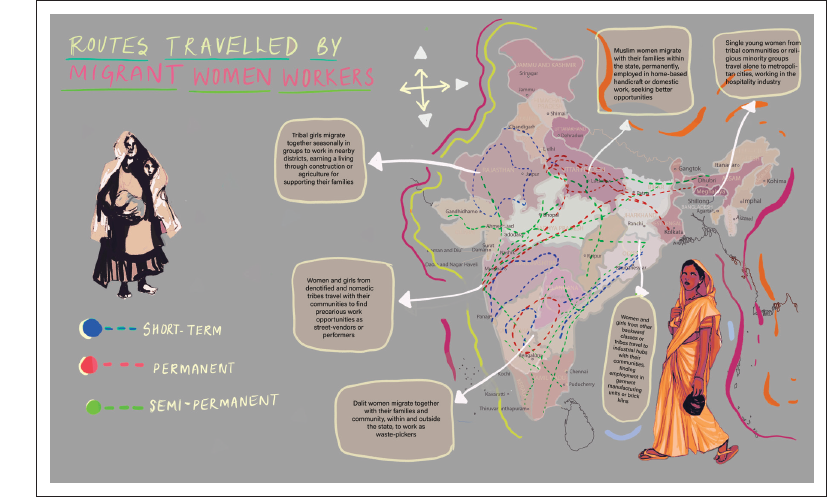
Figure 1 has been created by 11 non-profit organizations working with poor migrant women workers during Dasra’s workshop ‘Visibilizing Poor Migrant Women’, held online on 19 and 20 October 2021. The map shows that women migrate on a short-term, permanent, and semi-permanent basis across the country for work.
CONCLUSION
Internal migration is a crucial driver in India’s development story. The phenomenon of migration presents great economic opportunities for women as well. However, it is driven by distress, and the lives of poor migrant women are rife with vulnerabilities linked to their intersectional identities. Ecosystem actors must collectively acknowledge the pervasive constraints faced by poor migrant women and visibilize them as workers. Without due visibility of their lived experiences in the mainstream, their work will continue to be undignified, underpaid, or unpaid. The personas shared above are a first step in providing a platform to share their voices. It is important to generate more of such evidence and create multisectoral approaches to address their issues.
THE CONSTRUCTION SECTOR AND ITS INFORMAL WORKERS 41
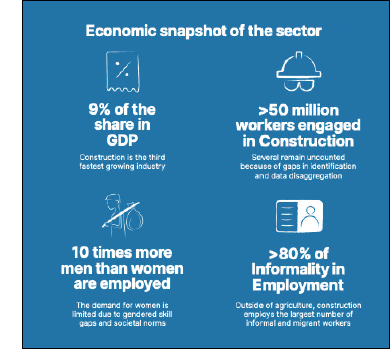
The construction sector employs the maximum number of informal workers outside of agriculture, predominantly migrants. Fast-paced urbanization and high demand for a low-skilled workforce are the pull factors for this vulnerable demographic. Government data estimates that the sector employs 59 million workers, 52 million men and 7 million women. 42 The construction sector is also the single largest absorber of informal workers. Due to the low entry barriers for recruitment, the industry employs a large chunk of the surplus of India’s non-agricultural workforce. Construction is India’s third-fastest growing industry, contributing to ~9% of India’s gross domestic product (GDP) 43 (see Figure 2). However, the inequalities faced by the vulnerable workers employed in this sector are a stark contrast to its economic progress.
Despite being an established industry, the knowledge on the inner workings, especially regarding the well-being of its unit-level workers, remains fragmented. The industry and the government both play important yet distanced and apathetic roles for these workers. There is little actionable insight on the systemic breakpoints that undermine the construction sector’s ability to ensure greater dignity and equity for its informally employed workforce.
MULTIDIMENSIONAL VULNERABILITIES EXACERBATE THE CHALLENGES
The migrant and gender status of individual workers further intensify the complexity of the informality of employment within construction. Most informal workers in construction, especially migrants and women, have negligible legal protection and face a hostile and punitive policy and regulatory environment. Though migration is a critical solution to build economic opportunity, for this section of workers, it is currently driven by severe distress. About 10% of the workforce comprises women, often employed in unskilled manual labour, and remain lost because of the gender-neutral discourse that surrounds this space.
The State, through the Building and Other Construction Workers (Regulation of Employment and Conditions of Service) Act, 1996 (BOCW Act), provides a robust legislative framework for the social protection and well-being of workers who are engaged in the sector. However, there are severe gaps in the last-mile delivery of services for the construction workers. As per the government data collated after the first round of the pandemic, 62% of the total cess collected for the welfare of construction workers remained unutilized. Further, only 50% of the workers were eligible to gain benefits as per their active registration status under the provisions of the act. 44
The official data after the first lockdown and the facts discussed above clearly indicate that there is a severe need to ensure social protection, rights, and dignity for workers in construction. It is important to undertake a thorough analysis of the breakpoints surrounding workers.
Workers in all communities share the experience of distress and exploitation. The interlinkages between critical stakeholders and the complex journeys of workers (as individuals and communities) need to be deconstructed thoroughly to target approaches for resolving the most pressing problems.
BREAKPOINTS ARE LINKED TO PRIMARY TOUCHPOINTS AND CRITICAL STAKEHOLDERS
The inequities faced by informal workers in the construction sector are multifaceted. Several issues impede their social and economic growth due to complex labour supply chains. Probing into the journeys of informal workers in the sector reveals the primary touchpoints and critical stakeholders playing defining roles in their interactions across the system and well-being. The key stakeholders at important touchpoints in workers’ lives are the government, industry, contractors, and community. The primary employers or industry are far removed from their ground realities as the majority of the work is liaised out to a web of contractors and subcontractors. The fragmented reach and accountability of the government is another overarching problem that affects their lives. Since the phenomenon of migration is interspersed so closely with their journeys across the system, it is important to layer this in while analysing the breakpoints.
The challenges faced by workers are starkly visible across source, destination, and systemic levels. Focusing on gender is critical while discussing the challenges surrounding migrant workers, given the exclusionary practices surrounding women.
Critical breakpoints are highlighted across stakeholder groups, including government, industry, contractors, and community in the following paragraphs. Furthermore, a paragraph has been dedicated to gender, drawing attention to the problems in facilitating equitable outcomes.
Government
The government and its policies are backed by a strong legal framework, but they still fall behind in implementation. The BOCW Act, the Inter-State Migrant Workmen (Regulation of Employment and Conditions of Service) Act, 1979 (ISMW Act), and other schemes are progressive and intentional policies for workers’ well-being. Furthermore, the Union Budget 2021 seeks to address some challenges that emerged during the COVID-19 crisis with vigour. 45 The Government of India is now taking proactive steps towards strengthening food provisioning through universalized ration availability and increased efforts towards an enumeration of workers. To address women’s specific needs at the workplace - there exist government policies to prevent sexual harassment and provide maternity benefits, within the construction industry. However, there are shortfalls in its implementation due to overburdened public systems. There is a fragmentation in services delivery because of inadequate tracking and monitoring mechanisms.
Industry
Industries survive due to underpaid informal migrant workers amidst a paucity of local labourers. The construction industry is challenging, where daily jobs are dangerous, posing numerous unaccounted risks for the workers, which can even be potentially life-threatening. Therefore, it is important for industry players, who are primary employers, to exercise even more caution and act responsibly in protecting the interests of the workers on site. Unfortunately, the complexity of the labour supply value chain places the ‘principal employers’ far away from the workers, such that they are either unaware or apathetic towards their plight.
Contractors
Contractors are primarily responsible for recruitment and welfare, and are often mired in informality themselves. They are key intermediaries in the construction ecosystem, as they are the primary figures responsible for recruitment and payments. The BOCW Act defines a contractor as a person who undertakes to produce a given result for any establishment, other than a mere supply of goods or articles of manufacture, by the employment of building workers or who supplies building workers for any work of the establishment and includes a subcontractor. However, the prohibitive degree of informality and casualization of the labour force has severely obliterated the scope of an employer to include even a petty contractor.
Communities
Communities share experiences of distress from source to destination and over generations. Socio-economic factors and geography are important determinants of breakpoints at the community level. The construction sector largely sees the entire communities of migrants, seasonal and circular, moving together for working in the adjoining districts or across state borders. Therefore, migration is imperative to consider while studying the challenges surrounding these communities. The vulnerability of informal workers in construction is linked with intergenerational poverty, natural disasters, climate change, and discriminatory practices such as the caste system.
Gender
Exclusionary practices and policies make gender equity a growing concern in the construction sector. Given the overarching patriarchal system, the construction industry is not a level-playing field between genders. Employed in the lowest-paying, hazardous, and labour-intensive jobs (like heavy lifting), women workers are marginalized and unrecognized in the construction sector. Gender disaggregated data on women’s migration and actual participation in the construction industry is limited. There is an acute difference in their access to equal wages and skilling opportunities. This affects women’s competitiveness in the labour market. The on-ground response to their practical needs such as maternity benefits, hygiene, sanitation, and day care facilities is dismal. Further, women are also at a higher risk of violence and sexual harassment. It is also pertinent to mention that India’s overall score in regards to the Sustainable Development Goal (SDG) 5 (Gender Equality) is below 50 (on a composite score range of 0–100). 46 Therefore, gender equity demands special attention from an SDG progress point of view.
CORNERSTONES FOR IMPROVED WORKERS’ WELL-BEING
The breakpoints can be transformed into opportunities for each stakeholder to seize, ensuring that those who constructed our cities also have a place in them.
To trigger a holistic change, there is a need to spotlight the workforce and account for them and their needs in policymaking. It is essential to bridge the gap between those in plush offices and those on-site by formalizing their employment and facilitating financial inclusion of the most vulnerable. Eliminating distress, providing support to families and communities, and ensuring information symmetry are key factors that will drive informed decision-making for the workers. The cornerstones that can establish the foundation for a more inclusive tomorrow are as follows.
Enable Financial, Social, and Legal Protection by Securing Requisite Identity Proof and Worker Registration
There is a need to increase awareness about rights and entitlements, especially registration under BOCW, through legal education, aid, and counselling to make laws more comprehensible and accessible. Measures must also be taken to boost financial literacy and create ease of access to formal financial services such as savings, credit, pension, and insurance to bring about economic stability and security. Fundamental on-site facilities such as access to safe and hygienic accommodation, including easy access to water and sanitation, are required to reduce the incidence of disease and infections and bring about overall well-being. Lastly, conducting camps to impart knowledge about common occupational hazards and illnesses and preventive measures can go a long way to inculcate healthy practices and enable early detection.
Create Expectation Alignment for Workers Through a Channel Informed by Industry Demand
The first step to an informed and aspiration-led migration is equipping workers with information about job profiles options, minimum wage rates, and ideal working conditions before they migrate. Second, creating resource centres and helplines for information support and grievance redressal across source and destination will ensure seamless support irrespective of location. Simultaneously, capacity building contractors most closely engaged with worker communities in a manner that empowers them to not only provide but also advocate for better welfare measures and increase oversight of industry leaders and contractors higher up in the value chain concerning worker profiles and working conditions would be a useful way to maintain effective checks and balances at the destination.
Empower Construction Workers’ Families and Communities by Providing Access to Diverse Livelihood Opportunities to Prevent Distress-Led Entry into the Sector
To increase a worker’s potential and enable socio-economic movement, it is imperative to conduct on-job training and upskilling programmes. Entrepreneurship through programmes that provide skills, confidence, access to social and professional networks, and mentorship must be encouraged to break the intergenerational inheritance of job profiles/work roles. To further complement this, active efforts will help create viable job opportunities at source such that distress migration is reduced. Specifically, self-help groups and cooperatives for women should be promoted to create an enhanced source of income.
Ensure Gender Equity in Opportunities, Working Conditions, and Wages Through Inclusive Policies and Practice
Gender equity is an intentional focus area across the world of work. Institutionalizing policies that mandate equal pay for those undertaking the same tasks and competency-based reward mechanisms, free from gender-related bias or discrimination, are required to foster a culture of fair treatment of all workers. These should also include a mechanism that presents uniform skilling opportunities across genders to provide a similar scope of upward mobility to all. Facilitating regular sensitization sessions and undertaking strict punitive actions for sexual violence against women and children are key to eliminating such incidents. Lastly, fulfilling the gender-responsive needs of women such as maternity benefits and crèche facilities on-site would greatly enhance the environment to boost female labour workforce participation.
Improve Data Collection and Integration Across Workers’ Migration Corridors and Value Chains to Enable Greater Visibility and Security
Given that workers on a construction site have a fixed-term contract and then move on to a different site, their integration into the formal workforce hinges on effective maintenance of their records with respect to personal information and work history which can be easily accessed. These must be then collated as a part of a central repository that also captures their skills and market opportunities to create information symmetry, leading to informed choices.
At a macro level, there is a need to undertake deeper analysis of national surveys to understand trends contextualized to the reality of the sector and implement and fund research studies to detail specific breakpoints and inform policy advocacy.
ROLES OF KEY STAKEHOLDERS IN ENABLING HOLISTIC TRANSFORMATION
The country’s demographic dividend can be effectively leveraged by investing in productivity-enhancing measures for this huge workforce. Once the informality of their employment is eliminated, and their identity as worthy employees and citizens is acknowledged, there is potential for exponential socio-economic development, not just for the workers but also the whole nation.
All the key stakeholders impacting the lives of these workers have a key role to play herein.
Government
There is a dire need to ease access to entitlements and undertake effective enforcement and monitoring of schemes and policies. Other aspects lending to effective implementation would be improved interstate coordination and the efficient use of data and technology. The ability to create and influence change through policy must be utilized effectively through holistic evidence.
Industry
The pause brought about by the COVID-19-induced lockdown can be used as a moment to reset aspirations before building back a new and improved future. Corporates must take on increased responsibility for the workers in their ecosystem by improving on-site supervision, institutionalizing measures to create gender equity, promoting digital forms of payment, and introducing robust and stringent subcontracting policies.
They can support other stakeholders, including their peers and the government, by playing an active role in implementing the existing measures facilitating data collection and maintenance of records.
Business leaders also play leading roles within industry associations, and the influence of such an authority on a large network can be leveraged to champion the cause of workers’ well-being and to create a level playing field for front runners in this movement to ensure that responsible businesses continue to survive as successful businesses.
NGOs
Non-profits have been working tirelessly for decades to improve the plight of workers, and this can be scaled rapidly once they strengthen collaboration with peers and other stakeholders. It is also imperative that they apply a gender-transformative lens while designing new programmes. These measures need to be applied at destination areas and source areas to lend support to workers through the entire spectrum.
Philanthropy
Companies can participate in the movement by examining their ecosystem for workers’ well-being and by bringing in their CSR funds to support the cause. They, along with other funders, must boost catalytic areas, promote data collection, and foster innovative experimentation. Providing resources to outcomes that align with government priorities has increased the probability of quicker and deeper impact.
A combined effort from all the stakeholders to solve the identified systemic barriers and promote greater dignity and equity for informal workers in the construction sector is the need of the hour. Holistic transformation by building missing bridges and addressing the needs of the most distressed communities will lead to a win-win situation in three areas—enhancing lives of a major vulnerable population, bringing on an era of responsible business, and a boost to the economy by effectively harnessing the strength in numbers of this cohort. This will also contribute towards 6 of the 17 SDGs:
No Poverty Gender Equality Decent Work and Economic Growth Reduced Inequalities Sustainable Cities and Communities Partnerships for the Goals
The COVID-19 lockdown exposed and re-entrenched long-existing structural inequalities in India’s workforce. Underpinning this was the fact that India currently does not have a robust system to recognize and register almost 92% of its workforce engaged in the informal sector. 47 Without formal recognition, workers in the informal sector are left with no legal recourse to assert their rights. Non-registration also means that the State does not have the necessary data for ensuring workers’ access to entitlements. This became particularly apparent during the lockdown when lack of data/recognition meant that many workers could not assert their right to entitlements such as social security and wages.
Taking cognisance of this, in the case of In Re: Problems and Miseries of Migrant Labourers [Suo Moto Writ Petition (Civil) No. 6 of 2020] (In re miseries), the Supreme Court ordered all states to complete registration of informal workers by 31 December 2021. In pursuance of this order, the Central Government launched the National Database of Unorganized Workers (NDUW), that is, the E-Shram portal on 26 August 2021, to register and collect information about unorganized workers across the country. Although this is a long-overdue measure, its implementation on the ground has been haphazard. One of the multiple impediments to its implementation is that the labour law regime in India is currently in the process of being overhauled, leading to confusion on the ground.
In 2019 and 2020, the Indian parliament enacted four new labour Codes, including the Code on Social Security, 2020, which deals with the registration and social security of informal workers. The four codes repeal and replace 29 existing labour legislation. The four new codes, which were initially meant to come into force on 1 April 2021 have not been fully notified. As of 22 November 2021, draft rules have been formulated under all the codes. However, only one of the draft rules has been finalized yet. 48 Due to ambiguity on how and when the labour codes will be implemented, there is little clarity on the process through which registrations should occur. Moreover, despite the announcement of the number of schemes linked to E-Shram registration, as listed on the E-Shram website, there is still confusion about whether registered workers will automatically be provided with benefits associated with the schemes or if they will need to apply for benefits under these schemes separately. In other words, there is considerable ambiguity in how the labour law regime, and hence the labour registration system, will transition from the old to the new.
Drawing on the experience of four organizations (CSJ (Center for Social Justice), Aajeevika Bureau, Econet, and Zenith) of facilitating labour registrations and interacting with government officials in Gujarat, Chhattisgarh, Maharashtra, and Madhya Pradesh, this article will highlight the challenges faced at the ground level as the labour law regime gets overhauled. Before delving into this analysis, we will contextualize the discussion by outlining the changes taking place in the labour registration regime.
BACKGROUND: CHANGES TO REGISTRATION-RELATED PROVISIONS
Labour laws in India provide for two types of registrations with respect to the informal sector: establishment registration and direct workers’ registration. While in the former, social security benefits are conferred on workers only if the establishment is registered, the latter directly entitles workers to social security benefits. As per the old labour law regime, Unorganized Workers
49
and Building and other Construction Workers (‘construction workers’)
50
are eligible for self-registration. Upon registration, workers falling under each of these categories are entitled to some level of social security, as described below.
The Unorganised Workers Social Security Act, 2008 (‘UOW Act’), places a duty upon the state and central governments to formulate schemes to provide social security benefits to registered workers. Under the BOCW (Building and Other Construction Workers (Regulation of Employment and Conditions of Service) Act, 1996, registered workers are entitled to a package of benefits (including pension, maternity benefits, medical expenses, etc.) funded through the collection of cess from the employer.
The new Code has largely retained the existing framework. The Code distinguishes between unorganized and construction workers and replicates the scheme and cess-based social security systems for the two, respectively. There are, however, some minor differences in the definitions of the different categories. The Code has also added two new categories—gig workers and platform workers—which are dealt with similarly as unorganized workers. Apart from this, the main changes are in the registration procedure, which will be discussed below. As both the old and new systems empower unorganized and construction workers to directly register, the rest of this article highlights ambiguities in the design and process of self-registration with specific reference to unorganized and construction workers under both systems.
AMBIGUITY ON THE LEGISLATIVE BACKING OF E-SHRAM
One of the biggest reasons for confusion on the ground is that there is no clarity on the statutory backing of the E-Shram portal. It is unclear whether the E-Shram portal is based on the old UOW Act or the new Code on Social Security, 2020.
There is some evidence to suggest that E-Shram is under the new codes. First, the process of E-Shram registration mirrors the process laid out in Rules 47 and 50 of the draft rules on social security. The draft rules specifically mention that registration will be conducted through an online portal linked to Aadhaar, as is the case in E-Shram. Second, the eligibility criteria mentioned on the E-Shram portal (16–59 years) is almost identical to the criteria laid out in Section 106 of the Code on Social Security, 2020, for construction workers. Third, in preparation for the roll out of E-Shram, the Ministry of Labour and Employment notified Section 142 of the Code on Social Security, 2020, which makes Aadhaar compulsory for unorganized workers to register ‘as member[s] or beneficiar[ies]’ under the Code. E-Shram, an Aadhaar-based unorganized workers registration portal, was launched soon after the notification of Section 142, which further strengthens the argument that E-Shram has been developed pursuant to the new Code.
However, the Code as a whole has not yet been notified. The notification of Section 142 in isolation, without the notification of registration-related provisions in the Code that Section 142 is to be read with is, as argued by Yajat Kumar, a constitutional anomaly. 51 Furthermore, the draft rules have not been finalized or notified as of 22 November 2021. In light of this confusion, we filed a Right to Information (RTI) to the Gujarat Labour Department seeking the official notification as per which E-Shram has been formulated. The department did not specifically address our query and instead provided us with information about the process and benefits of E-Shram. Without notification of the parent Act and Rules regarding the implementation, E-Shram seems to be operating in a legislative vacuum, making it difficult to demand accountability from the state. 52 This has created fertile conditions for confusion and chaos in implementation.
THE EMERGENCE OF PARALLEL REGISTRATION SYSTEMS
From our experience, the practical implications of this ambiguity on the ground can be seen in the emergence of parallel systems of registration under the old system and under E-Shram. In Chhattisgarh, workers presently can register themselves in the state’s portal as per the UOW Act or the BOCW Act and avail benefits under the State Government’s schemes. Until recently, the State Government ran two portals under each of these Acts. The State Government has now created a new user-friendly joint self-registration portal, which allows both categories of workers to register. This portal was rolled out around August 2021, not long before the launch of the E-Shram portal. This has resulted in a curious situation wherein workers can either register themselves under the state or central system.
Despite parallel systems, mass registration drives are being conducted in collaboration with Common Service Centres (CSCs) across the state to register workers only under E-Shram. This is partly due to the heavy publicity that E-Shram has received over the past few months. However, the main reason for this is that states have been given targets for E-Shram registrations by the centre in pursuance of the In re miseries order. Most importantly, there have been no efforts to converge the two systems. Nor has the state taken any efforts to conduct simultaneous registrations under both systems through the ongoing registration drive. Considering that the documentation requirements for the two systems are similar (with the state system requiring a few additional documents), CSCs can easily be instructed to simultaneously register workers under the state system without mobilizing additional resources. On being asked why such convergence is not taking place, a district-level government official from a district labour department in Chhattisgarh responded that they are simply performing their mandate of registering workers as per the In re miseries order. According to him, since the Central Government’s response to the Supreme Court order was to set up the E-Shram portal, the responsibility of the state government is restricted to E-Shram registrations. Such a selective reading of the Supreme Court order undermines the spirit of the order, which calls for the State and Centre to perform their duty of registering workers, encompassing all existing systems.
In Gujarat, the State Government has taken some steps towards convergence. Nevertheless, considerable ambiguity persists. Soon after the In re miseries order, the Gujarat government re-launched its U-Win Card Scheme under the UOW Act to register unorganized workers through an online portal. Concurrently, the Gujarat government launched E-Nirman, an online portal under the BOCW Act. U-Win was subsequently merged with E-Shram. However, E-Nirman is still functional, suggesting that workers can register under the central E-Shram system and the state E-Nrirman system. Adding to the confusion, this is not the first time that the Gujarat government has conducted registration drives. In 2015, mass registrations were done under U-Win. Similarly, construction workers’ registration used to be conducted offline before the introduction of E-Nirman. This offline system is locally known as ‘Lal Chaupdi’ or ‘red booklet’, as workers would get red booklets upon registration. There has been no official communication on whether registrations done under U-Win before the recent drive or registrations under the Lal Chaupdi system will get carried over to E-Shram and/or E-Nirman. Ground experience so far suggests that no such convergence has been planned.
A somewhat similar picture emerges from Maharashtra and Madhya Pradesh. A perusal of the Maharashtra Labour Department website shows that the state has three registration systems. This includes registration under the UOW state rules, the BOCW state rules, and the state-specific Maharashtra Domestic Workers Welfare Board Act, 2008. Madhya Pradesh similarly has a system for registration of workers under the state-specific Madhya Pradesh Asangathit Karmkar Kalyan Adhiniyam, 2003, and the BOCW state rules. Experience from the ground in both states confirms that E-Shram has superseded these systems without accounting for the existing infrastructure. Unlike Chhattisgarh and Gujarat, where registrations can still occur under the state system, state systems in Maharashtra and Madhya Pradesh seem to be defunct.
IMPLICATIONS OF THE PARALLEL SYSTEMS
The existence of parallel systems has resulted in the following complications.
Transfer of Data
There is no mechanism to carry over or transfer registrations between these parallel systems. This means that workers registered under the E-Nirman in Gujarat or the state UOW/BOCW systems in Chhattisgarh after the launch of E-Shram do not automatically get transferred to the E-Shram system. It also means that workers registered before the launch of E-Shram under the state systems (e.g., under the Lal Chaupdi or E-Nirman system in Gujarat, or under the U-WIN system in Gujarat before its convergence with E-Shram, or under the various state systems in Chhattisgarh, Maharashtra, or Madhya Pradesh) do not automatically get registered under E-Shram despite being eligible.
The validity of such State-based registrations going forward is also doubtful since there is no clarity in the registration guidelines contained in Sections 106 and 113 of the Code and Rules 47 and 50 of the draft rules on whether registrations done before the commencement of the new Code will be carried over or subsumed in the new system. This is critical since the definitions of unorganized and construction workers have only been slightly modified. This means that most workers who were eligible under the old system will also be eligible under the new system.
More critically, the validity of E-Shram registrations as the new system comes into force is also an area of ambiguity since the legislative backing of E-Shram is not certain. If E-Shram is under the old law, we do not know how and if the registrations will get transferred to the new framework.
Entitlements and Benefits
While E-Shram and State systems in all the States discussed above have similar eligibility criteria, the entitlements are different. This means that workers registered at the same time under different systems will be entitled to different sets of entitlements. Since most registrations are taking place under E-Shram portal, workers are deprived of benefits under the old system, despite a framework for registrations. The fact that E-Shram’s legislative backing is not clear only compounds these complications. If E-Shram is under the old acts, the registration should entitle workers to schemes formulated by the state under the old UOW and BOCW Acts. If E-Shram is under the new Code, there is no clarity in the Code on how and whether the existing schemes will be transferred over to the new system. Thus, whether those registered under E-Shram can avail benefits from schemes that are not mentioned on the E-Shram website is not clear. This becomes further complicated in the context of construction worker registrations since both the old BOCW Act and the new Code entitle registered beneficiaries to statutory entitlements such as a pension, maternity benefit, insurance, etc., that are not covered in the schemes listed under E-Shram. Since the legislative basis of E-Shram is not certain, one does not know whether the registered construction workers can assert their right to these statutory benefits and if so, then under what legal instrument. What is clear amidst this confusion is that the entitlements listed under E-Shram fall short of the benefits guaranteed by law under both the old and new systems. However, in the absence of clarity on the legislative backing of E-Shram, it becomes difficult to ascertain the exact bundle of rights that workers are entitled to.
Authorities
While the parallel regimes have created confusion about the exact nature of entitlements that registered workers are entitled to, and the status of these registrations, how registrations are currently taking place also makes it difficult to attribute responsibility and demand accountability. Since the legislative backing of E-Shram is not known, it is not clear which authority can be invoked to demand accountability and clarity on the nature of entitlements. While State Labour Departments are responsible in practice for ensuring the implementation of E-Shram, their duties cannot be traced to a statutorily binding instrument in the absence of legislative clarity. Moreover, ground experience suggests that state labour departments have been instructed to implement E-Shram, without any guidelines for managing the transition between the two systems. The National and State Social Security/Welfare Boards, created under the old Acts and new Code, could be called upon to clarify the confusion created by these dual systems. This is because the Boards are responsible for formulating and administering social security entitlements. However, since we do not know which legislative framework is currently in force, the exact nature of the Board’s duties is unclear.
This is heightened because the Code and Rules are also silent on what will happen to the bodies set up under the old system. The structure and duties of the boards constituted under the old system have been largely retained in the new system with minor modifications. However, the Code does not provide details on whether the existing Board will be disbanded and reconstituted or whether a handover process will happen. In the absence of such clarity, it becomes difficult to attribute responsibility and thus demand accountability from duty-bearers during this transition.
In light of this ambiguity, there should ideally exist a system to converge the existing registration processes so that the workers can avail their entitlements under all operational schemes through a single registration. However, as discussed above, effective convergence is not taking place.
CONCLUSION
Without a mechanism to facilitate the transition from the old system to the new system, there is a high risk that registrations that are currently taking place will not provide enough tangible benefits for the informal workforce. The E-Shram exercise represented a valuable opportunity to prepare the groundwork for a smooth transition. However, ambiguities surrounding the legislative basis of the E-Shram process have only compounded implementation issues on the ground. As our experience from Gujarat, Chhattisgarh, Maharashtra, and Madhya Pradesh has shown, there is very little clarity on how these various registration systems are meant to interact, leading to redundancies and confusion. The centre needs to act urgently to protect the rights of informal workers by providing clarity and setting up a clear mechanism for the transition. Most importantly, it needs to ensure that workers receive the social security entitlements that they require and deserve.
RECOMMENDATIONS
Based on our field experience, we recommend the following as immediate action points.
The central government must clarify the legislative backing on E-Shram. State labour departments must transfer all old registrations to E-Shram. State labour departments must proactively merge the existing multiple registration systems, including those under state acts that are not repealed by the new Code, to ensure that a single registration entitles labourers to benefits from all existing systems. While such a mechanism for merging is being developed, CSCs and other registration personnel should be instructed to register workers as per all systems that they are entitled to. Once the merging mechanism is in place, previously conducted registrations should be transferred to this singular system. The Central and State Governments must clarify the entitlements that workers are registered to on registration under E-Shram and state systems and the process for availing these benefits. The Central and State Governments must clarify how the following transitions will take place:
Transfer of registrations conducted under previous systems. Transition of authorities responsible for administering labour registration systems from old to new. The transition of the various boards set up under the old laws. Transfer of budgetary allocations, specifically cess money under the BOCW system. Transfer of existing state and central schemes under the old laws as the new laws come into force.
Pursuing profits is one objective of business, and profits are necessary for a business to be sustainable. However, the sustainability of business has taken on new dimensions in the past 10 years. The environmental, social and governance (ESG) aspects of the business have become an increasingly important element in how business performance is assessed given the serious concerns in the world today about climate change and social inequality due to the widening gap between the rich and poor. There is a growing sentiment that businesses have not adequately addressed these concerns. There is, therefore, a need for business to create a more sustainable model of growth and development.
TO ADDRESS SUSTAINABILITY MORE HOLISTICALLY, BUSINESSES MUST FOCUS NOT ONLY ON CLIMATE CHANGE AND ENVIRONMENTAL ISSUES BUT ALSO ON SOCIAL FACTORS—THE PEOPLE WHO CONTRIBUTE TO THE BUSINESS AND WHO THE BUSINESS IMPACTS.
The last 20 years have brought about several initiatives targeted towards the environmental aspects of sustainability. For instance, the recent United Nations Climate Change Conference hosted in Glasgow in October–November of 2021 (COP26) saw global leaders commit to reducing carbon emissions. Similarly, at COP21 held in 2015, the parties signed the Paris Agreement to contain global temperatures. As such, within the sustainability ambit, impact on the environment has become a priority for a business.
However, what continues to remain neglected is the social aspect of sustainability or the ‘S’ pillar of ESG, which focuses on an organization’s practices vis-à-vis human rights, business ethics, diversity and inclusion, working conditions for a company’s vendors, and social impact as a result of corporate actions. Neglect of these aspects were harshly exposed during the lockdown in India at the onset of the COVID-19 pandemic in 2020. It brought to light the deplorable condition of India’s informal workforce that form part of companies’ supply chains and larger ecosystem.
Treating the people contributing to the business all along its value chain irrespective of the level or mode of engagement with dignity and equity has begun to gain prominence as a critical factor of a sustainable and resilient business. This was little understood and poorly embraced by industries until the pandemic highlighted the importance and necessity of a more ‘human-centric’ approach in business.
HUMAN-CENTRIC BUSINESSES GO BEYOND THEIR EMPLOYEES TO THOSE IN THEIR CONTRACTUAL AND SUPPLY CHAIN SEGMENTS, WHO ARE INFORMALLY ENGAGED AND VULNERABLE
It would be pertinent to first understand the problem. In 2019, a working paper by the International Law Organization (ILO) stated that 90% of India’s entire workforce is informal, and 85% of the non-agricultural workforce is informal. 53 The informality of employment implies that workers, by law or practice, are not subject to labour legislation, income tax or employment benefits. Some manifestations are the lack of registration in the employers’ or government databases and lack of formal enforceable employment contracts. These workers include skilled and unskilled workers who work in their domiciled state as well as non-local migrant workers. These workers include security guards, housekeeping staff in organizations, workers employed with third-party vendors, workers at small manufacturing units, construction workers, and the informal hospitality segment. 54
Most of these industry engaged informal workers are solely dependent on their employers for livelihood. A 2018 report by ILO stated that in around 40% of the states in India, the application of minimum wages was less than 50% 55 and women earn 30%–40% less than men in the same occupation. 56 As per data from the Ministry of Labour and Employment, between 2014 and 2016, 3,562 workers lost their lives and 51,124 workers were injured in factory accidents. 57 In addition, the data shows that only 14% of Indians in rural areas and 19% in urban areas have any form of health coverage. 58
The outbreak of COVID-19 only aggravated these statistics. With the announcement of the lockdown in March 2020, millions of workers (primarily migrants) were left stranded without any income, food, or shelter. A report by Jan Sahas foundation indicated that 42% of the workers interviewed by them had no rations left for even a day, let alone the duration of the lockdown. About 33% of the workers were stuck in their destination city with little or no access to food, water, or money. Further, the survey indicated that approximately 90% of labourers lost their source of income during the lockdown in March–April 2020. 59
To address the problem, it is necessary that these workers are provided with liveable wages, safe practices in the workplace, and access to basic health and a social safety net. It is important to understand that these workers are also integral to the business and caring for one’s white-collar workforce alone is not adequate. Business needs to go beyond the layer of formal employment and reach these workers who, though at the bottom of the value chain or invisible in support roles at our sites, contribute to the effective functioning of the business.
THE SOCIAL COMPACT ENABLES BUSINESSES TO BECOME MORE HUMAN-CENTRIC FOR THEIR VULNERABLE AND ‘INVISIBLE’ WORKERS
During the period following the first lockdown, a few businesses that included Forbes Marshall, Thermax, and Godrej, and non-governmental organizations (NGOs), Aajeevika Bureau, and CSJ came together with Dasra to form a multi-stakeholder platform called the ‘Social Compact’. The idea behind the Social Compact was to ensure greater dignity and equity for the informal workforce through six basic outcomes that underpin the core vulnerability of these workers: an adequate living wage rather than just a legally mandated minimum wage, health and medical care, safety in the workplace, gender equity, access to government entitlements, and upskilling to enable future growth.
The Social Compact aims to enable companies to self-assess their worker practices on these six outcomes, identify gaps, suggest and support the implementation of solutions both within the company and for its contractors and supply chain vendors.
The Social Compact challenges the narrative that a successful business only focuses on minimizing costs and increasing revenue with no attention paid to the conditions to which the workers are subjected to in the company’s larger ecosystem. And, it is intended to create the aspiration that a successful business is one that is also a responsible business.
ENSURING THE WELL-BEING OF INFORMAL WORKERS WILL NOT REDUCE THE COMPETITIVE EDGE OF BUSINESS
It is thought (incorrectly) that providing the benefits described here to informal workers would drive up costs and lead to uncompetitiveness. It is important to demystify this misconception with numbers.
As an illustration, and based on a fair size sample, it emerges that in most engineering/manufacturing enterprises (where informal workers are deployed in large numbers), the total cost of people ranges between 6% and 12% of sales turnover. A round figure of 9% will be representative. If we break this up further, nearly 90% of the people cost is of white-collar and those blue-collar workers who are on the company’s payroll. So, effectively, the remaining category of informal/contract/outsourced workers who are not on the payroll but work full time for the organization constitute only 10% of the people cost. Hence, the cost of these informal workers is only around 0.9% of the organization’s sales (Figure 3).
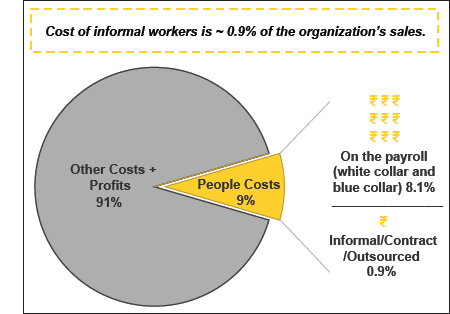
An equally compelling argument can be made in the case where labour is outsourced to a vendor. Consider the following actual case from an engineering/manufacturing company. The material cost of a particular item that sells for Rs 200 is Rs 100. The labour element outsourced to the vendor for the item is Rs 8, and so labour is just 4% of the sales price of the item. If the company were to pay just 12.5% more to its vendor than what it is presently paying (i.e., Rs 9 instead of Rs 8), it would raise its cost as a percentage of sales by just 0.5%. If it paid Rs 10 instead of Rs 8 (i.e., 25% more), its cost would rise by 1% of its sales value. The impact of that 0.5% or 1% increase in cost would result in a 12.5% or 25% increase in what would be paid to the vendor. If this increase is passed on by the vendor to its informal workforce, it could have a significant impact on their well-being (Figure 4).
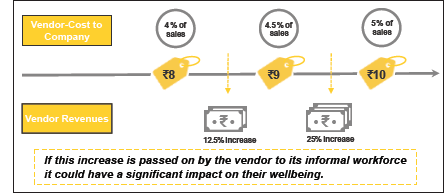
It is therefore illogical to suggest that tweaking a cost element that is less than 1% of sales turnover will make a business uncompetitive or unviable. If anything, being fair and equitable to this group of people can make the business more dependable, productive, and even possibly more competitive in the long run.
HISTORY, IN FACT, PROVES THAT HUMAN CENTRICITY ENHANCES THE SUSTAINED PROFITABILITY OF THE BUSINESS
The 2020 lockdown showed that companies that chose to ignore their workers faced disruption in operations when the lockdowns were lifted. They had to subsequently incur higher costs to get people back to resume operations. Many of these companies have continued to face supply chain issues, labour shortages, strikes, and even lockouts due to worker unrest, which have ultimately resulted in a loss of revenue and reputation. On the contrary, companies that paid attention to the integrity and well-being of their workers have reaped the benefits of continuity of operations, despite the disruptions, with higher productivity and better profits.
Studies have shown that paying attention to the ‘S’ pillar of ESG positively impacts equity returns of a company through increased employee productivity. Ignoring the ‘S’ drags down productivity through strikes, worker slowdowns, and other labour actions, not only within the company but also across the supply chain. 60
Some examples of good practices are given below.
Walmart tracks the work conditions of its suppliers, including those with factories in China, on a proprietary company scorecard. 61 Similarly, Mars has developed model farms that introduces new technological initiatives to farmers in its supply chains and increases farmers’ access to capital so that they can obtain a financial stake in those initiatives. 62
GPL subjects its suppliers to a screening based on social criteria to ensure no negative impact arises through any of its suppliers. 63 TATA Consultancy Services have specific policies to actively engage with supply chain partners in implementing their sustainability agenda. They seek commitment to comply with international labour standards with a specific focus on ILO conventions. These include freedom of association and collective bargaining, elimination of all forms of forced or compulsory labour, effective abolition of child labour, and elimination of discrimination with respect to employment and occupation. 64
THE MOVE TO A FUTURE OF BUSINESS THAT IS RESPONSIBLE AND SUSTAINABLE
The focus on workers’ well-being practices and supply chain management from a social perspective is gaining importance. Globally, the interest in ‘S’ or the social component of ESG is proving particularly resonant. In fact, several investment firms have begun to analyse their investee companies’ employee practices during the pandemic. 65
The Family Business Network (FBN), an international association of 4,000 family-owned businesses in 65 countries, has partnered with United Nations Conference on Trade and Development (UNCTAD) at the UN to create a pledge and a platform that their member companies can use to measure their performance on various ESG sustainability parameters. Many parameters of the ‘S’ aspect are common to the Social Compact outcomes mentioned earlier.
Regulators such as the Securities and Exchange Board of India (SEBI) have recently introduced the ‘Business Responsibility and Sustainability Reporting’ (BRSR), replacing the earlier ‘Business Responsibility Report’, which provides a more robust and comprehensive reporting on worker practices along the business chain. BRSR requires companies to report on the percentage of male and female employees and permanent and temporary employees, the grievance redressal mechanism in place for value chain partners, and sustainability issues pertaining to social matters that present a business risk. 66 The BRSR would be mandatory for the top 1,000 listed companies from the financial year 2022–2023. 67
The ILO published a report in 2021 on inequalities and the world of work and how it poses one of the biggest challenges of our time. The report highlights the different forms of inequality, the extent of informality as a major source of inequality, gaps in social protection, gender inequality, and how enterprises which incorporate inclusivity and work towards fairness, dignity and gender equality, among other good practices, are key for a more sustainable, human-centred, and inclusive future of work. 68 The report also highlights some pressing statistics highlighting the global situation regarding human centricity and inequality. As per the report, the lack of social protection during the COVID-19 pandemic has been catastrophic for informal workers globally. 69
Hence, within India and globally, there is a move towards a future of business that weaves together responsible and sustainability-oriented business practices that can lead to a long-term success. All businesses will eventually need to align, and they have a choice of either getting on board now and setting the trend or being made to follow later.
THE SOCIAL COMPACT: SHAPING THE FUTURE OF WORK AND BUSINESS
The long-term success of any social movement hinges on society’s outlook towards the issues and the level of initiative they are willing to take to address these. It is time for all stakeholders within the Indian economy to come together and address the gaping inconsistencies in worker practices across industrial supply chains, which the Social Compact aims to address. Industry bodies should also look at mainstreaming the Compact’s aspirations through thought leadership, collective discussion, shared solutions, policy advocacy, and possible incentivizing of their members to lead this change. Investors could also act towards integrating the Compact’s standards as a prerequisite for supporting their investment in companies. This would also be beneficial to the investee companies to compete globally in markets where ESG standards are already more established.
The Indian business ecosystem needs to understand that poor standards in the informal workforce are a reality and that the informal workforce needs to be protected and uplifted towards greater dignity and equity. Ultimately, if industry does not address the outcomes that the Social Compact is actively striving towards, India will not achieve ESG sustainability in its true sense. History has also shown that disruptive changes in business practices are often triggered through necessitating circumstances. COVID-19 should be perceived from this perspective. Change must be brought about now, and businesses of this country have a responsibility to fix the inequality in India’s divided industrial society.
On 12 December 2020, Wistron Corporation’s Bengaluru premises was vandalized by employees, purportedly for the non-payment of wages for an extended period. 70 A pertinent question here would be that whether the outcome would have been different if both sides felt heard and consequently arrived at an agreeable solution without the $7.1 million in damages.
In October and November of 2021, the military junta in Myanmar prevented the sale and exit of businesses and their employees in an attempt to hold on to business investments despite the coup. 71
Another example of uncertainty concerning individual rights is China’s crackdown on big tech. It was seen by many as an attempt to ‘end the domination of a few heavyweights’ 72 and individual figures in these industries particularly because they were seen as growing in status and, therefore, a threat to the Chinese Communist Party (CCP) 73 à la Jack Ma and the collapse of the Ant IPO.
These three examples demonstrate situations where there were decreasing levels of adherence to the rule of law and the resultant inhospitable conditions for businesses to thrive.
WHAT IS THE RULE OF LAW? WHAT DOES IT ENTAIL?
The most common principles alluded to on the rule of law are the protection of property and the enforcement of contracts. While these two principles may serve to carry out the most fundamental functions for businesses, we know that they do not suffice.
We like to think of the rule of law, fundamentally, as the confidence with which one can undertake activities that one deems fit without the worry of harm to oneself, if such activity is permissible for anyone else in a similar situation. Put less simply, the rule of law is the confidence that the tripartite relationship—between individuals/businesses, the state, and other individuals/businesses—have predictable, consistent and similar outcomes. It is the expectation that when I promise to undertake an activity for an agreed-upon consideration, permitted by the law of the day, I can expect on the undertaking of that activity to be within my right to expect the fulfilment of the agreed-upon consideration. It also means that state functionaries and state action are bound to act consistently and treat similar situations similarly; that the state will protect individuals from harm when not acting in contravention of any laws.
RULE OF LAW AND BUSINESS
It is but apparent why a rule of law would be conducive for business—transactions are secure, compliance is valued, and in the oft chance that there is dishonouring of arrangements, there is recourse to remedy as agreed to previously or the judiciary (Figure 5). The state’s role here is to secure one’s interests and not impede activity that is not legally prohibited, that is, power exercised in accordance with the law. 74 An essential element imperative for performing this role by state functionaries is equality and equal protection guarantee. These have throughout recent history been considered so paramount that it is often found enshrined in the constitutions of countries. Articles 14, 19(1)(g) and 21 in the Indian Constitution state equality before and equal protection of the law; freedom to practise any profession or carry on any occupation, trade or business; and protection of life and liberty, respectively.
In its implementation, what this would mean is the primacy of law and the independent institutions charged with adjudicating disputes in a system of governance. This works only when the laws have distinct characteristics and they prescribe the rule by general norms. Laws have prospective effects and allow for adequate time to be complied with. Such laws are made public. They are clear, have determinate legal norms, and are not vague or amenable to varying interpretations. Being otherwise would effectively bestow unfettered discretion on state functionaries. Finally, they ought to be practicable. 75 Its implications for governance are the absence of corruption, an independent judiciary, and a presumption in favour of freedom.
The next part outlines specific benefits to businesses from an environment/society that has greater adherence to the rule of law. It expounds on the implications for businesses and the social benefits that flow from the concepts that are briefly touched upon in this section.
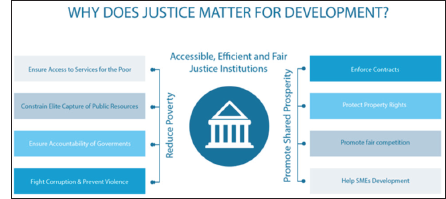
The outcomes of business decisions are more predictable, thereby decreasing risk with increased predictability of outcomes, consistent with norms being general, prospective, public, and clear. Social stability also increases, further reducing risk to businesses. This also contributes to increased social stability. In real terms, India lost $991.19 billion to violent crime, homicide, suicide, and other disruptors of peace in 2019 alone. 77 In terms of forgone growth, it is 1.4% greater growth of GDP every year, which over 20 years accrues to 30%. 78
The rule of law hinges on the respect for rights, obligations, and outcomes of remedies. 79 The balance struck between these will be acceptable and the peace will be kept only if such discernment is fair. Stability and predictability increase confidence, 80 boosting investment—both domestic and foreign. It also helps increase access to markets for both sellers and consumers of labour.
The damage to businesses is typified by real losses, forgone revenue, or higher costs. For instance, due to the 1993 Bombay riots, Muslim workers from Uttar Pradesh and Bihar, mostly employed in the ready-made garment industry, migrated to their towns and villages, costing manufacturers $3 million a day in lost production. 81 While last year’s COVID-19 lockdown measures could, arguably, have been inevitable, greater respect for rights could have avoided the refusal, for months, by migrant labour to return and the consequent supply chain maladies.82, 83 Greater security for migrant workers in Jammu and Kashmir (J&K) and measures to assuage local fears could have avoided their exodus, triggered by a spat of killings, causing a reported 80% decline in industrial output. 84
Improves Safety
Increased safety decreases the cost of security for businesses while decreasing the chances of harm to assets. There is a growing body of work documenting and assessing the damage to businesses and social peace because of ‘protection’ racketeering outfits.85, 86 Increased safety would have very closely linked threefold benefits. First, the need to hire and maintain security personnel and other measures to secure assets would be lower. Second, it would also lead to a decreased need to pay ‘protection money’ to racketeering outfits, and other such entities, as the state performs its law and order roles and limits, if not extinguishes, the functioning of such bodies. 87 It also brings down the costs for the consumers of goods and services, which in turn could spur increased demand and growth. Third, it would decrease abrupt changes to the availability of labour such as those described above in the case of the 1993 riots in then Bombay, post the pandemic, and the killings of migrants in J&K. 88
Increases Mobility
Safer cities increase the mobility of goods and people, particularly women,89, 90 and vulnerable groups, including minorities, and their access to employment. To put this in perspective, India has one of the lowest female labour force participation globally, dropping from a high of 31.79% in 2005 to 20.79% in 2019 91 with an all-time low of 16.1% 92 in the aftermath of the pandemic in 2020. The post-pandemic numbers for minorities, particularly Muslims, is also very concerning, with 42.6% unemployment in this group. 93 Increased predictability, safety, and mobility will have a twofold benefit. First, a larger pool of skills to pick from for business, particularly women and minorities (see Figure 6) will be available.
Second, increased diversity in the workforce is shown to have a direct correlation with levels of innovation, better business solutions, growth, and thriving in new markets.94, 95 The increased rule of law also increases confidence for all parties in a market, both sellers and buyers of labour, goods, and services, which stimulates economic growth and opportunities for business. 96
Increased safety also contributes to decreased costs of logistics, particularly the cost associated with the safety of goods in transit with respect to rent-seeking entities such as protection racketeers.
Decreases Venality
Increased levels of the rule of law also decrease venality in government bureaucracy. It would also reduce the need to have ‘connections’ to the government, or its functionaries, to get work done. India has among the highest venality rates in the 97 world. 98 This also affects the productivity of the labour force, not to mention business delays caused by the need to pay bribes for public services, particularly the police. 99 India also has the distinction of the highest use of ‘connections’ at 54%. About 63% in India, the highest in the world, believe they will face retaliation if they report such activity. Increased adherence to the rule of law will be a shot in the arm for reporting such instances, critical to curbing such activity. 100
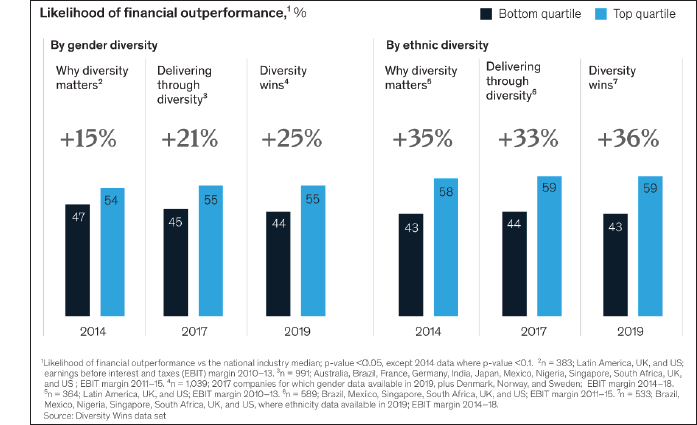
All of these add to costs of operation, affecting the bottom line for all businesses.
Increased transparency and accountability produce a more conducive environment for businesses, 101 particularly regarding regulations, and understanding why decisions were made the way they were. It would be pertinent to remember the effect of prospective, clear, and non-ambiguous regulation in measuring the adherence to the rule of law. 102 This would be frustrating with poorly performing institutions, an indicator that has a significant bearing on the rule of law and business outlook in general, such as the beating India’s image took on issues of retrospective tax. 103 The effects of this also permeate into the data and statistical outputs put out by the government, illustrative in the World Bank’s Statical Capacity measure (Figure 7). 104 This would be logical because the reliability or ‘confidence’ in real indicators for businesses to plan is impaired when reliable, timely, and accurate data is unavailable.

Accountability allows businesses to understand why their actions have been met with state action and, when legitimate, cause a course correction. Accountability also feeds consistency in a system, disincentivizing state action that is discriminatory or rent-seeking in nature. India has seen, as recorded by the World Bank (Figure 8), a decrease in the voice of constituents and accountability concerning state power, translating directly to decreased business confidence in the state being responsive to the needs and interests of businesses. 105 106
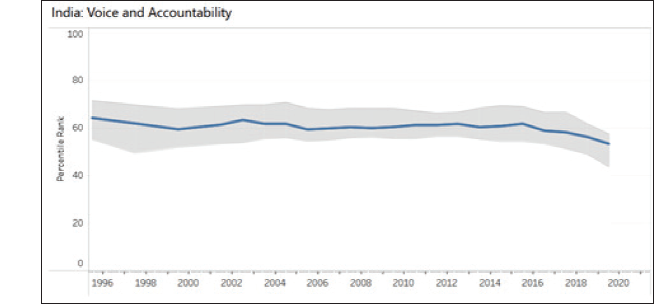
The labour participation rate pre-pandemic (February 2019) fell from 43.2% to 42.7% in just a month. A trend further exacerbated by the pandemic leaving the levels at 40.7% in September 2021.107, 108 There has also been a steep fall in quality jobs. Even during the July 2021 post-pandemic recovery, which announced record job addition numbers, there were 3.2 million job losses. 109
A big factor in these poor statistics is the unavailability of the skill required, something sought to be addressed through many initiatives such as the ‘Vocational Training Improvement Project’ (2007–18) and ‘Skill India’ initiative. But even the Standing Committee on Labour found many discrepancies, particularly on quality control through permission for such skilling organizations like Industrial Training Institutes (ITI). 110 With laudable goals and the matrix for assessment already set through various government measures, it is in the implementation that we are failing, not in small part, due to the inconsistent manner in which permissions for such intuitions are handed out. 111 Inconsistence, after all is the anathema to the rule of law. India also saw a long-term (past decade) decline of 25% in the adequacy of skill sets of all (school and university) graduates in the country. 112
Adherence to well-studied recommendations set out in the Vocational Training Improvement Project 113 and Working Group’s report on Skill Development and Vocational Training 114 would significantly increase the availability of such skilled labour.
A more fundamental question in the availability of skill and in reaping the dividends of the potential diversity of the workforce is at the primary schooling levels. Secondary and tertiary institutions can only upskill what they receive from primary institutions, that is, schools. Poor performance at this level will see the continued impact to the tertiary levels and beyond. In the fight to increase school enrolment, particularly for girls, and consequently higher skill levels in the workforce, an aspect often underscored is the perceived levels of safety 115 in getting to 116 and in education institutions, 117 all of which are pegged to the rule of law.
Increased transparency and accountability would help respond to these conditions in a holistic manner instead of a piecemeal form such as if private or philanthropic entities were to set up education/upskilling institutions. The latter will exacerbate inequality and increase the risk of social unrest.
Social Stability
Social stability is a significant marker and has large consequences for businesses. Social unrest, often included in or referred to as political risk, deters business activity.118, 119 It causes large contractions in both manufacturing, services, and consumption. 120 A mitigating factor for social unrest regarding businesses is strong institutions, which India does not do well on. 121 India’s track record on social unrest in the last few years has not been very inspiring leading risk-mitigating consultancies to downgrade the country’s business outlook 122 (Figure 9). The same is also reflected in the Fragile States Index. 123 These, in turn, would cause other businesses to avoid dealing with Indian businesses fearing unreliability due to such volatility. It also impacts ‘strategic resources, including energy, food, technology, and water or other inputs to key
national industries’. 124 Pressing businesses to adhere to and root out human rights violations has been a constant demand from rights bodies and international organizations, including the UN. 125 This has got a shot in the arm through international and local, public naming and shaming campaigns 126 ; recent studies have also shown that the market also penalizes such violations. 127
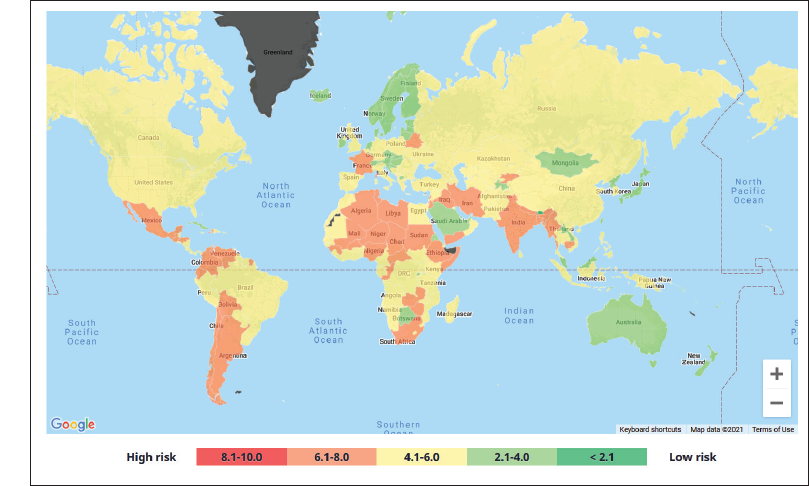
Adherence to the rule of law also increases competitiveness as it increases innovation and encourages taking advantage of unique aspects of each market. 128 In such environments, there also is a greater implementation of competition regimes, decreasing formations of monopolies. India stands at the 68th position out of 141 countries assessed for the Global Competitiveness Index. 129 An indicator of prospects of businesses by leaders from the field, less than 25% believed that greater prospects of competitiveness and consequently globalization for a more globalized economy, indicating a stymieing of growth.
Increased transparency and accountability also levels the playing field for businesses that do not/cannot exert influence through ‘connections’ on government functionaries or political government leadership. The increased competition from a more level playing field benefits the public through increased value and savings in public contracts, increases efficiency, and plays a positive role in the growth of the economy. 130
Decreases Discrimination and Bias
Discrimination, while mostly seen as a social issue, has serious implications for businesses not just in terms of labour output but also in terms of what would generally be described as purely business transactions. In terms of losses associated with hiring talent, there has been growing evidence from the economist and Nobel laureate Gary S. Becker in the 1950s to more recent works of loss to businesses where bias, including unintended bias, imposes sizable costs on businesses. 131 For example, gender-based discrimination alone costs the global economy $12 trillion and South Asia $888 billion. 132 Bias also creeps into business transactions and has large implications for efficiency and the bottom line. A recent study on mergers and acquisitions in India found out that firms are prone to acquire or merge with other firms with a similar caste make-up, particularly at the board and or senior management. While these exercises purport to rely on more free information flows, the study found that such transactions are significantly more likely to cost the entities more in valuations and/or pay to senior management that stays on without a notable increase in the expected benefit of better information flows. 133
Implementation of anti-discriminatory policies and its practice would hardwire these values into businesses, increasing innovation, worker output, better business solutions, and inspiring more efficient transactions.
THE SOCIAL COMPACT
Businesses are often averse, and legitimately so, to investing in the rule of law particularly because of the nexus between the political government and entities that sell protection from themselves and others like them, 134 and how governments may not view them favourably. A workaround to this would be working through collectives: industry bodies, civil society, or both.
The Social Compact, born out of the greater public focus on the well-being of industry engaged informal and migrant workers from the beginning of the pandemic, is anchored by Dasra. Dasra has been working to build such a coalition of businesses and civil society. This coalition has already been working with partners— Aajeevika Bureau, 135 and CSJ 136 on the civil society/NGO side and that of Forbes Marshall, GPL (Godrej Properties Limited), and Thermax on business, showing considerable interest in bringing their corporate voices and networks to adopting a Social Compact between business and their workers for better and more sustainable growth (Figure 10).
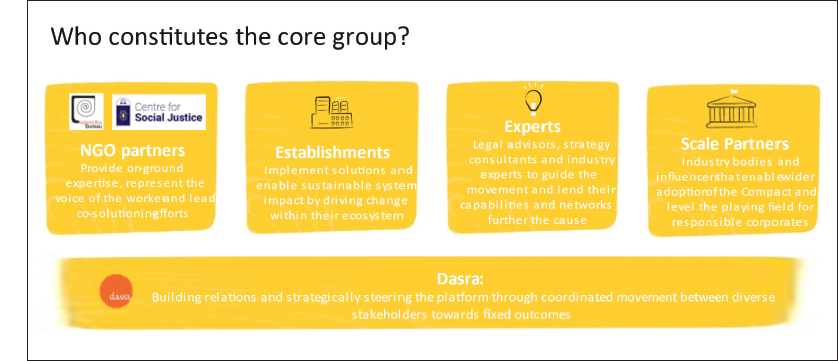
The Compact seeks to build broad consensus for safe, equitable, and productive working conditions for urban informal workers, developed together by leaders from Indian businesses and civil society. This critical inflection point—in the interest of both businesses and civil society—in what could be India’s ‘never again’ moment, in regards to the migrant labour crisis at the start of the pandemic, could be a sustained, long-term initiative to bring about systemic improvements in the working conditions of those informally engaged within industries in India. These would receive a significant boost through the support for the rule of law.
CONCLUSION
The rule of law is characterized by societies that are governed by law (as opposed to by fiat) that prescribe the rule by general norms: having a prospective effect, with adequate time to comply; that such rules are made public; that they are clear and determinate and not vague; limit the discretion of state functionaries to legitimate state interests; and that are practicable.
The fruition of all the benefits discussed in the article is hinged on the investment in the rule of law. Businesses are often averse to taking action or investing in the rule of law, particularly because of the nexus between the political government and entities that sell protection from themselves and others like them, and how governments may not view them favourably. However, this can be averted through acting collectively or contributing to a collective such as industry peers, bodies for industrial areas, or civil society bodies. The Social Compact, a movement anchored by Dasra, offers precisely this opportunity—to invest in the rule of law, particularly issues around labour security and meeting skill needs of businesses.
A moment of distress often holds within it an opportunity for change. And it is from one such instance, the first COVID-19-induced lockdown and the ensuing exodus of millions, that the Social Compact was born. The precarious plight of India’s informal and migrant workers, spotlighted during this phase, was not new but was indelibly impressed upon the country’s collective conscience like never before. And there were looming questions in everyone’s mind: ‘Who were these people? Whose responsibility was it to ensure their safety and well-being, especially in a time of calamity? And what were the reasons that overnight they had to walk thousands of kilometres back home on foot to escape imminent starvation and death?’
A human crisis of this scale demanded a deeper look and a befitting response that addressed the very fault lines that gave way to such an episode. But memories are short, and it was essential to respond quickly but with a sustainable solution. In this moment, it was imperative to understand as to ‘What will it take to initiate change?’
BRINGING TOGETHER INDIA’S LEADING BUSINESS AND NON-PROFIT LEADERS IN A CO-SOLUTIONING RELATIONSHIP
Over two decades of work, Dasra has worked with business leaders to advise their philanthropy and with non-profits to help them evolve with the changing demands of development. With the Social Compact, Dasra took this experience a step further to convene these very stakeholder groups into a co-solutioning relationship, not for CSR or philanthropic initiative but to strengthen core business practices to become more inclusive of and responsive to the informal workers in industry ecosystems. The coming together of these two hitherto opposing forces proved to be the first milestone of the Social Compact. Combining the on-ground insights and knowledge of leading non-profits such as the Aajeevika Bureau and Centre for Social Justice with the intent and risk appetite of established corporates such as Forbes Marshall, Thermax, Godrej Properties Limited and Pradeep Bhargava (Chairman, Automotive Stampings and Assemblies Limited, Pune) resulted in the kick-off of a transformative journey for business in India.
UNDERSTANDING THE PERVASIVE INFORMALITY
As a first step, corporates wanted to understand how informality existed in their systems and their role in enabling change. ILO defines informality as follows:
Employees are considered to have informal jobs if their employment relationship is, in law or in practice, not subject to national labour legislation, income taxation, social protection or entitlement to certain employment benefits (advance notice of dismissal, severance pay, paid annual or sick leave, etc.) for reasons such as: non-declaration of the jobs or the employees; casual jobs or jobs of a limited short duration; jobs with hours of work or wages below a specified threshold (e.g. for social security contributions); employment by unincorporated enterprises or by persons in households; jobs where the employee’s place of work is outside the premises of the employer’s enterprise (e.g. outworkers without employment contract); or jobs for which labour regulations are not applied, not enforced, or not complied with for any other reason. 137
These could be individuals engaged in formal sector enterprises, informal sector enterprises, or paid domestic workers by households. Amidst this huge demographic, the Social Compact focuses on those informally engaged within industries in India and categorizes them as follows:
Temporary workers/fixed-term workers: Workers employed directly by the company for a fixed duration. Contract workers: Workers of contractors (job contractors or labour contractors) working on the premises of the company such as offices, factories and sites; and employees of subcontractors (where the company itself is a contractor), working on the premises of its customers. The company is the principal employer. Supply chain partners: Workers in establishments where the company is a prominent buyer or seller. This includes service or sale franchises, warehouses, clearing and forwarding agents, business-to-consumer (B2C) sales service franchise partners, individual and petty contractors, and those recognized as platform or gig workers by the Code on Social Security, 2020. The company has no legal obligation under labour laws, but it has a significant relationship as a purchaser or seller.
DEFINING A BOLD ASPIRATION
After imbibing the vastness of the problem that existed, the initial group of partners motivated and inspired by one another to aim high coined an aspiration larger than themselves or anyone’s individual entity. The vision of the movement is to ‘ensure greater dignity and equity for informal workers within industries in India and mainstream the collective aspiration that responsible business is equal to successful business’.
As the movement was being conceptualized, certain features emerged as central themes:
Worker centricity: The most important lever of this movement is to keep the needs, vulnerabilities, and aspirations of the workers with respect to safety, security, conducive working environment, and wages at the forefront through non-profits co-leading problem identification and solutioning. Gender responsive: The initiative adopted a gender lens in all stages, beginning from the design of the Social Compact to the execution of remedial action to make sure that the effort has a positive outcome for all informal workers. Scalability: Lastly, create the design in a replicable and scalable manner such that the brand does not remain restricted to elective circles and can be amplified to and aspired for by all kinds of businesses, large and small.
The next step was to convert the vulnerabilities of the workers into six outcomes that would that would be the foundation of all activities of the movement. (Figure 11). Furthermore, to achieve the Social Compact outcomes, 30 standards based on experiential data and secondary research on best practices were put in place and converted into a tool for self-reflection. This resulted from the combination of decades of Aajeevika Bureau’s and CSJ’s experience in working with informal workers and interviews conducted by them during the initial phases of the movement; and inspiration from national and global best practices. Majority of standards are legally mandated while also enabling companies to ensure the targeted outcomes for informal workers in their ecosystem.
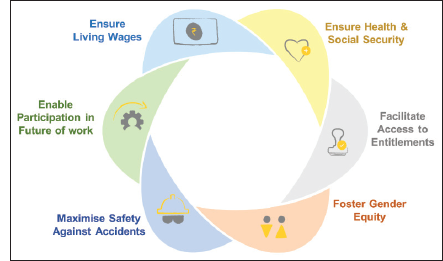
BUILDING BRIDGES OF COMMUNICATION AND A SHARED VALUE SYSTEM ACROSS THE COMPANY ECOSYSTEM
In the initial days itself, it was apparent that even the most conscious businesses were at best sure of practices only within their factories and immediate contractors. Workers engaged in the supply chain or even those supporting the core business as canteen staff, janitors, electricians, security staff, and more were not in the immediate counting when companies assessed themselves on ‘worker practices’. The huge demographic that contributes to the running of the business ecosystem had been invisible in broad daylight. The existing communication channels between principal companies, their contractors, and supply chains were typically used to discuss legal compliance and costs rather than linked value systems and the good practices thereof.
The realization of this grave miss was further driven home when the lockdown opened up and work remained stalled due to the lack of labour. The interdependence of the business and its workforce then became starkly apparent.
In addition to enabling principal employers to include informal workers in their realm of responsibility, the Social Compact also realized the role of industry bodies. They needed to not only support efforts to scale this ideological evolution into the definition of ‘future of business’ for India but also play their part in advocating policy corrections and incentives to encourage such business chains with a supportive environment.
These bridges between key stakeholders that are affected and can move the needle were the foundation on which the movement is built and continues to grow.
After understanding the need and brainstorming solutions, it was time to take the movement on the ground and conduct a pilot study: ‘What was the best way to action the idea?’
LEADING WITH AN ENABLEMENT APPROACH
Over the years, legal loopholes have been leveraged to limit employer accountability towards informal workers. And anything else that comes up as mandatory compliance has the same fate of being followed simply in the letter, but not in spirit. To mitigate this risk, the Social Compact has been designed as a voluntary initiative, where companies are enabled to move on a business improvement journey. It is localized on the basis of the understanding of India’s complex dynamics, granular by way of step-by-step guidance on what to do next, and is applicable across sectors.
The entire process is one of co-creation, co-solutioning, and implementation, where each company can carve out their individual journey with the support of Dasra and non-profit partners to make changes in key gap areas. The firm buy-in that this participatory approach allows ensures that the changes become business as usual, instead of a side initiative that requires constant fuelling.
Individual journeys: The Social Compact’s reflection tool allows chief experience officers (CXOs) to get a deeper understanding of the workers’ well-being in their system through an analysis of 30 standards mapped to the 6 core outcomes. Combined with the site visits that follow, a holistic picture is painted about the strengths and gaps, laying the premise for remedial action and feedback loops that lead to self-correcting momentum. The promise of end-to-end support and access to a peer group of like-minded companies through this journey is a reassuring and comforting factor enticing companies to join the movement (Figure 12). Third-party solutions: While principal employers remain the focal point of entry to create impact, it was also important to engage directly with the workers on ground. Establishing industry hub-focused Worker Facilitation Centers (WFCs) as a combination of a walk-in centre and a mobile unit, allows the quick scale to a larger cohort of workers, agnostic of companies. The main intent is to enable access to entitlements through support for domicile proof and other required documents. Direct access to the workers will move the needle on impact in a faster and deeper manner. Peer learning: Despite coming from different backgrounds, each member and partner of the Social Compact is bound by a common vision of ensuring greater equity and dignity for informal workers in the country. The sense of purpose brought forth by this results in a safe space for sharing challenges, common risk-taking, and mutual inspiration to continue forth on this arduous journey.
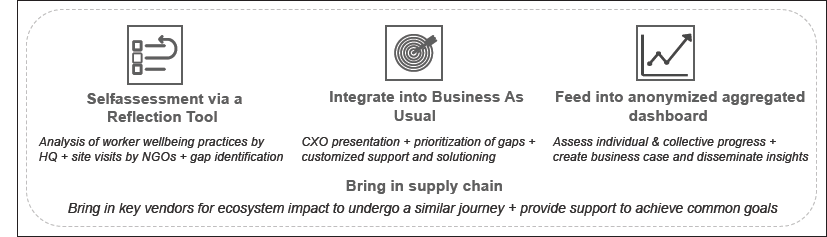
CREATING A MORAL, LEGAL, AND BUSINESS CASE FOR WIDER APPEAL
Reaching out to companies for onboarding brought the realization that while the moral case moved some, others were looking for more or different reasons to join. To be able to bring in all kinds of leaders, a case that appealed to the business minds and compliance aspects were created, with support from Boston Consulting Group (Figure 13).
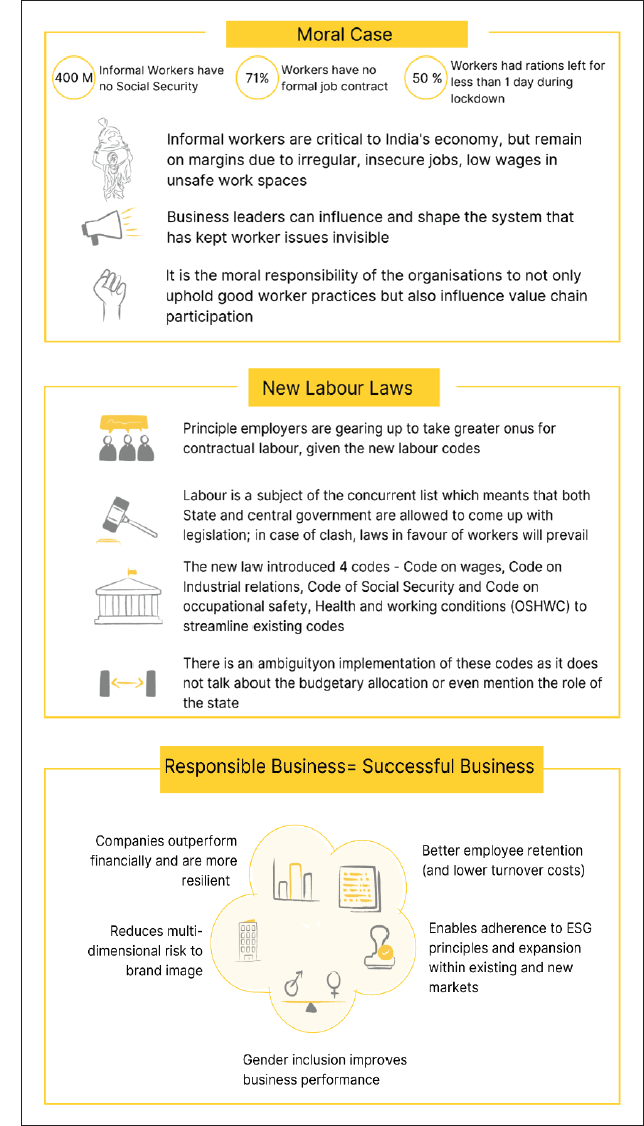
Once the movement took off, using learnings to make real-time changes was the main solution to the oft-asked question: ‘What makes this movement efficient?’
FORMING DIVERSE TRUST-BASED RELATIONS AND CREATING CHAMPIONS
While the highly motivated core group driving the movement came together in the initial days, there is continuing efforts to liaise with partners from different spheres. Partners who bring in their specialized expertise and perspectives to strengthen the movement are being pursued (Figure 14). This mitigates the risk of effort duplication—of recreating something that exists.
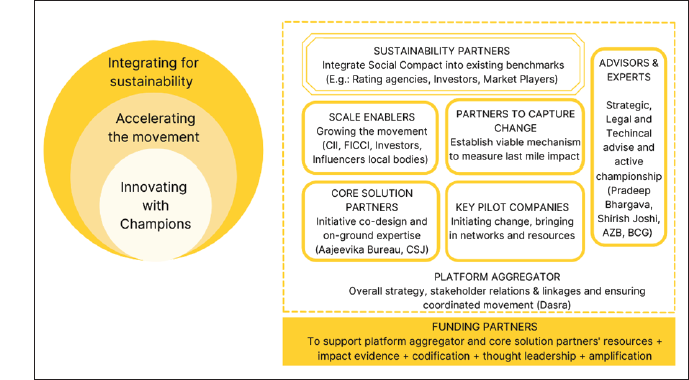
The shared onus on the core group of growing the movement ensures joint accountability that goes a long way in maintaining the momentum and bringing in fresh ideas at all times. If everyone becomes an ambassador of the cause, it will create a ripple effect ensuring that the impact reaches far and wide.
MAINTAINING AGILE FEEDBACK LOOPS BETWEEN ON-GROUND INSIGHTS, KEY ACTIONS, AND STRATEGY PIVOTS
At every step of the journey, the Compact’s key offerings have been designed for replicability and scalability. Records of the insights emerging from the ground or through conversations with each member have been maintained such that they can be linked together during strategic decision-making. A few examples of this would be as follows:
The reflection tool has been converted into a SoCo lite version and been translated into vernacular languages to enable easy access for vendors, MSMEs. The realization that implementing certain solutions would require third-party support resulted in the concept of the WFC, which can cater to a large cohort of workers within industry hubs. The recognition for a need to mainstream the aspiration leads to sharpening the focus on amplification through digital and traditional media. In conversation with companies, it became apparent that there were various frameworks in place to evaluate social aspects of the business, which were then mapped to the Social Compact standards to understand complementarities and USP (Unique Selling Point).
This continuous churn helps in being one step ahead to plan for what is coming next. To refresh the memory of companies, a few months after taking the tool and ensuring that the progress was being routinely tracked, the company dashboard was introduced: a tool by which not only the companies, but also the movement as a whole could measure progress against the core outcomes via common metrics.
LEARNING ACROSS THE ACTION LANDSCAPE
Building a portfolio of different initiatives
138
around the cause helps to bring in-depth perspectives.
Along with GPL, Dasra has launched the report ‘Inclusive by Design: Cementing the Future for Informal Workers in India’s Construction Sector’ to provide actionable insights on the systemic barriers that heighten the vulnerability of the informally employed workers in this sector. This is a clarion call to action to ensure equity and dignity for the workers informally engaged in the construction sector. In-depth insights about the breakpoints help strengthen the solutioning process of the Social Compact. The cornerstones for development highlighted in the report were inspired by the progress of the Social Compact. Dasra is also part of a global initiative, supported by Robert Bosch Stiftung, to understand what intersectionality means in practice and how it can address systemic inequalities. The co-created learnings and good practices, arising from engaging in an immersive reflective learning journey with non-profits championing and showcasing powerful impact by using intersectional approaches in addressing the issues of poor migrant women workers, will be amplified.
Keeping abreast of other activities in the national and global sphere and engaging with relevant stakeholders therein has proved useful to get access to wider networks and bring invaluable perspectives from others on similar journeys.
Living Wage Foundation has undertaken an exercise to map the different initiatives globally that are trying to advocate the need for moving the needle on living wages for all.
139
The Social Compact members participated in the workshops that led up to this culmination and provided insights on the Indian perspective. The engagement continues through network events, introductions to relevant stakeholders, and joint amplification of the cause. Global Fund to End Modern Slavery also engaged in research to understand migrant workers in the construction sector.
140
This report also highlights findings related to the effectiveness of the selected intervention models at improving labour practices for workers, which were extremely useful as recommendations for the Social Compact to consider partnerships. The core NGO partners of this movement, Aajeevika Bureau and CSJ, are involved in various initiatives apart from the Social Compact, including a national labour helpline for migrants and business and human rights programmes via access to justice. They routinely bring back relevant learnings and collaboration opportunities to the Social Compact.
The crux of most of the decision-making stems from the question that the movement began with: ‘How can sustainability be ensured?’
ENABLING INTEGRATION WITHIN BUSINESS AS USUAL
It was critical for the Compact to ensure that the recommendations made to the companies are not just used to make one-time corrections in studied sites but also for sustainable improvement in the company’s business mandate for informal workers overall (Figure 15). To this effect, the Social Compact endorses that companies begin with leadership buy-in to include the Social Compact standards into their company mandate, and then identify a reliable and pre-existing mechanism within their business to ensure that this is upheld across the length and breadth of the business. For this purpose, some companies utilized their sustainability dashboard, others their governance and compliance machinery, or even performance management systems. It was key to the sustainability of this correction, that the Social Compact is upheld not by a parallel or CSR wing but within business as usual. Social Compact also advocates proactive reporting to critical stakeholders of the business to ensure regular and quality progress on improving worker practices. Once this is imbibed within the thought process and part of business as usual, no separate efforts are required for sustainability.
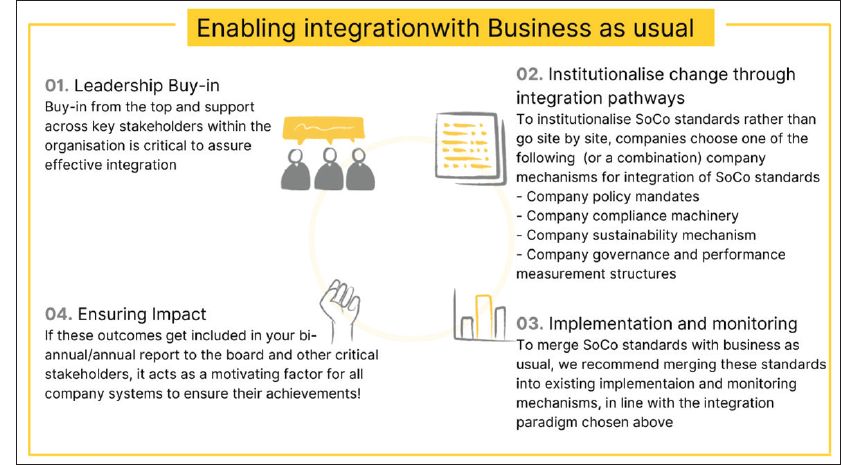
MAINSTREAMING AT A SYSTEMIC LEVEL
Amplification
Efforts are being made to engage with amplification amplification platforms (national and global), local associations, and influencers to spread the word and create a level playing field so that responsible businesses can survive as successful ones. Diverse audiences who can either serve as a node to bring in more companies or play the role of influencing authorities are being engaged. Traditional and digital means—via social media and other existing platforms such as Sankalp Global Summit, CII Zonal meetings, C20 forum, and IIM-A lectures—to introduce the concept of the Social Compact has been effective in widening the presence and building awareness about the plight of the workers and the linked moral responsibility.
Integration
Additionally, with the changing legal regime, the complementarity and contradiction of the Social Compact’s standards and recommendations on the existing legal requirements were analysed. Other benchmarks and reporting mechanisms already being used—such as Global Reporting Initiative (GRI), Social Accountability standards (SA8000), ILO, Sedex, UNBHR (United Nations, Business and Human Rights), BRSR, Global Real Estate Sustainability Benchmark (GRESB), and DGSI (Dow Jones Sustainability Index)—were also mapped to allow easy adoption by a variety of companies already adhering to any one of these. This effort allows companies’ ease of compliance and lays the foundation for synergistic integration into one or more of these, eventually. Similarly, engaging with initiatives like Living Wage Foundation and pursuing the likes of Credit Rating Information Services of India Limited (CRISIL) helps identify synergies to strengthen the model right from the design stage. This again is a mode of planning for the Social Compact standards to be subsumed into the existing and recognized benchmarks and become a norm for posterity.
When a movement sustains itself, without the need for anyone to drive it and continue to push the momentum, it is truly a success, and the aspiration is that the impact trajectory will continue long after the hustle of the movement subsides. ‘What have been the key learnings of being part of a movement this large?’
What started as an idea in the minds of some individuals, and with the courage of a few front runners, has in the span of 20 months become not only an aspiration for others but also an on-ground movement creating and enabling sustainable change on the ground and within industry practices for informal workers (Figure 16). The moment of truth, though, will be hearing back from the workers themselves, a little while into this journey on whether something has improved. That last mile proof is always a challenge for a system’s change movements, but it is something the Social Compact endeavours to pursue and convert into a communication bridge between the principal employers and informal workers within their ecosystem.
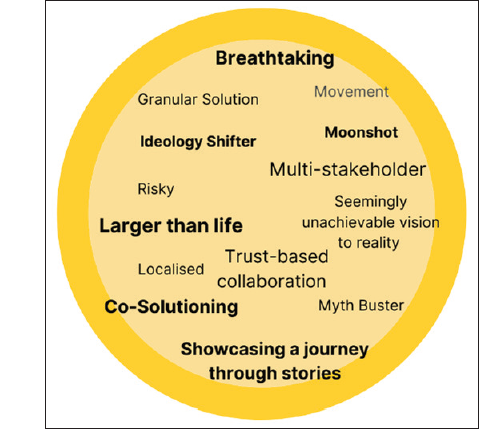
Along this path full of ups and downs, it is important to embrace the enormity of the vision and keep an eye on the North Star through it all: maintaining the humility of being part of something larger than any one stakeholder or stakeholder group, and cherishing and celebrating each victory to boost the momentum and, above all, ensuring that the relations that are built out of trust are maintained effectively and no one is left behind in the journey.
The pandemic led to an unprecedented convergence, which the Social Compact has converted into a momentum. As the members, supporters, and champions play their role to make this a success, each one has a role to play. Others, including funders, investors, and regulatory authorities also need to enter, share the risk, and support the cause until the last of the most vulnerable workers thrive with equity and dignity.
As beautifully put by Margaret Mead, ‘[n]ever doubt that a small group of thoughtful committed individuals can change the world. In fact, it’s the only thing that ever has’.
UNDERSTANDING THE TREND OF RISING INFORMALITY IN THE FORMAL SECTOR
Rising informality has been a persistent feature of India’s labour markets post-liberalization. NSSO data reveals that of around 61 million jobs created in India in the 22 years post-economic liberalization in 1991, 92% were in the informal sector. 141 The 17th International Conference of Labour Statisticians held by the ILO in 2003 defines informal employment as those jobs where ‘…employment relation is, in law or in practice, not subject to national labour legislation, income taxation, social protection or entitlement to certain employment benefits such as advance notice of dismissal, severance pay, paid annual or sick leave’. 142 Employed without work contracts, workers in the informal sector operate on a non-permanent basis with lower wages and a glaring absence of social protection.
High levels of ‘growth’ in the country have paradoxically translated into limited job creation in the formal sector, which now sees a steep rise in informality in various forms. A close look at some important statistics reveals how pervasive this phenomenon is: While informal jobs increased by 13% between 1999 and 2011, formal jobs increased by only 3%. 143 Even the organized manufacturing sector, which saw 78% job growth between 2001 and 2016, saw the erosion of direct employment by 10.8% and a 12.4% increase in contract employment. 144 Contractualization of jobs has pervaded most industrial sectors, often in contravention of the Contract Labour (Regulation & Abolition) Act, 1970, which constrains contractual employment in core functions (except housekeeping, maintenance, sanitation, and related functions). These statistics demand acknowledgement that the current model of industrialization favours informal or contractual workers over a formally employed, permanent workforce.
In the context of the manufacturing sector in India, in particular, the production processes are largely structured in ways that deepen informality. Driven by factors such as flexibility and lower costs, these processes are outsourced to small units that specialize in the manufacturing of subcomponents or specific smaller activities (such as welding or fabrication). The processes are typically divided into many tiers, depending on the complexity of the tasks involved. In the smaller units that form a major bulk of the supply chains, such fragmentation has also manifested into a wide prevalence of non-standard forms—such as piece-rate work or part-time work. Work arrangements are also diverse, moving from regular and permanent modes of employment to more temporary and casual forms of work that are seldom supported by a contract.
An important facet of the informal workforce in India is that migrant workers constitute a vast majority of it. Widespread rural immiseration 145 and declining potential for rural livelihoods, combined with a simultaneous increase in the pace of urbanization and expansion of urban labour markets, have triggered rural to urban migration on an enormous scale. New migration corridors have recently emerged following the migration of workers from the northern and eastern Indian states to the western and southern Indian states. This movement is triggered by the push of sparse livelihood opportunities in the home states and the pull of comparatively higher wage rates in the destination states. 146 With limited skills and almost no capital, the migrant workers get absorbed into the country’s vast informal sector, 147 occupying precarious work sectors in downstream units that have been long vacated by local labour.
Constant mobility and exclusion from state entitlements exacerbate their vulnerabilities, an amplification of which was seen during the COVID-19-induced lockdown in 2020. Experientially, many employers show a keen preference for migrant workers over local workers:
[L]ocal boys will not do work like this, they are not interested in difficult work, they keep making too many excuses and taking leaves. But migrant boys, they do whatever you assign them, they are happy to work overtime and rarely create trouble, their capacity for work is much higher too. 148 (An opinion shared by a manager in a chemical plant in Vadodara [Gujarat], but which was echoed by several employers in the manufacturing sector).
SOCIAL COMPACT: EXPERIENCES THUS FAR
While the pandemic has left an indelible impact on nearly every Indian, informal and migrant workers suffered very cruel shocks during its first wave. The terrible humanitarian tragedy, the migrant exodus, brought the structural vulnerabilities and uncertainties of informal workers’ lives to public attention. Attributing the exodus to only the lockdowns would be misleading—the income instability, lack of rainy day funds, housing instability, and precarity of employment were entrenched features of migrant workers lives, which the pandemic exacerbated. Dismay towards the tragic migrant exodus during the first wave of the pandemic prompted the origin of the Social Compact among a few conscientious employers seeking to prevent the recurrence of such a tragedy and address the vulnerabilities faced by workers in their ecosystems.
The process began with adopting a set of normative standards for dignified work, inspired by the Indian legal regime, the UN Guiding Principles on Business and Human Rights Principles, Decent Work, the Better Work project, and similar international instruments. A necessary step in distilling these standards was acknowledging the diversity of manufacturing jobs and establishments in India to enable the customization of these standards across different sectors. The Social Compact journey seeks to adopt dignified and fair working conditions not only within the participating companies themselves but also among their supplier ecosystems in an incremental manner.
One fundamental step in the Social Compact journey is the creation of a baseline for each selected site nominated by the company, capturing a detailed assessment of their labour governance systems and practices. These have been carried out both inside the company gates and at the worksites of vendors within their supply chains, but always with a focus on the informal workers, who are temporarily employed with the companies or with their labour suppliers/contractors as well as with smaller units in their supply chains. The main intent of the baseline exercise has always been about finding joint solutions that ensure dignity and security to workers. It has also generated several data points on the situation on the ground, both within the work environments of leading industry chains themselves and in more external units within their supply chains.
The following section outlines some of the findings from our initial assessment visits, followed by a few recommendations for state and industry policies. These hold for most of the companies and their intermediaries we visited.
Outsourcing to labour suppliers and contractors reduces the visibility of principal employers: Principal employers often outsource fundamental human resource functions such as recruitment, hiring, and employing to labour suppliers/contractors across both core and ancillary categories of workers. While this certainly leads to a shifting (and potential dilution) of employer responsibility onto external entities, it also significantly diminishes the visibility of the principal employer into the labour management functions performed by these players. This, in turn, affects the ability of the companies to institutionalize a feedback loop on labour practices and take corrective action—not only from a compliance perspective but also from the point of view of ensuring dignity and labour protection for the marginalized worker.
A site visit to a chemical company in Maharashtra revealed the existence of forced labour on its campus. The company had created on-site housing for migrant workers to ensure continuity of operations during the pandemic. A contractor had prohibited migrant workers from leaving the company premises, directing his supervisors to assist with their chores outside (buying supplies, mobile recharges, etc.). This arrangement violates the Bonded Labour System (Abolition) Act, 1976, and this coercion escaped the notice of the company due to an inability to create mechanisms to communicate with contract workers. Another pervasive form of forced labour observed during the Social Compact visits was debt bondage. Some migrant workers spend years paying off advances taken from their contractors or subcontractors that seem to never diminish. The company remains unaware of the commercial relations (the vyavahar) between migrant workers and their contractors. These human rights violations can also bring severe disrepute and penal consequences upon the principal employer.
Flexible work arrangements hamper income security of workers: Several groups of workers were employed on flexible terms—such as on a daily wage basis or piece rates. Heavily casualized forms of work such as daily recruitment from factory gates were also common for specific types of work. The business logic of these practices is well understood—many companies must operate on narrow margins and in discontinuous or unpredictable volumes of demand, and a permanent workforce during economic instability would be expensive to sustain. However, such practices also severely compromise the employment and income security, especially those at the bottom end.
Companies are keen to avoid attracting the legal presumption of permanent or direct employment on their premises. Their legal advisors devise a complex list of strategies to interact with contract and temporary workers. In the past, workers have approached the judicial system to claim that their engagement through a contractor is a sham and that they are direct employees of the company. Such litigation has led to the adoption of two tests for what counts as proof of employment. These tests control the behaviour of companies towards their contract workers and limit the involvement of companies in the affairs of their contractors. A common practice among companies to prevent contract workers from claiming permanence is to employ them in a ‘break system’, with workers being employed for 6-month periods followed by breaks, and where possible, being shuffled between different plants of the parent company so they are kept in perpetual employment instability.
Non-compliance with labour regulations denies workers of basic entitlements: Basic labour regulations such as work hours and weekly holidays were not complied with for many workers employed in ancillary functions and within vendor units. A 12-hour workday was a standard practice for most temporary workers, with overtime (OT) not compensated on legally mandated rates. Several manufacturing and chemical companies had normalized this 12-hour workday for their blue-collar staff, despite clear legal mandates on limited OT. Longer working days, especially in jobs requiring manual labour, expose workers to greater body burdens and increase the risk of occupational injuries.
Employers attest that workers want longer working hours, and it is common for workers to quit jobs that limit OT for jobs that allow longer working hours. While the preference of migrant workers to work for longer hours to maximize earnings is well founded, it needs to be recognized that the suboptimal wage rates also leave workers with no option but to work for longer hours to ensure subsistence-level earnings for them and their families. Piece-rated employment deprives workers of paid weekly offs and OT compensation. Additional paid leaves (sick leave, casual leave) as per labour standards are even rarer for informal workers. Increments, if any, are calculated based on revised dearness allowances issued by the government, seldom recognizing or rewarding skills acquired through long years of experience.
Lack of social security contributes to precarity among workers: Several categories of workers employed through labour suppliers were actively covered under the ambit of Employees’ State Insurance Corporation (ESIC) and Provident Fund (PF), with the practice declining steadily as the supply chain progressed towards the downstream units. While this could also be a function of the threshold requirements for contributing to such schemes, a common observation across informal workers is that a vast majority of them do not have information about how much was deducted from their salaries towards contribution to ESIC and PF and how they can retrieve the same. In such a context, most workers prefer to take their wages in cash without deductions, which further perpetuates informality in the larger ecosystem. Maternity leave or allowance was almost non-existent, with pregnant women often having to terminate employment at the time of delivery. In most cases, rehiring was also not guaranteed. Minimal gender sensitivity at work reduces the potential of women workforce participation: The manufacturing sector reflects low employment for women. Roles for women are often clustered into certain categories—sanitation, housekeeping, canteen services, white-collar jobs. This indicates two possibilities—the exclusion of women from other jobs or the absence of women possessing the skills required for mechanical or civil work. Multiple sites we visited lacked female toilets (or toilets accessible to their blue-collar female staff). Female workers there reported defecating in the open, some distance away from the worksite or suppressing the urge to do so until they returned home. Not only is this immensely distressing, but it also poses immense consequences on their general and reproductive health.
While several companies proactively fulfil their responsibilities under the PoSH Act (creation of internal complaints committee [ICC], publication of material informing people of the procedure to make claims, annual training about sexual harassment), such compliance appears limited to the white-collar workforce. Very few female informal workers we interviewed were aware of the ICC or had undergone training about sexual harassment, despite their obvious vulnerability. The discontinuous nature of contractual employment also deprives workers of such sensitization.
Poor protection standards put workers at a life-altering risk: While the architecture for worksite safety and protection was very robust in the manufacturing facilities of the principal employers, worksite protection standards, availability, and use of safety gear and infrastructure was much less promising in the smaller units run by their vendors. A few units also doubled up as places for dwelling for the workers, a suboptimal arrangement that allows for employers to call upon workers at any time for pending work. Static labour costs in vendor contracts result in abysmal worker wages: The principal employers engage with their vendors through a work order that covers the cost of manufacturing or production. However, these contracts are awarded on a competitive basis, and vendors have to compete to lower their bids (and, therefore, margins). Thus, the provisions for margins and labour costs that get built into these work orders are so insufficient that small business owners struggle to institute systems for labour protection and security since these would directly cut into their profit margins. Further, these rates remain unchanged for many years altogether, not accounting for inflation, which further means that the wage rates of workers remain static.
Small manufacturing firms must operate within several constraints—market-sensitive material costs, fluctuating demand, narrow margins, lack of skilled workers, and competitive pressure to offer specialized services. Even in cases where smaller production units are part of global supply chains that mandate adherence to certain labour standards, they undertake the bare minimum required to pass the audits. Unless the bigger corporation offers very lucrative terms, there is no incentive to the supplier to adopt these standards into their internal system, especially since Indian work is allotted based on weight and the rates offered by the principal employers do not even keep up with the changes in the dearness allowance. Even conscientious vendors who wanted better working conditions and benefits for their employees found it difficult to adopt them due to the ‘race to the bottom’ manner of outsourcing adopted by larger companies.
Lack of awareness and access to avenues for grievance redressal lend to the invisibility of workers: Informal workers have almost no avenues for voicing grievances such as non-payment or delayed payment of wages or lack of social security. Very few companies have instituted such platforms. They are not accessible to workers informally employed in their ecosystem, especially in the downstream units. As an exception, we found an elaborate grievance registration system set up by one principal employer; however, even informal workers employed in the same premises lacked awareness of this. The absence of such systems and lack of information on accessing them renders workers quite powerless against labour rights violations in the system.
RECOMMENDATIONS FOR INDUSTRY TO ENSURE A BETTER FUTURE OF WORK
The observations in the earlier sections reflect the ‘decent work’ deficits that pervade the informal work arrangements in the manufacturing supply chains. Outlined below are a few fundamental policy propositions that would be imperative to address the current fault lines in the industry ecosystem:
Better wages and improved social security can aid the journey to formalization: A concerted effort to bring in more formalization to the processes of recruitment, wage determination, payment of wages, and other social security benefits will be crucial to implementing dignified working conditions for all workers and reducing the inequalities within the workforce. The new Occupational Safety, Health and Working Conditions Code, 2020, compels all employers with more than workers to issue an appointment letter detailing the terms of engagement. This document can contribute tremendously to workers’ ability to claim wage dues or social security benefits down the line. The provision for fixed-term employment (FTE) reduces the need for ‘break system’-based hiring and contractual hiring. More companies can employ workers directly for a determinate amount of time. This would allow larger companies far greater visibility into the terms of engagement of their workers. Bearing the labour bill to enable a trickle-down effect: The currently prevalent manner of outsourcing (discussed above) does not recognize vendors’ efforts in providing dignified working conditions and additional benefits to their workers. Competition for bids discourages vendors from paying their workers’ fair wages or making better social security measures available to them. Companies must recognize the importance of fair wages, OT pay, adequate occupational safety and health equipment, social security benefits, etc., and accommodate these expenses for their vendors to ensure that industrial manufacturing is not subsidized through diminishing expenditure upon workers’ welfare. Companies could encourage the adoption of safer and fairer working conditions by prioritizing vendors (possibly verified through certification or auditing) who fulfil the normative criteria adopted through the Social Compact. Boosting women’s employment through requisite policy changes: Purposeful inclusion of women workers into the workforce needs to be made an urgent priority to ensure that gender-related inequities are addressed. Ecosystem-level interventions such as skilling women can create a pipeline of trained women workers ready for industrial employment. Beginning with fairer recruitment processes that are deliberate about the inclusion of women workers, systems and processes that are more sensitive to gender issues will have to be instituted to ensure parity in wage rates, promotions, and stability of tenure. This is especially pertinent in the case of unskilled women workers who are compelled to take a break in their employments during pregnancy and maternity. Basic infrastructural facilities, including separate washrooms and access to menstrual hygiene products, will have to be a fundamental tenet in ensuring gender-sensitive workplaces. More stringent audits for contractors to enable ecosystem change: The present means of auditing and oversight adopted by companies enable several legal violations by contractors to go unaddressed. In their haste to avoid the establishment of direct employment, the management becomes blind to the issues faced by its contract workforce (which is a majority of its total workforce in most cases). The transfer of employee management does not absolve the principal employer of all their legal and moral responsibilities towards contract workers. A more sensitive and transparent contracting system is possible within the confines of the law, which enables workers to report their issues either directly or through third parties such as CSOs to seek reformative action from the principal employer. Maintaining the spirit of decent work for all beyond the legal minimum: Few companies adhere to all applicable norms to treat their informal or contractual workforce. But even fewer still go beyond the legal minimum—the principle of responsible business and decent work is based on a broader philosophy of fairness and redistribution of profit shares among the shareholders and the workers. Unlike smaller vendors, larger corporations can adopt industrial practices that reward multi-skilling and experience among their workers (concessions already made for their white-collar workforce and their permanent blue-collar employees).
CONCLUSION
The Social Compact initiative places workers’ rights at the centre of contemporary industrial sustainability discourse. It seeks to normalize decent working conditions for informal workers—to extend benefits that are routinely extended to formal and white-collar workers. Its most important attribute is its ability to penetrate, progressively, enterprises in the supply chains of larger companies. This ecosystem-based model has the potential to encourage smaller manufacturers to extend fairer conditions and pay to their workers—but their capacity to do so is limited in the status quo. To move towards a fairer social contract, the Social Compact encourages principal employers to help augment the ability of smaller employers through financial commitments and other measures.
MIGRANT-CRISIS AND THE MOMENTUM FOR PPP SYNERGIES 149
The COVID-19 pandemic highlighted the undeniable reality of informal workers’ exacerbated vulnerabilities with an absolute lack of social security. Despite the informal sector constituting about 93% of the labour force, the social security system that is supposed to safeguard them has merely been a mix of inadequate statutory rights and far-fetched promises in the guise of schemes.
There are various systemic issues regarding labour-specific entitlements, and one of the major areas of ambiguity is the labour registration process and its corresponding benefits, especially due to the transition to new labour codes. Even before these new challenges existed in guaranteeing the social security of the informal workforce, largely the problem has been that of governance and implementation owing to the lack of a robust infrastructure. To remedy this, the industry-based Worker Facilitation Centers are recommended as a public–private partnership (PPP)-based solution, in addition to measures for strengthening existing machinery.
Industries and CSOs coming together for a cause is not a novel venture. With the introduction of Section 135 in the Companies Act, 2013, India was the first country to statutorily mandate CSR for specified companies. Since then, the potential for PPP synergies has been demonstrated through various impactful initiatives to build a better India. 150 There was a sharp increase in momentum for industry–NGO synergies when the migrant crisis (2020) unfolded amid the pandemic. It highlighted socio-economic inequalities that have always been present but otherwise unacknowledged for generations. It visibilized the informal workforce that formed a significant part of the industrial workforce and highlighted their undeniable struggles caused by a lack of social security.
The Indian government also recognized the need for collaboration between the duty bearers, civil societies/NGOs, and industry bodies for facilitating social security entitlements. This ‘whole of society approach’ was reflected in the G-6 initiative (May 2020), where NITI Aayog played a key role in galvanizing CSOs/NGOs and development partners, industry partners, and international organizations to create synergies with the Government of India and facilitate entitlements. It is not surprising that the results 151 had a wide reach and positively impacted the lives of the stakeholders involved in the process and the intended beneficiaries. All these initiatives contributed to providing relief and overall management of the crisis, which is crucial for maintaining the rule of law in the country.
However, NITI Aayog’s PPP synergy was limited to the COVID-19 relief. There is far more potential for these stakeholders, and it is precisely this energy that the Social Compact seeks to tap into and achieve large-scale impact. The Social Compact 152 is a multi-stakeholder dialogue involving industry leaders, CSOs, and academics to find systemic solutions for the issues affecting the workforce engaged informally within industry. By recognizing that this initiative presents an opportunity to display, demonstrate, and advocate for a systemic solution, leading industry voices from Forbes Marshall, Thermax, Godrej, and some thought leaders in Mumbai and Ahmedabad committed to collaborating with NGOs such as Aajeevika Bureau, and Centre for Social Justice to develop a Social Compact for workers’ well-being and create a ripple in the perception and policies related to worker wellbeing in the overall industrial ecosystem.
THE NEED FOR INDUSTRY-BASED WFCS
Legal Obligations and Furthering the Rule of Law Ecosystem
The need and importance of businesses to be actively involved in securing the rights of its informal workforce fulfils the obligations and principles set out in the UN Global Compact, 153 UN Guiding Principles of Business and Human Rights, 154 ESG Investing approach, and SDG 8 (Decent Work and Economic Growth), 155 and Goal 10 (Reduced Inequalities). 156
Apart from the international obligations, there are Indian compliance requirements set out under different legislations, such as minimum wages, social protection, and health services under ISMW Act, 157 BOCW Act, 158 and UOW Act, 159 to name a few. But the compliance costs for these obligations are high, and the government capacity for enforcement is not on par with it. This leads to some counterproductive consequences 160 such as low registration of establishments that employ migrants, under-reporting the number of informal workers employed, and employing workers on a contract basis without job security. All of this contributes to worsening the rule of law in the country. The industry-based WFCs is a remedial intervention that helps industries fulfil legally mandated obligations and take necessary measures for facilitating the social security of their informal workers.
The operationalization of WFCs allows different competencies (industries and NGOs) to come together and increase demand for public accountability. When demands are raised for entitlements (either through group claims or individual claims), this very act paves the way for communities to make public institutions responsive, transparent, and accountable. This creates a legally conducive environment for the business to thrive, attracts more investment, and thereby improves the rule of law in the country.
To illustrate, the intervention carried out in Himmatnagar (Gujarat) is worth mentioning. The issue here was that the majority of the informal workers were located in Khedbrahma district. It cost them significant time and money to travel to the Labour Commissioner’s Office in Himmatnagar to settle wage disputes. Initially, the workers felt discouraged in filing claims due to the distance and lack of awareness of the procedure. The paralegal volunteers working with CSJ spread awareness and steadily increased the number of claims under the Minimum Wages Act, 1948. As a result of the high volume of claims and the public demand, the Labour Commissioner’s Office in Himmatnagar agreed to do a special sitting every Thursday in Sabarkantha (located midway between Himmatnagar and Khedbrahma) to resolve wage disputes and related issues. Measures like these contribute directly to making public institutions accountable and furthering the overall rule of law situation.
Clear Business Case
For businesses, an operating environment that is governed by the rule of law provides the basis for commercial certainty and creates the foundation for long-term investment, growth, and sustainable development for all.161, 162 Research also points out that a good rule of law system attracts Foreign Direct Investment—which is particularly important for developing countries like India. Therefore, businesses investing in activities that directly further and support rule of law (such as the WFCs) are beneficial not just for the informal workers—these are necessary for the sustainability of the business themselves. 163
To substantiate this stance, R. K. Synthesis (Vatva, Gujarat) is a case on point. Here, the industry is diligent in facilitating the PF, gratuity and ESIC for its employees, including the informal workforce. Upon analysis, it was found that the informal workers and the management have also developed a good relationship. The informal workers employed here were mostly migrants from Motihari (Bihar), who have been bringing more and more of their community members to work here. On average, the workers have been working with R. K. Synthesis for the past 5 years. It was clear that the workers feel a sense of loyalty towards the industry and trust that some of their interests are accounted for by their employer. When the average duration spent by an unorganized worker is long enough to understand the work, they positively contribute to the output and become assets which are capable of training recruits. When the idea of a WFC inside their site was discussed, the workers and management recognized its need and heartily welcomed the idea.
Further, an important learning that came out of the Social Compact dialogue (post-migrant crisis) 164 was a present business case to improve working conditions for urban migrant workers and that industry-based WFCs are a good intervention. While there are laws and policies linked to the welfare of informal workers, notably the BOCW Act, the developer/employer is rarely legally liable to provide extensive welfare support and improved working conditions to the workers present on sites, primarily due to the complexity of the associated value chains.
However, beyond the compelling humanitarian reasons, there is a clear business case to improve working conditions: worker tenure, often short at 30 days per worksite, can be increased, and productivity will also likely increase over time. Even the largest construction companies in India have workers for 3–6-month periods—over the life cycle of a project. This could mean a full team turnover multiple times. The engagement period of informal workers can be stabilized by reducing the precarity surrounding their work and increasing social security with the help of industry-based WFCs.
It is pertinent to note that labour costs for large developers typically fall in the range of 8% of total costs associated with major projects—the cost increases required for improved working conditions can add one to two percentage points to these total costs but can have an outsized benefit. For example, an established company in the wake of the pandemic provided COVID-19 insurance coverage of Rs 50,000/- for tens of thousands of contractors and shop owners (who are not on payroll). Economies of scale allowed lower premiums at lower costs when extended to many individuals and cost the company about Rs 5 crores only. 165 Additionally, it also allowed these contractors and shop owners to encash loyalty points in the light of COVID- 19 to supplement their incomes in the light of economic slowdown. This ensures that the company has a base of contractors and shop owners ready to get back to business as the restrictions ease and the situation improves.
Therefore, facilitating entitlements through industry-based WFCs also contributes to an overall positive industrial ecosystem (because the social security of the informal workers is strengthened) in addition to improving the bargaining power of the informal workers. When the bargaining power of the informal workers is improved, it builds trust and confidence among trade unions. It improves the overall employer–employee relationship, which is crucial for the success of any business. Overall, responding to the needs of the industry’s workforce and the nearby communities is the responsibility of the business, which is utilizing the local resources.
Reducing Access Barriers and Influencing the Local Matrix
The industry-based WFC is a strategic choice that is also a melting pot of local and migrant communities. There is often tension between local communities and migrants in terms of local resources, culture, and opportunities. Through WFCs functioning, it becomes a space for these two supposedly different identities to understand the multiplicity of identities and build solidarity based on their shared vulnerabilities.
The industries are generally concentrated in the outer limits of the city in industrial development or in specific special economic zones (SEZs), which are usually located far from the administrative bodies responsible for facilitating different entitlements. The nature of employment for informal workers is such that in the majority of the cases, the working hours are long (8 hours or more) and strenuous, without a paid weekly off. Even with proper awareness (which is rarely the case owing to different access barriers) about different schemes and procedures for availing benefits, the reality of working conditions gives little to no scope for the informal workers to step out of the industry, apply, and avail social security benefits. And in the case of migrant workers, it becomes even more challenging given their language barriers, limited economic means, and non-familiarity with the functioning and location of the government bodies in the host state. These challenges are remedied through industry-based WFCs—to which the informal workers, as well as the local communities, have access.
To give a typical example of an access barrier, let us consider Seema’s case. 166 She is a daily wage worker who had to pay ₹ 600 to an intermediary to get her Malanpur Domicile certificate—an entitlement that is to be provided by the state free of charge. She said that she preferred sacrificing her hard-earned 2-days’ worth of wage to procure this document as it is a base document for other entitlements. She was also not aware of the support facilities available for this process. The recent baseline survey conducted by Vaagdhara and CSJ among migrant workers across Madhya Pradesh, Maharashtra, and Rajasthan confirms that the majority of the informal workers were unable to access entitlements due to lack of awareness and lack of aid in the claim filing processes. With a functional industry-based WFC in Seema’s place of work, we can significantly reduce access barriers and reach many more beneficiaries like her.
Apart from lack of awareness, lack of basic documents is one of the major barriers to accessing entitlements. For many schemes/government entitlements, basic identity documents (such as Aadhar card and PAN card) are mandatory prerequisites. And the CSCs do not assist the beneficiaries in procuring these basic documents. One of the biggest issues that workers face in the current E-Shram registration is having a phone number linked with an Aadhar card. 167 Among migrant communities, especially, there is a need and a tendency to change their mobile numbers, often owing to travel and other reasons.
There have been many en masse registration initiatives introduced by the government in the pretext of securing social security. But seldom has this magnitude of databasing been able to cover everyone or led to the informal workforce’s actual welfare. The challenge is partly because when state-run WFCs run in isolation, it becomes difficult to identify and target the registration of migrant/informal workers. Another challenge is that the establishment of WFCs is the discretion and not mandate of the respective state governments, which affects the importance and resources dedicated to it, thereby affecting its overall functioning. Through the industry-based WFC, the informal workers who are part of the industry’s labour force are visibilized and accounted for. The facilitation of their claims activates the government bodies in the area, builds the capacity of workers involved in the entitlement facilitation process, and positively contributes to a rule of law ecosystem within and outside the industry.
Schemes (or yojanas) are not statutorily mandated entitlement, so the burden falls on the beneficiary to be aware of the eligibility criteria and procedure to avail benefits. Further, there is no statutory remedy when an informal worker has not received the benefits of a yojana except the constitutional remedy through Articles 226 or 32 route—something which is very rarely within the informal workers’ access. Even if these rights are statutorily mandated, as mandated for the organized sector, without proper monitoring mechanisms and robust infrastructure to implement, there is no guarantee that statutorily mandated rights of the informal workers will be fulfilled.
This is where the need for an industry-based WFC is further substantiated. When the principal employer takes it upon themselves to ensure the social security of the informal workforce by collaborating with NGOs/CSOs and dedicating human resources for the process, there is immense potential for change. And the action is no longer merely within the confines of fear of legal repercussions and sanctions. The result of industry-based WFC is the realization journey. Companies witness the proof of concept and inculcate this responsibility as part of their regular functioning and create a ripple in the industrial ecosystem.
Better Management Information System (MIS)
The importance of data management and the repercussions of poor data management were highlighted during the migrant crisis when the government absolved itself from maintaining data on migrant workers.168, 169 When workers are not traceable, it creates a barrier for the formalization of engagements, and the delivery of entitlements, resulting in a bad rule of law situation. Data keeping at the industry level will act as a backup source for government data. As this data will be industry specific/location specific, it would also be easier to target and deliver the social security benefits. This kind of traceability makes it easier to understand migration patterns and allocate industry resources according to the season. It also enables specific informal workers like construction workers to receive benefits under the BOCW Act. This level of data management also means that payments made to bank accounts can digitally integrate workers and can provide a financial channel for the delivery of entitlements. Integration into the banking system can also help mitigate losses incurred in ‘analogue’ forms of remittances—which have costs of up to 40% of the amount remitted. 170 All these make a clear business case for data management, which is easily facilitated by the industry-based WFCs.
It is the duty of the Panchayati Raj Institutions (PRIs) and labour departments to track the migrants at the source and destination states. These institutions are, however, extremely under-capacitated: according to an expert, there are about 2,400 labour officials in the country and well over 100 million domestic migrant labourers. 171 Upon interaction with the district labour commissioner in Banswada (Rajasthan), it was highlighted that the district assistant labour commissioner (Banswada) has been appointed/acts as registering officer, licensing officer, and inspector under the ISMW Act. 172 Again, when it comes to the responsibility of registering establishments involved in building and other construction work and granting licenses to BOCW contractors and inspection, 173 these have been assigned to the same duty bearer—the district assistant labour commissioner. On average, the commissioner is expected to clear around 6,000+ claims in a day, which gives no scope for carrying out an inspection of establishments for compliances. Further, the administrative design of the district labour commissioner’s department is such that it does not have visibility (staff) at the taluka/block level to implement these labour registration responsibilities.
Therefore, it is crucial that interventions like industry-based WFCs be developed to increase the traceability of workers as a complement and not as a substitute to the existing government mechanisms. The use of technology and tracking will be of the essence to create data sets that enable the government, civil society, and industry to take action as and where required.
The WFC established by the Karnataka government 174 is a good example of a state-run WFC. The concept of community facilitator as part of its functioning is good as the facilitators do not wait for the beneficiary to approach the WFC. They engage in door-to-door information collection instead. Based on this data, an MIS is developed, and eligible beneficiaries are enrolled in different schemes accordingly. However, even in this model, the outreach of community facilitators is limited, whereas in an industry-based WFC, all the workers based in the industry will get covered. Industry-based WFCs with informal workers’ representatives will also help in completing the loop of identification of issues, creating awareness, increasing claims, finding systemic issues, and advocating for change in the process.
THE CHALLENGES OF RUNNING INDUSTRY-BASED WFCS
The operating systems of NGOs and businesses are very different, and it takes dedicated and consistent communication efforts from both sides for these two systems to work in collaboration with each other. The systems are different in their approach and framework of functioning which leads to conflicts, albeit navigable. To strengthen this process, the industries have to be oriented with the challenges of doing grassroots rights-based work. At the same time, the NGO partner has to be oriented regarding expectations and other formalities revolving around the collaboration. There is a general need to get outside the project framework and work on sustainable models that help secure the rights of the informal workers.
Based on the collective experience of the authors, a major challenge has been communication and coordination because of the nature of the initiative, which involves multiple stakeholders. Each party comes with their own set of strengths and vulnerabilities, value orientation, perspectives, and worldview. During one industry-based initiative, there was a glitch when the audit sought action over duplication of beneficiary mobile phone numbers in the data submitted. The ground reality was that the beneficiary communities (especially women) were hesitant to give their mobile numbers and preferred to give the mobile number of the village volunteer or a male relative instead. And in some cases, they did not possess a mobile. After mutual communication, these challenges were communicated, and the industry partners also understood the situation.
Another experience for mutual learning happened when the WFC in Mahad (Maharashtra), responded to the heavy flood/disaster situation (August 2021). The objective of this project was to facilitate entitlements of its informal workforce and in situ local communities. However, the distribution of relief work was perceived as a shift in focus and outside the purview of the project bysupporting corporate. While the initial agreement was for certain deliverables, the need of the hour post floods was disaster response. In this period, regular work was impossible, and as a body established to respond to the local community’s needs, the WFCs are bound by their pressing needs. The disaster response was executed also keeping in mind the building opportunity it presented with the beneficiary community, leading to subsequent trust and ease of work. It took a mutual dialogue to understand how entitlements encompass all government benefits upon meeting the respective criteria. It was also a big learning for the WFC to understand different reporting requirements and procedures pertaining to CSR projects. We understood that dedicated efforts are required to create sensitive systems and processes that are understanding, effective, and efficient on the resources of all systems involved.
The industry-based WFCs are established to further the interests of the society at large, and they operate with a rights-based lens. It is not easy to dialogue when a system operates with a charity lens—a major challenge that is navigated better with persistent engagement and mutual dialogue.
CONCLUSION
For a sustainable solution, industry-based WFCs should run complementary to the existing government mechanisms established for ensuring the social security of the informal workforce. Parallelly, long-term advocacy has to be done to establish fully functional WFCs that run in collaboration with Legal Services Authorities (LSAs) to facilitate these rights.
The ideal collaboration would be to operationalize WFCs as part of an industry’s regular functioning as opposed to its CSR activity as the former helps the business in adopting and achieving the Social Compact standard, which is designed keeping in mind the international and legal labour standards. With this process in place, even in complex areas like wage disputes, resolution is designed and navigated by the WFC in a collaborative manner and not in an adversarial manner.
So far, the Social Compact initiative has been functional in Ranip, Nandesari and Vata (Gujarat), Chakan and Pimpri Chinchwad (Pune), and the champion industries that are on board include Thermax, Forbes Marshall, Bakeri Constructions, and R. K. Synthesis, Bajaj Auto and TACO.
Informal workers account for approximately 90% of total employment in India. 175 Informal workers, by definition, 176 do not have worker contracts, paid leave, health benefits, or social security. While these informal workers contribute to over 50% of the gross value added 177 in the country, they continue to face significant challenges. Challenges include poor access to healthcare, unsafe working conditions, non-payment of wages, and less than minimum wage earnings. The COVID-19 pandemic exacerbated the condition of informal workers, with an estimated 90% of workers losing their incomes within three weeks of lockdown in April 2020. 178 Further, 33% of workers 179 did not have money to buy food for a single day.
The pandemic acted as a wake-up call for companies to improve worker practices within their companies and also across their value chains. Evolving compliance and business environments further support the need for improved worker practices—the new labour codes are placing a greater onus on principal employers to ensure compliance to labour requirements, including for contractual workers. The ESG 180 movement is increasingly focused on the ‘S’ component,, including the need to monitor worker practices within supply chains, given that the level of vulnerability often increases in the lower supply chain.
Forbes Marshall is leveraging the ESG movement and its distinct purpose and values to enable better worker practices within its supply chains. In adopting better practices, Forbes Marshall is driving a systematic approach of driving change, starting with a pilot group of eight vendors. Forbes Marshall is also calling on other companies and partners to come forward and work collaboratively towards driving social change within the industry, recognizing that there is greater success in combining efforts and resources.
A THIRD-GENERATION FAMILY BUSINESS WITH 1,200+ WORKERS AND A WIDE SUPPLY CHAIN
Forbes Marshall is a third-generation family business headquartered in Pune, Maharashtra, India. For over 7 decades, the company has been building steam engineering and control instrumentation solutions. Through technology tie-ups and focused investments within manufacturing and research, the company has become a leader in process efficiency and energy conservation.
Forbes Marshall’s dual expertise in steam and control instrumentation enables it to engineer industry-specific solutions that focus on energy efficiency, utilities management, emissions, and effluent monitoring for sectors as diverse as chemicals, food processing, hospitality, paper, power, and textiles. This enables Forbes Marshall’s customers to run safe, energy-efficient factories minimizing their environmental footprint and maximizing their economic impact.
Forbes Marshall’s operations are enabled by a worker base comprising more than 950 permanent workers and approximately 300 temporary and contractual workers. Further, Forbes Marshall has over 1,500 supply chain partners providing critical business inputs and support services. These supply chain partners, in turn, have their own set of workers.
A FOCUS ON ALL STAKEHOLDERS DRIVEN BY COMMUNITY-CENTRIC PURPOSE AND VALUES
Forbes Marshall’s purpose is ‘Energising Businesses and Communities Worldwide’. The company believes that it can only be as healthy as the community that it is a part of.
Forbes Marshall embraces a stakeholder model of capitalism. The company’s core values are as follows:
Family spirit Integrity Excellence Good citizenship
These values are relevant to employees and customers, suppliers, associates, and the community. The family business believes that a company is only as good as its people and takes great pride in its family of nearly 2,000 employees, workers, and service providers.
SUSTAINABILITY DRIVEN BY THE POLARIS IMPACT ASSESSMENT AND SOCIAL COMPACT
Sustainability is embedded in the DNA of Forbes Marshall. The company holds that a sustainable business generates profit while improving societal and environmental conditions. This includes what one does—the products and services it brings to market as well as how one does it—the operations and processes.
Forbes Marshall holds that embedding sustainability is a tenet of responsible ownership. In addition, the family is convinced that this trajectory has enabled the business to attract and retain staff, build brand value and reputation, increase efficiency and growth while providing a platform for innovation and strengthening stakeholder relations.
Forbes Marshall is measuring and benchmarking its progress using FBN’s Polaris Impact Assessment (PIA). The company is also a champion of the Social Compact. This multi-stakeholder initiative brings together diverse stakeholders—including companies, civil society, companies, industry associations, academia, and experts—to drive greater dignity and equity for industry workers. The Social Compact has a set of six outcomes further divided into 30+ standards. The Social Compact outcomes include wages, health, safety, gender, access to entitlements, and future of work.
THE MOTIVATION TO ENSURE A MORE SOCIALLY SUSTAINABLE SUPPLY CHAIN
As a signatory to the FBN Pledge for ‘A Sustainable Future’, Forbes Marshall carried out an assessment under FBN’s PIA. 181 The PIA is a customized version of B Lab’s B Impact Assessment (BIA)—a confidential self-assessment tool that has been used by over 40,000 companies in 42 countries to benchmark and improve performance in the areas of governance, workers, community, environment, and long-term impact. The findings from the PIA carried out by Forbes Marshall led to the need to focus on assessing whether the supply chain partners are ensuring sustainable worker practices.
Further, via the Social Compact, Forbes Marshall reflected on the performance of its supply chain partners across the six outcomes of the Social Compact and identified areas that required focus, as outlined in the next section.
The findings of the PIA and the Social Compact, combined with Forbes Marshall’s purpose of energizing businesses and communities, led to the company committing to working with its supply chain partners to ensure a more socially sustainable supply chain.
LEVERAGING A SUSTAINABILITY APPROACH COUPLED WITH THE SOCIAL COMPACT FRAMEWORK
Forbes Marshall leveraged three of the Social Compact’s outcomes to identify focus areas across its supply chain starting with eight supply chain partners. In each of these three outcomes, Forbes Marshall identified specific actions that have been listed below:
Health: Ensuring linkages to ESIC and other government schemes. Safety: Conducting health check-ups during the peak production season. Future of work: Training sessions through Forbes Marshall to enhance productivity, linkages to government schemes; for example, National Backward Classes Finance & Development Corp-funded NSDT Scheme, Pradhan Mantri Kaushal Vikas Yojana.
These efforts will be linked to the ‘S’ (social) aspect of Forbes Marshall’s ESG sustainability mandate shown in Figure 17. By carrying out the above efforts, Forbes Marshall is likely to significantly and positively impact its ESG sustainability performance.
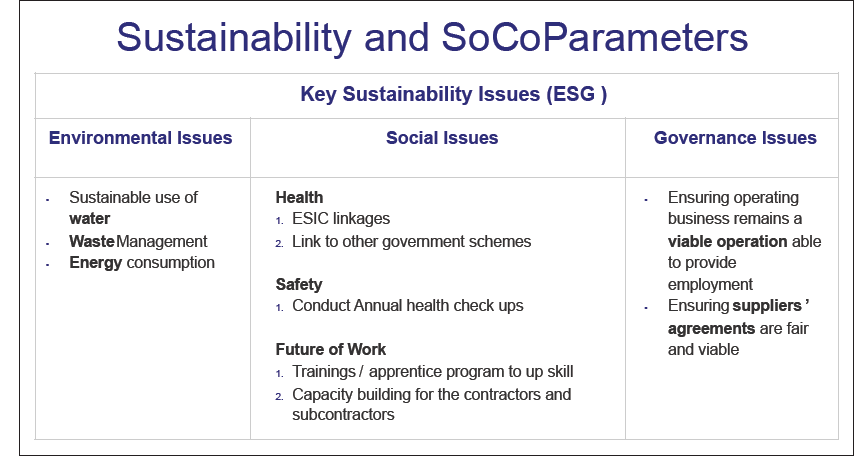
PILOT APPROACH AND DRIVING AWARENESS WITHIN THE SUPPLY CHAIN
Forbes Marshall is working on an end-to-end enablement approach to support strong worker practices across its supply chain. The enablement approach drives greater awareness among supply chain partners and moves towards the implementation support and policy updates. Forbes Marshall is currently enabling a pilot batch of eight supply chain partners with strong existing relationships. This pilot batch will allow Forbes Marshall to test solutions and get quick feedback before approaching more partners in its supply chain.
As part of its efforts in driving awareness, Forbes Marshall began with training for its pilot supply chain partners. The training will cover a range of topics such as safety and quality, leading to improvement in their productivity.
Forbes Marshall also held a follow-up session with the eight partners, specifically on supply chain sustainability, leveraging the ESG framework to discuss overall expectations as shown in Figure 17. The session covered environmental and governance issues while keeping ‘social’ as the key focus of the discussion.
In Forbes Marshall’s experience, driving awareness and facilitating dialogue among supply chain partners is critical to help the supply chain partners feel included in the process of change. This eventually assists the company in defining effective and relevant supply chain policies and codes of conduct. While Forbes Marshall continues to engage with the eight pilot supply chain partners, its teams are in the process of gathering data for the next set of supply chain partners to be brought into the scope of these social sustainability efforts.
ENABLING CHANGE WITHIN SUPPLY CHAINS VIA FACILITATED ACCESS TO SOLUTIONS
Forbes Marshall is enabling supply chain partners through multiple solutions to ensure dignity and equity for informal workers. The company launched a WFC in partnership with TATA AutoComp and Aajeevika Bureau in the Chakan (Pune) area, which has about 250,000 workers. TATA AutoComp is India’s leading automotive components conglomerates, while Aajeevika Bureau is a prominent Indian NGO committed to combatting the challenges faced by India’s informal and migrant workforce. The WFC is being offered to other companies, supply chain partners, and directly to communities to enable access to key government entitlements such as identity proofs, financial inclusion, government schemes, and worker registration. The WFC is also available via a mobile model so that peer companies, vendors, and other partners can provide these entitlements to their workers.
Forbes Marshall is driving greater ESIC compliance among its vendors. The ESIC is applicable for employers with 10 or more workers and provides many tangible benefits to workers earning less than ₹ 21,000 per month (or ₹ 25,000 for people with disability).
Annual health check-up is another area that Forbes Marshall enables for its partners. Often health issues that the workers face go undetected due to a lack of preventive measures to ensure annual health check-ups for workers. Forbes Marshall is proposing a way to cover this as part of its annual audit and checks. While the check-ups are done as per statute, the tests will be done under advisement from the in-house doctor such that it has a wide coverage of preventive measures.
As part of managing the pandemic, Forbes Marshall has delivered over 10,000 vaccination shots, covering its members, families, associates, and community by running an in-house registered vaccination centre.
The company also extended the vaccination drive to critical supply chain partners, helping them ensure continued and safe working conditions for their workers.
The initiatives listed are a few that Forbes Marshall has already implemented on the ground. The company will continue to expand its breadth and reach of solutions.
NEED FOR SUPPORTING SOLUTION AND DRIVING COLLABORATION
Forbes Marshall believes firmly in the power of driving collaborative solutions. The WFC in Chakan (Pune) was launched in partnership with TATA AutoComp and Aajeevika Bureau.The partners play synergistic roles. Forbes Marshall has a strong base and community relationships in the Chakan (Pune) area. TATA AutoComp enables risk-sharing and greater reach via a mobile facilitation model. Aajeevika Bureau is bringing its rich understanding and experience of working with workers on the ground to ensure the voice of the worker.
Similarly, for ESIC, Forbes Marshall worked with Safe in India—an organization with rich experience in ensuring successful adoption and implementation of ESIC—to carry out an awareness session for more than 50 vendors of Forbes Marshall.
Collaboration allows for sharing risks, economies of scale, shared learnings, and greater reach and impact as partners bring in their own unique capabilities, strengths, and resources to drive change.
LAYING THE FOUNDATION FOR CHANGE THROUGH AN INTEGRATED TRACKING MECHANISM
Forbes Marshall has introduced a tracking mechanism that measures the monthly progress of the eight pilots on the identified areas under the Social Compact. The tracker includes information across social parameters, employee health and safety, and the environment (Figure 18).
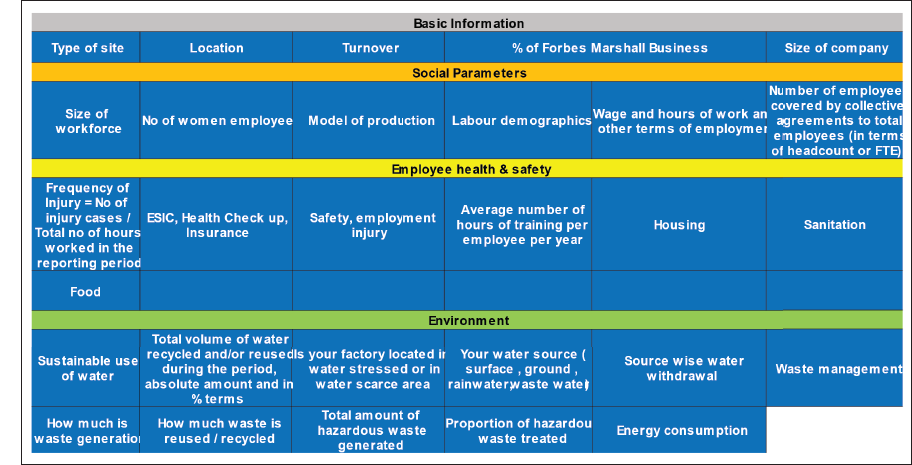
The goal of the pilot is for supply chain partners to continuously improve on the focus areas shown in Figure 19 through regular reporting and course corrections. Following the pilot, the goal is to expand the reach of the Social Compact measures to cover a significant proportion of Forbes Marshall’s supply chain.
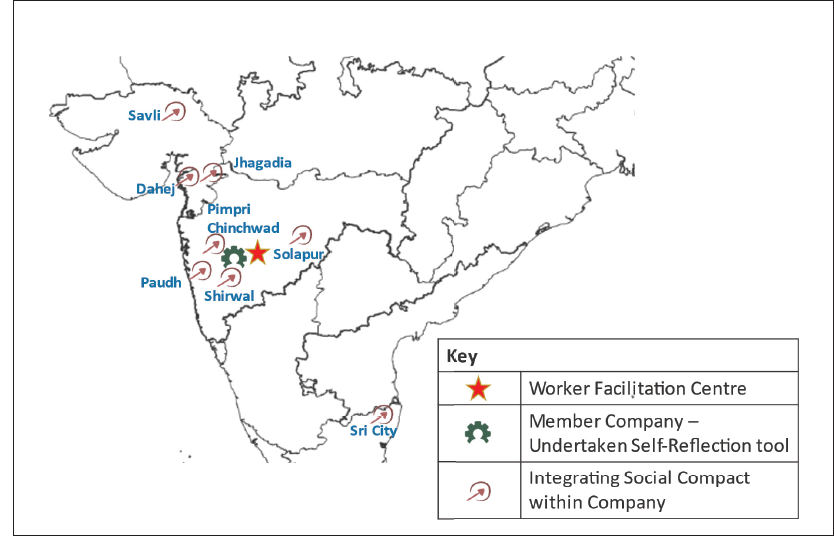
CONCLUSION
As companies face greater expectations from regulations, investor markets and clients, driving positive change within company supply chains is likely to become a critical priority in the immediate future. Companies can make significant progress by enabling their supply chain partners with awareness, guidance, and implementation enablement. Strong monitoring mechanisms should be put into place by companies to track progress across supply chain partners on key social indicators and support continuous improvement of worker practices across the chain. Solutions aimed at better worker conditions can be devised, funded and implemented collaboratively to lower costs, ensure cross-learnings, and eventually achieve greater impact for informal workers.
The ESG paradigm is gaining greater traction globally. The world, including India, is becoming more thoughtful towards the environment. However, it took a pandemic to push India towards acknowledging the social inclusion aspect of ESG—understanding the vulnerability of its over 200 million industry engaged informal workers. Many of these informal workers were left stranded without work, money, and homes overnight after the first lockdown was declared in March 2020. Men, women, and children were forced to walk thousands of miles to their villages and hometowns, to escape the starvation and uncertainty offered by their cities of work.
Seen in the form of an exodus, these people were visible for the first time. It begged a deeper look into who they were and what underlay their extreme vulnerability. The following facts came to light: 85% of India’s non-agrarian workers are informally engaged often with no written contracts and without local documentation to establish their identity in the city, making them untraceable, invisible, and therefore, ineligible for public schemes. They are not entitled to the PDS—hence, no ration, public housing, public healthcare, and local voting rights. They are exposed to grave risks of injury and accidents at work. There is a high occurrence of tuberculosis among them. Nearly half of their meagre earnings are spent just on food and fuel; the rest is sent home to their families. With low wages, they are in constant debt and at risk of becoming bonded. They are largely from Dalit and Adivasi communities and are also, therefore, widely victimized based on their caste and class.
This has long been the status quo in India’s leading cities, cities that offer extreme privilege and extreme poverty to different parts of the population. The pandemic only brought it to the surface and pushed some business leaders to challenge this status quo in their company ecosystem, taking a concrete step forward to make life more equitable, dignified, safer, and humane for their labour force—whether they are permanent or on contract, contractors’ workers at the company’s manufacturing and customer sites, or workers of vendors and channel partners who largely depend on the principal company and can be influenced to take affirmative action for their informal workers.
An initiative called the ‘Social Compact’ was conceived to realize this vision in partnership with an NGO, Dasra, and other like-minded corporates across Mumbai, Pune, and Ahmedabad. Dasra brought together unlikely partners, and in a rare setting, corporates are working with Aajeevika Bureau and CSJ—NGOs who have provided services and support to vulnerable workers for decades—to co-solution for informal workers engaged within industry. In September 2020, the Social Compact kicked off with the ambition of ensuring greater dignity and equity for industry-engaged informal workers and to mainstream the aspiration that in the long run, a responsible business equals successful business.
A JOURNEY OF SELF-REFLECTION TO REMEDIAL ACTION
The Social Compact is a self-driven journey by companies committing to ensuring a set of standards for their workforce, irrespective of their formal or informal status. The Social Compact focuses on six critical outcomes that underpin the vulnerability of informally engaged workers. This includes the following:
Wages, not just minimum but living wages that enable a life of dignity for all informal workers and their families. Health, social security cover, and grievance redressal mechanisms to enable these informal workers and their families to weather a crisis with dignity and adequate support. Maximizing safety as per the type of work rather than the type of engagement to protect informal workers equally against occupational hazards and risks. Gender equality in pay, treatment as well as opportunities for women, even those informally engaged. Facilitating workers’ access to government entitlements they are eligible for but are unable to access or use, such as E-Shram registration, functional Aadhar card, Ayushman Bharat, and other schemes meant to offer support to these workers. Future of work which not only emphasizes on the white-collar workers but which also extends upskilling, reskilling, and growth opportunities to blue-collar and informal workers as well.
Thermax is among the companies that have undertaken the Social Compact journey. It started with a reflection tool that converts the outcomes mentioned above into 30-standards. This allows the company headquarters (HQ) to map the maturity of its worker practices along each standard, for its fixed-term workers, and what it knows about the maturity of practices followed for contractual and supply chain workers. Aajeevika Bureau then visited two of Thermax’s factory sites, two customer sites, and seven vendors, and had detailed discussions with workers and management on these sites to corroborate the HQ’s self-mapping with on-ground findings. Key findings included the following: While safety at all Thermax sites was very high, the instructions were written in English on the factory floor. At one location, the contractor had not issued formal appointment letters, and the workers were getting compensated for overtime at the same 8-hours wage rate and the mandated double. On few of the sites, women were facing issues that even the women leaders would not have anticipated when they visited these sites. For instance, one site had two women workers but no separate toilet for them; on another, no maternity leave was being provided, and if a woman got pregnant, she had to leave the job. Creche facilities and sanitary napkins on-site were recurring gaps across units. In short, it was an eye-opener!
IT NEEDS TO START AT THE TOP
Many years ago, the Board had decided to focus on safety since Thermax was growing rapidly and took on a number of projects at various sites. In the past, only one accident that led to death was brought to the Board. But once safety overall was prioritized, every Board meeting started with a presentation on safety; every accident and near miss was reported to the Board, with the intent to discuss learning and how it could have been avoided in the first place. ‘Even though pulling up safety meant a higher investment, in the long run, a responsible business continues as a successful business.
Thermax intends to replicate this approach to integrate the Social Compact into its business as usual. While the Social Compact started with the family, findings of the reflection journey were taken to the managing director (MD) & chief executive officer (CEO) and the Board, to enlist their buy in for integrating the Social Compact standards across its business units (BUs) nation wide. Then came the challenge of actually integrating the Social Compact. It was clear that unlike safety, wherein people had no choice but to follow a very disciplined approach, the Social Compact movement could only be mandated along with autonomy to the BUs on undertaking and planning its implementation. Only if people truly believed that every human being has the right to a dignified and equitable life will this movement be co-owned, well-integrated, and sustainable within the company’s daily run.
GIVING MANDATE ALONG WITH AUTONOMY IS KEY TO MAKING THIS EVERYONE’S MISSION
Fortunately, it did not take the family and the MD & CEO very long to create a buy-in across Thermax’s strategic business units (SBUs), heads of business, human resources (HR), industrial relations (IR), supply chain, and quality personnel. Given this collective buy in, a cross-level team was created to integrate the Social Compact into business as usual, with the autonomy to decide what they wanted to prioritize for immediate action.
The Social Compact standards for four outcomes—wages, safety, social security, and gender equality—were prioritized for immediate integration across all BUs of Thermax, its eight factories, and multiple sites (Figure 19). All BU heads and factory leads were oriented to a common planning and tracking mechanism to ensure progress on these standards, and convened together in their first progress update meeting with the leadership in September 2021.
INDIVIDUAL OWNERSHIP, SHARED LEARNING
Thermax has instituted a meeting of all BUs every 90 days to report back progress on prioritized Social Compact standards, identified gap areas, and action plans to address these. The progress update is not done in silos, but in a collective meeting including the company leadership, Thermax Social Compact team, and all BU owners. The set up not only triggers healthy competition amongst Thermax’s BUs, but also leads to cross sharing of challenges, replicable ideas to address these and of common resources and services that can be leveraged by the company’s BUs towards the shared mission.
NOT JUST THE RIGHT THING TO DO, SOCIAL COMPACT MAKES BUSINESS SENSE
One of the first points of resistance to any sustainable business practice is the argument of increased cost, reduced profits, and a threat to the business’ viability. Having lived through this change once, Thermax can confidently argue otherwise.
About 12 years ago, Thermax decided to start a business that sells ‘green steam’ instead of selling a boiler. This was a build, own, operate (BOO) model wherein Thermax would need to engineer the plant, invest the money, and operate and maintain the product in the customer’s premises, selling steam as a service to the customer for over 10, 15 or 20 years. Since it wasdecided that the subsidiary, Thermax Onsite Energy Services Limited (TOESL), would sell only ‘green steam’, the management felt it would limit the growth and possibly the profitability of the subsidiary. The Board was also divided.
They had a choice to keep it green or allow fossil fuels to be introduced wherein the growth may have been significantly higher and highly profitable. However, few Board members believed that they had a responsibility to the planet and future generations, and were keen that any capital expenditure on their books should be green. Hence, they finally decided that they would embark on this path even if growth was limited. It did take time and patience for growth to pick up; TOESL did lose out on many opportunities that needed inclusion of coal. However today, after 10 years, the world is changing; customers are keen to decarbonize and are looking at companies like Thermax to be their partners in energy transition. Today, TOESL is growing significantly, with a decent return on investment, and remains focused on green solutions. It is a win-win for customers, the environment, and Thermax. As the ex-chairman & managing director (CMD) of Thermax, Mr Aga strongly believed and practised that ‘profit is not just a set of figures, but of values’.
BELIEVE, RESOLVE, ACT, PERSEVERE
It has been written somewhere that business has to be based on growth and profits, else it will die. But if business is solely based on growth and profits, then also it shall die for it no longer has a reason for its existence.
Just as investing in the environment saves the planet and future generations, investing in the well-being, resilience and growth of those contributing to business along the chain, serves both purpose and profit. It is essential to recognize the role of ‘S’ in ESG and incorporate changes to adopt it. Thermax has commenced this journey with a few others—we look forward to collaborate, learn, and share this experience with others.
Real estate development is a resource-intensive enterprise accounting for nearly 40% of the world’s energy consumption, 30% of raw material use, and 33% of the related global greenhouse gas (GHG) emissions. 182 Real estate is the second-largest source of employment in India, significantly impacting livelihoods and lives. The sector, therefore, requires an integrated sustainability approach to address ESG parameters. GPL has set up a comprehensive sustainability framework across ‘people, processes, partnerships, product, profit, and planet’ to focus on ESG goals including emissions, water, waste, diversity, human rights, compliance, health, and safety that have the potential to translate to meaningful industry and countrywide positive impact.
ESG focus is fairly advanced in developed markets and is becoming increasingly relevant in India. Major global investors are looking at ESG indicators. There is also a focus on UN Principles for Responsible Investment (UNPRI), which is showing increased adoption with 26% more investor signatories in 2021. Several sector-specific benchmarks such as the GRESB for real estate are also helping companies establish ESG strategies and demonstrate consistent improvement. Specific to real estate, there has been a shift in investor focus to asset classes such as commercial/office realty, especially regarding funding with several funds (foreign direct investors, institutional investors, etc.), evaluating ESG as base hygiene during their diligence process before capital deployment. Expanding the overview of company performance beyond financial returns to include ESG parameters allows for a more holistic assessment of sustainable business growth. Incorporating ESG goals into the business value chain is the right and responsible thing to do. This does not contradict business viability, rather it sustains and enhances it in the longer term.
The CRISIL ESG India report 2021 states that the Nifty ESG 100 Index surpassed the Nifty 100 Index for all periods analysed between April 2011 and March 2021, demonstrating that Indian sustainable businesses have performed better than their peers in terms of financial performance. The same report shows that companies are now turning their attention to the ‘S’ component of ESG, especially in light of the pandemic where many social issues have been brought into sharp focus. The ‘social’ component of ESG evaluation has a strong bearing on employee and worker practices, particularly diversity, safety, treatment of families, compliance to laws, entitlements, social protection supply chain alignment, and worker communities, among others.
GPL has set up performance-linked ESG goals cascaded from the C-suite to all functions across companies with robust internal dashboards instituted to measure progress. GPL ensures independent assurance and public disclosure of all ESG data. It has focused on setting up and securing ISO certifications to strengthen sustainability performance beyond mere initiatives. GPL’s ESG committee has a forward-looking approach that is necessary to address complex challenges such as climate change risks, supply chain integration, and social protection for an informal workforce.
Specific to the social indicators within the ESG framework for real estate, it is vital to ensure the health, well-being, upskilling, and livelihoods of construction workers. Enabling access to entitlements and social protections can address gaps in the informal construction worker ecosystem highlighted in these COVID times to ensure that the sector moves from a secondary source of income to primary employment of choice. GPL believes that a socially responsible business is a successful one, and the workers are a big part of that responsibility. While workers are brought on board by GPL’s contractor partners, the endeavour is to ensure that the working and living conditions uphold human dignity. From an industry perspective, GPL’s investments are made in skilled and unskilled construction workers to strengthen their capabilities/income potential and contribute to a future-ready workforce. With over 20,000 workers across 39 operational sites, GPL’s workers are significant contributors to the company working on the front lines within construction sites. Given their significant contribution, worker strength is one of the proxies for operational productivity across the organization, with daily site reports reviewed to monitor progress and project health. To integrate worker welfare across GPL’s processes, a tiered system has been set up to strengthen compliance, widen the ambit of governance, and extend GPL’s impact beyond its workforce through social protection programmes.
On the compliance front, GPL’s general conditions of the contract have been strengthened to integrate all applicable labour laws for the informal workforce along with robust mechanisms to audit these across sites. Governance measures include integration of worker welfare as part of the Environmental Management System (EMS) and Occupational Health and Safety Management System (OHSMS) audits for workplace conditions including sites, particularly labour camps, creches, and access to schooling for children with worker parents. Worker entitlements and social protection programmes are a core focus for GPL’s CSR programmes expanding impact beyond operational sites.
GPL recently collaborated with Dasra, a leading Indian strategic philanthropy-focused NGO, to commission a report that brings forth the realities of informally engaged workers in the construction sector. The report highlighted five cornerstones
183
for stakeholders for ensuring an equitable future for workers:
Improve data collection and integration across workers’ migration corridors and value chains to enable greater visibility and security Enable financial, social, and legal protection by securing requisite identity proof and worker registration Create expectation alignment for workers through a channel informed by industry demand Ensure gender equity in opportunities, working conditions, and wages through inclusive policies and practice Empower construction workers’ families and communities by access to diverse livelihood opportunities to prevent distress led entry into the sector
Specific to the learnings from this report and in reference to the welfare of migrant workers, some key actionable points
184
have been identified, and work has been initiated on these:
Improve on-site responsibility: Undertake greater oversight of working conditions on site, including routine visits or reports to senior management, for maintaining workplace safety and an overall healthy environment. Promote digital modes of payments: Enable payments through bank accounts as the first step towards financial inclusion that eventually leads to economic security, access to formal credit, and utilization of other products like insurance. Institutionalize measures to create gender equity: Enforce policies of equal pay for equal work, activate targeted behaviour change communication regarding gender equity and champion the same within supply chains, and address practical needs of women to boost participation of women in the workforce Introduce robust and stringent subcontracting policies: Instil better checks and balances while hiring contractors to ensure prescribed standards of minimum wages (including timely payment cycles), fair treatment, health and safety measures are met. Support implementation of government measures: Mandate registration of all workers on the site—facilitated through awareness generation measures—enable access to entitlements, and aid in decoding legal processes and requirements. Facilitate data collection: Create and share worker databases with peers in the same region/geography to build a repository of profiles that can be used to facilitate registrations, match with future opportunities, and build a legitimate work history that enables upward mobility. Create a level playing field: Leverage the voice and influence of industry associations/bodies to enable systemic improvements that incentivize the adoption of improved worker practices within the entire ecosystem to ensure that responsible businesses continue to thrive as successful ones.
GPL is also a part of the Social Compact, a multi-stakeholder initiative, that brings together non-profits, industry organizations, industry associations, experts, and civil society in India towards driving more socially sustainable practices across the value chains of businesses. The Social Compact provides a framework, arrived at through months of diverse industry consultations, to help companies identify potential gaps and blind spots in worker practices. It consists of 6 outcomes further detailed into 30 standards. GPL’s participation in the Social Compact highlighted several areas of intervention allowing for the strengthening of its ‘social’ dashboards. This included bifurcating data of workers into resident labour camps and day workers enabling the setting up of targeted programmes for each cohort.
The Social Compact standards helped identify focus areas for worker welfare. To facilitate adoption by a wider set of industry peers, the GPL team worked in tandem with the Social Compact team to map the 30 standards to both Indian legal and global ESG frameworks. Through this exercise, worker practices were evaluated against the new labour codes, ILO, SA8000, GRI, and GRESB.
For GPL, health and safety, and wage practices emerged as areas of strength. Health and safety can be attributed to requirements for the contractors to follow stringent ISO mandates—ISO18001 (Occupational Health and Safety Assessment Series) and ISO 45001 (Occupational Health & Safety Management System).
Additionally, two focus areas emerged from the assessment: gender equity and skilling. Women workers form a very small percentage of GPL’s current worker base. Currently, an exercise to map labour participation, attendance records, and BOCW registrations by gender is being undertaken and insights will be used to work towards improving gender participation and ensuring equity for women workers. GPL is also deeply committed to mapping, recognizing, and strengthening worker skilling.
As one of the employers of India’s 50 million-strong construction workers, business leaders must take greater responsibility for worker practices in their ecosystem, acknowledge the criticality of this workforce, and uphold the highest standards of workers’ well-being in a way that enables socially responsible businesses to continue as viable and successful ones. The pandemic has afforded a unique opportunity to reset existing practices to those that befit an industry of the future, one that places workers’ well-being at the core of resilient/sustainable business. GPL is committed to playing a role in fulfilling this aspiration.
In a world where we typically see men at the helm of businesses, the young women leaders of K. K. Nag Private Limited, Gits Food Products Private Limited, and Papa Don’t Preach are trailblazers. They are trying to make a difference not only through their products and services but also through the kind of ecosystems they create for their workers. Keen on ensuring the well-being of all their workers, these women leaders and their companies have joined the Social Compact to adopt a holistic set of outcomes—which includes wages, health, safety, gender, access to entitlements and future of work—to ensure that vision and to undertake this journey alongside like-minded companies who want the future of work and business to be aligned in India’s future story. While their companies span the diverse sectors of manufacturing plastics, food, and fashion, this article brings together their perspectives on social sustainability in businesses and the need and joy of embracing such a mission as young business leaders in a position of influence.
K. K. NAG PRIVATE LIMITED
K. K. Nag Private Limited is a plastic processing company, a pioneer in the field in India for more than half a century. The company established as a family business has expanded its operations to Pune, Chennai, and Puducherry. In recent years, the family’s youngest generation has started leading operations in management and sustainability.
The company believes that business owners are equally responsible for the well-being of their employees and their families. This also includes their blue-collar and contract workers, which the industry often neglects.
K. K. Nag Private Limited has been involved with the Social Compact since the pilot phase of the initiative to identify gaps within their system, co-create solutions to take corrective measures, and understand and learn the best practices in the industry. The company understands the value of social sustainability and believes that the Social Compact has the potential to impact millions of lives by guiding businesses towards a future that is safer, healthier, and value-adding for all while helping businesses continue on the path of growth and sustained profits. From a leadership perspective, the Social Compact accelerates the following key business goals for the company:
Inclusive expansion across India
The vision for K. K. Nag Private Limited is to grow its business pan-India. It currently has a strong presence in the western and southern regions, however, it has not ventured north. Being part of the Social Compact will ensure that when the company plans to expand, it can do so in an inclusive manner. Its standardized rules and policies, in line with the Social Compact standards, ensure high working standards for all its permanent and contract labour. Informal workers are the foundation of any manufacturing business, and with their needs taken care of, it will be much easier to establish new locations and grow the business.
Entering global markets
The company is also looking to expand to global markets, a mammoth undertaking. In developed economies, the policies are standardized, more stringent, and need to be adhered to, without compromise. This is specifically applicable to labour policies because developed economies have a higher standard of living, which extends to the workplace. Mapping the maturity of the company’s informal worker practices against the holistic human-centric outcomes offered by the Social Compact has emboldened the company’s confidence and given a robust foundation for its expansion into foreign territories, which are increasingly emphasizing on ESG within the business, and going beyond the focus on environment alone, to also speak of social inclusion within business chains.
Bring in gender representation and parity in workforce
Social Compact also pushes the business to look beyond its immediate people and their needs to prepare itself for greater diversity. The huge disparity in gender representation in the manufacturing industry is attributed to the extremely labour-intensive nature of work in the earlier times when technology was not so advanced, and to the gender roles that emerged through it in a patriarchal society. With major developments in technology, the work is not always very physically demanding. There is a need to bring in a mindset change in the industry to become more inclusive of female workers and have gender-responsive policies.
This is also a quest for K. K. Nag Private Limited. The Social Compact pushed the company to acknowledge the limited representation of women in the workforce and think about potential reasons behind it by mapping the company on the outcome of gender parity. More importantly, through various practices outlined for achieving this outcome, the Social Compact helped K. K. Nag Private Limited understand what it needs to ensure as it prepares for more women among its workers, through formal or informal engagement, thereby not only improving gender representation but also ensuring a safe, equal, and supportive work environment for them.
GITS
Gits, a well-known food manufacturing brand is now led by the third generation of the family. The company is unique because females constitute 98% of its workforce. Gits has been a champion for these women through various initiatives over the years. The company’s values are based on a moral and ethical obligation towards the well-being of their employees and the society at large. Taking this value system a step further, the young leadership is keen to explore avenues through the Social Compact for more efficient implementation of initiatives for their workers.
Responding to a women-centric workforce
Even before joining the Social Compact, Gits had already integrated the Social Compact’s outcome for gender parity into its business practice. Typically, work in the food industry requires a lot of attention to detail, and Gits from its experience have felt that women are more attuned to the nature of such work. However, female workers in the manufacturing sector face challenges that are unique, and this requires business leadership to rethink business practices. For instance, it is a widespread practice to pay salaries to workers through bank accounts. However, this idea is challenged by the fact that many women do not have individual bank accounts or share an account with the family. It, therefore, becomes difficult to exercise autonomy over the bank account. There are also cases of women whose husbands are unemployed or alcoholics and often assert control over the family’s finances for personal expenses. To solve this, Gits has been helping these women by opening bank accounts in their names and linking them with ESIC and PF schemes to fostera sense of financial autonomy.
As women tend to face the double burden of domestic labour, the company has been responsive in supporting the needs of these women and have undertaken various such initiatives to empower them. The leadership at Gits believes they must seek out more through the Social Compact and be the ultimate champions for women working in the manufacturing sector. They are also keen to institutionalize these through the Social Compact and support systems to make more transparent and accessible to every woman in their workforce.
Participating in a community of practice
Gits has woven gender-responsive initiatives into their business practices. They strongly believe that these initiatives are not very tough to bring about. The company is happy to share their best practices with other companies through the Social Compact, motivate and take them along in their journey. They also realize the value that their peer companies can bring to the table and are keen to learn from their practices and achievements.
Uplifting the ecosystem
The young leaders of Gits believe that it is their responsibility to be the change-makers. The Social Compact is an information and implementation agency by nature and offers the capacity building support to bring in change effectively. Gits wants to push the envelope, and the Social Compact provides the handholding support in doing so. Joining the initiative is a step in the right direction as when companies make their involvement publicly known, it becomes a point of no return on this challenging yet necessary mission.
PAPA DON’T PREACH
Papa Don’t Preach is a luxury fashion brand based in Mumbai. The company is—only a decade old and with a team mainly under the age of 35, making it the youngest company to join the Social Compact. In a decade of its existence, the brand continues to grow in popularity, especially among Indian youth nationally and internationally. The company has undergone massive expansion in the past few months. With growing size, the leadership feels a growing responsibility to look after the well-being of their karigars who are essentially the backbone of the company.
Improving understanding of labour-related compliance
One of the primary motives for Papa Don’t Preach to join the Social Compact was to seek guidance and expertise with regard to Indian labour laws. The company’s blue-collared workers, that is, their karigars are on permanent payroll. However, being a young fashion company, their team is looking to fill the knowledge gap in labour-related compliance for their karigars. With the expansion underway, the team wants to be equipped with the knowledge and tools for creating a sustainable and safe working environment for the karigars. The Social Compact is helping them in identifying blind spots, co-creating internal policies, and rules to ensure high standards of working for the karigars along with strengthening the team and the processes to ensure its implementation, impact, monitoring, and continuity.
Empowering ‘karigars’
While the company’s karigars are on-roll employees, most of them are migrants from outside Mumbai. When the pandemic hit in 2020, the importance of having job security became even more apparent for these workers. Even though the company suffered a lot financially, the management retained the workforce and supported the karigars and their families by paying at least half their salaries at least half their salaries during early months of the lockdown. However, there was a realization that this was not the case for many others who were migrant workers or informally engaged. Most of them, especially those engaged in businesses that struggled to sustain during the lockdown, did not have anyone to look after them.
The company wants to prevent their karigars from falling through the cracks in the system and equip the workers with knowledge and resources to face any such challenges in the future. Through the Social Compact, they want to link their karigars with basic entitlements and government schemes. At the same time, the company also wants to undertake initiatives to upskill their workers through learning programmes for their own departments and other organizational and financial skills so that they have greater mobility to undertake various roles in their careers.
The team also sees value in rewarding the hard work of their karigars as it also keeps the morale high, instils team spirit, and improves productivity. Small traditions such as monthly biryani days, birthdays, and festival celebrations are often exciting for workers and help bridge the bond between the workers and the management, often not seen in other companies.
Integrating sustainability into business
Apparel, accessories, and footwear is at present number one in the e-commerce sector in the world, worth over $700 billion. It is also one of the top five polluting industries globally with a concerning low standard of working specifically in the developing and underdeveloped countries. It is also important to acknowledge that the fashion/garment industry is very exploitative in India and many other South Asian countries due to a lack of transparency between brands and supply chains.
The team at Papa Don’t Preach believes in the value of sustainability and wants to take steps in the right direction to be truly future-ready. Besides undertaking initiatives for environmental sustainability by sourcing vegan and sustainable materials, the company is also keen to explore social sustainability through the Social Compact. One of the realizations for the company through the Social Compact was lack of women representation in their blue-collared workforce. During the first phase of their expansion, they have managed to create a new process within the production line, which is now run by 16 women workers. Their vision is to be a truly inclusive company, within their workforce and in their clientele and increase the transparency of their labour-related initiatives, even down to their supply chains. It is very important for Papa Don’t Preach that the process of manufacturing and retailing a product is wholesome and impactful for the end consumer while also driving changes within communities.
Redefining the aspiration
Having a young team has enabled Papa Don’t Preach to think out of the box and not be restricted by the industry’s typical way of working. Taking advantage of being a young company, they can also define high standards of business practices from the outset. Being responsible for their workers is a moral duty for the company. They also plan to take it a step further by benchmarking themselves against the Social Compact standards and developing a vision for holistic welfare programmes for their karigars. They want to set a strong example for their peers in the industry and inspire them to drive similar change within their companies and learn from others who are leading sustainable fashion initiatives of their own.
CONCLUSION
As a platform that emphasizes human-centric outcomes, the Social Compact has brought like-minded companies from diverse sectors into forming a community of practice that shares its vulnerabilities, risks, and learning on this common path to sustainable and inclusive business. As young leaders, there is significant interest in ensuring the business is future-ready, and it can be stated without doubt that a significant differentiator for Indian businesses in the future will not be their profit margins, but the value they create for all stakeholders, including those who toil for the business, even if informally. There is true value in the Indian industry defining the future of business in synergy with the future of work. The growing cadre of young leaders in the country have a significant role in voicing, seizing, and driving this aspiration for the country.