




Abstract

Keywords
Executive Summary
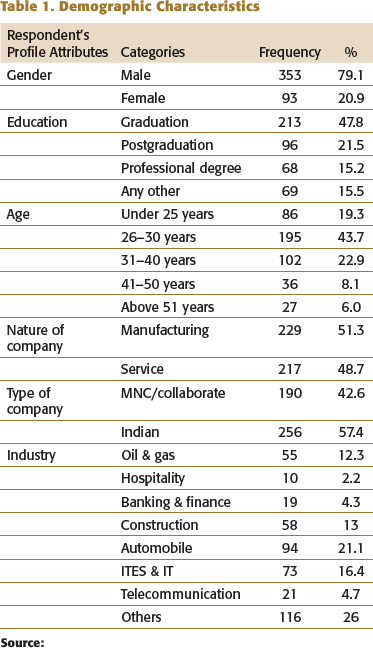
Considering the mounting expectations of socially responsible behaviour from contemporary organizations and consistent pressure from different stakeholders, estimating the possible outcomes of organizations’ corporate social responsibility (CSR) initiatives has become imperative. For organizations, it has become essential to be socially responsible and ensure that the employees positively perceive the organization’s CSR aspect. Therefore, the present study is an effort to examine the direct effect of employees’ perception towards CSR on organizational citizenship behaviour (OCB), and to also measure the indirect effect through organizational trust (OT). For theoretical foundation, the study relied upon social exchange theory, signalling theory and social identity theory. Data for the analysis was collected through convenience random sampling technique. The survey reached out to 446 employees of the service and manufacturing sector operating in India. To test the measurement and structural model, the partial least square based structural equation modelling (PLS-SEM) has been applied.
SEM results confirmed that employees’ perception of CSR positively and significantly affects OT and OCB. Moreover, the findings also observed that the relationship between CSR and OCB is partially mediated by OT. The study helps to develop a better understanding of CSR dynamics through stakeholders’ perspectives in shaping good citizenship behaviour among employees. The study demonstrates that organizations’ non-business social agenda creates a feeling of trust, leading to citizenship behaviour. These findings will motivate organizations to invest more in CSR activities. The management should ensure that all the employees are aware of the CSR activities of the organizations. It should also encourage the employees to show prosocial behaviour. Limitations and scope for future research have also been discussed.
Over the last decade, the significance of organizational citizenship behaviour (OCB) in organizational achievement and success is broadly acknowledged among researchers. Katz (1964) contended that organizational members should be encouraged to participate in the organization’s creative and prosocial activities for better organizational understanding. OCB is defined as ‘Employee’s voluntary activities that may or may not be rewarded, but that contribute to the organization by improving the overall function or quality of setting in which work takes place’ (Cha et al., 2013). By considering this notion, various studies in the past had empirically investigated the positive association between OCB and organizational performance (Nisar et al., 2014; Whitman et al., 2010). Further, researchers accept that employees’ engagement in prosocial behaviour is rooted by the reciprocity of norms and fairness in the organization (Chaudhary, 2020; MacKenziem et al., 1991). If the culture supports the social environment inside or outside the organization, it can strengthen the individual and organizational employees’ behaviour at the workplace. Therefore, management needs to adopt those ethical and socially responsible human resource practices that lead to positive behaviour amongst its employees. Corporate social responsibility (CSR) is one of the recognized practice that helps an organization to maximize its positive impact on employees by providing a diverse and inclusive environment at the workplace (Crowther & Capaldi, 2008).
Recently, the CSR construct has gained considerable attention in the field of management. CSR is a corporate commitment towards society; in other words, for organizations, it is a course of action to build a strong corporate culture and spread social awareness (Rupp et al., 2006). In the literature, the stakeholder perspective is a widely acknowledged theoretical framework to explain the concept of CSR (Vlachos et al., 2010). By concentrating on the stakeholder perspective, the current study embraces the definition of CSR given by Turker (2009, pp. 413–414), that ‘corporate behaviours that aim to affect stakeholders positively and that go beyond its economic interests’. CSR means taking care of the stakeholders of the organization, for example, employees, government, customers, suppliers, non-government organizations and shareholders. Due to the increasing pressure and demand from different stakeholders, CSR is gradually seen as a significant part of the firm-level strategy (Jones, 2010). Numerous organizations identify the need to find harmony between profitability and a positive image in society by focusing on social and environmental responsibility (Mozes et al., 2011).
India is a land of philanthropy and has followed CSR since ancient times. In the recent past, The Companies Act, 2013, has made it mandatory for companies to spend a certain amount on CSR activities. Unfortunately, not all organizations come under the mandatory clause because of low turnover and profitability. There has been very little research conducted on employees’ perception of CSR initiatives of their organizations. Therefore, studies in India on CSR in the human resource management (HRM) context are limited. So, while the authors have included a few available Indian studies (Chaudhary, 2020), the comparisons are primarily based on research from developed countries. Macro-level research, in which researchers endeavour to find the organizational outcome such as firm performance as a result of CSR activities performed at the firm level (Glavas, 2016), holds the majority of the literature on CSR studies. In recent times, researchers have begun to embrace a micro-level viewpoint concentrating on how CSR activities may impact the organization’s people, that is, employees (Morgeson et al., 2013). It seems apt because employees are the important stakeholders within an organization, and by satisfying employees’ desires, an organization can create and maintain long-term values (Hillman & Keim, 2001). Micro-level studies concentrated on employees have mainly focused on attitudinal outcomes of employees, for example, the higher level of commitment by employees (Brammer et al., 2007) and job satisfaction (Bauman & Skitka, 2012), overlooking the significant workplace behaviour. Studies looking into the strong relationship between CSR and employees’ behaviour are inadequate. Moreover, the existing CSR studies confirmed the direct relationship with its outcomes, ignoring the underlying mechanisms (Aguinis & Glavas, 2012). Therefore, we argue that organizational trust (OT) can be a possible mediator in the CSR outcome. In particular, we propose that (a) there exists a direct relationship between employees’ perception about CSR and OCB, and (b) OT mediates between CSR perception and OCB. The present study draws insight from social exchange theory, signalling theory and social identity theory in investigating these relations.
The following section of this article concentrates on the literature review and theoretical framework, followed by the methodology of the study, data analysis and results. Further, the study includes discussion, implications, limitations and future research directions, and finally concludes.
THEORETICAL FRAMEWORK AND LITERATURE REVIEW
CSR and OT
Researchers have identified that the organizations which ethically resolve social issues are generally trusted by their stakeholders (Hosmer, 1995). Trust is defined as ‘the willingness of a party to be vulnerable to the actions of another party based on the expectation that the other will perform a particular action irrespective of the ability to monitor or control that other party’ (Mayer et al., 1995, p. 712). The employees’ perception of CSR activities will probably affect their trust level, considering that CSR activities raise their self-image and self-confidence by adjusting individual personalities to their organization (Le et al., 2012). CSR perceptions of salespersons and OT are positively related (Vlachos et al., 2010). Further, a study by Le et al. (2012) identified that CSR dimensions positively affect hospitality industry employees.
The relationship between CSR and OT can be tested with the help of signalling theory. As per the signalling theory, CSR activities drive a positive signal about firms’ ethics and values, creating a positive perception among employees and strengthening their trust (Rupp et al., 2006). In support of this theory, a study suggested that a company taking part in a CSR programme act as a trustee for its stakeholders, including customers and employees, as these stakeholders give close consideration to the activities of the organization morally and ethically (Balmer et al., 2007; Dirks & Ferrin, 2001). In favour of this observation, Pivato et al. (2007, p. 3) additionally suggested that trust is the most immediate impact of CSR activities in terms of outcomes such as attitude, behaviour and financial performance. Based on the evidence, we frame the following hypotheses:
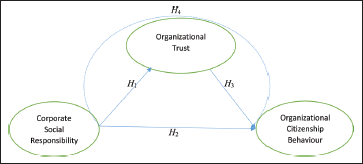
H1: CSR perception is positively related to organizational trust.
CSR and OCB
The concept of OCB is considered a multidimensional construct. Organ (1988) proposed five OCB dimensions such as altruism (helping others); civic virtue (attentive and proactive in organizational activities); conscientiousness (compliance with organizational law); courtesy (avoiding work problems and consulting others before taking action) and sportsmanship (not complaining about unimportant matters). The link between CSR and OCB can be confirmed using social exchange theory and social identity theory. According to the social exchange theory, employees’ reactions depend on reciprocity norms (Gouldner, 1960). The theory proposes that if organizations are serving stakeholders’ interest, including employees, it probably affects OCB among employees.
Furthermore, when employees discover a harmony between the firm’s CSR esteem and their own, the association becomes a target for them to identify with, as per social identity theory (Brammer et al., 2015). Lin et al. (2010) investigated that both perceived legal citizenship and ethical citizenship positively influenced the OCB of employees, while perceived discretionary citizenship negatively affected OCB. Azim et al. (2014) studied the relationship between external CSR and employees’ behaviour. The study highlighted that employees feel motivated and enthusiastic when organizations’ involvement in external CSR practices towards the community indirectly affects them. In terms of internal CSR, wages, training and development facility, and concern for health and safety directly influence employees’ behaviour, while procedures and policies indirectly affect employees’ behaviour (Zafar & Ali, 2016). Based on earlier studies, we frame the following hypotheses:
H2: Employees’ perception of CSR is positively related to OCB.
OT and OCB
Recently, organizational behaviour scholars have recommended that trust be considered an essential instrument through which the impact of CSR actions’ on employees’ behaviour can be seen. Social exchange theory (Blau, 1964) represents that OCB can motivate the employees to act in a way that is not strictly mandated by their employer (Rousseau & Parks, 1993). Researchers have discovered that OT is fundamental in encouraging participation within the organization, directed to enhance the behavioural and performance-related outcomes (Dirks & Ferrin, 2001; Kramer, 1999). According to researchers, CSR actions impart vital signs to employees about an organizations’ moral and ethical values and about how much it tends to be trusted (Rupp et al., 2006). Other studies also found a significant effect of trust on employees’ extra-role behaviours (Gould-Williams, 2003; Tyler & Blader, 2003). Thus, the study attempts to discover the relation between OT and OCB, and it frames the following hypotheses:
H3: OT is positively related to OCB.
CSR, OT and OCB
The existence of trust in an organization is essential in keeping long-term relationships (Morgan & Hunt, 1994). In an organization, trust is generally reflected by its ability to improve the performance and cooperation within and outside the organization by safeguarding stakeholders’ interest (Colquitt et al., 2007). One of the studies proposed that trust mediates between CSR and corporate reputation (Yadav et al., 2018). Even though existing studies have recognized that positive perception of CSR among employees subsequently builds trust in their association; few researchers thought that CSR’s effect on employees’ behaviour could be seen through the mediating role of OT (Hansen et al., 2011). Singh and Srivastava (2016) proposed that to better engage employees in OCB resulting in increased individual and organizational effectiveness, organizations should encourage procedures to prompt trust in the managers. Empirical results support that trust acts as a mediator between antecedents of trust and employees’ behavioural outcome (Colquitt et al., 2007; Dirks & Ferrin, 2001). Therefore, we frame the following hypotheses:
H4: Positive relationship between employees’ perception of CSR and OCB is mediated by OT.
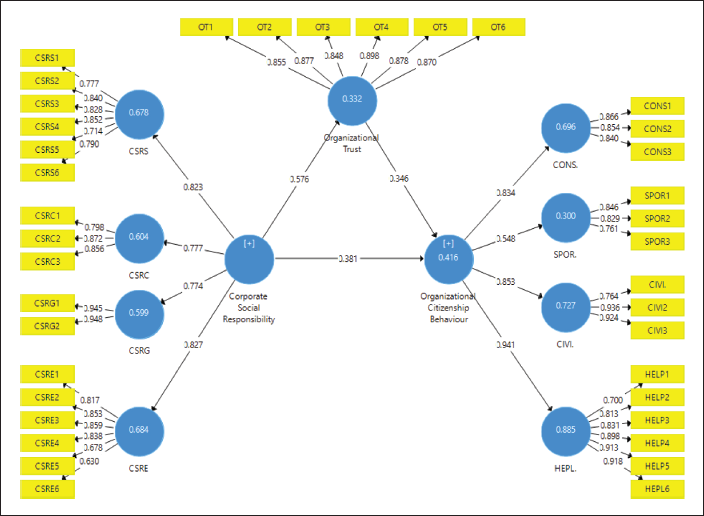
The proposed research model depicts the hypothesized relationships among the variables (Figure 1).
Proposed Research Model
METHODOLOGY
Sample and Procedure
Demographic Characteristics
Measurement
The present study measured all the constructs on a five-point Likert scale, where 1 stands for strongly disagree stands and 5 stands for strongly agree. The scale for measurement was adapted from the existing published literature. A total of 38 items for the study were divided into three sub-sections: CSR, OT and OCB.
This article uses a stakeholder-based approach to measure CSR perception suggested by Turker (2009). It includes 17 items grouped into four dimensions: social and non-social stakeholder, customer, employees and government. A sample item is ‘My company participates in activities which aim to protect and improve the quality of the natural environment’. We measured OT through six items adapted from Allen and Meyer (1990). A sample item is I believe my employer has high integrity’. OCB is measured by questions adapted from Podsakoff et al. (2000). The scale includes 15 items and four dimensions, namely, altruism, sportsmanship, conscientious and helping. A sample item is ‘I willingly help others who have work-related problems’.
DATA ANALYSIS AND RESULTS
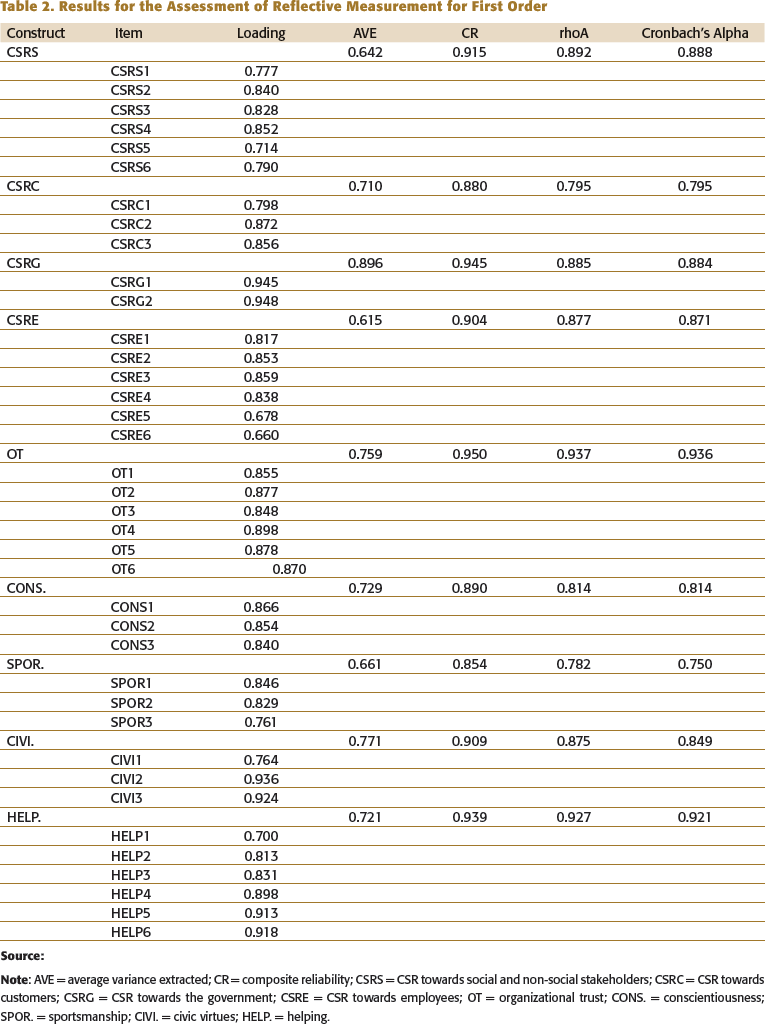
The study utilized the partial least square (PLS) method for data analysis using Smart PLS version 3.2.7 software. For the assessment of measurement and structural model, PLS-based structural equation modelling (PLS-SEM) was applied. The measurement model confirmed the relationship between the items and the unobserved latent variable; on the other hand, the structural model concentrated the hypothetical relationship between latent variables. As the study employed a second-order reflective-reflective model, the PLS-SEM approach is suitable for determining results for both the measurement and the structural models. Moreover, considering the hierarchical order model, Anderson and Gerbing (1988) suggested a two-stage approach. In the first stage, assessment of the first-order reflective construct of the measurement model was done through convergent validity, reliability and discriminant validity, and hypothesis testing to check whether the structural relationship is significant (Hair et al., 2014).
Measurement Model
Results for the Assessment of Reflective Measurement for First Order
Results for the Reflective Measurement for Second Order
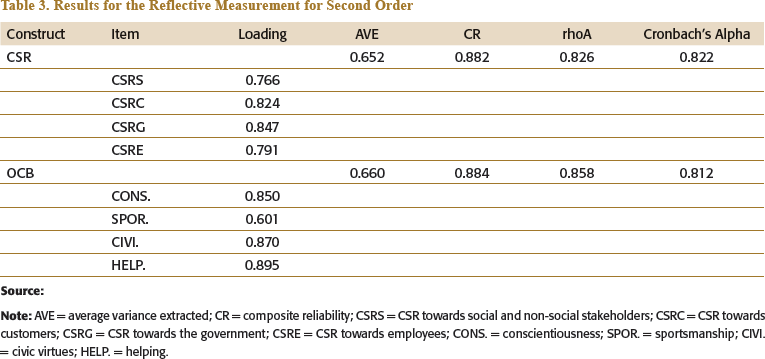
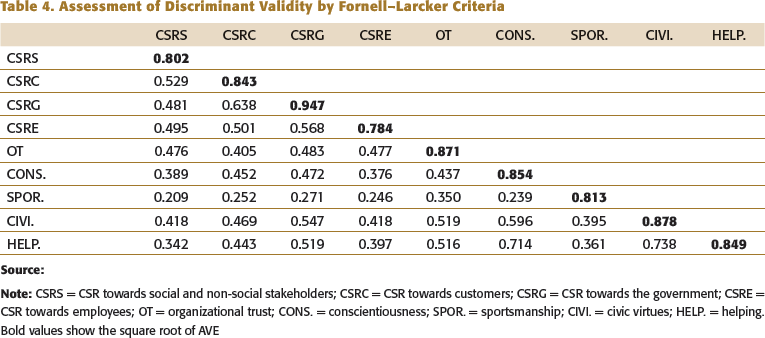
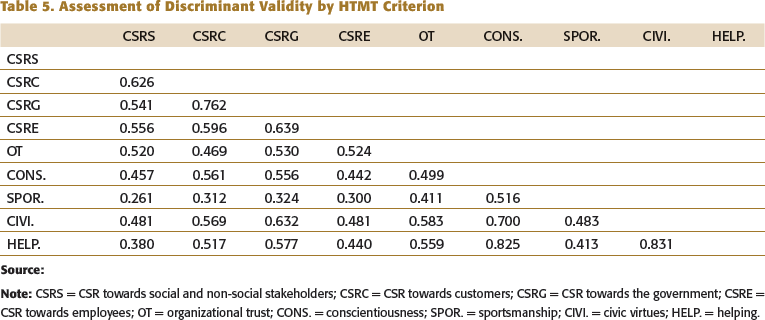
CR indicates the internal consistency of the latent construct estimated by Hoffmann and Birnbrich (2012). The score of CRs should be more than the suggested threshold value of 0.7 (Nunnally, 1978). Furthermore, each constructs’ AVE comes is between 0.615 and 0.896, surpassing the value of 0.5 recommended by Fornell and Larcker (1981). It has been observed from Tables 2 and 3 that the values of Cronbach’s alpha are also acceptable.
Assessment of Discriminant Validity by Fornell–Larcker Criteria
Assessment of Discriminant Validity by HTMT Criterion
Structural Model
Determination of Coefficient (R²), Adjusted R² and Predicative Relevance (Q)

In the structural model, the predictive relevance is assessed through Q²- Stone-Geisser. The blindfolding procedure has been applied to determine the value of Q². The recommended value of Q² for large, medium and small predictive relevance for the certain dependent construct should be 0.35, 0.15 and 0.02, respectively (Sarstedt et al., 2017). Table 6 shows that Q² values for OT and OCB are 0.242 and 0.285, respectively, representing strong predictive relevance.
In addition, F² is used to determine the effect size of latent variables on the dependent construct. And the recommended value of F² should be 0.02 for small, 0.15 for medium and 0.35 for large effect size (Cohen, 1988). Table 6 shows the value of F² for OT and OCB as 0.219 and 0.482, respectively, representing large effect size.
For model fitness, standardized root mean square (SRMR) recommended by Hair et al. (2017) has been used. In CB-SEM, the threshold value of SRMR for model fitness as recommended by Hu and Bentler (1998) is 0.08. As per the results, the value of SRMR is 0.055, which signifies a measure of a good fit.
Bootstrapping
Results of the Structural Model
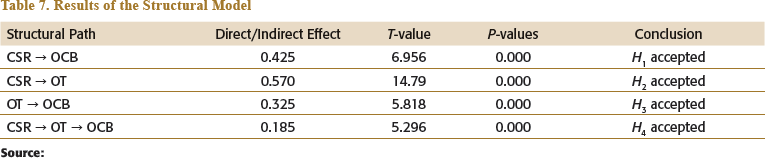
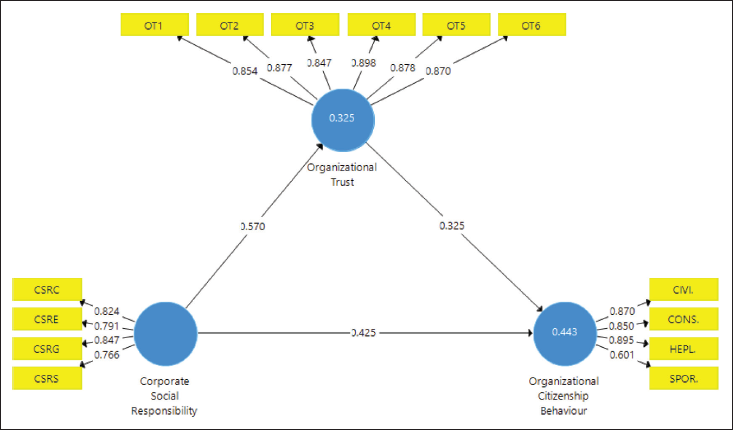
Mediation Analysis
The mediating role of OT or indirect effect on OCB was examined through bootstrapping technique with (5,000) resample technique. The result of mediation is provided in Table 7. As per Preacher and Hayes (2008), both direct and indirect effects were ensured to test the mediation effect in the model. The direct effect of CSR on OCB is resulted in b = 0.614, p = 0.000 and t-value = 13.985. After introducing the mediator in the model, the result is b = 0.425, p = 0.000 and t-value = 6.956, indicating that CSR decreases its influence on OCB. According to Hair et al. (2014), the variance accounted for (VAF) was calculated to determine the degree of indirect effect. In our study, the value determined after calculating VAF (total indirect effect/total effect) is 0.185/0.610 = 0.303. The result shows partial mediation because the value of 0.303 lies in the range between 0.20 and 0.80, as recommended by Hair et al. (2017). Thus, the fourth H4 is also supported.
DISCUSSION
The current study investigated the impact of employees’ perception of CSR and OT on OCB in different sectors such as automobile, ITES and IT, construction, and health and care in India. Empirical results show a positive relationship between CSR and OCB precisely, as suggested by other research studies (Azim et al., 2014; Zafar & Ali, 2016). Results implied that when an organization performs socially responsible activities, employees try to reciprocate it by engaging in good citizenship behaviour towards other individuals and organizations, thus supporting the social exchange theory. The results show the positive effect of CSR on OT. This is similar to the findings of past studies (Dirks & Ferrin, 2001; Balmer et al., 2007) where it was proposed that organizations undertaking CSR activities in their strategy work as a trustee for their employees. It also implies that CSR activities send signals about ethical and moral values to employees, thus supporting signalling theory.
In addition, the findings supported the argument that OT mediates the relationship between CSR and OCB. This implied that CSR activities create trust among employees, which further leads to OCB. These findings match some existing studies (Hansen et al., 2011; Singh & Srivastava, 2016).
IMPLICATIONS
The present study has theoretical as well as managerial implications. By investigating the influence of a firms’ CSR activity on employees’ prosocial behaviour and trust, the study tends to call for more micro-level research in the CSR area. Findings of the review paper (Jamali & Karam, 2018) revealed that merely 9% of existing CSR studies rely on individual-level analysis. CSR has been mainly discussed in the Western context. Therefore, the study contributes to the Indian literature by adding empirical evidence of CSR from the employees’ perspective. Moreover, the majority of studies in literature mainly exist around customers and investors’ perspectives. By applying PLS-SEM, more robust results of the proposed conceptual model are assessed.
Organizations need to be conscious of employees’ behaviours in reaction to the CSR activities. In India, the Companies Act, 2013, has made it mandatory for all companies to disclose their CSR activities. Organizations in India undertake CSR activities to improve the image in public and not as a business strategy. They participate in CSR activities by focusing on external stakeholders to establish and maintain good public relations. Our study suggests that organizations should focus on external stakeholder wellness and on employees’ interest to boost trust levels and citizenship behaviour among employees. The present study is likely to assist organizations and managers in bringing positive behaviour to the workplace and in strengthening the trust ties between employers and employees.
LIMITATION AND FUTURE RESEARCH DIRECTION
The present study is also not devoid of limitations similar to other empirical studies. First, cross-sectional data has been used in this study; future studies should focus more on longitudinal data. Second, the study has not included the moderator variable (boundary condition) that may strengthen or weaken the relationship between CSR, OT and OCB. Employees’ perception of CSR varies according to their personalities, demographics, etc. These variables can act as a moderator for future study. Third, another limitation of our study is that we used the Western scale to measure CSR (Turker, 2009). Future research should look out other dynamics of CSR in the Indian context. Fourth, we only tested the employees’ perception of CSR; managers’ perception about CSR can also be studied. Fifth, the stakeholder-based approach is used in the present study to measure employees’ CSR perception; future studies may utilize another conceptual framework for testing the proposed model, such as Carroll’s pyramid (Carroll, 1991). Future studies can also check the effect of various leadership styles on the CSR perception of employees.
CONCLUSION
Citizenship behaviour is thought to be an important indicator of high organizational achievement and success. The present study examines the effect of CSR activities on OCB through the mediating role of OT within the Indian context. PLS-SEM is used as a statistical instrument in the study to provide more robust results. The application of social exchange theory, signalling theory and social identity theory shows the direct and indirect effect of CSR on OCB in the organizations sampled from India’s service and manufacturing sector. The results supported all the proposed hypotheses.
The organization’s CSR adds value to the society, community, environment and future generation, and is also cherished by the individuals working in the organization (Rupp & Mallory, 2015). Notwithstanding, employees’ performance and behaviour depend on the environment they are working in and the way they are treated outside the organization. The strategic role of CSR has become crucial for organizations with the socio-economic background. Based on the findings, it can be concluded that organizations that are good at performing socially responsible activities towards society, customers, government and employees garner immense trust from their employees. Good citizenship behaviour is also observed in these organizations.
Footnotes
Declaration of Conflicting Interests
FUNDING
The authors received no financial support for the research, authorship and/or publication of this article.