




Abstract

DIGITAL TRANSFORMATION
Many articles on digital transformation report on the successes of born-digital pioneers (a.k.a. digital natives) in new, high-tech industries in developed countries (Sebastian et al., 2017). These frequently cited initiatives have critical advantages from the start. Their founders and employees understand, possess, and are passionate about emerging technologies. They are not burdened by significant investments in legacy technologies and investors who seek returns on those assets. Instead, they are able to remain nimble. And because those companies operate in developed countries, they have access to bountiful funding and large markets.
All too often, research in those settings does not shed light on a more challenging question: How can older firms in traditional industries in emerging markets digitally transform long-standing marketing and sales practices to capitalize on changing market conditions? To succeed in new markets, companies must overcome resistance from senior managers who were successful in the traditional business world, marked by limited and dated technological systems and resources. Our case study examines how one company, Tata Steel in India, has successfully addressed these challenges.
TATA STEEL’S INITIATIVE FOR DIGITAL TRANSFORMATION
Tata Steel, founded in 1907, is part of the Tata Group. Tata Steel’s total revenue from operations in India during the 2018–2019 fiscal year was about ₹836 billion (about $11.5 billion) and for Tata Group overall, about ₹7,927 billion (about $108 billion). In India, Tata Steel has 32,984 employees with a production capacity of 19.5 million metric tons per annum (Tata Steel, 2018).
Tata Steel serves three principal market segments. By far, business-to-business companies (B2B) constitute the largest group of customers with about 60% of sales. The company’s B2B market includes key segments such as automobiles, appliances, construction, industrial products, metal components and power generation. The company also serves an emerging corporate account segment (B2ECA), which is about 20% of sales. These B2ECAs, alternatively known as small and medium-sized enterprises (SME’s), are the growth engine of India’s manufacturing sector. The final segment, focused on serving consumers (B2C), is a recent target of Tata Steel’s efforts (about 20% of sales). For this segment, Tata Steel sells rebars for home construction, galvanized sheet steel used to build homes in the rural sector, as well as the recently launched doors, home building products and furniture to do-it-yourself consumers.
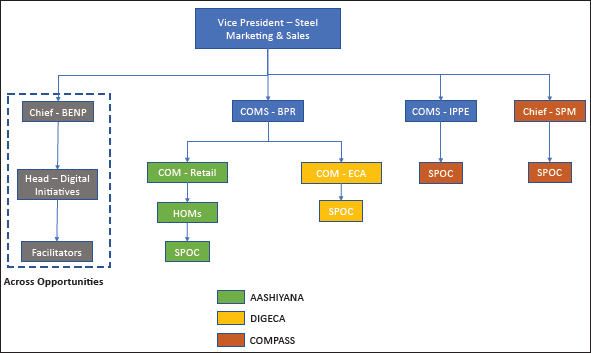
The initiative for digital transformation at Tata Steel is spearheaded by its Marketing & Sales (M&S) function to integrate digital technology to solve problems and address customer needs. Tata Steel constituted a focused special task force under the Head of Digital Projects representing the Business Excellence & New Projects division and working with key business verticals: Automotive & Special Products, Branded Products & Retail, and Industrial Products, Projects & Exports. Each of these verticals is headed by a Chief of Marketing & Sales and is supported by a Business Excellence & New Projects team. Figure 1 presents the organization structure. This customer-focused structure enabled the digital transformation of the company.
FACING THE FORCES OF CHANGE
Senior Management at Tata Steel recognized the potential impact of digital technologies on the steel industry and the company back in 2015. According to a Senior Business Leader of M&S:
The boundaries between the digital and physical worlds are blurring and people navigate seamlessly between the two worlds. Digital disruption is all around us, creating winners and losers in industries, and this will be true for steel too. In the digitally enabled world, Tata Steel intends to continue to be a pioneer in value creation in the steel industry. Our aim is to create a digital strategy that addresses the emerging scenario and exploits the various opportunities that it presents to us across the value chain.
Indeed, the number and variety of digital technologies has proliferated in recent years to include such innovative applications as social media, smart phones, analytics, cloud computing and data storage, the Internet of Things (IoT), and artificial intelligence (Jammulamadaka, 2017). Pondering this dazzlingly vast array of choices, a top executive of M&S concluded:
As we look at making the organization future-ready, we need to ask ourselves, ‘How can we further utilize digital to help enhance customer experience, thereby enabling businesses achieve their objectives?’ Should we go deeper in the initiatives that we have started? Given the fast pace of technological evolution in the digital space, should we chase newer opportunities that are on the horizon, such as pricing analytics, and digital technologies to make it easier to do business with us and extract value from our products? Alternately, should we pursue both depth and breadth at the same time? In short, what trajectory should digital transformation follow to provide a launchpad from which further digital programs can be launched?
To achieve these goals, the senior management created a taskforce on digital strategy, which was charged with capitalizing on market opportunities. (See Figure 2 for Taskforce Teams). The task force issued three mandates for the entire company.
Create new business models or re-imagine existing ones to leverage the digital environment. Build stronger and richer experiences for stakeholders—employees, customers, vendors, shareholders, partners and related community. Identify disruptions posed by the new digital environment in terms of opportunities and threats to Tata Steel India operations.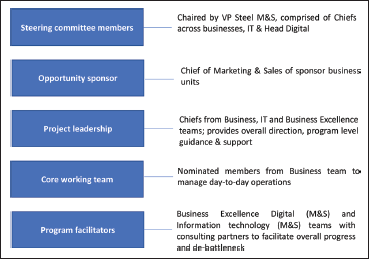
Here are a few ways they addressed these mandates. The digital team at Tata Steel envisaged rolling out digital transformation across the organization, cutting across various segments—namely B2C, B2B and B2ECA—as well as across various business verticals. Digital projects incorporating entirely new business models vis-à-vis the way business was done in the past, such as AASHIYANA® (B2C), COMPASS® (B2B) and DIGECA® (B2ECA) were identified for execution. Strong, well-defined governance mechanisms were instituted, encompassing key project stakeholders. The top management conducted project progress reviews through monthly Steering Committee Meetings (SCOM) and weekly Project Management Office (PMO) Meetings, to ensure that the expectations of all concerned stakeholders were delivered. Given that the expectations of some of the stakeholders such as in the case of customers was dynamic, tremendous agility was built into the processes. In this forum of top managers, new insights from the markets were discussed, which led to new ideas that had to be taken up for implementation. Tata Steel had the early mover advantage; the progress was limited only by the capacity to reimagine the new digital future.
The leadership of Tata Steel’s Marketing & Sales realized that across large companies worldwide, thousands of change programs are launched each year. An in-house team was set up within Tata Steel to study the best practices across the world, spanning different industries. The Benchmarking group concluded that only 30% of initiatives delivered sustained improvements, leading them to ask, ‘Why do so few initiatives succeed?’ The Benchmarking group discovered that a vast majority fail since they focus on quick-fix programs that deal almost exclusively on financial/operational improvements or are focused on nebulous attempts to change the culture without hardwiring the change to address performance imperatives. After such big bang launches, which is the reality for the majority of failures, the organization returns to business as usual, with short-term improvements quickly eroding, leaving in their wake, distrust, scepticism and cynicism, making it even more difficult to re-invigorate the organization for the next round of improvement drives.
In contrast, Tata Steel has had about three decades of experience in navigating challenging, organization-wide and significant change management initiatives in the company, commencing from the decade-long journey of the turnaround of the company in the early 1990s consequent to the liberalization of the Indian economy. In short, the top management of the company had deeply internalized in its DNA, what it takes to succeed in multiple company-wide change management initiatives that are often launched concurrently.
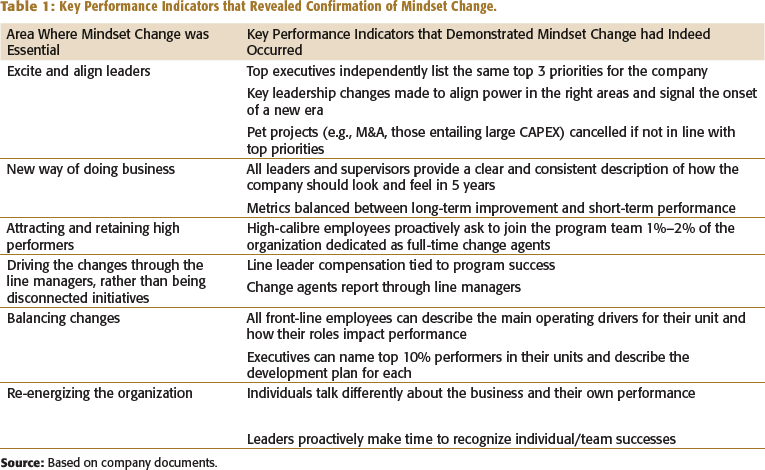
To address the challenges of change management faced by most large companies across the world, the team entrusted with the change management typically takes a holistic approach. It seeks step-change improvement in performance while ensuring a new way of working and ensuring continuity of organizational energy and capabilities throughout the change management process. The change management process is anchored at the highest levels of the organization. To ensure that the process stays on course during the entire journey, clear key result areas (KRAs)/key performance indicators (KPIs) are defined at every stage for various levels of managers. Monitoring mechanisms are put in place to ensure the achievement of these KRAs/KPIs, with these being adjusted as necessary for making needed mid-course corrections. As such, any transformation program at Tata Steel must be intensely rolled out for at least three years, thus signalling to the organization that these well-thought-out initiatives are not just fashionable flavour of the season drives.
Key Performance Indicators that Revealed Confirmation of Mindset Change.
TATA STEEL’S PROCESS FOR DIGITAL TRANSFORMATION
Tata Steel’s taskforce on digital strategy comprised of 25 senior and mid-level executives. The team’s first task was to brainstorm and implement a formal and systematic process for digital transformation. After research and deliberations, the taskforce proposed a five-step process:
Build organizational consensus for action. Identify high potential digitization initiatives within divisions. Select and implement high potential initiatives drawing upon the strategic directive—Think Big, Start Small and Scale Fast. Set up governance mechanism for performance review of digital initiatives. Make digital transformation a virtuous cycle.
BUILD ORGANIZATIONAL CONSENSUS FOR ACTION
Early on, it became apparent to the taskforce members that it would be necessary to gain buy-in from employees at all levels for the radical cultural changes that digital transformation would bring. When the initiative began in 2015, the taskforce did an internal survey to learn the extent of digitization at Tata Steel. The results overwhelmingly showed digitization was not widely practiced. Furthermore, the taskforce identified two critical problems. First, they found that senior managers were digital novices who could not envisage the benefits of digitization and were often non-committal or resistant to its implementation. Second, many employees were unaware of the potential applications of digital technologies in their context and their benefits. To remedy these two problems, the taskforce implemented two initiatives—reverse mentoring and the Digital Enthusiasts Exploration Program (DEEP). The first relied upon internal personnel and resources, while the second drew from outside experts.
Reverse Mentoring
Recognizing that most of the firm’s younger employees (i.e., average age of 28 years) were digital natives who were well-versed and comfortable with using digital technologies, the taskforce hit upon the idea of reverse mentoring, that is, having tech-savvy younger employees mentor senior executives. A handful of reverse mentors were selected with 1:1 mentor and mentee tagging. The taskforce members realized that this would be an opportunity for what might be called transgenerational two-way mentoring. Younger employees would mentor senior executives on technology, and in turn, senior executives would mentor younger employees, who were business novices, on business practices. This way, when the younger employees matured, they would be able to step into senior management roles capably and with minimal additional training (Gupta et al., 2020).
The initiative started with the selection of 16 reverse mentors who ranged in age from 23 to 27 years. The selection process was quite rigorous as 300 employees volunteered for the program. To qualify, candidates had to take a written test, interview with two top managers and consultants, demonstrate significant past work done in the digital space, and show a willingness and ability to challenge the status quo. Each of the reverse mentors was paired with 16 leading Tata Steel executives. The 16 mentors and senior executive counterparts met at least once per month to discuss digital technologies as well as business practices. In subsequent years, Tata Steel added 25 more mentors and 48 senior managers as mentees to the program.
Digital Enthusiasts Exploration Program (DEEP)
To expose senior and middle-level managers to emerging technologies, the task force introduced two related programs under the DEEP banner. As part of the first program, ‘Go and See’ managers of Tata Steel were sent to visit different organizations in different industries, including leading global corporations, to see for themselves applications of cutting-edge digital technologies. Simultaneously, the taskforce introduced digital immersion sessions, that allowed managers to immerse themselves and learn what exemplar companies were doing in the digital world. As part of the second program ‘Come and Demonstrate’, leading consulting firms competed to give presentations to the managers on leading digital applications and their own proprietary systems.
As an illustration of a positive example from DEEP, Tata Steel managers learnt that the customer decision-making journey was more important than merely selling the product. Technology was consequently used to map the customer decision-making journey, and a new technology platform called AASHIYANA for B2C markets was created.
IDENTIFY HIGH POTENTIAL DIGITIZATION INITIATIVES WITHIN DIVISIONS
Consumers in the B2C segment are familiar with using new hand-held devices and preferred digital tools that were commonplace. Here, the Tata Steel Marketing & Sales function relied on demand-pull and attempted to replicate digital technologies that already existed in consumer markets. In contrast, many customers in B2B markets had no working knowledge of digital technologies. Utilizing a technology-push approach, Tata Steel divisions selected digital technologies that added value and then educated B2B customers on their applications and benefits. Lastly, customers in the B2ECA segment had moderate knowledge and skills in digital technologies. In this segment, a combination of demand-pull and technology-push was used to identify promising opportunities (Dosi, 1982).
For example, in the B2C segment, learning about demand-pull possibilities required in-depth customer research. The research entailed devising detailed customer journey maps that traced customers’ decision journey to determine key steps in buying and product usage processes (Court et al., 2009; Richardson, 2010). For each step, M&S managers carefully recorded the digital tools being applied. Following further investigation and analysis, managers then considered which digital technologies could add customer value by resolving serious customer pain points. A multi-brand platform catering to the B2C segment, namely, AASHIYANA was launched as a high potential digital project.
SELECT AND IMPLEMENT HIGH POTENTIAL INITIATIVES DRAWING UPON THE STRATEGIC DIRECTIVE: THINK BIG, START SMALL AND SCALE FAST
Senior executives believed that identifying potential digitization initiatives would be relatively easy given a myriad of possibilities. However, selecting and implementing high-potential initiatives posed a critical challenge. To do so in a rigorous and structured manner, the team began by choosing and internally promoting a strategic directive or mantra for the digitization efforts—Think Big, Start Small and Scale Fast. Given Tata Steel’s limited experience with digital technologies, the team also decided to hire a consulting firm with deep knowledge and significant expertise in implementing large-scale digital transformation programs for leading firms worldwide. To motivate superior performance, Tata Steel offered the consulting firm a lucrative risk-sharing and gain-sharing compensation package based upon performance (Thomson & Anderson, 2000).
Think Big
Rather than executing digitization programs on a one-off basis, business members and consultants jointly crafted a digital technology roadmap (Barker & Smith, 1995; Kim et al., 2018). Managers relied upon three lenses to arrive at the roadmap, which could be applicable to all these customer segments, namely, B2C, B2B & B2ECA.
Benchmark global best practices across various organizations in the domain of marketing and sales to identify key characteristics exhibited by digital frontrunners. Check that high potential initiatives are aligned to the strategic objectives of the division. Take a deep dive into customer decision journeys on a segment-by-segment basis to discover customer pain points and opportunities to delight the customer (O’Connor, 2004).
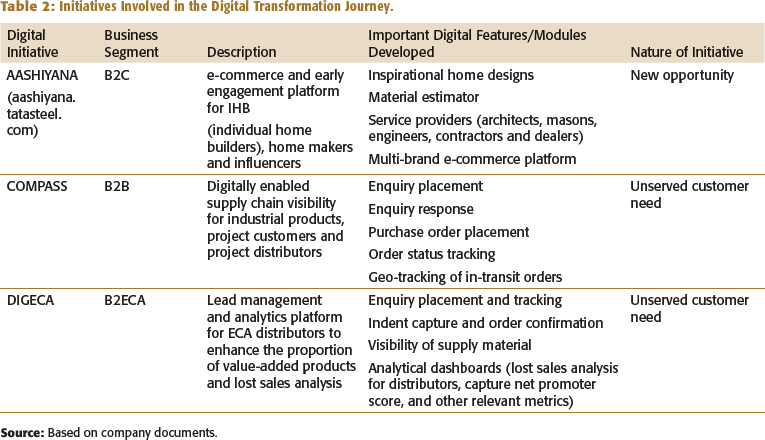
Initiatives Involved in the Digital Transformation Journey.
Start Small
This phase included picking a segment, piloting the digital initiative and ensuring support from the external business consultant. Initial implementation efforts focused on three initiatives. For B2C consumers, namely individual home builders and influencers, Tata Steel designed Search Engine Optimization (SEO) efforts, Search Engine Marketing (SEM), social media promotional activities and an e-commerce platform. For B2B customers, Tata Steel created a transaction management system and a high-end, value-added service for the supply chain management. Lastly, for the B2ECA segment, Tata Steel developed lead management and analytics platforms to garner greater business share.
To manage the roll-out of the three initiatives, a senior manager involved with each segment was appointed as project sponsor. The senior executive of M&S supervised all three initiatives to maintain consistency and continuity of efforts. In the spirit of start small, team members restricted implementation to a few regions and a few high-potential customers.
Progress in implementing each of the initiatives was reviewed each month by a steering committee of cross-functional senior executives. During the execution phase, each of the three groups proposed KPIs. After a reasonable amount of time, senior executives judged that each of the three initiatives had successfully demonstrated proof of the concept and gave approval for scaling the projects.
Scale Fast
This phase was characterized by horizontal scale-up and vertical scale-up. In vertical scaling, more brands and businesses were added, while in horizontal scaling, more geographies were added, which led to a pan-India roll-out for full presence. For the B2C segment, all consumer brands of Tata Steel were added to the platform. Additionally, the platform features were continually enhanced based on customer feedback. The brands added on the B2C platform included Tata Pravesh (steel doors and windows with wooden finish), Tata Shaktee (galvanized corrugated sheets for roofing used in rural housing), Tata Wiron (wires for fencing and binding applications), Tata Structura (hollow sections for roof and gate applications), and Tata Agrico (agricultural instruments). In the B2B segment, the digital platform was extended to cover customers and segments such as automotive, tubes and wires. In turn, the B2ECA initiative was expanded to cover all SME (called ECA) customers, in addition to distributors, providing customers with a direct connection to Tata Steel. For each of these platforms, new features were added, thereby expanding their functionality. For instance, in the B2C initiative, articles and blogs were featured to educate consumers. Cross-sell opportunities were presented to B2B customers. Test certificates and account information were made available to B2ECA customers and distributors. B2ECA customers could also find easy access to financing through the platform.
Scale-up would not have been possible without on-boarding the stakeholders who had to come together and aligned themselves to achieve common objectives. However, scale-up had its own challenges. The number of stakeholders proliferated, both within the organization and outside it. Some stakeholders were sceptical, others upbeat, yet others were in denial, while a majority were indifferent.
In the Scale Fast phase, the voice of customer-facing internal stakeholders and capturing their concerns became important. In this phase, governance mechanisms were significantly strengthened. For instance, the Steering Committee (SCOM) was now actively involved in conducting monthly reviews. The Project Management Office (PMO) review was done every week to integrate the multiple initiatives since the degree of dependencies among multiple stakeholders intensified. A dedicated team member from the IT function was deputed to work closely with the opportunity owner from the business to strengthen implementation. In addition to being a forum for the first level of escalation, the PMO facilitated immediate solutions to any challenges faced by a stakeholder, thus fostering an environment of trust among the stakeholders and spurring the concept of agile development (Wilson & Doz, 2011).
SET UP GOVERNANCE MECHANISMS FOR PERFORMANCE REVIEW OF DIGITAL INITIATIVES
By the end of the Scale Fast Phase, the focus of the Steering Committee was to see the measurable impact in terms of higher customer engagement through the use of the digital platforms, increasing top line. Success KPIs, which were monitored, underwent a sea change from the previous phase. There was a significant three times increase in the number of KPIs that were being monitored by the Steering Committee. For each opportunity, there was equal emphasis on KPIs to measure adoption by customers/consumers as well as KPIs to assess the value impact to Tata Steel. For example, in the B2C segment, some of the KPIs measured were average browse time and percentage of visitors interacting with a service provider (i.e., architect/engineer/mason), both of which measured the engagement of a visitor with the company, in addition to value KPIs such as e-commerce conversion rate and Total e-commerce revenues. Similarly, in the B2B and B2ECA segments, monthly active users (in percentage) was an adoption KPI, in addition to value KPIs such as platform revenue and percentage increase in sales of value-added products. The steering committee emphasized KPIs that tracked adoption across opportunities, as it directly correlated with the ease and user-friendliness of the platforms. The reviews were done to encourage the teams, promote well-intentioned failure, and facilitate discovery and exploration.
Wherever appropriate, success was celebrated and appreciated in wider forums. This was done through company events where exemplar managers who heralded the digital transformation were feted, along with their families, who also had to support the managers to work long hours to make the digital transformation journey a success.
MAKE DIGITAL TRANSFORMATION A VIRTUOUS CYCLE
The growing structural complexity posed a new set of challenges in terms of ownership. For instance, in the B2C segment, the managers implementing the digital opportunity for Tata Tiscon (an early adopter) developed deep competencies and a sense of ownership of the whole initiative. In the Scale Fast phase, many new brands were added to pursue digital opportunities; however, the key managers of these other brands did not have any reporting relationships with the founding digital platform managers. Some of these brands also did not have dedicated digital competencies. Order fulfilment through the digital platform was unfamiliar to them, as they had hitherto operated in an offline mode. However, online customers had uniform expectations across all brands. There was a need to find a fine balance and consistency of experience with respect to the various brands on the online platform so that functionality was the same even though each brand was different in the mind of the consumer. Similar challenges were faced in the B2B segment initiative, both on the people and the product fronts. However, the complexity stemming from products on the B2B portal was less since the promise was for On Time & In Full (OTIF) delivery as opposed to guaranteed 72-hours delivery in the case of B2C products.
While the Think Big phase and Start Small phase yielded the desired results, especially since the locus of implementation was relatively restricted, both from brand and geographical perspectives, the results of the Scale Fast phase were mixed at best. The horizontal Scale-up (i.e., expansion to other geographies or customer groups for the brands and verticals engaged in Think Big and Start Small phases) went as expected and even out-performed expectations in some instances. The problems arose in vertical Scale-up, which entailed expansion across different B2C brands such as Tata Pravesh, Tata Shaktee, and so on, and different B2B customer segments such as automotive, tubes and others. It was clear that scaling entailed very different challenges compared to implementation at the proof-of-concept level.
The count of M&S managers participating in digital projects across the organization had increased to 75, which was gratifying. No one doubted the necessity of accelerating the digital transformation journey. This was in huge contrast to the sceptical and tentative beginnings in April 2017. People across the organization realized that the journey necessitated significant unlearning of past irrelevant knowledge, learning new knowledge and enormous effort, and it was beginning to show many benefits. Consumers and customers saw and interacted with the company in totally new ways.
LESSONS LEARNED FOR TRADITIONAL BUSINESSES IN EMERGING MARKETS
Focus on Customer Needs and Not on Trendy Digital Technologies
A core, strategic directive at Tata Steel was to deliver superior value to the customer. That mantra played out in the digital transformation exercise through detailed research on customer decision journeys for each segment and efforts to relieve customer pain points with digital technologies. While Tata Steel management drew heavily on demand-pull efforts, it also recognized the importance of technology-push. A key goal of the management in the coming years will be to find a balance between the two, with a focus on work faster, smarter and better.
Customer pain points were identified during focused group discussions, leading to the understanding that it was important to fulfil multi-product requirements from a single platform while at the same time servicing the customers efficiently. In addition to rebars for columns/pillars and concrete roofing applications, as well as sheet steel for rural housing, a typical consumer in the B2C segment required doors for her home and garage, windows, shelves, and more. Hitherto, these latter requirements were being catered to by sundry vendors, including woodworking, steel fabricators, and so on, which led to significant coordination problems for the home builder. However, the onus of project completion was on the home builder, causing considerable slippage in project timelines and consequent project cost escalations. Based on market research, the company realized that there was huge potential for it to provide integrated offerings, both in the rural and urban markets. These markets were crying for solutions. Hitherto, few competitors had made any headway in meaningfully serving these markets in a holistic manner. Instead, most steel companies were just pushing their traditional steel products such as rebars and sheets into the marketplace. The digital transformation journey that Tata Steel had embarked on greatly helped roll out these solutions effectively. Tata Steel leveraged its digital transformation journey, and opened new avenues for AASHIYANA in the form of newer versions (AASHIYANA Version 2.0, Version 3.0, etc.), since the platform was constantly evolving based on organizational learning as a consequence of consumer feedback.
The company’s management realized that catering to these customized needs required specialist skills. Hence, a separate division was formed to focus on these value-added solutions, which required a very different mindset to market them, vis-à-vis the company’s traditional products such as rebars and sheets.
Prioritize and Stay Riveted on High-Potential Opportunities
There are challenges in directly attributing the benefits and value of any initiative in a large company. The problem gets amplified in the case of digital transformation. The problem is more severe in the case of the Marketing & Sales function since any upside or downside value swings could result from a host of factors outside the control of the organization, such as macro-economic trends, competition, customer churn due to reasons extrinsic to Tata Steel (such as the customer declaring bankruptcy), price fluctuations, and so on.
The fragmented B2C segment was very challenging for any steel manufacturer to address meaningfully in terms of providing a holistic solution. Tata Steel teams working in this segment were encouraged to do market research, analyse the data, garner insights, and come up with market offerings, both products and services, of value to the consumers. At the same time the offerings were expected to provide avenues for Tata Steel to garner a fair share of the value generated. These teams were characterized by high levels of empowerment, and well-intentioned failures were respected and celebrated. They were essentially entrepreneurial teams within the large organization that created a very agile organization. Tata Steel realized that if it could provide such a holistic solution, it would be possible to capture significant value to the company in return for superior value delivered to the consumer. Based on these insights and consequent digital transformation initiatives that it launched for the B2C segment, the company was able to realize higher margins in the B2C segment vis-à-vis the other two segments (B2B and B2ECA), increased brand loyalty, higher cross-sell opportunities, positive word of mouth and enhanced consumer engagement.
Invest in Digital Capabilities and Technology-Savvy Personnel and Consultants
It was ironic that while India was the supplier to the world of top IT talent, there was little digital transformation competence available in the country among large companies. Hence lateral recruiting was not easy. Only a few external people had a deep knowledge of the new technologies that were needed to accelerate Tata Steel’s digital transformation journey. Besides, the company had its own challenges of integrating lateral hires into its culture. There was a dire need for people who were not only masters of the technology; it was essential for them to also have a deep understanding of the steel business. Only then would they be able to generate value and contribute meaningfully to the digital transformation effort.
Further complexity arose from the fact that across the board, the company had progressively right-sized its workforce over the years. Thus, there was little organizational slack to intensely take up new initiatives. However, due to the strategic importance of the digital transformation initiative, the top management ensured adequate, high calibre human resources to drive this initiative. The nature of the transformation journey necessitated that to foster ownership, line managers needed to be in the thick of the digital transformation journey, rather than delegate this task to an independent, specialist team or a group of external consultants.
Follow Agile Principles for Quick Deliveries, Small but Numerous Successes, Low Risk of Failure and Quick Turnaround in View of Competition
During the Start Small phase, when the opportunities were being tested by a small team of people at a small scale with a handful of customers, it was easy to be agile and incorporate necessary changes that were necessitated through quick learning of what works and what does not. The explosive growth in geographies and customers during the Scale-up phase revealed the inevitable cracks in the processes and in the portals (both organizationally and technologically). The key was to move fast and with certainty. Reconciling these two opposites turned out to be a difficult paradox to resolve. To address this need, 12 people, including operating-level managers (the next line employees) from M&S were trained in the agile methodology. Yet, for a 400-strong countrywide M&S organization, significant gaps remained in terms of agility. Top management’s belief in the project reduced bureaucratic burdens, quickened important stakeholder connections and sped up approval of needed budgets. The senior M&S manager likened the challenge of agility at scale to getting an elephant to dance!
EPILOGUE: CURRENT STATUS OF TATA DIGITAL INITIATIVES
Any initiative that is launched in a large company loses novelty in six to twelve months. As competitors are prone to mimic the initiatives launched by the leader, these initiatives are treated as hygiene factors or, over time, become stale inside the organization. Hence the company felt the need to identify newer pain points and use advanced analytics to solve them. The way steel was bought in 2010 is very different from how steel will be bought in 2025. Consumer behaviour also undergoes change, and hence there is a need to find new ways of reaching customers and discovering new pain points. Providing digital as a solution is thus a moving target.
Nearly two years into the digital journey, the three digital opportunities have scaled up their presence both horizontally and vertically. Several key initiatives are worthy of note. AASHIYANA has become an engine to continually generate newer consumer insights for the brands in the B2C segment. Moreover, it has significantly helped Tata Steel cross-sell different products to the same consumer segment through integrated marketing across brands. It has also helped Tata Steel gain a longer touch time with the consumers throughout their home-building journey, thus adding to brand equity and brand recall. In the year ending March 2021, AASHIYANA was expected to cross $100 million in revenues, given its modest inception in the year 2018.
In addition to providing visibility of order supply, COMPASS now empowers B2B customers to better plan their working capital since stock movement is available to them online. It also provides better material visibility to the customers. COMPASS has since expanded its coverage to its B2B customers across other business verticals such as tubes, wires and automotive.
DIGECA has helped Tata Steel develop products to cater to unique demands of its varied customer micro-segments through enquiry management and lost-sales analysis, thus serving ECAs better than ever before. By enabling access of the platform to ECAs directly, it has further scaled up its offerings by integrating multiple touchpoints such as financing and loans, training, expert interactions and ECA complaint resolution. The DIGECA platform has emerged as a one-stop window for ECA customers to interact with Tata Steel. It has helped the company to focus on value added products and better understand customer requirements from a single platform.
To expand the organization’s interest in digital and explore more customer pain points, PARAS and AMRIT were begun as new digital initiatives. While PARAS focused on geospatial satellite-based demand-sensing and use of macro-economic variables for demand estimation for brand Shaktee, AMRIT focused on improved value realization from extra-to-order (ETO) products through the implementation of digital analytical models and automation of workflow. The sales were enabled by a newly created platform called MAGICBOX that enabled a bidding-based price discovery mechanism.
The success of Tata Steel’s digital transformation journey offers a roadmap for other companies in traditional industries and those in emerging markets on how to embrace digital transformation for enhanced business performance.
Footnotes
ACKNOWLEDGEMENT
The authors would like to sincerely thank Mr Gangesh Chaturvedi, Head-KVHS and Digital Projects at Tata Steel for his valuable inputs.
Declaration of Conflicting Interests
FUNDING
The authors received no financial support for the research, authorship and/or publication of this article.