



Abstract

Keywords
Ridhima was on her way back home from the Passport Seva Kendra (PSK), that is, a passport service centre. She had recently applied for the re-issue of passport for her minor daughter Anukriti. After filling out all the forms online, she visited the local PSK for verification of documents and submission of forms. Having invested one and a half working days and her experience at the PSK during that time, she was left wondering whether she received seva (service) as claimed in the name of ‘Passport Seva Kendra’. She could not help recalling the old days when she provided all the details to the agent who, on her behalf, submitted the forms for issuing her passport at the passport office. The agent charged her an amount equal to the passport issue fee, but she did not have to waste so much time standing in the queue.
PASSPORT ISSUANCE IN INDIA AND PSK
The Consular, Passport and Visa (CPV) Division of the Ministry of External Affairs (MEA), Government of India, issued passports in India. They provided passport services through the Central Passport Organization (CPO) and its network of passport offices and PSKs. A system consisting of headquarters of CPV division, 37 passport offices and 93 PSKs, which served as extended arms of passport offices, facilitate passport issuance. For overseas Indians and foreign nationals, the CPV services housed at Indian Missions and Posts abroad provide passport and visa issuance services.1
As part of the Government of India’s e-governance initiative, many government departments had taken actions to improve the delivery of their services. As a passport is an essential document for travelling abroad, there was a spurt in demand due to increased globalization and fast economic growth. It was estimated that the passport demand in India would grow by around 10% annually. This increased demand was witnessed from both larger cities as well as small towns, thus creating a necessity for broader reach and availability. To improve passport service delivery to Indian citizens, the MEA, Government of India, decided to launch the Passport Seva Project (PSP) in May 2010.
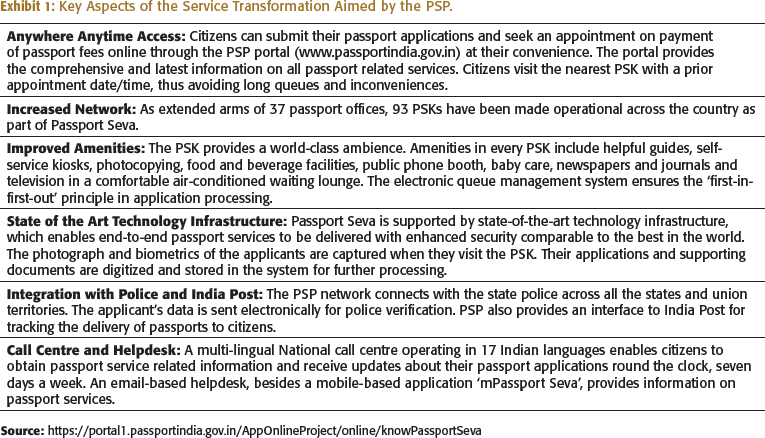
Key Aspects of the Service Transformation Aimed by the PSP.
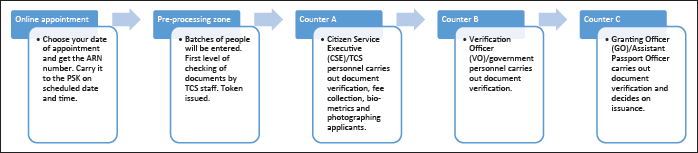
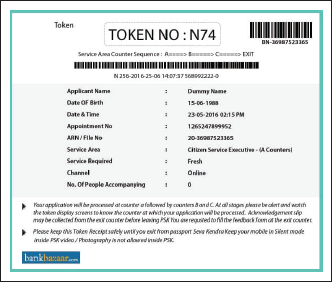
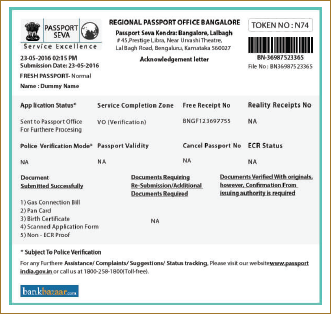
The process of passport interactions at PSK consisted of five steps (The detailed operation of PSK passport processing is given in Exhibit 2.). TCS executives do the pre-processing task and the verification at Counter A. The MEA officials of the passport office do the verification at Counter B and granting of passport at Counter C. Exhibit 3a provides a sample token issued in the pre-processing area. Exhibit 3b provides sample receipt after completion of passport granting process at Counter C.
RIDHIMA’S EXPERIENCE IN THE FIRST VISIT
Ridhima worked as a faculty at one of the leading business schools in the National Capital Region (NCR) of India. For initiating the process of Anukriti’s passport, she visited the Passport Seva Online portal to schedule the appointment. She was quite happy with the user-friendliness of the website and also with the features such as appointment tracker and national call centre number. She also noticed the vision on the home page mentioned as ‘To deliver passport services to citizens in a timely, transparent, more accessible, reliable manner and in a comfortable environment through streamlined processes and committed, trained and motivated workforce’.
Ridhima booked the appointment for 10 April 2019. It was a holiday for Anukriti, and she would not have to miss her school. The reporting time for the appointment was 11:15 am, and the actual appointment time was 11:30 am. Ridhima took leave for the day from her office to devote the needed time to the process. She also planned to spend some time with her daughter once the passport application process was over. Her husband also took a half-day leave, assuming that the process would be over before lunch, and he would be able to attend an important meeting in the office after lunch. The local PSK was about 20 km away from their residence, and they had never been there earlier. To reach on time, the family left home a little early and arrived at the PSK by 10:30 am.
After reaching the PSK, Ridhima found that there were two long queues in front of the entrance door. On enquiring with the guard at the entrance, Ridhima learned that people from earlier batches were waiting to enter, and they would have to wait for the turn of the 11:15 am batch. The guard asked her to sit in the waiting area. Ridhima and her family decided to remain in the waiting area as they had arrived early. The waiting area had few benches and a fan that was providing air to people sitting just below it. While talking to fellow applicants who were also waiting, they got to know that the process was running late. At that time, the PSK was allowing entry to applicants from the batches of 9:30 am and 9:45 am reporting time. They waited for their turn in the queue and finally got to enter the pre-processing area at 11:50 am.
Interactions in Pre-processing Area
When Ridhima entered the pre-processing area, three parallel counters were operational. The first one was for senior citizens and tatkaal passport applications, which is the category of passports that are issued for those who need them urgently. The remaining counters were for the standard and other categories of passport applications. Ridhima stood in one of the standard passport application queues with her husband. Their daughter was restless by now and wandered around in the area around them. The waiting area was small, with just two-three chairs. However, the waiting area in this section was air-conditioned, which made waiting comparatively comfortable than waiting outside. When it was their turn, the executive at the counter carefully checked all the documents which included a filled passport form, the old passport of the applicant with a self-attested copy, post-paid mobile bills of both parents as proof of the current address and a declaration of the parent (termed as Annexure D in passport application). These documents were required for the re-issue of the passport when the validity of the old passport was to expire within one year.
Additionally, Ridhima was also carrying her husband’s and her passports and their copies in case they might also be needed. After going through the submitted documents, the executive removed some of the additional documents Ridhima had attached with the application. He returned all the documents and gave her a token number for further processing. The whole process of checking the documents did not take more than 5–6 minutes. She got to know that TCS representatives operated these counters.
Interactions at Counter in A Zone
With the token in hand, which the security guard scanned at the small gate, Ridhima and her family entered the hall where the document verification and passport granting process was going on. There was a small waiting area right after the door. There was a water cooler and an outlet of Café Coffee Day selling eatables. As Ridhima and her family members were about to sit in the waiting area for their turn, they heard their token number being called. They immediately went inside the A zone counters where executives were checking the documents carefully, scanning them and storing them for their records, clicking the applicant’s picture and gathering biometric data. Ridhima had already deposited the passport application fees online. She was attended to by a lady who completed the procedure within 10 minutes. At this counter, the lady also collected an additional amount to activate the SMS facility. After finishing the procedure, the lady officer tried to sell an attractive leather pouch for holding the passport, which was politely declined by Ridhima’s husband.
After completing all the formalities, Ridhima and her family were guided to the counters in the B zone. Ridhima got to know that there were more than 30 counters in the A zone operated by the TCS executives. She was impressed by the promptness of the service and the friendly attitude of the counter executives so far. Now she was hopeful that she would be able to finish the process at B zone counters quickly. Most of the tasks were over, with only a slight delay during the entry.
Interactions at Counter in B Zone
It was around 12:15 pm, Ridhima and her family sat in the waiting area for their turn. They could see a lot of people waiting for their turns as compared to the previous areas. Some of them were sitting while many others were standing because of limited available seating space. Ridhima’s token number was in the 300 series. She could see the 100 series being displayed on the monitor for tokens in B zone. It meant waiting for some time. In B zone, there were 10 counters and an additional counter of the Assistant Passport Officer (APO). Among the 11 counters, only 5, including APO, were operational during that time. Ridhima observed that out of the four functional counters, the executives frequently left their desks, further reducing the number of operational counters on and off.
The waiting crowd was getting restless as lunchtime was approaching, and many of them had to report back for work. Ridhima’s husband was also losing patience as he had an important meeting to attend. Finally, they decided that Ridhima and Anukriti would wait for their turn, and he would go back to office. It was about 1:40 pm at that time. Ridhima’s daughter was also getting restless due to hunger, thirst and also boredom. The endless delays and waiting was becoming an ordeal for an 8-year old. Ridhima was passing her time by looking at the display monitor, trying to figure out the algorithm by which the token numbers were displayed. She could not find any pattern in them as, according to her, they were being displayed randomly. She finally gave up on that. After a wait of about two and a half hours, their token number got displayed. The mother–daughter duo was elated. They reached their stipulated counter. It was 2:45 pm. The executive sitting at the desk glanced through the documents.
‘You have not attached your address proof in original’, he coldly stated.
‘Sir, I have attached the post-paid mobile bills of both the parents as address proof’, Ridhima replied.
‘You have downloaded them, and they are not original. You need to get the stamp of the store over the bill for that’, he said. Ridhima got irritated. She asked, ‘Where is it mentioned that a mobile bill needs to have a store stamp?’ She continued her argument, ‘Who gets the physical copy of mobile bills these days? Due to green initiatives, everyone opts for e-copy of bills’.
But it was all in vain. In just a few seconds, Anukriti’s application was rejected. Ridhima was asked to come next week on any working day between 9:00 am to10:00 am. She crossed through C counters, which were of no use to her now, and exited the PSK door. It was 2:50 pm at that time. She received an SMS from PSK that her next appointment was scheduled for 15 April at 9:30 am, and she needed to report at 9:15 am that day. Ridhima looked at the calendar on her mobile and realized that 15 April was Monday, a working day for her and a school day for her daughter. She quickly went back to the pre-processing area to clear a few doubts. Executives in the pre-processing area were closing the counters and winding up. She first asked one of them why her documents could pass through two stages without the ‘original address proof’ issue being flagged to her. No satisfactory response was provided to her. Then she asked if her daughter’s presence would be needed on 15 April as it would be a school day for her. The executive responded in affirmative.
Ridhima came out of the PSK building, feeling irritated about the time wasted over a task that did not get done. Why were her documents forwarded by executives in the pre-processing area and A zone? Why had nobody raised this issue? Why was the stamping of telephone bills by the store not mentioned anywhere on the website? While applying for the Schengen visa some time back, she remembered seeing instructions on the website about getting the branch manager to stamp and sign the bank statement if it was downloaded. Couldn’t a line like this be mentioned either on the website or on the form? Why had nobody described what was meant by an original telephone/mobile bill? She waited for almost two and a half hours. She could have very well found a store of her mobile service provider nearby and got the bill statements stamped during that time. At least the process could have been completed the same day. Now, for her, this seemed like yet another fresh round of application on the 15 April.
Moreover, she would have to take a leave from the office, once again. And what about her daughter’s school? She headed back home after a dissatisfied experience. Ridhima spent the rest of the day at home with her daughter. She called her husband and explained the events at PSK. Ridhima’s husband consoled her and told her not to worry too much.
EXPERIENCE OF MR SHARMA AT PSK
While taking a walk with her daughter in the apartment’s gardens later in the evening, Ridhima met her neighbour’s father, Mr Sharma. He was a 78-year-old retired government employee. After the pleasantries, Ridhima told him about her visit to the PSK. Mr Sharma told her that in his opinion getting a passport was far easier now. He mentioned that recently, he had applied for his wife’s and his passport under the senior citizen category. ‘The form was uploaded and submitted through the website very easily. My grandson could do it’, Mr Sharma shared happily. He went on to describe his experience. He remarked, ‘It was a speedy and convenient system. They kept us informed through SMS about everything. After completing the online form, the interview date was fixed, which was 4–5 days away. As we were busy on that date, we asked for another date which was assigned to us’.
Mr Sharma shared that he was pleasantly surprised that now anyone can even get the date changed without any hassle. Mr Sharma explained that he and his wife reached the local PSK office at the appointed time of 9:00 am on the date given to them. The staff guided them to the senior citizen queue. There were only two other people in the line. Their turn came within 10 minutes. He gave both the applications at the counter. The documents were checked. They were asked for an Aadhaar card (a 12-digit Unique Identity Number (UIN) that can be obtained by residents of India, based on their biometric and demographic data) and PAN card (a 10-digit alphanumeric number issued by Income Tax Department of India), which they had chosen, from among the many options allowed in the application for verification. The pre-processing work was completed within 5 minutes. Then they were asked to go to a big hall where many counters for different categories were operating. He queued in one counter, and his wife got a slot in another counter. After scanning documents, their biometrics, including fingerprints and eye scan was done. This process was completed within 10 minutes. After that, they were asked to sit in one place and watch the information screen for their token number being announced for the next appointment.
After waiting for 10 minutes, their token numbers were flashed for different counters. The interaction with the officials at Counter B took less than five minutes. Following this process, they were asked to leave and told that there would be a police verification. According to Mr Sharma, everything was hassle-free, and the people at the PSK were very helpful and courteous, unlike in the old times. They continuously received text messages and email updates from the passport office about the progress of their passport. The first police verification was completed within 4–5 days of their visit to PSK. The second one was after 10 days from the date of the first police verification. The passports were delivered within 25 days after their first visit to the passport office. Mr Sharma was so exhilarated with the whole experience that he announced in his regular senior citizens group that their passports had been delivered at super-fast speed without any problems. He was happy that they were treated with respect, and he appreciated the PSK staff for being polite and doing their jobs. He said, ‘It was much more than what we expected. We were super pleased. I treated my grandchildren with ice-cream to share the joy of a work well done!’
Ridhima started comparing Mr Sharma’s experience with her own and found not even an iota of similarity in the two experiences though they had visited the same PSK.
RIDHIMA’S EXPERIENCE IN VISIT 2
Ridhima was prepared for her second visit to PSK. She got the mobile bills stamped from a nearby store of the service provider. It did not take her more than two minutes to get the bill stamped at the store. She also requested Anukriti’s teacher to allow a late entry to school once the passport application process was completed. Fortunately, the school administration considered her request and allowed it. To reach by the reporting time, that is, 9:15 am, Ridhima started from her house at about 8:00 am. She faced massive traffic since it was the peak office time and somehow managed to reach the PSK by 9:10 am. Her appointment time was 9:30 am. She quickly joined the queue and entered the PSK when it was her turn. At the counter in the pre-processing area, she was given a token after the documents were checked and the reason for which the process was withheld was explained. This time she got the O series (in the first visit it was of N series, which meant Normal) token. On enquiring, she got to know that O stood for passports ‘on hold’.
After clearing the pre-processing area, she was directed towards counters in the A zone. The document verification was, once again, done by the executive. The stamped mobile bills were scanned and saved in the database. She was then directed towards counters in the B zone. It was before 9:30 am, and this time only 2 out of 10 counters were working. Luckily, her turn came quickly. At the counter, she was asked why the passport was put on hold. On being explained, the executive re-visited the stamped mobile bill and completed the verification process. She was directed to counters in the C zone. It was close to 9:30 am now. Ridhima was quite happy with the pace and was hoping that both her daughter and she would be able to make it to their respective school and workplace, though a bit late.
Interactions at Counter in C Zone
When Ridhima reached counters in the C zone, it was 9:30 am. To her surprise, no executive was available at any of the six counters. People were waiting for them to arrive. She also rested on a chair in the small waiting area. After some time, she enquired informally from the security guards on duty and got to know that the officials generally came after 10 am. This meant another half an hour, she thought with concern! They had no other choice but to wait. In the meantime, four more counters and the APO counter in the B zone started functioning. Within no time, almost hundred-odd people gathered for their turn in the C zone counters. None of the counters were operational till then. The waiting area had seating arrangements for only 30 people, and therefore most of the people were standing.
At 9:55 am, the first executive for the C zone counter arrived. Within few minutes, a staff member announced that all S (S category referred to Service category which was issued to officials representing Indian government on official business) and N category applicants who had cleared A and B zone counters need not wait as the last process would be completed online for them. There was a commotion in the crowd. People got confused; some started complaining that this could have been told to them earlier, so they should not have waited for almost an hour. Most of them were officegoers, who were getting late for their offices. Only O and T (T referred to tatkaal) category candidates were asked to stay.
Ridhima’s turn came at about 10:15 am. The executive looked at the documents and the child and then asked for the original passports of the parents. Even before Ridhima could take out the documents from the file, the official confirmed that the passport was granted, and he completed the process. Ridhima was wondering if original passports were not needed then why she was asked to show them. The whole process at the C zone counter took less than two minutes. Overall, she left PSK feeling elated, as if she had won the finals of the World Cup championship. Now she had to rush to her daughter’s school, which was going to take another hour. After dropping her daughter at school, Ridhima reached her office at 11:30 am. It was almost three and a half hours since she started in the morning to the PSK.
ANOTHER EXPERIENCE AT PSK
Two days later, Ridhima received a call from her friend Kaushal Kishore, based in another city. Kaushal had an MBA from one of the most reputed business schools in India. A gold medallist, who after his education had opted out of a corporate career to become a social entrepreneur. He was well-known in his sector and often interacted with government officials. He was planning a visit abroad with his family. He urgently needed a passport for his minor daughter. And therefore, he wanted to understand the passport issuance process followed for Anukriti. He planned to apply for his daughter’s passport in the tatkaal category. Ridhima explained the process step-by-step to him.
It had been almost three weeks since Ridhima visited PSK. She still awaited Anukriti’s passport. While Ridhima was busy with her office work, she received a call from Kaushal, who seemed very pleased since he had received his daughter’s passport. He thanked her for the guidance, which got him the passport within one day of visiting the PSK. Kaushal narrated his experience to her.
He told her that he reached PSK after picking up his 3-year-old daughter from school. At the entrance of the PSK building, the security guard asked him the reason for entry. He was then asked to show his appointment letter. As Kaushal was a little early, the security guard asked him to wait till his reporting time. Kaushal got irritated and said that he could not wait in the peak summer sun with his young daughter and entered the PSK premises. He, along with his daughter, got in the queue for entry. The security guard at the entrance called him to the front and asked him to enter the PSK premises where the pre-processing area was stationed. As Kaushal got into the line for the tatkaal passport, the executive operating the counter asked him to move forward, bypassing the queue. His papers were screened, and he was asked to get his forms approved by the APO since the mother of the daughter was not present.
Kaushal went to the APO office, where the officer, after listening to Kaushal’s reasons for the non-presence of his wife, immediately signed the form and approved the application request. The official also explained to Kaushal that generally they never keep an applicant waiting if he/she was accompanied by a minor child. Kaushal went to A zone counter. There was no waiting time at this counter. The executive processed all the documents within 10 minutes. He was asked to move to a counter in B zone, where again there was no waiting time. The executive at counter B shared that he had seen Kaushal entering the APO office. While having some casual conversation with Kaushal, the executive finished the verification within 2 minutes and asked him to move to the C zone counter with his daughter. Kaushal’s turn came as soon as he entered C zone. He approached the designated counter, where he was told that everything was in order and his passport had been issued. Like counters in A and B zones, Kaushal did not have to wait even for a minute at the C zone counter. For Kaushal, it was a very seamless process at all three zones. The executives at A, B and C zones were mindful of a 3-year-old kid in the school uniform. They talked very playfully with her, asking her about her favourite colour, ice cream, toys and even the school’s name.
Kaushal stepped out of the PSK, quite satisfied and moved towards the PSK building entrance, where his car was parked. He saw another security guard and remembered the words of APO who had told that they never keep an applicant waiting if he/she was accompanied by a minor child. He went to the security guard and questioned him about why he was asked to wait with a small child. The security guard responded by saying that it was a new guard on the first day of duty who was filling in for him at that time. He confirmed that they had been asked not to keep anybody waiting if they were accompanied by a minor child. Kaushal decided to move on as it was pretty hot and there was no shade. As he entered his car, he received a text message on his mobile stating that his daughter’s passport had been printed.
After listening to Kaushal’s experience, Ridhima wondered if her assessment of the PSK was a one-off incident of a bad day at work. As Ridhima taught management to students, she thought if anything could be done to improve the citizen service at the PSKs.
Footnotes
Declaration of Conflicting Interests
Funding
The authors received no financial support for the research, authorship and/or publication of this article.