




Abstract

All was not well for Tata Motors’ most ambitious product, Nano. There were rumours floating in the media about the discontinuation of the brand (Kumar, 2015). Pushing aside all the speculations, Girish Wagh, Senior Vice President, Tata Motors, said,
Nano is an extremely critical product for Tata Motors. Never did we have discussion about killing the brand. Our discussion has been how to re-energise the brand. We see there is a tremendous emotional connect with the brand and at the same time emotional hurdles too. (Economic Times, 2015)
Nano had been connoted as the cheapest car since its launch in 2009 (The Hindu, 2015). The company aimed to do away with this tag of being the poor man’s car. To recreate the magic of what Ratan Tata, Chairman, Tata Group, had called ‘The People’s Car’, Tata Motors had geared up to launch the new version, Nano GenX, in May 2015 (The Indian Express, 2015a). With the new positioning as an aspirational car, the company was aiming to attract first-time young buyers. It made critical changes in Nano’s specifications and offered new features (The Indian Express, 2015a). With the premise that people tend to forget an old story once they hear a new exciting one, the management endeavoured to shed away the image of being a poor man’s car by launching a new version, Gen X. Industry experts were not sure of the ease with which Tata Motors could shift its current positioning. The questions writ large were as follows: Is it a good idea to go with the new positioning of Nano or not? Was it riskier to focus on a smaller niche of young college students and ignore the earlier market, which aspired to move from a two-wheeler to a family car?
TATA GROUP
Jamsetji Tata established Tata group, a multinational conglomerate, in 1868 (Tata Group Profile, 2015). It is comprised of more than a hundred operating companies, including both listed and unlisted companies. Headquartered in Mumbai, India, prominent group companies included Tata Consultancy Services, Tata Steel, Tata Motors, Tata Chemicals, Tata Global Beverages, Tata Tele Services, Titan Industries, Tata Communication and Taj Hotels. Besides catering to the vast domestic Indian market, the group companies traded several products and services in approximately 150 countries and operated in more than 100 countries (Tata Group Profile, 2015). With more than 581,000 employees across six continents, the group had revenues close to ₹7228.9 billion (US$103.27 billion) during the financial year 2013–2014 (Tata Group Profile, 2015).
Tata Motors Limited
Tata Motors Limited, India’s largest automobile company, was established in 1945 as Tata Engineering and Locomotive Company (Tata Motors, 2015a; Times of India, 2003). The vision of Tata Motors was to be the most admired company among all stakeholders for the experiences and value they enjoy from being with them. Its mission was ‘[t]o be passionate in anticipating and providing the best vehicles and experiences that excite our customers globally’ (Tata Motors, 2015b). To achieve these, the company continuously strove for improvement in its passenger and commercial vehicles.
Launched in 1991, Tata Sierra was the company’s first passenger car (Tata Motors, 2015a). The spree of launches during 1996–1998 rolled out three vehicles—multi-utility, Tata Sumo; India’s first sports utility, Tata Safari; and a passenger car, Tata Indica.
The company changed its name from Tata Engineering and Locomotive Company (TELCO) to Tata Motors Limited in 2003 (Tata Group Profile, 2015). In September 2004, it became the first Indian engineering company to be listed on the New York Stock Exchange (Tata Group Profile, 2015). In the same year, it acquired South Korea’s second-largest truck maker Daewoo Commercial Vehicles. Within a decade, Tata Daewoo was exporting three-fourths of all commercial vehicles out of South Korea (Tata Motors, 2015a). The company launched India’s first indigenously manufactured mini-truck, Tata Ace, in 2005 (Tata Motors, 2015a). It acquired Jaguar Land Rover from Ford Motors in 2008. Tatas operated, designed, manufactured, and sold Jaguar luxury performance cars and Land Rover premium cars across 178 countries (Tata Motors, 2015a). Other prominent offers from the company included Tata Bolt, Tata Vista, Tata Xenon, Tata Indigo, etc.
Tata Motors was a well-recognized brand in passenger vehicles and was the top producer in the commercial vehicles segment in India (Tata Motors, 2015a). Besides India, the company also operated in South Korea, South Africa, Thailand, Indonesia, Singapore, Spain, and the UK (Tata Motors, 2015a). It had a comprehensive global distribution network in Europe, Africa, the Middle East, South East Asia, South Asia, South America, and Russia. With more than 6,600 sales and service touchpoints across India, Tata Motors had more than eight million vehicles on Indian roads (Tata Motors, 2015a).
In the financial year 2013–2014, the company’s consolidated revenues were ₹2.328 trillion (US$38.9 billion), and profit was ₹3.33 billion (US$55.58 million) (Tata Motors, 2015a). The company employed nearly 60,000 personnel across the world.
TATA NANO
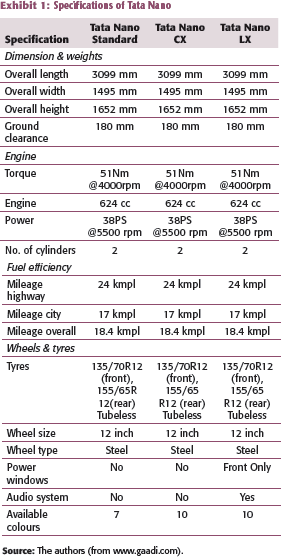
Specifications of Tata Nano
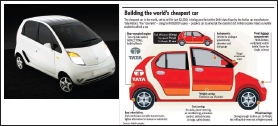
This was considered to be a proud moment for not only the Tata Group but also for the whole country. It was hailed as a reflection of India’s technological and entrepreneurial ability (Bruce, 2008). The car was specially designed and manufactured for the middle-class population of India that desired to have a safer mode of transportation at an affordable cost (Bruce, 2008). The company saw Nano as a business opportunity at the middle and bottom of the pyramid (John & Vivek, 2008). According to the analyst, Vaishali Jajoo of Angel Broking (Mishra, 2010),
The Nano could add ₹10 billion (US$233.15 million), or about 3% of annual revenues to Tata Motors.
It was a splendid period for Tata Motors. The initial period witnessed higher demand for the car than its supply. The company resorted to advance deposits from buyers. The deposit was almost equivalent to the car’s total price (Mishra, 2010). Tata Motors identified and collaborated with 15 preferred banks and lenders to facilitate financing of the car for buyers who needed it (The Economist, 2009).
However, all was not free of turbulences. The company had to face the political fiasco at its manufacturing base at Singur in the Indian state of West Bengal. The manufacturing plant was eventually shifted to Sanand in the Indian state of Gujarat. This was extremely tumultuous and attracted unnecessary controversy (Mishra, 2010). The booking of cars was jeopardized. The situation worsened in mid-2010 when few cars caught fire due to electric circuit failure. The incident raised fear about the safety of the vehicle (Mishra, 2010).
Sales Data of Nano for 2009 to November 2018
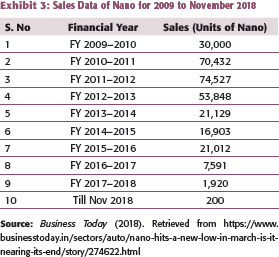
It was calculated that Tata Motors had to sell at least 15,000 Nanos per month to sustain its business (Povaiah, 2013). However, it could sell only 263,619 units until January 2015 (The Indian Express, 2015b). The highest number of Nanos ever sold in any month was 10,475 units in March 2012, and its worst sales figure was 509 cars in November 2010. In the financial year 2014, the company managed to sell only 21,129 units of Nano (Kumar, 2015) (refer to Exhibit 3 for sales figures of Nano).
POSITIONING OF TATA NANO
The Indian car market had been a huge draw to all the major automobile companies across the globe. This was because of India’s low car penetration of just 10 cars per 1,000 people compared to 550 in Australia, 501 in Germany, and 256 in South Korea (Road Transport Year Book, 2011). This presented a real opportunity for a low-cost car. While selecting a car, Indian consumers considered price, fuel economy, driving comfort, maintenance cost, attractive model, status symbol, resale value, latest technology and brand image. Automobile companies had been using these parameters as differentiating factors to develop their positioning strategies.
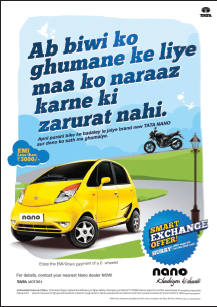
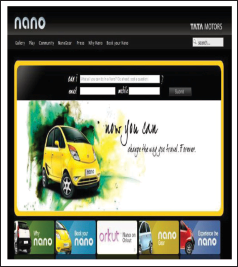
Promoted as a replacement for two-wheelers in its initial campaigns, Tata Nano was positioned as ‘The People’s Car’ (Times of India, 2013). Targeted at middle-class Indian families, the advertisements portrayed Nano as an affordable car. Using the price positioning strategy for Nano, the pivot of positioning and communication efforts of Tata Motors was on the affordability factor (see Exhibit 4). Until 2010, Tata used only print media and social media (Orkut) and billboards (see Exhibit 5). To position Nano as the common man’s car, the company delivered its first car to a paan-wala, a small kiosk owner (Gaurav, 2013).
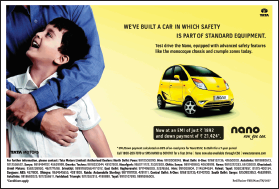
In 2010, the company moved to safety as a theme in its campaigns (see Exhibit 6). This was a part of the counter-marketing strategy against media reports related to instances of fire. However, people were not still sure whether to book the car. They wanted a test drive before making a decision. Tata Motors focused on cementing Nano as a safer vehicle for two-wheeler families (Kuila, 2013).
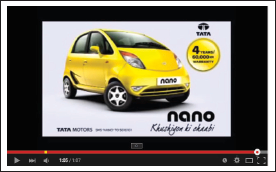
Subsequently, the company opted for a complete change in its positioning and advertising campaigns. In December 2010, Tata Motors launched the campaign, ‘Khushiyon ki Chabi’ (Translation: Key to Happiness) campaign, ‘Khushiyon ki Chabi’ (Translation: Key to Happiness) on prominent television channels. Positioning the car as an aspirational car, the campaign portrayed Nano as a car for the lower middle class, especially families for whom possessing a car was a wish. The campaign targeted those who aspired to replace their two-wheelers with a car (Gangal, 2013). 1 Contrary to the 2010 campaign, where the highlight was affordability, this campaign pivoted around the desire to have one (see Exhibit 7).
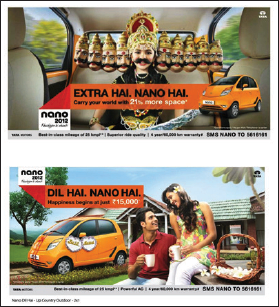
In 2012, there was a slight variation in the positioning of the car. Tata Motors positioned the car with a campaign on comfort at an affordable price 2 (see Exhibit 8). The new campaign, in print and electronic media, reflected Nano’s key features such as ruggedness, pickup, mileage, cooling, play, and manoeuvrability with a subtle emotional pitch. Under this multi-copy campaign, each print copy or hoarding highlighted a unique feature and had a different tag line, such as Dil Hai. Nano Hai (Translation: Nano—like a heart); Extra Hai. Nano Hai (Translation: Nano—with an extra space); Saath Hai. Nano Hai (Translation: Nano—like a companion) (Nagpal, 2012).
In the words of Hormazd Sorabjee, the Editor of Autocar India, ‘The Nano is a brilliant concept’. He also praised the car for its spaciousness and fuel economy (The Economist, 2009).
By this time, the company had ventured thoroughly into both conventional media and non-conventional including social/ digital media for advertising (Panther Media, 2014).
In its odyssey so far, Tata Nano got inadvertently positioned as the cheap car. Locally, it was being referred to gharib ki gaadi (Translation: Poor Man’s Vehicle) (Gupta & Baggonkar, 2009). The company had miserably failed to utilize its strength—technological qualities and features in positioning. The market received the company’s dream car as a cheap car for a poor man, though Ratan Tata had desired it to be positioned as a car for everyone (Brand Kare, 2013). Buying a car in India was quite different from buying a two-wheeler scooter. Having a car was generally considered as a huge leap towards lifestyle and status upgradation. The target buyer of Nano was a scooter/two-wheeler owner buying his first car. According to R. Ramakrishnan, Vice-President (Commercial), Passenger Cars, Tata Motors, ‘Many (two-wheeler) customers feel shy in a swank showroom’ (Businessworld, 2015).
Karl Slym, Managing Director, Tata Motors, had said, ‘Scooter drivers weren’t attracted because others don’t think I’m buying a car, they think I’m buying something between a two-wheeler and a car. Anyone who had a car didn’t want to buy it because it was supposed to be a two-wheeler replacement’ (Philip, 2013).
People had varied reasons against buying a Nano. These ranged from perceptual to those related to physical features. Said one customer, ‘It sounded like an auto-rickshaw (a three-wheeled vehicle common in India). Also the car was underpowered for driving in the mountains (Mclain, 2013).
Delna Avari, a Tata’s Marketing Executive, said,
When a person buys a Nano, there are a lot of people who always ask them: ‘Why? Why did you buy this car?’ Younger customers, are saying ‘I’m not happy with the car the way it is, I need certain things in it for it to be my first car’.
Publicized as the world’s cheapest car and the centrepiece of Tata’s strategy to tap the opportunity at the bottom of the pyramid, Nano had failed to excite buyers after the initial hype (Kant, 2014). For India’s middle class, buying a car was a statement of financial and professional success. For them, Nano’s positioning and brand narrative were too downmarket (Kant, 2014).
TATA NANO: THE NEW AVATAR
The Indian market was graduating up. It had moved from simple feature phones to high-end smartphones, CRT to LCD/LED televisions, and other status symbol products. Premiumization of categories was happening very fast. For it, low price meant poor quality and a low status product.
According to Ratan Tata, Tata Motors had made a mistake in the marketing and positioning of the Nano. He said, ‘It became termed as the cheapest car by the public and, I am sorry to say, by ourselves, not by me, but the company when it was marketing it. I think that is unfortunate’ (The Hindu, 2013).
The company had to move away from this earlier held positioning of the world’s cheapest car and later a people’s car. In the words of Ankush Arora, Senior Vice-President and Head Passenger Vehicle Business Unit, Tata Motors, ‘The Nano needs to be aspirational rather than spartanly utilitarian’ (Economic Times, 2014).
The revitalization of Nano was long overdue.
2013 TWIST LAUNCH
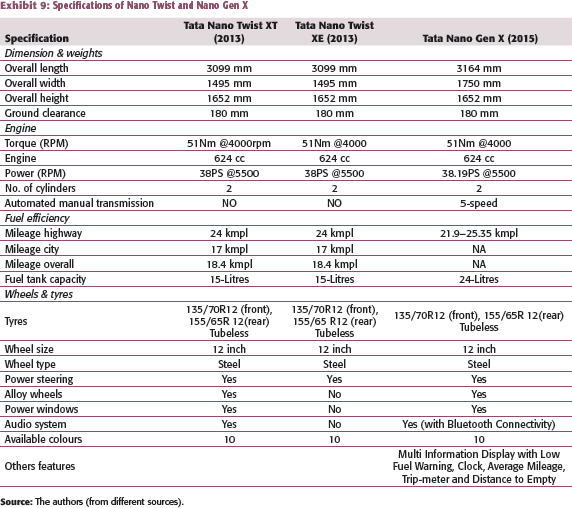
Specifications of Nano Twist and Nano Gen X
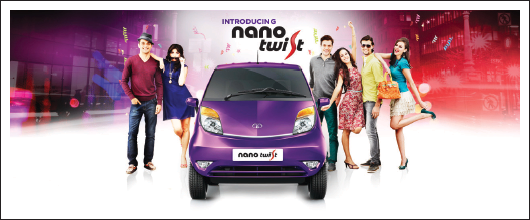
With this revitalized image, the company aimed to attract the vibrant young India. The endeavour was to build a youthful and aspirational value around the brand. The company’s marketing team wanted to reposition it among younger customers and people looking for a second car. The brief accorded was to present Nano Twist as a college graduation gift. The aim was to make the new market use terms such as cool, peppy, and fun while describing the car (Katyal, 2014).
For this, Tata Motors hired upcoming fashion designer Masaba Gupta. ‘Awesomeness’ was the company’s new branding and marketing campaign to overhaul Nano’s brand image (Economic Times, 2014). This new campaign was directed towards the daring, fun-loving and contemporary youth celebrating life energetically and colourfully. It reverberated with brash and youthful words such as youness, kickassness, epicness, magicness, and awesomeness. The campaign was viewed more than five million times within a month of its launch. 3 Besides this, the video had more than 17,000 post likes and over 700 comments from the Nano fan base (Gaurav, 2013).
However, this new version of Nano couldn’t jack up the sales that had been continuously falling over the years. In 2014–2015, the sales of Nano were down by 20% to 16,901 units from 21,129 units in 2013–2014 (The Hindu, 2015).
2015 GENX LAUNCH
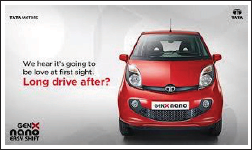
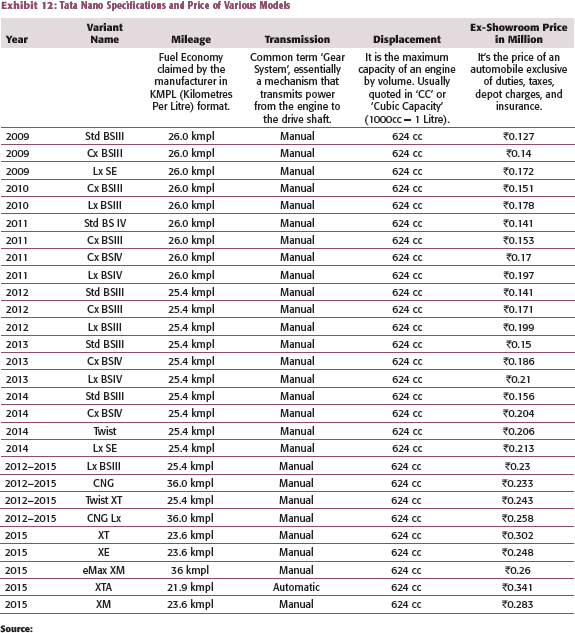
Once again, to shed its cheapest car tag, the company announced the launch of GenX Nano in May 2015 (see Exhibit 11). This time, the plan was to position GenX Nano as an aspirational vehicle among youth (The Hindu, 2015). Here, the engine was to be paired with 5-speed AMT and 4-speed manual gearbox. The Nano with AMT was claimed to have the capability to run for 21.9 kilometres with just one litre of fuel. The company had also replaced its tiny 15-litre fuel tank with a 24-litre one (Overdrive, 2015). This car was to run on the same 624cc petrol motor that generated 35bhp and 51Nm of maximum power output and torque, respectively (The Indian Express, 2015a). Refer to Exhibit 9 for the specifications of this new version of Nano and refer to Exhibit 12 for price.
Tata Nano Specifications and Price of Various Models
Source:
THE WAY FORWARD?
According to many analysts, Tata Motors had perhaps paid the price for being too ambitious. Its portfolio included the country’s cheapest car and the expensive sports utility and luxury vehicles (Kant, 2014). The story might have been different had Tata Motors tried to win one segment at a time just like it had built its commercial vehicle business. The management faced multiple dilemmas. The foremost being to decipher what went wrong: should the company continue with its original positioning or move away to touch the emerging Indian youth.
Footnotes
DECLARATION OF CONFLICTING INTERESTS
FUNDING
The authors received no financial support for the research, authorship, and/or publication of this article.