




Abstract

Executive Summary
The phenomenal growth of e-retailing, particularly in developing countries like India, has created a profitable opportunity for e-retailers. It has attracted many online retailers, which resulted in a crowded marketspace and tough competition to win customers. This has leveraged customers to switch over other e-retailers by the click of a button. It creates a challenging situation for e-retailers to compete with not just offline retail stores but also with different e-retailers. Online retailers use quality web service features to differentiate their offerings from their competitors and evoke positive trustworthiness among online consumers. In this context, the study analyzes the impact of e-service quality determinants on perceived usefulness and e-trust in internet shopping. The study also investigates the mediating role of perceived usefulness amongst the e-service determinants and outcome variables. The study employs stimulus-organism-response as the basal framework to explain online shopping behaviour. A consumer survey was carried out with a questionnaire, which was empirically validated by employing confirmatory factor analysis (CFA). A sample of 660 respondents was non-randomly drawn from a population of online consumers in Jammu and Kashmir. Structural equation modelling (SEM) was adopted to analyze data and test hypotheses. Results revealed that online service quality determinants and perceived usefulness directly affect e-trust, and perceived usefulness has a mediating effect on e-trust. The study’s findings are useful for website developers and online retailers in crafting innovative and effective designs to maximize trust and perceived usefulness. The study adds to the understanding of e-commerce by developing a revised trust-based consumer online shopping model to describe various factors that influence consumers’ online shopping attitudes and how perceived usefulness mediates the relationship among the variables.
Internet and web development have become one of important channels for selling, purchasing, trading, and distributing goods and services between enterprises, within enterprises, between enterprises and consumers, and even between consumers (Faraoni et al., 2019; Turban et al., 2017). With increasing internet access, the use of online shopping services has been booming globally and locally. It has been observed that the global online retail sales during 2017 were observed to be $2.38 trillion and is predicted to reach $4.20 trillion in 2020 and $6.54 trillion by 2023 (eMarketer, 2019). Locally, the Indian online retail sales were estimated to be $60 billion in terms of the gross merchandise value (GMV) by the end of 2020. Further, the total number of online shoppers was observed to be 35 million in 2014 and will increase to 175 million by 2017, and about 33% of the customers will drive two-thirds of their total shopping via the internet (Google–A.T. Kearney, 2016). Even in rural India, the number of online shoppers is increasing by 58% annually. Comparing online retail sales with China brings out stark differences even though India has the almost same population as that of China. China’s data shows that online sales as a percentage of total retail sales were over 15% versus 1.6% for India and around 14% globally (Economic Times, 2019). This depicts that Indian consumers are still reluctant to purchase high-value products from e-retail sites. The possible reason can be attributed to their lack of trust in e-retailers. While shopping online face-to-face interaction with the salesperson is replaced by a complex socio-technical system in the form of the user-friendly web interface, reliability, security, web information and healthy interaction between the user and e-shopper (Islam et al., 2019; Wolfinbarger & Gilly, 2003). Both academic research and popular press regarding e-commerce phenomena in India are primarily metro-city centric (Rao & Rao, 2012). The primary motivation for this study comes from the research work of Connolly and Bannister (2007) and their call for more work across different economies to gain a deeper understanding of e-trust.
Researchers have argued that trust is a prerequisite for successful e-commerce because consumers hesitate to make purchases unless a trusting relationship is developed between e-retailer and e-buyer (Gefen, 2002; Jarvenpaa et al., 1999; Kim et al., 2005; Urban et al., 2000). AlGhamdi et al. (2011) have observed that a lack of trust in a vendor is a critical factor inhibiting online transactions. Further, researchers have suggested that lack of trust is emerging as one of the significant obstacles to the success of internet shopping (Alshehri et al., 2012). Research has shown that a high level of consumer trust encourages online purchase intentions and helps in retaining online customers (Gefen, 2004; Reichheld & Schefter, 2000). Today, India’s e-vendors are facing an uphill task of bringing new customers, retaining existing ones and increasing revenue per customer. A better understanding of trust and its determinants could enhance the prospects of e-vendors to offer customized products and services to Indian consumers.
E-retailing is about not just selling products through web stores but also offering tangible and intangible services to the consumers. Developing a website that is responsive to customer needs is crucial for web designers and managers. To become successful and achieve better customer satisfaction, superior e-service quality is essential (Kim & Kim, 2010; Yang et al., 2004). According to Santos (2003), e-service quality can maximize the online competitive advantage of e-retailers. High service quality would increase the firm’s overall profitability and customers also become more comfortable in making purchases through the internet (Shankar & Datta, 2020; Yang & Fang, 2004). It would be interesting to identify the key determinants of e-service quality that potentially influence perceived usefulness and e-trust. The central idea of such an effort is to minimize the gap between companies’ efforts and customers’ expectations with advanced technology by enabling the customer service front to be more efficient (Thakur & Srivastava, 2015).
Several studies have empirically evaluated website quality (Ahmad et al., 2017; Hsu et al., 2012; Jeon & Jeong, 2017). However, little diagnosis of the impact of e-service quality on e-trust conditioned by perceived usefulness has been conducted. This study aims to identify and prioritize the dimensions of e-service quality in an e-tail context so that an e-vendor can focus on the dimensions that matter most. The study may be more relevant in developing economies where e-tail is currently in the growth stage. Because most of the e-tail related research has been conducted in developed economies and researchers call for rigorous investigation in emerging economies (Mummalaneni et al., 2016) and non-European cultures (Blut et al., 2015). In light of the above discussion, the current study is devoted to understanding the relationship among e-service quality, perceived usefulness and e-trust in emerging economies namely, India and specifically focused on a unique market segment within this larger economy, that is, Jammu and Kashmir.
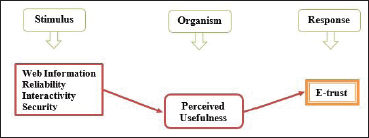
To undertake the study, the authors applied the concept of stimulus-organism-response (S-O-R) framework as the underlying mechanism to establish the conceptual relationships among the various identified variables in the study. The S-O-R theory deciphers that environmental attributes act as significative stimuli that influence an individual or organism’s internal (cognitive) state and compels them towards the desired behaviour. In congruence with the S-O-R theory, ‘stimulus’ in the present study is represented by e-service quality attributes (with which consumers interact) that affect consumers’ internal state and perceived usefulness. Such attributes act as cues and penetrate consumers’ conscious brain and provoke them to action (Loureiro et al., 2019). The ‘organism’ relates to the evaluation of significative stimulus through internal cognitive processes (between inputs and consumer’s outcome). Perceived usefulness is posited as an ‘organism’ in the present study. This processing of stimulus helps to make some action-oriented decisions (Loureiro et al., 2019). The ‘response’ is related to the outcome in the form of behavioural change. While interacting with e-tail service quality attributes, customers are exposed to several cues that trigger a favourable attitude towards the e-tail website. This favourable experience results in consumer trust development and maintains their retention intention (Roschk et al., 2017).
Literature Review and Hypotheses Development
E-service Quality Scales.
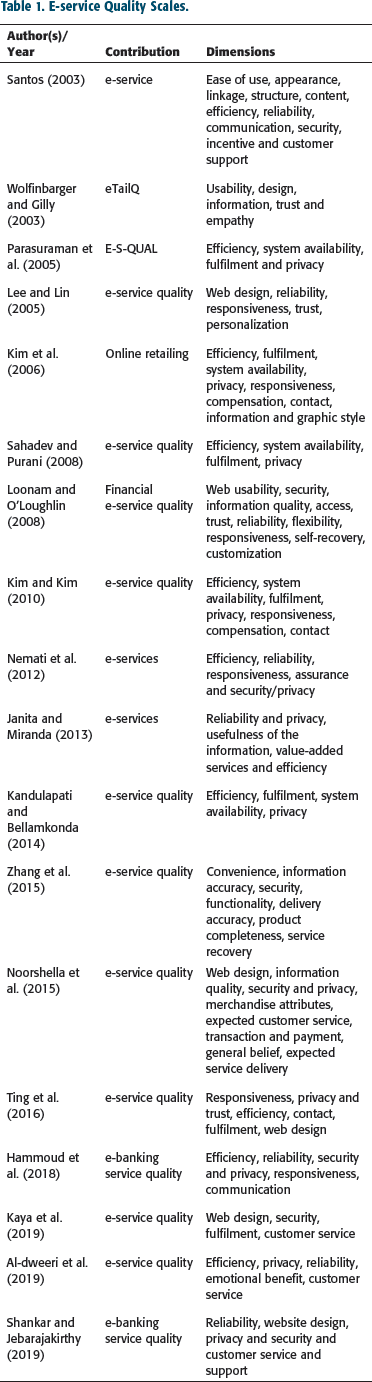
As shown in Table 1, Santos (2003) and Wolfinbarger & Gilly (2003) developed an e-tail quality scale to include dimensions such as usability, reliability, security, efficiency, customer support, trust and information. Later, Parasuraman et al. (2005); Lee and Lin (2005); Kim et al. (2006) developed several scales to measure e-service quality. They further opined that online purchasing behaviour is also influenced by system availability during purchasing, customer information privacy, personalization of e-vendor offerings, and responsiveness during service delivery. But these e-service quality scales lacked aspects related to pre and post-interaction stages in e-services. Some researchers added items related to the quality of the information displayed on the webpage, access to web store, and service recovery in case of service failure (Kim & Kim, 2010; Loonam & O’Loughlin, 2008; Nemati et al., 2012). Therefore, web information, privacy/security and interactivity (two-way communication) become crucial aspects of e-service quality. Janita and Miranda (2013) have added a new dimension to the e-service quality scale, that is, value-added service. Zhang et al. (2015) found that convenience and functionality increase the frequency of usage of e-facilities.
Further, researchers also opined that improving web design and security/privacy is a concern for retail web store users (Shankar & Jebarajakirthy, 2019). Hammoud et al. (2018) reported security and privacy to be an essential concern even after the purchase of e-services (Shankar & Datta, 2020). Recently, it was reported by Al-dweeri et al. (2019) that emotional benefits associated with web store purchases influence consumer attitude towards e-services. Researchers have opined that the validity of previously developed scales should be continuously assessed across time, culture, market, and industry (Griffin et al., 2004). They suggested that these external elements affect the psychometric properties of the scale and necessitate calibration of scales. It was concluded from the above discussion that very few studies had considered web information, reliability, privacy/security and interactivity together as the dimensions of e-service quality and antecedents of trust in the e-tail context. In light of cited literature following dimensions of e-service quality have been considered for the present study.
E-trust
E-trust has been defined as ‘an attitude of confident expectation in an online situation of risk that one’s vulnerabilities will not be exploited’ (Corritore et al., 2003, p. 740). Trust can also be referred to as a belief of an individual in the trustworthiness of others that can be dogged by their perceived veracity, generosity and proficiency (Lin, 2011; McKnight et al., 2002). Urban et al. (2000) have deciphered that the use of the internet in e-commerce involves trust, and therefore trust is very significant in the e-tail context. Grabner and Kaluscha (2003) opined that trust as a construct has widely been considered in e-commerce research. However, very few of these studies have linked trust with e-service quality. Gefen et al. (2003) argued that consumers gradually (after shopping online) come to know about the benefits and usefulness of online shopping. The image builds in consumers’ mind enhances a sense of security, quality and trust perceptions (Kim et al., 2008; Lee & Lin, 2005; Lin et al., 2019).
Web Information
Web information is the quality and quantity of information available on the website regarding a product or service (Lohse & Spiller, 1998; Schubert & Selz, 1998). Liu et al. (2000) emphasized the importance of useful product information to consumers, allowing them to perceive high-quality content to websites in both graphic and text form (Lee & Littrell, 2005). The information provided on the web portal of e-stores will decrease shoppers’ time and energy spent on searching for information regarding a particular product or service (Kim et al., 2008; Kim & Li, 2009). Researchers have found that information quality and system quality significantly influence consumers’ website satisfaction and willingness to use the website again which develops e-trust among users (Everard & Galletta, 2006; Jones & Leonard, 2008). It was found that web information and interface factors are strong predictors of customer trust, satisfaction, and loyalty for internet retailers (Wolfinbarger & Gilly, 2003). Muylle et al. (2004) suggested that entry guidance pertains to web site user satisfaction, leading customers to locate the needed information easily. Consumers give more weightage to the information that meets product purchases from the website and enhances both perceived usefulness and perceived ease of use and trust levels (Ahn et al., 2003; Chen & Wells, 1999). Based on the above discussions following hypotheses are proposed:
Reliability
In the present study, reliability is operationalized as the accurate display and description of products and services so that customer receives products that they have ordered on promised time (Vos et al., 2014). It is considered one of the critical factors in e-service quality because most of the websites provide customers with information about the order’s status via mail or SMS. It is noteworthy that consumers should also be able to return goods purchased on the web store if they do not find it to their liking (Ho & Lee, 2015). Dabholkar (1996) has observed that ease of use and reliability has a significant relationship with usefulness. Moreover, Zhu et al. (2002) have found that reliability has a direct positive effect on perceived service quality and customer satisfaction in e-banking systems (Lee & Lin, 2005). Wolfinbarger and Gilly (2003) have argued that reliability is the basic building block of online quality and influences usefulness and e-trust in internet retailing. It has been deciphered that reliability helps build trust, and enhance customers’ repeated purchase intention (Swaid & Wigand, 2009). Researchers have also confirmed that reliability is the strongest predictor of online satisfaction, usefulness and e-trust (Giovanis & Athanasopoulou, 2014; Kim et al., 2009). In the light of above-discussed literature following hypotheses are formulated:
Interactivity
Interactivity in an online shopping context refers to the degree of communication between consumers and e-retailers, anywhere any time (Jayawardhena & Wright, 2009). The various online services provided by e-store websites increase interactivity with consumers, including- e-inquiry form, order tracking status, consumer review and feedback (Islam et al., 2019; Lim & Dubinsky, 2004). Ghose and Dou (1998) have argued that the degree of interactivity between e-retailers and consumers influences perceived web quality and usefulness. Welch and Hinnant (2003) have opined that transparency and interactivity are key elements of online services that might help build user trust. Venkatesh and Ramesh (2006) have argued that customizing a website helps users save time and provides information that is of greatest interest to them. Lee (2005) has argued that interactivity has a significant effect on consumer trust in e-commerce. Researchers have investigated that interactivity has a positive effect on higher product prices only when the consumer has a high level of online trust (Hammouri & Abu-Shanab, 2017; Islam et al., 2019). On the basis of the above discussion following hypotheses have been proposed:
Security
Cox and Dale (2001, p. 44) define online security as the ‘technical safety of the network against fraudulent practices or hackers’. In e-retailing, it refers to e-vendors not sharing information with third parties unless any permission given by the customer to share customer’s details (Collier & Bienstock, 2006). It has been reported by Hammoud et al. (2018) that security is an indispensable concern even after the purchase of e-services. Web stores that provide system security during consumer interactions enhance both usefulness and trust. Researchers argued that improvement in the security of online transactions is a key concern for the users of e-facilities (Shareef et al., 2011). It was also deciphered that trust is closely linked with security and system integrity within an online domain (Madu & Madu, 2002). Flavian and Guinaliu (2006) have found that perceived security by online consumers regarding their personal data held with e-retailer influences trust. Online retailers can increase perceived usefulness and trust among consumers by reducing perceived environmental risk and increasing security (Eid, 2011; Warrington et al., 2000). Based on the above discussions following hypotheses has been formulated:
Perceived Usefulness
Perceived usefulness has been defined as a degree to which e-shoppers believe that internet shopping will enhance his/her buying performance. An e-store website can accomplish usefulness if it delivers services to customers according to their expectations (Barnes & Vidgen, 2000). The usefulness and accuracy are the two prominent variables that influence consumer attitude. Mcknight et al. (2002) have argued that perceived usefulness and perceived ease of use can help develop trusting intentions on an e-commerce website. However, some researchers have observed that perceived usefulness influences e-trust (Mou et al., 2017; Suh & Han, 2002), while others argued that trust influences usefulness (Chiu et al., 2009; Gefen, 2004). Salimon et al. (2014) observed that perceived usefulness positively correlates with satisfaction and trust in banking service adoption. Further, it has been opined by Tu et al. (2012) that perceived usefulness and e-satisfaction have a positive relationship in consumer to consumer markets. On the basis of the above discussions following hypothesis has been formulated:
Research Model
Figure 1 displays the proposed research model for the study. The model indicates four e-service quality determinants, namely web information, reliability, interactivity, and security as independent variables and e-trust as a dependent variable. In addition, perceived usefulness acts as a mediator in the proposed model. Since the study has adopted the stimuli-organism-response (S-O-R) framework, e-service quality dimensions act as a stimulus, perceived usefulness as organism and e-trust as a response in the proposed research model (Figure 1). The line from e-service quality dimensions to perceived usefulness and perceived usefulness to e-trust indicates structural paths. The study is aimed to empirically verify these relationships among the variables.
Research Model.
Methodology
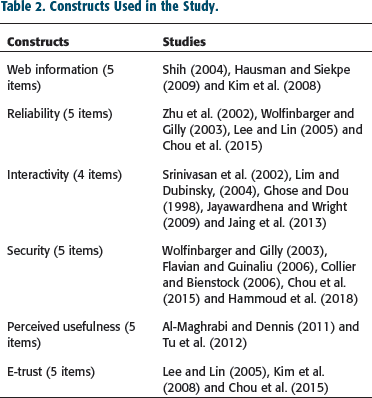
Survey Instrument Development
Constructs Used in the Study.
Pre-testing and Questionnaire Validation
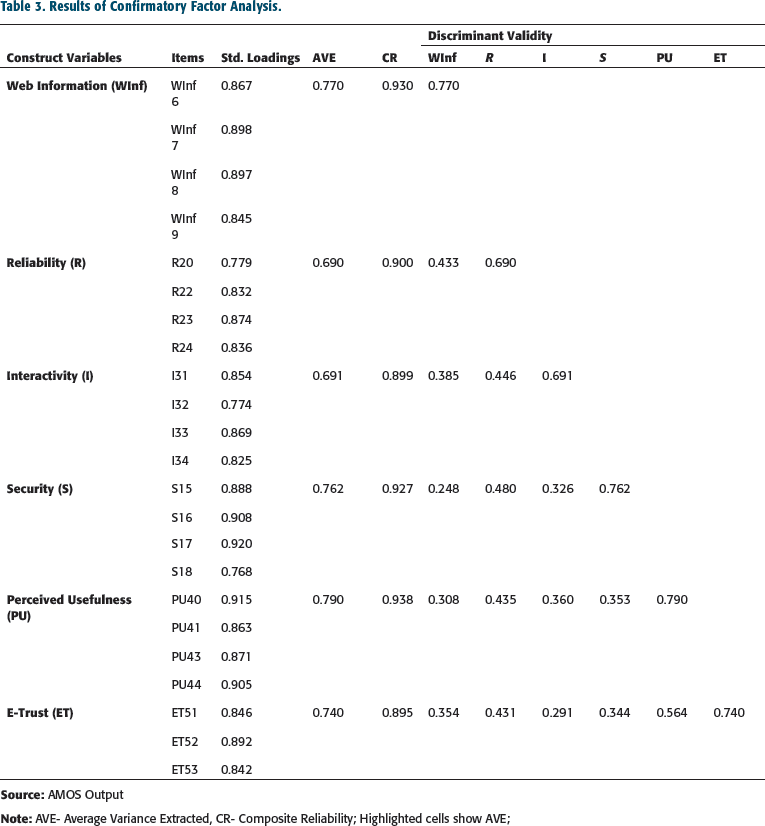
Before drawing a sample from a population of online consumers, a preliminary test was performed to finalize the questionnaire developed. In the initial stage of preliminary testing, the face and content validity of the questionnaire was finalized by consulting several experts from both academia and the e-retail industry. In the second stage, questionnaires were distributed among 135 e-shoppers to identify any ambiguity in the statements that were likely to confuse respondents and to make the questionnaire a standardized instrument. After receiving the feedback from experts and pilot respondents, a few questions were modified. Statistically, the instrument/questionnaire was validated by applying confirmatory factor analysis (CFA). CFA was performed using AMOS 21 to check the fitness of the measurement model. The results show that all fit indices exceed the required minimum threshold. It was observed from the model that the ratio χ2/df is 1.58, which is lower than the threshold value of 3.00 (Carmines & McIver, 1981). Comparative fit index (CFI), goodness of fit index (GFI) and normed fit index (NFI) values are 0.950, 0.901 and 0.904 respectively; it is desirables that these fit indices should exceed 0.90 (Byrne, 1998).
Results of Confirmatory Factor Analysis.
Population, Sampling and Data Collection
The present study includes consumers who have prior experience of online shopping in Jammu and Kashmir. The reason for selecting Jammu and Kashmir for the present study is that this region is quite different from the rest of India in terms of its unique geographical location, socio-cultural aspects and more importantly, the prolonged political conflict and its subsequent influence on the day-to-day business in the region. Consequently, J&K is positioned as a distinctive market segment that needs a unique marketing strategy to cater to customers’ changing aspirations in this region. Criterion based on which the sample size was selected includes that each item should have 10 respondents (Hair et al., 1998; Hinkin, 1995). Hoelter (1983) has argued that a sample size of 300 is adequate for testing a SEM model. Hence, a sample size of 300 or above is good. The study employed purposive sampling for collecting data from respondents. A larger sample was taken to avoid sampling bias that might be caused due to non-probability sampling. It has been ascertained by Leary (2004) that a non-probability sample could provide evidence in supporting the theory. Respondents were approached through online mode by e-mail and WhatsApp. Since the sampling frame was not available, the consumer contact details were obtained from the courier firms (e-com express, JV express, Blue Dart, etc.), which deliver the products to the customer. The courier firms mentioned above deliver 85% of the parcels in Jammu and Kashmir. Consent was sought from the courier companies to share customer information with researcher/s, and upon confirmation, a total of 868 questionnaires were circulated online (by generating a link in Google Forms), 674 responses were received. Of these, 660 were considered for the study and a few questionnaires were incomplete.
Common Method Bias
Common method bias is being considered as the main source of measurement error in behavioural sciences. Such errors may arise due to consistency motif, illusory correlations, implicit theories, leniency biases, acquiescence and so on. To overcome such bias, the study applies Harman’s Single Factor test for addressing such issues. This exhibits to load all the items in exploratory factor analysis into a single un-rotated factor solution to determine the variance explained by this single component. This single component should explain less than 50% of the variance (Harman, 1960; Podsakoff et al., 2003). After loading all the items in a single component, the results of this test explain 36.17% of the total variance.
Sample Characteristics
Of the total 660 respondents, 45% of respondents were from Jammu, 47% from Kashmir and 8% from the Ladakh region. The highest percentage of respondents were found from rural areas (55%) than urban areas (45%). The sample contains 55.6% male respondents and 44.4% female respondents. The maximum number of respondents in the sample were single (78.9%) vis-à-vis the married respondents (21.1%). The highest number of respondents belongs to the 21–30 years age group (53.3%) and the lowest number of respondents belongs to the above 40 years age group (4.2%). The other two age groups, that is, below 20 years and 31
Results
SEM Results
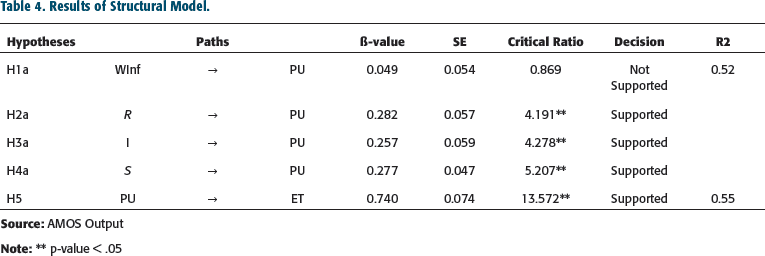
Hypotheses testing was performed through structural equation modelling. A structural model was developed to determine the relationships among constructs (web information, reliability, interactivity, security, perceived usefulness and e-trust) and evaluate the validity of the proposed model. SEM was carried out on the final data of 660 respondents. Table 4 presents
Results of Structural Model.
Mediation Results
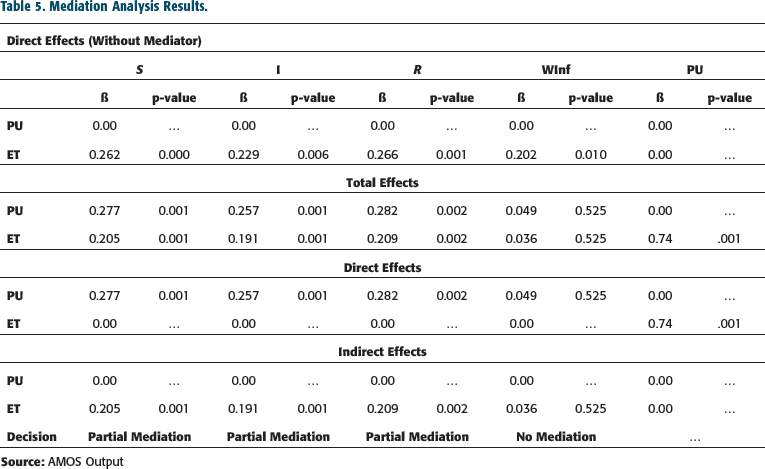
Mediation Analysis Results.
Discussion
The study has empirically evaluated the research model by applying the S-O-R framework in the online retailing context with specific reference to Jammu and Kashmir. This study attempts to contribute to internet marketing literature by validating the e-service quality dimensions and empirically evaluating their impact (both direct and indirect) on e-trust in uncertain and volatile economies. The findings of the study reported that e-service quality dimensions (stimulus) influence perceived usefulness (organism), and perceived usefulness directly influences online trust (response). The study has found that web information has an insignificant influence on perceived usefulness. Information made available on the website of an e-store regarding online transactions and products has no effect on consumers’ perceived usefulness. Perhaps, the customers have enough information about the products and online services before going to the website. These findings are in direct contrast to the research works of Ahn et al. (2003) and Kim and Li (2009), who have confirmed that web information influences perceived usefulness. However, a significant direct impact of web information was observed on e-trust in the absence of any mediator. Such findings support the research works of Jones and Leonard (2008) and Wolfinbarger and Gilly (2003).
It was found that reliability has the strongest impact amongst the e-service quality determinants on perceived usefulness. E-store vendors should ensure error-free transactions and should have a reasonable policy for the return of the products. Product return is one of the major problems faced by webstores and is one of the prominent reasons for losses to the e-retail industry in India. If a product return exceeds 10% it becomes a burden on an e-retail company. Therefore, it is suggested that the products displayed on the website should not have counterfeits and only actual products should be delivered to consumers. The consumers should come again to purchase from the particular webstore rather than return products back to the company. These analytical results are consistent with Lee and Lin (2005), Kim et al. (2009), and Giovanis and Athanasopoulou (2014). The study has also found that perceived usefulness partially mediates the effect of reliability on e-trust. The reason for such mediation being that timely delivery of products and reliable product quality displayed on the website will enhance the usefulness of the website which in turn builds stronger trust & commitment among consumers towards the website. Therefore, trust can be enhanced more when perceived usefulness is given due consideration rather than reliability only. These findings are in accordance with the findings of Kuo (2003), Wolfinbarger and Gilly (2003) and Vos et al. (2014), who have observed that reliability is a basic building block of online service quality and positively influences the perceived usefulness of webstores towards consumers. Therefore, efforts should be made to convert low-frequency e-consumers into regular consumers by addressing web information and reliability issues.
Further, it has been revealed that interactivity has a significantly positive impact on perceived usefulness. To enhance the impact of interactivity on usefulness, better customer support services should be provided, and customer complaints should be promptly addressed. Product reviews are considered as the key motivators which influence the purchase decision of online consumers. The webstores should seek post-purchase product reviews from buyers and make them available on their websites. These findings are in conformity with the findings of Ghose and Dou (1998). The study has also found that perceived usefulness partially mediates the effect of interactivity on e-trust. The reason for partial mediation is that e-relationship quality and better customer engagement will encourage consumers to visit the website more frequently, which builds trust and commitment towards the website. These findings conform to the findings of Srinivasan et al. (2002), Welch and Hinnant (2003), and Hammouri and Abu-Shanab (2017), who have found that customization of the website helps users save time and provides information that is of greatest interest to them, which enhances web usefulness and e-trust level among the consumers.
The study has also found that security has a significantly positive impact on perceived usefulness. To enhance perceived usefulness, online webstore should have adequate security measures that will facilitate safe and secure online transactions. Customers’ banking and credit/debit card details need to be kept confidential to win consumer trust and commitment. These findings are as per the research findings of Shareef et al. (2011) and Flavian and Guinaliu (2006). Further, the results depict that perceived usefulness partially mediates the effect of security on e-trust. These findings conform with the research findings of Madu and Madu (2002) that security is closely linked with trust and system integrity within an online domain, which can directly enhance trust and indirectly can make the website more user friendly. Flavian and Guinaliu (2006) also support the findings that perceived security regarding personal data held with e-retailer influences trust. R-square statistics reveal that the four constructs in combination determine 52% of perceived usefulness. The remaining 48% can be explained by constructs beyond the scope of this study. Contrary, when individual influences of these variables are evaluated, reliability has a stronger influence followed by security and interactivity.
Furthermore, study findings reveal that perceived usefulness has a significantly positive influence on e-trust. Thus, consumers agree that perceived usefulness influences consumer attitude and their trusting behaviour towards web stores. These findings got support from the previous researchers, namely McKnight et al. (2002); Suh and Han (2002); and Barnes and Vidgen (2000), whose findings reinforce the study’s findings. Therefore, webstores should deliver a better customer experience through customer engagement and customer co-creation. R2 statistics reveal that perceived usefulness explains 55% of the variance in e-trust (R2 = 0.55) and the remaining 50% is explained by variables beyond the scope of this study.
Implications
The findings of this study will assist managers in designing strategies and programmes for online markets. The three e-service quality determinants directly impact perceived usefulness and have an indirect impact on e-trust. The highest impacts were observed for reliability and perceived usefulness, which means e-retailer managers should focus on these key dimensions as the major drivers on e-trust. The study will also provide value to international online retailers to expand their operations in Jammu and Kashmir, where the e-commerce business is still poorly developed due to geopolitical disturbances. Based on consumer assessments of e-service quality dimensions, practitioners can allocate corporate resources to various e-service quality attributes needed to build strong bonds of trust and commitment with webstores. Managers can benchmark the e-service quality assessed in the study with regular quality assessment measures used in the e-retail industry. This will enable practitioners in the efficient management of internet service quality. Such activity could be routinely replicated (annually or quarterly) to assess consumers’ changing needs and tastes over time. These regular evaluations will help in designing a proper e-service quality mix that has a significant effect on e-trust. Therefore, continuous monitoring of consumers’ trust regarding e-service quality dimensions discussed in the study will help take the right marketing and managerial decisions, and design proper e-marketing strategies to expand and grow the business.
The results have deciphered that reliability has the strongest impact on usefulness and trust. For reliability, the idea here is that customers should receive what has been ordered by him/her. On the part of the e-retail store, there should not be any discrepancy in what was ordered by customers and what has been delivered. Therefore, practitioners and webstore managers should consider this criterion as a strategic input to strengthen the relationship with their customers and maintain healthy relationships for longer time periods. Because building trust is a long-term process that requires developing a strong and long-lasting bond with customers. This long- term relationship is built with the delivery of services according to customer expectations and repeated purchases/visits to e-stores.
Limitations and Scope for Future Research
The study’s main limitation relates to a small sample, which was derived from one region, that is, Jammu and Kashmir. Therefore, the generalizability of the results is limited, and practitioners need to be cautious while generalizing results. Since the study was conducted in the e-retail sector, replicating the study to other sectors such as e-banking, e-healthcare and e-governance is recommended. The variables were adopted from existing studies and were later on tested for reliability and validity, which provides initial support for these measures. But there remains a possibility that all e-service quality measures are not captured (because only 55% of e-trust is explained by the e-service quality dimension undertaken in the study). Therefore, future researchers should adopt a qualitative methodology to get additional insights from customers regarding other aspects of e-service quality that are yet to be examined. Future researchers can also explore the effect of variables such as social bonds, habit-driven behaviours, online purchase experience and switching costs on perceived usefulness and e-trust.
Conclusion
Lack of trust in internet shopping has been recognized as one of the key factors for engaging individuals in e-shopping. Lack of trust leads to financial losses to an online business as the vendor will not generate expected revenues. For the future success of dot.com, online vendors need to create a climate of trust and confidence. The proposed model contains four e-service quality determinants: viz. web information, reliability, interactivity, and security. Three directly influence perceived usefulness and indirect e-trust except for web information. Online vendors need to focus on visually appealing, user-friendly and informative web designs to enhance usability and build up their confidence. Web stores need to focus more on web reliability and quality of interaction between the users through customer service delivery. This specific information regarding products and services, safe and secure online transactions, and consistent product delivery systems adopted by web stores help enhance perceived usefulness, and develop trustworthiness and credibility among the users. The web store server should not be heavily loaded with contents as it might cause unnecessary delays in loading the web page. These unnecessary delays in loading websites can irritate users and influence their trust level. The purchase transactions should be secure, error free and without undue delay. E-retail managers need to adopt a combined strategy that targets both e-service quality dimensions and perceived usefulness. Also, perceived usefulness partially mediates the effect of e-service quality dimensions on online trust. Hence, building and sustaining consumer trust in e-commerce settings has nowadays become a challenge for e-retailers. It has become imperative for e-retailers to design and develop websites that address the behavioural interests of consumers.
Annexure I
Web Information
WInf5. The e-store website provides sufficient information when I try to make a transaction.
WInf6. The online websites provide correct information about the items that I want to purchase.
WInf7. The e-store websites provide timely information.
WInf8. The online shopping websites provide reliable information.
WInf9. I am satisfied with the information that the online shopping websites provide.
Reliability
R20. The items displayed on the e-store websites are actually the same that are delivered.
R21. The products delivered by e-stores are well packaged.
R22. The e-store websites provide error free transactions.
R23. The return policy of e-stores is reasonable.
R24. The product is delivered at the time promised by e-vendor.
Interactivity
I31. The e-store websites have prompt customer support system
I32. The e-stores have better service than traditional retail stores.
I33. The e-stores have an efficient policy for product return and cash back.
I34. Product reviews are easily available on e-store websites which influence my buying decision.
Security
S15. The e-store websites have adequate security.
S16. The e-stores websites have safe online payment mechanism.
S17. I feel that e-stores implement security measures to protect the users.
S18. I believe that e-store has a superior mechanism to handle online hacking.
S19. I believe that online shopping transactions are protected and secured.
Perceived Usefulness
PU40. Online shopping makes me accomplish my shopping goals more quickly.
PU41. Online shopping makes it easier to satisfy my needs.
PU42. Online shopping helps me in improving my shopping decisions.
PU43. The online shopping makes it easier to search for and purchase goods.
PU44. The online shopping increases my effectiveness in purchasing goods.
E-trust
ET50. I believe that online shopping sites are trustworthy.
ET51. The e-stores are more customer-caring.
ET52. The e-stores keep its promises to its customers.
ET53. The e-stores encourage and build customer confidence.
ET54. Online shopping has many uncertainties so cannot be trusted.
