




Abstract

Take up one idea. Make that one idea your life- Think of it, Dream of it, Live on that idea.
—Swami Vivekananda
In January 2016, Dr Uday Gajiwala, co-founder of the Divyajyoti Trust, was thinking about the progress and future of Tejas Eye Hospital (TEH). The hospital, promoted and managed by Divyajoti Trust was located in Mandvi, 1 served a tribal population of 2.5 million spread in 2,000 villages. In addition to providing ophthalmology 2 services, TEH expanded its scope to become a community health care centre. In a span of five years, TEH conducted more than 16,000 surgeries and treated 1.3 million outdoor patients. Dr Gajiwala was satisfied with the progress of TEH so far. He was also instrumental in providing rehabilitation support to the visually challenged population in this area. He supported the Trust’s initiatives to enhance the skills of the community members for better employment. He was concerned about the challenges in deepening the value chain of TEH in this area and replicating this model in various tribal locations in India.
OPHTHALMOLOGY CARE IN INDIA IN 2015
India is home to about 12 million visually challenged people, and 8 million people who are visually impairment in one eye. Approximately 36 million people have low vision requiring regular professional monitoring and fellow up. Cataract is the single largest common cause of blindness in India.
As of 2015, there were 16,000 practising ophthalmologists in India, of which 8,000 were surgically active. Approximately 80% of the ophthalmologists were located in cities, whereas 70% of the Indian population lived in rural areas. The ophthalmologist: population ratio ranges from 1:50,000 to 1:20,000 depending on the region. The total number of cataract surgeries performed in 2015 in India was 6.5 million. The average number of surgeries performed in a year by an Indian ophthalmologist was 400. In 2015, India had the highest cataract backlog in the world. To clear the backlog of cataract surgeries in India over the next five years, each ophthalmologist would need to perform 700 surgeries every year. 3
DIVYAJYOTI TRUST
Mr Bharatbhai Shah and Dr Uday Gajiwala, established Divyajyoti Trust in January 2010. Shah was the president of ‘Manav Seva Sangh’, a non-governmental organization, located in Civil Hospital, Surat, for nearly 12 years. The Sangh provided free food to the caretakers of patients from an economically vulnerable background in the civil hospital, Surat.
Dr Gajiwala was the head of the Ophthalmology programmes of the Society for Education Welfare and Action (SEWA) rural. He has been associated with SEWA rural for more than two decades. He contributed extensively to the development of standard operating procedures to deliver comprehensive ophthalmology care services. His extensive fieldwork in rural areas gave him first-hand experience and exposure to the ground realities related to ophthalmology health care among underprivileged tribal communities in Gujarat. Dr Gajiwala performed about 600 surgeries in a year. Through his efforts, nearly 800 incurable visually challenged people were rehabilitated in Jhagadia 4 Area. Dr Gajiwala designed an integrated education activity for visually challenged children and administered the same to 100 children. (For a detailed profile of Dr Gajiwala, see Exhibit 1.) Inspired by Mahatma Gandhi and Swami Vivekananda, 5 the founders of Divyajoti Trust decided to devote their life to the service of humanity. They sought support from several like-minded people. The Trust launched a series of activities by leveraging local talent and resources to help economically weak tribal communities. The main objective of the Trust was to deliver comprehensive ophthalmology care, therefore, enabling overall development by providing the community enhanced access to employment opportunities. In future, the Trust proposes to extend its services to primary healthcare, medical relief, hospital services, education, farming and cultivation for the benefit of the local tribal population. The general thrust of these initiatives was to promote socio-economic welfare among tribal communities in rural areas.
Profile of Dr Uday Gajiwala.
Master’s Degree in Ophthalmology from Gujarat University, 1991.
Dr Gajiwala headed the Ophthalmology healthcare programmes of Society for Education Welfare and Action (SEWA) Rural for about 20 years. He was instrumental in developing comprehensive ophthalmology care services.
Divyajyoti trust and ophthalmic mission trust, District: Dahod, Gujarat.
Vision Foundation of India and Trust operated eye hospital, District: Valsad (Gujarat)
Dr Gajiwala is considered to be an expert in infection control practices. He has authored and co-authored several manuals and guidelines. He has published several publications in national journals and articles in international medical journals.
Recipient of—‘Sivananda Ratna’ from Gujarat Divya Jivan Sangh, Sivananda Ashram, Ahmedabad in 2006. ‘Vision Award’ by Vision 2020: Right to Sight India programme at Udaipur on the occasion of World Sight Day celebration October 2010. ‘Vocational excellence’ award by Rotary Club of Ahmedabad in 2011. Dr G. Venkatswamy memorial award by Community Ophthalmology Society of India, Delhi 2015.
Member of All India Ophthalmological Society, Delhi Ophthalmic Society, Indian Medical Association
BJ Medical College Alumni Association, Hospital Infection Society of India and International member—American Academy of Ophthalmology.
Institutional member of the Vision 2020 India forum on behalf of Divyajyoti Trust.
Editorial board member of Community Eye Health Journal.
President—Vision 2020 Gujarat Chapter and President, Indian Medical Association, Mandvi chapter.
The need for ophthalmology care in the economically weaker rural tribal community was high in the tribal districts of Gujarat. As one of the co-founders was an ophthalmologist with extensive field experience in community ophthalmology, it was only natural that the Trust commenced its activities (in 2010) with ophthalmology care through TEH.
Mandvi, located in Surat district, is 61 km away from Surat city. TEH provided ophthalmology care for about two million population in the district. In addition, it extended its services to another two million people located in Bharuch, Navsari and Tapi 6 districts and tribal areas of Maharashtra (an Indian state), which were geographically contiguous to Surat district.
Evolution of Divyajyoti Trust.

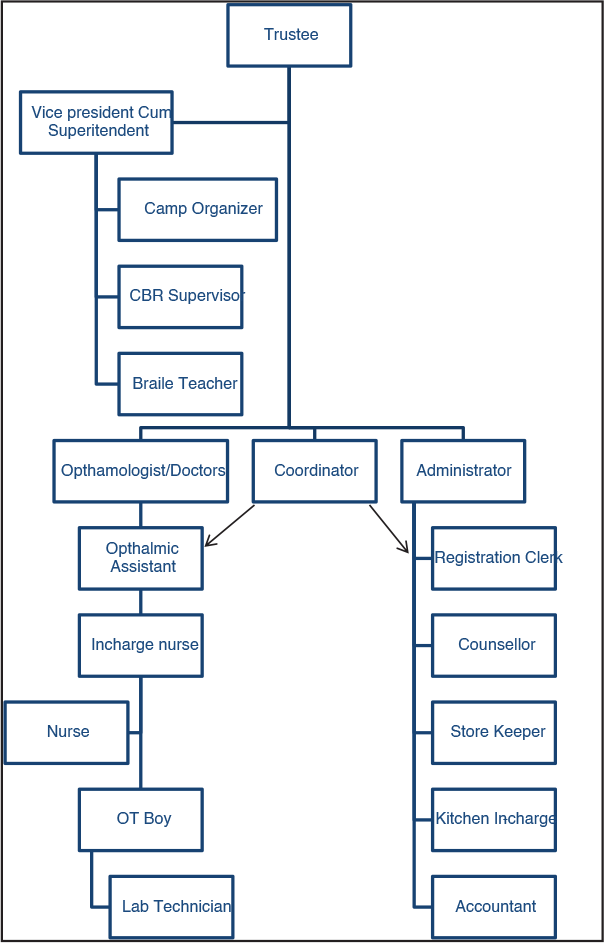
POPULATION PROFILE
Patients coming to TEH were tribal, economically weak and underprivileged. They lived in the geographical neighbourhood of Mandvi. Due to the limited availability of resources, their ability to invest and generate income was low. They usually worked as daily wage earners. Therefore, the income was irregular and meagre. It was a struggle to manage two square meals a day. Since their earning potential was limited, their spending capacity was low. Their priorities were food, clothing and shelter. Spending on health was often a last priority. Further, access to affordable healthcare facilities (both public and private) in their geographical area was limited. These communities were generally influenced by traditional habits and orthodox behaviour. For common health-related issues, they sought the advice of a traditional healer in their community. The literacy level in the population was low. Health care facilities in this region were sparsely located. Mandvi town had one MBBS 8 doctor in a Government health care facility. Rest of the practitioners were engaged in private practice.
The inhabitants in this area are farmers or landless labourers. Primary healthcare facilities were sparsely located in this tribal region spread over 100 sq. km. Most often, the tribal population was unable to access any healthcare facility due to prohibitively high cost of transportation and the opportunity cost of wages lost during the time taken to travel to the nearest healthcare facility. They usually made a tradeoff between access to healthcare and earning a daily wage for immediate survival. Needless to emphasize that survival took precedence over healthcare (Exhibit 4 depicts the profile of the patients).
Patient Profile of TEH.
Compassion in Action: Episode 1
Sunita Padvi, 21 years, is from Khapar village (108 km from Mandvi)—of Akkalkuva taluka in Nandurbar district of Maharashtra. Sunita and her mother Komalbenare the only two members in the family. They earn their living as marginal agricultural labourers.
Sunita developed redness in both her eyes. She consulted a medical practitioner (not an ophthalmologist), who prescribed her some medicines. The condition did not improve. After this Sunita consulted several doctors. She was also admitted to a private hospital. The treatments were not effective. During this period, her corneas became opaque.
TEH had organised a diagnostic camp in Khapar on 9 October 2011. Komalben took Sunita for examination at the camp. The Ophthalmologist advised that only a corneal transplant could bring her (Sunita) eyesight back. She came to the hospital on 11 October 2011 and was admitted to perform a minor operation to reduce the vascularisation of the cornea called peritomy. She underwent a cornea transplant in a span of four days. Expenses related to Sunita (pre- and post-operative) care, including the cost of surgery, were met by the hospital.
When Sunita was visually challenged, her mother Komalben had to face several hardships. On one hand, Sunita was confined to home, hence could not work. Komalben also had to stay back at home to take care of Sunita. Accordingly, the earning potential of the family dwindled. Having spent more than six months in darkness, there is now light in the life of young Sunita—a new life—a new sunrise.
Compassion in Action: Episode 2
Karnilal Vasava of Limdha village (18.7 km from Mandvi) in Mandvi Taluka, Surat District is a farm labourer. He has three dependent children. His elder daughter Sunaben was experiencing dimness of vision in both her eyes over a period of two years. She was taken to several private clinics for treatment. As Karnilal’s resources were limited, he could not afford to support the treatment for a prolonged period of time. Sunaben’s age (24 years) eyesight was getting poorer. Her mother had to stay back at home to look after her. Sunaben also had to withdraw from school.
TEH organised a mega eye screening camp on 23 May 2011 in Mandvi. The parents brought Sunaben to Mandvi for checkup. The doctors diagnosed that Sunaben had cataract in both her eyes. Her retina was weak due to recurrent inflammation of the eye (in the past) which was not treated properly. Initially, she was given treatment for reducing the inflammation in the eye. Then both eyes were operated for cataract extraction with IOL (intraocular lens) implantation at an interval of one month. She was given spectacles. After one and a half months of operation, she regained vision in both her eyes.
As Sunaben’s father is a farm labourer, her treatment was free of cost including operations. Now, Sunaben’s life is back on track. She takes care of her younger siblings and also does household chores to support her mother. Accordingly, the parents are able to go to the field for farm labour related work. The parents are now discussing Sunaben’s marriage.
The family is happy today. They are grateful to the doctors and staff of THE. The parent’s eyes are filled with tears of happiness as their daughter will now be able to lead a normal life.
Compassion in Action: Episode 3
Menaben Dhansingbhai Chaudhari resides in Titoi village (9.6 km from Mandvi) of Mandvi taluka, Surat District with her husband Dhansingbhai. Both survive on the meagre income as farm labourers. Since they do not have children, all household work has to be done by them.
Menaben developed cataract in both her eyes. They were ignorant about cataract. Also, she had no money to afford treatment from private healthcare providers. Her progressively diminishing eyesight confined her activities to home. She would stumble upon objects while moving around the house. As she could not go out, her income from farm labour reduced considerably, adding to the family’s financial difficulties.
TEH, Mandvi organised a camp in village Ambapardi (10 km from Mandvi) where Menaben got her eyes examined. Doctors told her that by performing cataract operation on both her eyes, she would be able to recover her vision. Menaben was brought to the hospital in a (40 seater) bus used for transporting patients from rural eye camp to hospital. Both her eyes were operated one after the other. Menaben was prescribed eye-glasses six weeks after her operation. Now, she is able to take care of the household activities on her own. She is able to go out farm labour work contributing to the family’s earning pool.
Compassion in Action: Episode 4
Savitaben Vasavaan, aged 35 from Pipalwada village, (11 km from Mandvi) Taluka, Mandvi, Surat District, visited Tejas Eye Hospital (TEH), Mandvi with her husband Maganbhai. She complained of total vision loss in both her eyes. She was diagnosed with mature cataract in both eyes and was advised surgery as soon as possible.
Being labourers, they were hesitant in undergoing surgery due to the associated cost. A hospital counsellor convinced them that her surgery would be paid by the trust. In addition, she would be provided free lodging and boarding, along with medicine and spectacles. After the counselling, Savitaben agreed for surgery. Cataract surgery was carried out one by one on both her eyes. Her eyesight was restored completely.
Before surgery, for almost a year Savitaben had remained blind and was neither able to perform household chores nor care for her children. Now all this has changed. She has commenced attending to farm labour work.
Compassion in Action: Episode 5
Ramanbhai Patel of Dedvasan village, (38.7 km from Mandvi) Taluka Mahuva, Surat District is economically disadvantaged. He grows vegetables in a small parcel of land. He supplements his income with farm labour to support a family of four.
Once, Ramanbhai lost his temper on his younger son Milan under the influence of alcohol and hit him with the wooden stick. Milan sustained serious injury in his left eye, which eventually developed as cataract.
Due to lack of financial resources and proper guidance, they (father and son) kept on moving from one healthcare facility to another. The required surgery was delayed for more than a year. A private hospital gave an estimate of ₹30,000 for treatment. Ramanbhai’s family could not afford this expense and hence, he stopped thinking about treatment. After a year, Milan came to Mandvi with his mother Gitaben. By this time, his left eye was damaged significantly. TEH carried several operations on Milan–cataract removal, anti-glaucoma operation and so on.
Impressed by his conduct and attitude, the doctors and the staff developed sympathy for him. His mother helped in the hospital kitchen when Milan was being treated in the hospital. When Gitaben was offered remuneration for her help in the kitchen, she polity declined the same. She was proud that she was getting an opportunity to serve poor. Both Milan and Gitaben felt the warmth and affection extended by the hospital and its staff when they were facing difficulties in life.
Milan had scored 75% marks in 7th standard school examination. But in the 8th standard school examination, due to his injury and prolonged treatment, his academic performance did not support promotion to the next class. He took three years to complete the 10thstandard and decided to pursue industrial training in electrical trade. All his study expenses were supported by Divyajyoti trust. He eventually joined the Divyajyoti trust in maintenance department as a full-time employee.
Compassion in Action: Episode 6
Ghanabhai Valvi (age 88 years), resident of village Khaper (108 km from Mandvi) Taluka. Akkalkuva, Nandurbar district of Maharashtra state lost his vision. Ghanabhai visited Khapareye camp with his son Ranjitbhai (age 60 years) where he was diagnosed with cataract in both his eyes. He was advised surgery in Mandvi hospital. Because of his old age and anxiety related to surgery, he was reluctant to undergo an operation.
Hospital staff found it difficult to deal with him in view of his non-cooperative attitude. After the surgery and the removal of the bandage, Ghanabhai could see everything around him. His behaviour became normal and cooperative. The second surgery was routinely carried (to restore vision in both his eyes) and did not require any effort in managing his attitudinal problems.
His son Ranjitbhai was diagnosed with cataract, and he was also a diabetic. His cataract operation was carried out after controlling his sugar level. During surgeries, both father and son stayed in the hospital for a brief time and experienced the warmth and the care of the hospital staff. According to them, this hospital is a boon for the economically disadvantaged people in Mandvi.
OTHER ACTIVITIES OF THE TRUST
Kitchen
The trust operated a kitchen to provide free meals to the patients admitted in TEH and their care takers. It also served food to the visually handicapped children who are being rehabilitated by the Trust. Staff members of the Trust availed the kitchen facility at a subsidized rate of ₹15 per meal. 9 While waiting for medical examination, treatment, or recovery, the outpatients and their relatives were allowed to use the subsidized canteen facility. The facility was designed to serve up to 100 people at a time.
Medical Store
There was a medical store integrated with TEH. To make the hospital a one-stop-shop for ophthalmology care, the Trust operated an integrated medical and optical store in TEH. Medicines sold through the stores were discounted up to 15 % on the maximum retail price (MRP). The store also dispensed medication for diabetes and hypertension.
The optical store provided spectacles at less than 50% of the market price. The hospital also maintained adequate stock of readymade vision glasses at a subsidized rate of ₹30. 10
At campsites, after examination; based on the need, spectacles were provided. The trust managed to ensure delivery of tailor-made spectacles to patients within two hours at a modest ₹200. 11 Therefore, another visit to the hospital to collect spectacles was not needed. Indirectly this initiative ensured compliance on prescribed spectacles. It reduced the overall logistics cost to the patients.
Laboratory
An in-house pathology laboratory met the needs of all pathological investigations of TEH. Because the laboratory was owned and operated by a non-profit trust, the investigation cost was almost half of any private laboratory. On a need basis, special investigations were referred to reputed laboratories in Surat.
A complimentary blood sugar test was administered to all the TEH patients above 40 years of age On an average ten new diabetic patients were identified on routine days. According to the hospital, this early identification of a diabetic condition helped patients consult an appropriate physician for further treatment.
CHALLENGES
According to the trustees,
Divyajyoti Trust by establishing TEH, had demonstrated the power of compassion and dedication in changing the living conditions of the economically poor rural tribal community. The value proposition of the Divyajyoti trust included creating health care awareness by education, prevention of ophthalmology diseases by organizing eye camps for screening, scientific treatment including surgery, need-based rehabilitation and addressing direct and indirect healthcare needs of the community to enhance their earning potential. This intervention has the potential to liberate the relevant population from the vicious cycle of poverty.
TEH provided expertise and medical facilities to treat a range of ophthalmological conditions reported by the community members. To contain cost and motivate the relevant population to access ophthalmology health care, the hospital operated a subsidized canteen and a pathological laboratory. The outreach programmes ensured the prevention and monitoring of ophthalmological diseases.
In terms of surgeries, the volume, procedures, and outpatients treated by TEH was impressive (see Appendix 1 for operational efficiency of TEH). However, according to Dr Gajiwala, the challenge was to ensure access and affordable ophthalmological care and other related healthcare facilities (diabetes, hypertension) to all members of the tribal community in and around the Surat district. He was considering multiple options.
Establish a network of primary ophthalmology care centres, distributed across the geographical area with command and control at Mandvi. Experiment with mobile ophthalmology clinics to take ophthalmology care to the doorsteps of the target population. Leverage the power of telemedicine in reaching out to the relevant population.
Tribal Districts in India.

The North-Eastern states such as Assam, Meghalaya, Tripura and Mizoram are covered by the Sixth Schedule and not included in the Fifth schedule.
Tribal Homelands in Gujarat

Income and Expenditure Statement of Divyajyoti Trust 2014–2015.

RSBY: Rashtriya Swasthya Bima Yojana (meaning ‘National Health Insurance Programme’); it is a government-run health insurance scheme for the Indian poor.
OPD: Outdoor patients department.
CBR: Community-based rehabilitation.
Given that the hospital had a presence in all sub-segments of ophthalmology, was it worthwhile to create a standalone healthcare delivery facility (perhaps located in Surat) to provide a complete range of ophthalmology care services at an affordable price? Should the operating surplus from this facility be used to leverage the reach and impact of the trust activities?
Was it possible for the Trust to manage two different entities? (a) A community-oriented patient-centric (economically poor rural tribal community) hospital and (b) A cutting edge ophthalmology clinical and research centre located in an urban area not far from Mandvi. What are the contradictions? And how could they be managed? What were the potential synergies?
The Trust was well poised to conduct community-based research programmes. How could this be leveraged to network with other funding agencies, NGOs, medical universities and medical scientists in India and abroad? Should the Trust focus on training the workforce at various levels like technicians, paramedical and medical professionals?
Dr Gajiwala knew that the most unique Trust activity was the rehabilitation programme of visually challenged people. He was curious to explore how this could be integrated into the overall portfolio of the Trust activities?
He was also troubled by the thought of whether the Trust was drifting away from its core purpose by doing a wide range of activities. For example, was there a need for the Trust to fund the education of younger patients? Was it worthwhile for the Trust to design and implement a green building? (See Exhibit 8). Should TEH administer the screening for diabetes and hypertension, or should it focus only on ophthalmology related care?
Indian Green Building Councils recognised Netrajyoti (one of the buildings of trust) constructed in 2015 as an eco-friendly building. The design and construction features of this building are given below. The Divyajyoti trustees believe such a initiative is a manifestation of their thought process in harmonizing humanitarian work and environment.Green Building Initiatives.

The Trust’s real purpose was to enhance the dignity of life and provide economic independence to the underprivileged tribal, rural community. Providing access to affordable ophthalmological care was the first step in this direction. His immediate priority was to examine the addition of other healthcare-related facilities in the hospital. Such an initiative would accelerate the economic independence of the tribal community.
Along with healthcare access and affordability, providing reasonable literacy to these tribal communities to improve their ability to be meaningfully employed was the next aspirational objective for the Trust. At the tertiary level, the Trust could sharpen the skill-sets of the tribal community and create employment opportunities for them in micro-enterprises operating in the relevant tribal area. How should the Trust approach these opportunities?
Dr Gajiwala was clear that the Trust should bring smiles to the faces of the economically poor rural tribal population. Providing access to healthcare free of cost was only a beginning. Every attempt to improve the economic conditions of the underprivileged was to be made. This would therefore enhance the quality of their life. According to him, the Trust should be guided by this cardinal principle in selecting and managing its portfolio of activities.
APPENDIX A.
Tejas Eye Hospital Operations Profile.

Number of Laboratory Investigations

Tejas Eye Hospital Surgery Volume

Tejas Eye Hospital Income and Expenditure Statement

Footnotes
DECLARATION OF CONFLICTING INTERESTS
FUNDING
The authors received no financial support for the research, authorship and/or publication of this article.