




Abstract
Executive Summary
In the contemporary time, the reliability of any product has become a big issue from the customer’s perspective due to exponentially mushrooming markets of electronics and digital gadgets. Since the use of digital equipment is tremendously increasing, as a consequence, the production and availability of products are also increasing rampantly. Due to the flooding of digital products, customers often end up in a dilemma regarding the abundant choice and subsequently, become very much dependent upon the reviews of experts and fellow customers as well. In many cases, unfortunately, it is encountered that the products are not reliable enough as suggested by the reviewers. Besides, it is often seen that the manufacturing companies provide almost similar types of features and facilities for products and customers usually end up in a dilemma The confusion gets triggered when varieties of commodities are manufactured and supplied by different manufacturers bearing almost the same features nearly at the same price. In such situations, the reviews of experts and customers already using the product become essential. The reliability of a product relies upon the reviews of the previous customers of the same product. In this article, fuzzy multi-criteria decision-making methodology has been employed to find the reliability of a product considering different features of the product based on the reviews of customers and experts. This paper presents a neo distance measure on hesitant fuzzy set which is found on the notion of score function and mean deviation. Explanatory instances are provided to reveal the distinctiveness and merit of our proposed idea on distance measure over existing distance measures. After that, the proposed distance measure is applied in the decision-making approach for taking up the best electronic products. It is evidenced that the proposed distance measure is beneficial to measure distance degree between two unequal Hesitant Fuzzy Elements (HFEs) without putting extra elements in the shorter HFE. The proposed distance measures can be utilized in the decision-making field in the near future under diverse conditions to display undetermined particulars in a much-clarified manner.
Verma and Sharma (2013) introduced some operations on hesitant fuzzy sets. Hesitant fuzzy information measures were applied in MCDM problems by Hu et al. (2015). Verma (2016) presented a number of properties on hesitant fuzzy sets. Hu et al. (2017) discussed similarity and entropy measure on hesitant fuzzy sets. Verma (2018) developed some operations on hesitant interval-valued fuzzy sets and studied their properties.
In the fuzzy set theory, distance measure plays an important role, and these distance measures have been applied successfully applied in different fields. Afterwards, researchers have introduced a distance measure concept in the hesitant fuzzy set theory. For example, Xu and Xia (2011) investigated distance measure and similarity measure on hesitant fuzzy sets. Recently, a new distance measure on hesitant fuzzy sets has been developed by Goala and Dutta (2018) and applied in fuzzy multi-criteria decision-making to help crime linkage analysis.
From the aforementioned analysis, it can be evidently stated that distance measure is one of the important measures for MCDM problems under a hesitant fuzzy domain. However, further investigation revealed that there are some limitations of the existing distance measures. In Xu and Xia’s (2011) approach, one needs to add extra elements in hesitant fuzzy elements (HFEs) using the method for finding distance between HFEs if they have a different number of elements, which may lead to wrong results. Although Goala and Dutta (2018) tried to overcome this limitation, in their approach, they were unable to show that the distance between full HFE and empty HFE is 1. These limitations directed us to reflect on the following main objectives:
To propose a novel distance between two HFEs. To develop an algorithm to solve MCDM under hesitant fuzzy domain by using our proposed distance measure. To present a comparative analysis with the help of examples to predict the advantage of our proposed distance measure.
In this article, an attempt has been made to devise a novel distance measure on hesitant fuzzy sets initially. The proposed distance measure has been applied in the decision-making methodology for choosing their liable product under hesitant fuzzy environment considering the customer’s and expert’s reviews well. In addition, a comparative analysis has been carried out to throw ample light on the advantages of the proposed distance measure over existing distance measure. Finally, a case study has been carried out to demonstrate the applicability of the proposed distance measure and decision-making methodology.
PRELIMINARY
In this section, a discussion on some preliminaries of fuzzy set, hesitant fuzzy set and distance between hesitant fuzzy sets has been presented.
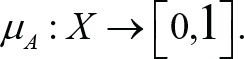

Here,
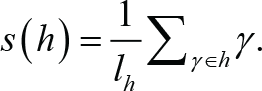
Here lhis the number of elements in the hesitant fuzzy element h.
Using the score function of HFEs, a method for comparison proposed by Xia (2013), between two HFEs is as follows:
Suppose
Using the deviation degree, Chen et al. (2013) defined the comparison rule between
Let us consider two HFEs
If If If If
In this article, deviation function has been utilized to develop a novel distance measure on hesitant fuzzy set.
Distance Measures
Distance measures are an integral part of decision-making theory. Some studies have been done on decision-making theory using hesitant fuzzy distance measures.
In this section, some existing hesitant fuzzy distance measures are presented.
Some well-known hesitant fuzzy distance measures are as follows:
Distance Measure (Xu & Xia, 2011):
Let us consider two HFEs
The generalized hesitant normalized distance is defined as follows:

For

For

Here
Now, the generalized weighted Hausdorff distance measure is defined as follows:

For

For

Afterwards, Xu and Xia (2011) put forward a generalized hybrid hesitant weighted distance measure which is as follows:

Similarly, for

For

Distance Measure (Goala & Dutta, 2018)
Let us consider two HFEs
The distance measure between the HFEs A and B is defined as follows:

where l is the number of elements in the hesitant fuzzy sets,
A NOVEL HESITANT FUZZY DISTANCE MEASURE
In this section, an effort has been made to define a novel distance measure for HFEs and investigate its properties. Let us consider two HFSs
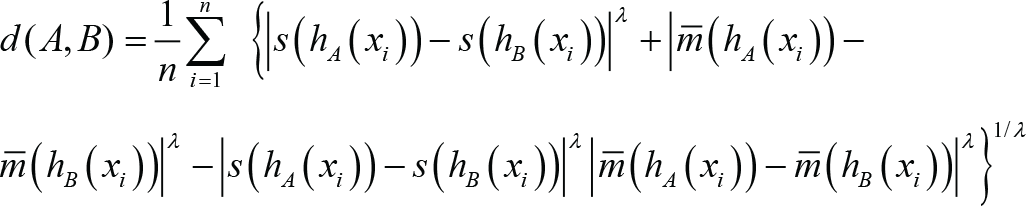

Here
n is the number of elements in the hesitant fuzzy sets,
Now, we have
Proof:
Let
Also
Similarly,
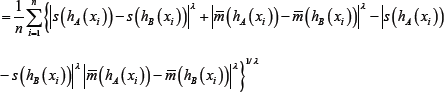
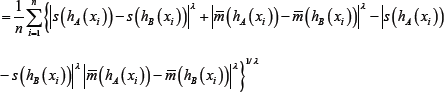


Proof:
Let

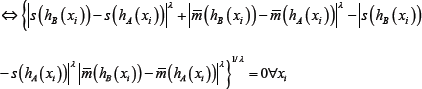


Therefore, the three conditions required to be a distance measure are satisfied.

ADVANTAGES OF THE PROPOSED DISTANCE MEASURE
In this section, we cite some numerical examples for displaying the advantages of our proposed distance measure over the existing distance measures. Major drawbacks are encountered in the existing approaches presented by Xu and Xia (2011) and Goala and Dutta (2018). In Xu and Xia (2011) approach, extra elements are added in HFEs with a view to balance the order of HFEs. Due to this reason, decision-makers are unable to give accurate results. Besides, in Goala and Dutta (2018) process, the distance between the whole HFE and empty HFE is 0.5, which is not reasonable. Such type of result affects the ranking in the decision-making problems.
Advantages of our proposed distance over the distance measure presented by Xu and Xia (2011):
Different Distance Measures after Adding Different Elements in Deficit HFEs
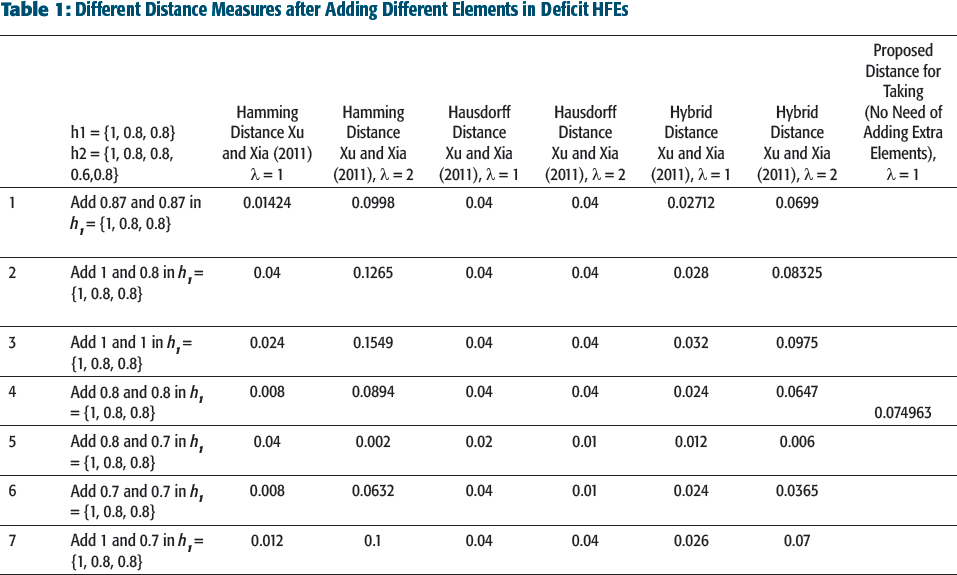
From the aforementioned table, in case of an unbalanced length of HFEs it is seen that the proposed distance measure has the capability to measure distance degree between two HFEs without adding extra elements in the shorter HFE. As a result, it can decrease the chance of intentional or unintentional biases of the decision-makers during decision-making problems.
Furthermore, let us consider the following three hesitant fuzzy sets: h1 = {0.1, 0.3}, h2 = {0.1, 0.1, 0.3}, h3 = {0.1, 0.3, 0.3}
Now, the distance measure (Hamming/Hausdorff/ Hybrid) between h1 and h2 defined by Xu and Xia (2011) via pessimistic approach is (i.e., adding the least element in the shorter HFE as h1 and h2 are of different lengths)


Similarly, the distance measure (Hamming/ Hausdorff / Hybrid) defined by Xu and Xia (2011) via optimistic approach is (i.e., adding the greatest element in the shorter HFE as HFEs are of different lengths)


Thus, the distance measure presented by Xu and Xia (2011) violates the elementary norms of a distance measure in some cases. But
From the above analysis, we can say that the distance measure presented by Xu and Xia (2011) do not produce reliable results, whereas the same shows the exceptionality, originality and advantage of our proposed distance measure.
Advantages of our proposed distance over the distance measure presented by Goala and Dutta (2018):
Let us consider the HFEs
From the above deliberations, we have exhibited the uniqueness, novelty and advantage of our proposed distance measure. Thus, we can say that the proposed distance measure is a better indicator.
DECISION-MAKING METHODOLOGY
Let us consider a set of features of a specific kind of product in the market be
In this approach, products are considered as the alternatives, and the features of the products are considered as the attributes of the fuzzy decision situation. Therefore, a fuzzy decision situation can be expressed by the following matrices (Klir & Yuan, 1995):
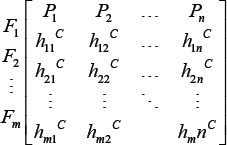
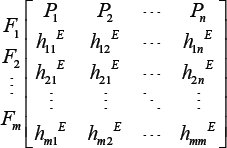
Here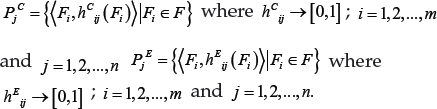
Obviously, the minimum value of distance measures, that is,
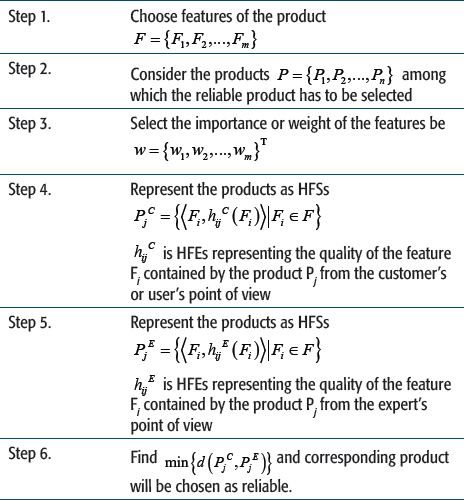
In this section, a case study will be carried out to exhibit the consistency, rationality and usability of our proposed distance measure. Our methodology will be applied to choose the most reliable product considering different features of the product based on the reviews of customers and experts.
Let us consider a set of four smartphones having almost the same type of features. Feedback is then collected from technical and experienced experts. After that, the review of the smartphone is collected from some real users or customers based on the features of the smartphone. In this case, we have taken into consideration the following features:
Speed and performance of the smartphone: The higher speed quad-core will operate apps quicker and is usually less time consuming for everyday tasks, but octa-core is better for weighty tasks, such as gaming and video editing. Display quality: The display quality depends upon the following parameters: Pixel density: Pixel density is the most deciding parameter for quality of the screen and the real resolution of the display. The higher the number, the better the quality of the display. Brightness: Brightness is another component or parameter that affects the degree of excellence of a screen. Better brightness capabilities mean our smartphone is more operational in bright places. Display protection: One of the most vital features that confers safeguards to the smartphone is the Gorilla glass protection, used extensively in order to guarantee screen dependability. Glare resistance: Many phones offer glare resistance technology so that we do not have to escape our own shadow when using our phone in a bright room. Not all phones offer this, but it is something to look for. Size: Another factor that can come down to personal preference is the size of a screen. If we are a techno freak or we really prefer digitalized mode for reading, we always opt for a phone with a greater screen. Video and photo quality: The following are the parameters affecting the video and photo quality: Sensor type: The most significant element of a camera is its sensor as the sensor dictates the image size, rotation, focal range, lenses compatible and overall size of the body. Sensor size: Larger sensor magnitude assistances in producing high-quality images. Pixel size: When we have a small pixel in our sensor, it does not accept light precisely and tends to yield an unclear photo. So, pixel size is also a significant factor for getting good quality photo. Image stabilization: Image stabilization also plays a vital role in producing sharp images. Post-processing techniques: Lastly, there are handsets that have their own post-processing techniques as a final touch to their images. So, to produce highly saturated photos we need post-processing techniques.
In the above case, the specifications of the product are explained in terms of their parameters so that decision-makers are able to judge how the change in parameters can affect the specifications of the product. Furthermore, the specifications are selected for the case study due to the fact that most of the online shopping websites such as Amazon and Flipkart display comparisons among phones depending mostly upon specifications and people tend to buy products by looking the review of customers and experts depending upon these three specifications.
A comparison has been made to choose the reliability of products on the basis of reviews of technical and experienced experts with reviews of real users or customers of that product. Since our objective is to choose the best product from the available products, therefore we will consider or take only positive reviews of the products from the experts. But there will be no such restriction about consideration for the reviews of the customers or real users of the products in this case study. Here, we are taking the review of the smartphone from three technical and experienced experts and five customers, and consider that the weight of each feature is equal, that is, Step 1. The rating information of smartphones under the different criteria is accessed by the technical experts and expressed as HFEs. Step 2. The rating information of smartphones under the different criteria is accessed by the customers and expressed as HFEs. Step 3. The decision matrix for technical expert’s review is constructed with HFEs. Step 4. The decision matrix for the customer’s review is constructed with HFEs. Step 5. The distance between the technical expert’s review and customer’s review of the smartphones expressed as HFEs are computed. Step 6. The reliable smartphone is selected with the help of the ranking of the alternatives for distance measures.
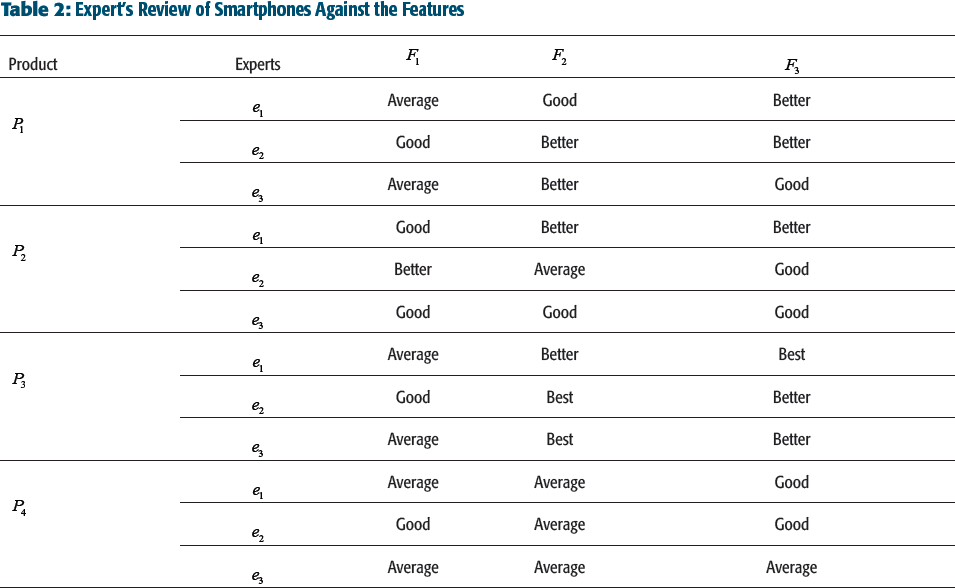
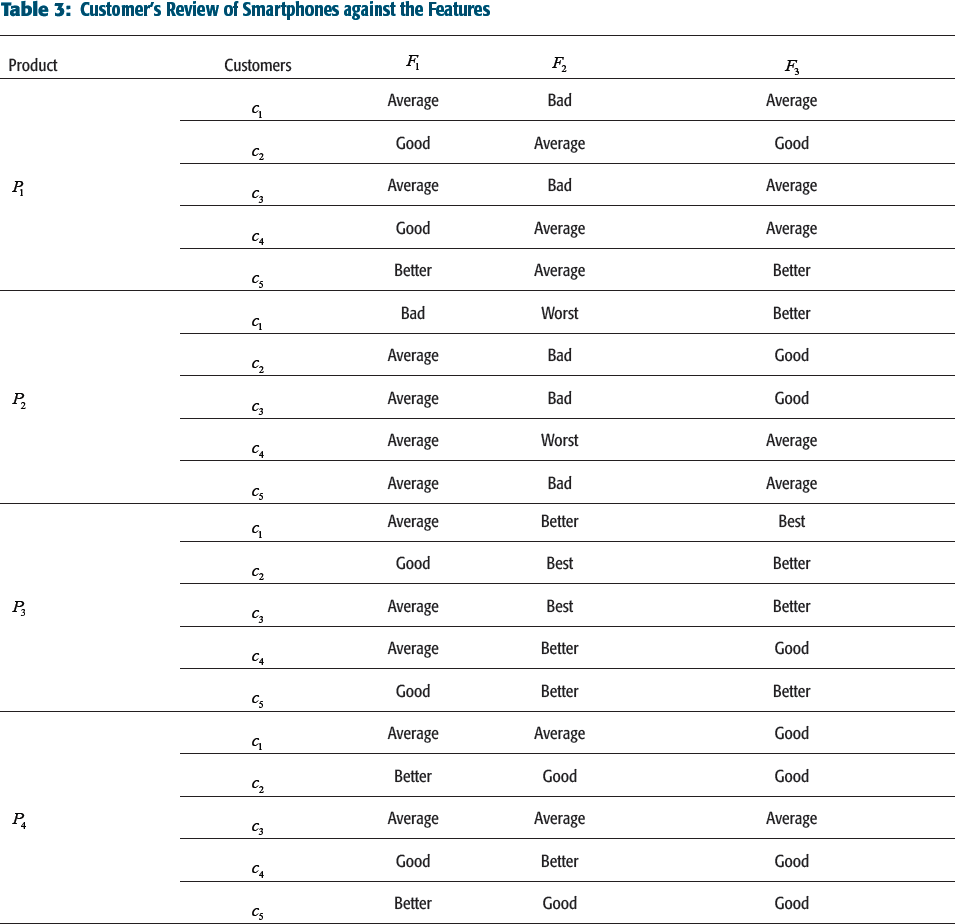
The overall scenario is explained by the following Table 2 and Table 3:
In the following tables, we consider the following:
: Expert’s Review of Smartphones Against the Features
Customer’s Review of Smartphones against the Features
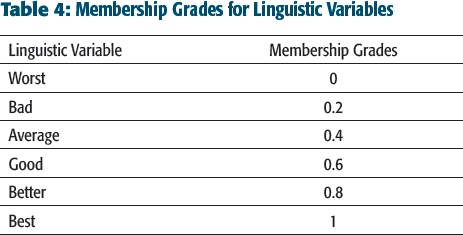
Membership Grades for Linguistic Variables
From the above information, the following decision matrix for expert’s review can be constructed with HFEs:
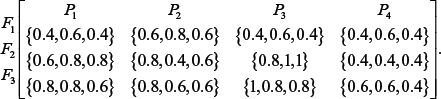
Similarly, the following decision matrix for customer’s review can be constructed with HFEs:
Now, the products can be represented as hesitant fuzzy sets from information of expert’s review and are expressed as follows:




Similarly, the products can be represented as hesitant fuzzy sets from the information of customer’s review and can be expressed as follows:





Now, the distance between expert’s review and customer’s review of the products expressed in hesitant fuzzy sets are obtained for different parameters
Ranking of Alternatives for Distance Measures for Different Parameter
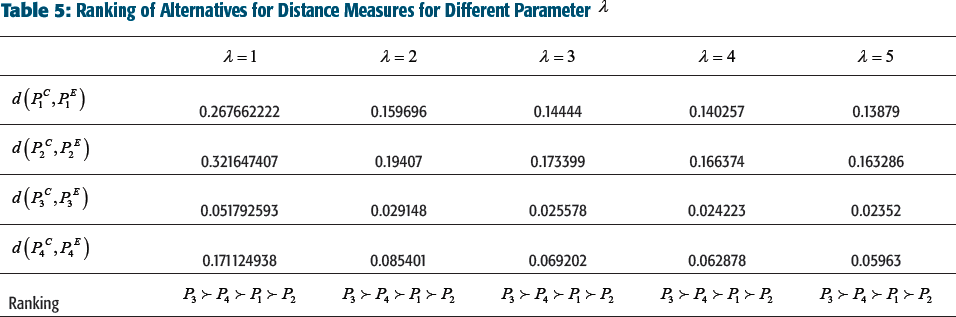
From Table 5, it is observed that
CONCLUSION
In this research work, a novel distance measure on hesitant fuzzy set has been developed based on the concept of score function and mean deviation. Illustrative examples are taken to exhibit the uniqueness and advantage of our proposed distance measure over existing distance measures. The proposed distance measure has an advantage over existing distance measure because the latter requires the addition of extra elements in HFE in case of the deficient number of membership grades in HFEs. This may lead to biased results intentionally or unintentionally. We have applied the proposed distance measure in the decision-making approach for choosing the best electronic products. In the forthcoming days, this distance measure can be extended to the decision-making field under diverse environment to represent uncertain information in a much-refined manner.
Footnotes
DECLARATION OF CONFLICTING INTERESTS
FUNDING
The author(s) received no financial support for the research, authorship and/or publication of this article.