




Abstract

CASE (A)
In April 2014, Swati Bhargava, Dean of the National Institute of Management (NIM), suggested to Col S R Rao, VSM (Retd.), the Administrative Officer (AO) of NIM that a comprehensive review of security contracts of the last four years of NIM be conducted. A number of administrative and operational issues were plaguing the management of security services at NIM. Swati suggested that Col Rao find an innovative and effective solution to this problem.
National Institute of Management
NIM was setup in 1996 by the Government of India (GoI) to impart quality education in management. In a short span of time, NIM established itself as a premier institute of management in the central part of India. In 2014, it had a student strength of 1,500. A team of 400 staff and 80 faculty contributed to the administrative and academic activities of NIM. Its residential campus (193.4 acres) was adjacent to an industrial park and was 20 km away from the city.
The campus topography was in three inter-connected concentric levels. The top level was used for academic and administrative activities. The middle level housed residential facilities (for faculty and staff families). Fifty faculty members and an equal number of staff and their families lived on the campus. The student hostels were spread between the middle and base levels. The base level also provided space for utilities, a sports complex and two ancient temples.
The support services included multiple student mess facilities, multi-cuisine restaurants, a children’s park, power utilities, a water storage system, a laundry, automatic teller systems, a dedicated branch of a nationalized bank, and a shopping complex including a barber shop.
A seven bedded hospital supported by a 24 × 7 ambulance on campus was also operational to respond to any medical emergency. The campus was accessible by two separate gates—one to the residential area and the other to the academic area. On an average, 100 practitioners visited the campus in a week for short duration executive education programmes.
The campus was residential, therefore, safety and security of the NIM community was the paramount responsibility of the Institute.
Security Agency: Experiences
Salient Features of the Contract Between NIM and a Representative Agency
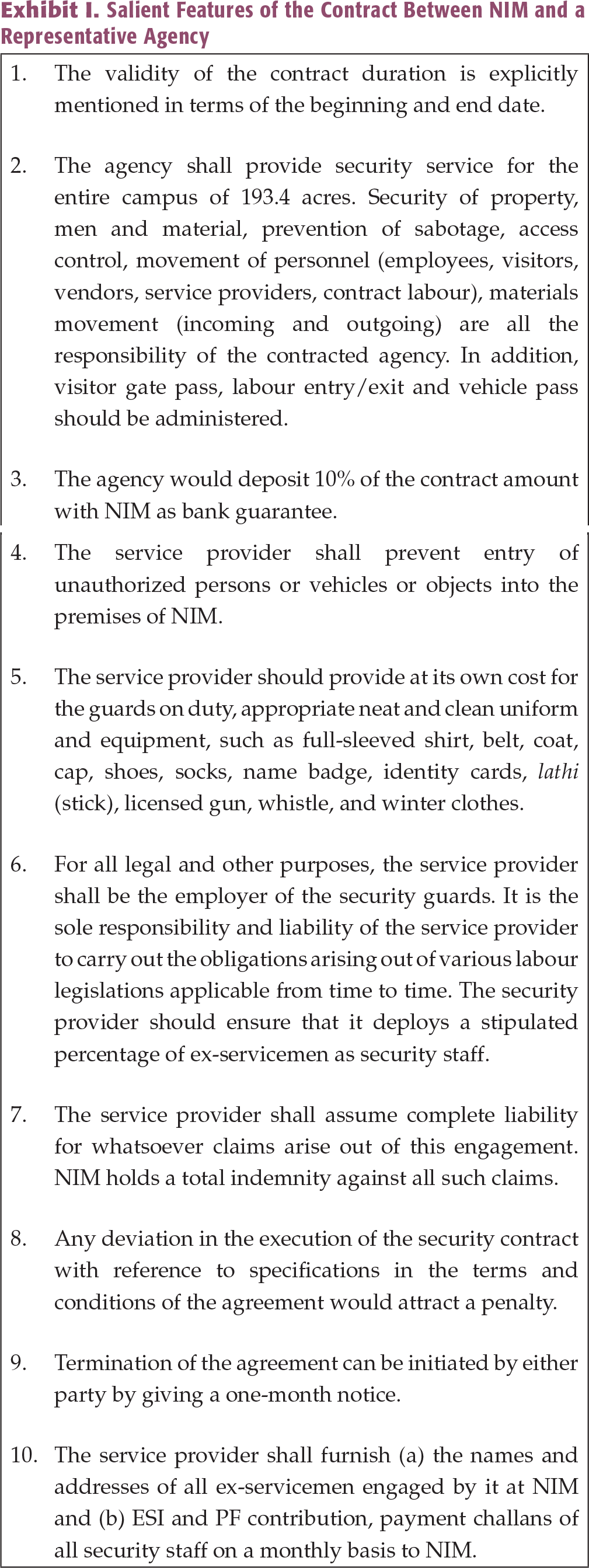
During the years 2010–2014, four different (security) agencies had worked for NIM. None of the stake-holders (security staff, security agency, NIM, Col Rao, and the community members) seemed to be satisfied with the quality of security services. The agencies routinely invoked the arbitration clause in the contract to settle real or imaginary disputes. The senior management, Col Rao and Swati, spent a considerable amount of time and energy in dealing with such situations. Some representative incidents are:
Typically, the manpower agency was a small organizational set-up established by retired defence personnel. Often, the agency did not respect the contractual obligations in terms of benefits to security staff, working hours, and shift durations. Monthly payments to the (security) staff were delayed for various reasons. Any penalty imposed by NIM on the agency for deviation in their performance was routinely passed on to the security guards on a pro-rata basis.
The security staff complained of late-payment of monthly wages, extended duty hours, and inadequate working facilities. The agency paid security staff a fixed wage, even though the agency claimed and obtained from NIM, the minimum wage escalation applicable as per the GoI circular. While the agency routinely made appropriate claims on NIM related to the employee provident fund (EPF) and other entitlements, the benefits were not passed on to the individual security staff.
It was believed that, in order to be enrolled and to stay associated with an agency, a security staff paid a sum of ₹500 per month to the agency. The security staff worked under the perpetual risk of losing their job. At the slightest provocation, the agency discontinued their services. Their literacy skills were also low, and no periodic training was given to the staff.
Apart from these issues, according to Col Rao of NIM, the security guards were found inadequate on the following dimensions:
They were found to be sleeping while on duty. Often, they did not wear the complete uniform. The guards were on duty without flash lights and communication devices (walkie-talkies), due to inadequate supply of equipment from the agency. They were unable to effectively prevent thefts and infiltration on the campus. The registers on the visitors’ entry, material movement and vehicle movement were not updated accurately and maintained properly. The agency deployed fewer security guards than what had been stipulated in the contract and attempted various unscrupulous means to save on operational costs.
Security Agencies’ Business Model
NIM appointed a security agency based on a tendering process. Therefore, in order to secure a contract, the agencies usually quoted (against the tender document) low service charges. They operated under the assumption that the security guards could be recruited and deployed at the minimum prescribed wages in the tender document. In reality, (after the contract was awarded) they found that this assumption was not valid.
The security staff market consisted of ex-servicemen and locally available unemployed youth with modest education and no training. The security staff who retired from defense services were competent and qualified. However, given the demand-supply imbalance of manpower, ex-servicemen demanded premium wages. On the other hand, security agencies were unable to meet the expectation of the qualified security staff on premium wages.
Therefore, in order to ensure operational profitability, the agencies recruited and deployed semi-skilled, unskilled and unemployed youth at minimum wages. Often, these semi-skilled youth looked for employment when there was a lean period in agriculture-related work in their native villages. Such security staff worked for a meagre salary and treated the job opportunity as a stop-gap arrangement. Consequently, the manpower turnover in security agencies was high. In view of the high turnover, the agencies were unable to recruit and deploy minimum staff as per the contractual term. This, in turn, attracted penalty as per the tender agreement.
Often, the service provider attempted to deploy stipulated manpower by provisioning overtime to guards. Deploying security staff on overtime on a routine basis was a violation of the contractual agreement. Further, security staff deployed on overtime were required to be paid twice the normal wages. Consequently, the security agencies were caught in a bind of violating the contractual obligations or incurring additional expenses on account of appropriate wages.
As a trend, most security agencies usually seem to have only a regional presence, with the scale and scope of operations being limited to one region. Ad hoc systems characterize their mode of operations. Information technology adoption is modest. Further, these agencies lack professional and service orientation. They are essentially commercial establishments exploiting an opportunity arising out of the high demand-low supply scenario.
Challenges
Swati, based on the experience with four different agencies over a period of four years, was keen to develop an arrangement which would ensure -
Fair, accurate, and timely payments to the security staff Strict compliance with the terms and conditions of the contract by the agency Minimized extended duty hours of the security staff deployed An alert system which could respond rapidly and adequately to emergencies
A Proposal for Providing Security Cover to the NIM Campus
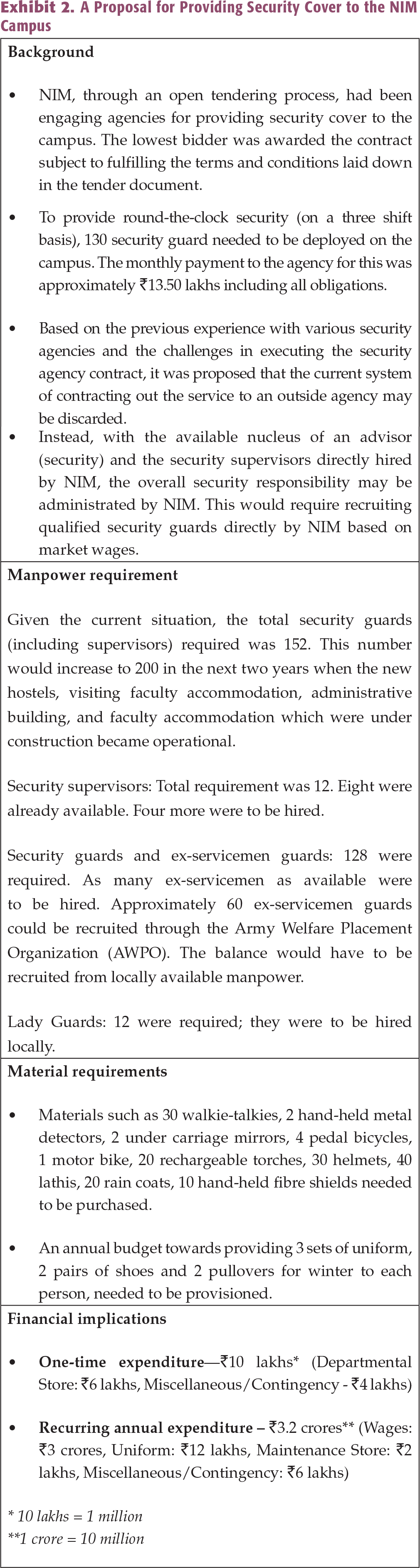
* 10 lakhs = 1 million
**1 crore = 10 million
While preparing for the discussion in the board meeting about insourcing security services, Col Rao briefed Swati about the alternative initiatives that NIM had explored to manage its security effectively. These included (a) exploring the option of using Home Guards/Central Industrial Security Forces (CISF) to manage the security cover and (b) to encourage national players to participate in the bidding process.
Option (a) turned out to be exorbitant since it required a monthly budget of ₹2 crores against the current budget of ₹20 lakhs. Option (b) did not materialize, as no national player had a branch in the city where NIM was located.
According to Col Rao, another option that NIM could consider was promoting a separate not-for-profit company which could provide professional security services to a number of higher educational institutions in the central state of India.
Swati and Col Rao recognized that insourcing security services by NIM would require additional administrative bandwidth. The cost of services would increase. A one-time administrative action was necessary to recruit staff and train them. Investments on necessary equipment and related accessories would have to be provided for. On the positive side, the security staff would be paid the promised fair wages and benefits. The quality of services would be acceptable and could be continuously improved. Issues related to overtime, absenteeism and turnover would also be easy to address.
The business environment in the city in which NIM was located was not conducive to support quality conscious security agencies. This was demonstrated by NIM’s experience with multiple agencies so far. However, insourcing security services was not in line with the existing industry trend.
Further, Swati understood the gravity of the situation and realized that an arrangement needed to be made at the earliest. She wondered how she could convince the BoG, NIM to support the option proposed by Col Rao.
CASE (B)
The Board Meeting in June, 2014
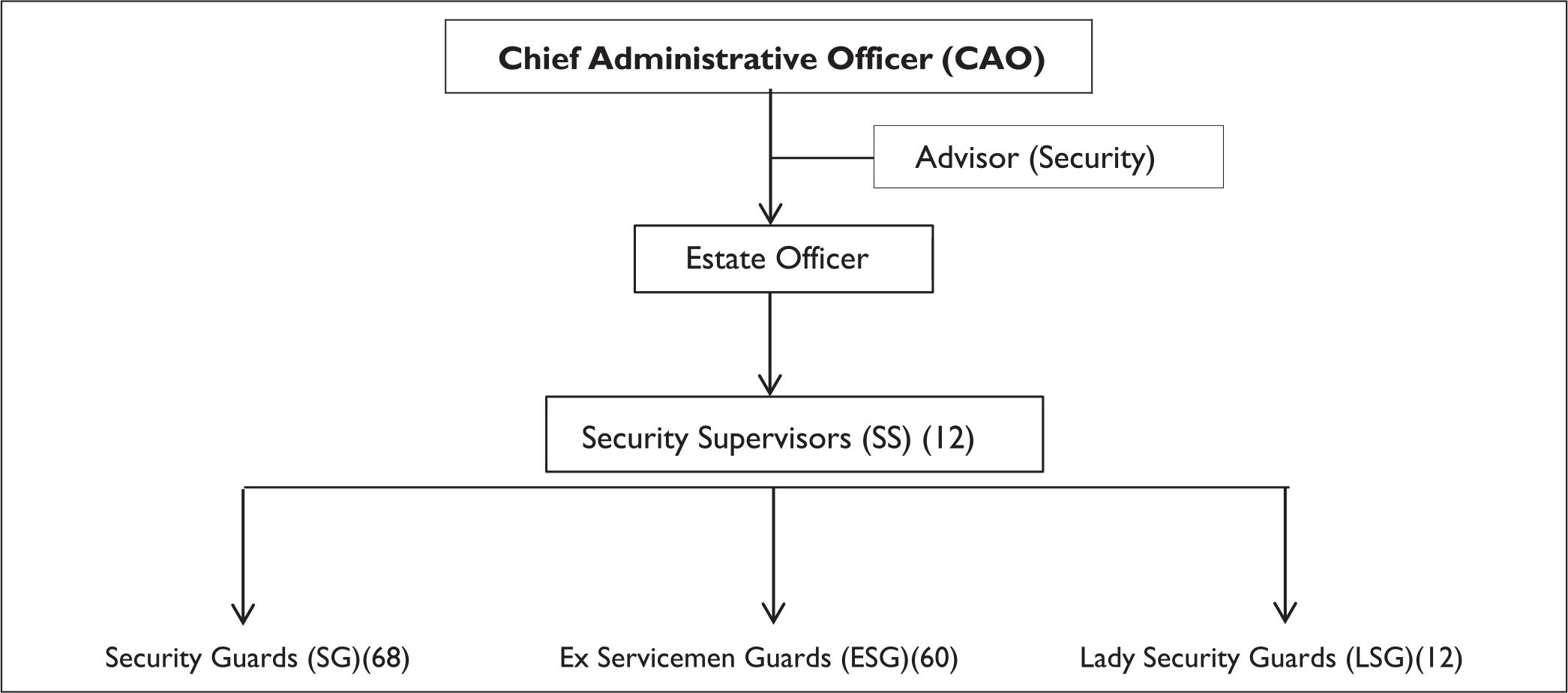
In the board meeting held in June 2014, an important agenda item was to discuss and seek the Board’s approval to integrate the security management of the campus with the overall administration of NIM. A comprehensive note outlining the terms and conditions of the proposal, the experiences so far, challenges in administering the contract by NIM, alternative options, cost implications, administrative realignment (refer to Exhibit 3) required for the new proposal was circulated to the members of the board. The conversation between the dean (Swati Bhargava) and members of the board (BoG) is reproduced next.
Security Services Organizational Structure at NIM
SB: We had four different agencies providing security cover for us in the last 4 years. This is rapid churning. There have been a number of complaints; lack of compliance by the agencies is common. A range of administrative challenges in managing outsourced security services surfaces on a day-to day basis. Based on ground realities, Col Rao, the AO, has proposed insourcing security services.
BoG: This seems to be a dramatic decision and is out of tune with general management principles—non-core activities are usually outsourced for cost efficiency reasons. NIM is an educational institution, providing security services is not our competency. Therefore, it appears reasonable to outsource this service. However, the board will be happy to consider the recommendation based on its merits.
SB: The financial outlay on security when it is outsourced is about ₹2 crores per year. When security is managed by NIM, it would require an expenditure of ₹3.2 crores. This is a 50 per cent increase in the overall budget.
BoG: Apart from the industry trend, the cost is also not favourable to NIM. Therefore, it is not clear as to why this option is being pursued.
SB: NIM is located in a tier-II city. There are not many quality conscious, service oriented, professional, national level players (security agencies) represented in this city. There are only a handful of regional agencies that operate in this state. Their primary motivation is to run a commercial establishment by recruiting semi-skilled security guards and manage the contractual obligation to the minimum required extent possible. Often, they quote commercial terms which are unrealistic. To ensure a reasonable surplus, they resort to multiple ways of cost reduction including non-payment of wages and benefits to security guards. Often contractual obligations are violated. It requires tremendous administrative effort to oversee the contract administration and compliance.
SB: We have had four agencies in the past four years. Our experience is that that none of the stakeholders (agencies, security guards, administration, community) were satisfied. Often the security guards were exploited by the agencies to satisfy their commercial interests.
BoG: We do appreciate the challenges in managing the security contract in an environment where NIM is located. However, the cost of the option proposed is 50 per cent more than the base option. It is not clear how, as a GoI institution, NIM can justify this increase.
SB: We can certainly use cost minimization as a decision criterion, by resorting to a tendering process. While the visible cost is known, the invisible cost of supervision, managing the litigation, ensuring compliance etc. are not recognized. While on paper, awarding the contract to the most competitive bidder is correct, should a GoI institution be a mute spectator when the security guards are commercially and economically exploited by the agency? (Uncertainty related to employment, delayed and denied payments.) The situation is serious and requires urgent redressal, especially when NIM pays the agency wages and benefits as per the GoI norms and tender conditions, which in turn are not passed on to the security guards. In effect, the agency is taking undue advantage of the need of NIM and the vulnerability of the security guards. In the absence of national level professional agencies, we have no option but to find innovative solutions to our situation in the context of the environment in which we operate. The proposal by Col Rao should be seen in this perspective.
DECLARATION OF CONFLICTING INTERESTS
The authors declared no potential conflicts of interest with respect to the research, authorship, and/or publication of this article.
FUNDING
The authors received no financial support for the research, authorship, and/or publication of this article.