




Abstract
Executive Summary
This research article focuses on the importance of corporate social responsibility (CSR) in building corporate reputation of an organization. Scholars have studied CSR as an antecedent of corporate reputation, but the underlying mechanism of this process has been rarely explored. In order to fill this research gap, authors conducted an empirical study on 210 employees working in an automobile organization in India. The conceptual framework based on comprehensive literature review hypothesized that the perceived CSR of an organization may lead to trust development among the employees which in turn may lead to building of corporate reputation of the organization. The model was tested and all the hypotheses were accepted. Hence, it may be inferred that perceived CSR of an organization may develop a sense of trust among employees of an organization and in turn leading to the building of corporate reputation.
The study has several implications for managers and scholars. The findings give a clear understanding that CSR activities of any organization can lead to trust development among employees at the same time they may aid in enhancing the corporate reputation of an organization. Hence, we suggest that in order to gain maximum benefits from CSR, managers should ensure that all the employees are aware of their firm’s CSR activities. Further, managers should adopt CSR activities that have high salience among current or potential employees so that its benefits are positively impacting its stakeholders and the firm. Such CSR activities can include investments in institutions where training is imparted to the organization’s workforce; organizing social welfare activities in areas close to the company’s location. The study also has future research implications for researchers working in the area of CSR. Scholars can explore other mediating variables which may explain the underlying mechanism between CSR and corporate reputation. The study can also be replicated in other sectors in order to enhance the generalizability of the findings.
CSR performance has been positively associated with markers of a firm’s success, such as financial performance (Tsoutsoura, 2004; Waddock & Graves, 1997); customer trust (Salmones, Crespo, & Bosque, 2005; Marin, Ruiz, & Rubio, 2009; Van den Brink, Odekerken-Schröder, & Pauwels, 2006); customer buying behaviour (Mohr, Webb, & Harris, 2001); stakeholder trust (Castaldo, Perrini, Misani, & Tencati, 2009); employee satisfaction (Coldwell, Billsberry, Meurs, & Marsh, 2008), and firm attractiveness (Albinger & Freeman, 2000; Jones, Willness, & Madey, 2010; Maheshwari & Yadav, 2015; Turban & Greening, 1997). This suggests that CSR performance is a strong indicator of a firm’s sustainable success (Málovics, Csigéné, & Kraus, 2008). However, despite increasing interest, most of the research on CSR has focused on the direct relationship between CSR and business outcomes (Aguinis & Glavas, 2012). There is lack of research on the underlying mechanisms through which CSR activities affect the business and other related outcomes (Yadav & Singh, 2016). Furthermore, the extant research has overtly focused more on external stakeholders (customers) rather than internal stakeholders (employees; Lee, Park, & Lee, 2013; Raub & Blunschi, 2013).
This study aims to fill the research gap by studying the mechanism through which CSR activities help in building corporate reputation among employees. Researchers have identified a positive relationship between the development of trust among employees and a firm’s CSR activities (Berry, 1999; Hansen, Dunford, Boss, Boss, & Angermeier, 2011). However, the relationship between trust among employees on the organization and corporate reputation of the organization among employees has not been studied. Although, there are few studies conducted in the United States and Europe. Hence, there are doubts about the findings’ applicability to the Indian context, which is characterized by higher levels of collectivism and lower levels of economic well-being.
This study explores the mechanisms through which perceptions of CSR help firms in developing a positive corporate reputation amongst employees in India. The study also seeks to understand the relationship between perceptions of CSR activities and trust in the organization. The study focuses on perceptions of CSR because (a) employees’ perceptions about CSR affect their attitudes as well as their behaviour and (b) employees may lack information about an organization’s actual CSR activities. Rupp, Shao, Thornton, and Skarlicki (2013) suggested that employee perceptions of CSR may be more important than actual CSR performance in shaping employee attitudes. Trust among employees was selected as the mediating variable between CSR perception and corporate reputation.
LITERATURE REVIEW AND CONCEPTUAL MODEL
Corporate Social Responsibility
The term CSR refers to voluntary activities in which a firm is engaged with the intent of contributing to society and the environment (European Commission, 2001, p. 8). The theoretical justification for CSR lies in conceptualizing it as an unwritten contract between business and society in which companies are expected to fulfil certain socially responsible actions in lieu of the license obtained to operate (Woodward-Clyde, 1999). A socially responsible firm is supposed to perform three main responsibilities, namely economic responsibility, social responsibility, and environmental responsibility (Elkington, 1997).
CSR has been broadly classified into three types. Ethical CSR focuses on justice and fairness in practices grounded in moral principles (Carroll, 1991). Strategic CSR focuses on catering to social services with some profit orientation for the firm (Porter & Kramer, 2006). Philanthropic CSR, the third type, mainly focuses on giving back to society without expecting anything in return (Carroll, 1991). Most studies have tried to find the impact of CSR on different business variables, while very few have explored the impact on business outcomes. For instance, a study by Yadav and Singh (2016) assesses the impact of different types of CSR on trust. The study found that ethical CSR is more effective in trust building when compared to other CSR types.
Drawing from the existing definitions of CSR, this study depicts CSR as a set of voluntary activities a firm performs with the aim to ensure the well-being of its stakeholders without sacrificing the firm’s long-term economic interests. Perceived CSR refers to the degree of employees’ perception about the support provided by their employer to the CSR-related activities (Choi & Yu, 2014). The survey of literature indicates that most studies have used employee or customer perception to measure CSR; hence, the two terms have been used interchangeably. Employee perceptions of CSR lead to multiple positive organizational-level outcomes, such as organizational commitment and organizational identification (Gond, El Akremi, Swaen, & Babu, 2017). Multiple mechanisms, such as social identity and organizational identification, signalling theory, social exchange theory, and attribution (Gond et al., 2017) have been utilized to explain employee reactions to CSR activities.
CSR Activities and Trust
Trust refers to a relationship as well as an affect and is defined as a relationship in which one party has confidence in an exchange partner’s reliability and integrity (Morgan & Hunt, 1994). It is also defined as the feeling that ‘those who we relate to will meet our expectations and not hurt us’ (Choudhury, 2008, p. 590). This study focuses on trust as a relational construct rather than an affective construct. Trust has been considered as an important ingredient for smooth functioning of organizations (Goodsell, 2006) and for building their legitimacy (Bouckaert & Walle, 2003; Mitchell & Scott, 1987). Integrity, fairness, and benevolence have been found to be the necessary ingredients for building trust (Kim, 2005; Menzel, 1995).
Trust is developed based on the assessment of organizations’ ethics and values (Dirks & Ferrin, 2002). Signalling theory and social exchange theory help link CSR perceptions to trust. CSR activities create positive perceptions by sending positive signals to employees about the company’s ethics and values (Rupp, Ganapathi, Aguilera, & Williams, 2006). According to the signalling theory, the positive signals could lead to the strengthening of employee trust as firms perceived to be engaged in CSR are likely to be identified as ‘trustees’ that act in the interests of all stakeholders, including employees (Dirks & Ferrin, 2001; Urde, Greyser, & Balmer, 2007). This rationale is also supported by empirical studies that have found positive relationships between the perception of CSR activities and the development of trust among employees (Pivato, Misani, & Tencati, 2008).
Social exchange theory, on the other hand, predicts that the norms of reciprocity govern employees’ reactions (Gouldner, 1960). This suggests that positive CSR perception is likely to enhance employees’ trust in their employers because the employees feel that the organizations are serving the interests of all stakeholders and hence are more deserving of their trust. Based on the earlier discussion, we postulate that:
Perceived CSR and Corporate Reputation
Corporate reputation is defined as ‘the overall impression reflecting the perception of a collective stakeholder group’ (Lai et al., 2010). It is the result of the stakeholders’ accumulated perceptions regarding the organization’s ability and intent to meet their demands and expectations (Park, Lee, & Kim, 2014). Stakeholders form their assessment of corporate reputation based on the signals they receive from the firm (Brammer & Millington, 2005). Besides financial performance and ownership-related signals, signals of corporate philanthropy also contribute to CSR perceptions (Brammer & Millington, 2005). This is not surprising as stakeholders are also part of the society, and hence their expectations can go beyond their self-interest to include societal interest. Hence, we hypothesize,
Trust and Corporate Reputation
Trust and corporate reputation can be studied from the viewpoint of internal stakeholders, that is, employees and external stakeholders, that is, customers. A survey of literature suggests that the existing literature on trust and corporate reputation has focused on external stakeholders, or customers. Some studies have suggested that corporate reputation among customers precedes and leads to an increase in customer trust in the organization (Keh & Xie, 2009), while other studies have identified customer trust as an antecedent of corporate reputation (Walsh, Mitchell, Jackson, & Beatty, 2009).
This study assumes that trust is an antecedent of reputation rather than a consequence. This belief is based on the reasoning that cognition affects attitudes (Fishbein & Ajzen, 1975). Trust can be conceptualized as a set of beliefs, and hence is cognitive in nature (Park et al., 2014). Corporate reputation is an attitude (Lai et al., 2010), and attitudes towards an object are based on the strength of individuals’ beliefs regarding the object and the evaluative aspects of those beliefs (Fishbein & Ajzen, 1975). Thus, increased employee trust should ideally lead to increased corporate reputation among employees. Employees’ trust has been postulated to lead to positive attitudes, such as commitment and job satisfaction, and behaviours, such as extra effort (Avolio, Gardner, Walumbwa, Luthans, & May, 2004). These postulated links between trust and attitudes such as organizational commitment have also found empirical support (Michaelis, Stegmaier, & Sonntag, 2009). Hence, we postulate,
Trust as a Mediator between CSR Activity and Corporate Reputation
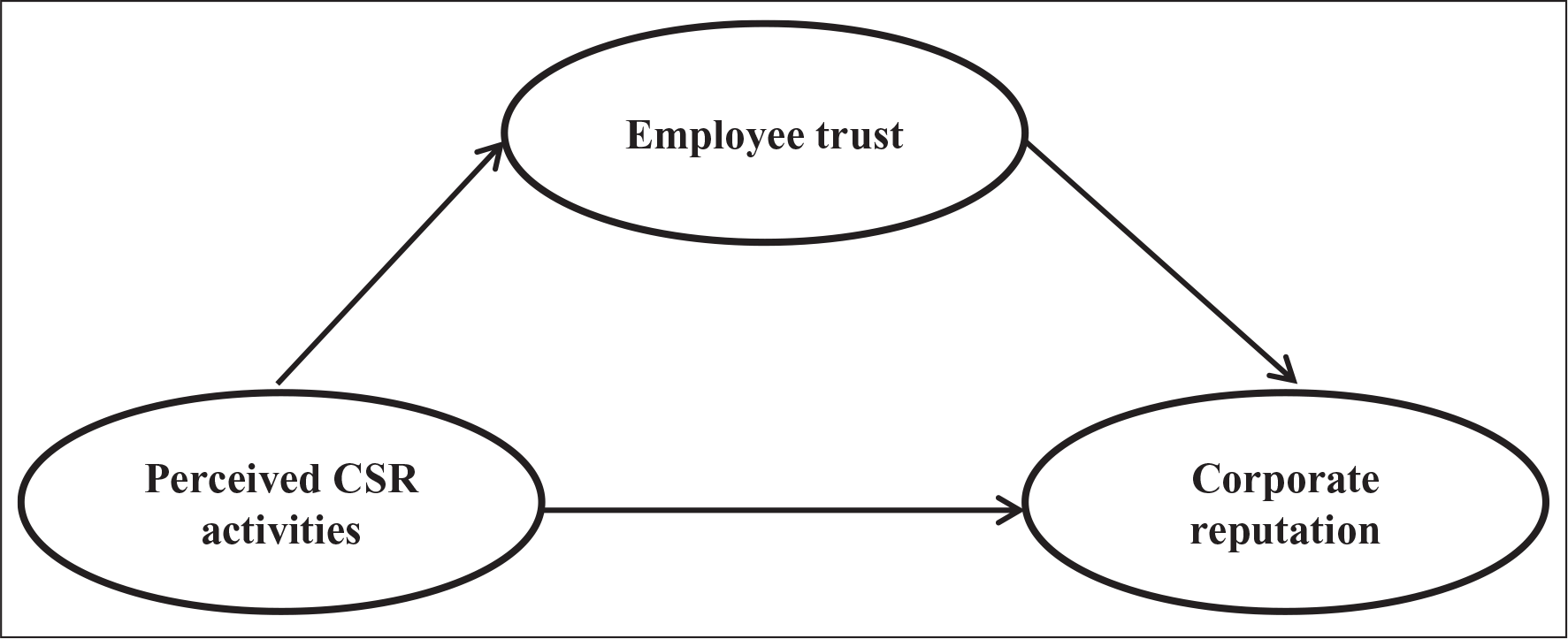
Trust has been identified as a key mediator of antecedent–employee-level relationship outcomes (Colquitt, Scott, & LePine, 2007) (Figure 1). Employee trust has been found to mediate the relationship between the perceived CSR and employee turnover intentions, as well as employee organizational citizenship behaviour (Hansen et al., 2011). Among consumers, trust has been found to mediate the relationship between CSR activities and corporate reputation (Park et al., 2014). Hence, we postulate a similar relationship among employees and hypothesize,
: Theoretical Model
Details of the Measures

Descriptive Analysis
METHODOLOGY
Sample and Procedures
The data was collected from the employees of an Indian automobile company operating in the northern part of the country. A single company with a long history of being socially responsible (Chahoud et al., 2007) was chosen to minimize the effect of CSR activity on perceived CSR. The study sample consisted of employees from various departments and hailing from different parts of the country. Permission was sought from the company’s human resources department to conduct the study.
The questionnaires were administered in two languages: English and Hindi. For the questionnaires in Hindi, translation and back-translation was done to ensure equivalence with the English version. Responses in English were collected from supervisors and managers, while responses in Hindi were collected from technicians and operators. The scales for perceived CSR and trust consisted of six items each, while the scale for corporate reputation consisted of three items. Each item was measured on a 7-point Likert scale, with 1 indicating strong disagreement and 7 indicating strong agreement. About 300 questionnaires were distributed among the employees and 210 usable responses were obtained.
The data was collected from employees with a minimum of six months of work experience to ensure that the employee is aware of the CSR activities performed by an organization. The minimum work experience in the sample was seven months, while the maximum was 456 months, with 35.4 months being the average.The standard deviation of work experience was 53.25. Of the 210 employees from whom the usable responses were gathered, 117 (55.71%) were supervisors and managers and the remaining 93 were operators and technicians. Among the supervisors, 52 respondents had a master’s degree and the remaining 65 respondents had either a bachelor’s degree or a polytechnic diploma. For operators and technicians, an Industrial Training Institute (ITI) diploma was an essential qualification.
Measures
The questionnaire used in the study had three sections with a total of 15 questions. The first section consisted of six items on employee perceptions about the firm’s CSR, which was a modified version of Mohr and Webb (2005); the second section consisted of six items on employee trust developed by Morgan and Hunt (1994); and the third section consisted of three questions on employee perceptions of corporate reputation which were developed by Lai et al. (2010). The scales used for the study are well established in the existing literature. The pre-testing of the questionnaire was done with 35 employees. It revealed no concerns regarding face validity. Some sample items are: I can depend on this company (employee trust); this company runs free medical camps (perceived CSR); customers believe in a good long-term future for this firm (corporate reputation).
Descriptive Statistics and Cronbach Alpha
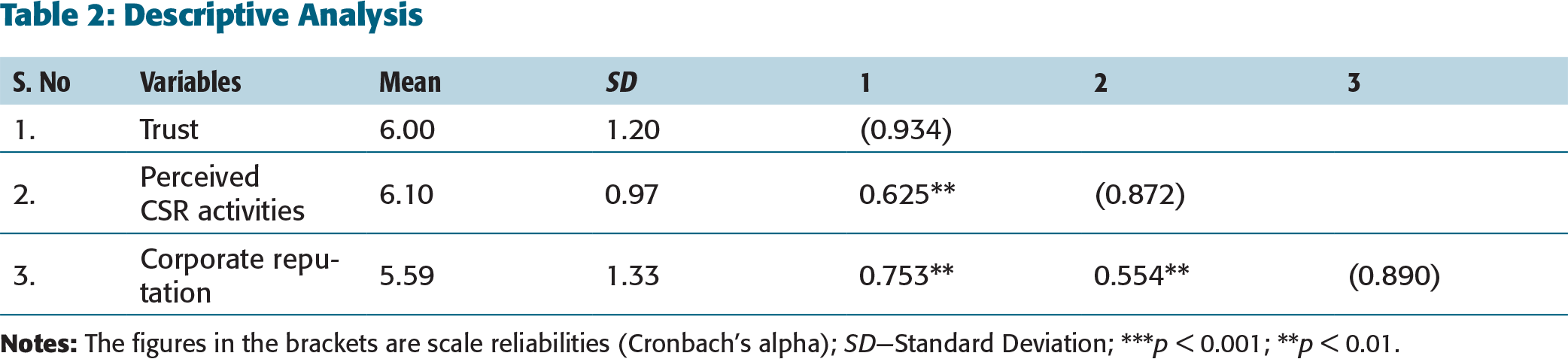
The means of the three constructs (perceived CSR, trust, and corporate reputation) ranged from 5.59 to 6.10 on a 7-point Likert scale, which suggests that employees with highly positive perceptions about the firm’ CSR activities and corporate image exhibited a high degree of trust towards the firm. The standard deviation ranged from 0.97 to 1.30, which indicates a moderate amount of dispersal. The Cronbach alpha for all three constructs ranged from 0.872 to 0.934, which is significantly higher than the recommended value of 0.7 (Hair Jr., Anderson, Tatham, & Black, 1995). The details about the descriptive statistics and the Cronbach alpha are presented in Table 2.
ANALYSIS
The study focuses on the role of employee trust in mediating the effect of perceived CSR activities on corporate reputation among employees. Step-wise regression with SPSS 21 was used to test the hypotheses. The control variables used in the study were age,marital status, and gender. The language used for filling out the questionnaires was used as a proxy for education and designation with the assumption that a certain degree of education equates to the ability with written English and signals a supervisory/managerial position.
The control variables were considered as the independent variables (IVs), corporate reputation was considered as the dependent variable (DV), and perceived CSR was taken as an additional IV. This technique helps to account for the additional variance that is explained by the predictor variable. Mediation was checked using the technique suggested by Baron and Kenny (1986). The following rules were used for checking mediation:
1. The IV must be significantly related to the DV. 2. The mediating variable must be significantly related to the DV. 3. The IV must be significantly related to the mediating variable. 4. When both independent and mediating variable are used as IVs, either the IV must become non-significant or there must be a substantial decline in the standardized impact of the IV on the DV (Baron & Kenny, 1986).
The results of the step-wise regression are summarized in Table 3.
RESULTS
The psychometric properties of the scales (descriptive statistics, correlations, and scale reliabilities) are presented in Table 2. Among the constructs, perceived CSR activities has the highest mean (6.10) and the lowest standard deviation (0.97), and corporate reputation has the lowest mean (5.59) and the highest standard deviation (1.33). The Cronbach alpha values range from 0.872 to 0.934, which demonstrate excellent scale reliability. This is especially pertinent because none of the scales has a large number of items. All three constructs are positively related with each other at p≤0.01 level. The correlation between trust and perceived CSR activities is 0.625, between trust and corporate reputation is 0.753, and between perceived CSR activity and corporate reputation is 0.554.
Results of the Step-wise Regression
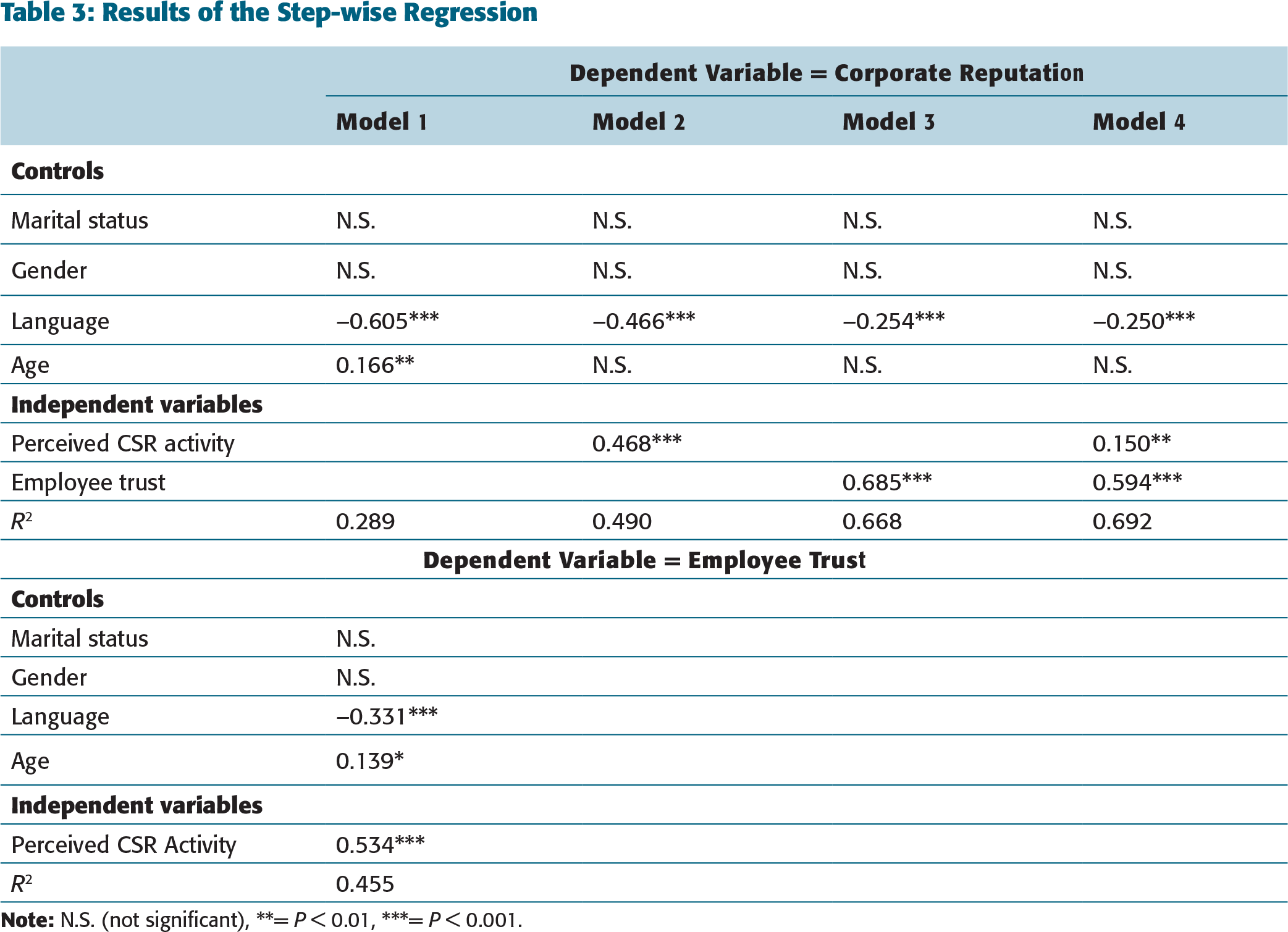
In Model 2, along with the control variables, perceived CSR activity was considered as another IV. It was observed that perceived CSR activity was positively related to corporate reputation (β=0.468 at ≤0.001), thereby validating Hypothesis 1. Use of English in filling out questionnaires were found to be negatively and significantly related to corporate reputation. Age ceased to be a significant predictor. This relationship held for all other models as well. No other control variable was found to be significant in any of the other models.
In Model 3, along with the control variables, employee trust was also considered as an IVs. Employee trust was found to be positively related to corporate reputation (β=0.685 at p≤0.001), thereby validating Hypothesis 2.
In Model 4, both perceived CSR activity and employee trust were considered as IVs in addition to the control variables. Both perceived CSR activity and employee trust were positively related to corporate reputation (β = 0.150 at p ≤ 0.01 and β=0.594 at p≤0.001 respectively). The effect of perceived CSR activity declined fromβ=0.468 (at p≤0.001) to β=0.150 (at p≤0.01), thus indicating partial mediation. Hence, Hypothesis 4 was partially validated.
Another set of regression equations was used to explore the relationship between perceived CSR activity and employee trust, where the control variables in Model 1 and perceived CSR activity were considered as the IVs, while employee trust was taken as the dependent variable (DV). Perceived CSR activity was found to be positively related to employee trust (β=0.534 at p≤0.001). Besides perceived CSR, the language used for filling out questionnaires and the age of employees were also significantly related to employee trust (β=0.331 at p≤0.001 and β=0.139 at p≤0.005, respectively).
DISCUSSION
CSR has been studied mostly in the Western context which significantly differs from the Indian context. Parameters such as lower economic well-being, greater levels of collectivism, and a significant presence of family-led firms contribute to this difference. These parameters can affect the potential of organizations to adopt CSR, the available set of programmes or initiatives under CSR, and subsequently the execution and perception of CSR. Although CSR activity has been explored as an antecedent of corporate image, the mechanisms of the relationship have not been explored in detail. Thus, this study adds to the literature on corporate reputation by not only explaining the mechanism of securing high levels of corporate reputation improvement but also providing empirical validation from the Indian context.
This research studies the role of trust as a mediating mechanism through which CSR activities help in increasing the reputation of a corporate organization amongst its employees. It was found that employee trust partially mediates the effect of perceived CSR on corporate reputation amongst employees. Based on the signalling theory, we argued that employees who perceive their firm to perform high levels of CSR activities believe that their organization will also be ethical in its dealings with them. High levels of CSR activities also have the potential to signal that the demands and expectations of employees will be met. Such positive contributions from the organization could induce positive feelings amongst the employees, thereby leading to the development of trust. Employees who trust their organizations are more likely to have a good opinion of their organization.
The results of the step-wise regression supported the argument that perceived CSR helps in building corporate reputation through trust. All three postulated hypotheses received support. Therefore, the results add to the existing body of literature by identifying a positive link between corporate reputation among stakeholders and trust in the organizations. Our findings complement previous studies (Bear, Rahman, & Post, 2010; Lee, Song, Lee, Lee, & Bernhard, 2013 Martínez & Rodríguez del Bosque, 2013; Pivato, Misani & Tencati, 2008), which have observed a positive relationship between the perception of CSR activities and the development of trust among the stakeholders. It is noteworthy that after considering employee trust as an IV in the model, the direct relationship between perceived CSR and corporate reputation prevailed, which suggests that there might be other variables—for example, organizational identification—that mediate the effect of perceived CSR activity on corporate reputation.
Among the control variables, marital status and gender were found to have no significant effect on determining corporate reputation. This was somewhat surprising, as a previous study found that the percentage of female board members is positively related to corporate reputation (as measured by expert ratings), and the effect is mediated by the firm’s CSR ratings (Bear et al., 2010). However, our study measures perceived CSR and corporate reputation amongst employees rather than expert ratings, which makes our study different from the study by Bear et al. (2010). Though marital status and gender were not found significant, age of employees was observed to be significantly related to employee trust, with elderly employees displaying greater trust. This could indicate that senior employees probably have different needs and expectations (fulfilled by the organization) vis-à-vis their younger counterparts. The finding also suggests that the fulfilment of a psychological contract between the employer and the employee is necessary for an employer to not just enhance the level of trust but also to improve the corporate reputation among employees. Assuming age is a proxy of the organizational tenure of employees, this finding further implies that high levels of trust amongst senior employees leads to their decision to continue their services within the organization. This finding could be further validated by exploring the relationship between organizational tenure and trust.
The languages used for filling out the questionnaires were significantly related to employee trust and corporate reputation. The people who filled out the questionnaire in Hindi demonstrated higher trust and a more positive corporate reputation when compared to employees who filled in the questionnaire in English. Given the socio-economic situation in India, it is assumed that the English-literate employees were more educated and held higher designations. The results were a bit surprising and contrary to our expectation that higher levels of education is directly related to a more positive corporate reputation among employees. One possible reason may be that people with a higher level of education have higher expectations from their companies when compared to their lesser educated colleagues. Another probable reason for this finding could be that the blue collar employees hail from nearby areas and many of them have been trained in ITIs supported by the target company. On the other hand, most supervisors and managers come from different parts of the country, and therefore they may not have felt the direct impact of the company’s CSR activities. Hence, there is a need for further research on the relationship between education, designation, hometown, and CSR perception.
Corporate reputation among employees can play a big role in attracting and retaining talent. This attraction and retention of talent is a significant advantage in a knowledge-driven economy, where firms that are perceived to be highly reputed will be better equipped to recruit and retain talent. The results showed that the target firm had a better reputation among less-educated employees. The likely reason behind this phenomenon is enhanced awareness and understanding among senior employees about other philanthropic organizations and their CSR activities. This can be explored in future research.
IMPLICATIONS FOR RESEARCH AND PRACTITIONERS
Corporate reputation has been linked to superior financial performance (Roberts & Dowling, 2002; Tang, Hull, & Rothenberg 2012) and philanthropic donations have been identified as an antecedent of corporate reputation (Brammer & Millington, 2005). In academic literature, corporate reputation has been mostly defined from the customer’s point of view (Gotsi & Wilson, 2001); however, previous studies have almost ignored the perspective of internal stakeholders, especially employees. This article looks at corporate reputation from the point of view of employees, and it argues that the determinants and consequences of corporate reputation among employees are different from those of customers. For example, corporate reputation is an antecedent of trust among customers, but among employees it is a consequence of employee trust. Thus, there is a scope for future research on identifying the antecedents and consequences of corporate reputation from employees’ point of view.
The study identifies perceived CSR as a distal antecedent of corporate reputation among employees and employee trust as the mediating variable. This suggests that managers must aim to build trust among employees for reaping the full benefits of their investments in CSR. One of the possible ways of gaining benefits from CSR is to ensure that the employees are aware of their firm’s CSR activities. Adopting CSR activities that have high salience among current or potential employees will also benefit the firm. Such CSR activities can include investments in institutions where training is imparted to the organization’s workforce; organizing social welfare activities in areas close to the company’s location and where employees reside. Organizations should also focus on the varying needs and expectations of employees from different age cohorts with respect to CSR activities.
LIMITATIONS
The study, by its design, has certain limitations. One important limitation is that all the data has been collected from employees. This leads to the possibility of common method bias. In cognizance of the possibility of common method bias, precautions have been taken in the study, which include explicit communication to the respondents about the confidentiality of their responses, in both written and verbal form; the use of well-established scales; and randomization of the items of the scale. Podsakoff, MacKenzie, Lee, and Podsakoff (2003) suggest that confidentiality clauses reduce the chances of social desirability bias. Items from the well-established scales are usually non-ambiguous (Tourangeau, Rips, & Rasinski, 2000), and hence, use of these scales helps in getting more accurate responses. The purpose of the study was also communicated in detail to the participants to assuage any misgivings regarding the use of the data. The scale items were randomized for minimizing the possibility of predictable responses.
Another limitation is the collection of data from a single organization. To ensure variability in data, responses were collected from multiple departments. Data collected from single firms can also be helpful in generating useful insights (Amaladoss, Manohar, & Jacob, 2011; Knudsen, 2013). However, the generalizability of the insights depends upon the duplication of the study in multiple organizations across multiple industries and regions.
A third limitation of the study lies in the cross-sectional nature of the study. Cross-sectional studies cannot establish cause and effect relationships; and hence, we need to conduct longitudinal studies to authoritatively claim the cause and effect relationship among the perceived CSR, employee trust, and corporate reputation among employees.
CONCLUSION
Aguinis and Glavas (2012) identified a lack of research on the mechanisms through which CSR activities influence various firm-level variables such as corporate reputation or firm reputation. This study conducted in the Indian context, which differs significantly from the European and US contexts in terms of overall economic well-being, collectivistic attitude in society, and role of family-owned firms’ aims to fill that gap. The article identifies perceived CSR as an antecedent of corporate reputation among employees, and this relationship is partially mediated by employee trust. The findings add to the existing body of research related to CSR perceptions and their relationship to the reputation of the firm, as it tries to answer the ‘how’ part of the phenomenon.
The evidence that different groups of employees have different levels of trust and images of the employer indicate that employees evaluate the CSR activities of their employer from different perspectives. Therefore, organizations need to consider a bundle of CSR activities rather than focusing on a single initiative, which might hold minimal value for a majority of the employees.
The study also becomes pertinent in the present context, as the Indian Companies Act (2013) has mandated organizations to spend 2 per cent of their profit on CSR activities. The act will be applicable to approximately 6,000 companies, which will in turn generate a total corpus of `20,000 crores (about 200 billion) per year for spending on CSR. Our findings demonstrate clear evidence regarding the benefits of CSR to the firms through initiation of CSR activities for the first time owing to this act.
DECLARATION OF CONFLICTING INTERESTS
The authors declared no potential conflicts of interest with respect to the research, authorship, and/or publication of this article.
FUNDING
The authors received no financial support for the research, authorship, and/or publication of this article.