




Abstract
Executive Summary
During the recent past, various researchers have argued that educational institutions fall within the domain of service industry (Joseph & Beatriz, 1997, Journal of Marketing for Higher Education, 8(2), 1–13). Consequently, service marketers have placed unprecedented attention on education sector to explore the marketing aspect of academic institutions. Furthermore, because of intensifying global competition and increasing cost of education, academic institutions are placing additional emphasis on student-related outcomes rather than merely concentrating on the skills and abilities of their graduates.
In this backdrop, this study investigates the hitherto unexplored antecedents of two significant student-related outcomes (student satisfaction and loyalty), that is, proactive personality of teachers. The study also provides a possible explanation of this relationship through the mediating role of job crafting and work engagement. This would help academicians to develop broader insights into the domain of antecedents of positive student experiences.
Dyads of 159 teachers from 20 universities in India were created and responses were collected on job crafting and work engagement (self-ratings) and proactive personality (peer-ratings) using a structured questionnaire. About 608 students were approached from the same universities to collect data regarding their satisfaction and loyalty. The sample universities included both central and state universities. All constructs were measured using previously developed scales. The hypothesized relationships were tested in AMOS 20 using structural equation modeling.
The results evidenced a significant positive influence of teacher proactivity on student satisfaction and their loyalty. Also, job crafting and work engagement are found to significantly and sequentially mediate the relationship between teacher proactivity and student outcomes. Therefore, academic practitioners are required to place additional emphasis on proactivity of the teaching staff so as to result in positive student service experience. It is suggested that the selection and recruitment process of teaching faculty be redesigned to identify proactivity of prospective teachers.
Keywords
There is a widespread recognition that educational institutions fall within the domain of service industry (Dolinsky, 1994; Joseph & Beatriz, 1997). Therefore, there is additional research attention on integrating educational institutions with service marketing research. The development of global education markets have resulted in intense competition and steep increase in the cost of education. Educational institutions are concerned not only about the skills and abilities of their graduates (Lawson, 1992) but also about the perception of their students about the educational experience (Bemowski, 1991). Positive service experience of students leads to their satisfaction and loyalty which in turn fosters competitive advantage through positive word-of-mouth behaviour. Achievement of student satisfaction and loyalty, by superior service creation and delivery, assumes additional relevance under the contemporary highly competitive international education market (Kotler & Fox, 1995).
In view of the considerable importance that service marketers attach to customer-related measures of performance such as customer satisfaction, service quality perception, word-of-mouth behaviour, etc., an investigation of proactive personality of employees (teachers) in relation to the customer outcomes (student satisfaction and their loyalty) would help academic practitioners to develop broader insights into the domain of antecedents of positive student experience. This study aims to investigate the influence of teacher proactivity on student satisfaction and loyalty. The study further examines the role of job crafting and work engagement in the relationship between proactive personality of employees and student satisfaction and loyalty.
The current research draws from the job crafting model (Bakker et al., 2012) to include customer-related measures of performance. Primary data for the study comes from the teaching faculty and students of 20 universities in India, both state and central. Focusing the study on the education sector renders it a twofold purpose: First, the author attempts to investigate the hitherto unexamined job crafting model in the context of Indian education sector. This will either reinforce or limit the generalizability of the said model, thereby delineating the horizons of its applicability. Second, the relationship between teacher proactivity and student satisfaction and loyalty is examined. Do the empirical results suggest that teachers who are inclined in their approach towards proactivity garner favourable student-related outcomes? The study also examines the role of job crafting and work engagement in the proactivity–performance relationship. This will further sketch out the linkage between employee proactivity and customer outcomes. Also, there is a paucity of empirical research with respect to job crafting, work engagement (Petrou, Demerouti, Peeters, Schaufeli, & Hetland, 2012), and customer outcomes, particularly in the context of a developing nation like India.
RESEARCH GAP
In Indian higher education sector, teacher proactivity and job crafting have seldom been studied in relation to student-related marketing-based outcomes like student satisfaction. Although evidence about relating work engagement with other organizational constructs such as job satisfaction (Umamheswari & Swarnalatha, 2015) and teacher performance (Gupta, Acharya, & Gupta, 2015) is available, a comprehensive framework which also incorporates the antecedents of work engagement is still missing. The present study, therefore, aims to address this gap by including two possible antecedents of work engagement—employee proactivity and job crafting.
Globally, various studies have been conducted to examine the relationship between proactive personality, job crafting, and work engagement in different contexts including education (e.g., Rothmann & Jordaan, 2006). But again, there is paucity of evidence linking these constructs with customer-related performance outcomes. In an Indian context, while Siddiqi (2015) examines job crafting, work engagement, and customer outcomes in the Indian retail banking, the study eludes to a possibly significant driver of job crafting behaviour, that is, employee proactivity. In order to be able to generalize its findings, the relationships need to be investigated in other sectors of an economy. This study focuses on the Indian education sector, for two reasons. First, it has never been the focus of any research work comprehensively incorporating employee proactivity, job crafting, work engagement, and customer outcomes. Second, Indian education sector has a potential to boost Indian economy towards the globally competitive platform which can make India a vibrant economy and a hub of global education (Basu, 2016) and, therefore, extensive research attention must be focused on this sector.
THEORY AND HYPOTHESES
Proactive Personality
In an attempt to integrate diverse perspectives on personality structure, Swietlik (1968) conceptualized a rubric of ‘reacting or proactive personality’. However, the idea attracted little attention at that time. More than two decades later, Bateman and Crant (1993) familiarized proactive personality to organizational research. They defined the concept as ‘the relatively stable tendency to effect environmental change’. This definition allows us to deduce that proactive personality is rooted in interactionist psychology (Magnusson & Endler, 1977; Snyder & Ickes, 1985) which argues that human tendencies are manifested as an outcome of individual–environment interaction. This implies that persons and situations are a function of each other (Snyder & Ickes, 1985). Hence, individuals are not ‘passive recipients of environmental presses’ (Buss, 1987)—they actively affect their environment.
Deriving from the interactionist theory, the extent to which an individual takes action to influence his/her environment characterizes his/her level of proactivity. Proactive people recognize opportunities, initiate action, and show perseverance until a meaningful transformation ensues (Crant, 1995). They are relatively unconstrained by situational forces (Bateman & Crant, 1993). On the contrary, less proactive people are crafted by their environment. They prefer to react and adapt to the environmental changes rather than influencing them (Bakker et al., 2012).
Past research indicates that proactive personality is positively associated with various important organizational behaviours. For instance, Greguras and Diefendorff (2010) reported a significant positive influence of proactive personality on in-role performance and organizational citizenship behaviour. Likewise, using a longitudinal research design, Seibert et al. (2001) found that proactive personality (at time 1) positively relates with innovation and career initiative (at time 2). Furthermore, leadership perception and effectiveness are also associated with proactive personality. A study of postgraduate management students by Bateman and Crant (1993) reported a positive association between proactive personality of a student and his chance of being nominated, by his peers, as a transformational leader.
Job Crafting
From a traditional standpoint, managers, by way of their hierarchical position, hold the responsibility of formulating jobs for their subordinates—job design. This is a top-down approach which does not consider employee input when deciding about various job characteristics such as tasks to be performed, nature of relationships to be maintained at the workplace, frequency of interaction with people, etc. Rather, these job aspects are decided by the superiors. Early literature on organizational behaviour emphasizes job design as a significant correlate of employee motivation (Campion, 1988; Hackman & Oldham, 1980). However, more recent literature evidences that employees, nowadays, enjoy some level of latitude to define their job roles (Oldham & Hackman, 2010) which allows them to influence their job characteristics. In this backdrop, Wrzesniewski and Dutton (2001) suggested an extension to the concept of job design–job crafting.
Job crafting is described as a bottom-up approach wherein employees, as a result of self-initiated change behaviours, influence their job boundaries to align them with their preferences, passions, and qualifications (Wrzesniewski & Dutton, 2001). It involves active modifications in the job design by way of choosing tasks, negotiating different job content, and assigning meaning to tasks (Parker & Ohly, 2008). Employees may make adjustments in the number of tasks to be performed or the way in which they are performed (physical crafting). They may also modify the complexion of relationships with others (Tims, Bakker, & Derks, 2015) at the workplace by influencing the quality and/or frequency of interactions (relational crafting). Finally, a self-induced change in the way an employee perceives his job (Wrzesniewski, Boluglio, & Berg, 2012; Wrzesniewski & Dutton, 2001) in terms of the tasks and their interrelationships constitutes cognitive crafting.
Contemporary literature draws heavily from the job demands-resources (JD-R) model (Tims et al., 2012) to elucidate different job characteristics that employees may alter while engaging in job crafting behaviour. The JD-R model categorizes all job characteristics into job demands and job resources. ‘Job demands’ refer to those aspects of a job that require effort (physical, social, or cognitive) and primarily result in employee health impairment (Demerouti, Bakker, Nachreiner, & Schaufeli, 2001). However, if perceived as challenge, job demands can also enhance employee motivation (Prieto, Soria, Martinez, & Schaufeli, 2008). ‘Job resources’, on the other hand, are those aspects of a job that facilitate achievement of work goals, stimulate personal growth, and can reduce job demands and its associated costs (Bakker & Demerouti, 2008).
Following an empirical investigation on a theoretically grounded JD-R model, Tims et al. (2012) proposed four distinguished job crafting dimensions, namely: (a) increasing structural job resources; (b) increasing social job resources; (c) increasing challenge job demands; and (d) decreasing hindrance job demands. These dimensions represent the actual self-induced employee behaviours aimed to maintain a balance between job demands and job resources (Siddiqi, 2015). ‘Increasing structural resources’ indicate a proactive resource mobilization by employees such as asking employers for greater job autonomy, seeking more opportunities for personal growth and development, participation in training programmes, etc. ‘Increasing social job resources’ involve seeking feedback from peers and subordinates, supervisory support and guidance. In an attempt to promote mastery and future gains, besides reducing monotony, employees sometimes try to reconfigure their job to make it more challenging (Siddiqi, 2015). Such kind of a behaviour refers to ‘increasing challenge job demands’. Contrarily, unlike challenge job demands, certain other job demands may negatively influence employee performance, for example, role conflict, long and tiring working hours, emotionally stressful interactions, etc. Employees may try to avoid or reduce such kind of demands so as to maintain a comfortable work environment—‘decreasing hindrance job demands’.
Crant’s (2000) theory of proactive personality argues that proactive individuals are more inclined towards influencing their environment to create favourable work conditions and opportunities. They wilfully initiate changes that result in synchronization of their abilities and preferences with the characteristics of job. Tims et al. (2012) categorize these characteristics as job demands and resources. Consistent with this formulation, it may be concluded that proactive persons will strive to balance job demands and resources (Siddiqi, 2015) to align their work environment with their aptitudes and requirements. In view of this, it is quite reasonable to propose the following hypothesis.
Relating Job Crafting and Work Engagement
Initially, an attempt to define work engagement was made by Kahn (1990). He defined engaged workers as those who have a positive attitude at the workplace. Mere physical presence at the workplace devoid of emotional and psychological involvement will not constitute work engagement (Kahn, 1990). Rather, an engaged worker will manifest attentiveness, involvement, and focus by cognitively integrating himself with his work role (Kahn, 1992). Saks (2006) argues that work engagement embodies cognitive, emotional, and behavioural components associated with individual role performance.
The most widely acknowledged conceptualization of work engagement is provided by Schaufeli, Salanova, Gonza´lez-Roma´, and Bakker (2002). They define work engagement as a positive, fulfilling, work-related state of mind characterized by vigour, dedication, and absorption. Vigour refers to an individual’s energetic approach towards work further marked by resilience to continue the work in spite of hardships. Dedication indicates enthusiasm and strong involvement in one’s work elicited by a sense of significance and meaningfulness towards the work role. Absorption signifies high level of concentration and worker’s happy engrossment in the work role to the extent that time appears transient and withdrawal from work seems difficult. In a nutshell, engaged workers are those with high energy levels and perseverance coupled with strong enthusiasm towards their work. They are so immersed in their work that time appears to be fleeting (May, Gilson, & Harter, 2004).
As stated earlier, the JD-R model of job crafting (Tims et al., 2012) divides job characteristics into job resources and job demands. Previous research findings indicate that job resources in the form of, say, feedback, supervisory coaching, skill variety, etc., enhance employee work engagement (Halbesleben, 2010). Either intrinsically or extrinsically, job resources play a motivational role in stimulating employee willingness to spend energy, perform better, and stay engaged (Bakker & Demerouti, 2008). By fulfilling the need for autonomy and relatedness, job resources activate a motivational process by fostering employee learning, growth and development—intrinsic motivation (Deci & Ryan, 1985; Ryan & Frederick, 1997). Extrinsically, job resources facilitate successful attainment of work goals. The reason being that resourceful work environment fosters willingness towards dedicated work effort (Meijman & Mulder, 1998) which in turn translates into goal achievement. Motivated employees are likely to stay engaged in their work by way of enhanced levels of dedication and commitment (Crawford, LePine, & Rich, 2010).
JD-R model classifies job demands as challenge job demands (e.g., taking extra responsibilities) and hindering job demands (avoiding complicated decisions and tiresome interactions). There is evidence in literature that job demands (when viewed as challenge) compound the impact of job resources on work engagement (Hakanen, Bakker, & Demerouti, 2005). Put differently, when job resources are high, the presence of high challenge job demands will result in improved work engagement and performance. These findings are also consistent with conservation of resources theory (Hobfoll, 2001) which postulates that people try to accumulate resources which they deem valuable. Resource accumulation, however, assumes greater relevance in the context of a resource loss (Hobfoll, 2002). That is, job resources can be more beneficial when job demands are high as it improves their motivational potential.
Apart from that, by decreasing hindering job demands, employees can mitigate their negative consequences such as exhaustion and burnout (Schaufeli, Bakker, & van Rhenen, 2009). Research evidence indicates a negative relationship between hindering job demands and work engagement (Crawford et al., 2010). Therefore, by proactively reducing hindering job demands, employees can enhance their level of work engagement.
Therefore, if employees experience a misfit between job demands and resources, they try to minimize this disparity by engaging in job crafting. Resultantly, they create a resourceful and challenging work environment for themselves wherein job characteristics are synchronized with employee needs and abilities. Such an environment nurtures enthusiasm and motivation which in turn enhances work engagement (Bakker & Demerouti, 2008). Based on this literature review, we hypothesize:
Relating Work Engagement and Customer Outcomes
Previous research findings establish that engaged individuals are motivated to put in greater work effort as a result of higher levels of energy, concentration, and resilience (Schaufeli et al., 2002). Work effort is significant in translating motivation into task accomplishment (Walker, Churchill, & Ford, 1977) and as such, work engagement, by enhancing motivation, leads to improved job performance via work effort. Moreover, engaged employees are happy, joyful, and enthusiastic (Schaufeli & van Rhenen, 2006), and they also experience better health (Bakker & Demerouti, 2008). Cropanzano and Wright (2001) state that happiness positively correlates with opportunity identification, confidence, and optimism. Therefore, happy people are more likely to be more productive and satisfied. Likewise, employees who are more engaged with their work report lesser instances of psychosomatic problems such as headaches (Schaufeli, Taris, & van Rhenen, 2008) and are, therefore, able to perform better.
Furthermore, there is accumulating evidence in the literature that employee job attitudes (e.g., job satisfaction, motivation, commitment, service effort) positively influence customers’ service experience. Since employee job attitudes are significantly correlated to work engagement, customers’ positive service experience is a likely outcome of employees’ work engagement. Furthermore, engaged workers are more attentive, focused, energetic, and confident. Therefore, they are likely to understand customer expectations during service encounters. Consequently, they can address customer demands in a more satisfying way. Satisfied customers are expected to engage in repeat behaviour and depict loyalty (Nayebzadeh, Jalaly, & Shamsi, 2013).
Despite the aforementioned argument, there is paucity of evidence in the literature that investigates direct relationship of work engagement and customer outcomes except one study conducted by Siddiqi (2015). The author investigated job crafting and work engagement in relation to customer outcomes in Indian retail banking. He found that engaged workers provide a more satisfying experience to customers which also enhances their loyalty towards the service provider. Consistent with these arguments, it seems reasonable to propose the following hypothesis:
Furthermore, by definition, proactive individuals identify opportunities, initiate actions to improve the existing circumstances and ensure occurrence of a meaningful change by showing perseverance. Therefore, in the context of a service interaction, proactive employees not only better comprehend customer service requirements but also ensure that their demands are satisfactorily met. Satisfied customers, logically, continue their relationship with the service provider (Daniel, Christopher, & Philip, 2011) and avoid unnecessary switching costs. In view of this contention and the earlier postulated ‘Hypotheses 1–3’, the following premise is proposed:
METHODOLOGY
Data Collection and Sampling
The data for the study was collected from the teaching faculty and students of 20 Indian universities using a structured questionnaire. The data collected from the faculty was regarding proactive personality, job crafting, and work engagement, while the students were asked to rate their level of satisfaction and loyalty with the institution. It is pertinent to mention that the teachers were grouped into dyads for data collection. The teachers besides rating themselves (self-ratings) also rated their colleagues (peer ratings). Self-ratings pertained to job crafting and work engagement, whereas peer ratings pertained to proactivity. This approach is consistent with Bakker et al. (2012). Responses on all the constructs were requested on a five-point Likert scale ranging from 1 (strongly disagree) to 5 (strongly agree).
The questionnaires were physically distributed to the respondents (teachers and students) by a group of scholars pursuing doctoral research in the Department of Management Studies, University of Kashmir. The response rate for students was 90.61% (i.e., 608 questionnaires received out of 671 questionnaires distributed). The response rate was not an issue with the faculty as questionnaires were distributed only to those who had already consented to participate in the study.
Furthermore, peer ratings were obtained for proactive personality which requires that the individuals in a particular dyad must have worked together long enough to understand each other’s personality. Therefore, only those faculty members who had worked together for at least three years were approached. Also, the student sample included only those students who had been in the institution for at least one year as they are better suited to reflect their satisfaction and loyalty in comparison to their fresher counterparts. Due care was taken to sample only those students who have had sufficient interaction with the teachers approached in the study.
Data from a total of 159 dyads of teachers and 608 students was received. From the faculty responses, about 64.15% respondents were males. The average work experience was 16.38 years. The sample included 97 professors (30.50%), 108 associate professors (33.96%), and 113 assistant professors (35.54%). The study sample covered faculty from varied disciplines, including management, zoology, economics, mathematics, and journalism. Among the students representing diverse disciplines, 46.38% were females. The average age of students was 24.48 years.
Research Instrument
In this study, the Proactive Personality Scale (PPS) developed by Bateman and Crant (1993) was used to measure ‘proactive personality’ of teachers. The scale provides for a unidimensional construct based on factor analysis and reliability coefficients. The factorial validity of the scale was examined using confirmatory factor analysis and reliability was tested by Cronbach’s alpha values. Results indicated a satisfactory model fit (χ 2 = 41.37, goodness-of-fit index = 0.91, adjusted goodness-of-fit index = 0.87, comparative fit index = 0.96, root mean square error of approximation = 0.04). All the factor loadings were above the threshold level of 0.40 (Nunnally & Bernstein, 1994). The alpha value was recorded at 0.79 indicating that the scale is reliably measuring the construct.
‘Job crafting’ was measured using 21 item job crafting scale by Tims et al. (2012). The scale consists of four subscales measuring ‘increasing structural job resources’ (factor loadings ranged from 0.48 to 0.61; a = 0.72), ‘increasing social job resources’ (factor loading ranged from 0.54 to 0.63; a = 0.75), ‘increasing challenge job demands’ (factor loadings ranged from 0.52 to 0.59; a = 0.73), and ‘decreasing hindrance job demands’ (factor loadings ranged from 0.56 to 0.65; a = 0.77).
In order to measure teachers’ perception of their level of ‘work engagement’, the shortened version of Utrecht Work Engagement Scale (UWES) developed by Schaufeli, Bakker, and Salanova (2006) was used. The scale consists of nine items measuring vigour (measured by 3 items), dedication (measured by 3 items), and absorption (measured by 3 items). Confirmatory factor analysis supported unidimensionality of all three subscales with factor loadings ranging from 0.49 to 0.81. The Cronbach’s alpha values were also above the cut-off level 0.70 (Cronbach, 1951), indicating that the instrument is reliable.
The nine-item scale developed by Maloles (1997) was used to capture the perception of ‘student satisfaction’. The items were rephrased to adequately represent the needs of the current research. The scale purification process indicated that three items loaded below 0.40 and were, therefore, excluded from further consideration. Rest of the six items represented a unidimensional construct (χ 2 = 39.21, goodness-of-fit index = 0.93, adjusted goodness-of-fit index = 0.85, comparative fit index = 0.94, root mean square error of approximation = 0.04). The reliability estimate, Cronbach’s alpha, was recorded at a = 0.81.
For measuring ‘student loyalty’, three items from Dick and Basu (1994) loyalty scale were used. The items represent behavioural intentions of students towards their university. The items are ‘probability of recommending the university to friends/acquaintances (item 1), probability of attending the same university if starting afresh (item 2), and probability of attending new courses/further education at the university (item 3)’. The scale represented a unidimensional construct. The factor loadings ranged between 0.52 and 0.75 and a = 0.82.
RESULTS
The analysis of the data under this study is spread over four stages. First, the influence of proactive personality on job crafting is estimated. Second, the impact of various dimensions of job crafting on employee work engagement is investigated. Third, the relationship between work engagement and customer outcomes (student satisfaction and loyalty) is examined. And finally, the mediating role of job crafting and work engagement in the teacher proactivity–student satisfaction and loyalty relationship is tested. In addition to this, the role of job crafting in the relationship between employee proactivity and work engagement, and the role of work engagement in the relationship between job crafting and student satisfaction and loyalty was also investigated. All relationships were examined by standardized beta coefficients using AMOS 20.
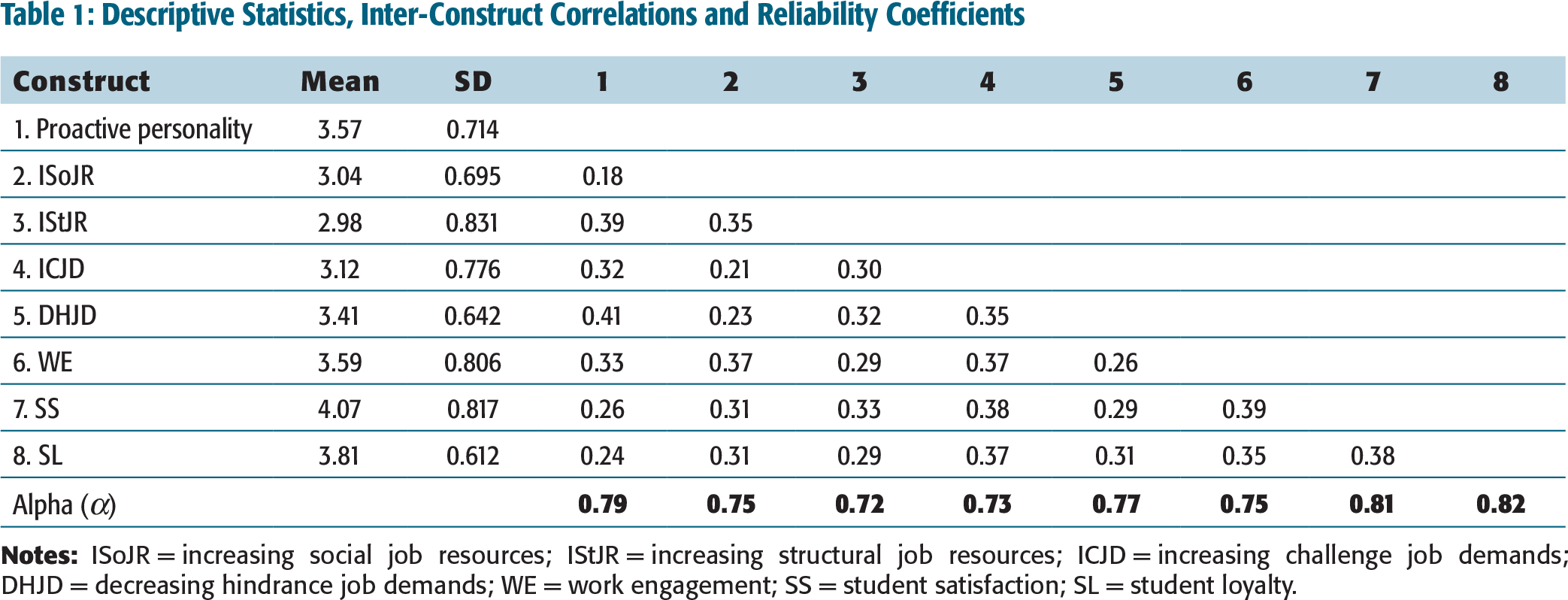
The results of structural equation modeling indicated that the proposed model fits the data quite well (χ2 = 38.46, goodness-of-fit index =0.91, adjusted goodness-of-fit index = 0.86, comparative fit index = 0.94, root mean square error of approximation = 0.03). The same is corroborated by the inter construct correlations (Table 1) which also provide evidence for the nomological validity of the scales. Table 1 presents the mean scores of all variables along with their standard deviation as well as the Cronbach’s alpha values of the scales.
: Descriptive Statistics, Inter-Construct Correlations and Reliability Coefficients
The statistical results, shown in Table 2 and Figure 1, indicate a significant positive influence of proactive personality of teachers on their job crafting (b = 0.43, p < 0.01). Furthermore, job crafting also significantly predicts work engagement of teachers (b = 0.48, p < 0.01) which in turn exerts a significant positive influence on student satisfaction (b = 0.47, p < 0.01) and student loyalty (b = 0.39, p < 0.01). The influence of proactive personality on student satisfaction (b = 0.35, p < 0.01) and student loyalty (b = 0.31, p < 0.01) is also positive and significant. These results provide supportive evidence for Hypotheses 1–4. Hence, the same can be safely accepted.
: Coefficients of Structural Relationships
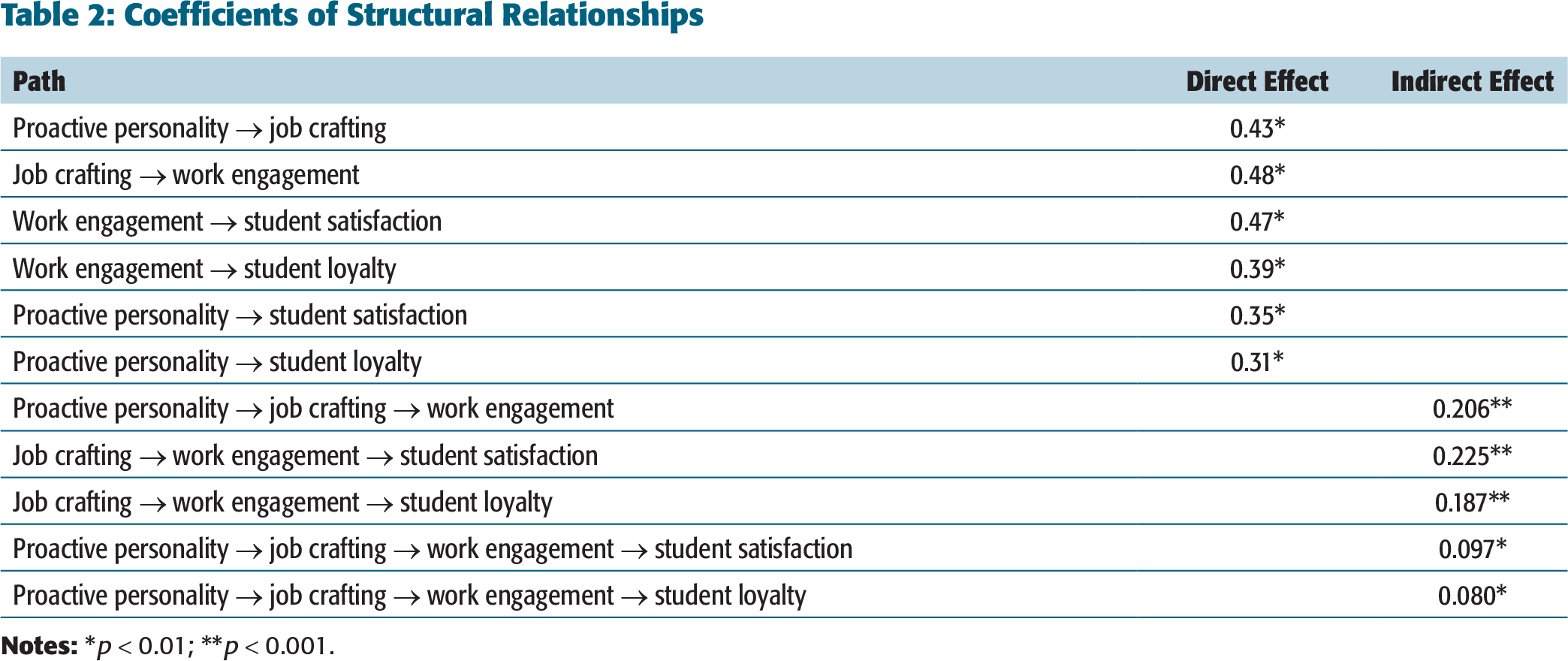
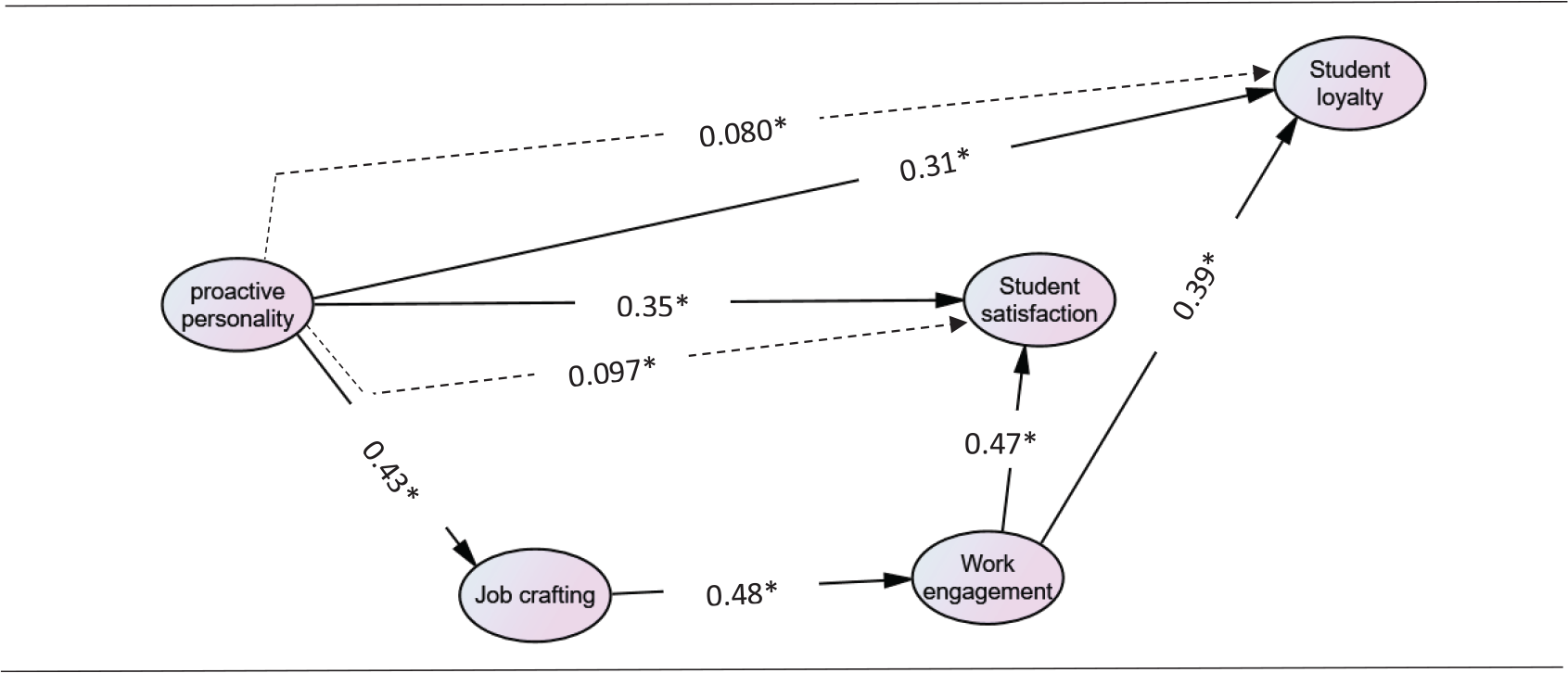
To examine whether the relationship between proactive personality and customer outcomes is mediated by job crafting and work engagement, standardized indirect effects were calculated in AMOS. The results are presented in Table 2 and Figure 1. First, the indirect effects of employee proactivity on work engagement through job crafting were examined. The results revealed that job crafting partially and significantly mediates the relationship between proactive personality and work engagement (indirect effect = 0.206, p < 0.001). Second, the mediating role of work engagement in the relationship between job crafting and student satisfaction and loyalty was tested. Here also, the mediation was partial and significant. Work engagement effectively mediates the influence of job crafting on student satisfaction (indirect effect = 0.225, p < 0.001) and their loyalty (indirect effect = 0.187, p < 0.001). Finally, the hypothesis for sequential mediation (Hypothesis 5) was tested. The results evidenced a significant sequential mediation of job crafting and work engagement in the relationship between proactive personality and student satisfaction (indirect effect = 0.097, p < 0.01) and loyalty (indirect effect = 0.080, p < 0.01). Taken collectively, these findings evidence support in favour of hypothesis 5 that proactive personality influences customer outcomes through job crafting and work engagement. Thus, it can be safely accepted.
Additional analysis was conducted to separately examine the constituent components of job crafting. This was done to ascertain their relative importance in predicting employee work engagement. The findings indicated that increasing social job resources is the strongest predictor of work engagement (b = 0.61, p < 0.001) followed by increasing structural job resources (b = 0.54, p < 0.001) and increasing challenge job demands (b = 0.47, p < 0.01). The least powerful driver is decreasing hindrance job demands (b = 0.46, p < 0.01). Furthermore, out of the three dimensions of work engagement, vigour (b = 0.56, p < 0.01) is the most powerful driver of student satisfaction, whereas absorption is the strongest predictor of student loyalty (b = 0.45, p < 0.01).
Testing Mediators Separately
In an attempt to obtain further insight into the role of job crafting and work engagement in relating proactive personality and customer outcomes, their mediating role was tested separately. First, only job crafting was included in the model as a mediator between proactive personality and customer outcomes. The indirect effect in this model was 0.195; p < 0.01 (with student satisfaction as outcome) and 0.172; p < 0.01 (with student loyalty as outcome). Both the estimates were significant as reflected by the p values. Second, work engagement was included as a mediator between proactive personality and customer outcomes. It was found that work engagement also significantly mediates the relationship between proactive personality and student satisfaction (indirect effect = 0.207, p <0.01) and their loyalty (indirect effect = 0.161, p < 0.01).
A careful look at the aforementioned results indicate that the indirect effect through job crafting, in comparison to work engagement, is higher when the outcome is customer loyalty. On the contrary, mediation through work engagement is greater than through job crafting with customer satisfaction as outcome. This leads the author to infer that job crafting is more relevant in relating teacher proactivity and student loyalty, whereas work engagement better explains the influence of proactive personality on student satisfaction. This may be because job crafting is largely influenced by institutional variables like autonomy. In contrast, work engagement is relatively a personal factor and is not influenced by organizational variables as much as job crafting. Similarly, loyalty, to a greater extent, is associated with the institution and satisfaction with the teacher. Therefore, it may be the reason for why job crafting is more relevant in explaining the relationship between teacher proactivity and student loyalty, whereas work engagement better mediates the influence of teacher proactivity on student satisfaction. However, it is still only a possible explanation to the result stated earlier and, therefore, should be taken carefully.
Additional Analysis
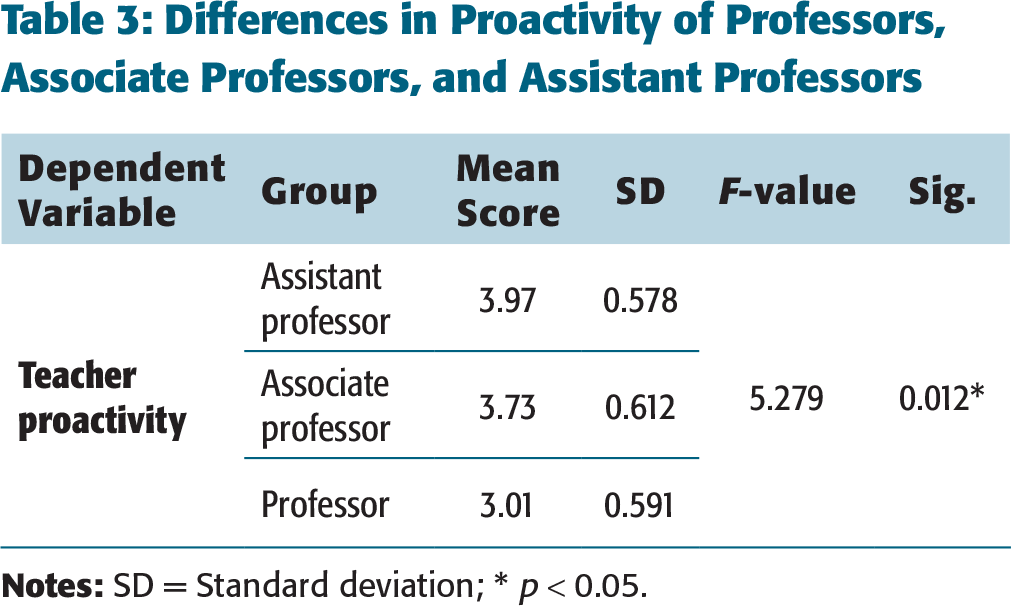
Analysis of variance (ANOVA) was used to examine the differences, if any, in the proactivity of teachers across different variables. The results indicated that teacher proactivity differs significantly across the rank of professors. Assistant professors are most proactive (mean score = 3.97; SD = 0.578), whereas professors are least proactive (mean score = 3.01; SD = 0.591). Associate professors range somewhere in the middle (mean score = 3.73; SD = 0.612). Please refer to Table 3. Since it was observed that the mean score of associate professors lies closer to that of assistant professors and relatively distant from that of professors, Duncan’s post-hoc test was used to examine their grouping pattern. The results categorized assistant professors and associate professors in one homogeneous subset, whereas professors were grouped into a distinct category. It indicates that professors are least proactive in comparison to both assistant and associate professors. Across other categorical variables like gender, and the discipline to which the teacher belongs, the differences on proactivity were insignificant.
Differences in Proactivity of Professors, Associate Professors, and Assistant Professors
DISCUSSION AND IMPLICATIONS
The results supported the hypothesized relationships among teacher proactivity, job crafting, work engagement, and student satisfaction and loyalty, thus indicating that proactive teachers intentionally craft their work environment to enhance their level of engagement with their work. This in turn, results in improved student satisfaction and loyalty.
Specifically, the proactive personality of teachers positively influences their job crafting behaviour which in turn exerts a significantly positive influence on their work engagement. Work engagement is revealed to be a significant driver of student satisfaction and loyalty. In view of this, academic institutions need to underscore the significance of proactive personality while recruiting teaching staff. Alongside the conventional scrutiny of subject knowledge, special personality tests must be used to assess the proactivity of prospective teachers during job interviews.
Furthermore, in view of the significant mediation exhibited by job crafting and work engagement in the relationship between proactivity and performance, reasonable latitude must be provided to teachers to engage in proactive behaviour so that they can align their tastes, abilities, and preferences with the requirements of the job. This leads to a better person–job fit and enhances motivation to perform well which in turn translates into improved student service experience. This finding is also consistent with the earlier empirical results by Tims and Bakker (2010) and Bakker et al. (2012). However, previous research works in this area of study were limited to relate employee proactivity with employee performance. The present study extended these findings to the service marketing context by showing that employee proactivity will ultimately result in customer satisfaction and their loyalty—a relationship seldom explored in the past. Since these outcomes are of utmost importance to service organizations, particularly in view of the contemporary globally competitive environment, the present study helps to broaden the scope of the antecedents that drive these outcomes.
This study also highlights that proactivity declines as a teacher goes on advancing through his/her career path—from assistant professor to associate professor to professor. Declining teacher proactivity will result in diminished student satisfaction and loyalty, something that Indian academic institutions can hardly afford in the current globally competitive educational environment. Therefore, educational institutions as well as their governing bodies must earnestly focus on designing strategies that will ensure sustainability in proactivity. It may not suffice that for generating desired results, the focus in only on the recruitment of proactive teachers. Rather, there is a need to focus on devising measures to ensure that a proactive teacher remains proactive all along the course of his/her career.
Previous research evidence suggests that personality is determined, among other factors, by environment (Robbins, Judge, & Sanghi, 2009). Moreover, the fundamentals of interactionist psychology advocate that a person, as much as he influences his environment, is also influenced by it (Snyder & Ickes, 1985). As proactivity is a personality dimension, the premises of interactionist psychology and past research evidence on personality lead us to believe that we can influence proactivity by making changes in the environment in which a person works. Therefore, academic institutions are required to make alterations in a teacher’s work environment, particularly that of professor’s such that it fosters proactivity. However, in order to identify the specific areas where changes would be needed, additional research needs to be conducted to investigate the reasons behind the decline in the proactivity of teachers as they advance along their career paths.
Proactivity and job crafting literature is bereft of evidences focusing on education sector where structural relationships between teacher proactivity and student outcomes are investigated. The present study plugged this gap by focusing on Indian higher education sector. Since the development of global education markets has resulted in intense competition and soaring costs, educational institutions need to extensively focus on their students’ perception of educational experience (Bemowski, 1991) rather than exclusively focusing on their skills and abilities (Lawson, 1992). In view of this, the current research, besides contributing to the existing literature on employee proactivity and customer outcomes, will help academic institutions to understand the ways and means of enhancing students’ positive educational experience.
LIMITATIONS AND FUTURE RESEARCH
This study while examining employee proactivity, focused only on the teaching faculty of the institutions sampled. However, the non-teaching staff of academic institutions also contributes substantially towards the creation of positive student service
experience. Therefore, future research in this area of study should analyse the influence of proactivity of administrative staff on performance. Furthermore, the analysis of moderating role of teaching/non-teaching faculty in the proactivity—performance relationship will help academic managers in prioritizing their efforts and resources.
The study considered job crafting as a precursor to work engagement. This is consistent with Bakker et al. (2012). However, literature also suggests a driver effect of work engagement on job crafting (Parker, Bindl, & Strauss, 2010). In the study by Bakker et al. (2012), the reverse causality model of job crafting and work engagement also fitted the data quite well. Therefore, research attention should be focused on empirically investigating the present study’s model by placing job crafting as an outcome of work engagement rather than as antecedent, as is done in the current research. This will broaden the understanding of the relationship of these constructs.
The present study used only student satisfaction and loyalty as the outcome of teacher proactivity. Therefore, further research should be carried out using other student-related performance measures, for example, service failure recovery, student complaints, etc., as these outcomes are equally important in influencing the image of an academic institution. Furthermore, the generalizability of the findings of the study should be carefully undertaken as the sample included only higher education sector. Therefore, replication of this research across other sectors and cultures is an earnest research requirement.
Finally, there is a reason to believe that differences in the leadership style may have an impact on the nature of relationship between teacher proactivity and student satisfaction and loyalty. An accommodative, democratic leader may lend more space to his subordinates for crafting their jobs so as to suit their skills as against an authoritative leader. Thus, future studies must investigate the relationship between teacher proactivity and student-related outcomes as influenced by leadership styles.
DECLARATION OF CONFLICTING INTERESTS
The author(s) declared no potential conflicts of interest with respect to the research, authorship and/or publication of this article.
FUNDING
The author(s) received no financial support for the research, authorship and/or publication of this article.