




Abstract

Case Analysis
The case deals with the product development and project execution of installing water ATMs in Indian railway stations. The project was conceptualized as early as 2007; nearly 50 water ATMs were installed in several railway stations, but the project was soon declared closed due to numerous operational hurdles. The Ministry of Railways (MoR) revived the project in 2015 and assigned IRCTC to install water ATMs in 7,500 stations. After the due process, IRCTC empanelled a set of qualified vendors to install the water ATMs; but the overall progress of commissioning and operationalizing was far from impressive. There were huge delays and hiccups, which had commercial implications for the vendors. Therefore, vendors were likely to be discouraged and could choose to not engage any further in the project. According to Mr Siya Ram, the fundamental issue was the delay in roll out of water ATMs arising due to lack of coordination between the vendors, station superintends, and IRCTC. How he attempts to resolve the issue is the focus of the case.
INDIAN RAILWAYS: AN OVERVIEW
Indian Railways (IR) is the single largest organization in the world in terms of size and scale of operations. IR operations in commuter transportation formally began in 1853. Over the years, it has grown to commuting 13 million passengers and 1.4 metric tonnes of freight/day. It has around 7,500 stations, 7,700 coaches, 7,900 locomotives, 64,000 route km, 100,000 track km, and an employee strength of 1.64 million as of 2017.
As the operational size grew, rigid hierarchy of the organizational structure, changing ministerial leadership, and their political manifestos killed the organizational direction, if any. Additional complexities arose, as all core and non-core activities were internally administered and managed, with little focus on stra-tegic planning, evaluation, monitoring, and control. Adherence to legacy systems and resistance to change defined the organizational culture. As a consequence, there were two major casualties: (a) customer centric service and (b) commercial viability.
The need to revamp and turnaround the organization was real and was also perceived to be significant. Several attempts were made to decentralize and distribute authority. One major thought change was to involve private participation wherever possible, so as to bring dynamism and creativity in resolving operational issues. Another approach was to constitute agencies and enterprises to independently handle few pre-defined domain functionalities on behalf of the IR. Persistent attempts are being made at various organizational levels to improve the service quality and to achieve operational efficiency.
IRCTC: A BRIEF BACKGROUND
The Indian Railway Catering and Tourism Corporation (IRCTC) is an independent public sector enterprise constituted in 1999 by the Ministry of Railways (MoR) to facilitate few non-core activities of IR. IRCTC was specifically constituted to manage the catering and hospitality services of the IR and to promote domestic and international tourism. However, by sheer opera-tional success, today, IRCTC is known more for its online ticketing services.
One initiative of the IRCTC, and the context of this case is drawn from Rail Neer, which is the sales and distribution of pure, bottled drinking water in the railway premises and the moving trains. Rail Neer was available only in 1 l bottles and was sold in stations and moving trains. In 2015–2016, 144 million Rail Neer bottles were sold and the revenues from Rail Neer accounted for 8 per cent of the total income of IRCTC.
CASE: CONTEXT AND CHALLENGES
Sensing the need of railway commuters for pure drinking water and encouraged by evolving technologies, IRCTC conceptualized water ATMs in 2007. Water ATMs are automatic water dispensing units that can provide cold and normal mineral water in different quantities and packaging on a pay-per-usage basis. But the project was soon declared closed due to various operational hurdles. In 2015, IR revived the project, and IRCTC mandated the implementation of water ATMs at nearly 7,500 stations. Mr Siya Ram was to plan and implement the roll out of water ATMs, which was perceived to be technologically superior, but with latent awareness and low usage among the society. His role was to coordinate between station authorities and water ATM vendors and accomplish the installation, commissioning, begin operations, and facilitate business.
Water ATMS could be installed with minimum civil works, but they needed a clean space with running water connection and an electric supply. Water ATMs were dust and corrosion resistant and could handle temperature and humidity fluctuations. They were compact, low maintenance, had self-cleaning mechanisms, and could be remotely monitored.
IRCTC empanelled a few micro, small, and medium enterprises (MSMEs) as vendors to manufacture, install, operate, and maintain the water ATM products at various stations. Due processes were followed while inviting and awarding tenders, before empanelment of the vendors. Bid documents clearly specified the scope of work, detailed list of services specific to stations, and financials involved. Detailed technical specifications and quality guidelines were also provided.
Commercial viability of water ATMs and sustainable revenues are pertinent for the vendors to continue product maintenance and service support. The size of an ATM and its production capacity have to be commensurate with the demands at a particular station. The water ATMs should be located at an easy reach on the station platform for all commuters.
Based on needs analysis, Mr Siya Ram had proposed in the tender invitations that the vendor should
Be experienced for a recent minimum of three financial years, in manufacturing RO or other superior technology based water purification systems with a production capacity of 40 l/h. Be experienced for a recent minimum of three financial years, in managing bottling plants of packaged water or other drinks in the capacity of owning, franchising, or OEM operations. Be experienced for a recent minimum of three financial years, in managing catering units as service providers.
Additionally, the vendor should be financially strong with a minimum total turnover of INR 15 million in the recent past three years.
Operational costs were to be borne by the vendors. Pricing of water units was prescribed by the IRCTC and had to be strictly adhered to. Vendors also had to share 15 per cent of the revenues from water ATMs with the respective stations at which they operated.
While IRCTC coordinated the project between the two stakeholders (vendors and station authorities), stations authorities lacked a strong motive and failed to see the purpose for water ATMs. The 15 per cent revenue sharing from the water ATM sales was a meagre, meaningless incentive for the station authorities. Therefore their commitment levels were poor. Also, in this particular context, they were not accountable to the other stakeholders.
Consequently, the ground realities of the project were far from what was desired and planned. Station authorities were non-cooperative with the vendors in providing electricity and water connections. The priorities of the station authorities were placed elsewhere, in spite of the project being initiated by the apex body: the MoR. Delays amounting to four to six months, even for civil installations, were not uncommon. There was a huge financial burden on the vendors due to reduced cash flows, blocked funds in idle assets, interest costs, and delay in realizing revenues.
Mr Siya Ram was becoming more apprehensive of the progress of the project, as dealt by the three stakeholders: the vendors, station superintends, and the IRCTC. The questions that hovered in his head were: (a) how to negotiate with the station authorities and to speed up the roll out of water ATMs, (b) will the vendors be able to overcome the business risks and continue to engage further in the water ATM business, (c) will the operations be commercially sustainable for the continued maintenance of water ATMs by the vendors.
Answers to the questions were imperative, lest not the current water ATM project face a premature death as the 2007 water ATM initiative.
MANAGERIAL INSIGHTS AND INFERENCES
The case is positioned in the context of product development and commercialization of a product in the social entrepreneurship space. Apart from the supportive discussion points elucidated by the author, the following points may be worthwhile.
1. Absence of Timelines
Importance of timelines, commitment and adherence to timeline by all stakeholders need to be emphasized; it is extremely vital in project management initiatives. Mr Siya Ram’s contractual agreements with the vendors and the station authorities should have mentioned the timelines or are these absent in the case document.
2. Absence of Checks and Balances
The case discussions may focus on the needs for checks and balances. Guidelines related to technical specifications and product features from the vendors have been articulated in sufficient detail. However, the commitment from the station authorities is not defined. The need for stakes and commitments from all parties is vital when entering into a two-way contract as a coordinating agency.
3. Lack of Commitment and Accountability
A clear definition of roles, commitments, and assignments for each stakeholder in the contracts entered by IRCTC may be proposed. There has to be some means of ensuring accountability of each stakeholder in the contracts; either the contract is devoid of such accountability checks or the case is silent on that. Discussions may emphasize the need for accountability measures and checks.
4. Lack of Penalty for Non-compliance
A formal contractual agreement (specifically one that deals with infrastructure and civil work in public space) quite often includes a penalty clause for non-performance and non-compliance on either parties. Insistence on penalty clause could be brought in the class discussions.
5. Weak Motivation
Discussions may be based on whether a higher revenue share with the station authorities would entail a better cooperation from the station authorities. What are the priorities of station superintends? Invariably, it could emerge that money had little impact on them; so what else could force them to offer more support and cooperation?
6. Lack of a Reporting Structure between IRCTC and Station Authorities
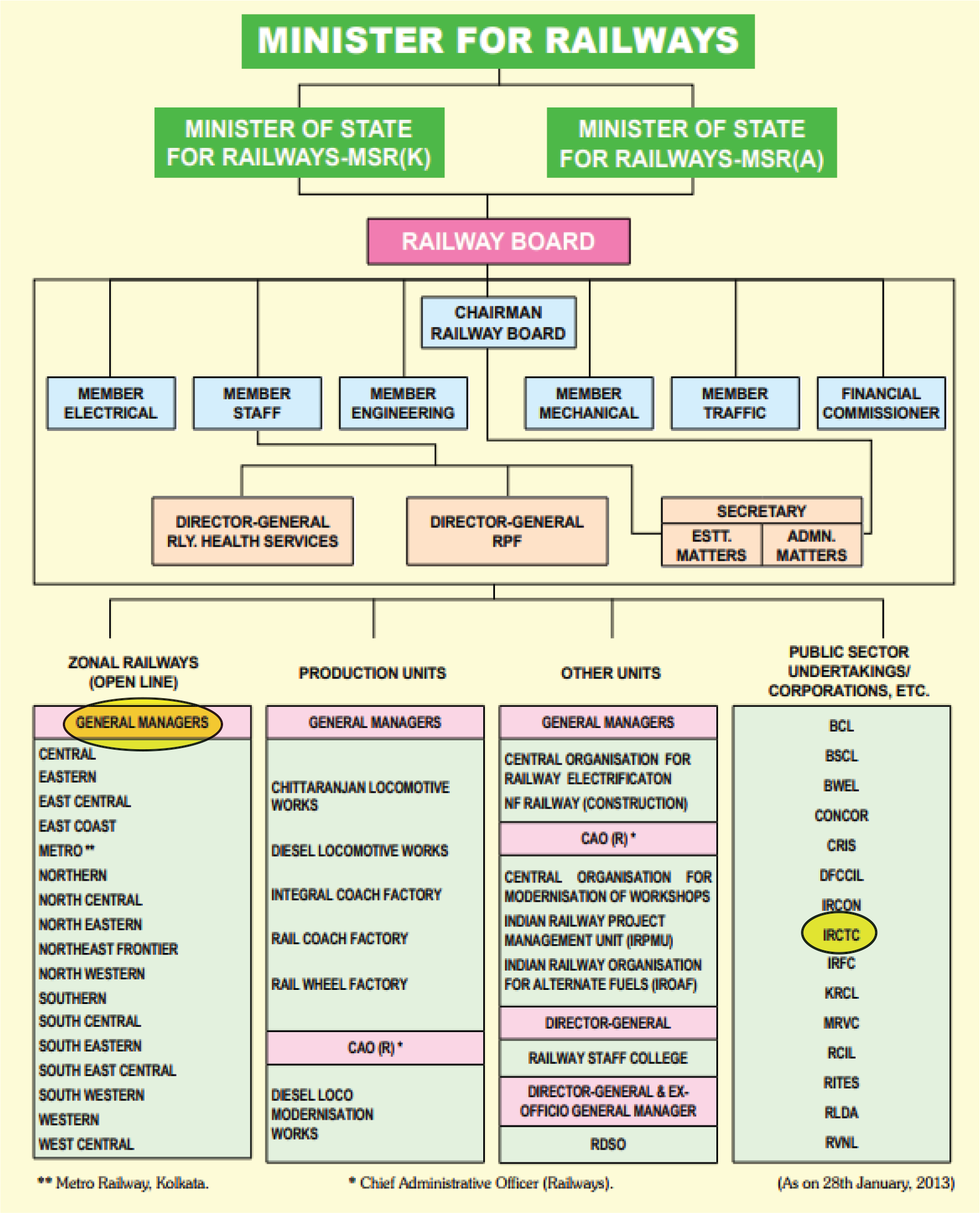
The organizational chart of the IR (Figure 1) could be presented. It is important to observe that there is no line of control or reporting between IRCTC and station authorities. IR being a legacy organization that follows age-old hierarchical traditions, it is less probable that one entity (station authority) would oblige or report to another (IRCTC) independent authority, who is not in the direct line of control.
7. Absence of the Much-needed Synergy
In the light of the above two points (5 and 6), the discussions may be taken forward as follows: involving private players in public initiatives and the reasons quoted thereof (sharing of risks, improving the operational efficiency, inculcating commercial feasibility, and developing creative solutions in emerging disciplines that are otherwise beyond the scope of public offices) are quite valid.
However,
a) What kind of support mechanisms public organizations provide to assure commercial viability and profitability for the private players?
b) With the limited support available from public organizations, how can private player’s transactions be fair and transparent?
c) When the profit margin becomes thin, how can private players sustain operations and maintain quality of service?
8. Directionless and Ill-formulated Processes
In addition to the rigid hierarchy, the problem situation may be discussed in terms of the short-lived policies, lack of policy regulation, and procedural/process violations that come with no price, formulation of rules/guidelines with seemingly vested interests, changing of rules with no articulated rationale, lack of transparency, compliance, and enforcement, specifically in government projects that deal with social support initiatives.
9. Commercial Objective for a Social Cause
A complementary discussion with an ethical dimension may also be presented. While we present the context as a social support initiative,
a) Are the commercial considerations so important? Can we forgo charging the commuters (who paid for their fares) for drinking water and provide them with complimentary, R/O purified drinking water? If so, who should bear the additional cost of purified drinking water? b) Should there be a trade-off between profit margins of the vendors and basic social needs of the citizen? Is it not the responsibility of the government to provide free, pure drinking water to all citizens? c) In that order, is water ATM genuinely an innovative product? Pure drinking water distribution (through pandals) has been happening throughout the length and breadth of the country for ages. d) What is so novel about this initiative? If it is size, is it not a subset of the rail commuters? If it is scale, have there not been numerous examples of scale of operations in various domains? (e.g., public distribution system (PDS), Indian elections, etc.) e) What is the ‘silent revolution’ mentioned in the title of the case? Is it real or perceived? Or is it an attempt to cope up with failed coordination?
CONCLUSION
The case is quite silent on the failures during the initial phase of the project in 2007. Bottled purified water could have been priced at a higher premium then and at a less premium now, due to increased health consciousness, social awareness, and spending power of the Indian society. An understanding of the business risks and failures during 2007 could be used as ‘lessons learnt’ by the IRCTC and also for class discussions.
The negotiation approach proposed in the case would be at best a short-term solution to the problem context. It would be a piecemeal solution that IRCTC would need to reinvent on a case-to-case basis in every project that it undertakes.
IRCTC is an independent enterprise, established to provide complementary services of IR with meagre influence on IR decision-making and operations, whereas IR is rigidly hierarchical (Point 6 in the previous section). Water ATMs, as such is a good initiative, but does not impact on the critical operations of IR (Point 5 in the previous section). The synergy between the two organizations is also weak (Point 7 in the previous section); therefore, IRCTC’s role can only be of mediation and not commitment on behalf of IR. If only IRCTC had meticulously followed few precautionary measures (Points 1 to 4 in the previous section), there could have been a positive hope. In fact, for each and every project that IRCTC undertakes for IR, these procedural norms should be insisted and documented formally. A philosophical perspective to overcome such shortcomings is briefed (Point 8 in the previous section). Finally, the analysis can be raised to a larger context from a social welfare dimension (Point 9 in the previous section).
Summarily, the regulatory framework and enforcement mechanisms adopted by IR need to be reformulated for a possible operational transformation. IR should consider empowering independent agencies, such as IRCTC, with more authority and control.
Installation and operationalizing of 7,500 water ATMs in railway stations is indeed a project of large size, but not too complex. Attempts should be made to modularize, replicate, and scale the sales and distribution of purified bottled water, taking a cue from other successful government initiatives.