




Abstract
The article is divided into seven sections. The first section provides a broad overview of the public policy–innovation interface (focusing more on industrial innovation) which the subsequent sections flesh out in some detail. The definitions of innovation and the perspective taken are deliberated upon. This is followed by a discussion of firm activities and choices that are related to innovation. The salient mechanisms through which public policy affects innovation through these choices are spelt out in the next section. This discussion is taken further by reviewing how various specific policies impinge on innovation through different mechanisms. The next section summarizes the issues relating to measurement while innovation–public policy linkages are analysed. The final section concludes with a brief discussion of potential areas of work in the context of India.
INNOVATION–PUBLIC POLICY INTERFACE
Public policy influences strategic choices of economic agents regarding knowledge generation and acquisition, which in turn affect innovation outcomes. More specifically, various public policy instruments affect the supply and demand of knowledge (innovation) 1
For an excellent summary of technology policies that affect supply and demand for innovation, see Steinmueller (2010). We will revert to some of these aspects subsequently in this article.
Given the perspective that public policy can influence innovation through its impact on supply and demand of knowledge or through changes in competition and contagion conditions, virtually all policies can be seen as instruments of innovation policy. Policies relating to trade, industry, FDI, labour, competition, and industrial clusters can influence firms’ innovation-related decisions. At the same time, specific policies that provide research and development (R&D) support, finance innovation-driven start-ups, create standards, help build university–industry linkages (UIL), or influence conditions of technology purchase (e.g., licencing) also affect firms’ strategies vis-à-vis innovation.
Innovation–Public Policy Interface
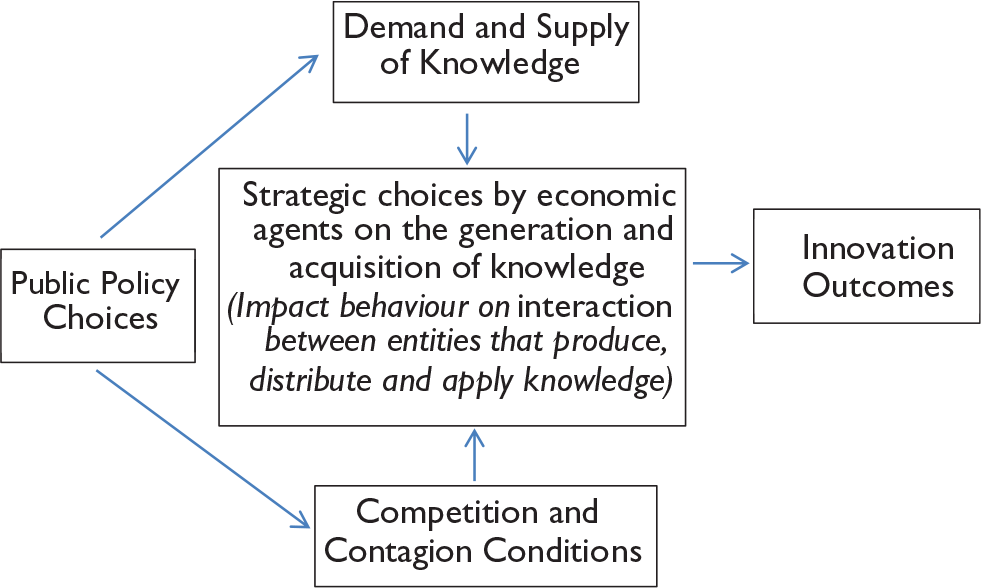
The interaction between public policy choices and innovation outcomes, however, is a complex phenomenon (Figure 1). The challenge is to find appropriate ways of conceptualizing the relationship between innovation and public policy. This would not only require getting inside the ‘black boxes’ of innovation and public policy, but also that of firm choices as the impact of public policy on innovation is mediated by firm choices that are linked to innovation. The complexity of the relationship to be explored increases as we open different boxes with a set of questions: How does one define innovation? What firm choices or activities are relevant for generating and acquiring knowledge for innovation? Which policies can potentially affect these choices? How policies can influence these choices and activities? What implications different policies have for the supply and demand of knowledge and as a consequence on these choices or activities? How policies change competition and contagion conditions and in turn the choices and activities of economic entities?
DEFINING INNOVATION
Innovation has been defined in a variety of ways. We focus here on technological innovation 2
Innovations in marketing, business models, etc. are not our focus here.
This is often referred to as Schumpeterian typology of technological change: ‘invention—the generation of new ideas, innovation—the development of those ideas through to the first marketing of or use of a technology and diffusion—the spread of technology across the potential market’ (Stoneman & Diederen, 1994).
The seminal work by Kline and Rosenberg (1986) initiated a lot of work on coupling and chain-linked models. Systems of innovation concept (based on interaction and learning) which is now used pervasively, has its roots in the coupling models.
Technology has been defined as knowledge embodied in products, processes, and practices (3Ps) (Basant & Chandra, 2002; Chandra, 1995). 5
For similar conceptualization, see Lipsey (2002). The perspective taken here is different from Lipsey’s insofar as the concept of practices (which includes the knowledge regeneration process) is wider in scope than his ‘organizational routines’.
Once innovation is seen as introduction of new knowledge in the market and one views the process from the perspective of an enterprise, it is useful to distinguish between degrees of novelty that the new knowledge entails. The literature typically classifies it as incremental (adaptive) or radical (disruptive). 6
While these are widely used categories of innovation in the literature, several typologies of technological innovation exist which can be quite confusing. See Garcia and Calantone (2002) for a critical review.
The policy dilemma regarding the trade-offs between innovation and diffusion is well known—policies that facilitate invention and innovation may constrain diffusion. 7
See, for example, Ordover (1991), and Stoneman and Dierderen (1994).
FIRM CHOICES AND ACTIVITIES
A firm has two broad (but not mutually exclusive) choices regarding the acquisition of technology: it can internalize the innovation process by pursuing specific activities to develop knowledge or use existing markets to purchase technology. The decision whether to develop technology in-house or purchase it is influenced by benefit–cost comparisons which have to take account of several factors including technology spillovers—the potential and costs of imitation. Broadly, three alternative sources of technical knowledge can be distinguished: (a) knowledge generated by the firm on its own; (b) knowledge purchased by the firm; and (c) spillovers created by knowledge generation of other firms. As aforementioned, purchased knowledge can be disembodied in the form of technology licences or embodied in inputs (including new vintages of capital) the firm purchases. Besides, licences and inputs can either be acquired domestically (within the country) or from foreign sources. In the same vein, technology spillovers or imitation potential can be created from knowledge generation of domestic entities as well as from knowledge generated by foreign firms. 8
Within these broad sources of knowledge, a wide variety of technology information can be distinguished. The relationship between sources of knowledge can get quite complex if we consider all these sources. Gomes, Kruglianskas, and Scherer (2011) identify a large number of sources of technology information. They rightly argue that it is important to understand different processes that firms use to manage these sources. In fact, their analysis shows that good management of the outside sources of technology information is associated with high innovative performance. If one wants to incorporate this process in our conceptualization of innovation, it can be encompassed in practices that companies adopt to manage technology information.
The choices made by firms regarding the scope and level of technological activity and modes of technology acquisition can be seen as an important element of technology strategy. This strategy is influenced by the ‘technology regime’ in which it operates. The regime is broadly defined by a combination of variables capturing industrial structure, nature of technical knowledge (e.g., complexity, tacitness, and cumulativeness of the relevant technology), and the policy environment. The policy environment includes all such policies that affect the three stages of technological change, that is, invention, innovation, and diffusion. Together, these variables determine the opportunity and appro-priability conditions faced by a firm in a well-defined industry (Pavitt, Robson, & Townsend, 1989). Given these broad relationships, firms’ technology strategies may differ across industry groups as the opportunity and appropriability conditions vary across industries.
SUPPLY SIDE, DEMAND SIDE, COMPETITION, AND CONTAGION EFFECTS
Policies can simultaneously affect supply–demand conditions for innovation as well as competition–contagion conditions faced by firms. Therefore, at times it is difficult to isolate the effect of policies through these two routes. 9
The rich discussion in Steinmueller (2010) on a variety of policies brings out some of these overlaps quite well.
Technology-related choices of economic entities affect demand and supply of knowledge in the economy. A major issue vis-à-vis the supply of new knowledge is the quantity and quality of R&D undertaken by economic entities—both in the public and the private sector. The character of new knowledge as a public good and its positive externalities result in situations wherein the creators of knowledge are not able to appropriate all the economic benefits of new knowledge and therefore underinvest in R&D. Therefore, while weaker competitive conditions may encourage the supply of new knowledge, it might discourage its demand. Alternatively, monopolists or oligopolists may have fewer incentives to innovate as they already control a large part of the market. Consequently, the absence of competition may result in less innovation. The links between competition and innovation are therefore quite complex and may depend on a variety of other factors.
In order to correct such market failures in the creation of knowledge, the government uses a variety of policy initiatives in the form of tax credits, protection of IPRs, and funding of research (especially early stage, commonly identified as basic and applied research). A decline in the cost of its use increases the demand for new knowledge. Government grants to directly fund innovation activities or promises to procure new products can enhance the demand for innovation. Policies that provide access to inputs that are complements to new knowledge can increase demand as well as supply of innovation. These inputs include skilled workforce, modern infrastructure (especially transport and telecommunications), etc.
The make-buy-‘imitate’ choices are also affected by competition and contagion conditions, which in turn are influenced by the ‘technology regime’ faced by the enterprise. Policies affect competition and contagion conditions as well. Ceteris paribus, a weak intellectual property (IP) regime enhances contagion potential as imitation possibilities grow, while trade liberalization increases competition as entry conditions through imports become easy. Firms may invent and innovate to meet the competition that they face while incentives to do so would decline in the absence of high appropriability or ‘monopoly rents’—a situation where spillover potential is high improving contagion possibilities.
Overall, therefore, while the existence of such linkages is well established, the nature of these relationships are quite complex and require a lot more research. For example, are the links between levels of competition and innovation non-linear? How much competition is ‘appropriate’ to create an optimal mix of invention, innovation, and diffusion?
It is well known that contagion effect (imitation potential) increases with larger pools (supply) of knowledge to learn from, and firms may undertake technological activity to benefit from these contagion effects (Cohen & Levinthal, 1989). It is also known that the impact of competition and contagion conditions on innovation is mediated by innovation and absorptive capacity of the focal firm as well as the distance of the firm from the technology that needs to be learned from (technology gap). 10
See, for example, Kokko, Tansini, and Zejan (1996); Girma, Gong, and Gorg (2008); and Kathuria (2010).
SPECIFIC POLICIES AND THEIR POTENTIAL IMPACT ON INNOVATION
As aforementioned, if we view policies as initiatives that simultaneously change supply and demand of knowledge as well as the competition and contagion conditions, virtually all policy instruments can possibly influence innovation-related activities. We discuss briefly some of those linkages further, using specific policies as examples.
Industrial Policy
Apart from other things, industry policy affects entry and exit barriers and hence the degrees of contestability or competition in the market. Therefore, based on the discussion of the role of competition previously, a liberal industrial policy creates a potential of innovation-driven entry and innovation by incumbents to deter entry or meet competition. Similarly, exit conditions like bankruptcy laws may affect experimentation and choice between radical and incremental innovation. Ceteris paribus, risk taking through innovative activity may decline if exit conditions are onerous.
In a very interesting paper, Philippe et al. (2009) build a theoretical argument and then test it with laboratory experiments to analyse the impact of competition on innovation. They find that an increase in competition leads to a significant increase in R&D investments by ‘neck and neck’ firms, that is, firms that operate at the same technology level. However, increased competition decreases R&D investments by firms that are lagging behind, in particular if the time horizon is short. More empirical work on such processes that explicitly recognize firm heterogeneity in exploring the links between competition and innovation would be very useful.
Foreign Direct Investment Policy
A lot of work has been done on the role of FDI policy innovation and productivity benefits for the host country firms. FDI influences both competition and contagion conditions as MNC entry adds to competition in the market and at the same time, the knowledge that is brought in creates spillover potential. There is evidence in some of the earlier studies to show that the nature of contagion and competition effects vary with the type of FDI (greenfield, brownfield, M&A, or other); the type of MNC ownership (wholly owned subsidiary, joint venture, or equity alliance); ‘hierarchy’ of activity in which the MNC is involved (R&D facility, contract R&D, manufacturing, marketing and distribution, etc.); technology intensity of the sector (hi-tech or low tech); and the nature of technology flows (embodied or disembodied, tacit, or codified) (Meyer, 2003). Empirical results on the impact of the characteristics of FDI, however, have not been always consistent. 11
Stiebale and Reize (2008), for example, show that after controlling for endogeneity and selection bias, foreign takeovers have a negative impact on the propensity to perform innovative activities and a negative impact on average R&D expenditures in innovative firms. Takeovers also do not seem to result in significant technology spillovers. Other studies tend to show opposite results (Johansson & Loof, 2005).
In recent years, while some studies on the role of FDI in technology transfer and spillovers suggest that the impact is somewhat unclear (Crespo & Fontoura, 2007; Iwasaki & Tokunaga, 2016), others argue that FDI inflows increase R&D and innovative activities in host countries (Erdal & Gocer, 2015). Still others suggest that the impact of FDI depends on the nature of linkages (backward, horizontal, forward), absorptive capacity, technology gap (referred to previously), and institutional characteristics (Gorodnichenko, Svejnar, & Terrel, 2014). There is also evidence to show that the impact of FDI on technology spillovers varies with time; it is initially negative but has a permanent positive effect over time (Merlevede, Schoors, & Spatareanu, 2014). Proximity of domestic firms to MNCs also helps (Wang & Wu, 2016). An interesting recent study using data on US-based MNC affiliates shows that the distribution of FDI in R&D differs from that of general FDI. It also shows that increasing value addition by MNCs predicts more foreign investment in R&D in the future. In other words, FDI in R&D is an upgrade decision (Wellhausen, 2013).
Given all the complexity of the ways through which FDI may affect innovation activity in the host country, policy makers need to worry about the nature of MNC involvement that various policy instruments would entail and their impact over time. They also need to keep sight of the fact that most studies reiterate the earlier findings that good absorptive capacities of domestic firms and of the regions where MNCs are located are preconditions for benefits to accrue from positive FDI externalities (Crespo & Fontoura, 2007).
Trade Policy
Trade policy choices affect access to embodied innovations through imports and competition through imports-based entry. The contagion potential is affected by the technology/skill intensity of imports (machines, components, raw material) as that provides the basis for ‘learning’. With trade liberalization, entry through imports is typically not affected by several entry and exit barriers that a domestic enterprise usually faces. Consequently, such entry can be of a ‘hit and run’ variety, resulting in high competition effects. Trade policy also modifies ‘entry’ choices for foreign firms; with very liberal trade policy, MNCs can potentially enter through exports rather than through equity-based entry. There is some evidence to show that in the pre-reform (1991) India, trade protectionism adversely affects technological activity among Indian firms; higher rates of protection discouraged firms from keeping abreast of recent technological developments through making or purchasing technology (Basant & Majumder, 1997). A recent paper introduces firm heterogeneity in a theoretical model to explore the impact of trade protection on innovation activities (R&D) of firms. The results suggest that trade protection provides incentives to undertake R&D and associated productivity benefits to less efficient domestic firms while the highly efficient firms see a reduction in R&D and productivity with such protection (Song & Vandenbussche, 2008). In this model, the less efficient firms undertake R&D presumably to catch up. It is not clear how this relationship will pan out over time. In any case, the results highlight the fact that the impact of trade policy on innovation would be affected by the distribution of innovation capacity among domestic firms. But once again, it is not clear whether a large technology gap would constrain catch-up processes and if the outcomes would be different in the absence of domestic competition.
Policies for Education and Science and Technology
Education and S&T policies can intensify compe-tition by generating knowledge for innovation/technology-based entry and facilitate contagion by building capabilities to absorb technology and exploit spillover potential. Existence of technological capabilities (e.g., trained S&T personnel) can attract innovation intensive investment, thereby enhancing competition as well as contagion potential. Such capabilities can also enhance participation in global innovation networks which also facilitates learning (contagion). Insofar as these policies can also create incentives for commercialization of technologies developed in higher education institutions (HEIs) and UILs, all the three stages of technological change—invention, innovation, diffusion—get affected. The Bayh–Dole Act is a classic example in this genre of policies. 12
The Bayh–Dole Act allowed the US universities to own the intellectual property generated through research funded by the state. While the jury is still out on the impact of the Act on the generation of knowledge in HEIs, it remains a potent instrument to undertake research and commercialize it through different mechanisms (So et al., 2008).
In the recent years, in most developing nations, including India, the governments are supporting the creation of incubators in HEIs to facilitate commercialization of university inventions through new enterprise creation. The models of incubation used by HEIs across nations vary a great deal (Basant & Cooper, 2016) and the efficacy of these models depends on a large number of factors. 13
See, for some interesting insights, Lockett, Siegel, Wright, and Ensleyd (2005) and the special issue of Research Policy (34, 2005) on spin-offs from public research institutions.
Intellectual Property Rights (IPR) Policy
IPRs affect competition and contagion conditions in a variety of ways. More stringent IPR policies provide incentives to innovate due to increase in appropriability (monopoly rights). This in turn might have a positive impact on firms’ R&D expenditures and patenting activity. Clearly defined IPRs facilitate innovation-based entry by smaller and new firms. Moreover, well-defined rights on intellectual property also create a market for technology as they reduce transaction costs and thereby create a potential for increase in competition through purchased innovation-based entry. With stringent IPRs, price of technology may be high due to monopoly over the technology but it is possible that in a competitive market, it may not be exorbitant. Moreover, the owners of technology may now charge a lower ‘risk premium’ as the imitation potential is lower with stringent IPRs. The links between IPR policy and contagion (or knowledge spillovers) effects are complex (Cohen & Levinthal, 1989, 1990). If incentives associated with stringent IP policies result in more knowledge getting generated, introduced in the market, and transferred through the market due to the development of technology markets, economic entities would have a larger knowledge pool to learn from. Consequently, aggregate spillover potential might increase. With a better IPR regime, more R&D and patenting by domestic firms would add to the ‘spillover stock’ (or pool). MNCs may also do more R&D and manufacturing in hi-tech sectors, especially those where imitation is high (e.g., chemicals, pharmaceuticals) with more stringent IPRs. Moreover, typically more ‘masking’ of knowledge is done in a weak IPR regime in order to reduce imitation which reduces contagion potential.
The links between IP regime and innovation activity are complex. While it is not possible to attribute all types of innovations to changes in the IP regime, there is evidence to a variety of innovations in the health sector in India after the introduction of a more stringent TRIPS compatible regime (Basant & Srinivasan, 2016). As expected, another study on India suggests that the impact of such reforms is higher in ‘IP sensitive’ industries like non-electrical machinery and drugs and pharmaceuticals than in other industries (Kanwar, 2013). In line with the insights of Cohen and Levinthal (1989), a firm-level study shows that while the use of IPRs (patenting intensity) reduces competition in the market, it also increases innovative activities such as R&D expenditures and product innovations (Beneito, Rochina-Barrachina, & Sanchis, 2012). It is not clear if stringency of IP regimes and innovative activity have a linear relationship; many argue that the most stringent IP protection may not be optimal for the economy, given the regime’s simultaneous and differential impact on invention, innovation, and diffusion (Ordover, 1991). The impact of IP regimes on innovation is also mediated by levels of development (Falvey & Foster, 2006). Moreover, very little is known about the implications of varying degrees of IP protection on the make-buy-copy combinations.
Policies for Technology Licencing
Technology licencing policy takes the form of government intervention in the market acquisition of technology by private enterprises. While it is not very common anymore, earlier several governments have regulated the licencing of foreign technology (Steinmueller, 2010). Such regulation affects the extent, price, and vintage of technology that gets licenced. In India, for example, during the pre-1991 phase, it was extremely difficult to licence foreign technology. Such a request not only had to satisfy the indigenous non-availability requirement but also had to abide by very stringent restrictions on the royalty that could be paid and the conditions of technology transfer. Even in the absence of such restrictions, this policy has implications for the extent and nature of knowledge transfer through the licencing process. This is especially so if the policy is looked at in conjunction with the IPR policy. A liberal licencing policy combined with a stringent IP policy may facilitate transfer of knowledge, especially tacit, through licencing-linked training. This in turn has a positive impact on the contagion potential. Overall, this policy affects potential entry-based (through licencing) competition as well as competition among incumbents as they can also licence technology and compete. The pool of knowledge that is transferred generates potential for contagion or knowledge spillovers. Since technology licencing policy directly affects technology purchase options (especially from foreign firms), this policy would influence knowledge sourcing strategies of firms (Basant & Fikkert, 1996). But hardly anything is known about how these policies change firm preferences with respect to make-buy-copy combinations to acquire knowledge (Basant, 1993).
Policies for Standard Creation
Standards affect demand- and supply-side network economies in the relevant market. Policy can allow standards that are based on market competition where multiple standards co-exist, it can create standards and make market entities to follow it or it can be neutral vis-à-vis standards but ensure inter-connectivity of standards. There is innovation to meet standards and, as standards typically increase the size of the market especially through network economies, there is a higher supply of innovation to satisfy the demand of the growing market. With firming up of standards, there can also be a focus on innovations in standards compatible complementary technologies that can help enterprises enter new markets (Allen & Sriram, 2000; Blind, 2013; Jacobides, Knudsen, & Augier, 2006; Shin, Kim, & Hwang, 2015).
Public Procurement, R&D Funding, Tax Credits, and Cost of Capital
Policies affecting procurement, funding, and cost of capital also have an impact on innovation activities. The state can procure ‘innovative’ products on a preferential basis from specific type of firms like SMEs or start-ups. Such support can also take the form of adoption subsidies for using new technology-based products or services in order to facilitate diffusion of new technologies (Steinmueller, 2010). The state can directly finance an innovation activity as well, which can take the form of ‘thematic funding’ to target and take advantage of opportunities that are specific to a technology, sector, and even a region. Such funding is more common for pre-competitive research. 14
See Steinmueller (2010) for a discussion on such support.
Public R&D and provision of subsidy or tax credits for R&D enhances R&D activity which in turn increases the knowledge pool (contagion potential) as well as the possibility of innovation. At the margin, it will also impact the composition of make-buy-copy choices among the private entities, with the ‘make’ option becoming more preferred, ceteris paribus. Available literature suggests that the type of R&D support may have different implications for innovation-related activities. In a developing country, public research is more likely to focus on basic research and early stage technology development while private research (with or without tax subsidy) would typically give priority to late stage technology development. Private sector research may also focus relatively more on learning from others, benefiting from global commons, building absorptive capacity, and undertaking context-specific adaptive innovation. The empirical evidence broadly suggests that tax incentives positively influence R&D spending of firms which are already engaged in such activity. But policy design that varies across nations does make a difference in terms of the size of the impact and interaction with other policies along with data-related challenges makes it difficult to make an unequivocal assessment of its efficacy (Guceri, 2016). If R&D subsidy substitutes or complements firms’ own efforts is still an under-researched area. A recent paper on the effect of R&D subsidies on Chinese medium and large firms shows that up to a threshold such subsidies enhance firms’ innovativeness; beyond this threshold the subsidies seem to substitute firms’ own efforts. Of course, as one would expect, firm’s own R&D capacity, its size and industry technology levels affect the efficiency of R&D subsidy (Zhang & Wu, 2014). 15
This seems to be consistent with an earlier paper which suggested that R&D subsidy complements firm-level R&D but some crowding cannot be ruled out (Busom, 2000).
Industrial Clusters Policy
In many parts of the world, governments have used a variety of policy instruments to either create industrial clusters or support market-induced clusters. These instruments take the form of investments in infrastructure, free-trade zones, special economic zones, setting up of common facilities for testing, and even establishing HEIs in the cluster. Physical agglomeration of diverse firms and institutions along with the co-existence of competition and collaboration in these clusters creates both competition and contagion effects. Flows of knowledge take place in these locations through various mechanisms including participation in intra-cluster or global production or innovation networks (Basant, 2002; Basant & Chandra, 2007; Yusuf, Nabeshima, & Yamashita, 2008). While firms in industrial clusters are found to be more technologically active and efficient as compared to non-cluster firms, there is also a possibility of firms in clusters getting locked into specific products and technologies. It has been argued that clusters where firms face competition (existing as well as potential) and are part of ‘internal’ and ‘external’ networks, are more sustainable and technologically active (Humphrey & Schmitz, 2002; Iammarino & McCann, 2006).
Many of the policies discussed previously can also be seen as initiatives that make institutional changes to facilitate innovation. These include policies relating to UILs, education, industrial clusters, thematic funding for research in the public and private sectors, support for technology co-operation, regulations for financial sector markets, standards, and so on. Such institutional changes help build national and regional systems of innovation—a critical set of informal and formal institutions which help build innovation capability. The literature using the systems of innovation approach also emphasize iterative learning (both leaning by doing and learning by using) and non-linear relationships between processes of invention, innovation, and diffusion (Fagerberg & Sapprasert, 2011). The literature in this area is vast (see Steinmueller, 2010) and we could have also used this lens for our discussion as well. It needs to be emphasized that the approach of this article is broadly consistent with the systems of innovation perspective; only the policy and other institutional linkages are conceptualized somewhat differently. The idea of learning is also captured through concepts of absorptive capacity, technology gap, and linkages of different kinds.
Interaction between Policies
The brief discussion on the role of various policies suggests that conceptualization of direct policy effect is quite complex. If one introduces interactions between policies (some of which have been mentioned previously), the analysis becomes even more challenging. Few studies have explored these interactions and it would be instructive to mention some of them to bring out the complexity.
There is some evidence to suggest that liberal trade policy results in more flows of embodied knowledge through high technology imports when IP regime is stringent (Briggs, 2013). It has also been suggested that transfer of embodied knowledge through trade as a result of changes in IP policies is mediated by education levels of the workforce, absorptive capacity, public funding of R&D, quality of infrastructure, market structure, and other government regulations (Akkoyunlu, 2013). This obviously makes the policy interactions really complex. In the same vein, and as partly alluded to earlier, the nature of FDI and the associated competition and contagion effects are conditioned by IP regimes, absorptive capacity of firms (which is dependent on firm’s own technological activity), licencing policy, and trade regimes. There is also some evidence to suggest that stronger IPRs: (a) increase technology licencing, especially in countries with higher imitative/innovative capacity; (b) result in technology intensive trade and associated spillovers in countries with larger markets and higher imitative capacity; and (c) lead to higher foreign patenting (and spillovers) in more open economies and in those with higher innovative capacity (Akkoyunlu, 2013; Falvey & Foster, 2006).
Moreover, FDI-related spillovers are also affected by the institutional environment—corruption, red tape, level of development—in the host country (Gorodnichenko, Svejnar, & Terrell, 2014). A detailed firm-level analysis of US multinationals by Branstetter, Fisman, and Foley (2006) shows that stronger IP regimes increase the technology transferred to MNC affiliates, R&D expenditures of affiliates as well as the level of foreign patent applications. Similarly, R&D subsidy and support is typically found to be more efficacious in open economies (Falvey & Foster, 2006), suggesting R&D and trade policy interface.
Competition policy is evidently critical for countering the ill effects of IP-based monopoly—both in terms of contagion and competition effects (Dumont & Holmes, 2002; Globerman, 2012). It is also argued that the cost of capital disadvantages may result in domestic firms not being able to meet the innovation-based competition from imports and FDI, which reflects the interaction between financial sector, trade, and FDI policies.
In a theoretical paper, Mohnen and Roller (2005) add an interesting insight into the issue of complementarity between policies to support innovation. They argue that there is a need to adopt a package of policies to enhance the propensity of firms to innovate but for improving the intensity of innovation, a more targeted choice of policies is required. In other words, the complementarity of policies varies for different phases that are being targeted. In an empirical exploration of this model, Strube and Resende (2009) find some supporting evidence in the context of Brazilian firms. In the same vein, Westmore (2013) also argues that while R&D tax incentives, patent rights, and direct government support encourage innovative activities, policies of product market regulation, openness to trade, debtor protection and bankruptcy provision are important for innovation and diffusion of technology.
One can multiply such examples to show that the analysis of public policy–innovation linkages becomes quite complex when we consider a plethora of policies that can influence innovation and also simultaneously explore the effects of the interactions among various policies. The challenge for the policy makers in the globalizing world of open and distributed knowledge networks is the need to identify a policy package that can simultaneously facilitate international linkages for accessing knowledge, incentivize domestic intra-mural R&D to build absorptive as well as inventive capacity, and help create domestic networks for knowledge accumulation and diffusion (Herstad, Bloch, & Ebersberger, 2010). It is well recognized that the most appropriate policy package is one that encourages innovation as well as knowledge spillovers to become pervasive. The elements of this ‘package’ is, however, not easy to unravel (Westmore, 2013).
THE MEASUREMENT CHALLENGE
Even when one is able to conceptually specify appropriate relationships, a big challenge is to measure various effects. Any empirical exploration of innovation–public policy linkages would require measures not only for innovation and innovation-related activities but also for various policies. This task is far from trivial.
Measuring Innovation and Related Activities
16
A lot of literature is available on the measurement issues. The Oslo Manual is the reference point for most of this work. See, for example, OECD (2011) and Gault (2016). This section draws on this literature and many of the studies quoted in the earlier part of the article.
A lot of literature is available on the measurement issues. The Oslo Manual is the reference point for most of this work. See, for example, OECD (2011) and Gault (2016). This section draws on this literature and many of the studies quoted in the earlier part of the article.
It has been argued that the relationship between innovation measurement and innovation policy needs to be appreciated; such an appreciation helps devise more efficacious policy instruments that recognize various dimensions of innovation and the underlying process. 17
Gault (2016) provide an excellent discussion on how important measurement of innovation, innovation-related activities, and process of innovation is to devise appropriate innovation policies.
Innovations that are new to the world are few and far between and one observes more innovations that are new to the market and, of course, even more of those that are new to the firm. Since diffusion is critical for economic impact, it is important to capture innovations that are new to the firm. But measuring innovation at these three levels throws up a variety of challenges. Figuring out ‘novelty’ at various levels is the first challenge. Technically, while patents are an output measure of research/technology efforts, they measure invention and not innovation. But the advantage is that the reference to prior art in the patent grant process provides a measure of novelty, although one can question that measure as well. So if a patent is commercialized, it is clearly ‘new’ to the world or the market. But a very small proportion of patents are actually commercialized. Besides, patent quality is not uniform across sectors and nations. Given all these issues, innovation is captured through surveys and is typically self-reported by enterprises. A set of additional questions are asked to get a sense of novelty, that is, new to the world/market/world, etc. or of the degrees of inventiveness, that is, incremental or radical (Gault, 2016; OECD, 2011).
While a patent is an output measure, R&D expenditure is a standard input measure for innovation effort. Just like patents, R&D expenditure is also inadequate. R&D may not result in innovation and often one does not know what estimates of R&D expenditures actually capture. Reported R&D expenditure can go into salaries, hardware, software, blue sky research, closer to the market research, adaptive research, prototype development, and so on. In a worst case scenario, these estimates are subject to accounting jugglery, especially in situations where firms can claim subsidy or tax credits for such expenditures (Guceri, 2016).
Technology licencing expenditures and purchase of new equipment and raw materials are used as proxies for buying disembodied and embodied innovation (technology), respectively. But here again, degrees of innovation are difficult to capture as the degree of embodiment and vintage of knowledge is not easily measurable. Except in cases where detailed information is available while doing case studies, etc., these expenditures on buying of knowledge often do not capture how much of the knowledge was actually captured; whether technology licencing or machinery purchase was associated with some kind of training or significant set-up support.
Imitation (contagion/spillovers) potential is typically measured by accumulated stocks of R&D expenditures, patents, and FDI at the industry level, assuming that such stocks capture contagion or imitation potential. Often such stock measures distinguish between domestic and foreign R&D and patents to develop spillover stocks emanating out of foreign and domestic knowledge generation. Role of stocks of purchased technology (innovation), and even training, is usually ignored in such estimates but can be quite important in providing avenues for reverse engineering and in absorbing technology. Most studies use aggregate FDI stocks in different industry groups to capture knowledge spillover potential of foreign investment. At times, these stocks are weighted by R&D, technology licencing, or patenting done by the MNCs.
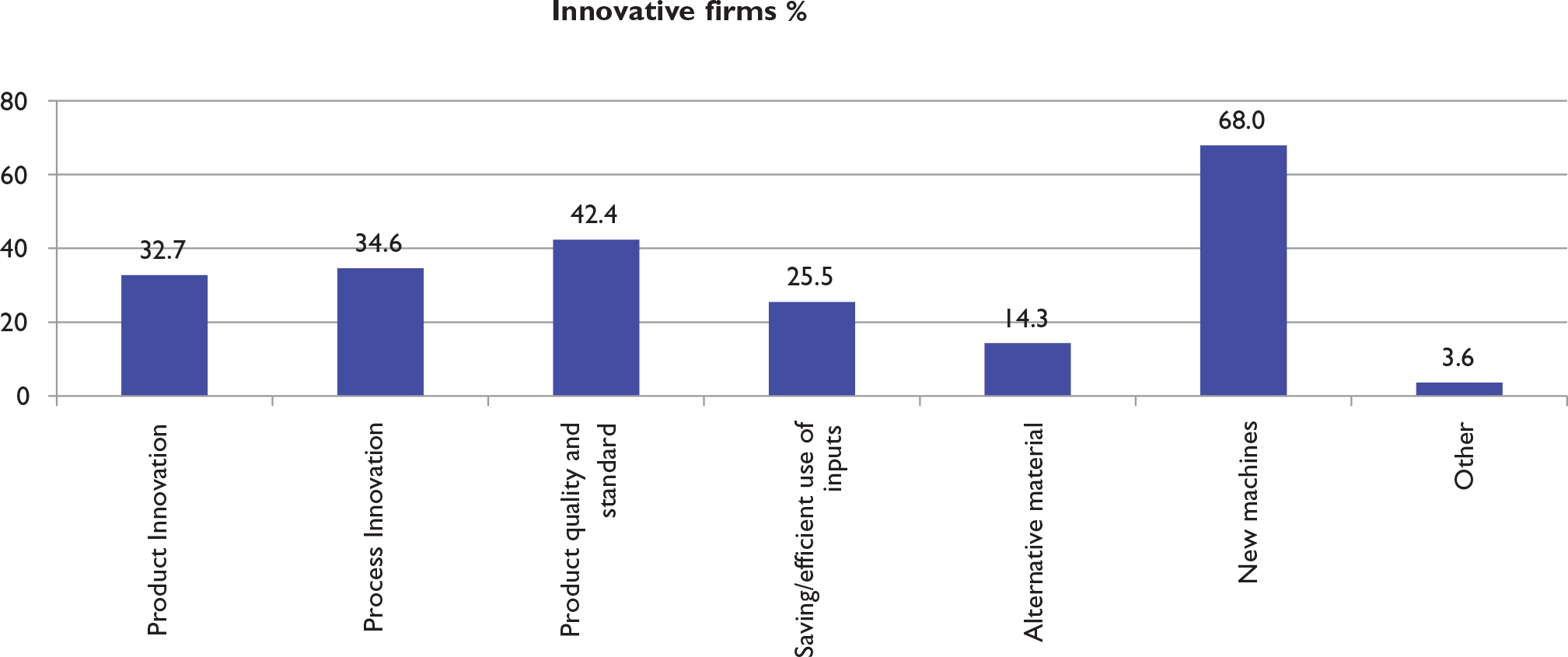
Innovation/imitation/absorptive capacity is also usually measured through patenting and R&D expenditures at the firm, industry, region, or country level depending on the analytical needs. At the regional or national level, and at times at the firm level, number of skilled workers (scientists, engineers) is also used as a measure of such capacity. As aforementioned, innovation surveys are used to capture innovations in the 3Ps (products, processes, and practices), purchase (adoption) of innovations and to some extent contagion effects and innovation capacity. Large surveys are very few and are difficult to organize. Figure 2 provides some recent estimates for India. It is interesting that purchase of new machines and improvements in product quality and standards are the most dominant among various kinds of reported innovations.
Measuring Policy (Changes)
For various policies discussed earlier, several measures have been used empirically to capture differences in policies across regions or change in them over time. We illustrate a few here. IP policy indices that capture stringency of IP regimes across nations are very commonly used. Very few of these capture enforcement/implementation issues. Within country analyses before and after exercises are typically undertaken to capture policy impact. For example, many studies on the role of IP regimes in India focus on situations before and after 2005 when the new regime was put in place.
Studies on the impact of R&D subsidy/tax policies also usually analyse before and after situations. There are very few cross-country studies as they require comparable indices (Gault, 2016).
Trade policy is usually captured through openness indices and various other measures to capture tariff and non-tariff barriers at the level of industry groups. These measures are too aggregative at times to be meaningful at the firm level.
FDI policy impact is generally not captured in innovation studies per se but as mentioned previously, ‘contagion potential’ is measured with aggregation of FDI flows over a specified period or FDI stock in an industry group at a point in time. Typically, periods of FDI liberalization are identified to measure policy impact but sectoral and sub-sectoral differences are often difficult to capture.
Industry policy liberalization is also not measured adequately to capture entry and exit conditions and degrees of competition. Usually, liberalization periods are identified for specific country studies and these are combined with measures of competition such as concentration and price–cost margins. These measures not only capture the impact of policy but also that of industry characteristics and strategies of firms in those sectors, and therefore cannot be seen as adequate in all respects. Cross-country indices are only developed for overall liberalization and capture all policies. Some studies use self-reported measures of the competition that firms face in a market.
Cost of capital measures are available but they are typically not linked to innovation. Here again, these are only partly determined by policy. However, a few recent studies explore the impact of VC funding for innovation-driven start-ups. Interestingly, here again, the ability of VC to be efficacious is found to be in situations where several legal and other institutions are in place along with appropriate labour market and tax regulations. 18
For some useful insights on this, see Lerner and Tag (2013).
It needs to be emphasized that in the absence of appropriate measures, it is difficult to undertake cross-country analyses of public policy–innovation linkages and explore the impact of interactions between policies within countries as well.
CONCLUDING OBSERVATIONS AND SOME POTENTIAL AREAS OF RESEARCH
Through a select review of literature, this article makes an effort to bring out the conceptual and empirical complexities that a researcher faces while exploring the linkages between innovation and public policy. Empirical results of the impact of different policies on innovation are mixed and somewhat difficult to interpret given the complexities highlighted here. Conceptual and measurement issues preclude rigorous analyses of the interaction of policies, especially in cross-country contexts. This is critical as one of the most consistent results in the available literature is that technology policies (relating to R&D, IPR, etc.) tend to have a positive impact in situations where innovation capacity is decent and levels of competition and openness are high. Consistency across policies is important for encouraging innovation but difficult to capture empirically. As mentioned, conceptual difficulties as well as non-availability of appropriate data makes it very difficult to explore the interactions among different policies and their impact on innovations. Due to the same constraints, the linkages between make-buy-imitate choices are under researched. Unless we are able to get a better handle on such linkages at a point in time and over time, it may be quite difficult to conceptualize public policy–innovation and effort–innovation outcome relationships. Of course, better data is a pre-requisite for any such effort. With all these problems, it is difficult to put together a comprehensive research agenda for research in this area. A few tentative research ideas are identified further in the context of India.
Since many economies have undergone significant policy changes in recent years, exploration of relationships within a country over time may be more useful and tractable. This can potentially be done for India through (a) firm-level analyses using large databases; and (b) case studies of specific policy instruments. Some large data sets provide data on disembodied and embodied purchase apart from data on R&D. Experiments in modelling simultaneous use of different strategies to acquire knowledge and using it for innovation can potentially be very useful to understand the innovation process. This would help explore linkages between technology strategies (make-buy-copy) of firms. Firm-level data needs to be exploited to generate measures for the three opportunities and see if strategies change with changes in these opportunities, controlling for policy and firm characteristics. Availability of data through large-scale innovation surveys would make such analyses even more potent.
The analyses of secondary data can be supplemented by innovation surveys to better understand the nature of innovation and the processes at work. Small sample interview-based explorations can focus on how and why the three opportunities (make-buy-copy) are explored at the firm level. Such analyses will also help us gain insights into links between intra-mural R&D and external relationships (including global commons). Small surveys can also help assess the impact of specific policy instruments, for example, tax exemption that will supplement the insights gained from analyses of large data sets. In addition, qualitative research can also help us understand what reported R&D and technology purchase expenditures capture in reality, making the interpretation of secondary data more meaningful.
Given the challenges discussed earlier, it may also be useful to focus analytical efforts on specific policy instruments, both with large data sets as well as through case studies. I conclude with a couple of research ideas that can be pursued in the current context of the Indian economy.
FDI inflows into India have increased quite rapidly in recent years. More importantly, the nature of MNC involvement in India has moved up the value chain and many of them are undertaking R&D in India, often for global markets. There is need to understand more clearly the role of policy on MNC R&D strategies, not only on its location but also on its composition. Such an analysis can build on cross-country studies with a survey and detailed cases. Who decides and what factors affect the focus of MNC R&D? Where are the outcomes of such research protected and used? Does stringency of IPR policy create a change in research focus of MNC R&D subsidiaries? What policies affect the host country focus of R&D undertaken by MNCs? For example, does openness and therefore trade policy matter? What role skills in the host country play? Detailed answers to these questions would be very useful to think of various policy options.
The other research focus could be on the policy and other drivers of innovation-driven start-ups in India in specific sectors. There is a lot of policy discussion on the potential transformative role of start-ups in the Indian economy but there is very little India-specific research that can provide insights to fine-tune policy interventions. Once again, a combination of qualitative and quantitative research would be useful with a focus on specific policy instruments. For example, what has been the role of policies like accelerated depreciation in the growth of technology-driven start-ups in the clean energy sector? In the same research space, there is much to be done on the role of policies in enlarging the scope and depth of UIL. Policies can impact linkages that deal with research, incubation, and even for finance, both for UILs themselves and for financing of incubated companies. In the space of early stage funding of innovation-driven start-ups, there seem to be significant market failures, despite the recent surge in policy interest. Moving away from conventional grant-driven funding models, it might be useful to explore policy innovations that can leverage public–private–academia partnerships. 19
For example, an assessment of policy experiment like Infuse Ventures would be useful to ascertain the efficacy of public–private–academia partnerships to address market failures in early stage funding of innovation-driven startups in sectors like clean energy (see for details, http://www.infuseventures.in/).
ACKNOWLEDGEMENT
This article builds on a presentation made by the author on the same topic on 28 June, 2016 at the Indian Institute of Management Ahmedabad.