




Abstract
India’s global rankings made the headlines at least twice in 2016, and both times the news was dampening. The first report revealed that India’s place in the Global Hunger Index (GHI) compiled by IFPRI fell from 83 in 2000 to 97 in 2016, with India scoring even worse than its much poorer neighbours Bangladesh and Nepal (Grebmer et al., 2016). The second report disclosed that India’s rank in the World Bank’s ease of doing business report rose by only one position, from 131 the previous year to 130, among 190 countries (World Bank, 2016).
The tardy improvement in India’s ease of doing business global rating led to immediate official statements of concern in the corridors of power. Minister of Commerce and Industry Nirmala Sitharaman said she was ‘disappointed’, and Prime Minister Modi directed secretaries of the union government and chief secretaries of state governments to analyse expeditiously the reasons for sluggish progress and identify areas for improvement both in central government departments and the states.
India’s dismal performance in fighting hunger, however, attracted no similar comment or the articulation of concern at senior levels of the union government. The volubility of the government on one and the silence on the other is in itself an eloquent commentary on the priorities of the government, a reflection of who it feels primarily responsible to.
What does a low ranking in the GHI indicate? It means, first, that too high a proportion of India’s people (around 15 per cent) are undernourished. It means that too many children under the age of five (15 per cent) are wasting, reflected in low weights for their heights. And too many are stunted (a shameful 39 per cent), meaning that their bodies are adjusting to chronic low nutrition by becoming shorter for their ages. And finally, it means that too many children (4.8 per cent) die before reaching the age of five years because of the fatal cocktail of too little nutritious food and highly unhealthy environments (Varma, 2016).
It is important to remember that what for scholars is ‘undernutrition’, is infact for people who live with this condition, the anguish of being unable to feed oneself or one’s loved ones, of reduced physical and mental capacities, and of succumbing to infections or circumstances that they would have been able to fight if they were well nourished. Stunting and wasting means that the bodies and minds of millions of our children are being starved into feebleness. Under-five mortality means the agony of millions of mothers and fathers who are helpless as they lose their children only because of their dirt poverty.
A low GHI ranking divulges that compared to other countries, the governments are simply doing too little to prevent this enormous and entirely preventable suffering of millions of impoverished citizens. And the silence of the government about these continued failings can only mean that it is not stirred or shamed by this report card; that there is still little urgency to alter the destinies of India’s poorest majorities, rural, slum-based, informal workers, women, tribal, Dalit, minority, disabled groups, aged people, single women, and above all children from all these groups.
It is not as though there has been no improvement in India in each of these parameters in recent years. In 2013, India’s position was rated as ‘alarming’; today it is slightly better at ‘serious’ (Grebmer et al., 2013). In 2016, India’s GHI score was 28.5, an improvement over 36 in 2008. Since 2000, India has reduced its GHI score by a quarter. But 20 countries—including much poorer countries such as Rwanda, Cambodia, and Myanmar—have all reduced their GHI scores by over 50 per cent since 2000 (Grebmer et al., 2016).
So, the problem is not that India is doing nothing to end hunger. But its improvements are much slower than even countries which are often much poorer, not self-sufficient in food production, without functional democracies, and sometimes strife-torn. India’s GHI score places it fifth from the bottom in Asia: only Afghanistan, Timor-Leste, Pakistan, and North Korea trail behind India. This surely is not an illustrious company for India that prides itself as the world’s fastest growing economy. The report estimates that if India continues to reduce hunger at the same pace, it will still be in the ‘moderate’ to ‘serious’ hunger zone in 2030.
India’s failures to reduce and end hunger, poor health, and early deaths, resulting in immense suffering of millions of its people, is even more unconscionable because all of this is preventable. India has the food production, the levels of growth, the economic resources, and the state capacities that it requires, if it resolves to make hunger history. Countries which have overtaken India often lack many of these advantages. India’s failures are not inevitable. They are the direct result of its public policy priorities and choices: its market fundamentalism and its refusal to invest adequately in the nutrition, education, social protection, and health of its people.
India’s continued trouncing in its battle against hunger stems first from its very low investments in agriculture, as a result of which India’s food producers constitute its largest ranks of the hungry and malnourished. For a sector that gives work to around 55 per cent of the population, government invests less than 4 per cent of public resources. Even within this small investment, the overwhelmingly large mass of the rainfed small peasant are most neglected. India’s failure to ensure decent work to nearly 9 of its 10 workers trapped in informal work also explains India’s losing hunger battle. India’s high growth is mostly jobless growth, which erodes completely the rationale for privileging business interests over those of impoverished populations. The historical inequities of gender, caste, tribe, and religious minorities further aggravate those created by inequalities of wealth.
Upstream sources of India’s disgraceful hunger record also include its investment of just a little over 1 per cent of GDP in public health (World Bank, Public Health Expenditure, n.d.), lower than most countries of the world, and its chronic miscarriages in securing sanitation and clean water to all its populations. Downstream, we see continuing chronic under-resourcing and corrupt implementation of important food and nutrition programmes such as the Integrated Child Development Services (ICDS) and school meals, the public distribution system, pensions for older persons, single women and the disabled, and maternity benefits.
To address some of these, India passed the National Food Security Act 2013, which sought to guarantee half the calorie needs of two-thirds of the population, as well as universalize maternity benefits, young child and mother feeding, and school meals. But even when such Acts are passed, they are rarely acted upon with diligence and commitment. The union government and many states remain reluctant and neglectful in operationalizing these entitlements.
All of these point to not just morally reprehensible failures of the state, but to a much deeper social and cultural malaise. It is that the lives, deprivations, and suffering of the poor do not matter. In this way, the GHI is an indictment not just of our governments but also of middle-class India itself, holding up a mirror to how little it cares.
Twenty-five years have passed, after 24 July 1991, when the then Finance Minister Dr Manmohan Singh rose in Parliament to present a budget speech which was to alter the destinies of India and its people in fundamental ways. He spoke in his characteristically gentle, low-key, and self-effacing manner disguising a steely resolve. His words were memorable even if debatable. Quoting Victor Hugo—‘no power on earth can stop an idea whose time has come’—he declared that ‘the emergence of India as a major economic power in the world happens to be one such idea. Let the whole world hear it loud and clear. India is now wide awake. We shall prevail. We shall overcome.’
The legacy of that moment remains highly contested. A quarter-century later, India is indeed a major economic power, altered in fundamental ways from the country that Dr Singh helped steer in new directions. With a GDP of 2 trillion dollars (World Bank, n.d.), it has edged itself among the 10 largest economies of the world. But in what ways have economic reforms—launched with this historic budget speech—contributed to changing the lives of India’s dispossessed millions? Has it, as was promised, hastened the end of poverty and want, ensured greater access to public goods to hitherto excluded populations, spurred jobs and incomes, and reduced state corruption? As we look back on the past 25 years, it is important to draw up a careful balance sheet, especially from the vantage point of the oppressed people of India, of what the promises were and what was actually accomplished after India changed course so fundamentally 25 years ago.
The ‘structural reforms’ that Dr Singh announced, and which every successive government elected to the union government with varying urgency and priority have since advanced, made way for global private enterprise to enter, and increasingly occupy the commanding heights of the Indian economy. Until then, these were dominated by the state. The reform package opened the economy to global competition: it stressed on fiscal consolidation and discipline for macroeconomic stability; it liberalized trade and capital markets; it dismantled the justly notorious licence-permit raj that stymied local enterprise by rent-seeking; and it facilitated and expanded competitive private provisioning of public goods such as health, education, public transport, and infrastructure.
There were three main promises of economic reforms. The first was that these would unfetter the economy and spur economic growth and development. The second was that growth would crank up manifold the creation of wealth and jobs, and through this would erase poverty, hunger, and want. And the third was that reforms would significantly reduce corruption and rent-seeking by ending licensing and bureaucratic regulation of private enterprise.
Let us take each of the promises, and assess with the hindsight of a quarter century what indeed was accomplished and what were the intended and unintended consequences of these reforms.
There is no doubt that reforms did hasten economic growth to rates that were double, and even, at times, three times the pace of growth that the country had settled into until then in four decades since India’s freedom. Twenty-five years later, India is the fastest growing economy in the world. It has also created unprecedented levels of wealth (however unequally distributed), so that today India is home to the third largest population of dollar billionaires in the world (Hurun Report, 2015). The ranks of middle-class Indians have grown, as they have transitioned from lives of customary austerity to substantial improvements in their material well-being, from habitual thrift to unrestrained and unapologetic hyper-consumption. This massive enlargement of wealth has also meant that governments in India at all levels—union, state, and local—have far greater resources in absolute terms available to them for public investment and spending than they did in the past. India’s budgetary spending on social sectors in 1990–1991 was approximately 6 per cent of its GDP which rose to 8 per cent in 2014–2015 (Government of India [GOI], 2015). Although because of official reluctance to expand India’s direct tax base significantly, public spending as a share of gross domestic product remains one of the lowest in India among comparable countries.
This is, however, where I believe that the ‘good news’ of economic reforms ends. Reforms did stimulate high economic growth and yield greater wealth creation. But this wealth was very unequally distributed, raising sharply levels of economic inequality in a country that was already historically profoundly unequal. Advocates of free markets, opposed to building a welfare state, have long argued that accelerated market-led economic growth in India has lifted millions out of want in ways that direct state support could never have done. They suggest that poverty is vanishing in India, and those who still advocate large-scale public action in support of the poor are caught in a time warp, failing to recognize that the lives of India’s poor have altered dramatically in the quarter century of neoliberal reforms.
In India, from 2 resident billionaires with an income of 3.2 billion in the mid-1990s their numbers grew to 46 and combined wealth to 176 billion in 2012, and their share in GDP rose from 1 to 10 per cent (Mander, 2015a). A recent report by Oxfam titled Even It Up observes that income concentration at the top fell in the first three decades after Independence; but since then, for the top 0.01 per cent, real wages grew annually at 11 per cent. By contrast, the rise in real household expenditure for the rest of the population rose by only 1.5 per cent. In agriculture, growth in real wages was 5 per cent in the 1980s, but fell to 2 per cent in the 1990s, and virtually zero in the 2000s. If judged by the median developing-country poverty line of 2 dollars a day on purchasing power parity (PPP), more than 80 per cent rural and just below 70 per cent urban inhabitants in India continue to be impoverished.
As Oxfam director Byanyima (Oxfam, 2014, p. 2) observes,
A child born to a rich family, even in the poorest countries, will go to the best school and will receive the highest quality care if they are sick. At the same time, poor families will see their children taken away from them, struck down by easily preventable diseases because they do not have the money to pay for treatment.
The unfairness of this unequal world is indeed enhanced because the majority of the richest persons are born into their wealth. Children and grandchildren of the rich will largely replace their parents and grandparents in the steep economic ladder, as much as children and grandchildren of the poor will remain impoverished, regardless of their potential and hard work.
In India, the burdens of unequal birth weigh heavily on those born into disadvantaged castes, gender, religion, and tribes. In the countryside, poverty rates are 14 per cent higher for Adivasis and 9 per cent for Dalits, compared to non-scheduled groups. In urban areas likewise, the poverty of Dalits and Muslims is 14 per cent higher than the others (Mander, 2015a).
A report of the OECD countries in 2011 titled Divided We Stand: Why Inequality Keeps Rising observed that inequality in earnings has doubled in India over the past two decades, making it one of the worst performers among emerging economies. The report noted that the top 10 per cent of wage earners make 12 times more than the bottom 10 per cent, compared to 6 times 20 years ago. India’s experience contrasts with that of Brazil, Indonesia and, on some indicators, Argentina, which recorded significant progress in reducing inequality during the same period, unlike China, India, the Russian Federation, and South Africa which have all become less equal over time.
I worry not just about the rapid pace of growing inequality. Even more worrying is the indifference, the absence of outrage, among people of privilege about the monumental levels of preventable suffering that surrounds them. As I argue in my recent book Looking Away: Inequality, Prejudice and Indifference in New India, historical ideas of caste and class that justify inequality have been topped up in neoliberal times with the belief that greed is good (Mander, 2015b). This has resulted in a particularly uncaring middle class, and the exile of the poor from their conscience and their consciousness. The Oxfam report calculates that if even a tax of 1.5 per cent was imposed on the wealth of all the world’s billionaires, it could get every child into school and deliver health services in all the poorest countries of the world, saving an estimated 23 million lives (Oxfam, 2014, p. 9). It estimates that if India just stops inequality from rising, it could end extreme poverty for 90 million people by 2019. If it reduces inequality by 36 per cent, it could eliminate extreme poverty.
Gupta (2012) is troubled by similar questions, when he calculates that the number of ‘excess deaths’—the number of people missing from the population due to malnutrition and morbidity—is over 2 million deaths annually.
Nevertheless, the system of checks and balances composed of the free press, and the democratic, multi-party, competitive political system that, as Amartya Sen (1999, pp. 180–182) claims, has been so effective in sounding the alarm of impending famine, drought, or natural disaster, has failed to mobilize state and private resources to prevent a disaster of these proportions.
It is the normalization of what ‘should be considered exceptional, a tragedy and disgrace, but is not: the invisible forms of violence that result in the deaths of millions of poor, especially women, girls, lower-caste people, and indigenous people’ that results in the persistence of such a magnitude of preventable deaths with no effective outrage. Dr Sen speaks of former Finance Minister Chidambaram saying in an interview to BBC that he is confident that poverty will end by 2040, in effect advocating as a positive achievement of a plan to eradicate poverty that essentially sacrifices an entire generation.
Advocates of neoliberalism still valourize these reforms by suggesting that it matters little that inequalities rise because of the success of these reforms to eliminate poverty, at a pace and scale that was impossible in the pre-reform period. Ghosh (2010), however, contradicts this claim, demonstrating that pre-reform periods had slower growth rates, but still eliminated poverty at a higher rate than in the reform period. For rural India, poverty was reduced by –1.24 per cent in the period 1973–1974 to 1987–1988 and –0.64 in the period 1987–1988 to 2014–2015; and for urban areas, –0.79 per cent in the period 1973–1974 to 1987–1988 and –0.74 in the period 1987–1988 to 2014–2015. Even the World Bank, otherwise a strong advocate for reforms, admits this. It observes that the aggregate headcount poverty ratio in India declined from 59.8 per cent in 1981 to 51.3 per cent in 1990 and 41.6 per cent in 2005. So, according to the World Bank, the rate of poverty reduction ‘slowed’ from 0.94 per cent points per annum during 1981–1990 to only 0.65 per cent points per annum during 1990–2005 (Ghosh, 2010). This breaks the myth that liberalization and the incumbent growth has hastened reduction rate of poverty. Yes, poverty has reduced in these 20 years, but this in itself cannot be a matter of approbation because poverty can be expected to fall between any two points in time; but the real question to ask is whether neoliberalism has pushed the process of reduction in poverty or has it done to the contrary.
Levels of absolute poverty have no doubt declined, as have malnourishment and hunger. But the question to ponder is whether these have declined fast enough. Even neighbouring Bangladesh with half of India’s per capita income has been able to eliminate want and malnourishment far more successfully than India, as underlined again in the recent 2016 Global Hunger Index report.
There are further problems with the extremely minimalist definitions of poverty adopted by the Indian government. Therefore, when neoliberal advocates promise to ‘wipe out poverty’ by 2040, all that they are promising even at this slow pace is an end to starvation-level poverty. Ghosh (2010) calculates that if we use an even slightly higher cut off of US $1.25 per day at revised 2005 PPP$, the number of absolutely poor people in India in 2005 were 456 million significantly more than the Indian government’s own estimate of 301 million in 2005–2006. In 2005, India had the second highest poverty ratio (54.8 per cent) among all the Asian countries studied, next only to Nepal (55.8 per cent) and higher than Bangladesh (42.9 per cent), Cambodia (36.9 per cent), Bhutan (31.8 per cent), the Philippines (29.5 per cent), Pakistan (24.9 per cent), Indonesia (24.1 per cent), Vietnam (16 per cent), and Sri Lanka (9.9 per cent). If we use the global yardstick of $2 a day, the numbers of poor people in India would even today be around 80 per cent (Himanshu, 2008).
The burdens of poverty and want are even higher in the countryside. The picture of rural Indian life today that emerges from what is probably the world’s largest study ever of household deprivation, preliminary results of the Socio-Economic Caste Census (SECC), is sobering and sombre. It describes a massive hinterland still imprisoned in persisting endemic impoverishment, want, illiteracy, and indeed hopelessness. With hand-held laptops, official enumerators were commissioned to ask members of all households in the country a few basic questions, including what they owned, how they earned a living, how much they earned, and how far they had studied. Their findings tell us first that in three of four rural households nobody earns more than 5,000 rupees a month. More than 9 out of 10 rural households have nobody earning over 10,000 rupees a month (GOI, 2016).
Prime Minister Modi in his midsummer 2014 election campaigns often spoke of aspiring youth, restless and impatient to join India’s growth story. The SECC results again offer a dismal reality check. Only 3 per cent rural households have even a single member with a graduate or postgraduate degree. On the other hand, more than a third of rural India is still illiterate. A quarter households have no literate adult above 25 years. Less than one in five households have one or more family members with primary education, whereas only 13.5 per cent have anyone who made it to middle school. This means that more than half of the rural Indians still have no or only minimal skills of reading and writing. If they can share in India’s growth story, as we will observe, it can only be in adding to its already mammoth reserve army of cheap and footloose labour.
SECC mandated officials to survey every single household in the country, which contributes to its importance and credibility. It is a census, not an estimate. All large official surveys, however, tend to neglect invisible populations, such as forest dwellers, nomadic communities, footloose distress migrants, bonded workers, and people stigmatized by their vocations, sexuality or ailments. These populations are invisible to state officials because of their extreme vulnerability and powerlessness, and as a survival strategy they are often also hide from the state. Moreover, although rules required that the survey results be ratified in open community meetings, this was rarely done. Far from overstating the situation, therefore, it is likely that it in fact the SECC significantly underestimated levels of poverty and deprivation.
Ghosh (2010), comparing India’s and China’s experience in fighting poverty in periods of high economic growth, argues that China does better than India because of pre-reform egalitarian measures such as land reforms and universal elementary education, and because of high public spending during reforms, especially on infrastructure. India by contrast has almost starved agriculture with negligible public investments, although it still employs 50 per cent to 60 per cent of the workforce, and it also continues to neglect basic education and, indeed, health care. Unlike China, which followed the classical trajectory of agriculture to manufacturing, India has shifted to the services sector, still leaving millions in low-end, low-productivity employment in the countryside. India’s human poverty is even more dismal than income poverty, as reflected in India’s falling position in the GHI to which we refereed earlier.
The lesson that Finance Minister Arun Jaitley drew from the incontrovertible SECC findings about the dismal situation of rural Indians—still trapped in age-old poverty—was predictably to call for a further hastening of India’s economic growth. This would mean administering more of the familiar medicine of market fundamentalism: reducing public spending further on education, health, and agriculture, combined with further weakening labour protections and safeguards against land acquisition. Instead we are convinced that we must heed the resounding message of the SECC, as also of the unending epidemic of farmers’ suicides and the continuing distress exodus from India’s countryside: that India does not shine for its teeming villages. This challenge requires an entirely different set of prescriptions: much greater public spending on rural infrastructure, watershed development and small-farm agriculture, farmers’ income protections, MNREGA, education and health, and reviving land reforms. Without these, rural India, still home to a vast majority of Indians—is fast becoming a wasteland of distress and despair.
The promise of reforms which have been most spectacularly belied in India is that reforms and galloping growth would unleash millions of jobs. If they actually did so, it is claimed by reform votaries that then this would not just lift people out of poverty; it would also make increasingly irrelevant state withdrawal from supplying basic public goods such as health and education because people would be able to buy these competitively in the market. However, the reality of what was accomplished in the years of high noon of economic growth in India was certainly the accelerated but unequal expansion of wealth, as observed, but not the expansion of decent work for India’s poor.
On the contrary, we have seen the reverse: the shrinking of decent work in the sunshine years of highest growth. As Kompier et al. (2014) establish in the India Exclusion Report (2013–2014; CES, 2014) undertaken by the Centre for Equity Studies (CES), very few jobs have been added, mostly of low quality, whereas employment opportunities in public enterprises, the formal private sector, and agriculture actually declined (my emphasis). In the decade 1999–00 to 2009–10, while GDP growth accelerated to 7.52 per cent per annum, employment growth during this period was just 1.5 per cent, below the long-term employment growth of 2 per cent per annum, over the four decades since 1972–73. Only 2.7 million jobs were added in the period from 2004–10, compared to over 60 million during the previous five-year period.
Far from the promise of more jobs and opportunities, the reality has been of more uncertainty, lesser job creation, and far lesser security. Even the government has had to reluctantly admit that ‘the economy has indeed experienced high rates of growth in the post reforms period [but,] the optimism on employment creation, however, has not been realized to the fullest extent’ (GOI, 2010).
It is significant that employment in the organized sector actually fell after 1997, while that in the unorganized sector rose. The 2009 report of the official National Commission for Enterprises in the Unorganized Sector finds that the vast majority of jobs created in recent years have been in the informal sector, in the absence of a legal framework for labour protection and social security (GOI, 2010). Out of every 100 workers, the report revealed, around 90 per cent work in the informal economy producing half of India’s economic output. This implies that out of a current total workforce of around 475 million, around 400 million workers, considerably larger than the total population of the USA, are employed with little job security or any formal entitlements to call upon the protection of the labour law regime. (Mander, 2014)
And for the tiny number of jobs that are being created, written job contracts with formal agreements and associated legal responsibilities (at least on paper) are already an endangered or near extinct mode of employing workers. About 93 per cent of the casual workers do not have any written job contract, while the figure for the same amongst contract workers is 68.4 per cent. Even amongst the supposedly more formal wage/salaried employees, about 66 per cent of employees are reported to be working without a written job contract. As per government estimations, labour relations in such instances are based mostly on casual employment, kinship, or personal and social relations rather than contractual arrangements with formal guarantees. 2
As per the Fourth Annual Employment–Unemployment Survey Report (2013–14) all India level, 49.5 per cent persons are estimated to be self-employed under the Usual Principal Status approach followed by 30.9 per cent as casual labour. Only 16.5 per cent were wage/salary earners and the rest 3.0 per cent covered contract workers. See
The worst hit once again, unsurprisingly, are rural workers. The SECC survey, referred to earlier, also reveals that 56 per cent rural households own no land. Around half of the rural households report that they depend primarily on manual labour to survive (Mander, 2015c). Economist Prabhat Patnaik (2010) observes in Outlook:
Our share of cultivators has actually fallen since 1951. A whole set of people who might have been independent peasants…have been pushed into the ranks of agricultural labour. They have no rights, no security of income, they are subject to the worst kind of drudgery because it is all manual work: they cannot be organised. It’s just a miserable state of existence.
Since the stagnant rural economy offers meagre opportunities for employment, a large segment of these households are footloose circular distress migrants, evocatively described by labour anthropologist Jan Breman as ‘hunters and gatherers of work’ (Breman, 1994). In order to stay alive, they will go to any corner of the country, to do any work, with any remuneration, and on any terms. An estimated 12.24 million people are seeking work for 2–6 months as per National Sample Survey Office (NSSO) data. Of these, 77 per cent are resident in rural areas and more than two-thirds of them migrate in desperate search of any kind of work to urban areas. Some estimates show that about 35–40 million labourers—almost half the number of casual labourers outside agriculture—could be seasonal migrants.
These are the migrant workers toiling in the prosperous rice, wheat, sugarcane, and cotton farms of Punjab, Haryana, Western UP, and Maharashtra; construction workers building high-rise structures in cities across the country; semi-bonded workers in brick kilns which pockmark the country; workers building roads in conflict-endemic frontier states, and so on. Often boys barely in their teens set out to distant lands to earn some money to keep their families alive. But now increasingly families migrate along with men, interrupting children’s schooling, forcing women to bear and raise children on dusty city streets and shanties, and leaving behind old people in the village to starve, beg, or die.
These findings are also incidentally another reminder of the potential contributions of what has been described as the world’s largest social protection programme, the MNREGA. When Prime Minister Modi dismissed this in Parliament as a living monument to earlier governments’ failures, he demonstrated little sensitivity to the struggles of distress migration that millions of rural households still have to endure, which could be prevented by the state’s effective guarantee of safe- and dignified-waged work in the vicinity of their homes, enabling them to escape their annual uprooting to distant lands.
Prime Minister Modi’s most powerful election promise in 2014 for millions of young voters was to create 10 million jobs. With 65 per cent of the country below 35 years, this promise undoubtedly drew millions of young people who legitimately dream of a better life to cast their futures with his leadership. A million new young people join the workforce every month. This does not account for those who seek work in the cities because of the near-death of the rural economy.
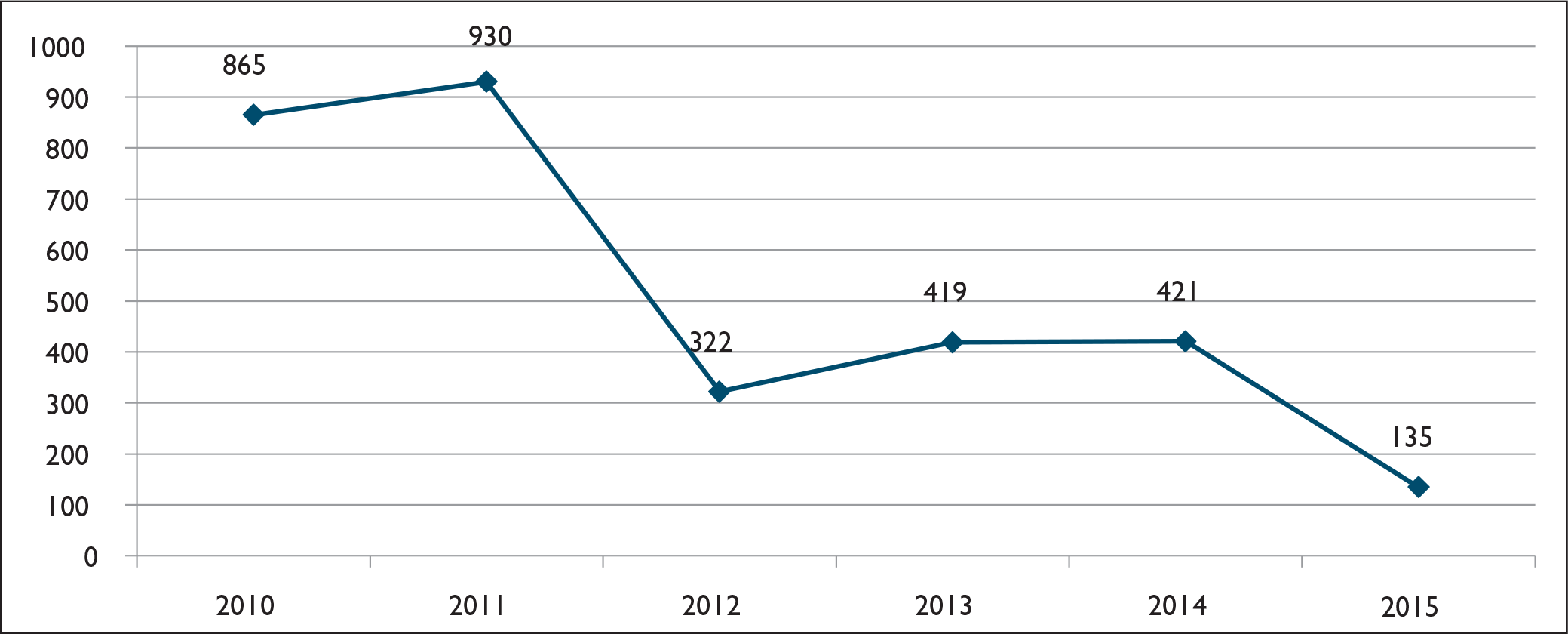
Yet more than halfway through his tenure, there are almost no jobs available. Job creation has fallen to levels even below those that the preceding UPA governments plunged to. Official data reveals that employment creation in 2015 plummeted to a mind-numbing low of 135,000 jobs (Figure 1).
The picture is even more complex because jobs are being extinguished even as others are being created, and net figures hide this. More and more people are being pushed into either lowest-end self-employment or the most unprotected and casualized wage employment. The countryside is of course the most stricken. But the situation is almost as hopeless for the distress migrant to the city. As Colin Todhunter (2013) observes in a biting indictment, ‘much mainstream thinking implies that shifting people from agriculture to what are a number of already overburdened, filthy, polluted mega-cities to work in factories, clean the floors of a shopping mall or work as a security guard improves the human condition’.
The third big promise of economic reforms—that the dismantling of the proverbial licence-permit raj would help greatly reduce corruption and rent-seeking—has also been belied spectacularly. 3
In this section, in particular, the contributions of Anirban Bhattacharya and Vivek Mishra have been particularly significant.
Another outcome of the new age of crony capitalism is very high public subsidies for big business, reflected, for instance, in over five lakh crore rupees of revenues foregone to industry in every budget, and this at the expense of adequate public funding of health care, education, water, sanitation and social protection, and the farm sector. This has led development economist Jean Dreze (2014) to describe India as a world champion of social underspending. In particular, out-of-pocket expenditure on health care is twice the levels of public spending, a disgraceful record unmatched by most countries. Our public schools are shamefully under-resourced with trained and motivated teachers and basic infrastructure, and only 7 per cent people are still able to complete their college graduation. Only 9 in 10 persons are in informal employment, and they are deprived of any or adequate pensions in their old age.
We can only glance over some of the mindboggling amount of debts that various top companies owe to the different public banks of the country: Anil Ambani (Reliance Group, ₹125000 crore), Anil Agarwal (The Vedanta Group, ₹103000 crore), Goutam Adani (Adani Group, ₹96031 crore), Shashi Ruia and Ravi Ruia (Essar Group, ₹101000 crore), Sajjan Jindal (JSW Group, ₹58171 crore), GVK Reddy (GVK Group, ₹33933 crore), Manoj Gaur (Jaypee Group, ₹75163 crore), and Venugopal Dhoot (Videocon Group, ₹45405 crore) are just a few examples of the corporate loan that are remaining unpaid in various nationalized banks, thereby starving these banks of the total cash deposit (Sharma, 2016). The State Bank of India (SBI), which is the biggest nationalized bank, has written off in the year 2016 alone, loans worth ₹7016 crore owed by more than 60 of its top 100 ‘wilful defaulters’. Among them is the absconding Vijay Mallya, whose outstandings with the bank are in the range of ₹1201 crore (The Indian Express, 2016). This same SBI in the very recent past has also showered other such ‘wilful defaulter’ business tycoons with huge loans, flouting RBI guidelines. Niranjan Hiranandani, who was declared a defaulter by RBI in 2014, was sanctioned two loans of total ₹5,550 crore by SBI and AXIS bank in 2015 and 2016 (Rai, 2016). Recently, the SBI has given a loan of 1 billion rupees to Mr Gautam Adani to secure his mining deal in Australia (The Indian Express, 2014). So these corporate tycoons are running their business literally on public money in order to fill the coffers of the corporate via the bank. The cosy relationship of several of these ‘captains’ of big industry with India’s top political leaders is the best-kept open secret of India’s public life.
According to a recent estimate by the Global Financial Integrity programme of the Centre for International Policy, the money that had illicitly flown out of India to accounts abroad over its post-Independence history stretching from 1948 through 2008 was around $213 billion, the present value of which equals 36 per cent of India’s GDP in 2008. But what is even more telling is that out of $462 billion siphoned out of India during the 61 years period, 68 per cent is attributable to the post-reform period of just 18 years (Chandrasekhar, 2010).
While corrupt practices have always existed, in the neoliberal times, the definition has gotten far more blurred. This is precisely because deregulation and predominance of financial capitalism ensures that what would earlier be characterized as corrupt practices has now not only been normalized and ‘legalized’ but also encouraged. Unlike earlier, cozying up with big capital no longer raises eyebrows or elicit frowns in public discourse. Much rather the neoliberal morality has ensured that governments vie with each other as being cozier with corporations than the other. This runs in the name of ‘development’ or ‘investment friendly’ or ‘pro-business’. In a world where profit-making and the accumulation of wealth are celebrated and rewarded, where it is the ‘bottom line’ that finally matters, unless circumstances lead to the detection of fraud or a violation of the law, an increase in the wealth of a private sector player is normally seen as a virtue and a reflection of ‘entrepreneurship’ and ‘innovation’.
Analysts have also observed that one cannot identify corruption today by looking for illegal activity alone. Many of the practices that happen in rich and poor countries are legal or in a grey area where it is difficult to tell criminal from the lawful. It is possible to argue that finance capital is by definition corrupt. The investment banks typically do not disclose their fees to investors in advance (they call their charges ‘consideration’) by deducting self-decided amounts as they go along. Free charging professionals like lawyers, and in many countries doctors and dentists, make up their own huge fees. Is this not corrupt? But there is nothing illegal about it (Hearse, 2016).
What this entails is that unlike earlier, it is far more difficult to establish culpability or determine accountability today when it comes to corruption. Patnaik (2011) points out that unlike the scams of the yester decades, corruption today has become far more sophisticated as a process which also requires certain financial networks and knowledge of leverage as the 2G, 4G, or the Coalgate scams show—which are products of elite capture of public policy making in a neoliberal age. He suggests that neoliberalism has created new and alternate ethical and political regime. The entire discussion of the spreading capitalist values, the passion for money-making, the intrusion of commoditization into every sphere of life, all of which are integrally linked to our current economic trajectory, has receded into the background, and in its place, all kinds of facile quick-fix solutions are being sought to be rammed down the throat of the nation by a range of godmen, economic gurus, and the bulk of the political class that opportunistically acquiesces to a policy regime and practice that act to the detriment of democracy and the poor (Patnaik, 2011).
Patnaik (2012) goes on to suggest that corruption plays a very important and specific role in the institutionalization of a neoliberal regime. It is not just something that a neoliberal regime increases the scope for because of its pervasive transfer of assets at throwaway prices to big capitalists nor is it merely the outcome of the large-scale avarice that such a regime unleashes in general. These factors of course are conducive to a massive increase in the scale of ‘corruption’, such as what we observe in India today. But over and above these, there is a structural reason for the increase in ‘corruption’, especially among bourgeois politicians, under such a regime; and that is to enlist their political support for this regime. ‘Corruption’ is politically necessary for neoliberalism.
Many believe that the retreat of the Indian state away from the principle of primary public responsibility for health, education, and social protection of its disadvantaged populations, and from redistributive taxation since the 1990s was part of the package of economic reforms driven by the Washington Consensus of the World Bank and the International Monetary Fund (IMF). But even these institutions have begun to acknowledge that they may have been drastically wrong. In 2014, the president of the World Bank, Jim Yong Kim, admitted that the assumption that people in poor countries should pay for health care was wrong: ‘There’s now just overwhelming evidence that those user fees actually worsened health outcomes. So did the bank get it wrong before? Yeah. I think the bank was ideological’ (Lawson, 2014). In any honest assessment of economic reforms in India, it is imperative that we admit that the movement away from public provisioned health and education has been a mistake that has resulted in enormous avoidable human suffering and loss for millions of our people. But there is little evidence of such soul-searching. In a similar self-critical tone, Christine Lagarde, managing director of the IMF has said:
‘In far too many countries the benefits of growth are being enjoyed by far too few people. This is not a recipe for stability and sustainability.’ She went on, Let me be frank: in the past, economists have underestimated the importance of inequality. They have focused on economic growth, on the size of the pie rather than its distribution. Today, we are more keenly aware of the damage done by inequality. Put simply, a severely skewed income distribution harms the pace and sustainability of growth over the longer term. It leads to an economy of exclusion, and a wasteland of discarded potential.
She compares rising inequality in the US and India.
In the US, inequality is back to where it was before the Great Depression, and the richest 1 per cent captured 95 per cent of all income gains since 2009, while the bottom 90 per cent got poorer. In India, the net worth of the billionaire community increased twelvefold in 15 years, enough to eliminate absolute poverty in this country twice over.
She argues that distribution of wealth matters, and contrary to prevailing economic orthodoxy until now, redistribution policies are not counterproductive for growth ‘because if you increase the income share of the poorest, it has a multiplying effect on growth … but this does not happen if you do so with the richest’ (Mander, 2016).
A fair and sober assessment of the impact of 25 years of economic reforms in India, therefore, requires, on the one hand, an acknowledgement of its contribution to unleash the potential of the economy for growth and the creation of wealth. But at the same time, it is both callous and disingenuous to ignore the evidence that growth by itself is no guarantee of a better life for people of social and economic disadvantage, which surely should be both its primary objective and the paramount yardstick for evaluation of its success. The unequal distribution of wealth, crony capitalism, low public investments in health, education, social protection and infrastructure, and the chronic neglect of small-farm agriculture continue to shackle millions into hunger, want, low-end uncertain employment, distress footloose migration, damaged health and survival chances, and denial of quality education that could harness young people’s full potential.
What is staring us in the face is the crisis of neoliberal capitalism and its greatest betrayal: its spectacular failure to create decent work. We were told that if a policy regime is created in which big business invests more and makes massive profits, and the state withdraws from provisioning public goods such as education, health care, water, sanitation, and housing, impoverished and deprived people would still be better off because they would have more well-paid jobs. They would then not have to depend on a corrupt, inefficient, and slothful state, and instead would be able to buy the best and most competitive public goods from the market. However, the core of this argument has collapsed because huge private profits are being made, the public sector in health and education have shrunken and caved in, but job creation is almost at a standstill. Without decent work and earnings, all that neoliberalism is doing for the poor is to widen the gaps between them and better-off people, while excluding them even more decisively from public goods that are essential for a human life of dignity.
Twenty-five years ago, when Dr Manmohan Singh spoke to the nation of an idea of which he was convinced the time had come, he called for freeing ourselves from one set of orthodoxies. But his prescriptions have had mixed results, many of its promises are unrealized and millions still live wretched lives of avoidable suffering with oppression and want. In the long dark shadows of the glitter of economic reforms are the unequal distribution of wealth, crony capitalism, low public investments in health, education, social protection, and infrastructure, and the chronic neglect of small-farm agriculture. These continue to shackle millions into hunger, want, low-end uncertain employment, distress footloose migration, damaged health, and denial of education that destroy the full potential of many millions of young people, still trapped in doctoral scholar Rohith Vemula’s haunting description of the ‘fatal accident’ of their births.
The radical prescriptions of 1991 have become the powerful new orthodoxies of today, canons which have conquered not just India but most of the world.
There is an implicit and sometimes explicit assertion in some circles that anyone who questions the push towards urbanisation, privatisation and neo-liberalism in general, which Chidambaram’s model of development rests on, ‘lacks perspective’ or is stuck in an outdated mindset that romantics ‘tradition’ and resents ‘progress’ and the private sector. (Todhunter, 2013)
But new voices in many parts of the world—such as of Bernie Sanders in the United States—are speaking out against these orthodoxies. Today in India, we need to summon even much greater courage than 25 years ago to liberate ourselves from these new dogmas. Only then will we muster the political and moral will to change course once again, to recognize that all people deserve decent work, health care, education, and social protection; that markets cannot assure them these; and that wealth is not development unless it is shared.
But to change course, more than courage we need compassion.