Abstract
On a Monday morning, after a three-week holiday in Brazil, Rakesh Patel, Chairman of Steel Tubes and Pipes Ltd (STPL), was consolidating his thoughts on the tasks ahead. He was back to work after his first family holiday in many years. Experiencing lovely beaches, football fever, and a leisurely cruise in the Amazon basin had rejuvenated the family. He too was recharged, and ready to take his medium-sized company into, as they say, the next orbit.
Keywords
STEEL TUBES AND PIPES LTD.: A BACKGROUND NOTE
Rakesh along with his brothers, Subhash Patel and Mihir Patel, promoted, owned, and ran Steel Tubes and Pipes Ltd (STPL), a medium-sized company that manufactured tubes and pipes made of stainless steel, exotic metals, and carbon. In 2012, the company generated sales revenue of `30,000 million (USD 467 million) with a 16 per cent profit on operating margins. In 2014, it had a capacity for manufacturing of about 30,000 metric tons of pipes (20,000 for welded pipes and 10,000 for seamless pipes) and more than 350,000 tons of carbon steel. Some of STPL’s popular products were high-frequency welded pipes, welded tubes, saw pipes, electric-resistant welded pipes, seamless tubes and pipes, etc. STPL employed around 2,000 full-time employees, including about 700 white-collar employees. The 1,300 blue-collar workers were recruited through over 70 labour contractors, 1
A common mode of recruitment in a traditional Indian family businesses. A labour contractor is an independent supplier of unskilled, semiskilled, and even skilled human resources. They are expected to be registered under the Contract Labor (Regulation and Abolition Act) 1970.
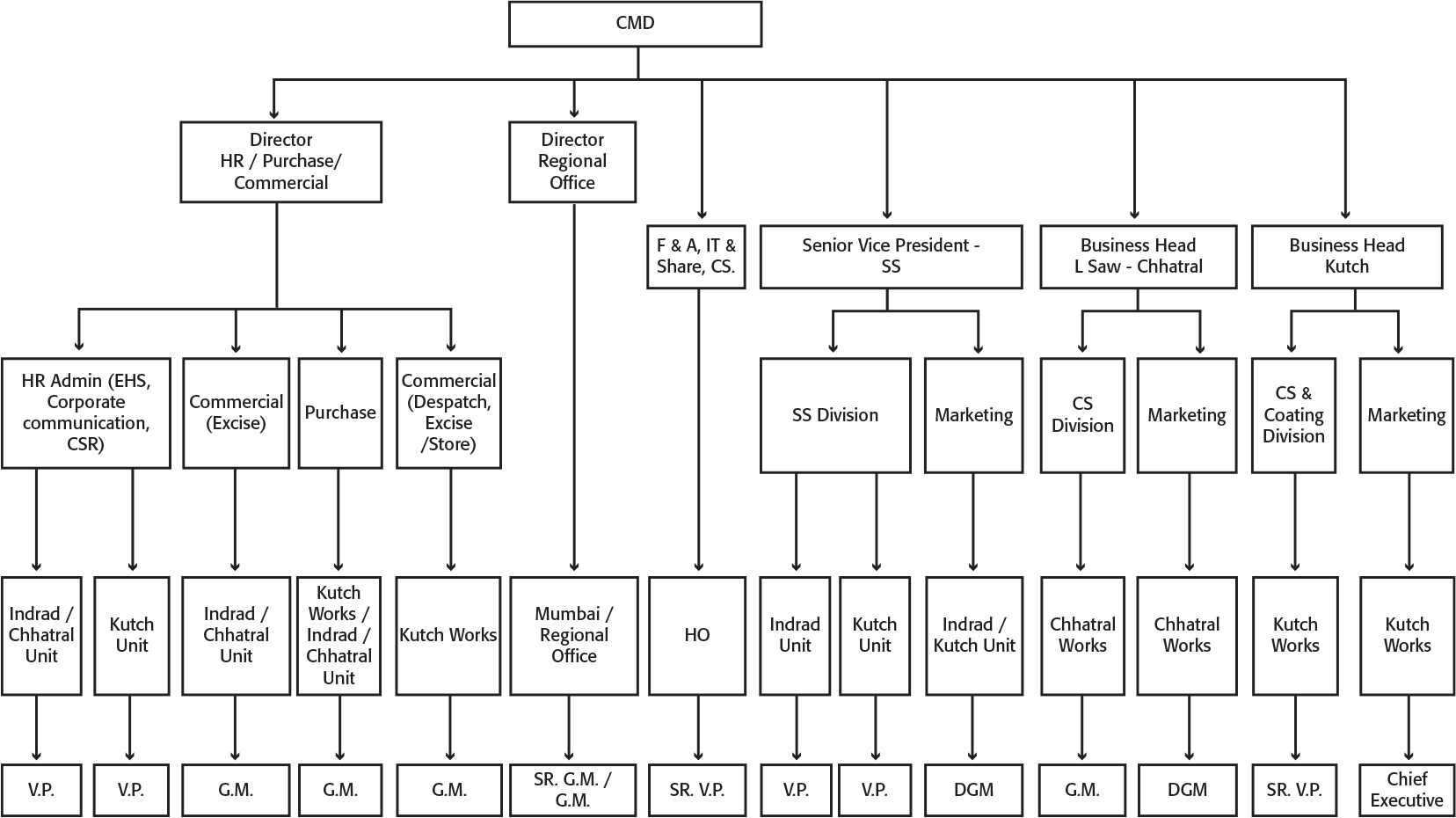
Exhibit 1: Organogram of the Organization
WORK CULTURE
Exhibit 2
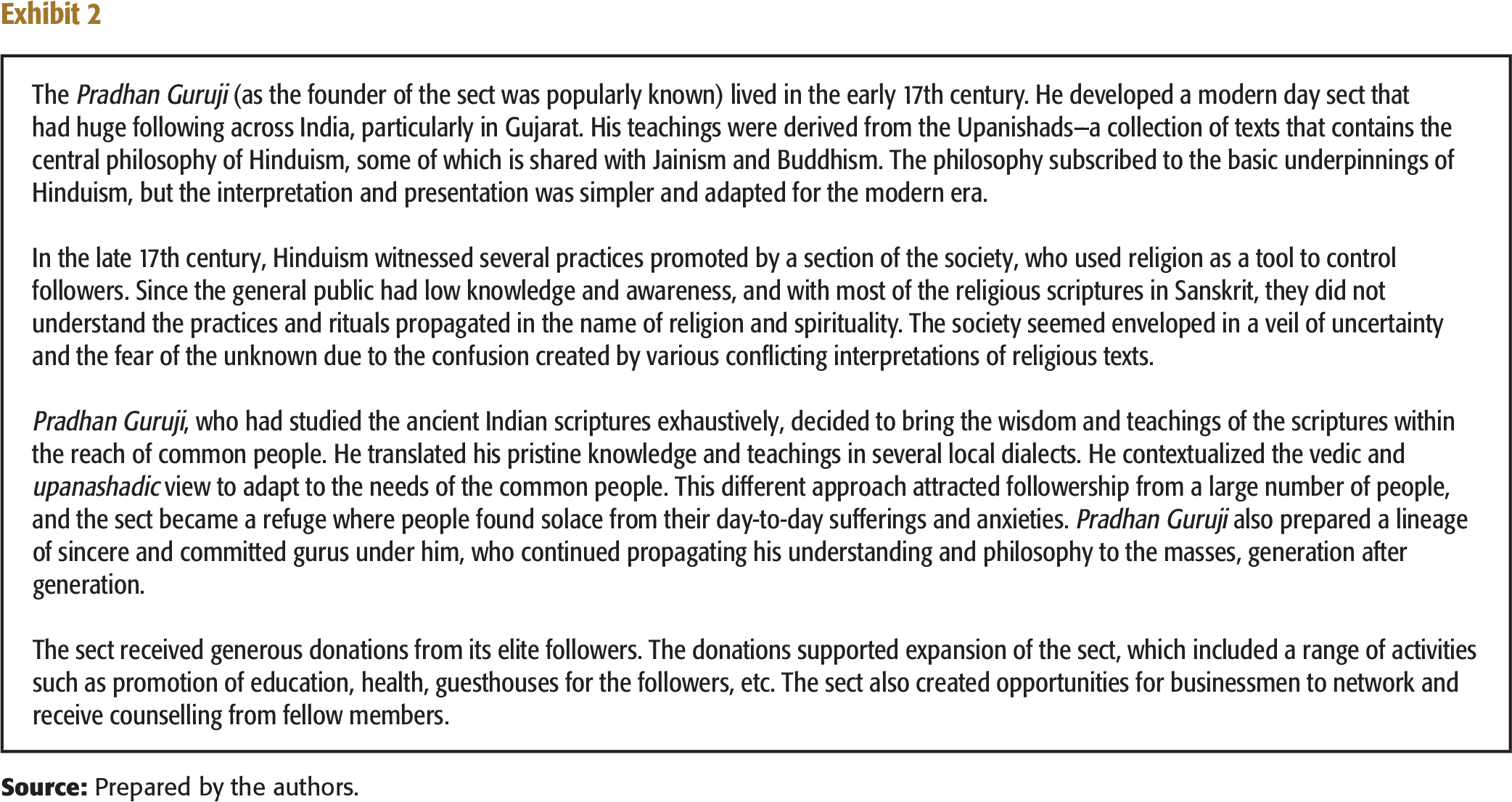
The Patel family was a third-generation follower of the sect and the Guruji. All personal and business decisions taken by the family were guided by the learnings they had received from the pravachanas (preaching of the sect) of Pradhan Guruji or other gurus.
Gradually, because of the dominance of the owners’ own beliefs, practices and beliefs advocated by Guruji were followed by the entire organization. Strict adherence to the basic tenets of Guruji’s philosophy and the regular, consistent practice of various rituals created a religion-based culture at STPL.
Employees greeted each other with Jay Guruji 2
Long Live Guruji, a way of greeting to promote sectoral belief.
Satvik diet means vegetarian food, rich in prana or ‘life-force’ such as organic fresh fruits and vegetables. Avoiding canned and processed food, and food prepared with ingredients treated with chemical fertilizers or sprays is important. It represents properly prepared fresh foods. In addition, Satvik also means ‘righteous’.
The women of the owners’ family frequently visited the canteen to oversee the hygiene and food quality. While they did not have a formal role in the organization, they did not hesitate to intervene and give directions in matters related to employee welfare. All three owners ate in the canteen once in a while to ensure quality.
Other values of the sect, such as ahimsa (non-violence) and tyag (sacrifice), were also observed as guidelines for developing work practices. There were signboards on the shop floor reiterating Guruji’s preaching. Owners advocated that the ‘only way to moksha (salvation) was through karma (action), and letting go of kama (desires) and emotions such as anger, greed, envy, and attachment’. Sacrificing self for the benefit of others and organization was expected from all. In case of disputes, ahimsa was the strongest guideline for resolution. Thus, most disputes were managed through dialogue and with respect for each other. Once, a senior vice president (SVP), who was also distantly related to the owners, physically assaulted a peon. The SVP was offended by a joke cracked by the peon. However, when this incident was brought to the notice of the owners, they promptly suspended the SVP.
Similar undercurrents anchored on religiosity were evident at the workplace. The owners’ tendency to place faith as the foundation of their decisions further reinforced the prominence of religion in the workplace. Such gestures clearly communicated the message to the non-followers that the owners expected the employees to adhere to the philosophy and values of Guruji, if not the rituals.
Many stories and superstitions related to the sect and Guruji prevailed in the company. A noteworthy story was regarding the Pradhan Guruji forewarning an errant employee in his/her dreams. It was also believed that Pradhan Guruji had once slapped sleeping guards on duty. Similarly, the Guruji was also rumoured to forewarn of natural disasters, and was believed to have done so by cautioning the owners or some SVP in their dreams. Though logically these were improbable fables, the legend continued. Even though Pradhan Guruji had passed away by the early 18th century, these beliefs were rampant and were enough to deter employees from any errant behaviour. Most unskilled and semiskilled workers believed that they must work diligently because even if the owners were not vigilant or visible, they were being watched by the Guruji, and any error or negligence of duty would attract karmic debts. 4
A belief that the human body form is achieved after 64,000 births, and it is an opportunity to earn good karma to achieve salvation. All bad karmas attract some form of punishment, which we have to suffer in this birth or the next birth.
Labour unrest was mediated by the religious/sectoral preacher and followers of the Guruji. During one such strike at one of the factories, the preacher delivered a pravachan, which was based on Pradhan Guruji’s teachings. This convinced the labourers to not only resume work without any delay but also inspired them to work with commitment. The owners also reciprocated the demands of the labourers. They ensured that their living spaces were comfortable; two healthy meals were served in the canteen and personal loans/assistance were extended on death, marriage, and ill-health of workers and dependents.
NEW BUSINESS OPPORTUNITIES
Having travelled extensively across the world, Rakesh recognized emerging global opportunities. The owners felt that STPL was favourably positioned to win global clientele. They aspired for 50 per cent of market share in India, and identified at least 16 countries where they could export. Since operating costs in India is low, with minimal additional investment, they could augment production capacity. Soon, STPL started enhancing capacity to manufacture pipes of critical grades, including specialty tubes for the stainless steel division, and increased the capacity to manufacture carbon steel pipes. The company also obtained approval from the Nuclear Power Corporation of India to supply pipes for heat exchangers in nuclear reactors and instrumentation tubes as well. The approval gave them access to the small group of high-quality and premium suppliers, which was a testimony for product quality and reliability.
With diversified product range and capacity, the firm was in a definite position to go international. The company was also buffered against the small industry and low-cost players. The cash-rich position ensured that funds were available. Also, since they were based in Gujarat, an investment-friendly state, they had the advantage of obtaining faster approvals and tax breaks, as against competitors located in other states.
However, when they started liaising with international customers, there were requirements to furnish firm-specific data about the manufacturing facilities, mana-gement practices, and human resource capabilities. Besides company’s records on Occupational Health and Safety Management Systems (OHSAS) 5
An internationally applied British Standard for OHSAS requirements.
ISO is an international standard-setting body comp-osed of representatives from various national standards organizations.
The brothers agreed that in order to cater to the requirements of international clients, they would have to invest in improving the production quality, train and motivate human resources, and professionalize the firm’s management. They had to look for efficiency and introduce new work practices in tune with the international standards.
STPL’s strength was the availability of unskilled and skilled labour. Most of them had learned to manufacture tubes and pipes while on the job. Most managers and technical experts had risen through the ranks. However, for implementing the proposed changes, the existing workforce profile was inadequate. STPL needed to hire professionally qualified managerial and technical employees, who were trained and experienced in modern methods of manufacturing and management. Even labourers had to be better skilled and certified to meet the global production and quality standards. For example, they would need a qualified chartered accountant to look after finance and accounting functions. The old style of having a trusted accountant, who was not professionally qualified but immensely trusted by the family, would not be acceptable. Hence, a new human resource management (HRM) strategy had to be put in place.
NEW HRM STRATEGY AND EXECUTION
Recruitment
To achieve the planned growth by 2015, STPL needed to increase its workforce from 2,000 to 3,500 employees on a priority. This was not possible if they restricted recruitment to only those within the sect and to references by existing employees. After a discussion among themselves, the brothers decided to recruit professionally qualified and experienced professionals from the open market.
It was decided that a senior management team member responsible for HR be hired first. Until then, HR-related decisions were handled by the brothers with inputs from respective team/department members. The vice president, HR (VP-HR) was hired from a family-owned pharmaceutical manufacturing company that had undergone a similar transformation.
The induction of the new VP-HR brought a different perspective to the company. Although he found the level of informality and strong value systems a great strength, he was uncomfortable with the unorganized way in which the HR functioned. Also, the owners had explicitly stated that they would like to retain elements of their faith in the organization even as it grew.
One of the first HR initiatives was to create a formal hiring plan aimed to attract better talent. The entire recruitment process was managed internally. STPL released advertisements in prominent newspapers, shortlisted, and interviewed the candidates to select a few professionals for senior positions. The owners knew that these professionals would have high compensation demands, and they were willing to pay market rates or more in deserving cases. STPL also started recruiting qualified employees such as Graduate Engineer Trainees (GETs) and qualified chartered accountants, at junior levels using formal processes (a clear change from earlier practices).
Clash of Cultures
Although recruiting professionals, particularly graduates and diploma engineers, with prior work experience was relatively easy, integrating them with the existing organization ethos was not. Existing employees expected the new recruits to understand and accept their faith as a way of life. Some rituals related to the sect were almost mandatory in the firm, and it was expected that newcomers would automatically adapt to that. There was a very strong informal structure/network existing within the organization, and people not adhering to the preaching of the sect were silently isolated. Earlier, this informal structure influenced decision-making of the senior management. Many decisions were guided by these relationships rather than the merit of the decision. Hence, a large number of professionally qualified new recruits soon felt that they did not ‘belong’ here and their voices of discontent reached the VP-HR.
The new recruits came from different backgrounds, and they needed logical answers for engaging in rituals and practices. For example, two of the graduate engineers left the organization within two weeks of joining because there were restrictions on consuming non-vegetarian food in the office premises. In their exit interview, they mentioned, ‘if an organization wants to even control what we eat, we do not know what else would be controlled in future’. Often the owners and senior officials asked juniors to perform some of their personal work like picking up laundry, expecting them to extend such help as they were part of the family. Many youngsters felt that this was a breach of professional boundary. Employees who did not believe in Guruji’s preaching felt that those who followed the rituals/practices did so only to impress the owners and the top management. Many new employees refused to attend these functions. While small and petty conflicts related to faith-based practices continued between old employees and the new recruits, other more critical issues emerged with fresh college recruits, who were hired directly from the university campuses as GETs.
The GETs had professional qualifications, but they needed guidance on machine-use and workplace practices. GETs also required a strong emotional support for integration into the workplace because many of them were living away from their homes for the first time. Similarly, there were other recruits, well-versed with work but needed some support in adjustment to the STPL culture. On the other side were the senior and experienced employees, who were not professionally qualified, but had learnt the job hands-on, and strongly believed in company values. These members refused to voluntarily share their knowledge/skills and train newcomers. In addition, the older employees were considered part of the inner circle (where decisions were taken informally), and many of them were close to the owners. This created status differences at workplace and gave rise to conflicts, leading to few GETs quitting, and others showing visible signs of disengagement.
The New Approach
The VP-HR realized that a strong reason behind the resistance from experienced employees was their feeling of alienation in the changed work environment, and their irrational fear of being left out. In spite of the owners clearly and repeatedly reassuring the employees, they felt that the newcomers, equipped with better qualifications and exposure, would edge them out of their positions. According to the VP-HR,
The thinking and behaviors of many newcomers were not found to be in congruence with the senior, experienced employees who had remained loyal to the company. The older team members were comfortable with compliance and control, whereas the new team brought in dissent and challenges. The owners wanted both groups to peacefully exist in the firm, and for that I was requested to suggest a concrete action plan.
Sensing that the conflict was mostly due to different educational qualifications, the VP-HR proposed introduction of a formal education plan targeted at all levels of existing employees with the objective of enhancing their capabilities and qualifications. On acquiring necessary qualifications, these employees could be promoted or moved to different roles. The initiative was in line with Guruji’s belief of Pravartaniya Sadvidya, Bhuvi Yatsukrutam Mahat (education is the only way to achieve change and excellence).
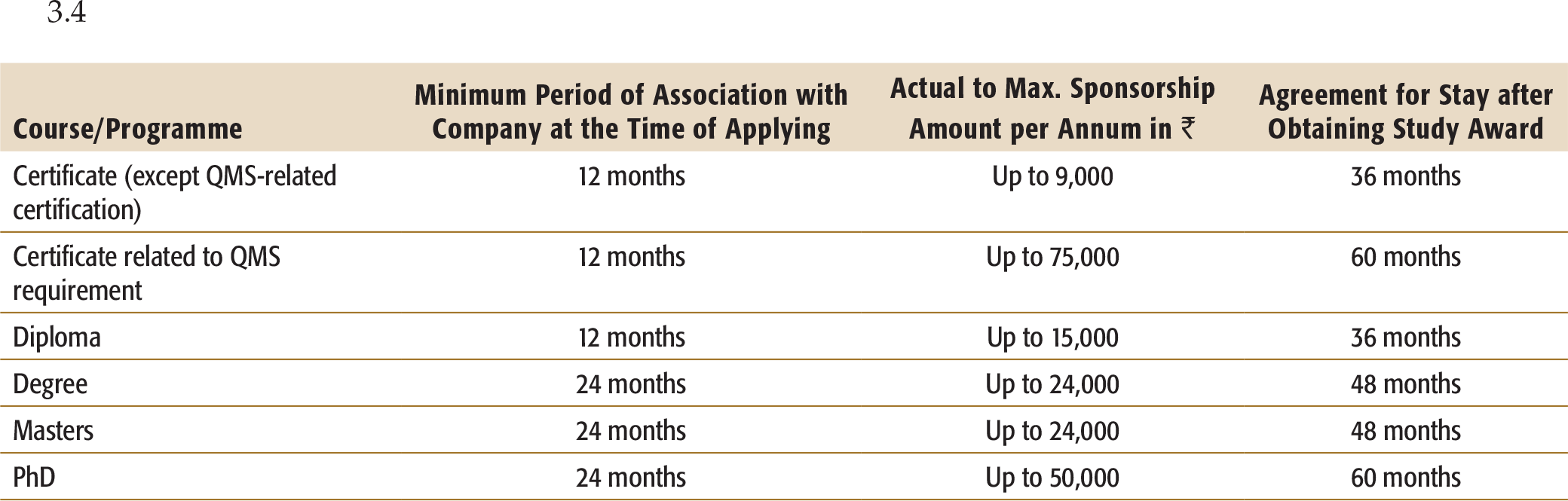
Under the scheme, those employees who lacked basic technical certifications were given the opportunity to secure Industrial Training Institute (ITI) qualification. Those with ITI certificates could study for diploma courses (in engineering), and diploma holders were offered a chance to attain a university degree. Those who already had a university degree could choose to opt for master’s programme and even PhD. All these courses could be pursued part time, so that employees could continue working and learning together. A few colleges and technical training institutes in the vicinity of factory were identified for financial support under the corporate social responsibility programme of STPL. These investments, therefore, benefited the larger public as well. Employees were also trained and certified in Quality Assurance Management certifications (QMS) such as Certified Quality Engineer (CQE), American Society for Non Destructive Testing (ASNT-NDT) certifications (level I, II, and III) and ISO 9007. All expenses related to the training were met by the company. Work schedules of those who enrolled for educational courses were adjusted to suit the college/institution timing. Special leaves were extended for examinations. A formal training policy was designed, which specified the eligibility criteria, financial implications, terms and conditions, etc. For instance, certification programmes related to QMS required a non-disclosure agreement to be signed. Total training budget per person was fixed at `75,000 annually and an internal committee of senior managers was constituted to recommend employees for attending the programmes (for detail see Annexure 1).
STPL also set up a mentor–trainee programme, where senior employees supported the new recruits. Feedback from both the mentor and the trainee was collected every six months, and the results were reviewed by the senior management. This system ensured that even mentors were under constant observation. The feedback was further linked with the performance appraisal report of the mentors. A mentor who was performing well functionally but was not/less involved in the mentor–trainee programme would lose scores on the appraisal, and thereby receive less financial incentives. Performance-linked pay scheme had also been introduced at STPL.
To ensure interaction between the new and old emplo-yees, additional opportunities in informal settings and secular celebrations were also introduced. Since the owners strongly desired so, the rituals and practices connected to faith also continued.
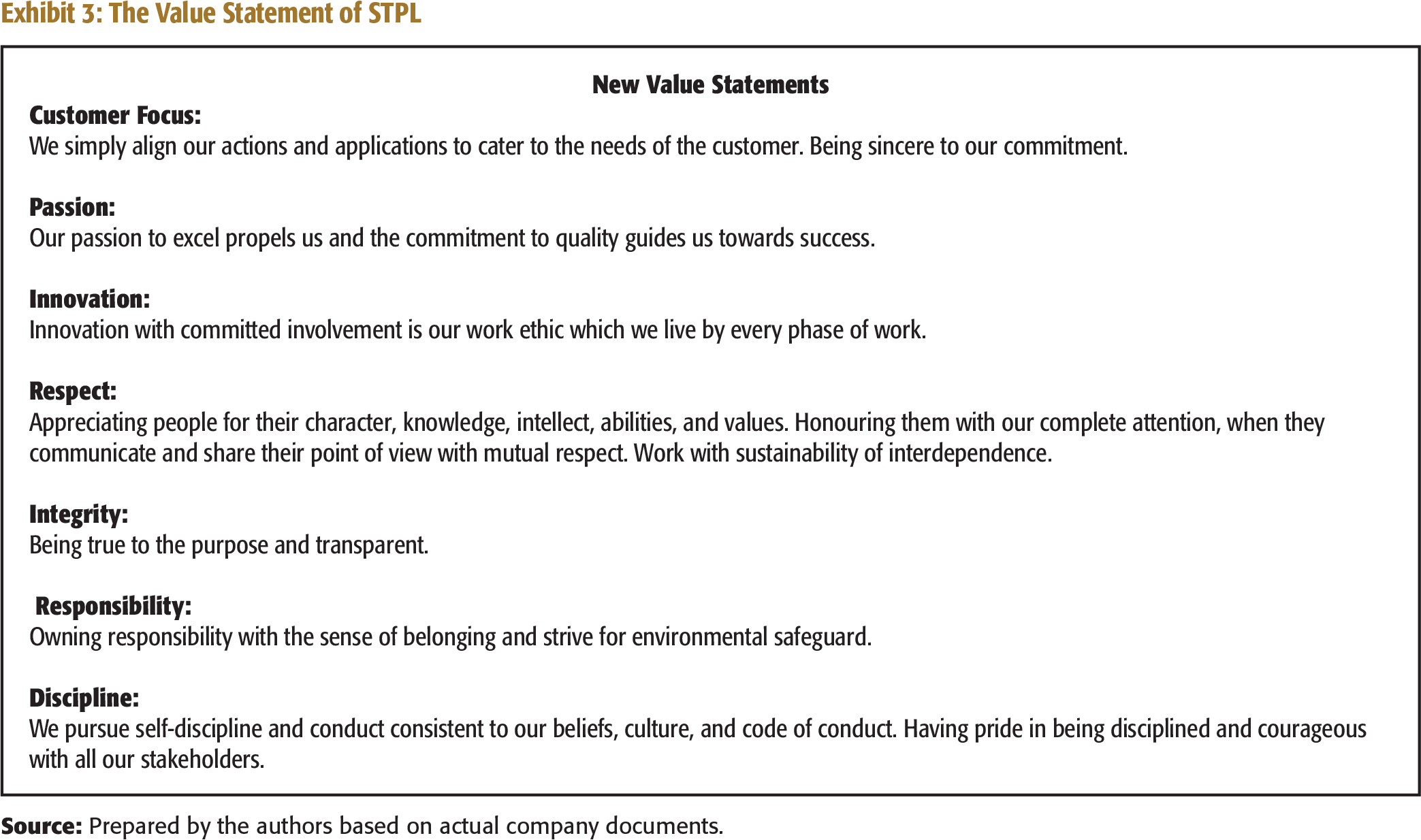
The owners felt that the transition to the new culture would also need redefinition of the existing value statements and guidelines for decision-making in a manner which would be satisfactory to both new and old employees. The senior management team and the owners held multiple meetings to discuss how a globally relevant value statement could be arrived at, without losing out on the essence of the traditional belief system and faith endorsed values. The owners believed that the traditional values they practiced were also globally relevant, and the only requirement was to articulate and present them as globally relevant values, which were widely acceptable.
Initially, all values propagated by Guruji, which were central to the organization’s ethos, were made known to the group. Specific key words and phrases that had strong connotation to the faith were substituted by appropriate synonyms/phrases in English. These words or phrases would keep the essence alive, but yet have a global and contemporary appeal. After a month-long brainstorming exercise with the senior management team, a tentative value statement was articulated, integrating words such as asteya (non-stealing) and satya (truth).
This was followed by a large-scale interface discussion (LSID) 7
An organization design technique to capture conversations and identify the common themes owned by the group.
Exhibit 3: The Value Statement of STPL
PRESENT SITUATION
The firm was beginning to attract competent talent with high-quality experience, and business was growing in new geographic locations as well. There was a buzz in the market about the firm opening up to outsiders. Job seekers had started to apply for jobs through online career portals. The formal and informal spaces created for facilitating workplace learning and socialization, and to reduce conflicts helped the two different groups of employees connect and work together. However, this was not as cohesive as expected. While instances of conflicts had reduced, there were visible signs of unease. Also, very few employees took part in the formal education programme initiative.
Post value redefinition, many international applicants were also attracted to the firm. Seven expats were chosen to work in STPL from the 40 online applications received. However, some of them chose not to join the firm. Finally, two expat employees joined the firm, only to leave within seven months, as they could not adjust to the culture and the location of the company.
Another incident that brought to focus the clash of two distinct cultures involved Rakesh hosting a prospective client from New Jersey, USA over dinner. During a conversation over dinner, Rakesh advised the representative that non-vegetarian food was harmful for health. The discussion on vegetarianism and non-vegetarianism over the dinner table became quite aggressive, with both rigidly adhering to their stances. The strained relationship reflected in future discussions and eventually the deal did not materialize.
The VP-HR had often emphasized on the redefined values and urged the owners to let other people follow their own belief. These incidents led the owners, particularly Rakesh, to change their perspectives and rigidities since they were looking for a global business outreach.
Though at times disappointed by the gap between the dream to be a global firm and the reality, Rakesh did not lose hope. He drew inspiration from the recent Amazon cruise he took while on vacation. He recollected the magnificent site where Rio Negro met the Amazon. While Rio Negro had black coloured water, the Amazon waters were golden brown. These rivers maintained their distinct identities up to 6 km from their meeting point, before finally merging. He recollected the explanation their tour guide had given: the two rivers had different densities, colours, and temperatures.
Was the same thing happening in his organization now? Were people of two distinct cultures flowing differently? Were they being forced to merge? What workplace learning practices could he develop so that they mix well and start contributing for growth of organization? Was whatever they had done so far ‘enough’? He was looking for answers.
ANNEXURE 1
Detailed Training Policy
This policy has been effective from 1 December 2013
To encourage employees to avail the opportunity for further studies that leads to professional growth and career flexibility.
2.1 The employee may opt for courses which provide essential skills, knowledge, and abilities that are required for the employee’s current job or related to any other job within the organization that are best met by recognized courses.
2.2 Based on the aforementioned criteria, the employee along with his/her immediate superior will determine if the proposed course/programme fulfils the requirements under the policy.
2.3 The review panel shall comprise the following people:
• Respective plant head/functional head/VPs
• Management representative (MR)
• Location/unit Jr. management representative (JMR)
• Location HR head
2.4 The review panel shall recommend the application based on the defined criteria to the senior management group, comprising the following members who would be in charge of governance and implementation of this policy:
• Respective business head
• VP group HR
• Director
2.5 All applications shall be processed after a unanimous recommendation by the review panel.
2.6 Courses can be a programme leading to a certification, diploma, degree, bachelors, masters, PhD, and/or other relevant short-duration courses.
2.7 The relevance of the course for the benefit of the organization would be at the discretion of the review panel.
2.8 The fund allocated for this policy shall be `1 million per financial year. In case the annual budget gets exhausted, the pending applications can be put up for consideration in the subsequent year.
2.9 An individual may be granted a maximum of `75,000 annually, which will be at the discretion of the committee. This will be inclusive of tuition fees, expenses towards course material, travel (inclusive of means and local conveyance), examination fee, application form fees, convocation fees, and any other miscellaneous expenses.
2.10 The HR representative shall be responsible to monitor and maintain the records of all sanctions, disbursements, budget, expenses, and recoveries (if any).
3.1 The candidate must be a confirmed employee and should have completed the minimum period of association with the company at the time of his/her application.
3.2 The course/study will be from a recognized authority and have relevance in the development of the individual and the organization.
3.3 Supervisory approval, satisfactory performance evaluation, and continued satisfactory work performance is required.
4.1 The employee should be willing to sign a ‘Non-use of data/Non-disclosure agreement’
as per Annexure II, in addition to the ‘Service Agreement’ as per Annexure I with the company.
4.2 If a person leaves the organization before completing the study course, or discontinues with the committed study course or leaves before the stipulated stay agreement, the person is liable to pay full costs incurred by the organization.
4.3 Preference shall be given to the employees who intend to enrol/register for the QMS-related certifications/doctoral programme with the universities/institutions that the company has formal arrangements with or are recognized by the industry.
4.4 With a view to extend the one-time benefit to the employees who have cleared the QMS-related certifications (Level-III/equivalent) after 1 January 2013 and have paid for the training/course on their own, can be reimbursement of the expenses as per the policy.
4.5 In the context of clause number 4.4, the request for reimbursement along with the payment receipt shall be submitted to the HR department routed through the concerned plant head/VP. In such cases, the individuals need to comply with the service agreement. The decision to this effect would be on the discretion of management.
5.1 The applicant should submit an application to the review panel through the concerned HOD, with the necessary documents related to course fees. A formal report of the year’s performance of the candidate, and relevance of the course for the individual and organization should be submitted by the HOD.
5.2 In case the applicant has paid the fees after approval, he/she is required to submit a photocopy of the fees paid for the relevant course to the HR department.
5.3 The cheque for the approved amount to be given to the applicant and the applicant signs the agreement with the company as per Annexure I and/or II.
5.4 In case the applicant fails to clear the QMS-related certifications in Level-III/equivalent in the first attempt, the company would not be in position to reimburse/sponsor the expenses towards its further attempts to clear the said examination.
5.5 In case of failure to clear the QMS-related certifications in Level-III/equivalent, the applicant would be permitted after the recommendation of the review panel for sponsoring the full examinations and other incidental expenses (other than travel) for the retest (second attempt). In an unfortunate circumstance, if he/she is unable to clear in the second attempt, any further expenses would be borne by the individual.
5.6 The stay agreement would be valid and enforceable even in the circumstances as defined in clause numbers 5.4 and 5.5.
5.7 While the company intends to encourage the employees for upgrade in academic and professional qualifications, it may not be in a position to grant study leave/alter shift timings/pardon arriving late at work or leaving the premises early, etc. The employees can be granted leave for attending the examination from their leave balance with prior permission of the reporting manager.
5.8 Any exception to the rule would be authorized collectively only by the members of the senior management group.
3.4