



Abstract

Often, in today’s data management initiatives, an organization does not know whether the data collected is useful until the analysis has been completed. Both the scale of databases and their processing have undergone significant changes. The discipline is now better known as marketing analytics (Hauser, 2007). While there is no standard definition for analytics in the literature, what we refer to analytics in this article is the function of processing large data using technology to obtain useful insights (information) for business decision-making. A prerequisite to analytics, in the context of our definition, is the availability of automated data collection processes to facilitate large-scale data handling.
Analytics and big data ventures in business are slated to continue to grow at rapid rates around the globe in the next few years. Studies by management-consulting firms like A T Kearney have projected a growth rate of 10 per cent compound annual growth rate (CAGR) of the analytics software industry between 2015 and 2020 (Forbes, 2015). With pressures on businesses to show growth and profitability, and with increasing competition, the role of analytics and knowledge management services in general is bound to grow further (Bhandari, Singer, & Scheer, 2014).
A major reason for choosing India as the focus of this enquiry was the sheer growth that the Indian industry has experienced in the knowledge services space (analytics included) in the last decade and a half. The growth rate in this industry has been around 24 per cent CAGR, which surpasses growth in this industry in any other comparable economy around the globe. Latin America, Eastern Europe, and Philippines—hubs of provider of services—serve as healthy complements, though none at a comparable scale. The local industry association in India projected the growth to be about US$8 billion by the end of the 2016. With a projected literate workforce of over 750,000 with postgraduate-level qualification and over 2 million people conversant with the English language, the competitive advantage is obvious (NASSCOM, 2010). Yet, there are some signals of structural disquiet in the industry.
An article in an Indian trade publication (AIM, 2014) describes the penetration of analytics in 15 major domestic companies in India. While there is evidence of adoption of knowledge processes in Indian organizations, the scale of adoption in India appears to be very modest. Researchers and practitioners in the field of data science will be interested to seek reasons for such heterogeneity in growth within the knowledge sector in a fast developing producer economy like India.
To the best of our knowledge, no major study on the nature of investments made in analytical processes and their effectiveness in the context of India (or other emerging economies) is available. This article purports to report on the development of the practice across various industries in India and the potential facilitators of and challenges to the adoption process. Secondarily, it will attempt to find reasons for the seemingly uneven development of analytics in Indian organizations. It is felt that this may be a manifestation of an economy that is largely oriented towards production of know-ledge and does not have an equally evolved consumption norm.
Additionally, the study will seek evidence, if any, of the diversity of analytic competency across organizations. In our view, such diversity in competency would indicate the heterogeneity in requirements and the need for better mapping of skills to business requirement in this industry. Finally, we hope to synthesize our survey findings towards a first attempt at building a conceptual framework (model) that will identify drivers of knowledge process (analytics) adoption, with a specific spotlight on the Indian business environment. Our qualitative study provides enough insights to build such a framework leading to useful insights for an emerging market like India. The findings from an India-based research may also resonate well with issues in other emerging economies. In that respect, our findings may be generalizable to other markets as well.
EMERGING TRENDS ON BUSINESS ANALYTICS IN INDIA
Analytics practice in emerging economies like India is projected to grow at a rapid pace. In India, it (for both business intelligence [BI] and analytics) is sized around US$160 million and is expected to grow by 22.4 per cent to US$300 million by 2017. The major chunk of the analytics usage is stated to be in banking, financial service, and insurance (BFSI), telecom services and information technology-enabled services (ITES), fast moving consumer goods (FMCGs), and retail. However the small and medium enterprise (SME) sector is still in a nascent stage of deploying analytics and BI as compared to their larger counterparts, the latter contributing up to 65 per cent of the total services utilized in the analytics and BI market (Netscribes, 2013).
A recent study points out that there are more than 2,500 companies in India providing analytics services. This number has grown significantly from 2015 (AIM, 2016). These also include peripheral services such as training and recruitment. While the macro-level data provides room for optimism, it may not be a true representation of the situation within many organizations. We expect that this study will provide some basis to evaluate the evolution of analytics in Indian organizations.
LITERATURE REVIEW
Literature on the analytics industry, specifically in the context of its development in India, is sparse. Our review reveals that the available literature delves on three broad dimensions of the analytical industry: diversity of skill requirement in the industry; the need for planning before deployment, and deployment of strategies and technologies in more evolved markets. Our review of the literature thus is organized along these three dimensions.
Diversity of Skill Requirement in the Industry
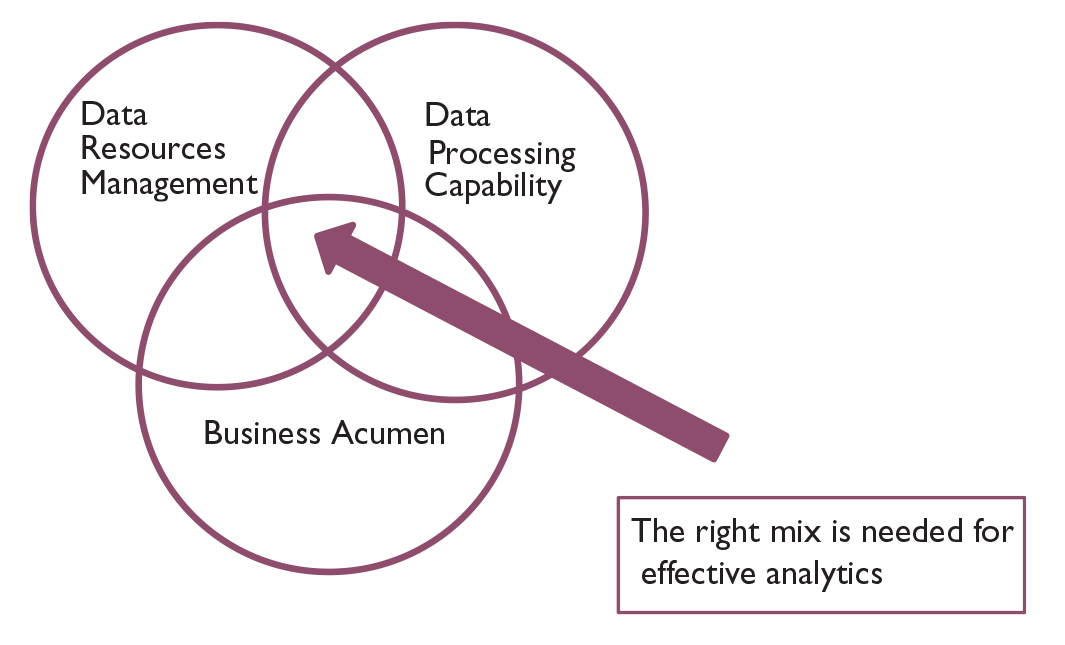
Banerjee, Bandyopadhyay, and Acharya (2013) described the fusion of three basic skills (see Figure 1) required for creating the right skill set for the analytics domain, namely information processing capability, data management capability, and business acumen. According to the article, the actual mix of skills may have diversity across industries in India based on the core capabilities that organizations in various industries possess from which the practice of analytics is derived. Another work in developed economy context corroborates this view (Hauser, 2007). Khan and Hagen (2014) in a research study co-managed by A T Kearney and the Carnegie Mellon University describe a new breed of professionals who will drive analytical prowess in organization. These professionals would have proficiency in technology, core critical thinking, analytics, and the mettle to put them together. This is indicative of issues regarding analytics adoption rate and its productivity in organizations which include penetration of skills amongst employees, dependence for appropriate decision-making, and engaging organization’s management.
The Need for Planning before Deployment
SWOT Analysis on Business Analytics in India

A few academic papers have reported positive results of analytics in terms of ‘relevance to industry’ (Hoch & Schkade, 1996; Kanan, Pope, & Jain, 2009; McIntyre, 1982; Natter et al., 2008; Silva-Rossa, Bucklin, & Morrison, 1999; Zoltner & Sinha, 2005). A notable example of applied research work in the US context is the Chan4cast model (Divakar, Ratchford, & Shankar, 2005) developed for consumer packaged goods using scanner data. Kappe, Blank, and Desarbo (2014) and Ghose and Han (2014) are few other examples of rigorous use of analytics that have yielded relevant models for business decision-making. An enabling factor that encourages such rigour is the intensity of competition that forces organizations to take precise action (Germann et al., 2012). Nevertheless, in spite of a long history of development, there appears to be tremendous diversity in the way analytics is used in a typical corporation (Coghlan et al., 2010).
Despite the increasing rate of analytics adoption in organizations, there are others who continue to be sceptic about the use of analytics. Kucera and White (2012) note that only 16 per cent of the 160 businesses they surveyed reported using predictive analytics. Winer (2000) reports similar non-existent use of models and scientific data-led procedures in industry.
A concurrent concern raised in practitioner forums is that many organizations are seen to be working in data silos. Besides, there is a greater reliance on tactical use of analytics compared to its usage in strategic planning and longer term decisions. A recent technology solution to this problem has been the development of data lakes, an enterprise-wide medium to manage this challenge. Nick Heudecker, research director at Gartner, states, ‘Data lakes analyze disparate sources of data in its native form thus making it available to everyone in the organization.’ This saves upfront cost of data transformation. However, whether these initiatives have led to productivity increases is yet to be validated.
Deployment Strategies/Technologies in Evolved Markets
Deployment of analytics has been relatively well documented in the developed world context. At a practitioner–academia interaction at the Harvard Business School (Gupta et al., 2014), it was agreed that analytical research should be directed towards solving topical issues facing corporations, including strategies to deal with intense competition, multi-channel strategies, and the preponderance of the Internet and its impact on business transaction. Davenport (2006) in an early paper on analytics deployment talked about the need for relevant insights that can help managers in organizations in the developed economies make better decisions. We suspect a major distinction between analytics deployment in developed markets and emerging economies such as India may lie in the availability of organized information resources. Therefore, the issue of rigour and its consequent relevance to practice is secondary in the context of a developing market.
In evolved markets, it is seen that value of analytical output for decision-making varies depending on the context of the business problem. However, organizations are also gradually moving towards using real time analytics for decision-making. Certain decisions require real time analytics such as price reductions, delivery schedules and risk analysis. Certain others capture real time data not by choice but rather as a result of acquiring sophisticated technology. The Internet of things (IoT) has facilitated real time analytics. For example, as noted by Meadows-Klue (2014, para 2), ‘the combination of analytics for conversion tracking with behavioural targeting has unlocked a new level of precision that enables display advertising to be focused on the devices of people with relevant interests’.
Businesses have adopted IoT to supplement machine-learning methods used from historical data for building predictive and prescriptive models by way of making faster timely decisions. IoT makes it possible for ‘things’ (not including computers, phones, or tablets) to be connected to other ‘things’, computers, or mobile devices, which provides a vast array of information about choices and decisions.
To summarize, our literature review suggests that deployment of analytics is influenced by multiple parameters that have significant interplay. While skill sets required for effectively managing analytic operations are diverse, the importance of planning (given constraints of information resources) is also highlighted in the literature. Finally, many descriptions of successful initiatives have their genesis in the developed world where infrastructure, information resources, and cumulative experience in handling such projects are significant. It is therefore worthwhile to document experiences of similar evolution in emerging environments like India to provide, at least, an interesting contrast to the growth story in the developed environment. Additionally, it is hoped that unique dimensions that facilitate or impede growth in emerging markets will be identified.
METHODOLOGY
The study conducted was exploratory in nature with the main objective of exploring the extent of adoption of analytics in organizations and identifying the key influencers (drivers) that enhance (stymie) the adoption process. The extent of analytics adoption was gauged in qualitative terms on dimensions such as (a) how significant was the usage of analytics in the organization (utilization rate) and (b) how significant was the usage of analytics as an input to decision-making (management engagement). The overall qualitative assessment of the respondent was taken as indicative of the perceived adoption level in the organization.
Data Collection Methods and Analysis
The data was collected using two approaches—in-depth interviews and observational studies.
Qualitative Interviews
Open-ended discussions were conducted with 21 business executives from six different sectors: public sector banks and insurance companies; consumer goods/FMCGs; private manufacturing firms; private financial institutions; global outsourcing and offshore firms (ITES); and analytics-based advisory services. Their interviews were held over a period of three months. The norms of purposive sampling (Kuzel, 1992; Morse, 1989) were used within the constraints of accessibility to relevant participants for our discussion. It was also presumed that a broad sweep across multiple industry groups would yield maximum insights and help in building a model of analytics adoption for an emerging market like India.
The respondents represented a diversity of functions and levels of seniority in their respective organizations. Their identities have been kept anonymous, a condition imposed by most of the respondents to agree to participate in this research. A set of guide questions (Appendix 1) was developed to initiate the discussion to ensure that most of the important dimensions of the industry were covered and the objectives of this research were met. Some of these dimensions emerged as a result of conducting our initial interviews and were included in subsequent interviews as well.
The text collected was coded and a second researcher assisted in validating the coding. The coding was done across industry verticals since (as expected) the perspectives were found to be very diverse across the industry verticals. Finally, the various identified constructs that influenced adoption of analytic capabilities were evaluated for their possible relationships/linkages. Research studies from developed markets were referred to in proposing these relationships.
Observational Studies at Select Organizations
We conducted an unstructured observation study using personal observation methods across four organizations (that we were allowed to visit) in diverse industries to assess their readiness to adopt data-driven analytics as a support for decision-making. This relatively deeper study of organizations was meant to complement our broader survey of perceptions of industry leaders. The purpose was to investigate in some detail how data is currently used and processed for business monitoring and decision-making. Additionally, we wanted to validate some of our findings based on the interviews of executives. Unstructured observational studies are appropriate methods to explore and extract information, especially when the unit of study is a complex and multifaceted entity (such as an organization). They are particularly well suited for early stage of research or when a fresh perspective is required (Eisenhardt, 1989).
Our focus was on India-based organizations. Identities of the organizations have been masked and no specific organizational data are shared (as desired by the organizations).
ANALYSIS AND FINDINGS
Insights from Qualitative Interviews
Identified Influencers of Analytics Adoption across Sectors

Non-availability of comprehensive business data: A prerequisite for effective data science application is the availability of data (Roberts, Morrison, & Nelson, 2004). It may be structured or semi-structured (or unstructured), but nevertheless it is important that the coverage of the available data source should be close to complete and the variety of information available is broad enough to provide a wholesome view of the business phenomenon that is studied. None of these conditions is satisfied in many organizations (public sector unit [PSU] banks, insurance, consumer goods/FMCG, and private sector financial services). A secondary concern is the unorganized state of data in many organizations which makes it difficult to develop a systematic information plan to connect to decision-making processes.
External information regarding markets and environment are the most difficult to acquire (manufacturing and consumer goods/FMCG) simply because there are few private or government agencies involved in the collection processes. Besides, the high cost of collection of data from relatively inaccessible parts of the country (rural markets, for instance) discourages investments in such initiatives.
Internal data in multiple and incompatible formats: The availability of business data, like transaction data in banks and retail stores, in different formats causes significant problems of consolidation (PSU banks and insurance). There has been rapid development in computerization and automation of operations in most large public sector institutions. As a consequence, recent data is available in standardized electronic formats but their integration (or lack of it) with paper format data makes it difficult to apply any data science procedures reliably to glean insights for decision-making. Ross, Beath, and Goodhue (1996) also mention the necessity of shared technical platforms and seamless data accessibility to improve productivity.
Dependency on heuristics for making decisions by top management (no felt need): Given the above constraints, many business organizations remain steadfast in their dependency on heuristic business rules developed over long periods of experience and a firm connect with the context. People-driven decisions override attempts at standardization and the common refrain heard is that information is not available or is incomplete to substitute the gut feel with the rigours of decision support systems based on scientific models (private sector financial services and consumer goods/FMCG). Additionally, this lethargy to change has a negative impact on active investments in data infrastructure. This tendency is somewhat supported by the upper echelons theory (Hambrick & Mason, 1984).
High market growth/regulated markets and low competition hides the virtues of analytics-driven precision in decisions: The futility of the analytics practice is also fuelled by the notion of the growing market syndrome (private sector financial services). Data scientists are supposed to extract business insights that act as a welcome succour in a highly mature and penetrated market. They are supposed to provide directions and refine decisions to hone in on the close to the perfect set of decisions for an environment. However, when the markets are in the expanding phase or are regulated by external entities (Reserve Bank of India [RBI]), such extraction of precise insights from past transactions is not quite relevant. Interestingly, there is evidence of this phenomenon in past literature. Anderson and Sullivan (1993) find that firms with less satisfied customers that face less competition perform equally as firms in more competitive markets.
Interestingly, the two points (3 and 4) focus on the true potential of analytics usage. Information based on analytic processes provides the fodder for measured response from the organization. Such responses are required (necessary) in environments which provide little latitude to organizations to manoeuvre (for instance, in highly competitive and free market conditions). Significant efficiency improvement, better deployment of scarce resources, and targeted initiatives for maximizing response and better measured/anticipated ventures are usual candidates for analytics deployment (SAS, 2013). If such issues are not critical, as expressed by many executives, need for analytics would be compromised.
Globalization and cross-pollination of ideas from multiple markets: This has led to more awareness about the benefits of the data-driven processes and the role of analytics. This is an optimistic note for the future. More trained resources are available in the Indian market, which has led to some traction in investments in data. Higher awareness has initiated some discussion and debate regarding the appropriateness of analytics to their specific context (FMCG/consumer goods). Literature has references to how such awareness eventually raises the bar for everyone in the industry (Chen, Su, & Tsai, 2007; D’Aveni, 1994; McMillan, McCaffery, & Van Wijk, 1985).
Geographic separation of functions (policy-making and analysis): This has led to lower productivity of analytics in the outsourcing/offshoring sector due to incompatible skills across functions and specialization at the expense of embeddedness. Banerjee and Williams (2009) explain the need for building policy-making expertise in offshore analytic centres for long-term sustainability of the outsourcing model.
Insights from Observational Studies at Select Organizations
We found that the surveyed organizations (an upcoming hospitality chain, an oil refinery, a process industry manufacturing industrial chemicals, and a regional dairy products marketing organization) have a fairly well-established automated internal data capture process, a necessary condition for large-scale data collation and processing and development of sophisticated analytics processes. An equivalent of an enterprise resource planning (ERP) system has been installed in most professionally run organization. However, heterogeneity exists in the nature of processing/utilization of the data across organizations.
Surprisingly, there is a lack of motivation among some business leaders to look beyond the normal operational usage of business database. Numerous attempts to enquire regarding how improvements can be brought into the analytical prowess were met with guarded optimism and often times seemingly little enthusiasm.
Our summary of various insights from these organizations identified (a) inadequate felt need, (b) top management’s unfamiliarity with the benefits, (c) low priority due to exigent needs elsewhere, (d) desire for turnkey solutions, and (e) low analytics skills penetration in organizations as probable reasons for slow adoption of analytics in some of these organizations.
THE ADOPTION OF ANALYTICS IN ORGANIZATIONS: A PROPOSED MODEL
Based on our findings, we propose a framework for adoption of analytics in Indian firms. We have not considered the issues identified in the ITES industry vertical, since, given its legacy, this industry is technically a service delivery extension of overseas businesses and does not really merit being considered an out-and-out Indian industry.
The overarching drivers of analytics adoption in organizations in India have been discussed further.
The (Non) Availability of Suitable Data Infrastructure
This dimension has emerged as a primary driver/constraint of analytics deployment across multiple industry verticals. Without availability and systematic management of information databases, significant deployment of analytics is not possible. Ease of access to data/market data, availability of methods to capture data, and availability of significant proportion of relevant data in compatible formats are some of the parameters defining this construct.
Competitive Intensity of the Business Environment
This dimension also emerged as an important influencer of analytics adoption from our study. The critical need for competitive markets is a measured, strategic, and tactical response to market challenges. This need is not perceived in the Indian market environment. Industry benchmarks have not been set on any minimum required analytics capabilities for business performance. Rival organizations are not perceived to have made significant investments in analytics and hence its importance is not recognized. Regulated environment, high market growth rates, and low priority due to exigent needs elsewhere are some of the parameters defining this construct.
Based on these two major identified constructs, we suggest a model of analytics adoption for India. In this pursuit, we are significantly influenced by a similar model proposed by Germann et al., (2012). While their paper looked at the drivers of analytics deployment and subsequent firm performance, we have restricted ourselves in this study to examining the influencers of analytics adoption/deployment in firms. We believe that emerging markets like India may require some more time to mature to realize the true impact of analytics deployment on firm productivity.
The primary driver for adopting and productively using analytics capabilities is the ‘availability and access to data infrastructure’ (positively related). This is supported by the views of our respondents in the survey. Taking support of the model proposed by Germann et al. (2012), we propose that competitive intensity of the business environment has a moderating role to this relationship (negative impact of low competition). While our claim is largely based on this previous research, we did obtain some evidence based on our discussion with PSU bank executives who claimed that higher order analysis was not needed, even if possible in a controlled environment where the banking regulator ensured a tight control over business possibilities.
Availability and access to data infrastructure investments in organizations are partly governed by
Level of support from the top management (top management advocacy). This construct is supported by parameters such as felt need, easy availability of turnkey solutions, and exposure to global standards in analytics.
Awareness in the organization. This awareness about best practices across business environments also helps in facilitating faster adoption. Dimensions such as global movement of analytics talent and availability of analytics vendors, who may provide comprehensive solutions to business analytics problems and low/high analytics skill penetration, determine the level of awareness regarding the benefits of analytics.
The proposed model is depicted in Figure 2.
Unlike developed markets, the setting for the earlier work, we did not find material evidence of more refined constructs like the presence of analytics culture and analytics skills in organizations in our study. Perhaps the methods we employed in developing the proposition (qualitative study) and the evolutionary nature of the Indian business environment constrained our ability to identify these dimensions.
CONTRIBUTIONS AND LIMITATIONS OF THE STUDY
This qualitative study has been able to provide substantive evidence for the existence of the proposed analytics adoption model. While the model is based on a similar model proposed by Germann (2012), it is different in many aspects. The model identifies an important antecedent construct (awareness in the organization) for adoption of analytics in organizations, which was not included in the earlier research. For evolving markets such as India, this study proposes that availability of data infrastructure is central to the adoption process. The study proposed parameters that support these primary constructs, which are specific to the context of evolving markets. Issues related to global movement of talent into India, visibility of global standards in analytics, market data access, availability of vendors providing turnkey solutions, and incompatibility of data in different formats are dimensions that are very specific to the context of analytics in evolving markets. A plausible reason why they have been identified in our data collection effort is that the sampling frame has been an emerging economy context. No reference to such dimensions has been found in studies conducted in more developed markets. By identifying these parameters from the qualitative study, we provide an important framework for further research in this domain in emerging markets such as India.
The proposed model, while generically applicable to many other business environments, specifically identifies dimensions (drivers) that are distinctive to resource scarce (and emerging) environments such as India. In more developed economies, with available data capture infrastructure, data (non-)availability is a secondary issue in many industries. In this respect, the model highlights for the readers/practitioners in emerging economies where immediate investments are required to propel their analytics capability development plans.

There were also some significant constraints in our study. Since the research is primarily focused on business practice domain, our sampling frame was Indian organizations and their employees. Some organizations were reluctant to share sample data for research and further investigation of analytical potential. That was an operational challenge and a limitation of our study. We do hope that this trend will reverse over time with the maturity of the domain.
Finally, we are hopeful that the proposed framework is a foundation for future exploration and validation work in the adoption process of analytics in Indian firms.
ACKNOWLEDGEMENT
This work is partly funded by a grant from the Research and Publications Office, IIM Ahmedabad.
APPENDIX 1: SURVEY QUESTIONNAIRE USED FOR QUALITATIVE INTERVIEWS
The basis for having a discussion with analytics practitioners is given below. These are broad guidelines that were used to initiate the conversation and thereon
flexibility was maintained to ensure that newer issues that emerged during the course of the conversation were explored further.
Broad categories of expectations from the analytics function in your organization. What is accomplished, what is desirable in terms of output, and what should be the areas to improve in the next five years? What are the immediate constraints in improving productivity of the analytics function and the causes of the same, and why are they hard to remove? In the long run, what should the industry do to overcome these constraints? Describe the specialist resource available/required in this function—where is it sourced from, its experience profile, its skill mix, and its future progression— and any possible constraints. Describe the leadership role for this function—profile, capabilities, long-term orientation, and possible gaps in future leadership. What causes or defeats a thriving analytics function/practice in an organization? Also explain the roles and responsibilities of analytics functionaries. Why analytics is important today and why it was not so earlier? How to avoid unreasonableness in expectations?
APPENDIX 2: SECTOR-WISE FINDINGS FROM THE QUALITATIVE INTERVIEWS
1
Quotes in italics represent direct quotes of respondents in the interview or, our interpretation of their factual inputs.
Quotes in italics represent direct quotes of respondents in the interview or, our interpretation of their factual inputs.
PSU Bank/PSU Insurance Company
There is a general consensus that availability of electronic data due to the bank’s computerization efforts in the past 10–15 years has led to a rapid increase in investment in data management (warehousing) and automated reporting (automated data flow process), which is also somewhat prompted by directives from the RBI. However, the respondents in this sector agreed that the faith in data systems and automation takes time to develop and it is only in the past two–three years that automated BI systems have started substituting for manual reports that have been traditionally created in state-run banks.
Higher level analytics (where in decisions are supported with insights based on statistical analysis) is not a significant requirement in this environment, partly because of the conservatism of the Indian banking sector and secondarily due to the tight control by the regulator (RBI) whose policies provide little flexibility for the banks to operate independently (regulated market conditions). The banks’ selection of markets for business is largely dictated by the government, and overall credit decision-making does not require the precision-based balance between risk and reward, unlike in a more competitive and free market.
Inputs from executives in the insurance sector in India were somewhat varied. In this sector, a respondent stated, ‘top management understood the need for analytics since the underwriting driven profitability was low’ and hence the customer acquisition process required some guidelines for astute selection of prospects and policy terms. However, the impediment, as a responded mentioned, was that ‘the data was not organized in a form which helped in doing consistent analysis’. Given their long legacy, state-run insurance corporations were saddled with data in various forms—paper-based and also electronically managed data from recent cohorts and hence the chaotic organization across forms of data was proving to be difficult to manage well for consistent analysis.
Overall, data infrastructure deficiencies stymied adoption and regulated market conditions dictated by an external agency did not allow too many business options to be considered and hence measured response from the organization was not needed.
Consumer Goods/FMCGs
In the consumer goods/pharmaceutical sector, market data has been collected and used for many years in India, although the richness of information is limited partly due to the cost of collection (across multiple channels of distribution) and additionally due to what was termed by a respondent as ‘myriads of marketing initiatives that cause complications in collections, collation and standardization of insights’. Lack of data infrastructure in many organizations facilitated further disarray in systematic record keeping.
Due to these complications, the market data is often times used only for monitoring and tracking performance through relatively simple analysis and their use for analytical diagnostics is somewhat limited. This infirmity acts as major deterrent for use of systematic market data for decision-making. Instead, as a respondent pointed out, ‘decision makers are more comfortable with tried and tested heuristic methods that may not be scientifically validated’.
Finally, there is what was termed as a perceived lack of common communication platform between the analyst and decision makers. Policy-making groups are not comfortable accepting analysts as an active part of their teams. This could be a reason why communication between these two disparate groups is disjointed, further deflating the true potential of analytics in decision-making.
However, respondents agreed that analytic capability in India in recent times has improved with the global movement of talent. Also, with the industry having slowed down in recent years, the need for better planning and optimized spending of resources has influenced organizations to adopt analytical capabilities faster.
To summarize, we identified the following facilitators of adoption:
Data collection and recording has improved marginally over the past 10 years. Access has improved because the client organizations’ demand for insightful information has grown and they are no longer satisfied with monitoring studies.
Exposure of top management to global analytics standards has led to the demand for more sophisticated analysis and investment in more complete databases. Talent availability has significantly gone up. However, their familiarity with business imperatives remains low and is an area of concern with business leaders.
Private Manufacturing Sector
Respondents in this sector described some very specific operational analysis pertaining to their domain which required production data. According to them, such analyses were done frequently since the data were available and technical skills to mine the data were easily available in their sector of business.
However, the challenge is to scale up this activity to spread across the organization. One respondent commented, ‘…have the capabilities in place, but require an organizational appetite to deliver more number centric monitoring systems’.
Others stated that ‘there are enough capabilities within the organization to help in operational and strategy planning function’. One significant area of improvement that they desired was in the realm of market data. This statement by a respondent summed up how most executives felt market data was sparse and building infrastructure to improve collection was a real need’. A noteworthy comment made was that ‘employing engineers in this sector ensured that processing numeric data was not going to be a challenge since they were all trained to do such processing’.
The additional facilitators (impediments) of adoption that emerged from these discussions were (a) availability of trained resources to do analysis, (b) lack of market data, and (c) utility of tactical analysis was very high.
Private Financial Institutions
Executives who responded to our survey seemed convinced about the significant role of analytics in driving business. However, as one responded stated, ‘the felt need was not as much in today’s context and, hence their organizations were not investing as much in data management and analytics’. This was partly due to low levels of competition in the market in certain sectors. Additionally, current organizational set-up that facilitates closer to customer operations (through proliferation of branch network) has reduced the need for large-scale analytics operations. For instance, a financer in rural markets commented that
[T]heir operations were completely decentralized to their branches, where decisions on almost all issues with regards to their local customers were taken—including financing options to be offered to their customers, terms and conditions and collection policies. This decentralization was necessary since the executive on the ground had a better sense of the context compared to an impersonal model based decision-making process at the central office.
The most important dimension that emerged was that lack of felt need from the management due to environmental reasons and organizational design was impeding the progress towards large-scale adoption of analytics.
Global Outsourcing and Offshore Sector (ITES)
Data processing systems are highly developed in this sector and usage of information resources (numerical data) is very prolific. Being largely focused on services rendered to the overseas (consumption) economies, constraints related to data and processing infrastructure are relatively less significant. A key point, as stated by one of the respondents, is ‘analytics being a relatively nascent function which has its lineage to the more ubiquitous technology function —the challenge is to determine the true metric of productivity in a backend operation’. Another point highlighted from our discussion with a responded is ‘leadership in analytics processes must have expertise in policy making—without sufficient user group experience, it may be hard to realize the true potential of this functional domain’.
Experienced executives in the offshore analytic operation expressed concern regarding a skewed leaning towards technology in the analytics terrain, which they felt may lead to the following trends:
A unipolar emphasis on standardization leading to product/process and efficiency building at the expense of its true potential in enhancing effective decision-making in organizations. Fingers and toes model: An organization structure that clearly identifies teams having analytics specialists and policy-makers in a functional unit, which create embedded analytics functions within business policy-making is very difficult to manage (in an offshore environment) and will be easily discarded for simpler ways.
To summarize, it appears that geographic separation of functions (policy-making and analytics) has led to unfettered specialization at the expense of superior policy-making based on embedded multifaceted skills deployment in organizations.
Analytics-based Advisory Services
Summary of Findings across Major Sectors

APPENDIX 3: FINDINGS FROM OBSERVATIONAL STUDIES
The common feature across these organizations was their ability to capture unit-level data (transactions) through a technology-enabled (automated) process. Many organizations in recent times (and as stated earlier) have embarked upon such technology platforms to enable easy data capture and collation, especially the data that gets generated within the organization. A result of these newly acquired processes is that many organizations have large-scale internal data available for processing and insight development. What we discuss here are the attempts made by organizations to utilize these data for decision-making purpose, either through reporting processes or by a more sophisticated analysis.
An Upcoming Hospitality Chain
The hospitality chain maintains two prominent databases of its customers that are used for decision support: (a) transaction (bookings) data for revenue management, accounting, and operational monitoring and (b) loyalty database that is used for tracking repeat customers for generating marketing, promotions, and customer retention initiatives.
Both these initiatives are managed separately and there is no data integration across these two platforms to manage the information holistically.
Ideally, it may require utilization of the planning processes to connect the disparate pieces of information and build a road map to leverage the information source for greater organizational use. However, this organization has personnel shortage as most executives are preoccupied with their near term operational responsibilities. The feeling is that we shall cross the hurdle when we encounter it. It was obvious to us that there is no felt need for such an initiative at the moment and if required, a technology consultant would be hired at a later date to build the infrastructure.
Given the situation at the time of research, it appears that the organization has not significantly moved beyond automated data capture (part of their operational infrastructure) towards better leveraging their information repository for strategic planning purpose. However, there is agreement that the future demands on such pursuits would be much higher.
An Oil Refinery
While this case does not pertain to the domain of marketing analytics, it does provide interesting insights beyond operations, which is the context in this case.
This refinery (like many) has invested in the distributed control system (DCS) to monitor crude oil refining process operations. This system monitors, displays, and stores various stage-wise process parameters along with the plant throughput. This kind of a monitoring report can be created at appropriate periodicity based on the suitable requirement of the decision-makers.
However, the DCS also stores various process parameters (pressure, temperature, etc.) on a continuous basis. In most cases, the data is used in real time to monitor the refining process. However, what is important is that the process data are stored as a time series which can be used to create appropriate aggregate diagnostics. Associations between changes in process parameters (on a periodic basis) can be correlated with variance in output on equivalent time intervals to develop plausible associations (may be causality). Of course, our survey rarely came across such diagnostics.
Instead, most process data from the DCS are used by operations managers to monitor plant productivity. For productivity review sessions, the data are not looked into formally, but we understand that the personnel responsible for managing operations provide a view based on their experience to senior management. A plausible reason for this reluctance to create a diagnostic report which associates variance in throughput with variance in refining process parameters could be that such reports are not demanded by higher authority. Although not openly articulated by any member of the organization, we felt that asymmetry in information availability (and knowledge of information processes) may have created differential power equations within organizations, which many would not like to disrupt without a necessary demand for the same.
Our study also revealed that the idea of attribution modelling (causality) using the DCS data would be of immense help to many plant/operations head. However, as stated earlier, there are signs of reluctance to change age-old procedures.
A Process Industry Manufacturing Industrial Chemicals
A similar situation prevails at another process plant that was surveyed. This plant produces industrial chemicals. A DCS is available to monitor and record process parameters continuously. Daily and fortnightly throughput and variance from plan is reported to senior management similar to the one described in the earlier case. However, if a variance report has to be discussed for possible attribution, it still has to be done at a review meeting with operations personnel providing a perspective rather than an automated process generating a report on variance in process parameters (causal factors) from the DCS.
When asked about why an investment in process control and monitoring system not used optimally, we received a response that ‘the time is not ripe to question age-old practices. Why rock the boat when no one is questioning current practices?’
It must be pointed out that we also found evidence of employees getting trained in quality management issues and some are skilled to develop reports associating process variance with throughput variances for leakage monitoring in the system. Most of these attempts are, however, still sporadic and the information system is not yet being utilized to build a culture to demand higher level diagnostics.
In both these cases mentioned above (at the oil refinery and the industrial chemicals plant), there is an enormous opportunity to automate the report building process, where the output will potentially improve decision-making significantly. However, before the stage of automation of analytic process is reached, business planners have an advanced role in building attribution models, using fairly sophisticated data analytic procedures and then syndicating the models so as to be amenable for automation. In fact, process automation is usually a last stage (evolved stage) enhancement in many analytic process development initiatives, usually deployed when the requirements become fairly standard and familiar. One may point out that this type of automation is distinctly different from the automation in data capture as described earlier. Interestingly, these are distinctive phases of automation that necessarily precede and follow analytic capability development within organizations.
A Regional Dairy Products Marketing Organization
A full portfolio regional dairy product company has product variants that run up to more than 100 stock-keeping units, including milk, processed milk products, and tertiary items like chocolates. Milk being a perishable item requires immaculate planning to ensure that wastage is minimized. Such precise planning would actually require a very sophisticated forecasting/planning model.
However, we discovered that concerns about the need for precise forecasting were not found to be of material significance in the organization. Historical basis of planning was past consumption behaviour. Although not confirmed by the management, it is felt that, in spite of a large operation, given that the per capita consumption of milk in India is still very low, production never exceeds the intrinsic consumption capacity. Hence, planning rarely leads to overproduction since supply is almost always lower than market demand. Additionally, the production cycle being daily, production planning can be recalibrated at a very high frequency to address stock-piling issues, especially for highly perishable items.
Hence, from a market planning perspective, this dairy organization still relies on experience and hunches and collective wisdom of its internal stakeholders, and it has worked fine for the organization so far. Analytics may not have a very important role in such environments for now.