




Abstract
Executive Summary
There are countless illustrations where companies are involving their customers in the creation of products and delivery of services, commonly viewed as co-creation of value (CCV). The present work explores the value co-creation concept in the house construction business that requires maximum customer engagement with the service provider as compared to other subsectors in the real estate.
With this background, the present study examined the comprehensive framework of antecedents and consequences of CCV leading to customers’ recommendation in the housing sector. Moreover, the effect of CCV on customers’ recommendation of a service provider is also studied by analyzing the role played by relational value and customized offerings.
One of the main findings of the study is that the three pre-conditions, namely customer participation, customer expertise, and resource integration, significantly affect CCV. It was also found that when customers are allowed to participate and are provided with more choices, it leads to a higher level of trust. Thus, CCV has a significant impact on trust. Customers usually promote a service provider through positive word-of-mouth and make actual recommendations to others when he is able to ensure satisfactory services. Hence, the direct relationship of customer satisfaction with recommendation turns out to be significant. Another highlight of the study is that value co-creation is a platform where customers should proactively participate and architects must give shape to this proactiveness by acknowledging their ideas and suggestions. Any ignorance in this process may bring in negative effect of relational value on customer recommendation. Moreover, the effect of trust on customer recommendation is completely mediated by relational value.
Thus, the results of the study have some important implications for an architect. Customers ought to be provided with innovative and unique architectural designs such as inspiration taken from different western countries and fusion for bringing variety. Also, an architect should check the feasibility of designs and execution of the plan. An architect can create value from other resource partners involved in the network, that is, by giving reference of the best suppliers for accessories like modular fittings to be used in the kitchen or washroom. Relational value can be created by motivating customers as well as involving customers’ family members in key discussions. Also, being empathetic and understanding about any special need of the customer has a profound impact on the relational value. The customer should be periodically assured about the timely execution of the plans drafted since the completion of a house not only depends on the services of an architect, but also involves a whole network of resource partners, that is, appropriate material, labour, and other suppliers.
In recent years, academicians and practitioners are increasingly recognizing the relevance of customer involvement in the creation of products and delivery of services through co-creation (Payne et al., 2008). It is also assumed that when suppliers and customers continuously interact, their mutual engagement for a longer duration results into CCV and forms the basis of trust-worthy relationships (Anderson & Narus, 1990; Dwyer, Schurr, & Oh, 1987; Prahalad & Ramaswamy, 2004). During the process, value is delivered both to the customer and to the firm (Auh, Bell, Mcleod, & Shih, 2007), though customers tend to be more satisfied because they perceive added value from their service encounter in the form of customized offerings (Ouschan, Jillian, & Lester, 2006). The existing literature which has largely been confined to conceptual and qualitative studies, linked co-creation with the economic value for service firms, such as the reduction of costs involved in service offerings (Auh et al., 2007), business-to-business relationships (Grundvag, Ranes, Gronhaug, & Gray, 2009), and customer experience in co-creation situations (Verleye, 2015) only. Customers are keen about value co-creation, either in terms of self-service (such as ATM services) or by cooperating with service providers (e.g., health care; Claycomb, Lengnick, Cynthia, & Inks, 2001). Additionally, efforts of service providers for providing co-created customized services through effective utilization of customer’s knowledge and experience is well documented in the context of banking and financial services (Chan et al., 2010). Therefore, co-creation involves not just customer participation but also other factors for service providers to consider while offering services (Bolton & Saxena-Iyer, 2009; Mustak, Jaakkola, & Halinen, 2013; Vargo & Lusch, 2008).
The real estate sector is one of the most globally recognized sectors. It comprises of four subsectors: commercial, housing, retail, and hospitality (India Brand Equity Foundation, 2016). The housing sector requires maximum customer engagement when compared to other subsectors, as customers interact with service providers to give insight into what is appreciated by them. It enhances the customer’s experience as well as the economics of the professional architectural service providers (Bos-de Vos, Wamelink, & Volker, 2016). Despite the rigorous quantity of research, the comprehensive framework of antecedents and consequences of CCV leading to customers’ recommendation supported with empirical studies is still lacking in the real estate sector and in the marketing literature too.
The basic objective of the study is to examine the effect of CCV on customers’ recommendation of a service provider by analyzing the role played by relational value and customized offerings. Here, we are proposing that CCV leads to trust, which ultimately influences customer satisfaction, but whether relational value helps in transmitting the effects of CCV on trust, whose impact on satisfaction is increased by customized offerings, is to be examined. Though the literature suggests that CCV leads to positive word-of-mouth, whether this relationship is direct or gets sabotaged by other intervening variables is of great concern to academicians, professionals, and industrialists. The amount spent on the project, the duration required to complete the project, and increased involvement of customers might help discover the interplay of different variables in influencing customers’ recommendation in a co-created process.
This research contributes to the literature in three ways: First, in the context of the study where investments are considerable, we shall explore whether the cost factor has significant impact on customers’ recommendation of a service provider. Second, whether the duration of the relationship helps in determining the type of recommendation for the service provider. Third, whether the involvement of customers in the co-creation helps a service provider in gaining loyalty. Therefore, the present study envisages the prospects to co-create valuable customer experiences in a market setting where customer and professional architect interact to create experiential learning.
HYPOTHESES FORMULATION
In our conceptual model, we hypothesize that the customer’s participation, expertise, and interaction with different resources during the construction of a house co-create value for both the customer and the service provider. Therefore, we are proposing that CCV is influenced by customer participation, customer expertise, and resource integration. Further, CCV leads to trust that accounts for customization and relational value, which further impacts customer satisfaction and finally, his recommendation. These propositions are in consonance with the existing marketing literature and are discussed in detail as under.
Antecedents of Co-creation of Value
The participation by customer is treated as an important prerequisite to value co-creation, which is supported by SDL (Vargo & Lusch, 2008), value creation (Gronroos & Ravald, 2011), customer participation (Bendapudi & Leone, 2003), and customer involvement (Kristensson, Matthing, & Johansson, 2008). In this regard, Dabholkar and Sheng (2011) emphasized the drivers of customer participation, which are relevant for understanding more about customer’s desire to participate in value co-creation. Earlier researchers (e.g., Hilton, 2008; Payne et al., 2008) studied the impact of socio-cultural circumstances on the customers’ motivation to participate in co-creation. To co-create, customers most often participate in the form of giving suggestions, new innovative ideas, sharing information and helping other customers for product usage and sometimes involve themselves in the promotion of products and brands through positive word-of-mouth (Auh et al., 2007; Bolton & Saxena-Iyer, 2009; Verleye, 2014). Similarly, Yi and Gong (2013) and Dong, Sivakumar, Evans, and Zou (2015) observed customer participation behaviour in terms of the four factors, that is, information seeking, information sharing, responsible behaviour, and personal interaction.
The next major frontier of value co-creation is a function of interaction (Payne et al. 2008), integration (Baron & Harris, 2008), and relationships (Domegan & Bringle, 2010), which facilitate the culmination of new and creative ideas (Purvis & Purvis, 2012) and the development of a value network (Romero & Molina, 2011). Subsequently, one of the foundational premises, as a result of dialogues and debates, originated from the seminal work of Vargo and Lusch (2006, p. 53), stated that ‘Organizations exist to integrate and transform micro-specialized competencies into complex services that are demanded in the marketplace.’ Therefore, the value creation process designates market actors as resource facilitators and integrators, who are connected to each other and it occurs when a potential resource is turned into a specific benefit (Lusch, Vargo, & Wessels, 2008) through application and integration. The foundation of a resource-based view in service science shares the following characteristics: close supplier, customer interaction, creation and exchange of implicit knowledge, simultaneity of production and consumption, combining knowledge into useful systems, focus on processes and experience, and creating value (Chesbrough & Spohrer, 2006). In this regard, Allred, Fawcett, Wallin, and Magnan (2011) stated the value creation process in terms of supplier–customer interaction, where they make use of each other’s resources with the aim of creating value. Therefore, resource integration is one of the central tenets for the CCV.
Another fundamental aspect of value co-creation is a customer experience, which is known to be a key focus area for both contemporary service research and management practice. Recently, Bolton, Gustafsson, McColl-Kennedy, Sirianni, and Tse (2014) viewed ‘customer’ in the customer experience literature as user, participant, co-creator, guest, or actor. Many researchers defined customer expertise differently, such as Alba and Hutchinson (1987) identified the five distinct aspects of customer expertise, that is, cognitive effort, cognitive structure, analysis, elaboration, and memory; Kleiser and Mantel (1994) defined it in terms of realistic knowledge of customer about the product and Auh et al. (2007) viewed it as customer role readiness. Consequently, customer expertise is considered as a differentiated resource located in the customer’s mind when interacting with a company (McColl-Kennedy et al., 2015). Therefore, more informed, networked, empowered, and active customers are increasingly co-creating value with the firm and thus, the interaction between the firm and the customer is becoming the locus of value creation and value extraction (Ojasalo, 2001). Accordingly, we propose that:
H1a: Customer participation is positively related to CCV.
H1b: Resource integration is positively related to CCV.
H1c: Customer expertise is positively related to CCV.
Consequences of Co-creation of Value
Trust is the confidence one reposes in a partner on the basis of feelings generated by the level of care and concern the partner demonstrates (Johnson & Swap, 1982). It is a mechanism to absorb uncertainty associated with risk and vulnerability of the exchange partners (Chaudhuri & Holbrook, 2001). The essence of trust is dependent on service provider’s expertise, level of performance and his reputation (Johnson & Grayson, 2005). It is closely related to the perception that partner’s actions are intrinsically motivated (Rempel, Homes, & Zanna, 1985) to provide him with greater economic value (Chan et al., 2010) in the form of reduced transaction cost, better service quality (Dyer, 1997) as well as relational value (Yoon, Seo, & Yoon, 2004). The personalized experiences of the customers can be co-created and managed by harnessing their competencies (Prahalad & Ramaswamy, 2000) due to an ongoing understanding, which forms a basis for trusting long-term relationships (Sichtmann, 2007) between customer and a service provider.
The literature on consequences of CCV for a company reveals an exceptional attention to customer trust and loyalty (Auh et al., 2007; Dong, Evans, & Zou, 2008; Selden & MacMillan, 2006), which is defined by authors as the greatest benefit that helps companies to retain customers and increase profits (Reichheld & Schefter, 2000). In this regard, Rajah, Marshall, and Nam (2008) examined that engagement of customers in value co-creation increases customer trust, which results in stronger relationship between the company and customers. Moreover, it is also presupposed by SDL, as highlighted by Vargo and Lusch (2004), that the higher the degree of customer engagement into value co-creation, the greater the trust between customers and company. In this context, Sashi (2012), Baumann and Le Meunier-FitzHugh (2014) also analyzed trust as a facilitator of customer engagement into value creation and established that there is a reciprocal relationship between CCV and trust. Customer engagement into value co-creation is useful for companies not only because it helps to better understand and satisfy customer needs, but it also promotes customer trust (Selden & MacMillan, 2006). In addition, Malaviya and Spargo (2002) posited that when engaging in value co-creation, customers are characterized by a higher level of satisfaction and trust in the company and they feel connected to it. According to Uncles, Dowling, and Hammond (2003), CCV leads to a bigger loyalty to the company and exhibition of high level of trust. Thus, we posit the following:
H2: CCV is positively related to trust.
Customization is conceptualized as an offer, which allows the customer to personally modify certain elements that make up the product, to engage in co-designed phase and make it a more personal experience (Merle, Chandon, & Roux, 2008). According to Kaplan and Haenlein (2006), customization is defined as the ‘build-to-order’ approach so as to deliver a product or service that fits the needs of the customer. In a recent work, Zine, Kulkarni, Chawla, and Ray (2014) referred to customization in services in terms of offering flexibility to the customer to choose service components, service mechanisms, service levels, and service frequency. According to all the major research studies on customization, it is an important construct in the service industry ensuring greater customer satisfaction among the customers in an interactive process (Gagnon & Roh, 2008). A similar understanding of the perceived customer value based on customization assists a service to gain competitive edge in mass customization by designing and delivering customized products or services that maximize customer satisfaction (Kaplan & Haenlein, 2006).
Trust is treated as a two-dimensional aspect formed on the basis of cognitive trust and affective trust (Parayitam & Dooley, 2009). The trustworthiness, which forms the basis of service provider’s expertise and performance, such as competence, credential, and reliability, is generally known to be cognitive trust (Johnson & Grayson, 2005). On the other side, the perceived form, which is subjective in nature and is based on ‘the feelings, emotions, and moods of the other’, is affective trust (Zur, Leckie, & Webster, 2012, p. 75). Consequently, it provides both the parties with openness as well as confidence to act decisively on the grounds to take risks and develop a social networking sense. In the similar vein, ‘trust’ is examined as a positive function in relationship building, which can easily communicate opportunities and threats (Chai, Malhotra, & Alpert, 2015). It is closely related to the perception that partner’s actions are intrinsically motivated to provide him with greater value in the form of reduced transaction cost, better service quality as well as relational value in terms of enjoyment (Chan et al., 2010; Yoon et al., 2004). Hence, relational value is due to the trustworthy relationship enhanced through increased communication and improved relationship between customer and service provider (Claycomb et al., 2001).
Every social or business interaction involves uncertainty about the behaviour of the counterpart; however, trust is one of the most effective methods to reduce this complexity, especially in circumstances that are not completely governed by rules and regulations. It serves as the key foundation on which customers base their research and purchase decisions, as customers regard customized products to be more useful when they have trust in a particular retailer or supplier because they can rely on its expertise and be confident of its integrity and refrain from detrimental behaviour (Bleier & Eisenbeiss, 2015).
From a service provider’s perspective, if a service provider builds good rapport with his customers, he enjoys competitive edge over others and a larger share in the market due to friendly relations, positive word-of-mouth and relational value in terms of respectful and attentive communication (Yoon et al., 2004). Therefore, every interaction between a service provider and customer provides an opportunity to co-create relational value for both the parties, which is predicted through trust and more satisfied customers (Fleming, Coffman, and Harter, 2005). In this context, Robbins (2016) revealed that trust formed in a specific person about a particular matter stems from general social trust and particular social trust. In the absence of social trust, people are less likely to trust others. Thus, general and particular social trust is central to the development and maintenance of relational value. In this regard, the present study posits the following hypotheses:
H3a: Trust is positively related to customization.
H3b: Trust is positively related to relational value.
According to Du, Jiao, and Tseng (2006), customer satisfaction is one of the most important factors in the evaluation of the quality and service during development of a new product, especially for customized product development. Customers are willing to pay more for products that cater to their individual preferences, styles, needs, or expressions (Li et al., 2014). In this regard, Deng, Lu, Wei, and Zhang (2010) presented the determinants of customer satisfaction and loyalty to mobile instant message (MIM) services in China. Their findings confirmed that trust, perceived service quality, and perceived customer value (including functional value and emotional value of the customized product) contribute towards customer satisfaction. The personalized experiences of the customers can be substantially co-created and managed by harnessing their competencies due to an ongoing understanding, which forms a basis for long-term trustworthy relationships between customer and a service provider (Sichtmann, 2007). According to the existing literature (Prahalad & Ramaswamy, 2004), customers are not passive receivers of services rather co-producers and co-makers of expressed emotions, where the role of trust is paramount. Therefore, the more they involve themselves in obtaining personalized and customized offerings, the greater is the certainty of maintaining ongoing relationship that forms the basis for trust.
Nowadays, relational value is the most prominent aspect and is treated as an important determinant of long-term collaboration and cooperation in business transactions (Chien, Chen, & Hsu, 2012). It is basically reflected through collaborative activities as well as on the basis of frequency of past interactions between customer and supplier (Bonner & Walker, 2005). Also, Dayasindhu (2002) defined it in terms of relational embeddedness based on strong social ties that lead to the creation of successful social mechanisms to preserve social relationship. Very often, parties connected with strong ties are more likely to share tacit information, develop mutual understanding, and long-term partnerships (Bonner, Kim, & Cavusgil, 2005). A great deal of information regarding business is generated on the basis of these social relationships, which reduce transactional uncertainty and increase customer satisfaction. In addition, Hassan, Nawaz, Lashari, and Zafar (2015) reported that customer relationship management has significant effect on the customer satisfaction. The increase in the satisfaction levels will allow the customer to visit the store again so as to use the company’s products, which will increase the sales of the company, ultimately causing an increase in organizational profit.
Thus, we propose the following:
H4a: Customization is positively related to customer satisfaction.
H4b: Relational value is positively related to customer satisfaction.
Usually, loyalty has been analyzed from two different perspectives, that is, attitudinal and behavioural (Bloemer & De Ruyter, 1998; Hallowell, 1996). This distinction implies that loyalty includes a psychological component, based on customer’s feeling that motivates a general attachment to the service provider (Hallowell, 1996) and a behavioural one, based on aspects such as frequency of interactions with service provider or the percentage of expense (Nilson & Olsen, 1995). The psychological aspect of loyalty is usually difficult to measure, therefore, behavioural loyalty has been considered for the present study, which represents the actual behavioural responses expressed over time. Customers’ assurance of services, promotion through word-of-mouth and recommendation to family, friends, and relatives are dependent on their positive or negative experiences. The interest in measuring customer satisfaction is reflected in their ability to build up customer loyalty (Cronin & Taylor, 1992) and to enhance favourable word-of-mouth (Halstead & Page, 1992). Thus, we propose that:
H5: Customer satisfaction is positively related to customer’s recommendation.
RESEARCH DESIGN AND METHODOLOGY
Data Collection
For examining customer recommendation through CCV, customization, and relational value while constructing a residential house with the help of a professional architect, the instrument was filled through first-hand information elicited from a member of the family who was actively involved during construction. All the constructs in the instrument were measured using five-point Likert-scale with response categories anchoring from ‘completely agree’ (5) to ‘completely disagree’ (1). One of the most frequently found sources of method variance in self-reporting surveys is acquiescence, which was minimized by few negatively worded items distributed throughout the survey instrument (Nunnally, 1967; Spector, 1987).
To acquire initial orientation in developing the scales, a preliminary study was conducted through personal interviews with 30 customers and 10 academicians. The subjects were asked to share their views about the appropriateness of each item (Diamantopoulos, Reynolds, & Schlegelmilch, 1994). Marketing academicians were contacted to reveal any missing item in the instrument, ambiguity in the item wording, and the face/content validity of the instrument. After pre-testing the questionnaire and making few changes in the layout and question ordering, the main survey instrument was finalized and administered for data generation.
Initially, the instrument consisted of 83 items and after the pilot survey, 16 items were merged with the remaining dimensions so as to avoid duplication. Finally, the refined instrument was left with 67 items, out of which customer participation items were borrowed from Auh et al. (2007), Bendapudi and Leone (2003), Chan et al., (2010), and Hsieh, Yen, and Chin (2004). Items of customer expertise (Ojasalo, 2001) and resource integration (Mele, Spena, & Colurcio, 2010) were also adapted from the extant literature. In addition, items of CCV (Hartline & Ferrell, 1996; Zeithaml, 1988), trust (Casalo, Carlos, & Guinaliu, 2007; Sichtmann, 2007), customization (Gagnon & Roh, 2008; Merle et al., 2008), customer satisfaction (Chan et al., 2010; Oliver & Swan, 1989), and recommendation (Bloemer & De Ruyter, 1998) were extracted from the previous related research work.
Population and Response Rate
In order to ensure serious participation and involvement, prior calls were made to fix appointments with the respondents. The respondents were apprized about the purpose of the study and the type of questions they would be asked during the call. Face-to-face interaction with the respondents facilitated in procuring related information whereby respondents also shared different experiences associated with the construction of their house.
During the pilot test, it was observed that most of the customers had constructed their new house in three upcoming areas of a northern city of India availing professional architectural services for co-creating the value. These three areas of the city had maximum number of available open plots. Due to legal constrains, very few apartments were constructed by private companies in these three localities. Thus, it was decided that during the final survey, the data would be collected from these three upcoming colonies, which had witnessed vigorous growth over the last 3–4 years in terms of the construction of houses and expansion into residential localities. A list of customers residing in these areas was obtained from the Municipal Corporation. As of 2011, the total number of approved maps for residential houses in these three areas was 230. Of these 230, only those customers were contacted who had shifted to their newly constructed house after January 2012 had been in constant touch with their architect during the construction period. Based on these filters, 185 responses were collected, constituting a response rate of almost 80 per cent. The sample consisted of 6 per cent females, an age range of 35–44 years and an average income of ₹50,000 per month.
Scale Reliability and Validity
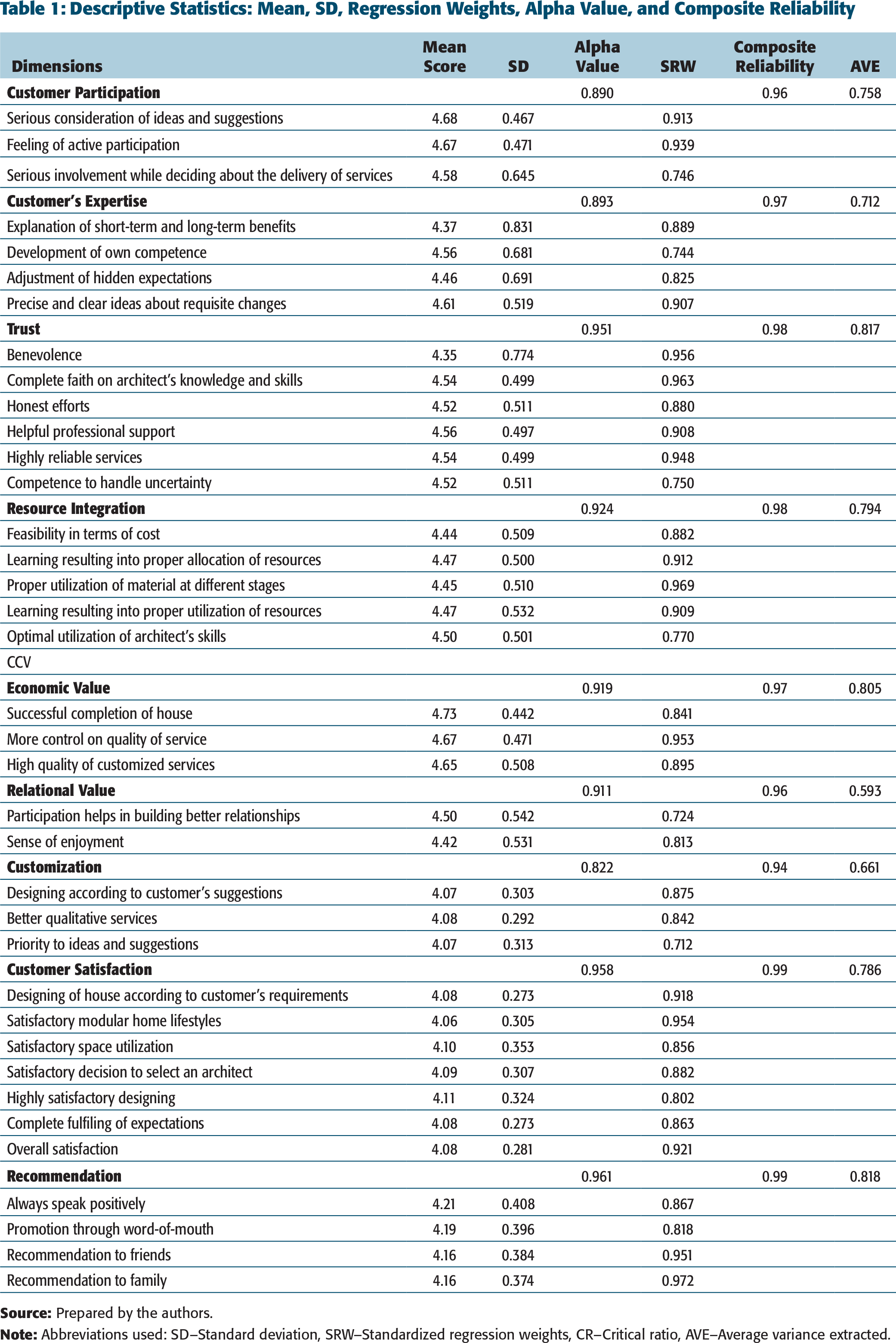
Alpha values were above 0.70 in almost all the cases except for customization (0.62), which is also acceptable, thus signifying the reliability of our data (Table 1) (Gerrard & Cunningham, 2003; Ngobo, 2004). Although Cronbach’s alpha indicator is frequently used to assess reliability, some researchers consider it as under estimating reliability, therefore, the use of composite reliability has been suggested (Joreskog & Sorbom, 1993), using a cut-off value of 0.65 (Bagozzi, Yi, & Phillips, 1991). The rule of thumb for composite reliability (CR) is 0.70 or higher (Fornell & Larcker, 1981) and in the present study, CR is above 0.90, thus indicating the internal consistency and thereby confirming the reliability of the data (Table 1).
The validity of the scale was established through convergent and discriminant validity. Convergent validity gets established in the present study as majority of loadings are above 0.70 (Table 1) and average variance extracted (AVE) for almost all the constructs is above 0.50 except for customization (0.33). Discriminant validity has been assessed by comparing AVE with the squared correlations between constructs (Fornell & Larcker, 1981). The squared correlation between a pair of constructs was less than AVE in almost all the cases, thereby suggesting discriminant validity.
We took measures to minimize common method bias by intermixing items of different constructs in our instrument, using different response formats for the dependent and independent variables, and protecting subjects’ anonymity. We conducted Harman’s single-factor test on all the items in the instrument. If common method variance was a problem, then the results would show that a single general factor explained a majority of the variance. However, findings of this test showed that the first component factor accounted for only 21.537 per cent of the variance. Thus, common method variance is not a problem in our survey data.
Confirmatory Factor Analysis
Confirmatory Factor Analysis (CFA) was run on all major constructs in the study. The reliability and validity of each construct was estimated using the regression weights obtained from the measurement model. CFA was run and items with standardized regression weights (SRW; factor loading) less than 0.50 were deleted (Hair, Black, Babin, Anderson, & Tatham, 2009). Deletion of items under each construct was done in two stages; initially, while checking the Cronbach’s alpha, an item having item-to-total correlation below 3.0 was considered for deletion and thereafter, the item having factor loading below 0.50 was removed (Netemeyer, Bearden, & Sharma, 2003). We checked the reliability and validity of each construct before and after deleting the item and observed that the reliability and validity improved after deleting the items having factor loading below 0.50. The final measurement model was left with two items of relational value; three items each of customer participation, CCV and customization; four each of customer expertise and recommendation; six each of trust and resource integration; and seven of customer satisfaction, respectively (Table 1). As per the ‘three-measure rule’, a measurement model will be identified if every latent construct is associated with at least three measures so that it can have enough degree of freedom to estimate all free parameters. Except for relational value, all principal constructs had at least three indicators so that a CFA could be undertaken. The measurement model was found to be statistically fit, as the Tucker–Lewis Index (TLI) and comparative fit index (CFI) values exceeded the recommended value of 0.90 and chi-square statistics was less than the threshold 5.0 level (Inman, Sale, & Green, 2009) (Table 2).
Testing of the Hypotheses
Descriptive Statistics: Mean, SD, Regression Weights, Alpha Value, and Composite Reliability
Results of Fit Indices
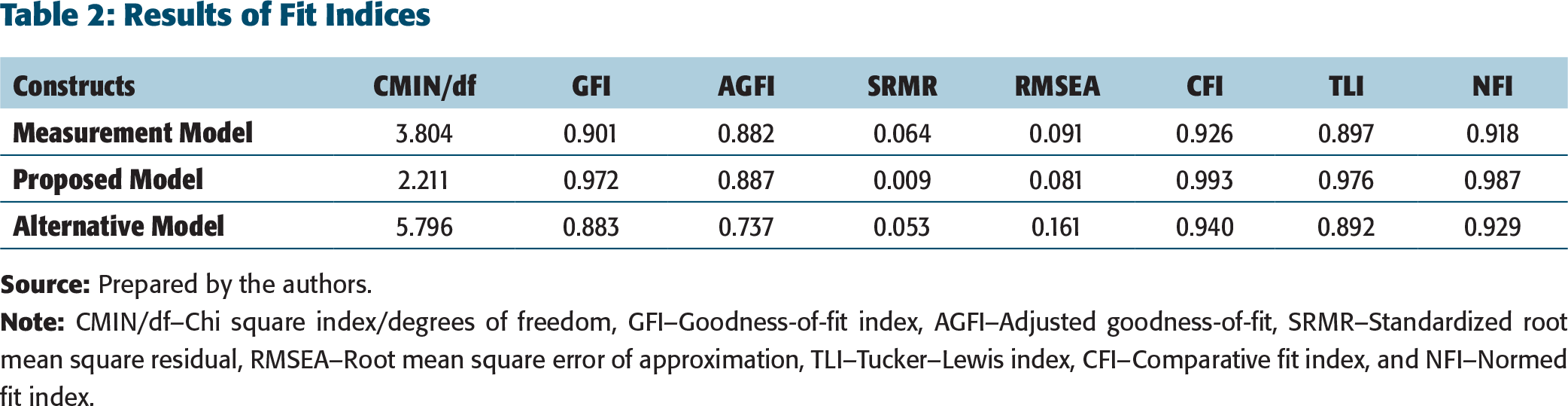
recommendation, we asserted that customer participation, customer expertise and resource integration are the antecedents of CCV, which influence trust, customization, relational value, customer satisfaction, and finally, recommendation. The act of integrating the customer in the value creation process is to develop an individualized offering, which is inherently included in the service definition, that is, customization. Thus, we proposed three antecedents of CCV, that is, customer participation, customer expertise, and resource integration and one direct consequent, that is, trust. The overall fit measures suggest that the data provide a good fit for the hypothesized causal model (Bagozzi et al., 1991; Baumgartner & Homburg, 1996). The GFI = 0.972, AGFI = 0.886, RMSEA = 0.081, and SRMR = 0.009 are within the acceptable range (Table 2). The other indices like NFI, CFI, and TLI are more than 0.90. As these values are above 0.90, therefore, it can be concluded that the model exhibits a good fit to the data.
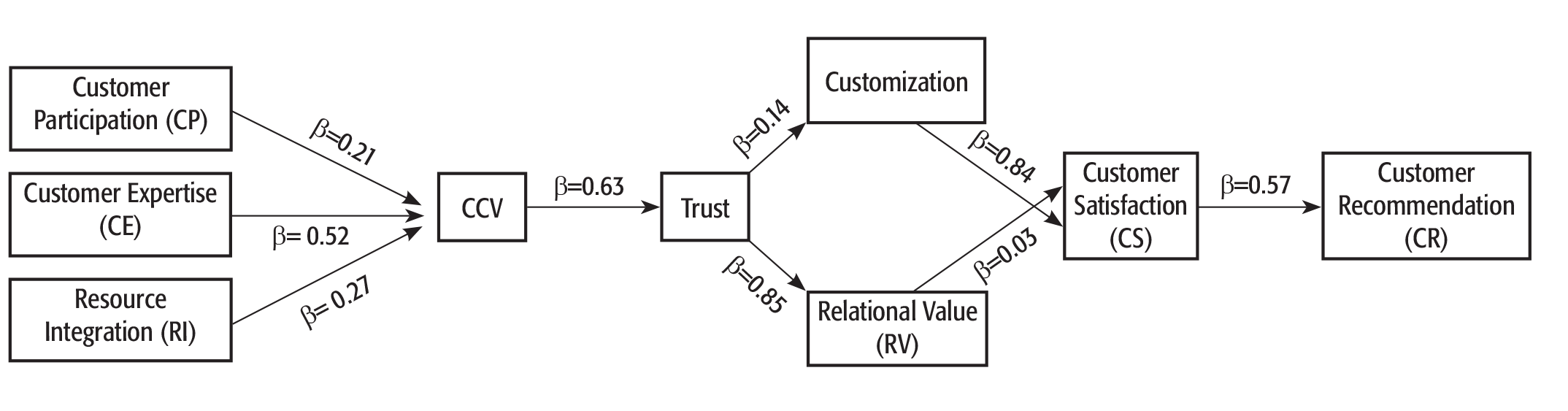
On the basis of the Structural Equation Model (SEM) results, the framed hypotheses have been tested. With the increase in customer participation, an ongoing service delivery process leads to more organizational socialization that generates positive effect and elicits customer commitment (Johnson & Grayson, 2005). The direct relationship of customer participation with CCV is positive and significant (β = 0.21). Resource integration is also significantly related to CCV (β = 0.27), which is the competence and capability of the service provider (Moorman, Zaltman, & Deshpande, 1992) that assist in managing and integrating the resources. Here, ‘competence’ is the firm’s relational competence in the establishment, development, and maintenance of successful relation between the customer and the supplier, which is possible due to their interaction and reinforcement for each other (Madhavaram & Hunt, 2008). Hence, increased level of basic knowledge and information of a customer result into greater value derived from each service encounter. Finally, the direct link of CCV with customer expertise is high and significant (β = 0.52), which provides support for the acceptance of H1a, H1b, and H1c.
With regard to the relationship between CCV and Trust, CCV is positively and significantly related to trust (β = 0.63). Customer co-creates value during the construction of a house with an architect for experiencing improved and professional quality of service, customized service, and a better control on achieving success over the completion of a house (Chan et al., 2010), which are required for gaining economic value. Thus, trust is determined by CCV, leading to the acceptance of H2. It also finds support from Zipkin (2001), who stated that service providers treat customer as part of the value creation process and thus, obtain specific information about their needs and desires, which can be translated into concrete specifications.
Moreover, it is emphasized by Anderson and Narus (1990) that trust is a key factor to establish successful long-term relationships, where customers participate and feel free to express themselves. Normally, customers can assume that a trusted service provider is motivated to offer valuable services in terms of lower transaction cost and superior information sharing, which improves coordination and the joint effort minimizes inefficiencies. It helps in maintaining sustained relationships with the service provider where customer feels free to share expectations. Hence, trust positively and significantly affects customization (β = 0.14) and relational value (β = 0.85), which lead to the acceptance of H3a and H3b.
In order to deliver customer satisfaction, service provider must have an understanding of the factors that impact customers’ service quality perceptions. In this regard, service quality researchers determined customization as the degree to which a firm’s service is tailor-made to meet heterogeneous customer needs (Fornell, Johnson, Anderson, Cha, & Bryant, 1996). Hence, customization has a major impact on customer satisfaction (β = 0.84) and therefore, most of the service industry firms focus on customization as an antecedent to customer satisfaction, which is well documented (Cronin & Taylor, 1992; Parasuraman, Zeithaml, & Berry, 1985). This leads to the acceptance of H4a. However, the relationship between relational value and customer satisfaction turns out to be non-significant (β = 0.03), thus rejecting H4b.
Increased customer satisfaction leads to customer loyalty, repurchase intentions, and positive word-of-mouth (Dabholkar, 1990). In the present scenario, where the length of the relationship between an architect and customer is more than a year, multiple interactions with the service provider might result into positive word-of-mouth. The link between customer satisfaction and recommendation turns out to be significant (β = 0.57), hence H5 is supported. This may happen because the duration of relationship between an architect and a customer is more than one year.
While analyzing the mediating role of trust, customization, relational value, and satisfaction in varied relationships, we observed that customization mediates the relationship between CCV and satisfaction (β = 0.030, p = 0.500), and relational value also mediates the trust and customer recommendation relationship (β = 0.094, p = 0.520). These indirect relationships have also been confirmed through Sobel, Aroian, and Goodman’s test.
In an attempt to empirically accomplish the research objectives, we ran separate models for analyzing the impact of customer participation, customer expertise, resource integration, relational value, and CCV on customers’ recommendation. The results reveal that these constructs are negatively related to customers’ recommendation. In particular, the effects of CCV and relational value on customers’ recommendation are negative and insignificant (CCV: β = –0.006, p = 0.930; RV: β = –0.102, p = 0.164). Though the impact of customer participation, customer expertise, and resource integration on customers’ recommendation is significant, it is negative (CP: β = –0.288; CE: β = –0.431; RI: β = –0.218). Thus, in this co-creation process, the effect of customers’ investment in terms of time involved, money invested and efforts devoted are negative towards spreading positive words for the service provider.
In an additional analysis, an alternative model was tested where the model included direct paths from customer participation, resource integration and customer expertise to CCV and CCV, in turn, leading to trust, customer satisfaction and recommendation. In addition, the links between satisfaction and trust and trust and recommendation were also proposed. Results of the alternative model show that the important paths are not significant (viz., CCV→T; CS→T and T→RC). Also, the fit indices (CMIN/df = 5.796; GFI = 0.883; AGFI = 0.737; RMR = 0.053; CFI = 0.940; NFI = 0.929; TLI = 0.892, and RMSEA = 0.161) are not within an acceptable range (Table 2).
DISCUSSION AND IMPLICATIONS
The study proposes that the CCV process helps in generating trust towards the service provider as the customer invests considerable resources for obtaining that value. Such a trust towards the service provider results into customized offerings and also assists in building long-term relationships. In turn, these customized offerings and relational value bring a sense of contentment among the customers. Finally, the satisfied customers motivate prospective customers to avail services from his service provider only. CCV proves to be an influential and creative marketing strategy for the expansion of the real estate sector. It assists service providers in providing possible solutions to customers’ problems which leads to a perception of more value from the service encounters. Customers tend to be more satisfied. Thus, the present study provides a complete framework, which examines the important preconditions of CCV such as customer expertise, resource integration and customer participation (Chan et al., 2010) and its effect on other constructs such as trust, customization, relational value, customer satisfaction, and recommendation. Most of the research work on examining CCV has been conceptual in nature and thus, there is a need to empirically investigate the antecedents and consequences of CCV, more particularly, recommendation. In this regard, Laaksonen, Pajusen, and Kulmala (2008) examined trust and dependence as important factors that co-evolve in customer–supplier relationships and Fuller, Muhlbacher, Matzler, and Jawechi (2009) analyzed the impact of information-rich interactions on positive trustworthy community–company relationships. The present study found a significant and positive relationship of customer participation, customer expertise, and resource integration with CCV (Chan et al., 2010). In addition, the structural model depicts an essential relationship between CCV and trust. In this respect, the study found that CCV has a significant impact on trust, as more participation allows customers to make more choices and work with the service provider so as to create higher level of trust (Auh et al., 2007).
The study also reveals that customer satisfaction is significantly increased through customization. In a similar context, an important study conducted in the hotel industry by Gagnon and Roh (2008) examined customization as one of the five important service quality dimensions that are required to keep customers satisfied. Moreover, the link between satisfaction and recommendation is well established in the marketing literature (Bloemer, Ruyter, & Peeters, 1998; Liang & Wang, 2007; Nguyen & LeBlanc, 1998; Tuu & Olsen, 2010). Customers usually promote a service provider through positive word-of-mouth and make actual recommendations to others when a service provider is able to ensure satisfactory services. Similarly, in the present study, the direct relationship of customer satisfaction with recommendation turns out to be significant (β = 0.57, Figure 1).
The present study revealed a negative and non-significant impact of relational value on customer recommendation. In this regard, the direct link between customer satisfaction and recommendation has been found significant while the effect of trust on customer recommendation is completely mediated by relational value. Thus, it can be concluded that value co-creation should be treated as an open forum where customers are required to be proactive and architects need to give shape to this proactiveness by acknowledging customers’ ideas and suggestions. In addition, to provide customers with what they want, a service provider ought to focus on unique and personalized services, which will help in increasing market share and competitive edge over competitors.
Managerial Implications
From a marketing perspective, the results of the present study have some important implications for an architect.
An out-of-the box marketing strategy should be adopted by an architect in order to provide customers with innovative and unique architectural designs such as inspiration taken from different western countries and fusion for bringing variety. For example, by adopting Japanese architectural designs, customers may be provided with earthquake resistant houses. Along with this, an architect should check the feasibility of designs and execution of the plan. A service provider will be able to deliver outstanding services only when he focuses fervently on customers’ needs. Therefore, he is required to use the latest construction technology, materials, and specifications that will help the customer in creating modern contemporary designs with good light and living environment so as to maximize the features of the site chosen by the customer.
To ensure an effective value co-creation process, an architect should motivate customers to give useful suggestions by befriending them, involve customer’s family members in key discussions, being empathetic and understanding about any special need of the customer. This will enhance the creation of relational values, ultimately leading to a positive word-of-mouth.
It is very important for an architect to imbibe the ‘go green concept’ in his layout, that is, special attention should be given to kitchen and terrace gardens that add beautification to a house, specifications for the small solar panels on the roof so as to give customers with green power, and rain water harvesting to save water. This philosophy not only adds value for customers but also has a long-term impact on the architect’s image in the market.
According to the CCV concept, service is defined as a process where one resource or competency can be used for the benefit of other (Spohrer & Maglio, 2008). An architect should also create value by involving other suppliers in the network, that is, by giving reference of the best suppliers for accessories like modular fittings to be used in the kitchen or washroom.
Customers tend to co-create more value when an architect delivers on time and easily accessible services. This can be done by assuring customers that the time spent in the planning phase would be kept minimum, that is, timely execution of what has been drafted in the plan. Timely completion of a house not only depends on the services of an architect, but it involves a whole network of resource partners, that is, appropriate material, labour, and other suppliers
Regular visit by an architect to the site is necessary during the construction period and also after possession in order to reduce wastage of material and problems faced by the customers. This can be done by giving appropriate solutions to their problems such as water proofing, roof tiling, and also arranging regular meetings with the customers.
CONCLUSION
In an emerging economy like India, architectural services are considered to be very significant because of customer participation during the construction of a house. People rely more on face-to-face interactions with an architect in comparison to virtual contact, hence, CCV is treated as a form of market or business strategy that emphasizes the generation and ongoing realization of mutual firm–customer value. With the changing roles and relationship between firms and customers, companies need to harness competencies of the customers by engaging and mobilizing them in dialogue, managing customer diversity and co-creating personalized experiences with customers. Thus, CCV is a seismic shift in thinking from the industrial age mindset to the people engagement mindset. Findings of the present study also reveal that CCV is influenced not only through customer participation but also through customer expertise and resource integration. Providing customers with more than what they have expected will help an architect in gaining real patronage in terms of positive word-of-mouth and further recommendations. Architects, therefore, are required to develop effective communication strategies, giving assurance of their services (affordable prices, easy accessibility, and availability) and also need to work on relationship building strategy, so as to gain increased market share and expansion of business. Overall, the results of the study reveal that CCV results into customer satisfaction and recommendation through the intervention of trust, customization, and relational value.
LIMITATIONS AND FUTURE RESEARCH
The findings of the present study can be generalized to similar settings, such as the construction of a building for business purposes, private schools or colleges and so on. Hence, the results of the study can be extended to settings where the co-creation process demands considerable investment of a customer in terms of cost, time, and efforts. The present study has not explored the impact of different market segment on the customers’ recommendation of service provider. Therefore, future studies should dwell on such effects by considering different segments like income, age, location, costs, product-mix and so on. Also, the benefits derived from CCV both by customers and service provider have not been investigated and thus, further studies are needed to explore the benefits derived by both the parties so that an understanding can be developed regarding the party whose benefits exceeded that of the other, that is, the budget estimated for the co-creation process and the deviation from the estimated amount. The study has not examined the extent to which a customer is ready to co-create throughout the construction of his house and to what extent a customer tries to maintain his competence and capability with the service provider. Future research can be directed towards working out the differences in the perception of expert customers and novice customers towards the CCV. Present research can be extended to dyadic relationship, in which the views of both parties (customers as well as an architect) can be analyzed simultaneously. The post-purchase behaviour of customers with regard to architectural services has not been studied. Such behaviour cannot be analyzed on the basis of one year experience, but only after the customer resides for more than 2–3 years in a newly constructed house. Future research can consider other services of similar nature, such as insurance, personal health care, hotels, apparel houses, event organizations, jewellery and ornament designing and so on.