




Abstract
Executive Summary
With increased popularity of positive psychology, there is a greater emphasis on exploring positive human resource strengths to address the workplace challenges and augment organizational performance. Previous research suggests that resilience positively relates to desired employee attitudes, behaviours, and performance such as organizational citizenship behaviour (OCB). However, it would be intriguing to understand the underlying mechanism of resilience-OCB relationship. Towards this, the study examines the mediating role of organizational commitment.
In the light of identified research gaps, the study explores the mechanism of the relationship between resilience and OCB in the context of Indian organizations. The study sample comprised employees (N = 345) working in the manufacturing industries of Uttarakhand and Himachal Pradesh in India. Data were collected with the help of self-administered questionnaires through systematic random sampling. A model was developed and tested in which the effects of resilience on OCB were hypothesized to be mediated by organizational commitment. The hypotheses testing was done using hierarchical multiple regression and for testing the mediating effects, bootstrapping in SPSS was used.
The results provide empirical evidence for the positive relationship between resilience and OCB. Also, the results emphasize that resilience influence organizational commitment as well. As hypothesized, results have also supported the mediating effect of organizational commitment in the relationship between resilience and OCB, explaining the underlying mechanism of resilience-OCB relationship. The mediation is partial which means that resilience influences OCB directly as well as indirectly through organizational commitment.
The study offers significant advancements for both resilience and OCB research. The results also offer direction to organizations which desire to stimulate and maintain employee outcomes in their organizations for competitive advantage. Employee outcomes in organizations can be improved by developing resilience among its employees. Implications of promoting resilience at workplace are discussed.
Keywords
In recent years, researchers have focused on exploring positive constructs influencing OCB (Bakker & Demerouti, 2007). One such positive construct is resilience—a psychological resource capacity, generally defined as the capability of an individual to withstand hardship and, while facing adversity, continue to lead a functional and healthy life (Turner, 2001). Luthans (2002) defines resilience as the positive psychological capacity to rebound, ‘to bounce back’ from adversity, uncertainty, conflict, failure or even positive change, progress, and increased responsibility. Resilience is often seen as a crisis or emergency management issue; the link between a resilient workforce and its impact on organizational outcomes is still not well understood by organizations (McManus et al., 2008). Brooks and Goldstein (2004) assert that a resilient perspective is helpful in every aspect of ordinary living as it provides the strength to tackle routine challenges and sudden problems. Crisis or adversity for an employee can be any problem at a personal level related to work or family. It may be a non-congenial environment or an unsupportive manager. Similarly, a female worker may face problems such as sexual harassment, glass ceiling, and lack of family support (Moran, 1994), which she might be unable to express. These seemingly small but significant problems not only affect the efficiency of the worker but also change the attitude of the employee towards the company.
Resilience is often associated with child psychology, but now it is also being explored in the context of the working population as it relates to how employees deal with the challenges of the business world (Badran & Kafafy, 2008; Caverley, 2005). However, in an organizational context, it still remains an emerging concept (Luthans & Youssef, 2004). Also, majority of the research on resilience has been conducted with a younger and treatment-seeking population (Campbell-Sills, Cohan & Stein, 2006). While the application of positive psychology at the workplace as positive organizational behaviour (POB) (Youssef & Luthans, 2007) has encouraged studies on resilience in an organizational context, most studies have predominantly focused on White American populations (Lopez et al., 2005). Considering Hofstede’s dimensions of national culture (Hofstede, 2001), Indian culture (demonstrating high power distance, collectivism, medium uncertainty avoidance, masculininity, long-term orientation, and restraint) appears quite different from the Western culture and therefore, the findings of studies on white populations may not be applicable in the Indian context. While evaluating the dimensionality of OCB in an Indian context, Gupta and Singh (2012) gathered support from literature to highlight significant cultural and economic differences among the United States and Asian countries, and their impact on the perceptions towards, and display of OCB. Thus, it would be interesting to verify the resilience-OCB relationship in the Indian context. There are studies (Gupta & Singh, 2014; Shahnawaz & Jafri, 2009; Vohra & Goel, 2009) which have explored resilience in an Indian context as part of a higher order construct called psychological capital. While these studies have been able to demonstrate the relevance of resilience in the Indian context, they have sought further extension of debate either in the form of exploring the mechanism by which resilience relates to employee outcomes or in the form of confirming the obtained results in different contexts.
While the arguments in favour of positive psychology and its applications in the organizational context are considered promising, empirical evidence particularly relating to resilience and OCB in the Indian context is scarce (Paul & Garg, 2012). Exploring the relationship between resilience and OCB is important given the rationality for a significant association of OCB with organizational performance (Podsakoff & MacKenzie, 1997). Insights into resilience-OCB relationship may also shed some light on how employees sustain their motivation levels to engage in OCB even in the face of adversity.
Although there are studies (Gupta & Singh, 2014; Shahnawaz & Jafri, 2009; Vohra & Goel, 2009) indicating a relationship between resilience and OCB, the results are mixed. Also, the intermediating mechanism through which resilience is translated into OCB remains unclear. It is proposed that the level of commitment of employees may play a mediating role in the resilience-OCB relationship because OCBs are discretionary behaviours and the individual’s identification with the organization influences the willingness and the decision to perform them. The present study seeks to examine and verify the relationship between resilience and OCB, and investigate the underlying mechanism of the resilience-OCB relationship through organizational commitment.
This study is conducted with employees working in the manufacturing sector. Despite the considerable growth of the service sector, manufacturing sector holds a distinctive position in the Indian economy. A knowledge-based economy cannot be sustained in the long run unless it is adequately supported by a growing manufacturing economy (UNIDO, 2005). However, the Indian manufacturing sector presents different challenges before its workforce. While it is the largest employer, the compensation and the work environment it offers are not as lucrative as the other industries (Basu, 2016). The stereotype that manufacturing workplaces entail a lot of sweat and grime (Goyal, 2012) make the sector even less attractive. Also, the manufacturing workforce is more vulnerable to hazards and crisis situations. To display extra-role behaviours while working amidst such disruptive challenges, the workforce requires the ability to respond effectively and recover quickly. The manufacturing sector was thus considered suitable to conduct the study.
CONCEPTUALIZATION AND DEVELOPMENT OF HYPOTHESES
Resilience
There are several definitions for the term ‘resilience’ which widen the scope of its meaning. A large number of studies have also considered different facets of resilience (personal resilience, trait resilience, psychological resilience, emotional resilience, career resilience, and ego resilience) in individual and organizational contexts (Block & Block, 1980; Block & Kremen, 1996; Bolton, 2004; Dulewicz, Higgs & Slaski, 2003; Fredrickson & Tugade, 2003; King, 1997; Waugh, Fredrickson & Taylor, 2008). In general, authors agree that resilience: (a) is a capacity that reflects in behaviour; (b) deals with change; and (c) relates to overcoming some unwanted situation (Paul & Garg, 2012). There are several reasons for considering resilience at the individual level. First, organizational outcomes considered for the study are exhibited at the individual level. Second, resilience measures at the organizational level include behavioural and attitudinal dimensions (of the individual) when predicting overall resilience. Third, an understanding of resilient individuals provides an appropriate starting point for defining resilient organizations since actions and interactions among individual organizational members underpin the emergence of a firm’s collective capacity for resilience (Lengnick-Hall, Beck & Lengnick-Hall, 2011; Morgeson & Hofmann, 1999). Fourth, since turbulence and instability are prevalent in the business world, resilience is a strength that individual managers would want to develop. Literature provides strong evidence that experiences of difficult situations, negative events or stressors at the workplace can lead to poor employee outcomes and may result in burnout (Maslach, Jackson & Leiter, 2001). Resilience as a resource capacity may help employees bounce back from such situations. Wagnild and Young (1990) named five essential characteristics that constituted resilience: (a) meaningfulness of life or the realization that life has a purpose and the recognition that there is something for which to live; (b) perseverance or the act of persistence despite adversity or discouragement; (c) self-reliance or belief in oneself with a clear understanding of own capabilities and limitations; (d) equanimity or balanced perspective of life and experiences which might be viewed as sitting loose and taking what comes, thus moderating extreme responses to adversity; and (e) existential aloneness or the realization that each person is unique and that while some experiences can be shared, others must be faced alone. Zautra, Hall and Murray (2010) asserted that the personal characteristics which led to healthy outcomes after a stressful situation determined the resilience processes. This conceptualization is used to measure resilience in the present study.
Extant literature presents evidence that resilience has organizational outcomes. These include employee attitudes like organizational commitment (Shin, Taylor & Seo, 2012; Youssef & Luthans, 2007), job satisfaction (Ramlall, 2009; Vohra & Goel, 2009), and flexibility (Siu et al., 2009); employee behaviours like OCB (Toor & Ofori, 2010); employee performance and effectiveness (Luthans, Youssef & Rawski, 2011); psychological features or experiences like self-awareness (Toor & Ofori, 2010), self-esteem (Ramlall, 2009), work happiness and well-being (Wilson & Ferch, 2005; Youssef & Luthans, 2007), motivations (Youssef & Luthans, 2012), quality of life and work-life balance (Siu et al., 2009); physical and psychological health (Siu et al., 2009; Youssef & Luthans, 2012); and organizational attributes like competitive advantage (Toor & Ofori, 2010), vitality and strategic agility (Lengnick-Hall & Beck, 2009), and leadership (Avey, Avolio & Luthans, 2011).
Organizational Citizenship Behaviour (OCB)
The concept of OCB was introduced by Bateman and Organ (1983) and later refined and strengthened by a number of researchers (Chahal & Mehta, 2010; Jain & Cooper, 2012; Podsakoff & Mackenzie, 1989; Podsakoff, MacKenzie, Paine & Bachrach, 2000). OCBs are defined as individuals’ ‘extra role’ behaviours that are beneficial to the organization and are discretionary, not directly or explicitly recognized by the formal reward system. These behaviours are primarily a matter of personal choice as their omission is not considered punishable in organizations.
OCB is a multi-dimensional construct (Coleman & Borman, 2000; Podsakoff et al., 2000). Smith, Organ and Near (1983) suggested two dimensions of OCB - altruism and generalized compliance. They defined altruism as random acts of kindness without expectation of reward or recognition. Generalized compliance has been defined as a behaviour which helps everyone involved in the system, for example, effective use of time. Later, Organ (1988) suggested five dimensions of OCB. The first of these is altruism, which refers to voluntary actions that help another person with a work problem, such as instructing a new employee on how to use equipment, helping a co-worker to catch up with a backlog of work or fetching material that a colleague needs and cannot get on his/her own. The second is courtesy, which refers to all those foresighted gestures that help someone else to prevent a problem, such as keeping others informed of decisions and actions that may affect them. The third dimension is civic virtue, which means responsible constructive involvement in the political process of an organization, including not just expressing opinions but also reading mail, attending meetings and keeping abreast of larger issues involving the organization. The fourth is conscientiousness, which implies a behavioural pattern of going well beyond minimally required levels of attendance, punctuality and housekeeping, and conserving resources and related matters of internal maintenance. The fifth dimension is sportsmanship, which refers to behaviour that tolerates inevitable inconvenience and imposition without complaint or grievance. Williams and Anderson (1991) suggested two dimensions of OCB: OCB-Individual (OCBI) and OCB-Organization (OCBO). These two dimensions correspond to altruism and generalized compliance dimensions originally identified by Smith et al. (1983). OCBI refers to the behaviours which directly benefit specific individuals and indirectly assist organizations. OCBO, on the other hand, refers to the behaviours which benefit organizations in general (Williams & Anderson, 1991). This conceptualization also corresponds to Organ’s five-dimensional model of OCB (LePine, Erez & Johnson, 2002). Conceptually, altruism and courtesy are consistent with OCBI, while sportsmanship, civic virtue, and conscientiousness may be categorized under OCBO.
Several other dimensions of OCB have been suggested by different researchers. Podsakoff et al. (2000) listed over 30 overlapping forms and dimensions of OCB. In an attempt to simplify the overlaps, Podsakoff et al. (2000) classified all those dimensions as the following seven common dimensions: (a) helping behaviour; (b) sportsmanship; (c) organizational loyalty; (d) organizational compliance; (e) individual initiative; (f) civic virtue; and (g) self-development. Although there are a plethora of forms and dimensions suggested for OCB, all these conceptualizations have either been borrowed from, or reflect the work of Katz (1964) or Organ (1988). Despite such diverse conceptualizations, Organ’s (1988) conceptualization of the five dimensions of OCB remains the most extensively accepted. This study uses the same concept.
While previous studies have widely explored the antecedents of OCB (Williams & Anderson, 1991; Zellars, Tepper & Duffy, 2002), they have largely focused on employee attitudes, personality characteristics, task characteristics, dispositions, and leadership behaviours (Organ & Ryan, 1995; Podsakoff et al., 2000; Smith et al., 1983). However, the mechanisms through which resilience influences OCB remain unclear. Resilience has also been a construct much explored in clinical and developmental psychology (Bonanno, 2004; Campbell-Sills et al., 2006), but the study of its significance in the organizational context has been limited to emergency situations or crises, and its implications in the day-to-day organizational life of employees have been, by and large, ignored. Sutcliffe and Vogus (2003) have asserted that in an organizational context, empirical research on resource capacities like resilience is scarce and fragmented. For example, Campbell-Sills et al. (2006) found a positive relationship between resilience and conscientiousness, which is one of the dimensions of OCB, but the study did not explore the association of resilience with OCB in totality.
The possible linkage between resilience and OCB can be derived from the work of Bakker and Demerouti (2007) in which they have propounded the job demands-resources (JD-R) model. The JD-R model demonstrates that resilience as a personal resource capacity influences organizational outcomes like commitment and OCB. The research suggested that providing employees with resources resulted in work engagement which in turn led to positive outcomes like organizational commitment and OCB (Hu & Schaufeli, 2011). These resources could be organizational or individual. Individual resources are one’s own psychological capacities which provide strength and support to deal with difficult or harsh situations. These resource capacities (such as resilience) help employees remain calm and relaxed even under pressure and consequently generate positive emotions instead of frustration and irrational behaviours. Schaufeli et al., (2002) also stated that resilience formed an integral part of their conceptualization of vigour (high levels of mental resilience, Schaufeli & Bakker, 2004) for which there is substantial evidence in literature that it influences organizational outcomes like OCB (Saks, 2006; Sweetman & Luthans, 2010). Martin (2005) considered workplace resilience a key dimension in the occupational motivation and engagement wheel model proposed by him.
In the present business scenario, employees work in a dynamic environment, facing challenges such as conflict, difficult circumstances, setbacks, failures, and high expectations of organizations on a regular basis. Positive events, career progress, and increased responsibility may also test an employee at times (Luthans, 2002). In such situations, resilience as a psychological resource capacity ensures that employees are able to adapt to changes at the workplace and are emotionally stable while dealing with challenges (Tugade & Fredrickson, 2004). Resilient employees do not react strongly to adverse situations; they would instead respond calmly and with positive emotions. They have the ability to derive meaning from their work, perceive the intensity of the situation, and handle it steadily. Consequently, they complete their tasks according to expectations and avoid creating problems for others while displaying citizenship behaviours such as helping co-workers and actively participating in organization’s politics. Ryff and Singer (2003) argued that resilience stimulated flourishing under hardship. An individual’s ability to successfully cope with stress and flourish under hardship drives positive outcomes in terms of increased commitment and OCB.
Resilient people are able to pursue new knowledge and experiences and get into deeper relationships with others (Luthans, Youssef & Avolio, 2007). The sense of exploring new experiences (Tugade, Fredrickson & Barrett, 2004) motivates employees to build social relationships at the workplace and engage into activities which are beyond their defined job roles. Further, resilient individuals are more likely to experience positive emotions even in the midst of difficult situations. Literature suggests that positive emotions are linked to positive outcomes at the workplace (Fredrickson, 2001). Thus, it is expected that resilience at the workplace will encourage employees to engage in OCB. Based on the above discussion, we hypothesize:
H1. Resilience is positively related to OCB.
Organizational Commitment
Over the years, organizational commitment has been conceptualized in various ways (Meyer & Maltin, 2010). For the present study, the well-established three-component model (Meyer & Allen, 1991; Meyer & Herscovitch, 2001) approach is adopted which views commitment as ‘a force that binds an individual to a target (social or non-social) and to a course of action of relevance to that target’ (Meyer, Becker & Van Dick, 2006). This binding force can be experienced in different ways (i.e., can be accompanied by different mindsets), including: an affective attachment and involvement with the target; a felt obligation to the target; and an awareness of the costs associated with discontinuing involvement with the target. In their pure forms, these mindsets are referred to as affective commitment (AC), normative commitment (NC), and continuance commitment (CC) respectively.
Resilience has been described as the positive response to stress (Luthar, 1993), which at the workplace helps employees to stay immune to the ill-effects of stress and other difficult situations. This may also help employees to maintain the positive emotions which can further get translated into an affective attachment to the organization. Affective attachment allows employees to uphold the psychological contract with the organization so that they sustain their organizational commitment. King (1997) defined resilience as the magnitude to which an individual resisted disruptions affecting his or her work. In the crescendo model, King (1997) highlighted career resilience as one of the components related to affective career commitment. He stressed on the contribution of an individual’s perseverance towards commitment to career and organization. Since perseverance is one of the essential characteristics that define resilience, it may be deduced that resilience will have a positive impact on organizational commitment. Another essential characteristic of resilience is meaningful life which includes meaningful work life also. Resilient individuals are able to find meaning in what they do. This meaning in work has been found to be a major source of individuals’ organizational commitment (Wrzesniewski, Dutton & Debebe, 2003). It is also likely that the belief of resilient employees in themselves and in the work itself provides them with the push to continue with the organization. Youssef (2007) and Youssef and Luthans (2007) supported a positive correlation between positive resource capacities (hope, optimism, and resilience) and performance and organizational commitment.
With the aim of investigating the relationship between positive characteristics and attitudes of organizational importance, Vohra and Goel (2009) measured the influence of resilience on organizational commitment and found that resilience was related positively to affective and NC but no relationship of resilience was found with CC. There are a few other studies (like Mansfield, Beltman, Price & McConney, 2012; Ramlall, 2009; Shin, Taylor & Seo, 2012; Toor & Ofori, 2010) which have talked about one or more forms of commitment as a consequence of resilience. However, all three components of organizational commitment reflect a psychological mindset related to the organization and can be present concurrently in an individual (Allen & Meyer, 1990). Allen and Meyer (1990), the authors of TCM model, and later, Solinger, van Olffen and Roe (2008) have established that a person’s total commitment would reflect the ‘net sum’ of these three psychological states. The extant literature has explored the link between resilience and individual mindsets; however, the relationship between resilience and total organizational commitment is not very well explored. In order to bridge this gap, we hypothesize:
H2: Resilience relates positively to organizational commitment.
Organizational Commitment and OCB
There are many studies that have supported the relationship between organizational commitment and OCB. It is argued that committed employees are more likely to engage in behaviours that support the organization. High level of identification with the organization’s goals and values and a strong desire to maintain membership entails a willingness to exert efforts for the benefit of the organization (Mowday, Steers & Porter, 1979). The social exchange theory (Blau, 1964) also supports the positive relation between commitment and OCB. Employees experiencing positive exchanges with the organization will reciprocate with higher levels of commitment and also contribute through other ways, for example, by exhibiting higher levels of OCB (Cohen & Keren, 2008). Organ and Ryan (1995) and LePine et al. (2002) in their meta-analyses found AC to be related to OCB. Employees with high AC have an emotional attachment towards the organization and thus engage themselves in organizational activities willingly (Zehir, Muceldili & Zehir, 2012). Further, Chiu and Hong (2007) opined that for a collectivist culture, normative influence was stronger. If this be true, then in the context of India, NC may be a significant predictor of OCB. Cohen and Keren (2008) suggested that employees with high NC were more likely to engage in OCB because they considered it as the right thing to do. Kuehn and Al-Busaidi (2002) found NC to be a significant predictor of OCB in a non-Western context.
Salehi and Gholtash (2011) found a positive influence of commitment on OCB in a sample of university teachers in Iran. Similarly, many other researches (Benjamin, 2012; Bishop & Scott, 2000; Cohen, Ben-Tura & Vashdi, 2012; De Lara & Rodriguez, 2007; Ucanok & Karabati, 2013; Williams & Anderson, 1991; Xerri & Brunetto, 2013) have established the link between organizational commitment and OCB. To support and establish this link in the context of the Indian manufacturing industry, we hypothesize:
H3: Organizational commitment relates positively to OCB.
Mediating Effect of Organizational Commitment
The above-mentioned studies to some extent have revealed a possible relationship between resilience and OCB but the mechanism through which resilience exerts an influence on OCB has not been investigated. It is evident from the above literature review that resilience can positively influence organizational commitment (Vohra & Goel, 2009; Youssef & Luthans, 2007), and increased employee commitment can increase the tendency of employees to engage in OCB (Kim, 2014; Lehmann-Willenbrock, Grohmann & Kauffeld, 2013). However, it is of particular interest to examine whether organizational commitment would affect (mediate) the relationship between resilience and OCB. Norman et al., (2010), while investigating the potential moderators in the relationship between resilience (as part of psychological capital) and OCB, have called for researches aimed at examining mediators in the stated relationship in order to extend the understanding of how emerging positive constructs affects organizational phenomena.
Organizational commitment is suggested to be an attitudinal intervening construct, mediating and determining various outcomes (Iverson, McLeod & Erwin, 1996; Wiener, 1982). With respect to OCB as well, many researchers (like Ghosh, Reio Jr. & Haynes, 2012; Kim, 2014; Lehmann-Willenbrock, Grohmann & Kauffeld, 2013; Liu, 2009) have explored organizational commitment as a mediator. Given the strong rationale for hypotheses H1 to H3 (which also serve as the required conditions for mediation), organizational commitment is expected to act as a mediator. In resilience-OCB relationship, it is argued that resilience helps employees to elicit positive emotions (Fredrickson & Tugade, 2003), which further allow employees to uphold the psychological contract and build attachment towards the organization (organizational commitment) (McCarthy, 2008). This attachment to the organization helps employees to engage themselves in organizational activities (like OCB) willingly (Chen & Francesco, 2003; Organ & Ryan, 1995). Thus, it is proposed that resilience is transferred into OCBs through organizational commitment, and hence we hypothesize:
H4. Organizational commitment mediates the relationship between resilience and OCB.
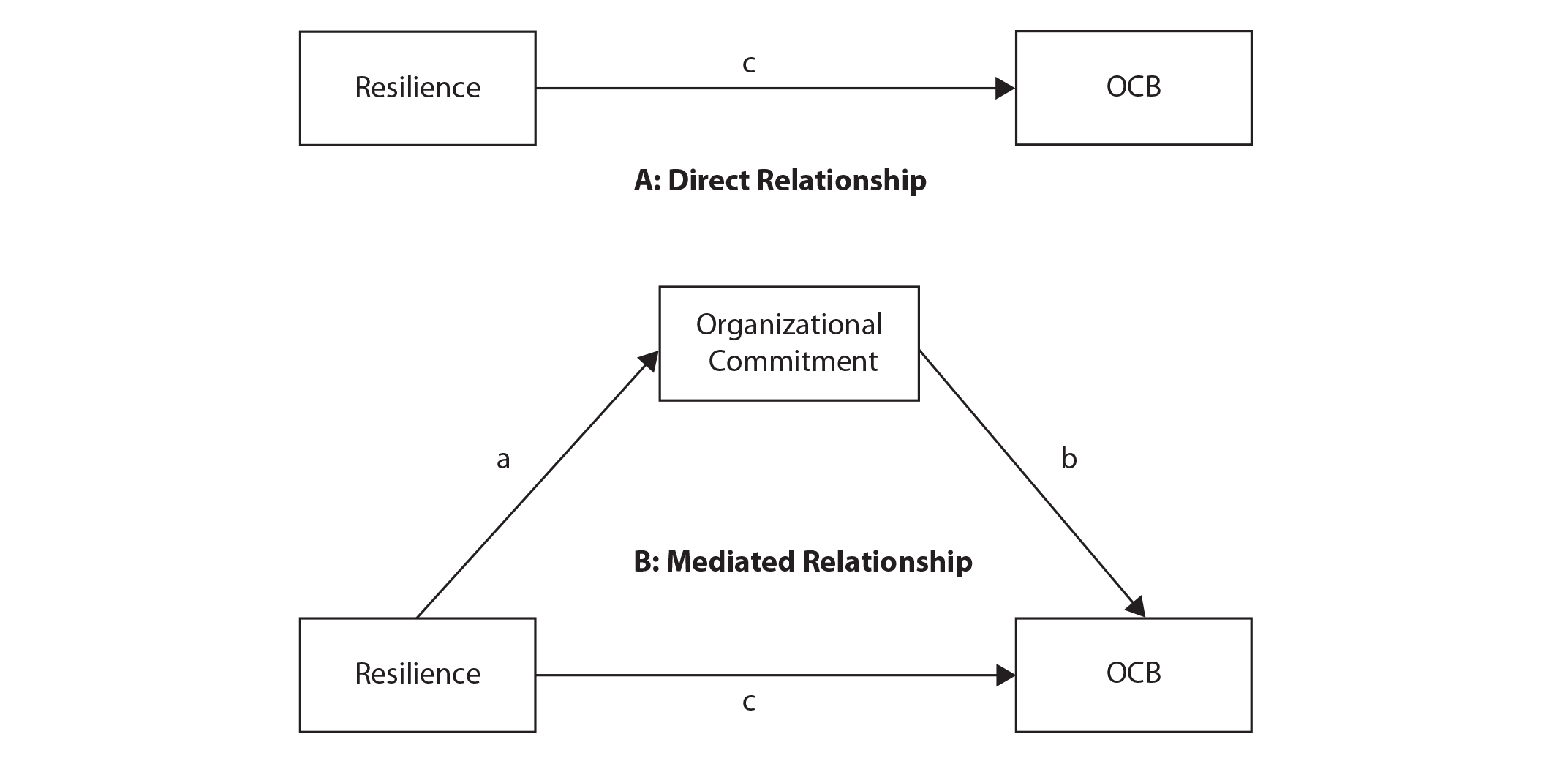
The proposed relationship between resilience, organizational commitment, and OCB is shown in Figure 1.
The mediation model depicts (a) the direct effect of resilience on OCB, and (b) the mediating effect of organizational commitment on resilience-OCB relationship.
METHODOLOGY
Participants
The study sample comprised employees (N = 345) working in manufacturing industries of Uttarakhand and Himachal Pradesh, India. Data were collected with the help of self-administered questionnaires through systematic random sampling. Of the 345 employees who participated in the study, 299 (86.7 per cent) were male and 46 (13.3 per cent) were female. The age of participants ranged from 23 years to 70 years with an average age of approximately 37 years. Further, 280 (81.2 per cent) participants were married and 65 (18.8 per cent) were single. The highest educational qualifications of respondents were also recorded: 198 (57.4 per cent) participants were found to be either graduates or with educational qualifications below the bachelor’s degree; 147 (42.6 per cent) respondents were postgraduates. Further, 165 (47.8 per cent) participants had less than 10 years of work experience while 180 (52.2 per cent) had experience above 10 years.
Measures
Resilience
To measure resilience, the Resilience Scale (RS-14) by Wagnild and Young (2009) was used. It comprised 14 items measured on a 7-point Likert scale. The scores in the scale ranged from 1 = strongly disagree to 7 = strongly agree. The reliability alpha has been reported to be 0.76 to 0.91. For the present study, it was found to be 0.81.
Organizational Commitment
Organizational commitment was measured with organizational commitment questionnaire (OCQ) suggested by Meyer, Allen and Smith (1993), and Meyer and Allen (1997). The questionnaire contained 18 items (6 items for each dimension) measured on a 7-point Likert scale. Reliability alphas reported are 0.82 for AC, 0.73 for CC, and 0.76 for NC. For the present study, the alpha coefficient for the entire scale was found to be 0.75.
OCB
To measure OCB, the scale developed by Podsakoff and Mackenzie (1989) was used. The items in the scale are designed to measure the five dimensions of OCB as identified by Organ (1988): altruism; courtesy; civic virtue; conscientiousness; and sportsmanship. The items are rated on a 7-point scale with the score ranging from 1 = strongly disagree to 7 = strongly agree. The reliability co-efficient of the scale was found to be 0.83 for the present study.
Procedure
A three-tier sampling was used after identifying the appropriate sector/industry and the states for the study. At the first level, industrial estates/areas were selected through random sampling using the lottery system. At the second level, a lottery system was again used to select organizations from the industrial estates/areas obtained in the first level. At the third level, systematic sampling was opted to minimize bias. Representatives (HR managers/production managers/unit heads) from the selected organizations were asked to distribute the survey instruments to employees of their respective organizations as per the given guidelines. They were instructed to use either employee list or the list of email-ids and hand over the survey to every fourth employee on the list with a random starting point, thus ensuring that a random sample was obtained for further analysis.
ANALYSES AND RESULTS
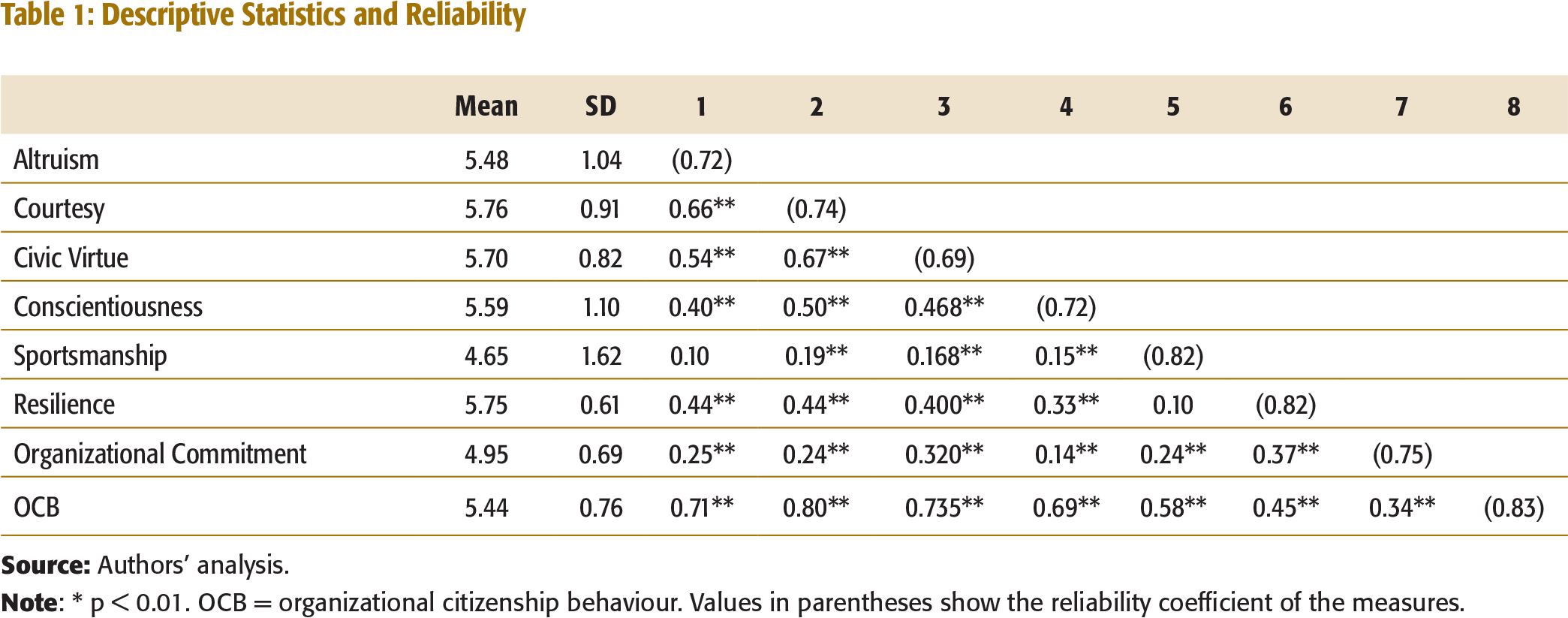
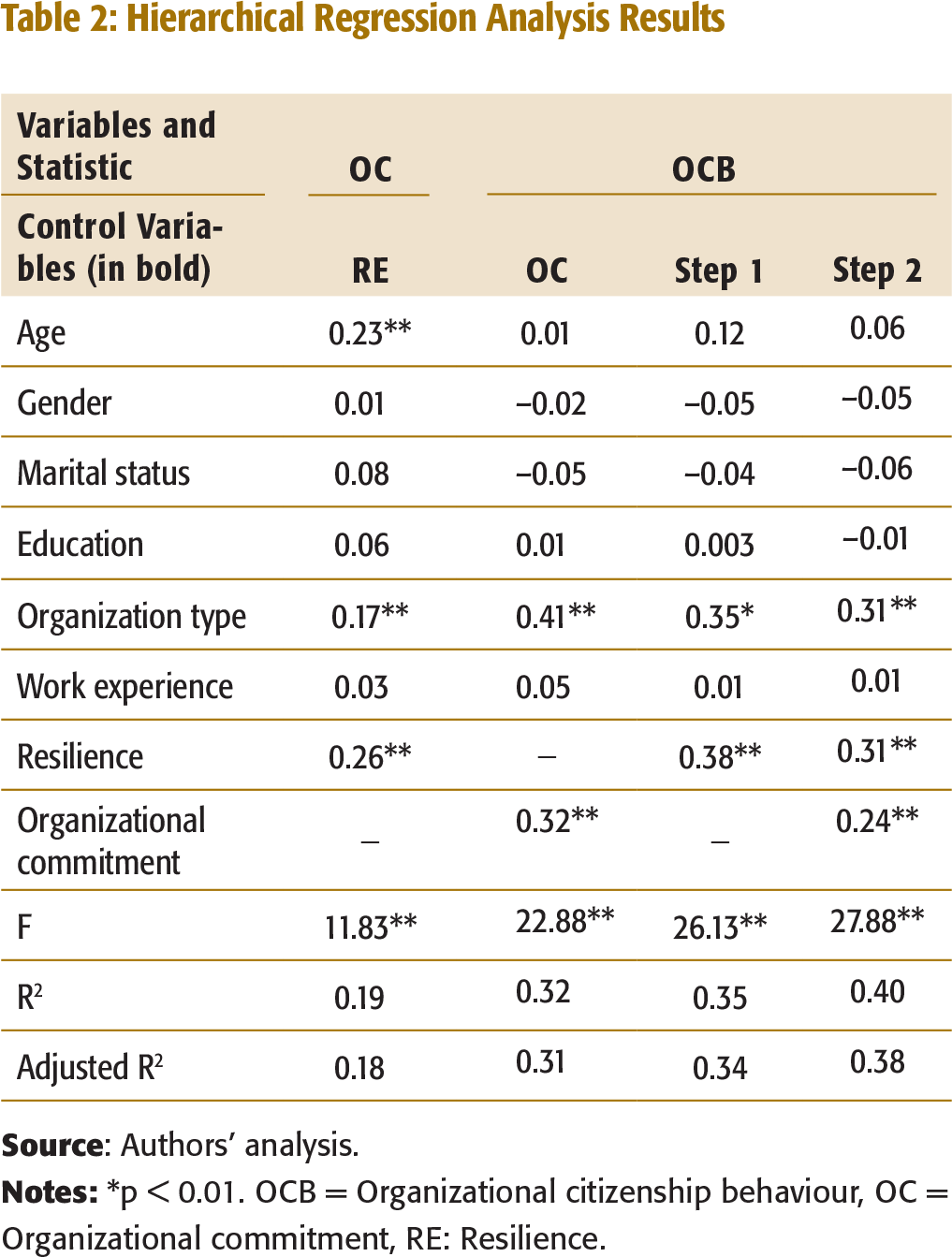
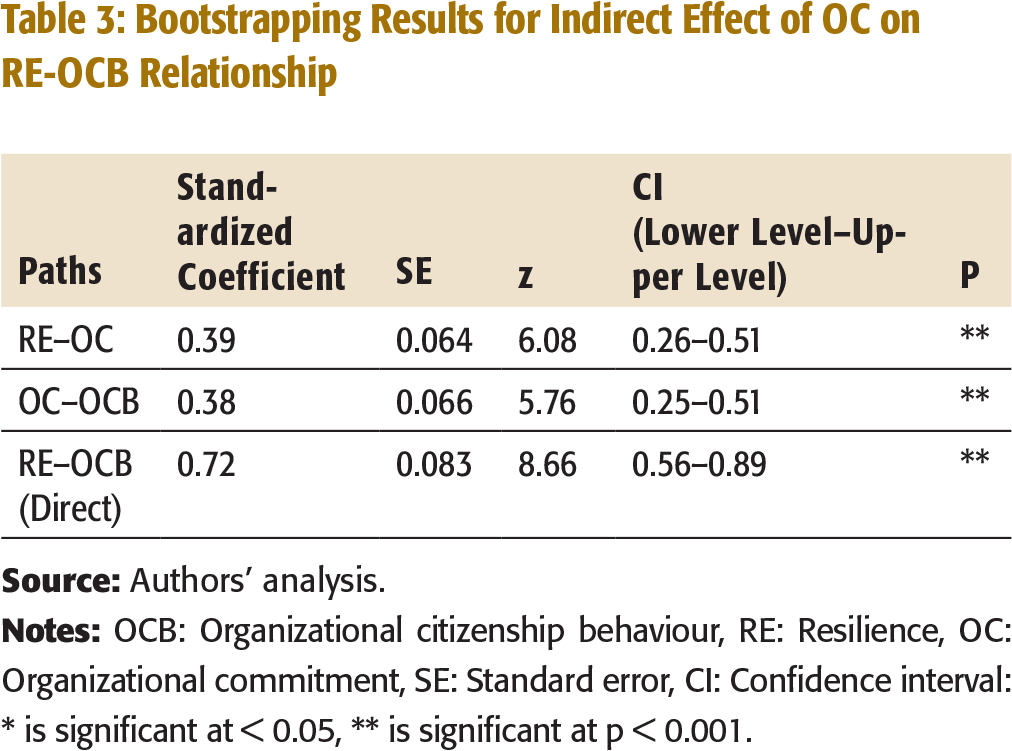
Analysis was done using SPSS© 22 version. Descri-ptive statistics, bivariate correlation, and Cronbach’s alpha value are reported in Table 1. Hierarchical multiple regression analysis was used to test Hypotheses 1, 2, and 3. Demographic variables such as age, gender, marital status, education, work experience, and type of organization were treated as control variables during the entire analysis. Bootstrapping was employed in SPSS following Hayes’ (2013) steps for testing the mediating effect of organizational commitment.
Descriptive Statistics and Reliability
Also, in order to test the plausibility of the proposed model, that is, resilience–organizational commitment–OCB over possible competing model, that is, resilience–OCB–organizational commitment, the model fit statistics was calculated using Amos. The obtained fit statistics ascertained the plausibility of proposed model (c2 = 466.9 (df 79), p = 0.00, c2/df = 5.89, comparative fit index (CFI) = 0.80, Tucker–Lewis index (TLI) = 0.83, root mean square error of approximation (RMSEA) = 0.08, GFI (Goodness-of-fit index = 0.82) over the competing model (c2 = 1009.9 (df 76), p = 0.00, c2/df = 13.28.14, comparative fit index (CFI) = 0.78, Tucker–Lewis index (TLI) = 0.72, root mean square error of approximation (RMSEA) = 0.13, GFI = 0.74). These results show that the fit statistics for the competing model has poorer fit indices as compared to the hypothesized model. The fit statistics show that the fit indices of the hypothesized model are not according to the fit range suggested by the Structural Equation Modelling (SEM) literature (Hooper, Coughlan & Mullen, 2008). However, they are close to threshold cuts in comparis on to the competing model. This suggests that the hypothesized model is a better fit in the present sample as compared to the competing model.
Descriptive Statistics
Descriptive statistics and inter-correlations among the study variables as shown in Table 1 indicate that resilience correlates positively with both organizational commitment and OCB. Also, all the dimensions of OCB correlated positively and significantly with resilience and organizational commitment. Further, reliability coefficients were calculated to test internal consistency and are shown within parentheses in Table 1. Measures of all the study variables have reported an acceptable alpha value which shows good internal consistency.
Hypotheses Testing
We hypothesize that resilience is positively related to organizational commitment (Hypothesis 1); resilience is positively related to OCB (Hypothesis 2); organizational commitment is positively related to OCB (Hypothesis 3); and organizational commitment mediates the relationship of resilience and OCB (Hypothesis 4). According to existing literature (Baron & Kenny, 1986), four conditions should be satisfied to establish the mediation: independent and mediator variables are significantly related; independent and dependent variables are significantly related; mediator and dependent variables are significantly related; and the strength of relationship between independent and dependent variable turns insignificant or weakens in the presence of mediating variable.
Hierarchical Regression Analysis Results
Bootstrapping Results for Indirect Effect of OC on RE-OCB Relationship
DISCUSSION
Results provide empirical evidence in favour of the positive relationship between resilience and OCB. This means that employees having higher levels of resilience are more likely to display OCB. These employees will engage themselves in ‘extra role’ behaviour voluntarily. Resilient individuals consider their lives meaningful. They are able to see their life as purposeful which gives them a sense of responsibility and ownership in whatever they do. They own their work and feel like citizens of the organization and display OCBs. Results also emphasize that resilience influences organizational commitment. As levels of resilience increase, the individual grows more perseverant which enables him/her to face difficult situations at work without much panic. Resilience as a resource capacity enables an individual to avoid impulsive and reactive behaviours. The resilient individual is more likely to continue with the organization even in major ups and downs. This view is well supported by Bharwani and Jauhari (2013) who have argued that characteristics like emotional resilience help individuals build self-confidence which further helps them sustain in harsh and challenging situations. Resilience increases the affective attachment of the individual towards the organization and its people. The present results are in line with those of the previous studies.
Results have supported the hypothesis that organizational commitment mediates the relationship between resilience and OCB. The mediation is partial which means that resilience influences OCB directly as well as indirectly through organizational commitment. The underlying mechanism in the relationship between resilience and OCB is that resilience helps individuals build organizational commitment. This binding force of commitment to the organization actually results in behavioural consequences in terms of OCBs. Even the most hopeful and optimistic employees can experience the negative impact of situational emergencies, stressors, hindrances, unwanted transfers, increased responsibility, poor interpersonal relations, bullying, and the like at the workplace. In such situations, resilience offers time, energy, and resource investments to recover, rebound, and return to an equilibrium point. In fact, many researchers have argued that resilience allows for the use of setbacks as ‘springboards’ or opportunities for growth beyond that equilibrium point (Youssef & Luthans, 2007). Fredrickson’s broaden-and-build theory (Fredrickson, 2003) also provides support for the unique contribution of resilience towards performance and other desirable attitudinal outcomes. In addition, the strong sense of belongingness and identification with the organization facilitates the tendency to engage in OCB. Employees with high commitment levels perceive themselves as having the ability to cope with difficult situations. This perception actually reflects in their behaviour when it comes to performing extra-role activities. Results indicate that organizational commitment is the significant intervening process that relates psychological capacity of employees to OCB. This implies that organizational commitment transmits the effect of resilience in employees to engage in OCBs. Thus, the present study provides evidence for the relationship between resilience and OCB through organizational commitment.
Theoretical Implications
The present study offers significant advancements for both resilience and OCB research. Resilience is much explored with pathological orientation in clinical and developmental psychology, and most of the research has been conducted with the treatment seeking population. This study draws attention towards its implications in organizations, thereby adding to existing literature. Further, in this article, resilience has been considered a resource capacity that is needed not only in some major crisis or emergency situations like tsunamis or earthquakes but is also required by employees in the day-to-day working life.
This research is particularly significant as the study is conducted in the context of the Indian manufacturing sector, extending extant literature which advocates the influence of culture on the development of positive personal characteristics and processes, thereby showing how resilience and other positive constructs are interlinked in a non-Western context.
Practical Implications
The significant relationships between resilience, organizational commitment, and OCB add to the growing evidence and support for the relationship between psychological constructs and organization-specific employee behaviour and thus, offer direction to organizations to stimulate and maintain organization-specific behaviours of employees. The finding that resilience predicts OCB suggests that measures of resilience could be incorporated into recruitment and selection procedures so as to get resilient employees on board. POB research (Gupta & Singh, 2014; Luthans, 2002) suggests that resilience contributes to the positivity index of an employee which furthers his/her ability of managing stress, tardiness, conflicts, crisis, etc. In the manufacturing industry, the nature of the job is quite routine and monotonous which very often leads to boredom, stress, and burnout. In addition, issues such as safety, chances of industrial accidents, and sometimes hard working conditions (such as high temperature zone and high noise) fuel employee absenteeism and turnover. Resilience develops the coping mechanism of an employee and could help the employee to better face setbacks, stress, pressure, challenges, and adversity at the workplace (Martin, 2005). Recruiting resilient people would help manufacturing organizations in controlling employee absenteeism and turnover.
Another way to encourage OCB is by developing resilience among employees. Designing and creating an organizational environment that nurtures resilience could be an effective way of making people resilient and committed. Beirne and Hunter (2013) expressed the need of cultivating resilience to deal with workplace problems such as bullying. Researchers (Masten, 2001; Masten & Reed, 2002) have suggested ways to develop resilience through asset-focused, risk-focused, and process-focussed strategies that are relevant and applicable to the workplace. Bonanno (2004) maintained that resilience could be developed through behavioural training. Resilience can also be nurtured through altruism (Martin, 2005). A work climate that nurtures resilience through caring practices and supportive work environment could encourage employees to display OCB.
CONCLUSION
In the present volatile business world, employees form the base for almost all organizational outcomes; therefore, increased attention is required towards novel measures to improve organizational outcomes such as OCB. In a nutshell, resilience is a crucial capability for employees as evident in the results of the present study. In fact, resilience emerges as a significant predictor of both organizational commitment and OCB. Resilience is a relatively unique positive psychological capacity relevant to the workplace which can be measured, developed, and effectively managed for getting desired outcomes. The present study highlights the importance of resilience to the workplace and at the same time emphasizes the role of organizational commitment to encourage OCB. While very few studies have talked about resilience (as an individual construct and not as part of any other higher order construct) in the context of working population, this study provides better insights into the relevance and implications of resilience at the workplace for predicting positive outcomes.
Like any other study, the present research also has limitations. Our findings suggest association between resilience, organizational commitment, and OCB. However, generalizability of the findings might not be established as the study relies exclusively on cross-stional data and majority of respondents were male. Future examination with a richer sample considering different industries is advised to attain generalization of findings. Although findings support the plausibility of resilience–commitment–OCB relationship in an Indian context, the causation among study variables was not examined. Future studies of an experimental nature could be conducted to ascertain the causality and establish the direction of causality. Also, the studied mediation model could be enriched by studying the effect of demographic variables such as gender, nature of job, working condition, etc.
OCB is a multifaceted concept. While the present research considered the five-factor model of OCB, for a better understanding of the resilience–OCB dynamic, we suggest an extension of this research by considering other models of OCB (e.g., Podsakoff et al., 2009).