



Abstract
Executive Summary
In view of the catalytic role of foreign direct investment (FDI) in promoting economic development, countries adopt various unilateral as well as bilateral arrangements to create a conducive environment for FDI. One such significant form of arrangement is bilateral investment treaties (BITs). As sizeable cost and resources are involved in treaty formation, it becomes important to examine the potential benefits of BITs for investment and whether such measures actually translate into higher FDI flows.
This article employs panel data regression on an augmented gravity model (under both static and dynamic conditions) to identify the determinants of FDI inflows into India with a special focus on the role of BITs. The panel data span over the period 2001–2012 and include the top investing countries in India accounting for around 92 per cent of India’s total FDI inflows. The explanatory variables employed are extended market size, vertical FDI drive, distance, colonial links, common language, political stability, financial openness, and population growth rate. BIT is incorporated as a dummy variable which takes the value 1 if a BIT exists between India and the investing countries in a given year, otherwise 0.
The results for both the fixed effects and the two-step generalized method of moments (GMM) model specifications confirm the positive role of BITs in attracting FDI inflows into India. BITs have contributed to rising FDI inflows by providing protection and commitment to foreign investors contemplating investment in India. The model also finds support for other factors facilitating FDI such as the large size of the economy and a more liberal FDI regime.
As attracting FDI is an important policy objective of developing countries like India, the results imply that one of the instruments of achieving this objective is for the government to negotiate BITs with countries which are prospective investors. By laying down clear guidelines with respect to investment and widening the scope of investment activities covered under a bilateral agreement, an environment of certainty is created which would facilitate FDI flows.
Keywords
The last three decades have been marked by a tremendous growth of international investments and trade along with the integration and openness of international markets. This has led to intense competition among countries, particularly the developing ones, to attract FDI so as to boost their domestic rates of investment and accelerate economic development. FDI flows are usually preferred over other forms of external finance because they are non-debt creating, less volatile, and facilitate transfer of knowledge, skills, and technology (Bhasin, 2012).
In view of the catalytic role of FDI in promoting economic development, countries adopt various unilateral as well as bilateral measures to create a conducive environment for FDI. The bilateral measures include, inter alia, double taxation avoidance agreements and BITs. The focus of this article is on BITs which are agreements that establish the terms and conditions for FDI in a country. According to UNCTAD, ‘Bilateral investment treaties are agreements between two countries for reciprocal encouragement, promotion and protection of investment in each other’s territories by companies based in either country’ (UNCTAD, n.d.). As on 31 January 2015, around 3,000 BITs had been negotiated across the world, of which 2,225 are in force (UNCTAD, n.d.). The scope and depth of BITs are expanding in terms of intra-regional and inter-regional coverage, which, in turn, is expected to strengthen the flow of investment among economies. Most of the BITs contain provisions for investment covering establishment clauses, legal provisions, tax norms, dispute resolution procedures, administrative specifications, and other related protocols. They also promote equal treatment towards domestic as well as foreign investors. Such arrangements create an environment of certainty for the foreign investors and, hence, are perceived as investment-friendly. At the same time, it needs to be noted that treaty formation involves sizeable costs and resources of the governments. In the light of above, it becomes important to examine the potential benefits of BITs for investment and whether such measures actually translate into higher FDI flows.
The literature review presented further shows that of the existing studies that cover the impact of BITs on FDI flows into developing countries, there are very few country-based studies. An aggregative study may not be able to account for the peculiarities of a country which, in turn, could define the objective of BITs. For instance, for a country that has started liberalizing, a BIT may hold more importance as it could attract more investment partners. In comparison, countries that have already been attracting foreign investment for a long period could enter into BITs to facilitate flows from their existing partners. We focus on the case of India as it is one of the top prospective destinations for FDI (UNCTAD, 2014a) and also because it has been a part of the growing trend of negotiating BITs to facilitate cross-border investment flow. India has been progressively liberalizing its FDI policy since 1991, which has resulted in an upward surge in FDI inflows. FDI inflows in India in the early 1990 were less than USD 1 billion and were more than doubled to exceed USD 2 billion in 1995. After 2005, FDI flows saw a steep increase from USD 20 billion in 2006 to nearly USD 35 billion in 2009 (UNCTAD, 2014a). To promote FDI inflows, India has entered into a number of arrangements with other countries such as double taxation avoidance agreements, free trade agreements, and BITs. A number of studies have looked at the impact of these diverse arrangements on India’s trade and FDI. For instance, Murthy and Bhasin (2015) captured the impact of one form of bilateral arrangement, that is, bilateral taxation treaties, on India’s FDI inflows. Another set of studies examined the impact of globalization and trade agreements on India’s trade (Bhasin & Manocha, 2014; Srinivasan & Archana, 2009). However, the literature on the impact of BITs on FDI flows into India is relatively sparse. We, therefore, attempt to understand the determinants of India’s FDI inflows with a special focus on the role of BITs of India.
TREND OF BILATERAL INVESTMENT TREATIES IN INDIA
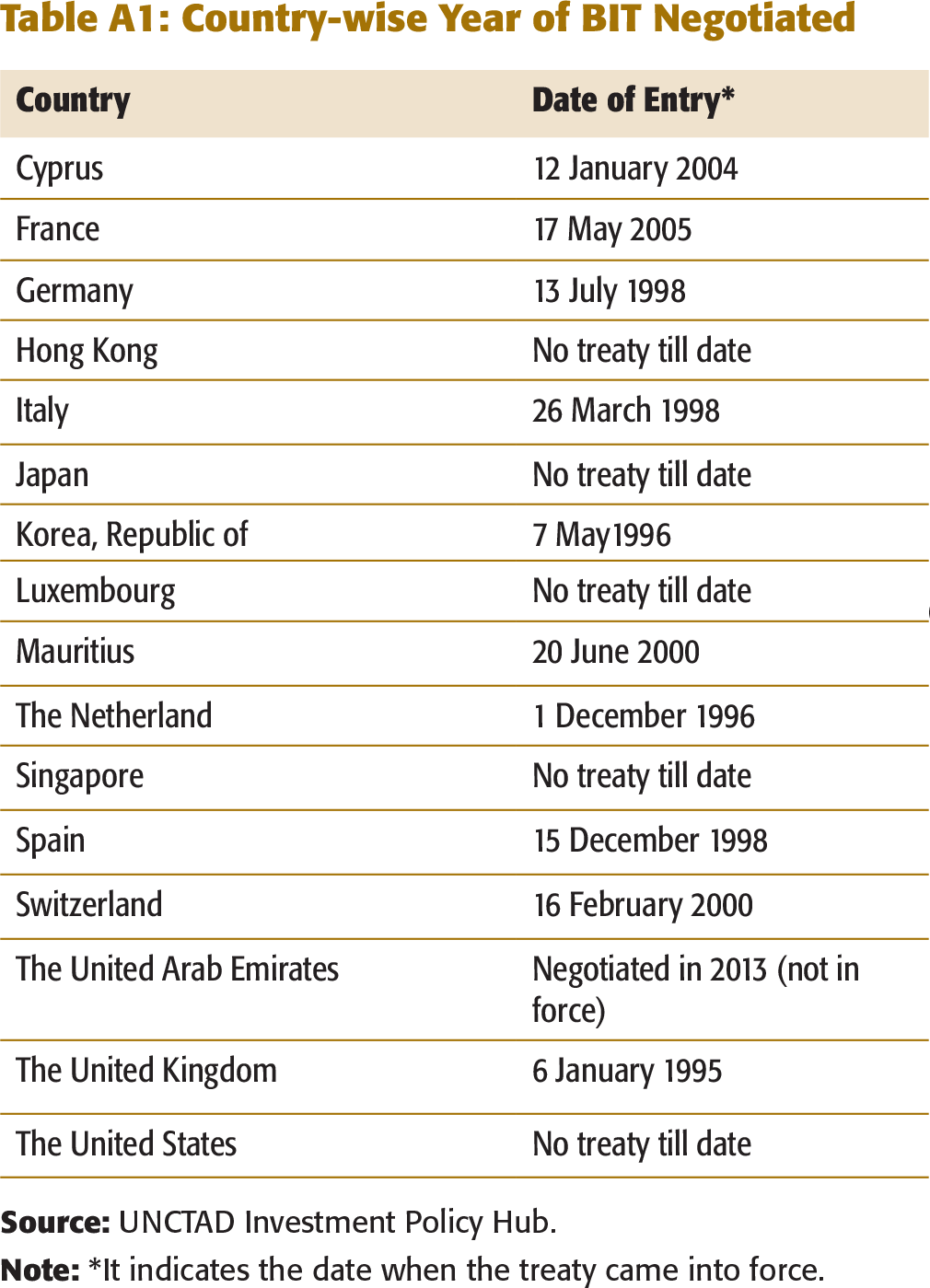
India has been actively negotiating BITs since liberalization to intensify cross-border flows of investment. It had only one BIT (in force) in 1995, but till 2013, there were 69 BITs in force out of the 84 negotiated (UNCTAD, n.d.). An upward trend in BITs for India can be seen in Figure 1. In developing countries like India, investment treaties are considered as a commitment to protect investors and to provide them with a more certain, predictable, and supportive environment. Investors contemplating FDIs require better institutional quality, supportive policies, and reduced restrictions on entry and operation. A comparison of FDI trends along with trends in BITs shows that along with an upward trend in BITs, India has also experienced a surge in the total FDI inflows in the last two decades (Figure 1). Post-liberalization, India is constantly working towards establishing a conducive environment for FDI, and BITs are a significant step in this direction.
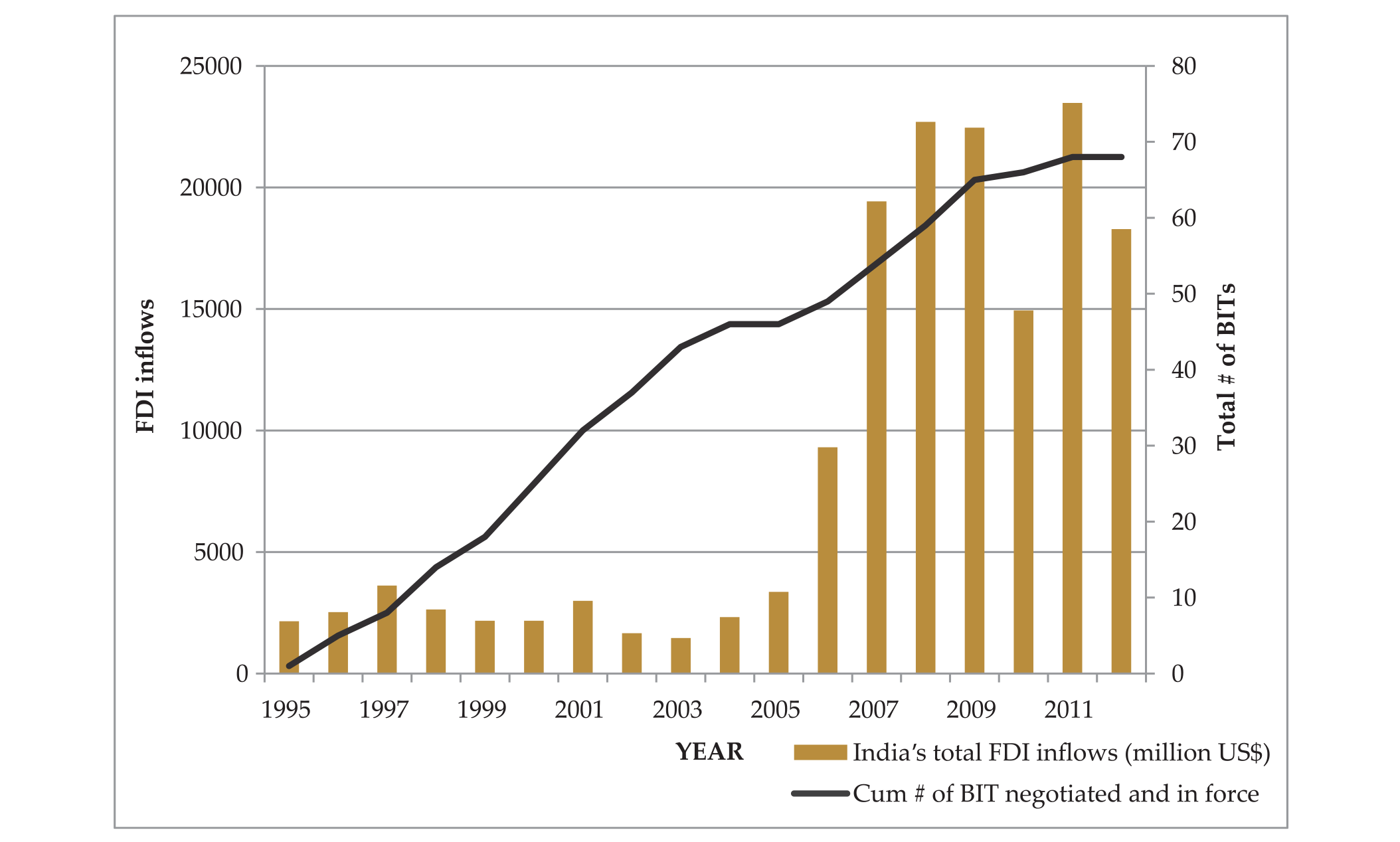
India’s FDI Inflow (in Million USD)
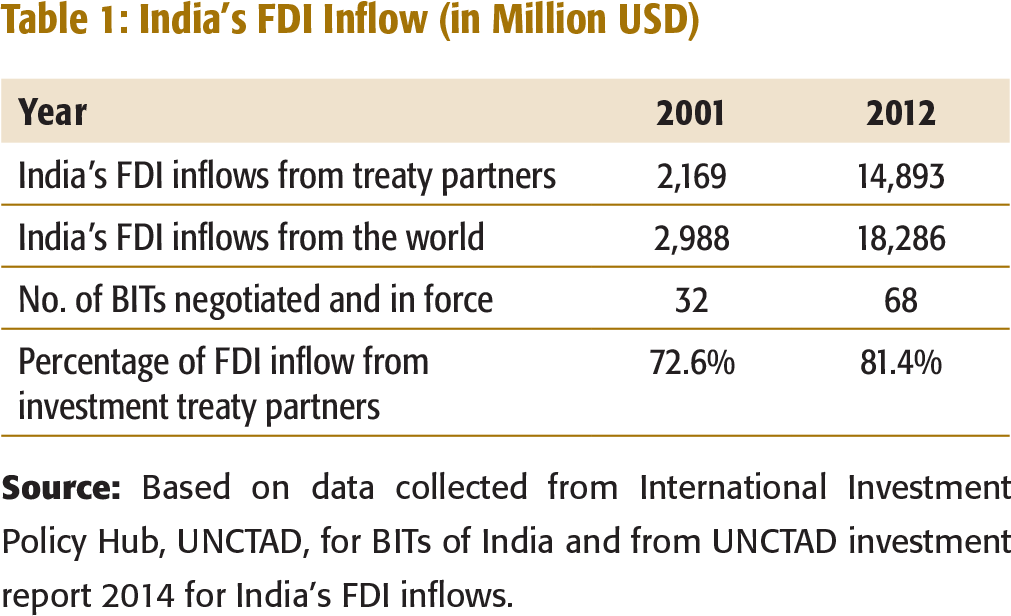
Region-wise Distribution of India’s BITs (as on 31 December 2013)
LITERATURE REVIEW
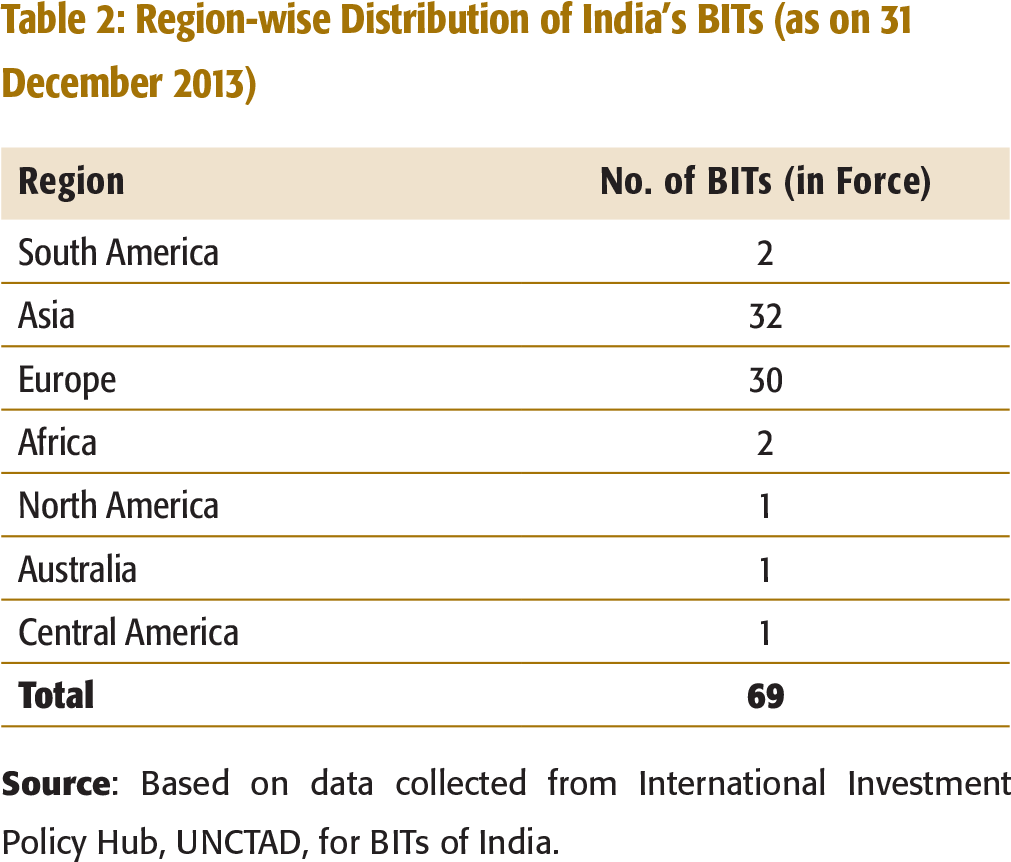
We look at some of the recent literature capturing the relationship between investment treaties and investment flows. While some studies estimated a positive association between BITs and FDI flows, others did not come up with such encouraging results. Studies by Hallward-Driemeier (2003) and Tobin and Rose-Ackerman (2004) found a negative relationship between FDI and BITs. Hallward-Driemeier (2003) analyzed the impact of BITs using bilateral FDI flows from 20 OECD countries to 31 developing countries and found that BITs did not serve to attract additional FDI. Tobin and Rose-Ackerman (2003) found the number of BITs having little impact on a country’s ability to attract FDI. However, there appears to be an interaction between the conclusion of BITs, on the one hand, and the level of political risk and property rights protection, on the other. Countries that are relatively risky seem to be able to attract somewhat more FDI by signing BITs. Mina (2010), using the panel data for the period 1984–2002 and adopting a GMM estimation methodology, found that domestic property rights protection institutions, as opposed to BITs, mattered more for OECD investors with investment coming from higher income, middle income, and lower income economies. Banga (2003) estimated the impact of the total number of signed BITs on FDI inflows for 15 developing economies of South Asia, East Asia, and Southeast Asia. The study found that BITs with developing countries did not have a significant impact on aggregate FDI inflows but those with developed countries had a significant impact on FDI inflows. The author attributed such result to large aggregate FDI flows from developed economies in the sample covered.
A number of studies on developed countries found BITs to support FDI inflows (Bae & Keum, 2013; Egger & Pfaffermayr, 2004; Grosse & Trevino, 2005; Guerin, 2011). Egger and Pfaffermayr (2004) used bilateral outward FDI stock data from 19 OECD home countries and 57 host countries (including 27 OECD member countries) to show that BITs exerted a positive and significant effect on outward FDI of home countries in BITs partner host countries, if the treaties were implemented. Grosse and Trevino (2005) examined the impact of BITs on FDIs in 13 countries of Central and Eastern Europe during 1990–1999 and found that foreign investors viewed BITs (together with other institutional improvements) as an assurance of equal treatment of foreign and domestic investors. Guerin (2011) concluded that BITs encouraged EU FDI outflows up to 35 per cent with a partner developing economy. Bae and Keum (2013), covering Korean investment, found BITs significant and positive for outward FDI but negative and insignificant for inward FDI. Cardamone and Scoppola (2012) assessed the impact of trade policies on the outward stocks of FDI of the EU using a model based on the knowledge-capital theory of multinational enterprises over the period 1995–2008. The results showed that BITs in force had a significant and positive impact on the outward FDI. Neumayer and Spess (2005) found that larger the number of BITs negotiated, better was the flow of FDI inflows to the developing countries. The results of studies focusing on developing countries are mixed. Busse, Koniger, and Nunnemkamp (2008) showed that BITs did promote FDI flows to developing countries and that they could also substitute weak domestic institutions. Büthe and Milner (2004) hypothesized that the greater the number of BITs to which a developing country was a party, the more attractive it was as an investment location. Pradhan (2011) traced the origin and growth of outward FDI by emerging Chinese and Indian multinationals and examined the locational determinants of such investments. He found that while Chinese multinationals had preference for hosts with locational proximity, small size, and high natural resource endowments, Indian firms appeared to choose countries with large size and those that had a BIT with India irrespective of their physical distance from India.
Select Literature on the Impact of BITs on FDI
DATA AND RESEARCH METHODOLOGY
We employ panel data regression on an extended gravity model to identify the determinants of FDI inflows into India with special focus on BITs. The basic gravity model was proposed by Tinbergen (1962) to explain international bilateral trade. In the literature, studies examining bilateral trade and investment patterns have intensively used this model. Foreign investment caters largely to two distinct domains, namely, expansion of market size (horizontal motives) and easing of production processes using cheaper labour (vertical motive). Carr, Markusen, and Maskus (2001) captured the extended gravity model for investment explaining both horizontal motivation and vertical dimensions of FDI. We study the layout of the gravity model for FDI capturing both horizontal and vertical aspects adapting the knowledge-capital model (Carr, Markusen, & Maskus, 2001). To encompass the horizontal dimension, the study uses the market size as an aggregate of the GDP of both the trading economies. To examine the vertical motives (or factor endowment), we calculate the difference in the GDP per capita of both the trading partners. So, we use the extended gravity-knowledge capital model (also known as the CMM model) to examine the determinants of FDI inflows.
Sample Period and Coverage
This study covers a period of 12 years from 2001 to 2012 to capture the impact of BITs on India’s FDI inflows. The countries covered are Japan, Italy, Singapore, Hong Kong, Germany, France, Cyprus, the USA, the UK, the UAE, Switzerland, Spain, the Netherlands, Mauritius, Luxembourg, and the Republic of Korea. In 2012, these countries accounted for 92 per cent (approximately) 1
Calculated on the basis of data collected from UNCTAD, Bilateral FDI Statistics 2014.
Country-wise Year of BIT Negotiated
Data Sources
The data on India’s FDI inflows from a trading partner were obtained from the UNCTAD database (UNCTAD, 2014b). For independent variables, the GDP, the GDP per capita, inflation (measured as consumer price index), and the official exchange rate were taken from the World Bank database. With respect to other explanatory variables, political constraint index data were collected from the Political Constraint Index Dataset (POLCON) Macro Data Guide (NSD, 2011). The data for BITs negotiated by India were gathered from Investment Policy Hub, UNCTAD (n.d.). The data for the distance between the capitals of both the countries were taken from CEPII (French Research Centre for International Economics, 2013).
Model Specification
The majority of the empirical work on the gravity model for investment have either used FDI flows or FDI stock as a dependent variable. Since we are using the panel data with different source countries, it would be more appropriate to use FDI flows because the calculation of FDI stock would be heterogeneous across countries (Globerman & Shapiro, 2002). Moreover, data for India’s FDI stock from its investing partners are available only for a very short period (2010–2012). In view of the discussion, we use FDI inflows as the dependent variable.
We use a double log model for panel data regression to analyse the determinants of FDI inflows between India and its investing partner. As the data figures for some of the years are zero, we follow the protocol of expressing the dependent variable as log(1 + FDI) in order to accommodate zero observations (Eichengreen & Irwin, 1995; Rajan, 2008; Stein & Duade, 2007). The basic regression equation used in the study is as follows:
ln(1 + FDI ijt ) = α + β1 ln(GDPit. GDP jt ) + β2 ⎜ ln GDPpc it - GDPpc jt ⎜+ β3 lnPOPGROWTHjt + β4 lnDISijt + β5 lnFOpenjt + β6 BITijt + β7 ComColijt + β8 LANGijt + β9 POLCONijt +εijt
In order to take care of the dynamics in the equation, the study also incorporates lagged FDI as one of the explanatory variables (Egger & Merlo, 2007; Mina, 2010). For dynamic adjustment, the equation is then written as
ln(1 + FDI ijt ) = α + β (1 + FDI ijt - 1) + β1 ln (GDPit . GDP jt ) + β2⎜ lnGDPpc it - GDPpcjt ⎜ + β3 lnPOPGROWTHjt + β4 ln DISijt + β5 ln FOpenjt + β6 BITijt + β7 ComColijt + β8 LANGijt + β9 POLCONijt εijt,
where
FDI ijt is FDI inflows from the home country i to the host country j (India) for year t,
FDI ijt -1 is one year lag of FDI inflows from the home country i to the host country j (India) for the year t,
GDP it is the nominal GDP of the home country i,
GDP jt is the nominal GDP of the host country j (India),
GDPpc it is the per capita GDP of the home country i,
GDPpc jt is the per capita GDP of host country j (India),
DIS ijt is the distance between the home and the host country (India),
ComCol ijt is the colonial links between India and the home country,
LANG ijt is the linguistic proximity between the home and the host (India) countries,
POPGROWTH jt is the population growth rate of the host country j (India),
FDIopen jt is the financial openness of the host country j (India),
POLCON jt is the political constraints index of the host country j (India),
BIT ij is a dummy variable taking value 1, if the countries i and j have a BIT in the given year t, otherwise 0,
i is the home country, j is the host country (India), t is the time indicator, and ε is the error term.
While some studies used the GDP per capita of the host country to measure the market size (Anwar & Nguyen, 2010; Chakrabarti, 2001), others considered the sum of the GDP of both the investing partner countries in order to capture the market size (Resmini & Siedschlag, 2008). We take the sum of gross domestic product of both the economies to capture the horizontal or extended market size. The coverage of the variable is similar to the variables examined by Park and Park (2006) and Bae and Keum (2013). The variable is expected to be positive in case the host economy acts as an extended market for the home economy attracting horizontal FDI.
The absolute difference between the GDP per capita of the home and the host (India) countries captures the vertical FDI drive. Jang (2011) captured the difference between the GDP per capita of the home and the host economies to measure the relative skill difference. The inflow of FDI is not only affected by the wage structure of the manufacturing sector but is also directly or indirectly magnified by the payment to be done to the non-manufacturing (service sector) related regime; therefore, the GDP per capita differential is incorporated as a measure of skill differential. The variable is expected to be positive if India is able to attract FDI due to relative factor endowment. The coefficient of the variable would depend on the extent to which India is able to encourage (discourage) the inward flow of FDI.
Distance between the home and the host explains whether the geographical proximity between both the countries is attracting FDI or not. In studies covering trade as a dependent variable, distance is associated with the transportation cost. However, in the case of FDI as a dependent variable, the impact of distance will vary depending upon the type of FDI (Egger, 2008; Kayam & Hisarciklilar, 2009). If the motive is to achieve production efficiency (vertical FDI), then lesser the distance more is the flow of investment. For market expansion (horizontal FDI), larger distance will promote investment in the destination economy. The tendency to capture the market by enhancing trade increases with lesser distance. Therefore, the impact of the variable is ambiguous. In order to measure the impact of cultural distance between the home and the host countries, the study incorporates two more invariant variables along with distance, namely, common colonial linkage and common language.
Common colonial link (ComCol) is incorporated as a dummy variable which takes the value 1 if both the economies share a colonial heritage, otherwise 0. Countries with similar colonial links tend to have some historical association which can positively affect FDI. Common Language (LANG) has been included to examine whether countries that share a linguistic proximity tend to be better investing partners. The study incorporates the variable as a dummy variable with value 1 in case both the economies share a common language, otherwise 0.
Political constraints measure whether the political structure and the related policies of India support FDI inflows to India. The study incorporates the POLCON produced by Henisz (NSD, 2011), which measures the political constraints by identifying the underlying political structures and the measures that support credible policy commitments. This dataset developed by Henisz (NSD, 2011) contained 90 variables covering legislative, executive, and judicial offshoots of a government set-up. The study used the index to measure whether the Indian political structure and constraints were supporting inflows in India. The impact of the variable is ambiguous and depends upon the strength of the political set-up. In order to capture the impact of the population growth rate on FDI inflows, we incorporate the population growth rate of the host country (India) and study the impact of extension on the size of the market. The variable measures the impact of the growth in the physical size of the economy (market) on the investment inflows. An economy with growing physical size generally indicates an extension of labour as well as consumer market. Though some studies (e.g., Akin, 2009) had found population growth to not promote FDI, we expect the variable to be significant and positive for a labour-intensive economy like India.
Financial openness of the host country is incorporated to measure the impact of India’s investment policies on FDI inflows. The variable is calculated as the sum of FDI inflows and FDI outflows as a percentage of the GDP in the study. The variable is expected to have a positive impact on India’s FDI inflows.
The variable of our interest, BIT, is incorporated as a dummy variable. The value of the variable is taken as 1 in case a BIT exists between India and the investing countries in the given year; otherwise, it is 0. The variable is used to capture the impact of BITs on India’s FDI inflows and is expected to have a positive sign.
RESEARCH METHODOLOGY
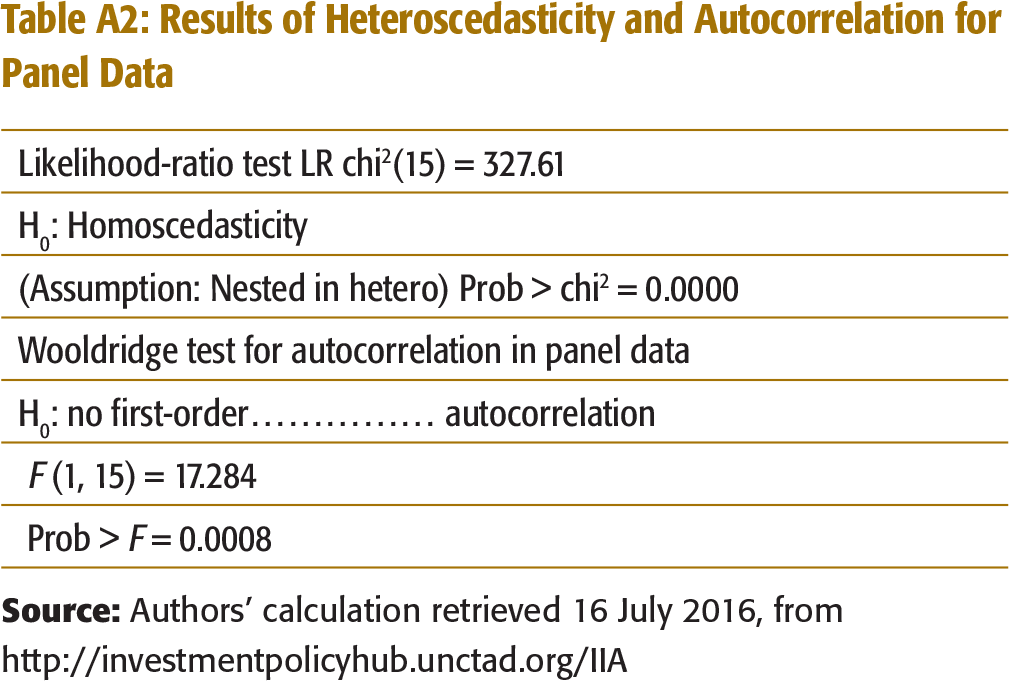
Studies covering the panel data regression model have intensively used the static model (fixed effects or random effects) specifications. A fixed effects (FE) model specification is incorporated in the studies where the individual and/or time-specific effects are correlated with the explanatory variable. Moreover, each cross-sectional entity is recognized with some specific attributes of its own. Baltagi (2001) referred the fixed effects model to be suitable for specifications where the study focuses on a specific set of entities (an individual, a country or firms) and the inference is restricted to the set of such entities. The random effects model is more appropriate when inferences are based on entities (individuals) randomly drawn from a large sample. Mundlak (1978) argued that the random effects model assumed exogeneity for all explanatory variables with the random individual effects, whereas the fixed effects model allowed for endogeneity of all explanatory variables with individual effects. Therefore, it is basically the selection of all or none of the regressors for endogeneity and individual effects. The Hausman test is generally applied to choose between random and fixed effect estimations. The impact of the explanatory variables was examined using both fixed effects as well as random effects specifications. The results of the Hausman test supported the use of fixed effects (Table A1). Therefore, the results were analysed using fixed effects and results for time invariant variables were captured from the random effects specifications.
Results of Heteroscedasticity and Autocorrelation for Panel Data
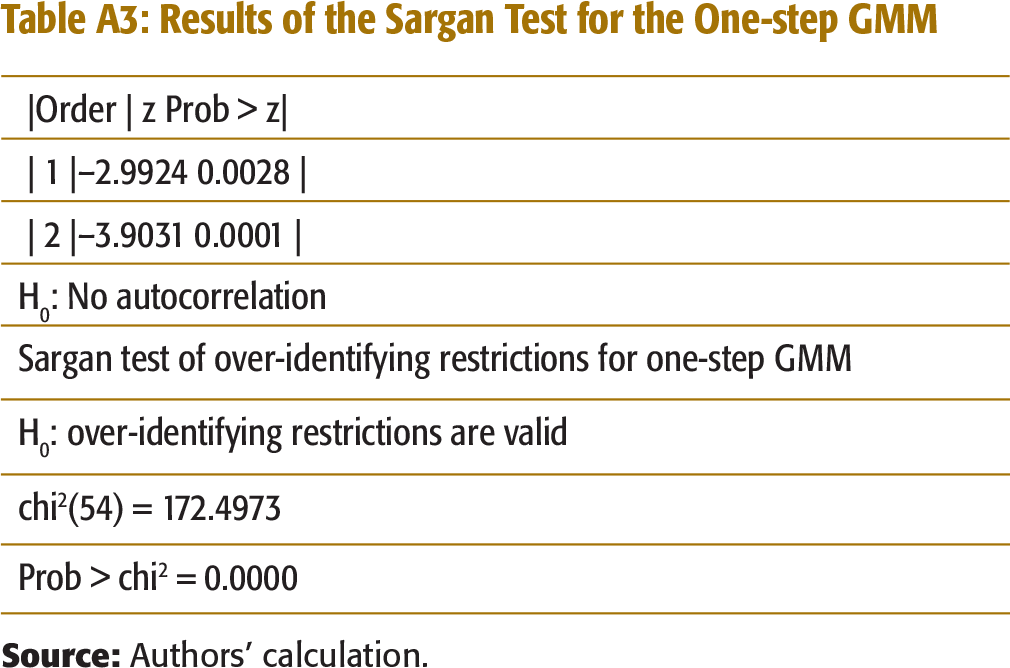
Results of the Sargan Test for the One-step GMM
RESULTS AND ANALYSIS
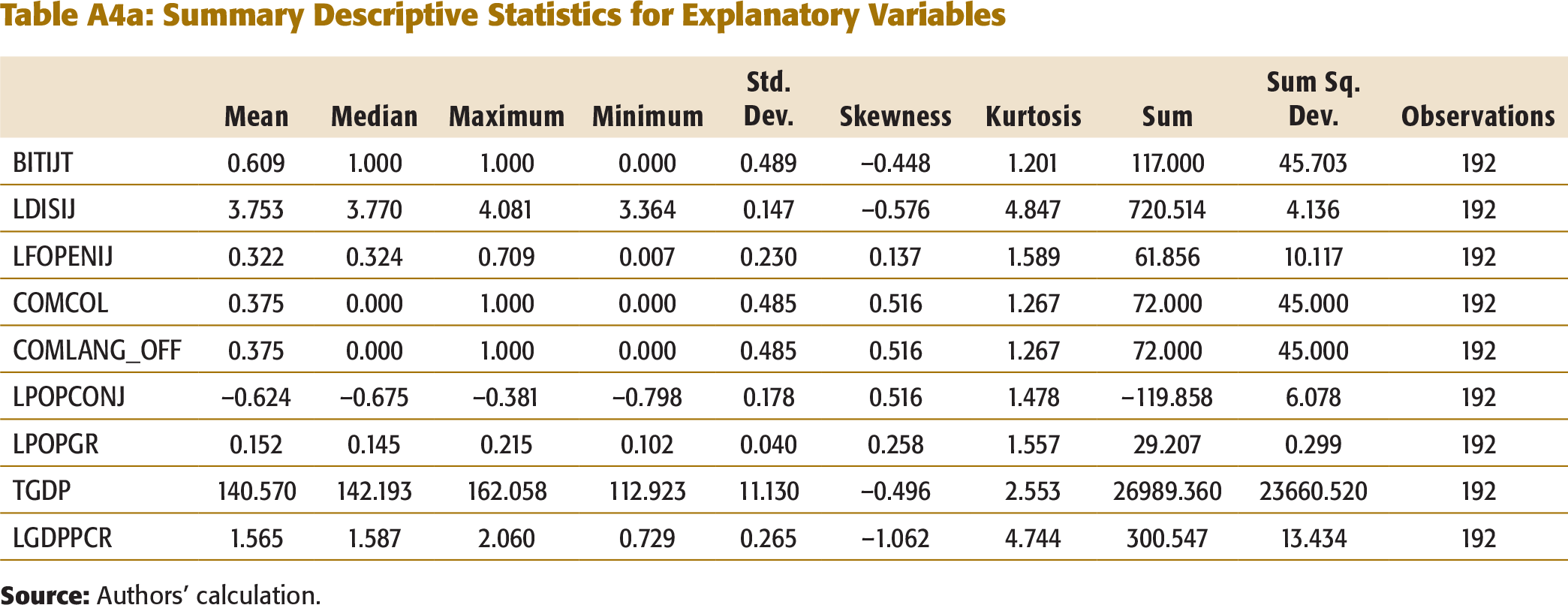
Summary Descriptive Statistics for Explanatory Variables
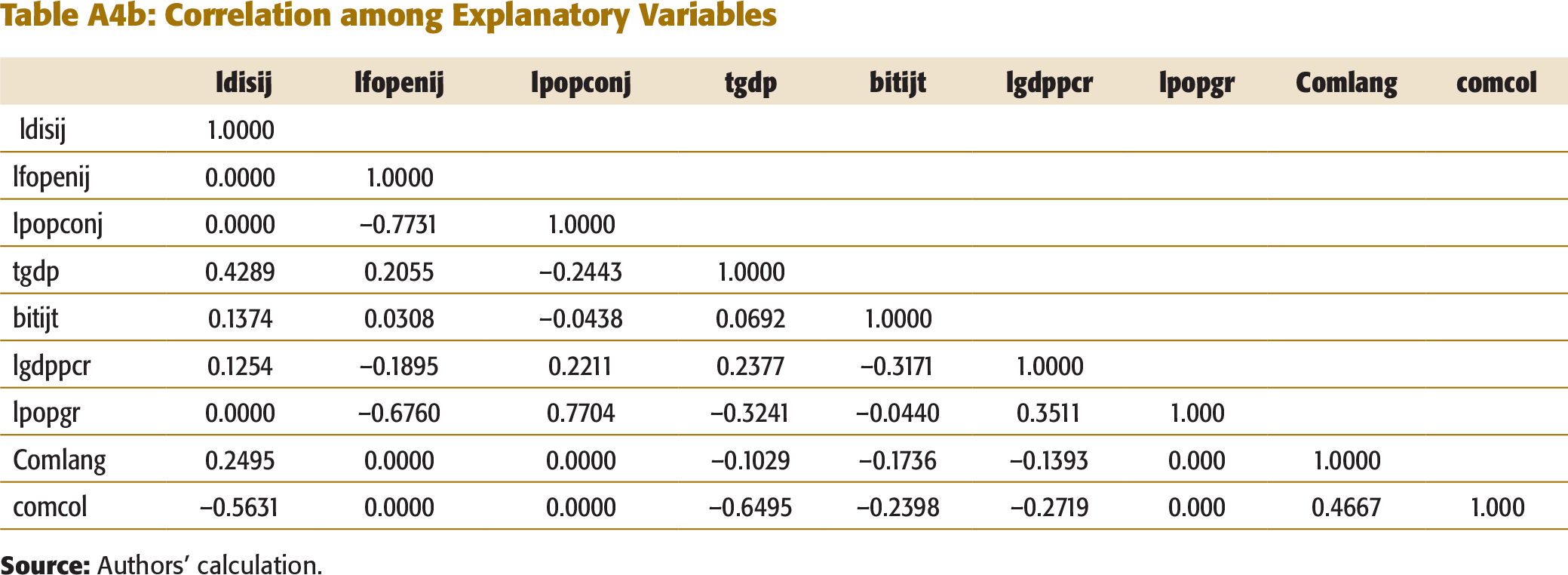
Correlation among Explanatory Variables
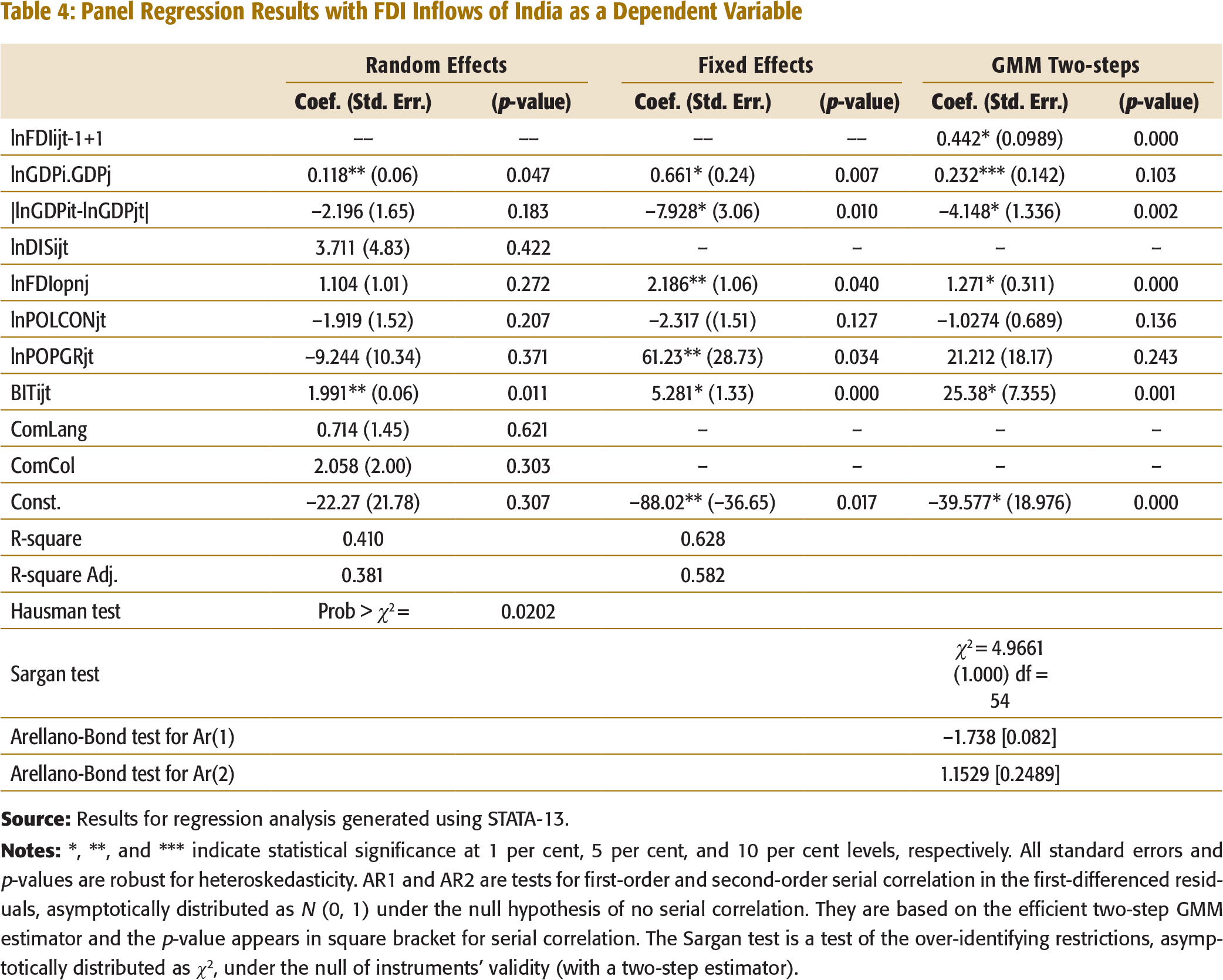
Panel Regression Results with FDI Inflows of India as a Dependent Variable
The sum of the GDP of both the economies is found to be positive and significant indicating a pull towards horizontal FDI inflows in India. With its large market size, India is seen as a captive destination for market-seeking FDI. The variable population growth (POPGR) is found to be positive and significant (only for fixed effects specifications), indicating that the expanding economic market of India is supporting FDI. The difference between the GDP per capita of both the economies shows a negative coefficient. This implies that India as a host economy for vertical integration is not able to attract enough FDI. A possible reason for this result could be that labour cost differentials are not supported by other factors which are instrumental in driving investment decisions such as the quality of supporting infrastructure and institutions. Further, differences in wage levels may not be compensated for by differences in productivity which might contribute to a negative sign for the differential GDP per capita of both the economies (Globerman & Shapiro, 2002).
The coefficients for all the three time invariant variables, namely, distance, common language, and common colonial links, are found to be insignificant using random model specifications. The variable capturing political constraints is found to be negative but insignificant. This implies that an unstable political environment which is not investor-friendly discourages FDI inflows to India, though not significantly. The variable FDI openness is found to be positive and significant, indicating that India is able to attract more FDI with better and liberal economic policies towards investment. The variable of our interest, BIT, is found to be significant and positive, implying that BITs are facilitating and promoting FDI inflows to India. Thus, a developing economy like India can capture and magnify the FDI inflows by entering into investment associations with prospective investing economies. BITs are providing a certain, predictable and investor-friendly environment to multinational firms contemplating investment in India, thereby positively influencing their decision to invest here.
The lag of FDI is found to be positive and significant. This indicates that previous years’ investment trends, if high, encourage investors to invest funds in subsequent years. The lag of FDI is indicative of the existing investment environment in India for the current investment.
The results for the fixed effects and the GMM model specifications are more or less similar. These results confirm our expectations and reinforce the positive role of BITs in facilitating foreign investment. For developing countries like India, such treaties play an important role in creating a conducive environment for foreign investment.
CONCLUSION
India has been attracting large amounts of FDI ever since it liberalized in 1991. The liberalization regime has also seen India become a part of the growing trend of negotiating BITs with a number of its trade and investment partners. This article sought to examine whether BITs were achieving the intended objective of higher FDI inflows to India. Using an augmented gravity model and estimating both under static and dynamic conditions, we find that BITs are playing their desired role in attracting FDI inflows into India. They have contributed to rising FDI inflows by providing protection and commitment to foreign investors contemplating investment in India. The model also finds support for other factors facilitating FDI such as the large size of the economy and a more liberal FDI regime. As attracting FDI is an important policy objective of developing countries like India, the results imply that one of the instruments of achieving this objective is for the government to negotiate BITs with countries that are prospective investors. By laying down clear guidelines with respect to investment and widening the scope of investment activities covered under a bilateral agreement, an environment of certainty is created which would facilitate FDI flows.