




Abstract
Executive Summary
Marketers try to influence consumers through promotional offers by restricting availability of products to a limited number of customers, a limited time period, or a specific segment, thereby creating a perception of scarcity. Such promotional appeal of making a product or offer scarce is called as scarcity appeal.
Literature suggests that people with high need for uniqueness (NFU) prefer scarce products, or at least products which are depleting fast. However, the relationship between scarcity of offers and the NFU has not been much explored.
The objective of this research is to understand how consumers with different levels of uniqueness respond to the scarcity appeal offer, especially with discount. Hypotheses relate to variability of purchase intent and attitude towards the product due to scarcity versus no-scarcity sales promotion appeals and by consumers with high and low needs for uniqueness. Proposed hypotheses were tested using 2 × 2 between-subjects factorial design. Quantity scarcity and no-scarcity appeals were manipulated using pre-tested and validated scenarios. Product used in the scenarios (laptop) was identified through an iterative process of seeking inputs from respondents with demographic profile similar to those in the final sample. Consumers’ need for uniqueness (CNFU) purchase intention, and attitude towards product were measured using scales that were pre-tested and validated using accepted protocols.
On testing the formulated hypotheses using experimental design, it was found that:
Consumers respond more favourably to quantity scarcity appeal offer when compared with no-scarcity appeal offer. Consumers with higher NFU indicate higher purchase intention in a no-scarcity appeal situation when compared with those with low NFU. There is no statistically significant difference in purchase intention of consumers with high and low needs for uniqueness in a situation of scarcity appeal messaging.
In the marketing context, a sales promotion scheme that restricts an offer to a limited number of customers, a limited quantity of product, a limited time period, or a specified segment is referred to as scarcity appeal. Broadly, scarcity appeal is divided into time scarcity and quantity scarcity. Promotional schemes that limit the duration of the offer are denoted as time scarcity appeal. Quantity scarcity, on the other hand, refers to sales promotion schemes that limit the number of products under the promotional scheme such as ‘limited edition’ offers (e.g., special anniversary offer in automobiles), offering discount only on limited quantity of products, and offers valid till the stock is available.
The focus of research on scarcity appeal has been on exploring consumers’ responses to scarce products/offers (Aggarwal, Jun, & Huh, 2011; Eisend, 2008; Jung & Kellaris, 2004; Wu & Hsing, 2006). Literature indicates that purchase intention and attitudes are more positive for products/offers with scarcity appeal than for the products/offers with no-scarcity appeal (Aggarwal et al., 2011; Bae & Lee, 2005; Brehm & Brehm, 1981; Jung & Kellaris, 2004; Snyder, 1992; Snyder & Fromkin, 1980). Most of the empirical work in the scarcity appeal literature has been conducted in the context of physical products and suggests that an individual’s response towards a scarce product (i.e., quantity scarcity) is more positive than towards a non-scarce product (Eisend, 2008; Fromkin, 1970; Jung & Kellaris, 2004; Lynn, 1989; Worchel, 1992; Worchel, Lee, & Akanbi, 1975; Wu & Hsing, 2006). Some of these studies also suggest that compared to consumers with low need for uniqueness (NFU), a consumer with a high NFU values products with scarcity appeal more than products with no-scarcity appeal (Eisend, 2008; Fromkin, 1970; Snyder, 1992).
Scarcity appeal may be attributed to a product that is sparsely available; for example, limited edition of a product like Mont Blanc pen. It can also be attributed to an offer where the product may be available, but the offer on it is restricted (Clow & Baack, 2012). However, only a few studies have explored the impact of scarcity appeal on the offer vis-à-vis no-scarcity appeal on the offer, and even those studies have produced mixed results (Aggarwal et al., 2011; Devlin, Ennew, McKechnie, & Smith, 2007; Inman, Peter, & Raghubir, 1997). Therefore, how do consumers respond to scarcity appeal on an offer is not clearly understood. There is also limited understanding on how do consumers respond to scarcity appeal, especially consumers with a higher NFU vis-à-vis those with low NFU. This article addresses this gap.
In an offer with scarcity appeal, two factors are important: the scarcity appeal (e.g., only for limited time, one per customer, limited stock) and the offer associated with the scarcity appeal (e.g., a specific percentage of price off; buy one, get one free). For example, the advertisement ‘50% discount—only for 15 days’ has ‘only for 15 days’ as a time scarcity appeal and ‘50% discount’ as an offer. Consumers associate different meanings with different types of offers that range from hedonic to utilitarian (Chandon, Wansink, & Laurent, 2000) and as a result, the meaning consumers derive from scarcity appeal may also depend on the type of offer on which the scarcity appeal is provided. Therefore, when a scarcity appeal offer is combined with a discount, consumers’ perception of the appeal may depend on both the discount as well as the scarcity message.
It has often been suggested that scarcity messages lead to a more positive attitude and behaviour of consumers with a high NFU (Eisend, 2008; Fromkin, 1970; Snyder, 1992). However, a discount offer with a scarcity message may not stress the ‘uniqueness’ factor valued by the high NFU consumers. This is because a discount is considered to be high on utilitarian benefits (Chandon, Laurent, & Wansink, 2000), and it is also found to lead to negative quality perception (Darke & Chung, 2005). The perception of high utilitarian benefit and negative quality may dilute the effect of ‘uniqueness’ associated with scarcity appeal. Therefore, the response of consumers with a high NFU may be different from those with a low NFU for a situation, where scarcity appeal is combined with discount versus a situation where scarcity appeal is used without any offer/discount.
In this study, we explore whether individuals with a high NFU value quantity scarcity appeal more than those with a low NFU when the scarcity appeal offer is used in a discount form. In other words, we explore the impact of consumers’ NFU (CNFU) on their response towards scarcity appeal combined with a discount offer. The facts that prior empirical studies have not examined this issue and that there has been a significant shift in the industry practice that gives greater importance to sales promotion offers make this research question important.
LITERATURE REVIEW
There are different types of scarcities or unavailability. Verhallen and Robben (1995) described four different types of scarcities: (a) ‘unavailability’—something no longer available to anyone because of nature or regulation, such as a ban on a product; (b) ‘restricted availability’—availability which is dependent on the membership of a specific group; (c) ‘limited availability’—availability because of market and non-market circumstances; and (d) ‘conditional availability’—availability of a product only if certain conditions are fulfilled. These conditions may be in the form of price to be paid or services to be rendered (Brock, 1968).
Unavailability can occur due to market circumstances, for example, limited supply in the market. Unavailability can also occur due to non-market circumstances, for example, an unexpected increased demand or accidental delivery issues. A marketer can control the market circumstances with the help of different promotional strategies; hence, ‘limited availability’ is considered as a scarcity appeal in this study. Therefore, taking limited availability as a scarcity appeal, in this study, scarcity appeal is defined as ‘the offering which shows limited availability of products or brands’.
The commodity theory in economics proposes that scarcity enhances the value of anything that can be possessed, is useful to its possessor, and is transferable from one person to another (Brock & Brannon, 1992; Brock, 1968). Several studies have suggested that scarcity of a product/brand leads to an increase in its perceived value (Bae & Lee, 2005; Eisend, 2008; Fromkin, 1972; Jung & Kellaris, 2004; Worchel et al., 1975; Wu & Hsing, 2006), higher purchase intention of the products/brands (Bae & Lee, 2005; Snyder, 1992), and lower willingness to spread word of mouth (Cheema & Kaikati, 2010).
The impact of scarcity appeal on attitude and behaviour is found to be influenced by factors such as involvement with the product and product knowledge (Bae & Lee, 2005; Brannon & Brock, 2001), perceived quality of product, symbolic benefits, perceived monetary sacrifice, perceived value (Wu & Hsing, 2006), third person effectiveness (Eisend, 2008), assumed expensiveness (Cialdini, 1993; Lynn, 1989), and deal evaluation or perceived high value of deal (Inman et al., 1997). A meta-analysis of the studies on scarcity appeal shows that the positive impact of scarcity messages on attitude and behaviour is robust across studies (Lynn, 1991).
While scarcity appeal influences attitude and behaviour, the effect depends on certain conditions. These conditions include the perception of the right to deserve the message/product (Worchel, 1992), attractiveness of the product (Verhallen, 1982), source of scarcity, for example, accidental delivery vs planned delivery (Verhallen, 1982), and scarcity due to limited supply vs excess demand (Herpen Pieters, & Zeelenberg, 2009).
Various theoretical explanations have been proposed as to why people respond to scarcity appeal more than no-scarcity appeal.
THEORETICAL EXPLANATIONS
How Scarcity Influences Attitude and Behaviour
Consumers show a more positive attitude and behaviour when a product or offer is scarce than when the product or offer is non-scarce. Theoretical explanations have been provided by psychologists on the reasons for this enhancement in attitude and behaviour due to scarcity appeal.
Uniqueness Theory
According to this theory, people are motivated to maintain a sense of being special as they define themselves on various important self-related dimensions relative to others (Snyder, 1992). People develop a need to be unique depending on their perceived similarity with their reference group. When they feel themselves to be too similar to their reference group, they develop a high need to be unique, whereas when they feel themselves to be too dissimilar, they develop a high need to be similar to the reference group (Snyder, 1992; Snyder & Fromkin, 1980).
According to Snyder (1992), people like to be moderately different from other members of their reference group. To be moderately different from the reference group, people act in different ways, such as possessing unique objects, using intellectual arguments in public, and showcasing that they have a unique mate (Snyder & Fromkin, 1980). The perception of people being too similar to or dissimilar from a group affects their emotions and behaviour. Scarce information and products become helpful in making them moderately different from the reference group and, thus, help them manage their emotions and behaviour. This makes scarcity appeal, that is, a scarce product or information, effective.
Heuristic Cue Theory
Cialdini (1993) notes that people have a tendency to associate things according to their availability. Specifically, scarce products are assumed to be better in quality than non-scarce ones. Therefore, information of scarcity serves as a heuristic cue for people to decide on the quality of the product (Verhallen & Robben, 1995).
Psychological Reactance Theory
Another explanatory framework is based on the work of Brehm (1966), which takes human response to diminishing personal control as the core explanation for the effect of scarcity. According to Brehm (1966), when opportunities become less available, a person loses freedom. Because people tend to value freedom, the loss of freedom creates a desire to preserve that established freedom. Increasing scarcity interferes with prior access to some items and, thus, creates a hurdle for the freedom of accessing them. People will react against this interference by wanting and trying to possess those items more than before (Cialdini, 1993). Thus, a desire to possess products/services develops more when they are scarce than when they are non-scarce because of the perceived loss of freedom.
Need for Uniqueness
NFU is described as people’s desire to be different as a result of their perception of similarity with others (Snyder, 1992). Snyder (1992) argues that the individual who finds herself/himself to be too similar to others develops a high NFU, whereas the individual who finds herself/himself to be too dissimilar develops a low NFU.
There are two behavioural outcomes of a perceived NFU (Snyder, 1992): (a) the behaviour elicited because of a perceived high NFU is the trial of assimilation with the reference group where an individual adopts those behaviours which help her/him to identify with the reference group and (b) the behaviour elicited because of a perceived low NFU is the trial of differentiation from the reference group where an individual adopts that behaviour which helps her/him to differentiate from the reference group. To assimilate themselves, people seek symbols and anchors used by their reference group; to differentiate themselves, people seek symbols and anchors that are different from but acceptable to their reference group (Lynn & Harris, 1997; Ruvio, 2008; Snyder, 1992).
From the counter-conformity perspective, NFU has been divided into three types based on the behaviour manifested (Tian, Bearden, & Hunter, 2001; Tian & McKenzie, 2001). These are creative choice counter-conformity, unpopular choice counter-conformity, and avoidance of similarity. In creative choice counter-conformity, a consumer seeks social difference from most others but makes choices that are considered good by her or his reference group. Unpopular choice counter-conformity refers to the selection or use of products and brands that deviate from group norms; thus, the consumer risks the social approval in order to establish her or his uniqueness from others. Avoidance of similarity refers to losing interest in and discontinuing the use or possession of goods that have become common in the consumer’s reference group. In this study, we follow the definition of NFU from creative choice counter-conformity perspective as explained by Tian, Bearden, and Hunter (2001): A trait of seeking social differentness from most others but making selections that are likely to be considered good choices by these others.
HYPOTHESES FORMULATION
Literature suggests that scarcity offers enhance consumers’ attitudes and behaviours comparatively more than the offers with no-scarcity (Bae & Lee, 2005; Cialdini, 1993, 2009; Jung & Kellaris, 2004). To assess whether this is the case in the context of this study, before comparing impact of quantity scarcity on the high NFU and the low NFU consumers, we have examined two base hypotheses comparing the impact of quantity scarcity to no-scarcity appeal:
B1: Purchase intention for quantity scarcity offer will be higher than purchase intention for no-scarcity offer.
B2: Attitude towards product with quantity scarcity offer will be more positive than attitude towards product with no-scarcity offer.
Relationship between Quantity Scarcity Offer and Need for Uniqueness
From a psychological perspective, scarcity implies that only a few people will have access to an object. Quantity scarcity depends on how much of the object others have purchased (Aggarwal et al., 2011); thus, it helps to infer a symbolic benefit (Jung & Kellaris, 2004). Therefore, the role of significant others in the group becomes important in case of quantity scarcity. As individuals with a high NFU value scarce products, they will be more concerned about the possessions of relevant others. Because quantity scarcity is related to the relevant others (uniqueness theory), it is expected that individuals with a high NFU will respond more favourably to quantity scarcity compared to individuals with a low NFU (Snyder, 1992; Snyder & Fromkin, 1980).
Other studies suggest that discounts may lead to negative perceptions, such as poor quality of the product/deal (e.g., Darke & Chung, 2005). In contrast, quantity scarcity indicates that few people can have the offer and, thus, indirectly suggests positive quality inference (heuristic cue theory) or symbolic benefit; thus, there is a combination of two different values in the offer. With the increasing number of offers year by year (Laungani, 2014) in which one offer ends and another one begins, a scarcity appeal offer with a discount may become a common offer available anytime to anyone and thus loses the uniqueness of the offer.
Because of the association of quantity scarcity appeal with a discount which creates negative quality perception, it is expected that the ‘unique’ factor of quantity scarcity appeal may get diluted. It is possible that consumers with a high NFU will put less value on scarcity offers because these offers are becoming very common; this is in opposition to low NFU consumers who are not concerned about a product/offer becoming common. Thus, low NFU consumers prefer quantity scarcity appeal more than high NFU consumers.
H1: In case of quantity scarcity appeal, purchase intention of consumers with low NFU will be higher than that of consumers with high NFU.
H2: In case of quantity scarcity appeal, attitude of consumers with low NFU towards a product will be more positive than that of consumers with high NFU.
A no-scarcity situation may not be a common strategy to attract consumers. But this may be considered a valuable tool to attract high NFU consumers, because it is not related to discount and other offers that may indicate negative quality perception as discussed above. Therefore,
H3: In case of no-scarcity appeal, purchase intention of consumers with high NFU will be higher than that of consumers with low NFU.
H4: In case of no-scarcity appeal, attitude of consumers with high NFU towards a product will be more positive than that of consumers with low NFU.
RESEARCH METHODOLOGY
The proposed hypotheses were tested using 2 × 2 between-subjects factorial design, namely 2 (High NFU/Low NFU) × 2 (Quantity scarcity/No-scarcity). Quantity scarcity appeal and no-scarcity appeal were manipulated with the help of scenarios. CNFU was measured with the 11-item scale from consumer counter-conformity dimension of Tian et al. (2001). One negatively worded item was added to the scale, thus making it a 12-item scale. This NFU scale has been used by other authors as well (Bertandias & Goldsmith, 2006; Cheema & Kaikati, 2010; Clark, Zboja, & Goldsmith, 2007). For measuring purchase intention, a single-item seven-point Likert scale was used that asked, ‘If you are planning to buy a laptop, would you buy the product mentioned above?’ The use of a single-item scale for measuring purchase intention has been found in literature (Haley & Case, 1979; Mitchell & Olson, 1981). We measured attitude towards a product with items containing options such as ‘good/bad, poor quality/high quality, unappealing/very appealing, I do not like it/I like it’ with a seven-point semantic differential scale. The reliability and validity of attitude towards product scales are found to be acceptable (Leclerc, Schmitt, & Dube, 1994; Mitchell, 1986; Reardon, Miller, Vida, & Kim, 2005).
Pre-tests
To select the required elements for the study, the following pre-tests were conducted:
Selection of Product
To identify a product that was relevant for the respondents, a short questionnaire was prepared in which respondents (similar in demographic characteristics to the respondents in the final sample) were asked to list 10 relevant products. The questionnaire was administered to 45 students of a local management institute, out of which 44 were usable. A total of 58 different product categories were considered; 32 respondents mentioned apparel, 30 mentioned laptop, 28 mentioned mobile, 30 mentioned shoes, and 24 mentioned watch. Apparels were not considered for the main study because this category consisted of many different forms of clothes, including formal wear to regular wear, and it would have been difficult to specify one type of apparel for the main study. There was less clarity on footwear as well because of a similar reason. Therefore, laptop was chosen as the relevant sample product.
Scale Pre-test
A scenario was created to test the reliability of measures. For this purpose, a discussion with some students of a local management institute was conducted. Students were asked to mention the most relevant products in their daily use, and mobile phone came out as the most relevant option. The scenario for mobile phone promotion was developed. This question was further administered to five students for feedback, and some corrections in language were made after that. The questionnaire contained NFU items followed by the scenario. After developing the scenario, questions about dependent variables, that is, purchase intention and attitude towards the product, were asked. The questionnaire was administered to MBA students of a local management college. In total, 46 usable responses were found. The Cronbach alpha scores were 0.793 and 0.945 for the 12-item CNFU scale and the 4-item AP scale, respectively. Nunnally (1978) has indicated 0.7 as the acceptable reliability coefficient; therefore, the scales were found to be reliable in the given context.
Selection of Amount of Discount
It is argued that when people feel that the offer is scarce, they respond more positively towards it. For an effective scarcity appeal, therefore, it is important that respondents feel that the offer is scarce.
A discussion with the vendors of laptop companies was conducted to obtain the quantity limit and discount percentage as per industry practice as the initial limits for the study; this was followed by a manipulation check of the same. To make the interviewee from the industry feel comfortable, the interview was not recorded; instead, notes were taken. In the discussion with the managers/vendors, it was found that, as per industry practice, a quantity limit offer was used occasionally. Therefore, it was decided to use ‘only on limited quantity’ offer for the main study. This is in conformity with Aggarwal et al. (2011) who found no difference in results while mentioning specific quantity and time in the experiments versus mentioning only ‘limited quantity’ and ‘limited time’.
It was also found in the discussion with managers/vendors that offering a 10–20 per cent discount was the industry trend for laptops (excluding bulk deals). At times, this discount was increased by 5 per cent. Therefore, to begin with, a discount of 20 per cent was considered and 21 respondents were asked whether they felt that the offer was scarce. Thirteen respondents said ‘Yes’, whereas eight respondents said ‘No’. Thus, the response was mixed. Hence, it was decided to increase the discount from 20 per cent to 25 per cent, and the same activity was repeated with another set of 40 respondents. All except for one respondent found the offer to be scarce for the same type of product. Hence, a 25 per cent discount was considered as the offer in the main study. The same question was also included in the questionnaire as a manipulation check.
Questionnaire Design
As suggested in the literature (Bae & Lee, 2005; Eisend, 2008), quantity scarcity and no-scarcity were manipulated with the help of advertising messages that appeared in the questionnaires. It was decided to use a non-existing and neutral brand name to avoid bias. Therefore, a brand ‘ABC’, which was considered neutral in a discussion with three respondents, was used.
We referred to several print advertisements to assess the essential elements required in the advertisement. It was observed that for laptops, the usual format of an advertisement contained some critical features, a picture, and the deal. Keeping this information in consideration, print advertisements were developed with the help of an expert. There were two advertisements: (a) quantity scarcity advertisement for laptop and (b) no-scarcity advertisement for laptop. Each advertisement comprised of a picture of laptop, the information about the discount, and the information about quantity scarcity. The quantity scarcity advertisement showed the phrase ‘Hurry, only on limited quantity’ after the discount message, and in the no-scarcity advertisement, no information was given; only a laptop with the specified features was shown.
The final questionnaire contained the CNFU scale, cue to the scenarios, and questions for dependent variables, demographics, and manipulation check. The cue to scenario mentioned that the respondent was planning to buy a laptop and that the offered product from ABC company was affordable, but the respondent had to stretch her/his budget a bit. This information also helped to control for specific price information. These statements were pre-tested, and after some modifications, they were included in the final questionnaire. For manipulation check, in case of quantity scarcity appeal, another question was added towards the end of the questionnaire: ‘Do you find this offer to be scarce?’ with ‘yes’ and ‘no’ as response options. Only responses that said ‘yes’ were considered for further analysis.
Sample and Sample Size
Data was collected from the management students of a local management institute. Students as a sample had been considered even in some of the previous studies of scarcity appeal (Aggarwal et al., 2011; Fromkin, 1970; Inman et al., 1997; Lynn, 1989; Worchel, 1992; Worchel, Lee, & Akanabi, 1975).
We decided to perform a tertile split to achieve high NFU and low NFU scores from the data. Because the final collected data had to be divided into three parts using tertile split, there was a difference in the number of cells of the full design of the main study and the number of cells for which data were collected. Therefore, for the purpose of data collection, there were two cells: 1 (NFU) × 2 scarcity type (Quantity scarcity/No-scarcity). After the tertile split of the NFU scale and dropping of the middle values, the data resulted in four cells: 2 (High NFU/Low NFU) × 2 (Quantity scarcity/No-scarcity).
The targeted sample size for the study was 30 per cell (Cohen, 1988) as it was thought that the large effect size was required to see the differential effect of time ‘versus’ quantity scarcity. Data had to be collected on two independent cells, and each cell was to be split into three different cells (high, medium, and low). To obtain a minimum sample of 30 in each of the three cells after the tertile split from one cell, a minimum of 30 × 3 = 90 data points per cell were required. Therefore, the total required sample size was 2 × 90 = 180.
Data Collection and Validation of Measures
Before collecting the main data, face validity was assessed. To establish face validity of the scales, three people knowledgeable in the domain were asked to assess the scale. This was required because some words may not have necessarily had the same meaning in the cultural context of this study. The evaluators, after reading the items of each construct, explained the issues they faced with a specific item or word and recommended changes in each of those items. For example, for item number 6 (item number 11 in the 31-item scale of Tian et al., 2001) in the CNFU scale that contained the word ‘run-of-the-mill’, it was suggested that the word should be changed to a simpler word, so that respondents could understand the meaning in their cultural context. Therefore, the word ‘run-of-the-mill’ was replaced by ‘products-in-daily-use’. Similarly, item number 8, ‘I purchase products which are very common because I don’t want to stand out in a crowd,’ was added to include a negative-worded item in the scale, thus making CNFU a 12-item construct. Attitude and purchase intention scales were kept as they were.
In total, 189 responses were collected. Out of these, six respondents had said ‘No’ to the manipulation check and, hence, were removed from further analysis, thus reducing the number of usable data to 183. After the tertile split and the deletion of data of the middle group of the tertile split (from these 183 responses), 122 responses were found to be usable. The Cronbach alpha scores were 0.94 and 0.92 for the 12-item CNFU and 4-item AP scales, respectively. Nunnally (1978) has indicated 0.7 to be an acceptable reliability coefficient; therefore, the scales are reliable in the given context and may be used for further study.
RESULTS AND ANALYSIS
The assumptions of analysis of variance (ANOVA) are independence of errors, homogeneity of variance, and normality of errors (Gamst, Meyers, & Guarino, 2008). Independence of error variance is maintained by randomizing the respondents to the experiments. Leven’s homogeneity of variances is 0.140 (F = 1.859) for PI and 0.969 (F = 0.481) for AP, with df1 = 3 and df2 = 118 for both PI and AP, showing that the error variances of the dependent variables are homogenous. The errors are also found to be normal, as observed in Q-Q plots in Figure 1. Thus, the data meets the required assumptions of ANOVA.
Results of Base Hypotheses
The result of the main effect for purchase intention is shown in Table 1. The result suggests that overall, there is a significant effect of scarcity message F (1,120) = 6.166; p < 0.05. A multiple comparison also indicates that purchase intention in case of quantity scarcity (M = 5.04; SD = 0.215) is higher than the purchase intention in case of no-scarcity (M = 4.295; SD = 0.215), p < 0.05. Hence, the first base hypothesis is supported.

ANOVA Output of Base Hypothesis 1
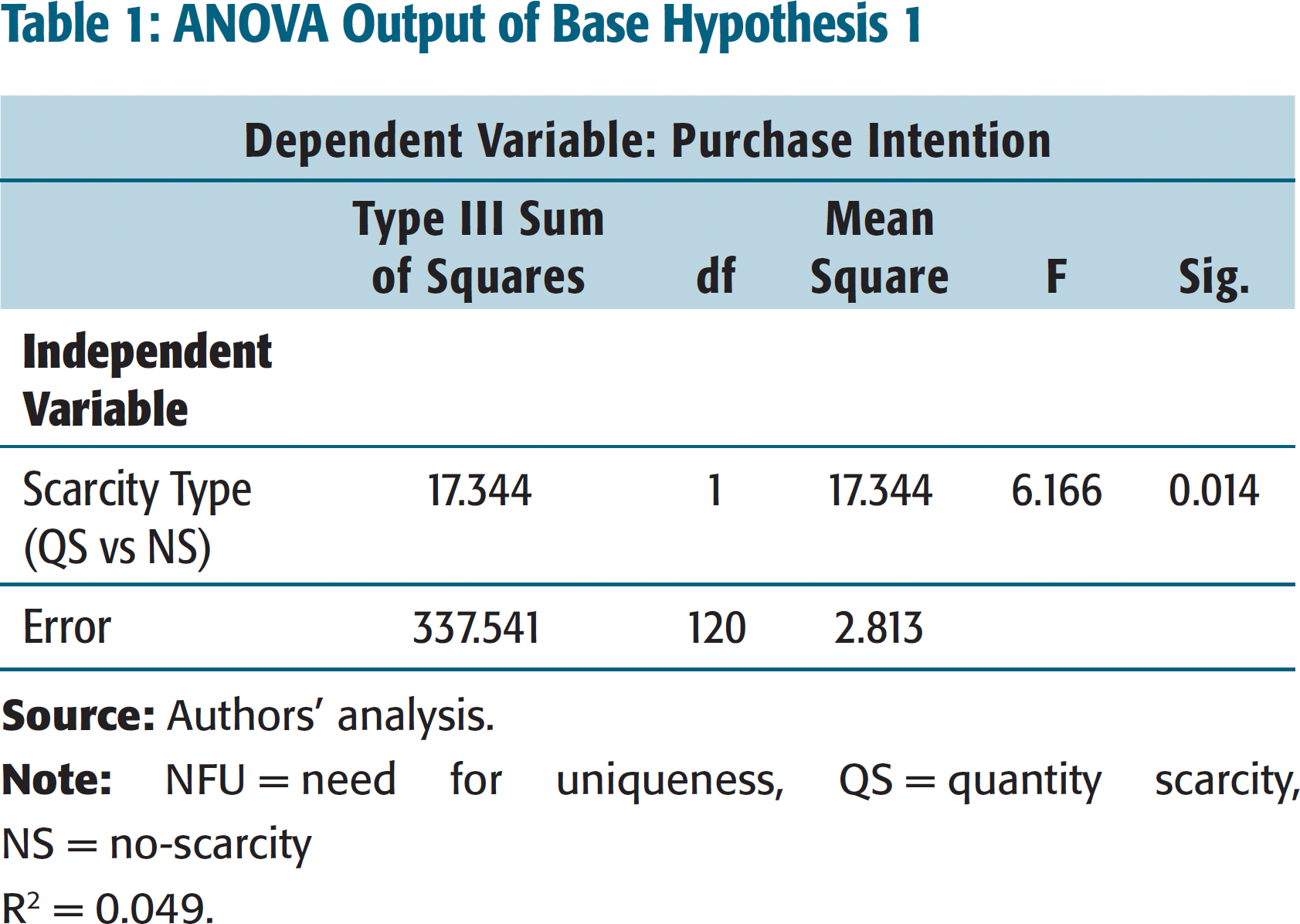
R2 = 0.049.
ANOVA Output of Base Hypothesis 2
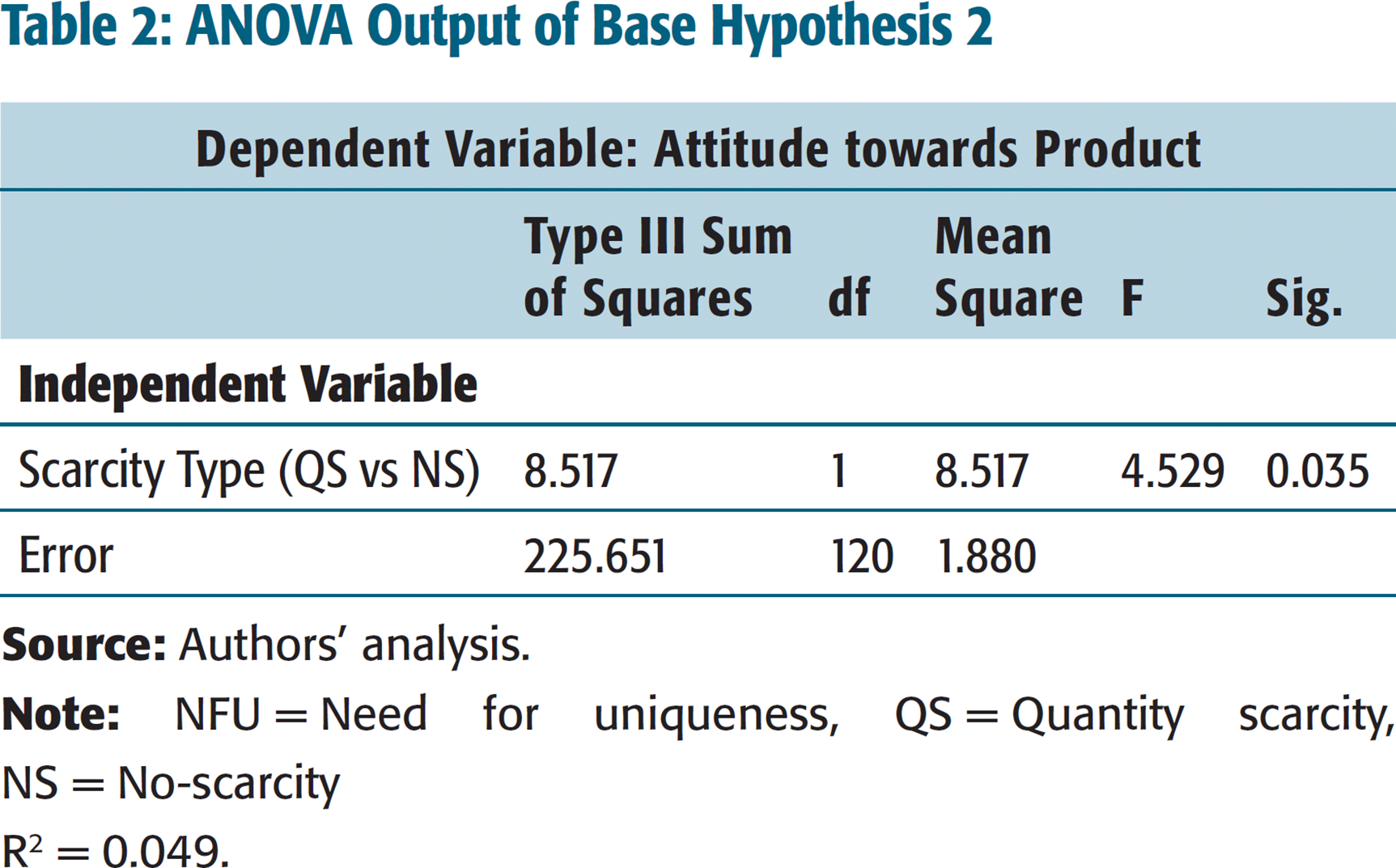
R2 = 0.049.
These results suggest that consumers’ response to scarcity appeal is higher than no-scarcity appeal.
Results of Hypotheses 1 and 3
: Descriptive Statistics of Purchase Intention and Attitude towards Product
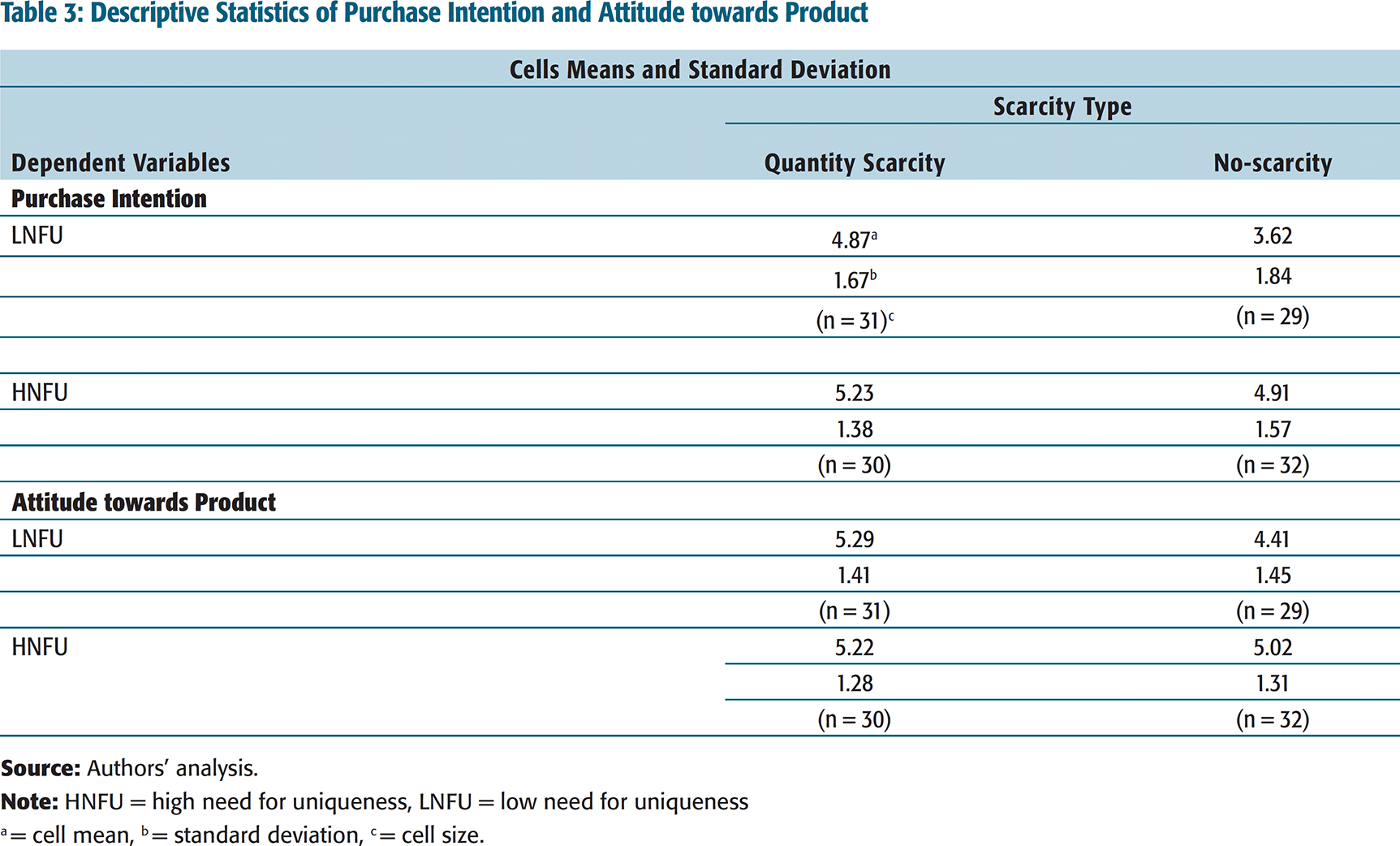
= cell mean
= standard deviation
= cell size.
ANOVA Output of Purchase Intention
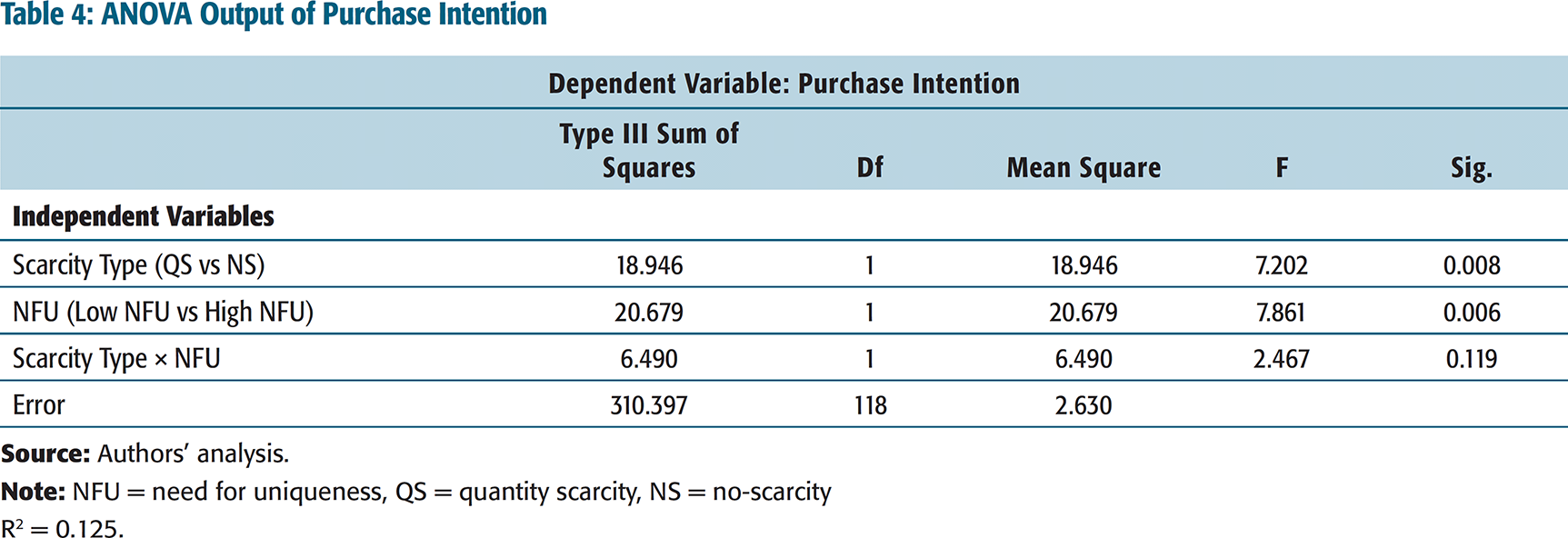
R2 = 0.125.
The result suggests that there is a significant main effect of scarcity message F (1,118) = 7.202; p < 0.05, a significant main effect of the NFU F (1,118) = 7.861; p < 0.05, and no significant interaction effect F (1,118) = 2.467; p > 0.05.
A pairwise comparison indicates that the mean score of purchase intention for the quantity scarcity message for consumers with low NFU (M = 4.871; SD = 0.291) is not significantly different from that of consumers with high NFU (M = 5.233; SD = 0.296) as p > 0.385. Therefore, H1 is not supported. This could be either because of message-related issues or non-message-related issues. One message-related issue could be that the scarcity offers are announced so frequently that perception of scarcity in these offers has been lost, and the focus of consumers has shifted to the offer itself (i.e., discount in this experiment case) rather than scarcity appeal (i.e., limited quantity offer). Similarly, the perception of uniqueness may have been diluted because scarcity appeal is combined with a discount, which is found to be associated with negative quality perception (Darke & Chung, 2005). A non-message-related issue could be that the perception of scarcity is associated with the type of product quality or the brand name in addition to the message. Because these issues were controlled in the experiment, neither the impact of brand name nor the impact of product quality type was studied.
A pairwise comparison also indicates that the mean score of purchase intention for a no-scarcity message for consumers with high NFU (M = 4.906; SD = 0.287) is significantly higher than that of consumers with low NFU (M = 3.621; SD = 0.301) at p = 0.002. Therefore, H3 is supported. Thus, when no-scarcity appeal is used, the purchase intention of high NFU consumers is higher than that of the low NFU consumers. Furthermore, there is no difference in the purchase intention of high NFU consumers and low NFU consumers in the case of quantity scarcity appeal. These findings suggest that both high and low NFU consumers value quantity scarcity appeal equally, but consumers with high NFU value no-scarcity appeal more than consumers with low NFU.
Results of Hypotheses 2 and 4
ANOVA Output of Attitude towards Product
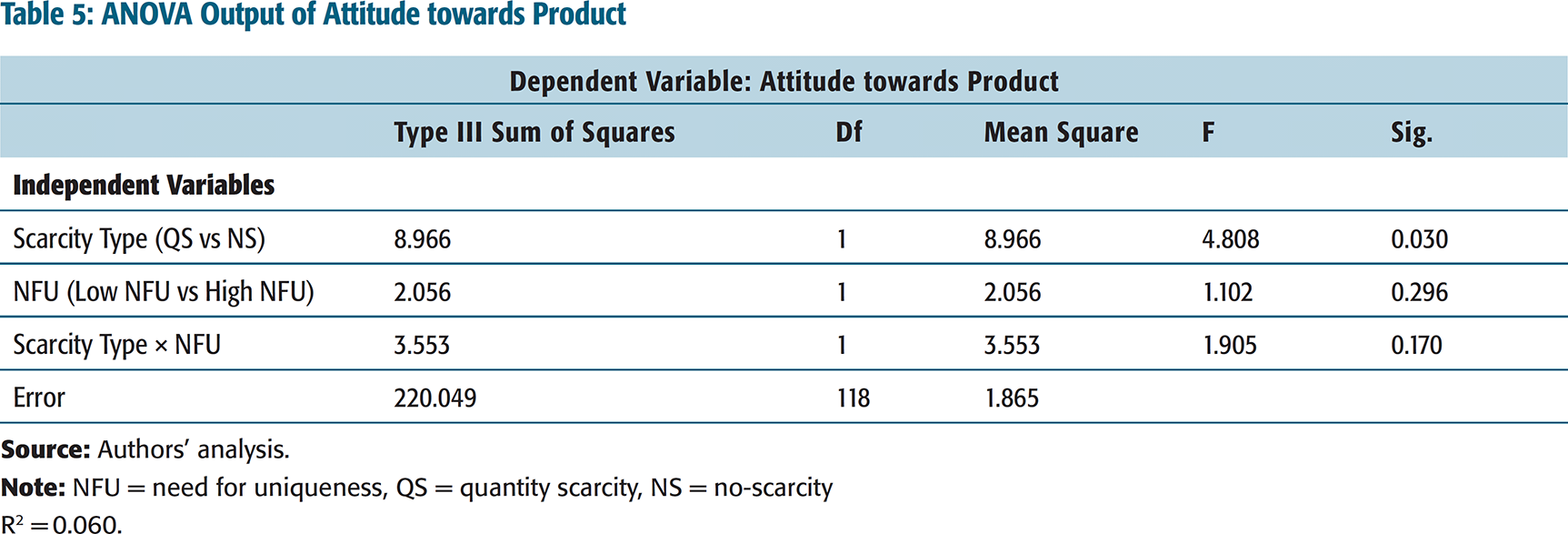
R2 = 0.060.
A pairwise comparison analysis reveals that the mean score of attitude towards product for quantity scarcity message for low NFU consumer (M = 5.298; SD = 0.245) is not significantly different from that of the high NFU consumers (M = 5.217; SD = 0.249), as p > 0.05. Therefore, H2 is not supported. A multiple comparison also indicates that the mean score of attitude towards product for no-scarcity message for the high NFU consumers (M = 5.016; SD = 0.241) is not significantly higher than that of the low NFU consumers (M = 4.414; SD = 0.), as p < 0.05. Therefore, H4 is not supported. Hence, it can be concluded that there is no difference in attitude towards products with no-scarcity message between high NFU consumers and low NFU consumers. Additionally, there is no difference in attitude towards a product with a quantity scarcity message for high NFU consumers and low NFU consumers. In short, unlike purchase intention, attitude towards a product is not influenced by scarcity/no-scarcity appeal. The possible reason could be that purchase intention is due to the offer, whereas attitude towards the product is an outcome of the product. Because the product was the same across experiments and the offer changed, attitude towards the product did not differ but purchase intention did.
DISCUSSION
The results suggest that consumers respond overall more favourably to quantity scarcity appeal offer compared to no-scarcity appeal offer, as found in the base hypotheses. This finding is as suggested in literature. However, when the response of a NFU variable was explored in these overall data, it was found that consumers’ response to a specific scarcity appeal type could vary depending on an individual’s NFU level.
Specifically, the findings suggest that purchase intention in case of quantity scarcity is not different for high NFU consumers and low NFU consumers. Moreover, purchase intention in case of no-scarcity is higher for high NFU consumers than low NFU consumers. This is a contradicting result because the literature supports the argument that scarcity offers are more highly valued by high NFU consumers than low NFU consumers (Brock, 1968; Cheema & Kaikathi, 2010; Snyder, 1992). Therefore, this result indicates that, in the context of scarcity appeal on an offer, purchase intention for high NFU consumers is higher than low NFU consumers only in the case of no-scarcity appeal. One of the possible explanations is that the scarcity offers are announced so frequently that perception of scarcity in these offers has been lost, and the focus of consumers has shifted to the offer itself rather than the scarcity appeal. Furthermore, the perception of uniqueness may have been diluted because scarcity appeal has been combined with a discount, which is found to be associated with negative quality perception (Darke & Chung, 2005). Another reason could be that the perception of scarcity for the NFU consumers is dependent on the product type or brand name and not on the message of ‘limited quantity offer’.
Findings also suggest that attitude towards a product for high NFU consumers is not different from that of the low NFU consumers, irrespective of the scarcity type. It may be argued that though scarcity has an impact on purchase intention for both high NFU consumers and low NFU consumers, attitude towards a product is independent of the type of scarcity offers. Therefore, quantity scarcity appeal offers can influence purchase intention but not attitude towards a product.
The study would be helpful for managers in designing the offers for a specific target segment.
It indicates that, if the target is specifically consumers with high NFU, a scarcity appeal offer combined with discount may not be a good choice. Instead, no-scarcity appeal may be a better option.
When combined with other deals such as discounts, scarcity appeal might lead to target multiple or different segments. In this study, purchase intention for scarcity offer was not different for consumers with high and low NFU. This study helps in understanding that scarcity appeal can be valued by other audiences too (here, by consumers with low NFU). This understanding may be helpful for managers for designing scarcity appeal offers for the prospective target segment.
It is also helpful for managers to understand that scarcity appeal might help in achieving higher sales, but the final attitude towards the product is not dependent on scarcity appeal. Attitude towards a product might be influenced by other factors, such as actual usage, word of mouth, and product quality. Therefore, offering scarcity appeal (indicating uniqueness) should be backed up by relevant product and brand attributes.
LIMITATIONS AND FUTURE DIRECTIONS
This study has explored scarcity appeal in promotional contexts and has not considered other contexts of scarcity appeal, such as free products and additional service with the scarcity offer. It is limited to one product category. However, the results might differ for other product categories.
This study has explained that purchase intention of consumers with low NFU may be equivalent to those with high NFU for certain types of offers. It is well established in the literature that consumers with high NFU value scarcity appeal because of their need for identity for being unique. Future studies may explore the underlying values of low NFU consumers that impel/enhance their behaviour towards scarcity appeal.
Moreover, scarcity appeal has been studied in a situation in which a scarcity offer is combined with a discount. Future studies may focus on impact of scarcity appeal with different types of offers, such as free gifts or ‘buy one, get one free’ promotions. The results of scarcity appeal with different types of offers may be compared to understand if there is any difference in scarcity appeal when associated with different types of offers. Quantity scarcity is used here as a form of scarcity. Other types of scarcities, such as time scarcity, may be explored for the issues mentioned in this study. Future studies may also explore whether similar results are found if the hypotheses are tested for a different product category.