




Abstract
CURRENT SITUATION
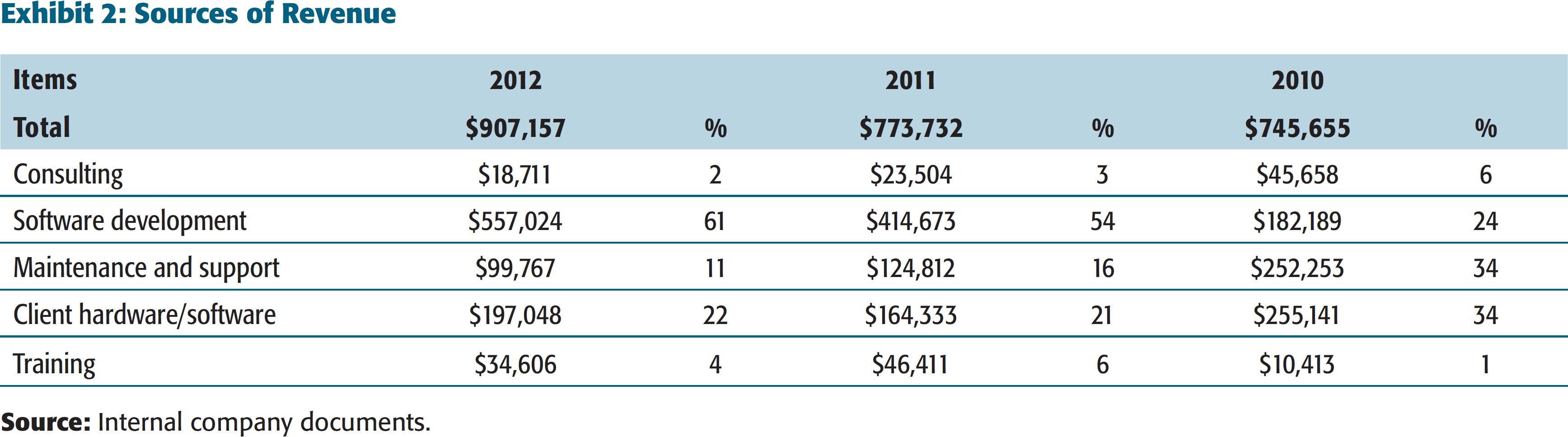
Georg hoped to generate yearly revenue of $1,500,000 along with a net income of at least $100,000 by the end of 2015. These goals were based on Georg’s desire to increase the marketability and value of his business to outside investors as he aspired to sell his business and retire in 5–10 years. He reasoned, ‘Profit margins must grow from current levels to support an attractive valuation of the company.’ The past decade had been spent developing the current line of products and services that had become extremely versatile and were easily implemented by new clients. While the business was beginning to reach full capacity with its existing team of employees, there was room to support greater sales. Additional employees would be necessary over the next few years if the business continued to expand as it had in the past. The company’s largest source of revenue came from its software development operations that accounted for 61 per cent of the revenue in fiscal year 2012. The remaining revenue came from a mix of hardware sales/rentals, technical support, consulting, and training services (Exhibit 2).
COMPANY BACKGROUND
Income Statement

Sources of Revenue
Source: Author created.
BLS originally began as a computer programming and technical consulting firm. One of their first projects was to develop KPMG’s time management software that allowed employees at KPMG to enter and track their billable hours. As the company was formed only a few years after the Internet had become available to the public, some of the projects initially completed included the improvement of company websites and database integration. Consulting services were also provided which included product research and strategic planning for organizations. What originally attracted Georg to the broadcast media industry was a contract that he had received in 1996 to develop a computer program for a television channel which generated his interest to continue to seek out similar projects. After that Georg was hooked; he said, ‘It’s amazing seeing your work displayed on live television.’ Georg was also attracted to the ability to compete on an international level with limited resources. Ever since then, he had been expanding his product offering in this industry, and the company now offered a wide variety of products and services. The company underwent a rebranding initiative in April 2012 whereby a new logo and website were developed (Exhibit 4).
PRODUCT/SERVICE LINE
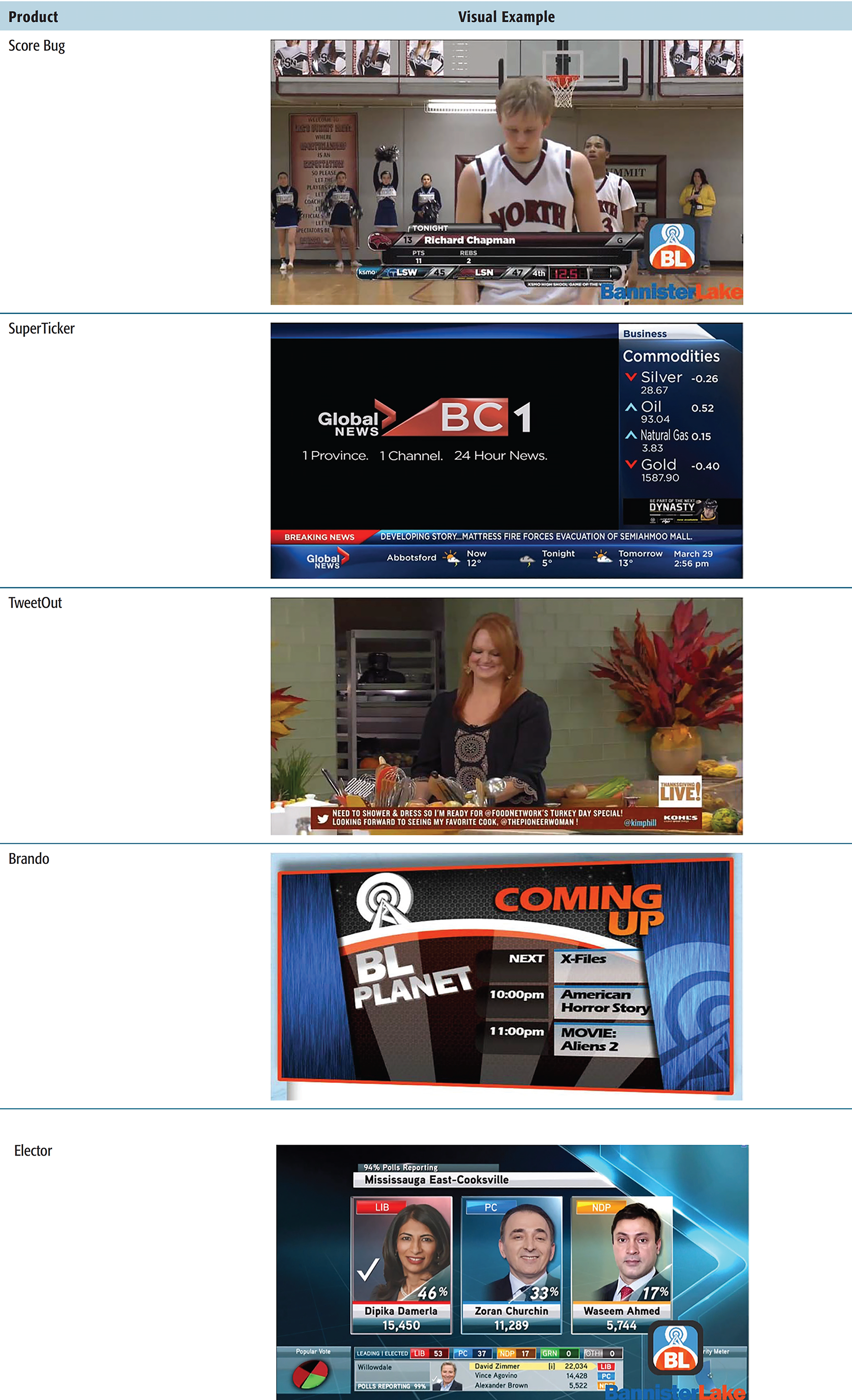
BLS had developed several products to serve the broadcast media market including:
Score Bug News Ticker TweetOut Brando Elector
BLS also offered various services to support and complement its range of products. These services included training, graphic design, technical support, and the installation of computer hardware equipment for customers. These services accounted for approximately 17 per cent of BLS’s revenue in 2012 (Exhibit 2).

Score Bug (also known as a Score Banner or Score Bar) was a layer of graphics that appeared on the top or bottom of a sports broadcast to provide the viewer with information about that game. It provided real-time statistics and data to the viewer and was designed to operate during live television broadcasts. BLS provided Score Bug to clients for a variety of sports including hockey, basketball, football, rugby, soccer, curling, lacrosse, and tennis. 1
Retrieved 8 January, 2016 from http://www.bannisterlake.com/broadcast-graphics/score-bugs/
A News Ticker was similar to a Score Bug in that it displayed a series of graphics during a television broadcast. However, the content displayed varied greatly depending on the channel; a news channel might display content from multiple sources simultaneously such as stock quotes, weather conditions, and sports scores. Social media elements were also beginning to become more pervasive, whereby users on Twitter and Facebook were able to contribute their comments and views to be displayed during a broadcast.
Specifically, TweetOut was BLS’s product that allowed for social media integration during television broadcasts. This product was becoming popular because of the rising and prominent role of social media. Georg estimated annual growth of at least 10 per cent in this segment of the market. BLS’s premium News Ticker software was called SuperTicker; it enabled the user to create customized graphics, automatically display real-time data from selected sources, and incorporate social media into their programming.
Brando was an automated branding solution that allowed the user of the software to create a playlist of customized graphics to display selected information to the viewer. An example of this was a schedule of upcoming shows that might appear during commercial breaks or at the end of a programme (Exhibit 5). This solution provided additional value by allowing for months of programming to be entered into a schedule and broadcast automatically.
Elector was an election results’ display system that combined automated data from external sources and manually entered content relevant to the channels viewership. Results of regional, provincial, and national Canadian elections could be broadcast in real-time or on a time-delayed schedule.
COMPANY CULTURE
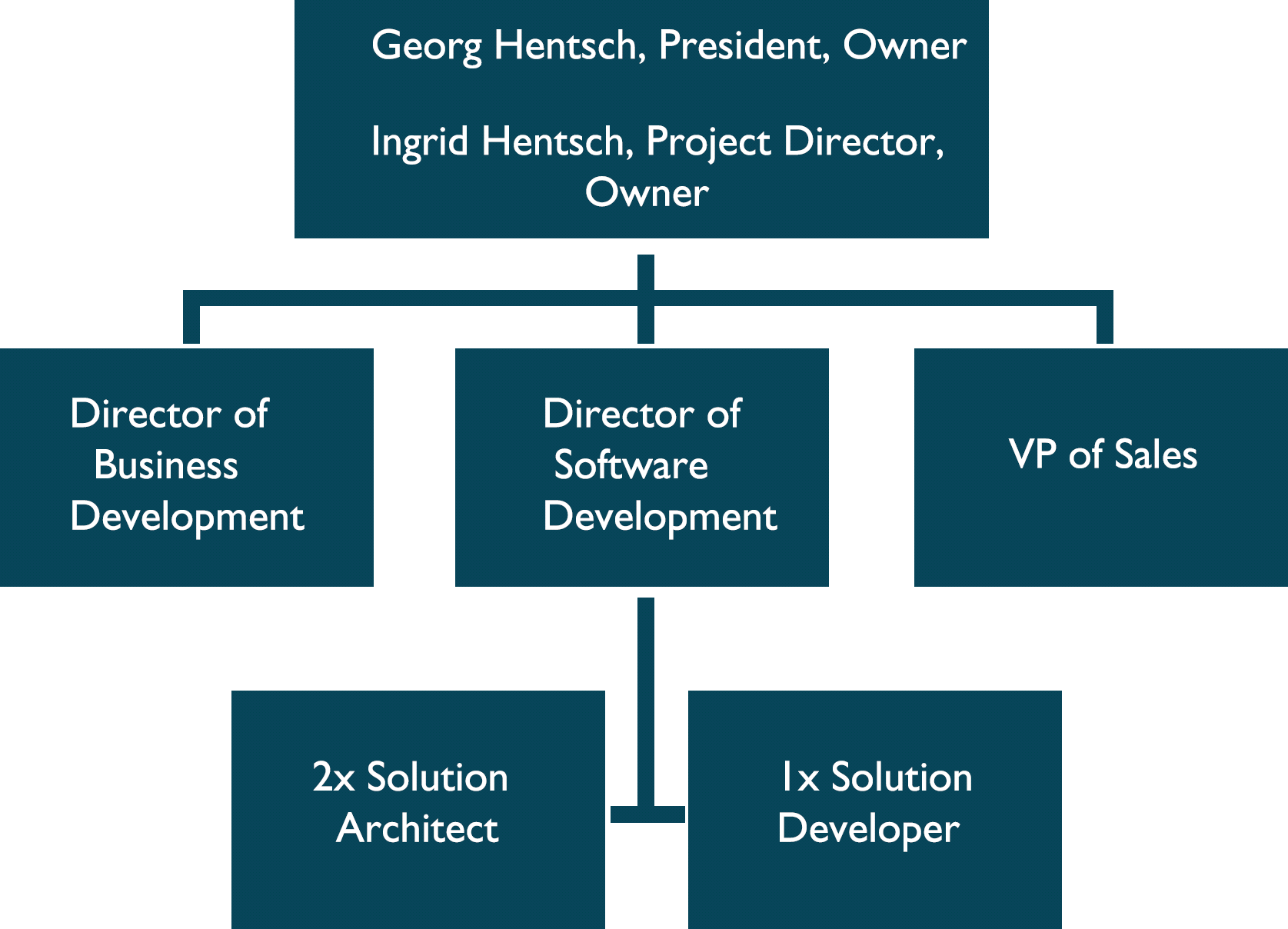
As BLS was a digitally connected workplace, employees worked remotely from home and communicated to one another through conference calls, instant messaging, email, and Skype. The culture Georg had created focused on two main things: flexibility and cohesion. All members of Georg’s eight-person team knew each other well and had a clear understanding of what their role was within the organization along with their individual strengths and weaknesses. When employees were working on a task, deadlines were set but the employees were typically given significant autonomy on how they chose to handle the assignment. BLS’s small workforce allowed the company to make decisions much faster than a larger organization while ensuring that everyone on the team had the ability to contribute his ideas and concerns throughout the decision-making process. Georg believed that if he had to use one word to sum up his team, it would be family.
WHAT DIFFERENTIATED BANNISTER LAKE SOFTWARE INC. FROM ITS COMPETITORS?
BLS offered easy-to-use, affordable, and innovative graphics solutions for a wide variety of uses combined with reliability and 24/7 customer support. The display solutions were versatile and designed to integrate seamlessly with the existing infrastructure of a client, and allowed for the automation of data entry for video graphics display to improve the productivity of the client’s organization. Many of BLS’s competitors were significantly larger corporations with greater overhead and labour costs; BLS’s small team of industry professionals was able to work remotely to produce premium solutions for clients cheaper than competitors, and thus had the ability to compete on price if a client was working on a tight budget. This flexibility on pricing translated to a large number of smaller clients along with consistent business from several large clients in any given year, such as Rogers Communications, Canadian Broadcasting Corporation, CTV Television Network, and Global Television Network (Global TV). Another benefit of working with a smaller team was the ability to produce solutions for clients faster and more efficiently than most competitors. All members of the team assigned to a given project worked in a state of cohesion such that everyone on the team was working towards a common goal in a supportive environment. The relatively flat hierarchy of the organization reduced the bureaucracy experienced by many larger organizations that allowed for more open communication among employees and a quicker response to problems that might occur.
BROADCAST MEDIA INDUSTRY
For comparative industry statistics, Georg looked at the US market because he felt, ‘the American market is by far the largest, and offers the best predictive value for the industry overall’. The broadcast media industry was driven by advertising revenue, which was predicted to grow at a compounded annual rate of 2.8 per cent until 2017 in the United States. 2
Retrieved 15 January, 2014 from http://www.tvtechnology.com/business/0107/bia-kelsey%E2%80%94localus-media-ad-revenue-growth-predicted-through-/222376
Ibid.
The broadcast media industry faced another threat that went hand in hand with lower advertising revenue—a drop in subscribers to cable television. For 2012, there was a net loss of 80,000 cable subscribers in the United States. Net gains of 445,000 subscribers in Q1 2012 could not offset subscriber losses throughout the remainder of the year. 4
Retrieved 20 January, 2014 from http://www.tvtechnology.com/business/0107/cable-suffers-its-first-annualnet-subscriber-loss/219493
Retrieved 25 January, 2014 from http://www.rapidtvnews.com/index.php/2013032226912/global-lcd-tvsales-decline-in-2012.html
PARTNERSHIPS WITH ROSS VIDEO LTD AND HARRIS BROADCAST
In May 2010, BLS entered into a partnership with Ross Video Ltd (Ross Video), a privately held Canadian company that designed, manufactured, marketed, and supported a wide range of products for use in broadcast, live event, and production applications. 6
Retrieved 25 January, 2014 from http://www.rossvideo.com/about-ross/company-profile/
BLS also had a similar partnership with one of Ross Video’s competitors, Harris Broadcast, through which commissions were earned when BLS sold Harris Broadcast’s character generators to customers. BLS was also an OEM developer for Harris Broadcast, as custom solutions were built for clients using the Harris Broadcast character generators. Georg stated, ‘I would be interested in pursuing other partnerships in the future if it would provide benefits to both parties involved.’
OPERATIONS
BLS provided its products and services to approximately 50 clients throughout the 2012 fiscal year. While the revenue received from most clients was between $5,000 and $50,000, there were five larger clients providing over $50,000 each. Georg was proud to say those clients were Global TV, Univision Communications Inc., Radio Télévision Suisse, Eastlink TV, and Sportsnet. Most software development sales came from word of mouth (through customers, resellers, and suppliers) and repeat business. Leads also occasionally came from BLS’s partners. Marketing materials and promotional offers had been quite limited in the past; in 2011, a print advertisement was published in an industry-related magazine and approximately $4,600 was spent on the services of a public relations firm to develop press releases in 2012.
Custom software solutions were designed on the basis of client specifications, and the clients were kept involved throughout the process to ensure that they were satisfied with the outcome and were not surprised with the finished product. Demos and prototypes were provided to clients to display the progress made on a project, and once the software was completed and in use, 90 days of free 24/7 technical support was available. With regard to BLS’s offerings that were not custom-made, such as TweetOut and Elector, one year of free technical support was provided, and afterwards the option of monthly billing for continued support was available.
REVENUE BREAKDOWN
Over the past three years, the mix of revenue had undergone significant changes: proportionally, consulting and support fees had declined while software development revenue had increased substantially (Exhibit 2). This was explained by the new business that was recognized over the past year; BLS had a total of 45 different clients in 2012 compared to 32 in 2011. While support and maintenance fees had decreased over the last two years, Georg expected revenues from these services to represent approximately 10–15 per cent of the total revenue in future years. The increase in sales over the last year was partially attributed to the hiring of a solution developer and a solution architect near the end of 2011 that provided greater human capital with which to work.
US/Canada Revenue Breakdown
COMPETITORS
The three competitors posing the greatest threat to BLS were Video Design Software (VDS), Capital Networks Ltd, and BTI Studios. Although BLS was able to offer clients customized solutions, unlike any of these three competitors, all three presented threats to the continued success and growth of BLS. VDS was a broadcast software provider based out of New York with a strong US sales channel. While VDS offered many of the same solutions as BLS, they did not offer web-based solutions, and they did not frequently make changes or add features to their existing software products. The development team at VDS was also smaller than BLS’s team, as they typically focused on increasing sales of their current line of products rather than continuously developing new products.
Capital Networks Ltd was a competitor from Markham, Ontario and a supplier of creation and content management software. They operated in niche markets with a primary focus on digital signage. Digital signage was a form of electronic display, in which multimedia content was delivered to viewers whether it was for informational or advertising purposes. Their audience software platform allowed users to create and manage digital signage displays for broadcast television that competed with BLS’s Brando product. Capital Networks Ltd had a strong software development team and offered a variety of services to customers including training, production assistance, and consultation much like BLS.
BTI Studios was a global company offering many of the same products as BLS. BTI Studios primarily delivered networking solutions but they offered several products, such as severe weather, school closing, and emergency alert solutions. These were products that BLS had thought about developing for some time but did not have in its repertoire. BTI Studios was largely focused on the US market, and therefore posed a threat to BLS’s business development in the United States as many large American broadcasters currently used BTI Studios’ products and services.
While BLS was smaller than these three competitors, this size differential allowed BLS to maintain a stronger focus on providing consistent customer satisfaction and build a strong reputation in the industry. As a large proportion of BLS’s new customers had used the products or services of one or more of these competitors in the past, it was essential for Georg and his team to monitor the products/services offered by these competitors and proactively analyze their strategies to remain competitive as the industry changed over time. Attending conferences had also been important in identifying emerging trends in the industry so that they were able to continue to support the changing needs of their clients. A benefit of a smaller organizational structure was the ability to listen to what its customers wanted and implement those changes quickly in its products; this was something that Georg believed would be much more difficult for larger organizations to accomplish.
FINANCIALS
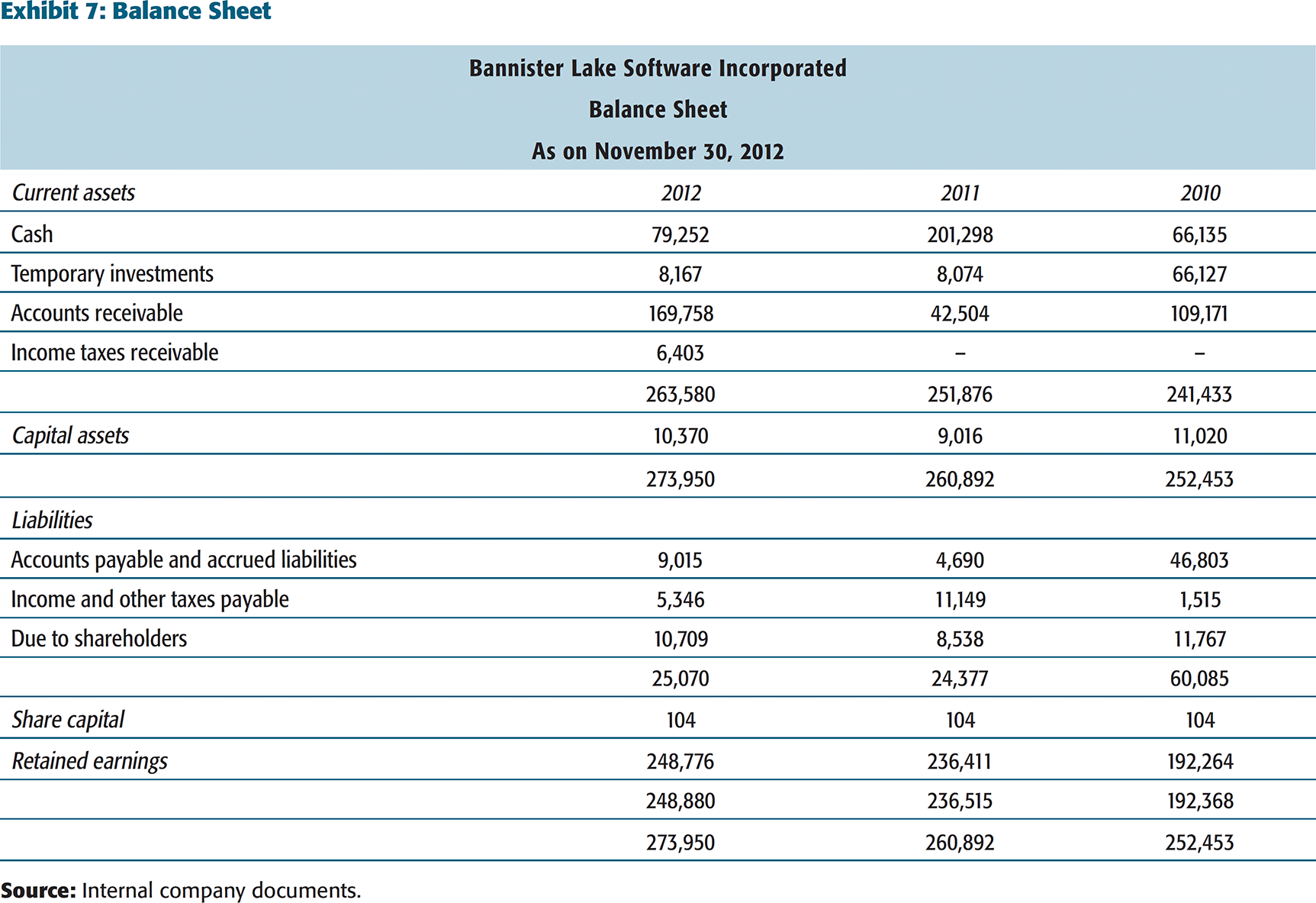
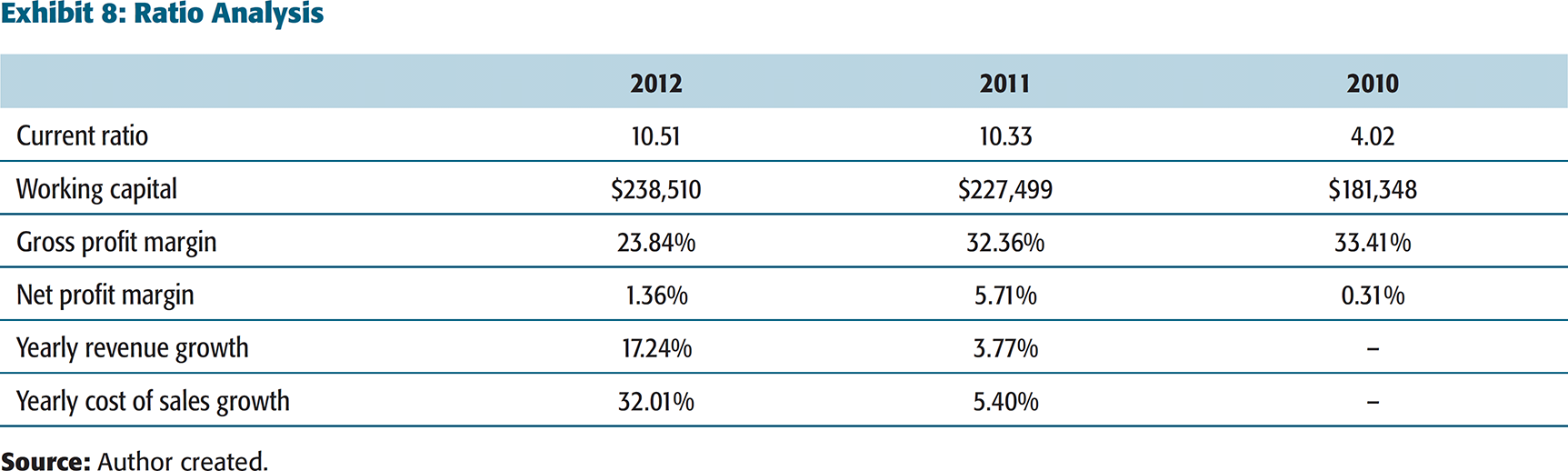
BLS, like many technology companies, operated with little to no debt, which could be seen by the fact that they had no long-term liabilities (Exhibit 7) and a current ratio of approximately 10 (Exhibit 8). However, Georg wondered if this was limiting the organization’s ability to grow, as credit was typically an engine for growth, greater leverage would also increase financial risk. Georg believed that an injection of capital would be an unnecessary risk given the limited need for fixed assets in the development of new products and solutions. The company did have access to a secured line of credit in the amount of $500,000, but it was really only viable for short-term cash needs; the interest rate charged on this line of credit was 3 per cent of the balance borrowed monthly, making it a very expensive option and thus it had not been used in the past.
To clarify the financial statements, a few things should be pointed out. First of all, in terms of the pay structure for employees, Georg and Ingrid had set it up so that the other six employees were recognized as subcontractors with their salaries listed under cost of sales on the income statement. The expense item ‘Salaries and Wages’ was the income that Georg and Ingrid allocated to themselves as owners of the business. All employees listed as subcontractors were paid on a bi-weekly basis and Georg and Ingrid Hentsch paid themselves monthly. There had been an opportunity to improve short-term cash flow if Georg and Ingrid decided to defer payments to themselves to a later month, but this would have only been done if necessary to avoid borrowing money using the line of credit. In terms of ownership, Georg owned 76 per cent of the company and Ingrid owned 24 per cent. As the company was set up as a private corporation, the account ‘due to shareholders’ actually referred to Georg and Ingrid.
BLS typically offered net-30 payment terms to clients whereby payment was due 30 days from the invoice date, although some sales were negotiated at net-45 or net-60. Instalment payments had also been used in the past through which a company might pay a percentage up front with one or more instalments as the work was completed. Typically, new customers were requested to pay either half or all up front, although more flexibility was offered to larger customers. The greatest concern was in collecting payment from overseas customers and full up-front payment was typically sought regardless of the size of the customer. In 2010, there had been a write-off of $63,030 from a customer that had gone through bankruptcy and although a large write-off of this nature was rare, the credit terms offered to customers reflected the inherent risk involved to avoid this from happening in the future. At the end of fiscal year 2012, accounts receivable were over twice the amount of cash held, but this was largely a timing issue, as many invoices were issued in November and the majority of this balance was received in December.
In the past, limited effort had been spent on producing press releases and maintaining a social media presence via Twitter, Facebook, and LinkedIn. For 2012, the proportion of revenue received from clients who were initially made aware of BLS’s products and services through social media was less than 1 per cent. Sales predominantly came from either word of mouth or repeat business and thus little effort had been spent on attracting customers through social media. Georg stated, ‘For the most part social media has been worthless for advertising our products,’ but he did keep an open mind about it. He admitted, ‘There is always the possibility that the company has not spent enough time on social media efforts to hit a tipping point where it would become an effective marketing tool.’
Balance Sheet
Ratio Analysis
STRATEGIC ALTERNATIVES
A variety of alternatives were available to Georg for the upcoming year. The alternatives were not mutually exclusive as multiple options could be selected, assuming it was feasible with BLS’s current and projected future resources.
Attend Industry Trade Shows
A number of broadcast industry trade shows occurred on an annual basis that attracted industry professionals worldwide. Georg and the Vice President (VP) of Sales attended previous trade shows together but had never rented a booth to display products/services to potential customers. Approaches such as commercials and Internet advertising were unlikely to be effective in this niche business-to-business market. Therefore, sales employees with industry contacts, referrals by word-of-mouth, and networking had all been critical in gaining new business.
The trade shows that Georg had thought about attending were the National Association of Broadcasters (NAB) Show and the International Broadcasting Convention (IBC). The NAB Show was an annual conference that took place at the Las Vegas Convention Center in early April. The 2012 NAB Show had an attendance of 91,565, making it the world’s largest electronic media show and attendance for the 2013 show was expected to be over 92,000. 7
Retrieved 10 February, 2014 from http://www.nab.org/documents/newsroom/pressRelease.asp?id=2937
Retrieved 10 February, 2014 from http://www.ibc.org
Georg estimated that the cost of providing an exhibit at the NAB Show or the IBC was approximately $65,000, which accounted for design costs, rental space, and travel expenses. Each of these trade shows would reach a wide audience and had the potential to attract new customers, but it did present risks, given that it was a large fixed investment. Since the company had not purchased an exhibit booth in the past, no reasonable expectations could be formed on the dollar value of new sales leads generated using this method of promotion. A further option would be to forego the renting of a booth and attend one or both of these trade shows to support their partners, Harris and/or Ross Video. While doing so would be unlikely to attract new sales, it would strengthen their existing partnership and would still give BLS the ability to stay up to date on the latest industry trends and network amongst conference participants.
Another option would be to become a corporate sponsor of the Sports Video Group (SVG) Summit in December of 2013. This two-day event took place in the City of New York and was focused primarily on the sports production industry. The cost of sponsoring the event would be $12,800, which included a display table to showcase several of their product offerings including Score Bugs through demonstrations and product walkthroughs to attendees. While the company had been successful in the Canadian sports entertainment market, they had not yet had much business in this area in the United States. In addition to the costs of sponsorship, Georg estimated the cost of travel, meals, and other expenses for two employees to attend to be $1,200. While this event was significantly smaller, with approximately 900 attendees at their 2012 conference, it presented the ability to generate US sales leads for their Score Bug solutions. The dates of the three events were as follows:
2013 NAB Show: 611 April, Las Vegas 2013 IBC: 1317 September, Amsterdam 2013 SVG Summit: 1617, December, New York
Hire Additional Software Developer(s)
Employee referrals were the primary source of hiring new talent at BLS. Employee turnover had been non-existent, and Georg was not worried about future turnover at the moment. While a solution architect and a solution developer were hired in 2011, Georg did not expect the business to be able to handle more than $1,300,000 in annual revenue with the current team of employees. The hiring of an additional experienced software developer would be needed to support revenue growth above that point, as Georg estimated that an additional $200,000–$400,000 in revenue could be supported per new hire in relation to current revenue figures. The salary of a new hire would be fixed at approximately $90,000 annually.
Hire a US Sales/Business Development Employee
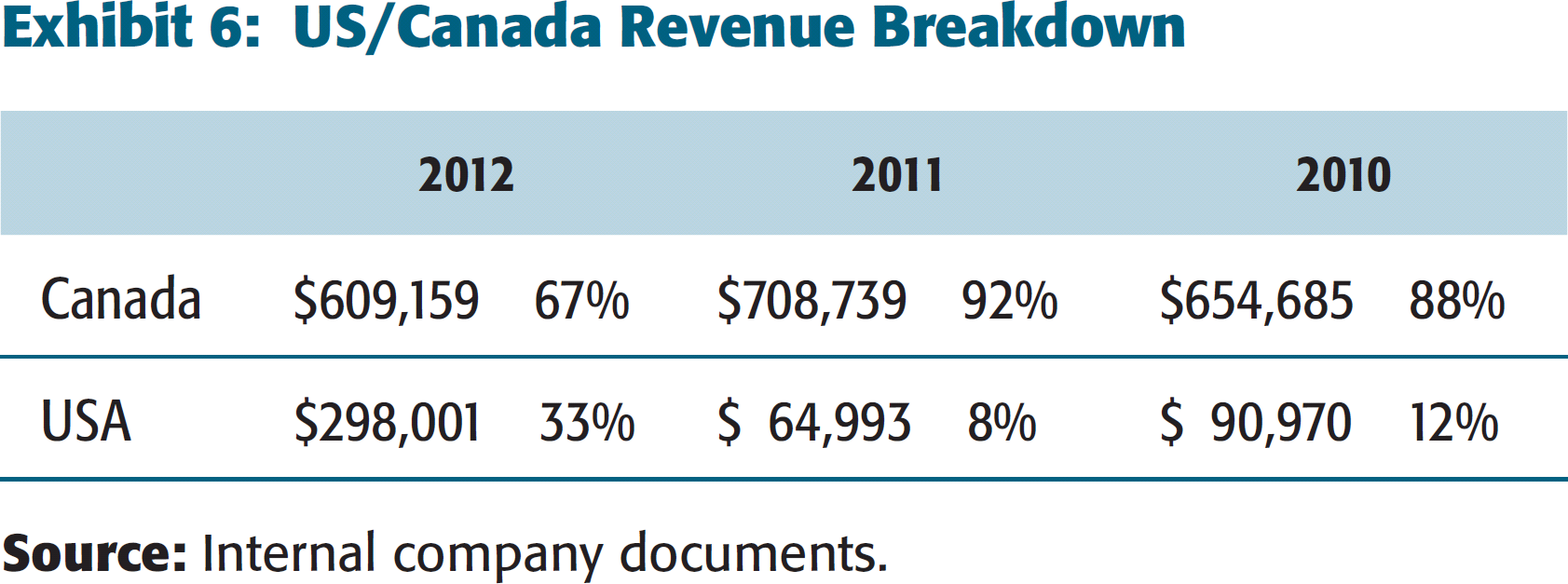
While 33 per cent of BLS’s 2012 sales came from US customers (Exhibit 6), the company had no official presence in the United States. The hiring of a US sales employee might be just what the business needed to facilitate growth in this market and expand its global operations. The compensation package could be either commission based or a combination of a fixed salary plus commission. Two potential compensation packages had been devised as follows: (a) $6,000 a month + 10 per cent commission or (b) 30 per cent commission. While a new employee hired on a commission-only basis would be relatively low risk, the employee would need to have significant experience in the broadcast industry, be well connected, and have a strong reputation in the industry.
Marketing Strategy
Promotional offers had not been used by BLS in the past, but given the desire to increase revenue growth, Georg believed that now might be the time to implement promotional offers on products. One idea was to offer prospective customers the opportunity to use BLS’s TweetOut product for free for one event or live show broadcast. BLS recently added cloud support as an option for customers to use TweetOut; it was an option that allowed the user to access the TweetOut product online through cloud-hosted servers. While the cloud option for TweetOut was currently available to customers by monthly subscription, this promotional offer would provide the user with access to this service for free for a short period of time. The promotion could be displayed prominently on BLS’s website whereby an interested user could sign up for the service by registering the event on which they wished to try TweetOut. BLS would not incur any expenses through this offer and it could lead to more sales of the TweetOut product (or subscriptions to the TweetOut cloud service) and the potential for repeat business with BLS in the future. If this promotion were a success, a similar offering could be made available on other products in the future. Georg expected that if this promotion was to be offered, it should run for six months after which the results could be analyzed to determine its effectiveness. As he stated:
While there would be no additional expenses incurred, an employee would need to be assigned the task of providing cloud access to the interested party along with brief training and support to ensure they understood how to appropriately use TweetOut for their event. The employee placed with this task would be a developer who was currently working on increasing Bannister Lake’s social media presence and issuing of press releases for the company during his downtime. The trade-off is that it would force the developer to drastically reduce his time spent on these current social media and marketing initiatives. Although sales generated by Bannister Lake’s social media presence and exposure through press releases has been minimal so far, I am not sure whether these efforts are worth abandoning to have a developer concentrate on these promotional offers.
Another idea was to try out advertisements in print publications that catered to broadcast industry professionals. BLS had only purchased one advertisement in the past at a cost of $1,000, so no accurate expectations of increased sales could be drawn from this experience. The publication that Georg had thought about advertising in was called TV Technology, a leading publication serving the broadcast and production market. It had been around for over 30 years and was available in both print and digital form to readers. A one-third page advertisement in six consecutive issues of the biweekly, US edition of TV Technology would cost approximately $30,000 (or $5,000 per issue). Alternatively, 12 consecutive one-fourth page advertisements would cost an estimated $42,000 (or $3,500 per issue). The publication reached more than 30,000 video equipment buyers in the broadcast, production, and cable markets. If these advertisements were to be purchased, it would take a couple of months for the ad to begin appearing in the publication, as BLS would need to create a brand new advertisement and submit it to the publisher at least one month prior to appearing in the first new issue. Billing would be payable on a monthly basis.
Develop New Products
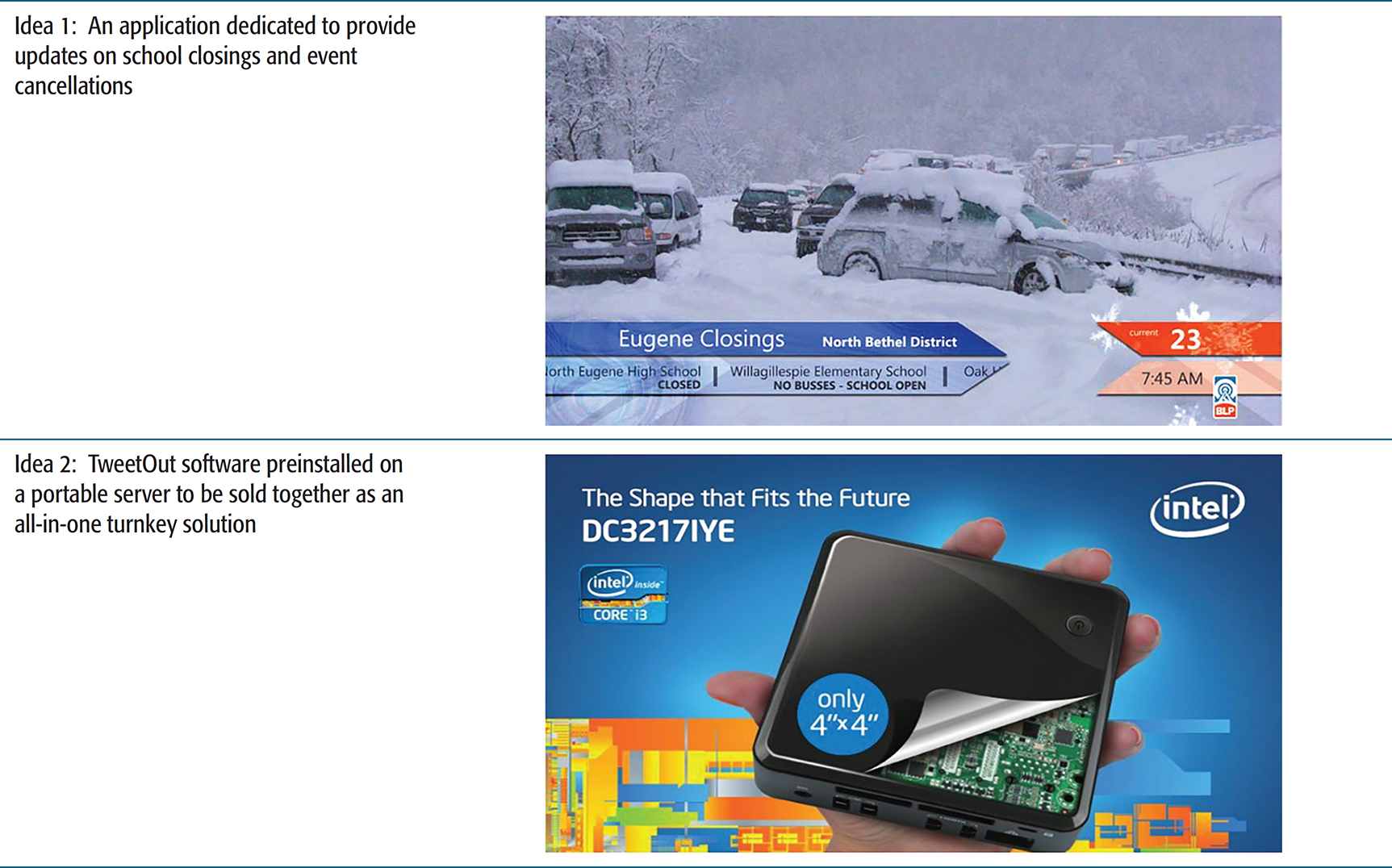
There were several new ideas for products that Georg and his team had come up with over the last year. The first idea was a product that would enable a television station to display local event cancellations and school closures in the case of inclement weather. The software would also enable a television station to create a playlist of content including local news stories, images, and videos to be played while the cancellations and closures appeared as a graphic layer on screen and in real time. A mock-up had been created (Exhibit 9), but no development had begun on this product; Georg estimated that it would take approximately four months to develop, as it would be a creative ‘side project’ for employees to work on during downtime. If this product were selected for development, he thought it would be best to begin working on it within the next few months, as it would be most useful to stations in the following winter season.
The second idea that his team came up with was related to the current TweetOut software that had become quite popular among customers; the idea was to pre-install the software onto a portable server to provide the customer with a ready-to-use product that had already been tested appropriately with all the benefits that TweetOut already provided. If this product became popular among customers, a similar hardware/software combination could be made available in the future, supporting other Bannister Lake software products such as SuperTicker or Brando. In order to provide this product, Georg believed that 15 servers should be purchased initially to ensure that inventory was sufficient to meet any initial demand. After browsing
available options, he believed that the Intel NUC Kit would be the best selection for hardware as it was portable, fast, and inexpensive (Exhibit 9). The cost of 15 servers would be around $12,000 ($800 each) and an employee would be needed to configure and test the servers individually before they were ready to be sold. A sizeable markup could be applied to the hardware purchased and Georg estimated that each server could be sold for $4,000. New servers could be purchased and configured as existing inventory on hand was depleted. He estimated that it would take only one month to configure the hardware and begin promoting this new product. While initial sales might be limited, Georg thought that this product could be a very popular item over the next few years, particularly among smaller clients looking for an all-in-one affordable solution for social media integration applications. He believed that the product would have a large target market in this industry, especially with local television/cable stations, but also in non-traditional applications such as schools looking to provide information on televisions or displays to students on campus using digital signage.
Develop a Proprietary Character Generator
As many custom solutions for clients had been developed using character generators from Ross Video and Harris, fees were currently being paid to these partners for the use of these products. Georg wondered if it might be best to begin development on their own character generator to avoid paying these fees in the future. While this would be a significant task, it would allow BLS to increase their margins on software development sales by around 10 per cent. A potential drawback from this alternative was a damaged relationship with Ross Video and Harris, as Bannister Lake would no longer be providing either company with income from the OEM usage of their character generators to develop custom solutions for clients. The development of such a product would likely take a full year to complete.
DECISIONS
As Georg watched the sun set over Bannister Lake from his balcony, a view which he had always enjoyed ending his day, he knew 2013 would be a significant year for the company. He knew that not only selecting the appropriate alternatives but also timing the implementation of these choices over the next few years would have a great impact on the growth of the business. This year would mark the 20th year that the company had been in business, and Georg hoped that his sleep tonight would provide him with the clarity needed to begin his
decision-making process tomorrow morning, which would inevitably affect the future of his enterprise.
Footnotes
ACKNOWLEDGEMENT
Funding for this research was provided by the Social Sciences and Humanities Research Council of Canada.